Titanic Revisited Part II

There are so many untold tales and now 100 years on from the Titanic tragedy, stories continue to be retold and others narrated for the first time, linked to the events that unfolded in the wake of the tragedy. Not only do we read accounts of those who were on the boat, but the event is used in fiction, a convenient device for eliminating a character such as the loss of the cousin and heir in Julian Fellowes Downton Abbey series, this event triggering the inheritance crisis that is at the centre of this drama. I read that if all the characters from fictional novels were indeed on the Titanic, it would more than triple the number of passengers she carried and sink it for sure.
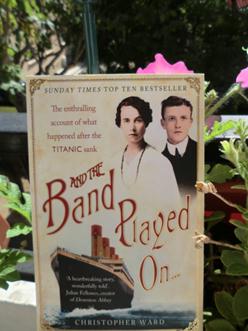
Christopher Ward’sAnd the Band Played On’ relates what happened after the sinking, the confusion and sometimes fictitious messages portrayed by the media, the arrival of the rescue ship SS Carpathia and the subsequent sailing and controversy surrounding the decisions made on-board the Mackay-Bennett, commissioned to return to the site to retrieve bodies. The author is the grandson of Jock Hume and Mary Costin; Jock was on the Titanic and his fiancé Mary awaited his return, three months pregnant with their first and only child.

The Daily Mirror assured its readers that all 2,209 passengers and crew on board the Titanic had been saved  and that ‘the hapless giant’ was being towed safely to New York.

Jock Hume was a 21-year-old Scottish violinist who had made many sailings across the Atlantic; it is believed he lied about his age as he first went to sea in 1905, when he was 14 years old. On the Titanic’s embarkation list, his age is given as 28. He stood on deck with the other members of the band and they played music until it was no longer possible, the band knowing that their act of altruism would likely be the death of them. It is a memory that many survivors recalled, those who were fortunate enough to be waiting in a lifeboat, watching the tragedy unfold before them to tunes that would forever haunt them.
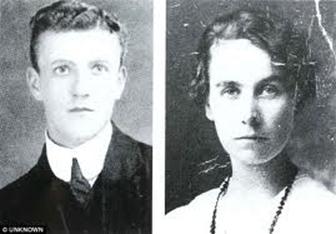
Jock Hume & fiancé Mary Costin
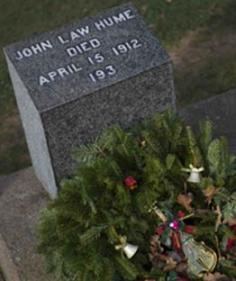
When it was no longer possible to stand, they strapped their instruments to their chests and jumped into the freezing cold waters together. None of the band members survived, however two of their bodies were recovered, Band Master Wallace Hartley (his violin case still strapped to him) and Jock Hume. Hours after the Titanic sank, White Star Line commissioned the Mackay-Bennett to recover the bodies of victims. Of the 209 bodies they brought back, 150 were laid to rest at three Halifax cemeteries. Jock Hume was buried in the Fairview cemetery, a site where visitors still pay their respects today.

The book shares little of the lives of Jock and Mary and focuses more on Jock’s father Andrew Hume, who was also a violinist. He paints an ugly picture of Andrew Hume as a difficult father, a fraudulent businessman and profiteer of his son’s death who rejected Mary and made disturbing accusations against her and the unborn child.

Ward recounts the trial of Jock’s 18-year-old sister Kate who pulled a prank on her father and stepmother in the form of a letter informing them of enemy involvement in her sister’s death during WWI; this escalated into a national outrage and the risk of contravening a newly passed Defence of the Realm Act (DORA) which gave the government wide-ranging powers for the duration of the First World War. Anyone charged under the Act would face a military trial by court martial with a maximum sentence of death by hanging or firing squad.
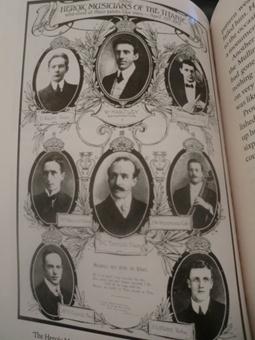
Heroic Musicians of the Titanic

The account of well researched historical facts following the sinking of the Titanic, lend the story a credibility that kept me interested throughout the book. What left me somewhat bemused was the sense of judgement against the Grandfather Andrew Hume. True, he appears to have been less than the perfect father, but he was a successful and motivated businessman and musician, even if exaggeration and a few lies did assist him (doesn’t that continue today?). However, between these pages, there is little room for compassion for the man, we only see him in the most negative light, which I find a little sad in a story portrayed by his great-grandson. To lose a wife, a son and be subject to the murderous revenge of his daughter surely deserves an ounce of compassion, no matter how unscrupulous he was as a person.

The Pearl

I am content as my first foray into the work of John Steinbeck reveals that he too loves a fable, and like the best of them, lets the story speak for itself.

His short novel ‘The Pearl’ is based on a Mexican folk tale about Kino and Juana, a young couple who live a basic existence, their joy of a first baby threatened when it suffers the sting of a scorpion.
Kino is a pearl diver and on the day he most needs a miracle, the discovery of a large pearl appears at first to be the answer to the couple’s prayer. However, its discovery disturbs the community’s tranquil equilibrium, it seems too much to embrace and while it is in their possession, it wreaks only havoc.

There is a sense of inevitability with this kind of tale, we know the pearl is symbolic, and we recognise that desperate grasping, clutch of desire, laced with fear and stalked by paranoia, the fleeting hope it inspires is stifled by the more pervasive greed and jealousy which quickly degenerate into suspicion and violence.

Despite the inevitability, I read with the wilful hope of an optimist, always searching for some altruistic sign, an indication of man’s humanity, the charitable gesture of an honest person. Steinbeck leads us along on this journey, as we develop our own understanding bathing in his glorious prose.

Now Kino’s people had sung of everything that happened or existed. They had made songs to the fishes, to the sea on anger and to the sea in calm, to the light and the dark and the sun and the moon, and the songs were all in Kino and in his people – every song that had ever been made, even the ones that had been forgotten. And as he filled his basket the song was in Kino…

Taking the pearl from its natural habitat changes its symbolism, for in nature it is pure, lustrous, a thing of splendour and inspiration, it represents the transformation of something irritable (the grain of sand) into something of divine beauty (the pearl). But removing it from the sea will corrupt everything that sees, hears of, imagines or touches it; it becomes representative of greed and avarice, the longer it stays in their possession, the greater its destructive power. But will returning it to nature undo its curse?

In addition to this enjoyable story, the book opens with a foreword which reads like a letter from Steinbeck’s wife Elaine. She shares something of the joy of his writing life, his impulsive and creative attempts to construct the perfect writing environment (including building a writing room in the back seat of his Ford Station Wagon) all of which for me, created an almost familiar context from which to begin reading the great man’s work.

Onward to his next oeuvre, Tortilla Flat awaits.

The Smile by Ray Bradbury

A Short Story Set in the Future

He wrote more than 27 novels and over 600 short stories and somehow his work has never crossed my path.

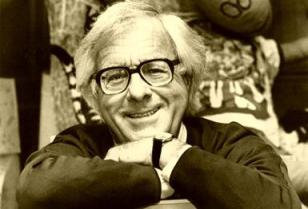
As I read the Culture and Book pages of The Guardian daily, I have been reading some wonderful tributes to the writer Ray Bradbury who died recently at the age of 91. ‘Margaret Atwood on Ray Bradbury: the tale-teller who tapped into the gothic core of America’ was interesting, Atwood celebrates the author, known for his science fiction but who has shown remarkable scope and influence throughout his career. He was a story-teller; he had an active and far-reaching imagination and rejected the limitation of labels.
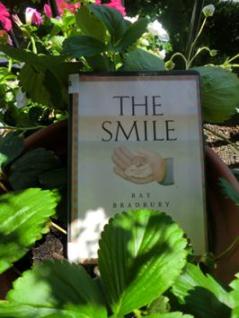
After a quick trip to our local French library yesterday, I stopped at a display table honouring Ray Bradbury and came home with his prophetic short story ‘The Smile’ the only English language work left on the display.

Set in 2061, the story is set in a square in Rome, where the boy Tom waits with an angry crowd to view the ‘Mona Lisa’. Joy has vanished from this world and people are filled with hate for everything that represents the past. Except Tom. He remembers. He represents hope. Perhaps love. Certainly appreciation.

Tom stood before the painting and looked at it for a long time.

The woman in the painting smiled serenely, secretly, at Tom, and he looked back at her, his heart beating, a kind of music in his ears.

Demi-God reawakens Classical Myths

It wasn’t the bookies favourite, but it was the bestselling book of the Orange Prize shortlist and as I discovered, Madeline Miller’s
‘The Song of Achilles’ had much to entice a multitude of readers, being a contemporary narration of an age-old tale drawn from the Greek Myths, published in the lead up to the Olympic Games and touching on issues that echo President Obama’s recent stand on equality for same-sex couples. Very 21st century then.

Inspired by Homer’s classicThe Iliad‘, Miller focuses on Achilles, the half God, half mortal son of Peleus and Thetis and his friend, the young exiled Prince, Patroclus, about whom little is known. Achilles’ mother Thetis is a sea-nymph and fears for her son’s future; she will do everything she can to protect him given his fate as the greatest warrior of his generation, and to avoid his death which it the oracles say will follow his killing of Hector.
The friendship between Achilles and Patroclus fires Miller’s imagination and the first half of the book beautifully depicts this at first distant relationship, blossom into a feverish loyalty. Not surprising to learn the author has been listening to and reading the Greek myths since she was 5 years old, a passion that carried her into studies of Greek and Latin, which comes across in this oeuvre.

Though I have only cursory knowledge of the Greek heroes, I have long been intrigued by their stories and archetypal symbolism, much in the same way I loved to learn about Maori myths and legends during my childhood; the legendary Maui, a demigod from Hawaiki, fished up New Zealand from the ocean.

I am reminded too of the child in A.S.Byatt’s ‘Ragnarök’ who relates to the Norse myths more than anything else anyone teaches her. So too, in my imagination do these legends of childhood come back to me and explain nature and humanity in a more primal way than anything else I was later taught – what we learn and how it affects us isn’t so much chosen as absorbed into our being when we are very young.

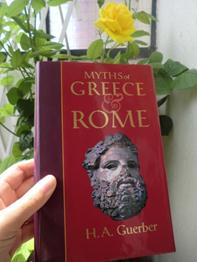
So ‘The Song of Achilles’ inspired me to pick up my ‘Myths of Greece & Rome’ by H.A.Gueber and read all the references to Achilles, Patroclus, Thetis, Peleus, Hector and more. Within its pages I found this reference to a word and metaphor we all know to refer to the tendon in the heel, but whose origin is much less known.

Thetis loved this only child so dearly, that when he was but a babe, she had carried him to the banks of the Styx, whose waters had the magic power of rendering all the parts they touched invulnerable. Premising that her son would be a great warrior, and thus exposed to great danger, she plunged him wholly into the tide with the exception of one heel, but which she held him, and then returned home.

In the original story an oracle foretells that Achilles will die from a wound in his heel after his dispatch of Hector; ultimately he will be remembered and perhaps even more renowned for this insignificant but fatal weakness, than for his epic courage and strength.

I liked this book as much for its inspiring me to look at other books and references to find out more about the legend as I did for the story itself. I came to it without much knowledge of its content and found the first half totally intriguing, reading it in one sitting. It did slow and almost lose me once they set sail for Troy and the ensuing battle scenes were a little two-dimensional, but when Patroclus found his healing abilities and tended to the wounded soldiers, the story refocused on the lead characters.  The action played off the battle field was more captivating and I was gripped throughout the last quarter.

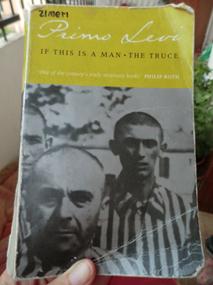
If This is a Man: The Truce by Primo Levi

I only had to read the first sentence of a Scotsman in Exile’s blog post of this book to put aside what I was reading and start this almost immediately; his review entitled And Over Our Heads The Hollow Seas Closed Up… continues its first line:

…These are words from the canto of Ulysses from Dante’s Inferno and they were quoted in the most moving book I’ve ever read, ‘If This Is a Man’ by Primo Levi.

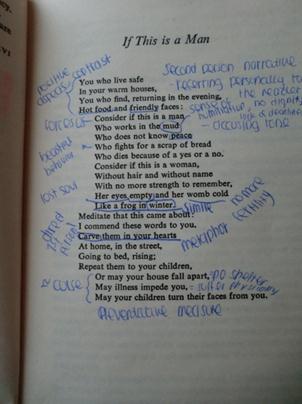
I found a copy on the second-hand shelf of our local bookshop the very next day, a copy I now own that would have to be the most annotated, scribbled in, colour highlighted, dog-eared, pored over volume that I possess (thanks to the previous owner ZIMERI). When I was a student, we studied ‘The Diary of Anne Frank’; how fortunate that today’s students are reading and studying this equally important work.

I’m not sure if I so much as read the book as followed closely in the footsteps of Primo Levi as he recounted the events that unfolded during his journey and time in the concentration camp, due to the way he chooses to express himself, which can best be summarised in his own words:

I believe in reason and in discussion as supreme instruments of progress, and therefore I repress hatred even within myself: I prefer justice. Precisely for this reason, when describing the tragic world of Auschwitz, I have deliberately assumed the calm, sober language of the witness, neither the lamenting tones of the victim nor the irate voice of someone who seeks revenge. I thought that my account would be all the more credible and useful the more it appeared objective and the less it sounded overly emotional; only in this way does a witness in matters of justice perform his task, which is that of preparing the ground for the judge. The judges are my readers.

Thus we absorb only that which he personally experienced and perceive not just the daily routine, the trivial yet so essential implements of his survival, the relentless toil and the near brokenness, but we view also the different strata of man in that direst of circumstances, a kind of perverse hierarchy.

Primo Levi was a young man of 24 years, a chemist and part of a partisan band hoping to join the Resistance movement when captured by the Fascist militia and sent to a detention camp at Fossoli. A few weeks later, all Jews in the camp were told they would be leaving for an unknown destination, revealed to be the camps of Monowitz-Buna and Birkenau, part of Auschwitz.

650 people made the journey that day; on arrival, the majority were ‘swallowed by the night’ and 125 sent to the camps. Of those, only three made the return journey to Italy after liberation, Primo Levi being one of them.

He was fortunate to return and discover his family intact; we in turn are fortunate that he returned and wrote these two books to be read together, one the descent into darkness, the other the journey back towards an altered but real luminosity.

All I can really say is that if you haven’t read it, add it to your list and find the time one day to slow-read it, Primo Levi was an important chronicler of a difficult period in history and a man who was interested in and able to put into words his observations of humanity in all its capacity, something we all the better for knowing.

The Secret History of Joan of Arc

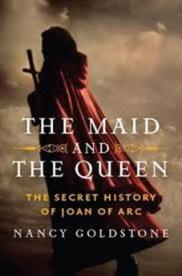
Such a seductive title ‘The Maid and the Queen’ – The Secret History of Joan of Arc and it is indeed an intriguing story, wrapped in faith, hope, superstition, manipulation, cruelty and ultimately the exoneration and beatification of a heroine (Joan of Arc was canonised in 1920).

 Joan of Arc is testimony to the transcendence of the human spirit….She remains an inspiration, not only to the citizens of France, but to oppressed people everywhere.

Ironically, it is due to the inquisition of Joan of Arc that much of the history of the era was documented and preserved, her testimony and the numerous depositions from the many eyewitnesses who knew her and who were in some way involved in the events of the Hundred Years war, that period of conflict between the Kingdoms of England and France and various other alliances from 1337 to 1453, as each sought to claim control of the French throne.

One of the insights that astounded me was the prolific negotiation of the female offspring of nobility to secure territorial alliances or peace between the realms. Daughters were auctioned off as young as 4 years, though depending on how power shifted and who survived into adulthood, those promises could alter.

Nancy Goldstone’s thoroughly researched oeuvre, takes a step back to look at the events, beliefs and susceptibilities of characters leading up the prominence of Joan of Arc, none more so than Charles VII, Yolande of Aragon’s (Queen of Sicily) son-in-law and the man who as a sensitive 11-year-old boy, she had taken into her home, nurturing and caring for him as her own, at a time when he was not destined for the throne (he had two older brothers). His propulsion into the role of King while the English were making inroads into the territory, King Henry having proclaimed himself King of England and France, and his reluctance to engage in battle, were significant risks to the Kingdom of France that required intervention.

Drawing inspiration from ‘The Story of Melusine’, commissioned in 1393 and written by Jean d’Arras (when Yolande was 12-years-old) a propaganda devised to address the political controversy surrounding the Duke of Berry’s appropriation of an ancient and imposing castle belonging to the aristocrat Lusignan family, Yolande of Aragon was able to usher Joan into an audience with the young King.

To Yolande of Aragon, the parallels to the story line of Melusine were obvious… there was just one element missing to turn this fiction into reality. The Queen of Sicily actively sought a Melusine as part of her strategy for reinstating the dauphin as the legitimate heir to the French throne.

That Joan was effectively recruited, is reinforced by a French historian who reported that in 1428 alone, twenty people, mostly women, claimed to have been chosen by God to deliver a message to the King. None of them were given the opportunity unique to Joan, whose faith and convictions aligned with what Yolande wanted to hear and would result in her leading an army to relinquish the city of Orleans. By speaking passionately to Charles inner most fears, in particular an obsession with his possible illegitimacy and by her knowledge of ‘his secret prayer’ to God which he cried out in his sleep, Joan materialised as a sign and a saviour.

Gentle dauphin, I am Joan the Maid, and the King of Heaven commands that through me you be anointed and crowned in the city of Reims as a lieutenant of the King of Heaven, who is King of France.

Having succeeded in turning the English back, Joan was eventually captured and no longer considered useful by her King or sponsor, was sold to the English who sought vengeance, and submitted her to a long inquisition hoping to rid themselves of her and the fervent following she inspired among the people. Though their interrogations were inconclusive, and their hopes to condemn her destroyed by a signed recantation, she was tricked into heresy and sentenced to be executed.

I found the book full of interesting facts and connected events surrounding Joan herself, but I admit it was not an easy read and slow going at times –perhaps by necessity– to comprehend all the characters, families, alliances and influences. I did find myself wishing at times that the author might have used more creative tools to inhabit the emotional life of some of the characters, something that makes reading well-researched historical fiction a real pleasure and certainly adds pace.

But for a factual account of how The Maid came to represent a significant turning point in France’s history, I can think of none better.

If it is accepted, as it is often said, that without Joan of Arc there would be no France, it is also true that without Yolande of Aragon, there would have been no Joan.

Note: This book was an Advanced Reader Copy (ARC), provided by the publisher via NetGalley.


In the Springtime of the Year

I seem to have been reading through the seasons this year, starting with Edith Wharton’s winter read ‘Ethan Frome’ then Susan Hill’s ‘In the Springtime of the Year’ and finally Wharton’s ‘Summer’. I don’t know yet what will appear for the one season that is missing but I am open to suggestions, is there a title that comes to mind for Autumn, the Fall? I am sure one must exist.


‘In the Springtime of the Year’ is a metaphor for existence, growth and renewal; after one dreamy year of marriage in which no one else but her husband seems to exist for the young bride, 19-year-old Ruth has become a widow, after Ben is killed in a freak accident. The pages carry us through Ruth’s grief, the calm, dormant stillness where she is frozen in her grief, unable to cry or speak, or be comforted by anyone. She doesn’t understand why they don’t understand this. While her husband’s family pour out their grief vociferously, they judge her silence as showing no feeling. Slowly her awareness returns and rises to the surface, she begins to see beyond her own immovable pain, to appreciate anew all that is around her, she is able to revisit the scene without suffering.

Susan Hill deftly captures each nuance of the young girl’s slow changing movement through her phases of grief, until like the branches of the tree that must eventually bud no matter how harsh the winter, she transforms and begins to emit a different vibe. She is witness to what she was and sees it anew; she develops an understanding for how others may have perceived her. She is able to make amends.

Rambling along in its quiet way, poetic line by line, Ruth’s perceptions change so subtly that when there is an actual event, it seems all the more dramatic for its contrast with the inner world we have been languishing within.

I first read of Susan Hill in a profile interview in Mslexia Magazine in January 2011, she had just published ‘A Kind Man’ and while visiting Daunt Books in London that same month, I spotted the slim hardback, which thanks to the lovely G and an approaching birthday came home with me along with Jenny Erpenbeck’sVisitation’. Since ‘A Kind Man’ I have equally enjoyed ‘The Beacon’ and ‘The Woman in Black’ and recognise that it is her style of writing that appeals so much.  This book was originally published in 1974 and has been rereleased in this Vintage edition.

All the books are situated similarly, in a small, poor village in rural England where not much happens except that we become witness to the inner transformation of characters after an event.  I would not suggest you read this however, if you’re looking for action, pace or plot, this is an inner journey. And it’s perfect as it is.

India My Heart

Over the long weekend I read the lengthy ‘Shantaram’ by David Gregory Roberts set in Mumbai (Bombay). I have never been to Bombay, but I did spend a month travelling in India in 1995 and the experience remains imprinted in my heart and memory, for me the country and its people have no equal. I love it. It is at the very top of my list of destinations, experiences and insights.

The first pages of this extraordinary story are reminiscent of many travellers’ journeys to India, the assault on all the senses, the welcoming committee, the brick of rupees, the taxi rides.

the glimpse of the suffering street brought a hot shame to my healthy face.”

“The street at the front of the building was crammed with people and vehicles, and the sound of voices, car horns, and commerce was like a storm of rain on wood and metal roofs.”

“there were beggars, jugglers, snake charmers, musicians, astrologers, palmists and pimps and pushers”

India is where you are introduced to your wits. Until I travelled there, it was a mere expression ‘make sure you have your wits about you’. In India, they rise up within you from some deep, slumbering place inside and become a living, breathing extra sensory force, providing a necessary equanimity and alert, their reward, insight.

Shantaram’ is the story of an Australian fugitive, posing as a New Zealand traveller who arrives in Bombay and unlike most travellers who stay only long enough to experience the city and plan their next destination, he stays.

Without exception, those who stay are escaping something and what that is, seems to have a direct relationship to how deep they become involved in the city’s underworld activities. Roberts stays out of trouble to begin with and provides a delightful insight into his blossoming friendship with Prabaker, who truly does represent India’s heart. Due to misfortune he moves to a slum where he spends his days working from his well-stocked first aid kit, providing rudimentary medical treatment to the inhabitants as he becomes part of the fabric of the slum community.

The two friends spend some months in Prabaker’s home village with his family and these are chapters are my favourite, portrayed with humour, a sensitive understanding and compassion. It is the calm before the storm and a period that I didn’t want to end.

Prabaker told me that family and his neighbours were concerned that I would be lonely, that I must be lonely, in a strange place, without my own family. They decided to sit with me on that first night, mounting a vigil in the dark until they were sure that I was peacefully deep in sleep. After all, the little guide remarked, people in my country, in my village, would do the same for him, if he went there and missed his family, wouldn’t they?”

However Robert’s luck changes when he is arrested one night and discovers he has unknown enemies with unknown motives and the experience of prison will unleash the darkest aspect of his character. When he is finally released he goes to work with the Bombay mafia, delving into the world of black market drug, currency and false document dealings all the while awaiting that future moment where he can exact revenge against his enemy.

This book draws you into a frightening and fascinating world that I am not sure whether we are better off knowing of or remaining in blissful ignorance of. I guess it is no worse than being subjected to the news media every evening with its plethora of images and reports of violence, oppression, corruption and greed, something I waver between wishing to avoid (and often do) and needing to have a balanced and informed awareness of.

What I perceive is the oft dreadful consequence of a genetic predisposition combined with early life tragic event that leads to a kind of corruption of the soul, I am reminded of Jonathan Ronson’s dip into the characteristics of a psychopath in The Psychopath Test which describes someone charming and influential who lacks empathy, and has an intense need to be liked. I don’t think the character in this story is a psychopath, but many in his circle survive precisely because they are not beleaguered by the emotional constraints of sympathy or empathy whether they were born like that or have become that.

Chilling indeed, though more than offset by that other extreme, a city of people whose smiles are in the eyes which broaden to encompass their whole face and being to cross that divide between people of different cultures and leave us with a warm, perplexed feeling. How is it that among such poverty, despair and ruthlessness exist the happiest people on earth?

And to know the answer to that one can only go there, experience it and ponder it oneself.

Is English a Friendly Language?

A bit of a cultural insight today, but one I think will interest you. I have lived in France for six years and affirming insights continue to delight me, and if you visit France for the first time, they can be a revelation and prevent a lot of frustration.

Recently, I discussed with two French students the use of “friendly” language, words and phrases that most of us use unconsciously, but for a foreign language learner, need to be emphasized – how to write or speak so that you sound friendly. It is particular to the English language (and others perhaps?) with varying degrees of importance to the British, American and other English language speaking cultures.

The French language and the way it is spoken in conversation is more direct in some respects than English (we are not talking about the length of time to make a point). Polite, yes. Friendly, no. They are not the same thing.

La Boulangerie, by Rita Crane

Every time you enter a boulangerie (bakery), supermarket, pharmacy, catch a bus, enter a hotel or any public place you will likely be greeted with ‘Bonjour Madame/Monsieur’ and you will also receive a farewell salutation ‘Au revoir (sounds more like ‘arve-wa’ here in the South), and ‘Bonne journée’. This is politeness and by learning these few simple French phrases, a more positive experience is likely. A smile however, is a rare and precious gift, and eye contact is not guaranteed.

For more insight on the smile, there are some interesting comments by French citizens in Elaine Sciolino’s ‘La Seduction – How the French play the Game of Life’, which infer a smile is something that must be earned, it is not a gesture offered freely to strangers, it signals the beginning of a relationship. It is not being unfriendly, it is being true. To smile at a stranger can be considered false and anyone indulging in that behaviour may even be regarded as suspicious, conduct Harold and Barbara Rhode’s were baffled by in William Maxwell’s novel The Château.

So during our lesson, we read an email text with some words underlined and then we read it a second time leaving out the underlined text. Here is a short section of the text.

Hi Patti! Thanks for your email. Your new job sounds really great – I know that you’ve wanted to work as a graphic designer for ages and ages, and now it’s finally happened! Congratulations! I’m sure you’ll do really well in the job. Well, what about my news? I arrived in Prague about a month ago. It was quite difficult at first. Of course I couldn’t speak the language, and finding a place to live wasn’t easy. Then my friend Belen and I found a lovely little flat in the old part of town. It’s quite small, but it’s full of character and we love it. I’m working as a waitress in a cocktail bar. It’s okay – I don’t suppose I’ll do it for long, but it’s a way to earn some money.

One student read the entire text and the other the shorter version. At the end, I asked what the difference was.

“The second one is more like we talk” one student responded confidently.

“Well, no.” I replied.

It is true, direct conversation sounds rude unfriendly in English and can be the cause of unintentional cultural misunderstandings when foreign language students attempt to speak in English. Equally, we should not expect our smiles and warm, friendly conversational attempts to be greeted in appreciation. We are strangers until we have been introduced, or at least until we have become regulars.

So what are those friendly words/phrases that we use? Here are some of them:

It seems that        Unfortunately         So    Luckily          In Fact     Of Course     Well      Basically     To be honest       Frankly         Anyway        Apparently     Actually       Obviously       Would you mind

Can you think of any others?

A Rhyme for the Odes (Mu’allaqat)

No one guided me to myself. I am the guide.

Between desert and sea, I am my own guide to myself.

Born of language on the road to India between two small tribes,

adorned by the moonlight of ancient faiths and an impossible peace,

compelled to guard the periphery of a Persian neighbourhood

and the great obsession of the Byzantines,

so that the heaviness of time lightens over the Arab’s tent.

Who am I? This is a question that others ask, but has no answer.

I am my language, I am an ode, two odes, ten. This is my language.

I am my language. I am words’ writ: Be! Be my body!

And I become an embodiment of their timbre.

I am what I have spoken to the words: Be the place where

my body joins the eternity of the desert.

Be, so that I may become my words.

No land on earth bears me. Only my words bear me,

a bird born from me who builds a nest in my ruins

before me, and in the rubble of the enchanting world around me.

I stood on the wind, and my long night was without end.

This is my language, a necklace of stars around the necks

of my loved ones.

– extract from ‘A Rhyme for the Odes’

by Mahmoud Darwish, from the collection ‘Unfortunately, It Was Paradise’

(13 March 1941 – 9 August 2008)