The Hare with Amber Eyes, A Hidden Inheritance

The Hare with Amber Eyes

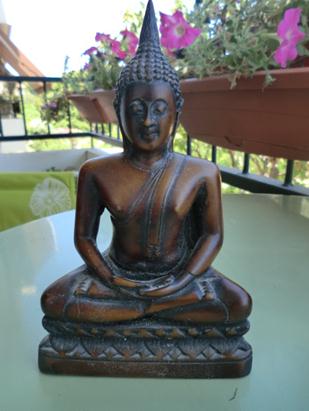
What a story this hare could have told should he have possessed the gift of speech. Instead we see him hunched there, ears pinned back, quivering, stunned by the journey he has taken, the events that have occurred around him, surprised to have survived when so many of his companion artifacts, the more sturdy furnishings, grand paintings and even other ceramics, did not.

The Hare With Amber Eyes is a Japanese netsuke, a miniature sculpture (though they can be wood or ivory) invented in the 17th century, not just as an objet d’art, but a functional kind of toggle to attach to the end of a cord for a pouch that a man might carry, since most of the garments they wore did not contain pockets (the two Japanese characters ne+tsuke mean “root” and “to attach”).

The hare is part of a collection of 264 netsuke purchased by the third son of an aspiring and ambitious Jewish family, Charles Ephrussi (son of Leon).

By 1860 the family had become the greatest grain-exporters in the world. In 1857 the two elder sons were sent out from Odessa to Vienna, the capital city of the sprawling Hapsburg Empire. They bought a huge house in the city centre, and for ten years this was the home to a shifting population of grandparents, children and grandchildren as the family moved backwards and forwards between the two cities. One of the sons, my great-great grandfather Ignace, was tasked with handling Ephrussi business in the Austro-Hungarian Empire from this Vienna base. Paris came next: Leon, the older son, was tasked with establishing the family and business there.

Hare Amber EyesBeing the third son, Charles was spared the obligation of being groomed for the financial sector in the family business (though it may well be he was not cut out for it either as de Waal speculates), preferring to frequent the cafes, salons and a certain boudoir of an older, married woman, attaching himself only ever temporarily to that which he admired – having already lived in three large cities, with his languages, wealth and a passionate interest in the arts, he had plenty of time to indulge his many passions.

It was through his pursuits in the arts, the start of his own collection, mingling with artists, other collectors and art dealers, writers about the arts, that he became interested in Japonisme, a rarity when it began appearing and so desirous. He would purchase a large collection of netsuke from the Parisian art dealer Philippe Sichel who travelled to Japan in 1874.

There is a wonderful connection to Proust throughout this part of the book, one that was a pleasure to discover, without the necessity of having read him, if anything it is an interesting introduction to that group of intellectuals of the 1880’s – 1900’s, Charles Ephrussi himself one of the models for Proust’s depiction of Swann in Swann’s Way.

The author of the book, Edmund de Waal is a descendant of the Ephrussi family and has inherited the 264 netsuke. He is a ceramic potter himself and spent two years studying in Japan, after many years as an apprentice in England. It was in Tokyo, while visiting his Uncle Iggie (another Ignace) that he first laid eyes and hands on the family netsuke that would eventually become his, learning a little of their journey from Paris to Vienna, London and back to Tokyo. Eventually he would spend five years researching what would become this incredible book.

He too, is the third son, though his is no longer a global banking family with the same expectations of its protege. Although he shares similar characteristics to his ancestors, those who did manage to escape the family business and were able to develop that appreciation and eye for a work of art, going beyond casual observation; it is as if he converses with these objects and reads them as if they have living, human qualities.

DeWaalThrough this book, he traces the history of these netsuke and his family, as they rise in ascendancy and are undone by the events leading up to the second world war. We come to know many of the family members and Edmund’s grandmother Elizabeth, a poet and a lawyer is a wonderful woman to learn about, the first woman to receive a doctorate from the University of Vienna and passionate about her poetry, she corresponds regularly with Rilke.

This book was so fascinating and so sensitively handled, it was with an almost palpable sadness that I finished it and felt bereft, wondering where on earth I could go to from here, reading-wise, after such a story.

And then I remembered it has been two years since publication and so I consoled myself with following the work of De Waal, who has been rather prolific since 2010 and I was not surprised to see his recent exhibition A Thousand Hours, showing works behind vitrines, evidence of the longer term effect of his immersion into all that research and study of netsuke and other artifacts his family had preserved.

I leave a link to him commenting on that most recent exhibition and a wonderful article in the Telegraph, in which I learn that De Waal has recently returned from a trip to Jingdezhen, home of the purest clay in China, where porcelain has been made for 1,000 years. This was a research trip for his next book and for a collaboration with the Chinese porcelain collections at the Fitzwilliams Museum for an upcoming exhibition:

De Waal is animated, inspired, gesticulating with his long fingered hands; there is a hum of creativity around him. You can almost see the words fizzing in his head, feel the ideas taking root, springing up out of nothing and arranging themselves in little groups, to form stories, dramas, like his pots.

The Netsukephotos of some of the Ephrussi collection + family pictures

Article Edmund de Waal on his new exhibition, A Thousand Hours by Jessamy Calkin

Video Watch Edmund De Waal transform clay into beautiful works of art

The Happiness of Blond People – A Personal Meditation on the Dangers of Identity by Elif Shafak

011312_1324_TheTigersWi2.jpgBastard of IStanbulElif Shafak writes great stories and as this essay illustrates, she both lives and has already lived an interesting life between East and West; experiencing different cultures and absorbing the influence of a high achieving, single parent mother and her superstitious, story-telling grandmother in a untypical but enriching, matriarchal upbringing.

ElifShafak Ask EbruBilun Wiki

Elif Shafak, Publicity shot by Ebru Bilun – wikipedia

As a young pupil she learnt what it means to be on the receiving end of prejudiced comments, introducing her to the clichéd stereotypes cast about by those who might never have experienced but seemed “to know” what it meant to be Turkish, that false responsibility, those who leave will all take on, for the actions of government or other citizens, on behalf of their maternal country and people.

Elif Shafak has inherited and nurtured a healthy imagination and studied many of the great philosophers, with a particular interest in Rumi, sometimes witnessed through her novels and now combines her knowledge with first-hand observations of how cultural differences are perceived in this short book.

The title of the essay was inspired by a conversation overheard at the Rotterdam airport in the Netherlands between Turkish fathers, one despairing of the difficulty of living in proximity to his downstairs neighbour.  She developed a habit of calling the police each time his children made too much noise playing in the apartment, causing his family much stress and anxiety, because the police invariably arrived with sirens blazing – makes me wonder what story she told the police, and thankful that my neighbour isn’t so bad after all!

The man finishes by asking his friend in earnest, how it is that blond children are so quiet and well-disciplined, introducing us to Shafak’s reflections on identity, cultural difference and the inherent, almost unavoidable angst of first generation immigrants worldwide.

The immigrant must be prepared to swallow his share of humiliations every day. He has to accept that life will treat him with disrespect and that he’ll be smacked and jostled with undue familiarity.

Happiness of Blond PeopleShe discusses the perception that happiness can be found in the West, less likely to have to deal with war, warlords, tribal conflict, poverty, corruption, human-rights violations or major natural disasters and the equally ingrained counter-assumption that life in the East is more real and less degenerate than in the West: where society is so selfish and individualistic that communal and family ties have virtually disappeared, unable to support a person, especially the elderly, in a time of need.

A secondary-school student I met in Ankara during a literary event put this to me in a slightly different way. “If you are young, it is better to live in the West than in the East,” he said. “But if you are old, then it is better to be in the East than in the West, because we respect our elders, whereas they don’t. In Europe I have seen old ladies in supermarkets buying one courgette, one carrot, one tomato, one bunch of parsley. Have you ever seen a Muslim woman doing that? No! We always buy at least half a kilo, if not more, because we cook for the entire family.”

What seems to be missing in the immigration experience is often lack of community, the lack of acceptance or gesture of kindness and therefore difficulty in integration, families are often not made to feel welcome (except among their own kind) which then encourages them to live separately and to maintain their own traditions and cultural perceptions and habits, rather than merging with the new country and culture. It can also breed resentment, particularly if it wasn’t a mutual decision to leave or even a choice, as in times of war.

It is often true that it must take at least one generation to normalise integration, but in more closed communities whose occupants themselves have little curiosity for the outsider or have not travelled and come to understand how and why things are done differently, with an altogether different logic elsewhere, this separation is at risk of continuing into multiple generations, especially where there are clear physical differences between people that can provoke prejudice, judgement or even worse, racism.

HonourFor me, most of the time I enjoy being confronted with those genuine mind-bending situations that require one to figure out how people came to see or do something in a way so different from our own – with the exception of violent or inhumane acts, but even behind those practices, there is a story to be told and a history to be understood, which doesn’t make it right, but can assist us to at least consider these practices in context, something Elif Shafak explores in her latest gripping novel ‘Honour‘.

An immigrant myself, I understand many of the isolating factors inherent in such a status, especially when it is necessary to learn a new language. Whilst it is not easy to participate in a traditional society with its many rituals and social codes, it is more likely that an immigrant will find success and contentment in creating a business or activity of their own, something unique that is or will be valued, than putting themselves up against their compatriots and being disappointed time after time, especially if living outside the larger multicultural cities.

This is a short read and a refreshing, open-minded perspective, from a woman who interacts with people in both the East and the West, always interesting to read and listen to.

In this life, if we are ever going to learn anything, we will be learning it from those who are different from us. It is in the crossroads of ideas, cultures, literatures, traditions, arts and cuisines that humanity has found fertile grounds for growth.

The Zenith by Dương Thu Hương

In 1996 I spent three months travelling in Asia, limiting my visit to four countries, India, Nepal, Vietnam and Thailand.

It was in Vietnam that I first travelled on my own and perhaps for this reason, it has always resonated deeply within me. It is a special place and I experienced it at a unique time, the city of Hanoi had no cars and most of its population travelled by bicycle, unlike the city of Saigon in the South full of the noise pollution of motorbikes. 090212_1801_IntheShadow1.jpg

That’s not to suggest it was easy to navigate those intersections, with bicycles coming from all directions, the ring of the bicycle bell a constant stream of warning as the masses somehow managed to criss-cross in opposite directions without accident. I watched that flow for a long time before I understood and dared to join it. The trick? Do not hesitate.

While in Hanoi, I decided to read a couple of Vietnamese authors, I was interested in reading something that came from a local perspective and not from the English-speaking perspective which seemed more prominent.  A young boy in the street sold me two books, Bao Ninh’s The Sorrow of War and Dương Thu Hương’s Paradise of the Blind, the latter a story that illustrated the effect of a rigid communist ideology on a family in the wake of the land reforms of the 1950’s, as narrated by a young woman travelling to Moscow in the 1980’s.

A quote on the back written by Grace Paley, confirmed my thoughts.

“At last a woman, a Vietnamese woman, tells us Vietnamese life: the village, the city, the repression and expansion, the middle peasant, the poor peasant, the years of exquisite food and no food, working in the Soviet Union – and all beautifully told so that we begin to understand not where we were for years, but where and how they – the Vietnamese – are now.”                                                      – Grace Paley

090212_1801_IntheShadow6.jpgThe author’s depiction of ordinary people, in both rural and urban Vietnam was compelling and the definition of terms at the back of the book, particularly of food and practical items was especially useful for me as I cycled my way around the city and out along the river, past markets and temples and saw how people lived, ate and spent their days. This book was the first Vietnamese novel published in the US (1993) I have since discovered, so no surprise that I had never come across this enlightened perspective before.

zenithDương Thu Hương now lives in exile in Paris and her latest novel The Zenith has recently been published. It gets off to a slow start initially, when Ho Chi Minh, the President looks back as a 70-year-old man at parts of his life with regret. He regrets the lack of contact with children that he fathered and the loss of a woman he loved, he regrets the distance that has come between himself as a man and the people he sought to represent.

Wishing to retrieve something of that contact, he attends the funeral of a woodcutter to pay his respects, only to realise the suffering his presence will have caused because of his distinguished position and the expectations that are carried with it should he grace them with his presence. He despairs at having lost sight of that which motivated him to first become involved in the revolution, to bring equality to all.

A bitter longing mixed with a searching curiosity flowers in his heart; he wants to attend the funeral of the woodsman because he wants to experience the funeral of a real father.

Things pick up in pace and interest when we learn more of the story of the woodcutter, his family and village, this one story perhaps seen to represent various stages in the country’s own experience of communism, both its idealistic benefits for the community and its destructive elements against the weak and innocent, when power, greed and envy are present within its leadership, turning even family members against each other. The story-telling reaches its zenith and had me totally convinced of the authenticity of the relationship between the wise sixty-something father/grandfather Mr Quang and his new 18-year-old bride Miss Ngan and relishing the way they managed the reactions of close family and their community with their provocative yet bona-fide marriage.

Of old, it was said: “Tears run downward.” So true.

“Filial love for parents can’t equal the ties of anxious love in a father’s soul for a child. Because when we love our parents we look up but when we love our children we look down. And according to the laws of heaven and earth, tears always flow downward. Especially whenever we recognise that as fathers we have done wrong. Hell itself will then open a door straight into the heart.”

It highlights the enormous gap that can grow between those who rule and have power and/or wealth and those who are trying to survive, just like the distance between rich and poor in a democratic society, similarly it exists between those who yield power and those who don’t in a communist society, trust breaking down within a community as people become increasingly desperate and open to being corrupted while others live in constant fear.

This is not a book to be read quickly, nor even understood immediately. I continue to think about what I read and what it attempted to portray about society, leadership, workers, family and the effect of power and its oft great distance from the reality of how people live, the destructiveness of jealousy and the perseverance of those who will never be compromised, who will always fight for what they perceive is good and right.

The country, its writers and message continue to allure and despite all the suffering, both past and present, there remains for me a quiet tranquility that pervades it, a steadfast patience and determination I admire.

Note: This book was an Advance Reader Copy (ARC) provided by NetGalley on behalf of the publisher.

The Light Between Oceans by M.L.Stedman

I begin reading with envy as M.L.Stedman’s playful yet adept metaphors slip off sentences, like droplets off the oars of a dinghy, each one plunging back into the ocean to collect another stream from which to compose those few extra words that create more than just mere description, revealing an image and inviting us deeper into the world she paints with words, an island hundreds of miles from civilisation, where only the two oceans, a grand light, the twinkling stars and the tall, elegant, imposing bearer of that light keep a young, newly married couple company.
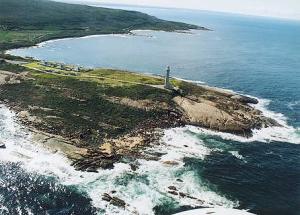
There are times when the ocean is not the ocean – not blue, not even water, but some violent explosion of energy and danger: ferocity on a scale only the gods can summon. It hurls itself at the island, sending spray right over the top of the lighthouse, biting pieces off the cliff. And the sound is a roaring of a beast whose anger knows no limits. Those are the nights the light is needed most.

Post World War I

It is the early years after the first world war and many families have been affected by the loss of their sons, Tom survived the war but carries the guilt of a survivor who has seen too much and wishes they could have done more.  Isabel’s family is no stranger to the grief of losing not one but two sons, within days of each other, never quite giving up the illusion of hope that maybe it was all an error and one of them will return.

The Isolation of Lighthouse Living

Tom accepts a job on Janus Rock, a lighthouse many miles out to sea, with visits to the mainland years apart, the island, the sea and that reassuring steadfast light his sole companions. Until Isobel joins him in wedlock and on the island will encounter her own form of grief, yearning for the child that never quite makes it into life.

After the last stillborn child, a dingy washes ashore with the body of a young man and a baby wrapped in a bundle, miraculously still alive. Convincing her husband to delay the inevitable moment, the two fall into a conspiracy of their own making, one that lifts Isabel’s spirit while crushing Tom’s peace of mind.

When he wakes sometimes from dark dreams of broken candles, and compasses without bearings, he pushes the unease down, lets the daylight contradict it. And isolation lulls him with the music of the lie.

Photo by Augusta Margaret River Tourist Association

Inspired by Cape Leeuwin Photo by Augusta Margaret River Tourist Association

At times uncomfortable reading, Stedman keeps you guessing and wanting to turn the pages, as the behaviours of the female characters are as unpredictable as the currents of the ocean herself. Tom, like the lighthouse itself is resolute, yet vulnerable to the consequences of his steadfast loyalty.

The choice of a third person narrative perspective has the effect of keeping the reader at a certain emotional distance and prevented me from being drawn into empathising with the characters, never being truly brought deep into their minds to see things from their perspective, thus we remain at a safe distance ourselves, just like those ships out at sea.

I did wonder why the author hadn’t taken that leap and told the story from the perspective of one of the central characters, but at the same time, sense the hesitation to go there. In all, a magnificent debut and thought-provoking novel, with many fabulous evocations of the turmoil of the sea and humanity.

Black Count – Glory, Revolution, Betrayal and the Real Count of Monte Cristo by Tom Reiss

Mention the name Alexandre Dumas and many will associate it with the classic stories as well-known now through their film adaptations, The Count of Monte Cristo, The Three Musketeers, The Black Tulip and La Reine Margot (Marguerite de Valois) as they are through the novels.

In France the novelist referred to as Alexandre Père Dumas, had a son Alexandre, also a well-known playwright. Less is known about the novelist’s father General Alexandre ‘Alex’ Dumas, born in 1762, the son of Marie Cessette Dumas, a black slave from Saint-Domingue (modern-day Haiti) and a French nobleman Alexandre Antoine Davy, the Marquis de Pailleterie, who was from a family of provincial aristocrats with a more impressive coat of arms and title than fortune to their name.

Tom Reiss has researched the life of General Alex Dumas and takes us from the French sugar plantations of Saint-Domingue to the battlefields of the French revolution and to a dark dungeon on an island in the Mediterranean, in recapturing the spirit of this extraordinary man, living in an unforgettable era, that we are all the better off for being reminded of.

Antoine was the eldest of three brothers, required to go out in the world and seek their fortunes, which they initially pursue in the army before Antoine followed his brother Charles to Saint-Domingue. At the time the world’s largest sugar exporter, it generated vast wealth using slave labour, as depicted so vividly by Isabelle Allende in her excellent novel Beneath the Sea.

Charles married into money and established himself as a planter so Antoine joined him, though without the same work ethic or ambition, content to live off his brother, until an altercation caused him to flee with a couple of slaves and his slave mistress. The brothers never saw each other again and the family lost track of the eldest brother believing him to be dead. As the eldest, Antoine was heir to the title and the ancestral estate of Bielleville, however it was passed to a nephew in the belief of his demise, until his sudden and unexpected return to France.

Antoine had fled across the mountains to Jérémie, a coffee plantation area where he settled with a woman named Marie-Cessette and had four children with, including a son born on March 25, 1762 whom they named Thomas-Alexandre.

Bielleville, the family estate

He eventually returned to France, and learning of the death of his parents attempted to claim his title which had passed to the nephew, Comte Léon de Maulde, who employed a detective to investigate the returning heir’s mysterious island interlude and return.

Chauvinault then reported on Antoine’s having bought, in the late 1750’s, the beautiful black woman named Marie-Cessette, for whom he’d paid that “exorbitant price” – implying some unusual interest in her. Before Antoine’s return to France, Chauvinault reported, he had sold three of his children, as well as Marie-Cessette herself.

The detective also brought the interesting news that Antoine’s fourth child, a boy who was said to be his favourite, had not been sold along with the others. This boy was “a young mulatto who, it is said, was sold at Port-au-Prince,” Chauvinaluth wrote, “conditionally, with the right of redemption, to Captain Langlois, for 800 livres.”

On arrival in France Antoine sends for his son and thus begins a different life for the adolescent Alex Dumas Davy de la Pailleterie. His father pawned the family estate and moved them to the rich and fast growing Saint-Germain-en-Laye, on the western side of Paris. Dumas received a superior education, expensive clothes, training in fine manners, riding, baroque dancing and duelling among other equally refined activities. After a falling out with his father, he enlisted as a horseman in the service of the queen just as the French revolution was gaining ascendancy, which resulted in him being promoted through the ranks rapidly, rising to command entire divisions.

Up until the reign of Napoleon Bonaparte, nothing seemed to phase Dumas, he was respected by all, he was fair, he introduced many improvements in the armies beneath him and challenged any wrongdoings of others, whilst keeping his head – not so easy during the reign of terror.

General Alex Dumas

Alex Dumas was a consummate warrior but also a man of great conviction and moral courage. He was renowned for his strength, his swordsmanship, his bravery, and his knack for pulling victory out of the toughest situations. But he was known, too, for his profane back talk and his problems with authority.

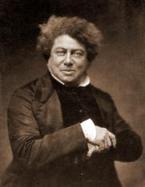
Alexandre Pere Dumas, Novelist

He was the inspiration behind the hero of his son’s novel ‘The Count of Monte Cristo‘, the story of the young sailor Edmond Dantes who, on the verge of a promising career and life, is locked away without witness or trial in the dungeon of the island fortress Château d’If.

An island dungeon is where Alex Dumas, finds himself after the failed French invasion of Egypt, when he is almost shipwrecked on his return, the ship limping into the south of Italy, which in the meantime has become an enemy of France and sadly Dumas’ influence with Bonaparte has diminished and he is all but forgotten.

Les Fers brisés, Paris

The story is rich in detail and reads more like a novel than the historical account that it is. Tom Reiss has excelled in researching both the vast volume of documentation, which from his account, sounds as if the Generals sent letters at an equivalent rate to which people send email today as well as visiting all of the battle sites and physical locations the General and his family were based.

Reiss encounters his own difficulties in pursuing the research, all of which contribute to making this a most compelling and entertaining read, but above all, one can’t help but admire the man, who lived in an extraordinary period of history, who was born into slavery, witnessed its emancipation, then both saw and experienced it tragically being rescinded. He deserves his rightful place in the historical annals of France, as a role model, a hero and a man of the people.

Note: This book was an Advanced Reader Copy (ARC) kindly made available by the publisher via NetGalley.

Thomas Jefferson – Lessons from a Secret Buddha

This is a delightful and simple novella that views the life and achievements of one of America’s great role models through the principles of Buddhist thought, a man who wished only to be remembered for three achievements, author of the Declaration of American Independence, of the statute of Virginia for Religious Freedom and Father of the University of Virginia. He was President from March 1801 – March 1809.

Suneel Dhand has created a Buddhist guru whom he connects to Jefferson’s mother, and who then begins to correspond with the young man when he is a discontented, overweight child. The letters introduce him to seven ancient principles of Buddhism and the Eastern way of life and we then witness Jefferson’s own lifestyle change as he becomes vegetarian, more interested in books and develops a greater awareness of how thoughts, actions and behaviours position a man.

When we take an in-depth look at all of his lifestyle practices we see that Tom practiced very Eastern ways of living, different from his fellow countrymen. In many ways he was a well-being guru, centuries ahead of his time.

Most of my knowledge of the role Thomas Jefferson played in American society comes from having seen the excellent HBO TV series ‘John Adams’ and the awe with which he was regarded by both John Adams and Benjamin Franklin as they encouraged him to pen the Declaration of American Independence.

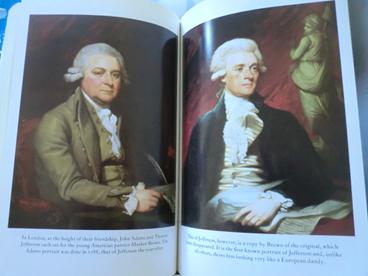
Portraits of John Adams and Thomas Jefferson by American painter Mather Brown 1788

The series is based on David McCullough’s Pulitzer prize-winning biography ‘John Adams’, a volume I have on the shelf and will one day set to and read as well.

As Abigail Adams would confide to Jefferson, there had seldom been anyone in her husband’s life with whom he could associate with “such perfect freedom and unreserve” and this meant the world to her.  If you haven’t seen the series, here are some of Jefferson’s greatest moments played by the British actor Stephen Dillane.

A surprising little book, one that is full of good sense and relevant to today while reminding us of the extraordinary man Thomas Jefferson was and the major contributions he made not just to American history but also to humanity.

Today millions continue to be inspired by Thomas Jefferson, the genius who galvanized his people to freedom. A truly enlightened soul indeed – and that, without ever requiring any lessons from a Secret Buddha.

Note: This is an Advance Reader Copy (ARC) provided by the publisher via NetGalley.

Titanic Revisited Part I

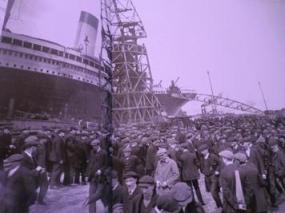
The significance of the Titanic continues to intrigue, or I should say has begun to intrigue me more since a visit to Belfast, Northern Ireland, the city in which it was built, a city which itself grew on the back of the growing shipyards and connected industries associated with it. Between 1851 and 1901 the city’s population increased from 87,000 to 350,000 and was the fastest growing city in the British Empire during that time.

Abandoned shipyards

From the top floor of the apartment in the Titanic Quarter where we stayed, I looked down on a vast, empty space, a maze of square and rectangular footprints of buildings and thoroughfares, once a labyrinth of busyness, that filled with the more than 30,000 men and women who would cross the bridge and walk or cycle down Dee St to work.

I contemplate that wasteland with its perpendicular lines; the skyline still dominated by two tall, bright yellow Harland & Wolff gantry cranes, a symbol which continues to salute the past, and I try to imagine the hive of activity that it once was.

Turning the last pages of Walter Lord’s ‘A Night to Remember’ I read in the end chapter Facts About the Titanic that she was launched at the Belfast shipyards of Harland and Wolff on 31 May 1911. The date rings a bell and I look in my diary and see that my daughter and I arrived in Belfast on 31 May 2012, exactly 101 years on from that auspicious date.
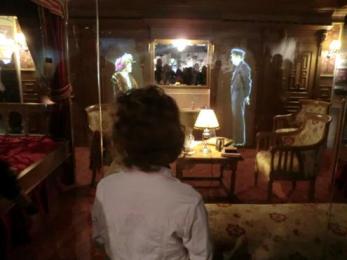
Julian Fellowes, creator of the series Downton Abbey and the film Titanic asks in the foreword why this tragedy still haunts us, as it does and certainly the opening of the significant Titanic Belfast museum is a testament to that. He suggests:

Maybe it is because the ship seemed, even then, to represent that proud, pre-war world in miniature, from the industrialists and peeresses and millionaires and Broadway producers who sat around the vast staterooms in first class, to the Irish and German and Scandinavian immigrants packed into third, carrying with them all they possessed, on their way to a new life in America….And as they headed for destruction, so did the larger world they represented, which would soon hit its own iceberg in the shape of the First World War.

Ist Class cabin on board Titanic

Walter Lord’s book is really just that, a factual account of what happened interspersed with the comments to create a narrative of various passengers and crew throughout the two to three-hour ordeal, from the moment of impact when the ship sideswiped an iceberg, until the Carpathia arrived in dock at New York and the truth about how few survived from the more than 2,200 who had been on board when she set out was revealed. He shares the reflections of many people from all classes, providing an overview of the atmosphere and a brief introduction to the individuals thrown together in this catastrophe.

One of the significant complexities which the Titanic represented, was the separation of the classes, the architectural blueprints clearly show the delineation between 1st, 2nd and 3rd class and the museum today exhibits perfect replicas of the rooms they inhabited, complete with holograms of talking passengers. This distinction also carried through to influence the evacuation of passengers, with 1st class women and children given priority, no children from 1st or 2nd class were lost, while 53 children in 3rd class were lost (23 saved).

Titanic Belfast Museum

Even as the Mackay-Bennett returned to the scene to retrieve bodies, similar principles were applied. There were too many bodies to cope with, so many were buried at sea, arbitrary measures were used to try to decide which bodies should be kept, those with tattoos were identified was 3rd class citizens and given a prompt sea burial. At the time it wasn’t criticized, but the sinking of the Titanic could be said to have been a turning point in this respect, it was the end of the Edwardian era, just before the outbreak of World War I and many things would change in the period that followed from a social perspective.

Looking at that period from 1900 to 1912, I noted that there were many exciting and exhilarating firsts, the Wright brothers first flight in 1903, the NY subway opening in 1904, the first European country to give women the vote in 1906 (Finland), and the first electric washing machine released in 1907. Ford introduced the Model T in 1908 and electricity was becoming more widespread.

Titanic Quarter

By contrast, in the years that followed the Titanic, personal income tax was introduced in the US in 1913, World War I started in 1914 which propelled women into roles they had never considered before and equality between the classes and the sexes began its long path towards some kind of rebalance.

Now that I have the context of the ‘Night to Remember’, I have started to read ‘And the band Played On’ an account written by Christopher Ward, grandson of the 21 year-old violinist Jock Hume, who together with the other band members of the Titanic, kept playing until the ship disappeared.