Literary Blog Hop Winners!

literarybloghop

Thank you so much to you all for entering and participating in the Literary Blog Hop and visiting Word by Word and thanks to Judith at Leeswammes for hosting it.

I was happy to offer two books that I read very recently and given that I read books by authors from 22 countries last year (What Do We Read?), it seemed appropriate to offer a book that had been translated from a foreign language, alongside a shiny new book just published this month.

Therefore, I am delighted to announce two winners, firstly thanks to the Penguin Group for offering a beautiful copy of Robin Oliveira’s historical novel I Always Loved You.

This book will soon be winging its way to …

I Always Loved You

Jenna Sauber!

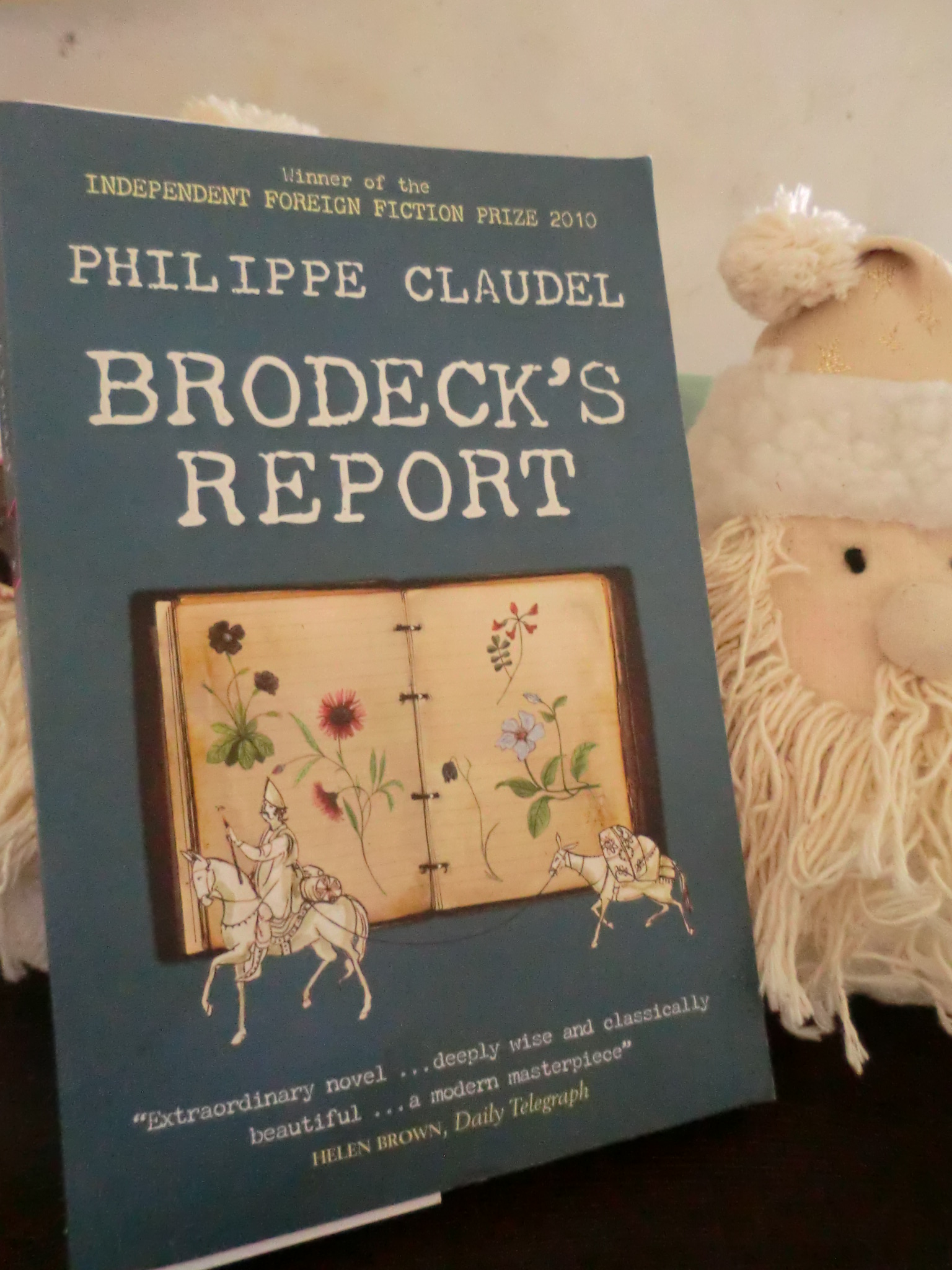
And for those who courageously put their name down to read this French literary gem, translated into English, Philippe Claudel’s Brodeck’s Report will soon be on its way to…

Le Rapport de Brodeck

Le Rapport de Brodeck

Susanna P!

Thanks again to everyone who visited my blog and was able to enter, happy reading to the winners and thank you to those who have decided to follow Word by Word, I hope you find some good recommendations here.

The Literary Blog Hop – #Giveaway

Today and until 12 February, I’m participating in a literary giveaway blog hop hosted by Judith at Leeswammes’ Blog, an avid reader and blogger.

literarybloghop

All the blogs listed below are participating and offering a literary giveaway to readers. Just leave a comment below to be in the draw for my giveaway and visit any of the blogs listed below, to be in with a chance to win a book. This giveaway is open to you all, worldwide!

WIN A COPY of

Philippe Claudel’s Brodeck’s Report !

I am giving away a copy of one of the best books I read in 2013, a brilliant English translation of a contemporary French novel and winner of a French literary Prize Brodeck’s Report by Philippe Claudel.

You can read My Review here or the brief summary I wrote immediately upon finishing it.

Quietly devastatingly brilliant. Claudel takes one village which happens to be near the border – and what is a border but an imagined line – of an occupying nation and uses the village and its resident to portray humanity and its many inclinations, when a stranger rides into town, makes himself comfortable and goes about his business, without letting anyone know what that business was.

Brodeck is tasked with writing an account of events that take place and as he does so, he simultaneously writes another account, his own, of what is occurring now and what has happened to them all in the recent past, he tries to make sense of it, as is his nature and to know what to do.

I have another giveaway running concurrently (only open to US readers), if you like historical fiction, I am offering a copy of the recently published I Always Loved You by Robin Oliveira recounting the life of the artist Mary Casssat and her friend Edgar Degas in Paris in the late 1800’s. Read my review here and enter the giveaway here.

This is a great opportunity to visit blogs that review literary books and win a book! Entry into the draw via comments are open until 12 February.

Linky List:

  1. Leeswammes
  2. Seaside Book Nook
  3. Booklover Book Reviews
  4. Biblionomad
  5. Laurie Here
  6. The Well-Read Redhead (US/CA)
  7. River City Reading
  8. GirlVsBookshelf
  9. Ciska’s Book Chest
  10. The Book Stop
  11. Ragdoll Books Blog
  12. Nishita’s Rants and Raves
  13. Lucybird’s Book Blog
  14. Reading World (N-America)
  15. Journey Through Books
  16. Readerbuzz
  17. Always With a Book (US)
  18. 52 Books or Bust (N.Am./UK)
  19. Guiltless Reading (US/CA)
  20. Book-alicious Mama (US)
  21. Wensend
  22. Books Speak Volumes
  23. Words for Worms
  24. The Relentless Reader
  25. A Lovely Bookshelf on the Wall (US)
  1. Fourth Street Review
  2. Vailia’s Page Turner
  3. The Little Reader Library
  4. Lost Generation Reader
  5. Heavenali
  6. Roof Beam Reader
  7. Mythical Books
  8. Word by Word
  9. The Misfortune of Knowing
  10. Aymaran Shadow > Behind The Scenes
  11. The Things You Can Read (US)
  12. Bay State Reader’s Advisory
  13. Curiosity Killed the Bookworm
  14. Lizzy’s Literary Life
  15. Books Can Save a Life (N. America)
  16. Words And Peace (US)
  17. The Book Club Blog

This giveaway is now closed.

I Always Loved You – #Giveaway

Thanks to the generous team at the Penguin Group, US and today, the day of its publication I offer one lucky reader (you must be resident in the US – sorry) a copy of this fabulous book:

I  ALWAYS  LOVED  YOU

by

Robin Oliveira

I Always Loved You

Read my review here of this historical novel set in 1880’s Paris, which the publisher describes as:

A novelization of Mary Cassatt and Edgar Degas’s relationship in Belle Époque Paris. It captures the golden age of Impressionism and is peopled with many prominent figures of the movement including artists Édouard Manet and Berthe Morisot (the only other prominent female artist working in Paris at that time).

Robin Oliveira writes with grace and uncommon insight into the lives of artists and the passions and foibles of the human heart.

Leave a comment below if you wish to be in the draw to be held on 12 February!

This giveaway is now closed.

I Always Loved You: A Novel by Robin Oliveira

Mary SutterWhile looking at a Goodreads list of Historical Fiction due out in 2014, I noticed the name Robin Oliveira, author of the excellent novel My Name is Mary Sutter published in 2010.

I don’t read a lot of historical fiction, but occasionally via word of mouth, I hear about a well written, compelling title that I can’t resist, particularly if it is set in France.

Well researched historical fiction in the hands of a talented writer, is my preferred method of learning about French history (or any history); engaging characters propel the narrative forward and we invest ourselves in the characters who have inhabited the period and discover the chronology of events as if we are living them. Historical events when presented without the force, nuance and characteristic dialogue of personalities that have shaped them, risk becoming dry, uninteresting, sedative and read by the few.

Set in 19th century America on the cusp of civil war, My Name is Mary Sutter chronicles the life of a midwife with ambitions to become a surgeon, something she will be thrown into with the advent of war. Her ambition requires the courage to cope with an abundance of men suffering war injuries amid dire living/working conditions plus sacrifices in her personal and family life. She is a captivating heroine, strong-willed yet vulnerable, living in an incredible pioneering era for women.

In her research, the author learned that 17 young women became physicians after their nursing experiences in the civil war. While Mary Sutter is fictional, she is a truly inspired character about whom Robin Oliveira had this is say:

“And through it all there was Mary Sutter, whose story I needed to tell as a celebration of women who seize the courage to live on, to thrive, to strive, even, when men conspire to war. Mary, flawed and intelligent, careening between desire and remorse, stumbling forward out of courage and stubbornness, hiding a broken heart, but hoping to redeem something beautiful from a life humbled by regret.”

Which is a prelude to saying that seeing a new Robin Oliveira novel coming out in 2014 and set in France, I jumped at the chance to read it.
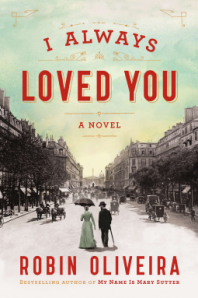
I Always Loved YouI Always Loved You, an unfortunate and slightly off-putting title, sorry, is about the life of  the American painter Mary Cassatt, her life in Paris struggling to make her name while remaining true to her art, and enduring a life-long fractious relationship with the impressionist painter and sculptor Edgar Degas. It also brings to life another female painter, Berthe Morisot and her relationship with the Manet brothers, Édouard and Eugène.

Mary had left her home town of Philadelphia to pursue artistic ambitions and after ten years of hard work, having once been accepted by the Salon for her work Ida (or Spanish Dancer Wearing a Lace Mantilla), has now been rejected and is feeling disillusioned and on the point of giving in to her father who wants her to return home, find a husband and be with her family. Had it not been for his fascination with Ida and the subsequent encounter with Degas, she may well have fulfilled her father’s bidding.

“C’est vrai. Voilá quelqu’un qui sent comme moi.”
(It’s true. Here it is, someone who feels as I do).
Edgar Degas commenting on Mary Cassatt’s painting, Ida

Through Mary, we learn what it meant to be a painter in Paris in the late 1800’s, the restrictive, suffocating influence of the Salon Jury, purveyors of the official annual exhibition of the Académie des Beaux-Arts, known as the Salon de Paris, to whom all artists looking for acknowledgement and recognition would submit one or two paintings and then await acceptance or rejection. Those deemed successful by the Jury would be hung at the next exhibition and if lucky, talked up by the critics. Those who weren’t, were resigned to another year of work before resubmitting – and they all did, for it was seen as essential to exhibit there in order to achieve any success, a status quo that existed for almost 200 years in France.

Salon de Paris

Salon de Louvre 1787
Source:Wikipedia

This process spurned a rebel group lead by Edgar Degas who refused to submit their work to the Salon Jury and began to hold an alternative exhibition.  These artists were willing to let go of the past with their references and rules and were bold with colour, subject and loose with their interpretation. They became referred to disparagingly by the media as Impressionists, a term Degas despised. It was a brave move and not all of the groups members managed to sustain their nerve, the lure of the Salon despite its limitations, not easy to stand up against.

Degas had admired Mary Cassatt’s work without knowing who she was and after organising to meet her, invited her to exhibit with his group of artists and to one of their weekly salons, a social gathering that included Édouard Manet, his brother Eugène, Berthe Morisot, Renoir, the writer Émile Zola, Pissarro, Gustave Caillebotte, Zacharie Astruc, the poet Stéphane Mallarmé and Claude Monet among others. The evening would mark the beginning of a long relationship between two talented artists whose work came before all else and whose similarities and stubbornness would continue to attract and repel them until their last days.

“He was right. The something, the leap an artist makes so that his painting is more than its technique, he had already achieved. And she wanted that.”

Edouard_Dantan Un Coin du Salon, 1880

Edouard Dantan
Un Coin du Salon, 1880
Source: Wikipedia

I had never heard of Mary Cassatt when I began reading and was intrigued to discover her art, but decided not to go looking at her or Degas’s work until I had finished, allowing my imagination to create an image of their creations during the period of their encounters, which added an exciting anticipation to the reading, especially while Cassatt was preparing for her first showing with the Impressionists and when Degas was working on his sculpture The Dancer.

I hesitate to show any of images of their art here, as it was such a reward for me upon finishing the book. Getting to know or reacquainting ourselves with the artists work is a personal journey and we should decide in our own time when to view the oeuvres of these great artists. No Spoilers here!

They were an inspiration to each other with regard to their work and Oliveira brings the two alive in rich detail, you can almost see their respective studios and smell the turpentine, imagining the furrowed brow of concentration as these two passionate artists throw themselves into their work and block out the world around them.

What they couldn’t inject into their relationship, they gifted to each other through their work, some of the most poignant and yet ironic scenes are when Degas helps Cassatt find her subject and confirms what it is she should be painting. And then the joy of finally seeing them and seeing the energy and vibrancy of those paintings she created during that period when they responded so positively to each others influence, fact or fiction, it stands out in the work.

“I have no money to pay a model,” Mary said to Degas. “I don’t know what to do.”

“You must find your subject.”

Mary said, “Like yours? Ballet, horses, brothels?”

“Obsessions are an artist’s gift. Obsession is poetry,” Degas said.

Just as other writers have brought alive the Lost Generation of writers resident in Paris in the 1920’s, Robin Oliveira does the same for this group of painters, awakening our interest in this turning point in the history of art and the influence of this group on painters in the wider world, which continues today. It is a brilliantly told story of fascinating characters and their passion for art.

National Gallery of Art Washington

National Gallery of Art
Washington

And if you are fortunate enough to live near or visit Washington, it appears that there is to be an exhibition of Cassatt and Degas’s work at the National Gallery of Art May 14 – Oct 5 focused on the critical period of the late 1870s through the mid-1880s when Degas and Cassatt were closest, bringing 70 various works together to showcase the fascinating artistic dialogue that developed between these two major talents and friends.

Note: This book was an ARC (Advance Readers Copy) provided by the publisher via NetGalley.

The Lost Domain – Le Grand Meaulnes by Alain Fournier

Classics don’t feature too often on my list and when they do, I tend to be attracted towards the Russian and French classics, because they offer an element of the unknown and the unfamiliar. I like reading across cultures and am fortunate to live within a culture that provides me with learning opportunities every day, whether I read the literature or not. But reading it adds so much more to the experience and to interactions with local people.

West End Lane Books

West End Lane Books

I had come across references to Le Grand Meaulnes a few times and nearly brought it home with me after visiting West End Lane Books in London last October, leaving it behind on that occasion, but purchasing Brodeck’s Report, which I have since read and Alistair Grayling’s non-fiction work Friendship, of which I read a few pages and found it a little dense, not yet abandoned, but left for a rainy day.

Le Grand Meaulnes crossed my path again via NetGalley, where I learned of the centenary version below which coincides with the 100th anniversary of Fournier’s death.  This version translated by Frank Davison, published by Oxford University Press.

I decided – enough – stop reading ABOUT the book and READ the book!

The Lost DomainAnd then what joy, to find myself in the company of Hermione Lee who has written such a wonderful introduction filling us in on Alain-Fournier’s life, that I could almost write an entire post on the gems she shares her excellent essay. She writes of the unique captivation this book has held over generations of readers and the literary qualities that have allowed it to continue to survive as a modern classic.

“Alain-Fournier’s only novel maps an imaginary vision onto a real landscape. It is the story of his childhood, transformed into a romantic quest. It is set in real places which he had known all his life, with real names of villages and towns and shops and train stations, but it takes us on mysterious journeys to places that seem to belong to a fairy tale.” Hermione Lee.

The title itself and its translation present a dilemma, as it is not possible to translate all that it means in one expression, it is a play on words, for it is the nickname of one of the chief characters and a reference to an estate, a château that he will search for in vain.

For a man who died at 28, Alain-Fournier lead a full and dramatic life, making one wonder what more he may have accomplished had he not been killed tragically in 1914 shortly after being called up to fight in WWI. The drama continued after his death, as this one book that he wrote became a cult sensation and created a feud over his legacy, complicated further by the split between his parents, claims by his sister and her husband (Fournier’s best friend) and the married women Simone (whose husband he had ghost written a book for) whom he’d had an affair with, who aborted his unborn child.

Alain-Fournier_maison_natale

Birthplace of Alain_Fournier
La Chapelle-d’Angillon
Source: Wikipedia

One gets the impression having read Le Grand Meaulnes, that having addressed childhood, the author was just warming up for an entire litany of novels, drawing on the many experiences and emotions he had already encountered in such a short life.

“His longing for his childhood places and his desire to turn that emotion into writing was one of the fundamental impulses behind Le Grand Meaulnes.”

Beginning in the 1890’s, Le Grand Meaulnes is narrated by the quiet, unassuming Seurel, a boy whose life at the schoolhouse is relatively uneventful until Meaulnes, nicknamed Le Grand Meaulnes arrives and just as soon disappears, only to return again.

The arrival of Augustin Meaulnes at a small provincial secondary school sets in train a series of events that will have a profound effect on his life. Lost and alone, he stumbles upon an isolated house, mysterious revels, and a beautiful girl. Determined to find the house again, and the girl with whom he has fallen in love, Meaulnes is torn between his love and competing claims of loyalty and friendship.

It is a story of a childhood and adolescence told by one who observes, follows, understands and tries to assist, at the expense of living his own life to fulfilment. What happened to his friend in those few days he disappeared will obsess both boys thereafter, one because he wants to know what happened and the other because he wants to return there and cannot remember the way.

The books first pages are narrated when Seurel is five, the main story taking place when he is 15 and Meaulnes is 18 and will end when Seurel is almost 20. Whenever Meaulnes is present, there is an air of drama. Life and even his character take on a different aspect for Seurel when his friend is there, and when he is not, he mulls over what has passed and tries to make sense of it, and at times even do something about it.

“Meaulnes gone, I was no longer following in the footsteps of a visionary path-finder; I was once more a village lad like the rest of them – a status which demanded no effort and concurred with my own inclinations.”

alain-fournier

Alain-Fournier
Source: Wikipedia

It is a nostalgic read, somewhat melancholy, infused with an air of pending tragedy – and reminiscent of the life of the author. It creates an ambiance of short-lived joy and then loss, one that is repeated often. We don’t read for the destination, but for the journey and its distractions, for the differences between characters facing the same situations. In this, it is a microcosm of humanity on a small scale during one phase of life, youth.

It is symbolic, not just of the end of childhood and romantic notions, but the end of an era of narrative style, published at the same time as Proust’s Swann’s Way, hailed as something new and a sign of the way forward for French literature, part of the new modernist movement, whilst Le Grand Meaulnes represented the end of the romantic tradition.

Loved it.

Note: This book was an ARC (Advance Reader Copy) provided by the publisher via NetGalley.

Brodeck’s Report by Philippe Claudel, tr. John Cullen

BrodeckThis book has been on my radar since I read Le Petite Fille de Monsieur Linh by Philippe Claudel last year. That was the first book I had read by Philippe Claudel and our book club decided we should read it in French. I remember at the time, one of my twitter followers mentioned Brodeck’s Report as being her favourite, and on a recent visit to West End Lane Bookshop in London, I found this copy.

Brodeck’s Report is the story of the young man Brodeck, who as a child arrived in a French village with an old woman who had taken pity on him, finding him sitting alone in the ruins of a house fire.

He becomes a protégé of the village, who save enough to send him to university with the intention of him making an important contribution to village life, as it was clear he had the capability. Their plans are thwarted by unrest in the city and Brodeck flees to the village with a young woman who will become his wife. The village soon becomes occupied, resistance is taught a harsh lesson and the community are encouraged to ‘cleanse the village’. Brodeck and one other who came from elsewhere are sent away.

InnWhen the story begins, Brodeck is home, having survived the camp and after stepping out to find butter, stumbles into the midst of a village gathering at the Schloss Inn, where those grouped have decided he will write a report about the unknown, nameless stranger who came to visit, who had now met his end.

The novel is quiet, devastating and yet brilliant. Claudel takes one village which happens to be near the border – and what is a border but an imagined, even a painted line on paper – of an occupying country, and uses the village and its resident to portray humanity and its many inclinations, including its inability to learn from mistakes – which manifest when a stranger rides into town, installs himself at the local inn and goes about his business, without letting anyone know what that is. Many of the events portrayed in the novel are the result of illusory thought, of man’s inclination to create a story when there is none and to punish the outsider, the one who has inspired their dark imagination.

BrodeckBrodeck is tasked with writing an account of the events that do take place and as he does so, he simultaneously writes another account, his own narrative of what is occurring and what has happened in the recent past. He writes to try to make sense of it, as is his nature and to know what he must do.

Reading Primo Levi adds to an understanding of Claudel’s work and having read this novel so soon after Aminatta Forna’s The Hired Man, it illuminates something more of that work as well, it is as if they write about the same people, only Claudel dares to take the reader deeper into the heart of his villagers forcing us to open our eyes.

“It is a strange time of day. The streets are deserted, the encroaching darkness turns them into cold, grey blurs, and the houses become shifty silhouettes, full of menace and innuendo. Night has the curious power of changing the most everyday things, the simplest faces. And sometimes it does not so much change them as reveal them, as if bringing out the true natures of landscapes and people by shrouding them in black.”

Stunning.

Are Prize Winning Novels an Indication of Readership or a Nation’s Literary Heritage?

After the BBC’s journalist in Paris Hugh Schofield asked the question about Why French books don’t sell abroad, the Cultural Attaché to the US Embassy in New York, Laurence Marie responded with an extensive list and discussion of a list of French titles that are selling abroad. She also mentions how widely French literature is being translated into other languages and her article makes fascinating and insightful reading. I have collected book covers of some of the works mentioned, plus others, below.

Sometimes we hear about literature from another country when the author wins a major literary prize. However:

Are Prize Winning Novels Really Indicators of a Nation’s Readership?

French Books That Are Selling Abroad!

French Books That Are Selling Abroad!

I don’t think so.

Literary prizes usually have an agenda, if not multiple agendas.

In the case of the UK’s Booker Prize it was set up to try to bring more literary works into the mainstream.

It is known that the prize doesn’t actually influence the reading habits of avid readers. It is targeted at those for whom books are competing against other forms of entertainment.

I like the literary prize season, not so much in anticipation of a winner, but for the longlist, where we are more likely to find something new that might appeal to our taste, because of the variety offered and the number of works screened.

So what are the French literary prizes?

Le Prix Goncourt

I don’t know the French literary prizes well, and Schofield mentions in his article that there are over 2,000 of them, but the Le Prix Goncourt is well-known and has been around over 100 years since 1896.

The last recipient was Pierre Lemaitre, whose thriller Alex  (reviewed here by Savidge Reads who said of it: “a thriller that almost made ‘Gone Girl’ look tame”), was a bestseller last year and his prize-winning novel Au revoir là-haut looks set to be the same.

Nancy, a blogger in the Netherlands whom I admire enormously, tasked herself to read only French novels last year, as an interesting way to learn the language and not only has she succeeded in learning the language, but she has not given up, she continues to read novels in French. You can read her review (in English) of Le Maitre’s Au revoir là-haut here.

The prize was established by Edmond de Goncourt, a successful author, critic, and publisher, who bequeathed his estate to establish an academy and the prize was initially created to allow talented writers the opportunity to write a second book. The prize is seen as being SO prestigious, the prize money has not changed since the early 1900’s and remains something around €10.

Le Prix Femina

Leonora MianoTen members of the Goncourt academy are responsible for the judging of Le Prix Goncourt, and in protest against this all male jury, le Prix Femina was inaugurated, an equivalent literary prize open to all sexes, however the jury is all female.

This year the prize was won by Léonora Miano, a Cameroonian author who has lived in France since 1991, for her 7th novel La Saison de l’ombre (The Shadow Season).

There is also a Prix Femina étrangere for foreign books which was won in 2013 by Richard Ford for Canada and Le Prix Femina essai, a popular genre in France, the essay; this year won by father and son duo Jean-Paul Enthoven and Raphaël Enthoven for le Dictionnaire amoureux de Marcel Proust (Marcel Proust’s Love Dictionary).

2013 Pric FeminaThere are certainly no shortage of prizes here in France (other major literary prizes are the Grand Prix du Roman de l’Academie Francaise, the Prix Renaudot, the Prix Interallie and the Prix Medicis), and their lists make interesting reading, for their longevity and breadth and for that fact, that they are so little known by readers in the English language.

Although prize-winning literature might be translated into English, it may also create a false perception of readership, being skewed towards that overly intellectual perception of literature that Schofield refers to as being elitist, which can alienate the average English language reader (and perhaps also the average French reader).

Every nation is proud of their literary culture and achievements and like to endow their icons of that tradition with prestigious titles, however down here at the ordinary people reading level, there is a whole other canon of literature being read, whether it is in the English language or any other.

CIMG3882To know more about what ordinary readers are immersing themselves in, it is necessary to speak to people like us, those who don’t often have a voice in the media or on a jury, they are the voices that are worth hearing from, even if what they provide is anecdotal evidence.

I am speaking to some of the French people I encounter in everyday life who are passionate readers, to find out what they think about French literature and what they are reading, to be featured in future posts.  And to find out more about all that translated fiction they love to read here.

They’re Reading Thousands of Great Books Here, Cité du Livre – A Local French Cultural Centre and Library

Yesterday via a link on twitter, I read a provocative article in BBC News Magazine by Hugh Schofield entitled Why don’t French books sell abroad? It was an interesting, if superficial article, that made a few observations without going into any depth to understand the contemporary literary scene in France. It asked questions, reminded us of some old provocative stereotypes and did little to enlighten us on the subject of what excites French readers and why the English-speaking world aren’t more aware of their contemporary literary gems.

Kate from BooksKateRates, reads and blog about French literature and wrote an interesting blog post in response to the article and I have been scribbling notes since reading the original article. I plan to share them here, as it is a fascinating subject if one takes the time to research and understand it.

But firstly, I wanted to show you the library, as it offers a glimpse into  how the French absorb literature and culture and it’s one our favourite local hangouts.

Situated in what was a 14,500 sqm match factory, the library, La Bibliothèque Mèjanes, is part of the Cité du livre, a centre for the arts and culture which includes an auditorium for lectures and readings, rooms for more formal lectures, a small cinema showing themed films for 3 week periods (currently Humphrey Bogart films), a music and film lending room, adult and children’s libraries, a press room, an exhibition space (currently celebrating the centenary of Albert Camus), a café and plenty of space for research and study.

Library Press Room

Library Press Room

As we walk in through the enormous sculptures of the covers of Camus’s  L’etranger on one side and Saint-Exupéry’s Le Petit Prince and Molière on the other, we arrive in a long corridor and the reception area for borrowing and returning books.

Turn left and we head towards the reading library where outside the door is a display of books for adolescents. A quick glance at these books shows us that half of them are translated fiction, from South African, German and Hispanic authors.

AsterixInside, we walk past displays of translated literature originating from South Africa, a tribute to Nelson Mandela, then the stacks of Bande Dessinée, the very popular hardcover graphic novels, which even today remain at the top of the French bestsellers list, right now its Asterix chez les Pictes, visiting the people of ancient Scotland!

And here are the novels, in French called romans. Rows and rows of books and you might notice something they all have in common, well, in fact, something they all lack. Colour.

Compare it to the shelf opposite which contains the English language novels. It certainly removes that whole likelihood of an impulse buy based on an intriguing cover.

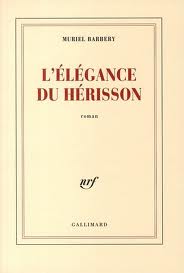
The Elegance of the Hedgehog

The Elegance of the Hedgehog

Most French literary novels are published without fancy colourful covers and while in the bookshop you might find first editions with promotional covers, there are many more with pale or cream covers without images and a black or red text title.

However, after looking around a little more, I discover that there is colour in some sections. Science Fiction and Fantasy are full of dark colours and the books covers in the section entitled Policiers (Crime) are mostly black. However, novels and poetry, even the section called American Literature pale into insignificance among a sea of white. It reminds me of one of the three principles of France l’égalitié and certainly here, all books have the same chance of being found, whether it’s from the library or in the bookshop, not just due to their bland covers, but also due to a government policy called le plan livre and the fixed price of books.

It costs €17.50 to join the library (adult) and its free for children, there is no cost for lending and no fees for late returns. 16 items (books and CD’s) and 3 DVD’s can be borrowed at any one time for a period of 3 weeks and the first renewal can be done online. The library is also full of computers providing free internet access to all members. My only complain is that its closed on Sunday and Monday. C’est la vie en France!

So what kind of books do French people read today? And is it true that nearly half of the fiction read is translated foreign fiction? And why don’t we see more books by French authors in English bookshops?  These questions and more I will talk about in the next post Reading Contemporary French literature.

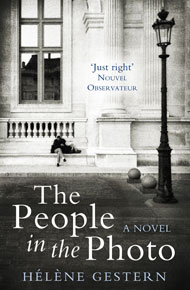
PeopleIn the meantime, if you want to know what’s popular in France and available now to read in English, check out Gallic Books, who offer the best of what’s available in French translated in English with new titles coming out every month.

I’m looking forward to reading The People in the Photo by Hélène Gestern due out in English in February 2014.  If you wish to read it in French, it’s already available with the title Eux sur la photo.

Hemingway’s Paris – A Moveable Feast

Hemingway makes me think of the debate streaming though comment threads on Goodreads.  The debate centres on the issue of discussing an author in book reviews, Goodreads suggesting that reviews focus only on the content of a book and not stray into opinions about the personality or character of the author. Hemingway

Being a book review site, it may not seem like an unreasonable request, except that the site has allowed five years of historical reviews to build up without comment, guidance or reprimand against reviews that may have crossed this line and in the meantime a strong community of reviewers has developed, spreading its roots and reviews deep into the site. Unsurprisingly, the community is now rebelling against wilful deletions of reviews. Some are threatening to abandon the Goodreads ship while its Captain is said to be sailing on oblivious to mutiny in its hold.

I think of Hemingway because in A Moveable Feast, he writes not just about himself, he reflects on writers he was acquainted with in Paris and about life in that city after the First World War. He shares exactly the kind of opinions that are forbidden to reviewers today. However, he is not writing a book review, he is writing about life.

Apart from the delightful short story A Clean Well-Lighted Place, I have not read Hemingway since the trauma of having to study The Old Man and The Sea at school. I am sorry to say that I detested this novel and although nothing of the prose has stayed with me, a kind of nausea, akin to sitting in a rocking boat with no means of rowing it, engulfs me when remembering it. I didn’t understand at the time why I reacted like this, worse than boredom, it was bereft of literary merit according to my 13-year-old standards.

Knowing now of Hemingway’s deliberate intention to strip his prose bare and understanding my love of the metaphor and habit to underline and admire the more descriptive linguistic passages, I see that we are not a good pair. But having met the writer again through the lives of Hadley Richardson in The Paris Wife and Zelda Fitzgerald in Z, I was intrigued to read his non-fiction account of life in Paris.

Ernest Hemingway,1923 Source: Wikipedia

Ernest Hemingway,1923 Source: Wikipedia

The chapters read like a series of vignettes, encapsulating the many aspects that made up his life during that time. He writes about the cafes he frequented and in particular the plight of two waiters, whom when the new management of the café decides it wants to attract a higher calibre of client, insists his employees shave their mustaches and wear a uniform. Hemingway and friend are poured overfull whiskeys by the waiter and they drink them in protest.

“They’re changing the management.” Evan said. “The new owners want to have a different clientele that will spend some money and they are going to put in an American bar. The waiters are going to be in white jackets, Hem, and they have been ordered to be ready to shave off their mustaches.”

“They can’t do that to André and Jean.”

“They shouldn’t be able to, but they will.”

Jean has had a mustache all his life. That’s a dragoon’s mustache. He served in a cavalry regiment.”

“He’s going to have to cut it off.”

He reflects on his habits as a writer and here we meet a man who was dedicated to his métier above all. He writes about his deliberate strategy to eliminate the adjective, to let the words stand alone without any qualifiers or modifiers, the naked verb. His aim is like the writing equivalent of meditation, de-cluttering the page instead of the mind. He would not have made a great meditator, as he was fearful of emptying the mind.

“I had learned already never to empty the well of my writing; but always to stop when there was still something there in the deep part of the well, and let it refill at night from the springs that fed it.”

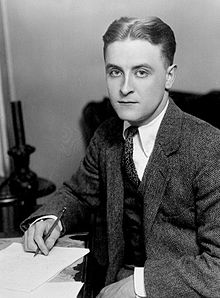
F.Scott.Fitzgerald,1921 Source: Wikipedia

F.Scott.Fitzgerald,1921 Source: Wikipedia

F.Scott Fitzgerald was a good friend. Both chapters that describe events with Fitzgerald show just how erratic his behaviour was and Hemingway suffers from having his writing discipline disrupted on a trip back to Paris from Lyon having recuperated a convertible car Scott and Zelda had abandoned due to the rain.

“I was getting tired of the literary life, if this was the literary life I was leading, and already I missed not working and I felt the death loneliness that comes at the end of every day that is wasted in your life.”

A Moveable Feast is an excellent read, sharing moments of life in Paris, we are introduced to some of Hemingway’s favourite cafés to write in, his conversations with Gertrude Stein and others about writing, up until he fell out of favour after publishing a mockery of another author’s work which she and others disapproved of, perceiving his act as disloyal to a fellow writer. He becomes a regular at the famous English bookshop Shakespeare & Co, where he is able to lend books, having no money to buy them and reads his way through Turgenev, D.H.Lawrence and Dostoevsky as well as striking up a friendship with the owner Sylvia Beach, a pleasant source of gossip as well as books.

Z: A Novel of Zelda Fitzgerald by Therese Anne Fowler

Zelda_Fitzgerald_portrait

Zelda Sayre

Born with an exotic name that lent itself to bright lights and a spirit that loved nothing more than to dwell under them, it is not surprising that Zelda Sayre’s life was illuminated and became of interest to so many who were less daring themselves but fascinated with her life and antics.

But just as light cannot exist without shadow, she would discover the darker underside of a life lived in the shadow of her husband, when she dared to pursue her own desire to be recognised as a professional in her own right.

ZZ: A Novel of Zelda is an excellent companion novel to The Paris Wife and one of an expanding collection that gathers around that group of artists, writers, wives and hangers-on of the “lost generation“, a term coined by a young French mechanic who was reprimanded for giving insufficient priority to repairs on Gertrude Stein’s Model T Ford and thus complained to his patron that they were all a “generation perdue“, those young people who served in the war, respected little and indulged themselves to immoderate excesses.

Hemingway’s A Moveable Feast is a logical follow on read, having now read the fictionalised accounts of the two wives of these well-known writers and great friends who were in the midst of that post WWI group that sought a kind of writing utopia in Paris.

scott and zelda

Zelda and F.Scott Fitzgerald

While the utopia may have eluded them, their experiences would provide rich material for their writing, even if at the expense of some of their friends and loved ones. It is interesting to note that while their output during those early years was largely even, the Hemingways‘ lived quite frugally with an awareness of their financial struggle, while the Fitzgeralds‘ lived hedonistically in complete denial of theirs.

Zelda was reluctant to be lured away from Montgomery, Alabama by a complete dreamer and in the early days of their courtship actually threatened to dump F.Scott Fitzgerald unless he proved himself worthy and obtained his first serious publishing contract.

“I was so sure of our love then, so determined to prove to Mama and Daddy that we weren’t doing things wrong, just differently. There was no way to know that certainty  would one day become a luxury too.”

save me the waltzWhen Fitzgerald succeeds in getting that commitment  from his publisher to publish This Side of Paradise, she is ready to join him in New York and their life of adventure will begin.

From New York to Paris and the south of France, where Zelda throws herself into her own professional dance ambitions and is rewarded with an offer, which makes this reader wonder, what might have happened if…

“Scott and I both were awed by how cultured all these folks appeared to be, how intact they all were. For a change, Scott listened more than he talked. They spoke of painting and music and dance – their own work as well as other artists’ – with knowledge and candor and passion. If they felt rivalries, they expressed the situations as challenges, not jealousies.”

I came to this novel with no idea about Zelda or the role she played among the writing set of Paris and while much has been written in personal letters and hospital records documenting her mental health challenges and treatments, I find Therese Anne Fowler’s depiction of the character Zelda to be both realistic and sensitive  and portrayed in a way that is compelling to read. It has made me interested to read more about Zelda Fitzgerald and that period in history she was a part of; she was one of, if not the first young women referred to as a “flapper” of the 1920’s, a kind of “it girl” whose rise in society came about alongside a public contempt for prohibition and was described by Dr. R. Murray-Leslie, who criticized

“the social butterfly type… the frivolous, scantily clad, jazzing flapper, irresponsible and undisciplined, to whom a dance, a new hat, or a man with a car, were of more importance than the fate of nations.” Times 5 Feb 1920, p 9

They were a significant step away from accepting the lives of their mothers before them and while they accepted the lesser role in support of their husbands and were not quite suffragettes, they developed an awareness that women could be more outgoing and present in the relationship and even pursue a career, something that usually required marriage to be forfeited for.

highland hospitalThe sad truth was that all that freedom and lack of  meaningful purpose was not good for their mental health and whereas today one might be prescribed medication for depression, bi-polar disorder or spend time in rehab, in the 1920’s/1930’s it was off to the psychiatric asylum for electric shock treatments and a prognosis of hysteria or even worse schizophrenia, if  one showed signs or symptoms of not coping with it all.

If you enjoyed The Paris Wife or A Moveable Feast, this book should certainly be on your list to read. A riveting read and a thought-provoking insight into an exciting and turbulent period of cultural history.

Note: This book was an Advance Reader Copy (ARC) kindly provided by the publisher via NetGalley.