Eugene Onegin – Chapters Three & Four Alexander Pushkin

Elle était fille, elle était amoureuse.

Jacques-Charles-Louis Clinchamps de Malfilâtre

Tatyana Eugene Onegin

January 25 – The Feast of Tatiana

What better day to write about these chapters, January 25 being the feast day of Saint Tatiana in Russia, a symbol of women and celebrated as a student festival. Both the name and the day have become even more popular since Alexander Pushkin made her the love interest of his epic poem.

Chapters Three & Four

Eugene Onegin inquires as to how his friend the poet spends his evenings and thus finds himself invited to join him for a family evening at the home of Olga and Tatyana, where they receive warm, old-fashioned hospitality, though afterwards he cannot remember which girl was Olga and which Tatyana. While the evening failed to ignite significant interest in our hero, it did set tongues wagging among the locals.

Conjecture found unending matter:

there was a general furtive chatter,

and jokes and spiteful gossip ran

claiming Tatyana’s found her man;

The girl who spends her hours immersed in romantic novels let her imagination run wild and fell for the insinuations, if not the man himself, suffering from a love sickness of her own making, culminating in a letter (in French) to the imagined hero she has shaped from the form of Eugene Onegin. A baffled Onegin, clearly does not read the same literary genre.

Who taught her an address so tender,

such careless language of surrender?

Who taught her all this mad, slapdash,

heartfelt, imploring, touching trash

fraught with enticement and disaster?

I can’t help but laugh, it is perhaps the poetic form combined with the ignorance of the hero, this bringing together of polar beings, to create such a discordant clash of romantic versus pragmatic. And so we wait to learn what will pass, when by chance the two meet, and Tatyana must listen to the unfeeling hero speak from a detached but well intended heart, warning her against baring her soul so easily in future. Though it is true, he tolerates and listens easily to similarly themed devotions from his friend the poet, for whom such outpourings are his raison d’être.

But I was simply not intended

for happiness – that alien role.

Should your perfections be expended

in vain on my unworthy soul?

Saint TatianaAnd finally the long autumn and winter bore him and he agrees to a second visit, one that will fall on Tatyana’s name day celebration!

Impressions of Tatayana and Olga

Tatyana is distant and aloof socially, yet vulnerable to the roller coaster of emotions she reads and studies at length in her romantic novels. Her falling in love is not as such inspired by meeting Onegin or anything he says or does in their first encounter, it is by the idea of him inflamed by the wagging tongues of neighbours, that allow her, now that she has some distance from the man himself, to imagine herself in love. She has a need to express herself and because she hesitates to ever do so in person, pours her emotion into the written word – a letter.

Olga we only see through the eyes of the enraptured poet Lensky, he is always with her, walking with her, reading to her, writing poems about her, he gives and receives love easily and neither of them appear subject to the more tumultuous vagaries of passionate love.

Onegin’s Reaction to Tatyana?

An almost fatherly response, he was concerned that she should not respond in the same manner when next she looks for love, outwardly he shows little emotional response to her revelations, however there is a hint that the words may have affected him at a more sub-conscious level that has yet to make its way into his more intellectual self. Fortunately, he does show careful consideration for her feelings, by refraining at least from criticising her too harshly or outrightly rejecting her. Ironically, it is his constant boredom that will lead back to the warm hospitality of her family home.

Le Grand Meaulnes

Le Grand Meaulnes

How Does it Contrast With Another Classic Romantic Novel?

I can only compare it with the most recent classic romantic novel I have read, though it was written nearly 100 years later, Alain Fournier’s Le Grand Meaulnes whose male characters are more afflicted by romantic notions in the vein of Tatyana, than Eugene Onegin. In Fournier’s novel and in his own personal experience, it is the women who dole out the practical advice and suggest that the young man is too young, only for him to become completely obsessed with her.

Overall, these chapters are much more dramatic and throw us deep into the story, they entertain, they shock and delight. It is a pleasure to read and I am looking forward to what the next two chapters will bring.

Click here to read the follow up review of Eugene Onegin Chapters 5 & 6

The Lost Domain – Le Grand Meaulnes by Alain Fournier

Classics don’t feature too often on my list and when they do, I tend to be attracted towards the Russian and French classics, because they offer an element of the unknown and the unfamiliar. I like reading across cultures and am fortunate to live within a culture that provides me with learning opportunities every day, whether I read the literature or not. But reading it adds so much more to the experience and to interactions with local people.

West End Lane Books

West End Lane Books

I had come across references to Le Grand Meaulnes a few times and nearly brought it home with me after visiting West End Lane Books in London last October, leaving it behind on that occasion, but purchasing Brodeck’s Report, which I have since read and Alistair Grayling’s non-fiction work Friendship, of which I read a few pages and found it a little dense, not yet abandoned, but left for a rainy day.

Le Grand Meaulnes crossed my path again via NetGalley, where I learned of the centenary version below which coincides with the 100th anniversary of Fournier’s death.  This version translated by Frank Davison, published by Oxford University Press.

I decided – enough – stop reading ABOUT the book and READ the book!

The Lost DomainAnd then what joy, to find myself in the company of Hermione Lee who has written such a wonderful introduction filling us in on Alain-Fournier’s life, that I could almost write an entire post on the gems she shares her excellent essay. She writes of the unique captivation this book has held over generations of readers and the literary qualities that have allowed it to continue to survive as a modern classic.

“Alain-Fournier’s only novel maps an imaginary vision onto a real landscape. It is the story of his childhood, transformed into a romantic quest. It is set in real places which he had known all his life, with real names of villages and towns and shops and train stations, but it takes us on mysterious journeys to places that seem to belong to a fairy tale.” Hermione Lee.

The title itself and its translation present a dilemma, as it is not possible to translate all that it means in one expression, it is a play on words, for it is the nickname of one of the chief characters and a reference to an estate, a château that he will search for in vain.

For a man who died at 28, Alain-Fournier lead a full and dramatic life, making one wonder what more he may have accomplished had he not been killed tragically in 1914 shortly after being called up to fight in WWI. The drama continued after his death, as this one book that he wrote became a cult sensation and created a feud over his legacy, complicated further by the split between his parents, claims by his sister and her husband (Fournier’s best friend) and the married women Simone (whose husband he had ghost written a book for) whom he’d had an affair with, who aborted his unborn child.

Alain-Fournier_maison_natale

Birthplace of Alain_Fournier
La Chapelle-d’Angillon
Source: Wikipedia

One gets the impression having read Le Grand Meaulnes, that having addressed childhood, the author was just warming up for an entire litany of novels, drawing on the many experiences and emotions he had already encountered in such a short life.

“His longing for his childhood places and his desire to turn that emotion into writing was one of the fundamental impulses behind Le Grand Meaulnes.”

Beginning in the 1890’s, Le Grand Meaulnes is narrated by the quiet, unassuming Seurel, a boy whose life at the schoolhouse is relatively uneventful until Meaulnes, nicknamed Le Grand Meaulnes arrives and just as soon disappears, only to return again.

The arrival of Augustin Meaulnes at a small provincial secondary school sets in train a series of events that will have a profound effect on his life. Lost and alone, he stumbles upon an isolated house, mysterious revels, and a beautiful girl. Determined to find the house again, and the girl with whom he has fallen in love, Meaulnes is torn between his love and competing claims of loyalty and friendship.

It is a story of a childhood and adolescence told by one who observes, follows, understands and tries to assist, at the expense of living his own life to fulfilment. What happened to his friend in those few days he disappeared will obsess both boys thereafter, one because he wants to know what happened and the other because he wants to return there and cannot remember the way.

The books first pages are narrated when Seurel is five, the main story taking place when he is 15 and Meaulnes is 18 and will end when Seurel is almost 20. Whenever Meaulnes is present, there is an air of drama. Life and even his character take on a different aspect for Seurel when his friend is there, and when he is not, he mulls over what has passed and tries to make sense of it, and at times even do something about it.

“Meaulnes gone, I was no longer following in the footsteps of a visionary path-finder; I was once more a village lad like the rest of them – a status which demanded no effort and concurred with my own inclinations.”

alain-fournier

Alain-Fournier
Source: Wikipedia

It is a nostalgic read, somewhat melancholy, infused with an air of pending tragedy – and reminiscent of the life of the author. It creates an ambiance of short-lived joy and then loss, one that is repeated often. We don’t read for the destination, but for the journey and its distractions, for the differences between characters facing the same situations. In this, it is a microcosm of humanity on a small scale during one phase of life, youth.

It is symbolic, not just of the end of childhood and romantic notions, but the end of an era of narrative style, published at the same time as Proust’s Swann’s Way, hailed as something new and a sign of the way forward for French literature, part of the new modernist movement, whilst Le Grand Meaulnes represented the end of the romantic tradition.

Loved it.

Note: This book was an ARC (Advance Reader Copy) provided by the publisher via NetGalley.

Eugene Onegin Read Along – Chapter’s One & Two Alexander Pushkin

Eugene OneginWell, this is a first for me, a read along!

Alexander Pushkin’s Eugene Onegin has long been on my list of books to read, since it was gifted to me by husband many years ago. I don’t know why it seemed to intimidate me, since I loved long prose poems as a teenager, especially that other Alexander – Alexander Pope.

The book is a verse novel and I’m reading the Penguin Classic version translated by Charles Johnston with an introduction by the novelist and literary critic  John Bayley (husband of the late Iris Murdoch).

So I’m a little late finishing, but I have read the first two chapters and have a few basic impressions, though not much idea of the story, without reading outside the text.

So, I’ll follow Tanglewood’s lead (hosting this read-along) and try to answer her questions:

First impressions of Eugene?

A bit of a dandy? Son of a lavish spender who clearly didn’t instill much of a work ethic into his son. Then thanks to the legacy of a rich Uncle, he will spend more time in a dressing room, than any character I’ve ever read of.

Eugene turned countryman. He tasted

the total ownership of woods,

mills, lands and waters – he whose goods

till then had been dispersed and wasted –

and glad he was he’d thus arranged

for his old courses to be changed.

Not interested in history or politics or activism, he possesses a wealth of well polished stories to offer at the many social engagements he attends. Hates the Greek heros and prefers the theories of economics. Something of a chameleon, a charmer, dare I suggest, a manipulator, seducer? Prefers balls to ballet, the city to the countryside, yet tolerates boredom, cynicism suits him.

Chapter One introduces Eugene while chapter two introduces the characters he meets when he moves to the countryside, descriptions of Eugene are superficial, he lacks depth, something he may encounter soon perhaps.

What do you make of the narrator’s commentary?

I find the commentary more accessible than I thought, certainly it’s easier to interpret than Shakespeare and mildly humorous with its frequent drift into French words and an “I’ll write how I like” attitude, although it’s difficult to know when reading a translation, fortunately the French isn’t translated, so we have a better appreciation for the play with words intended.

Thoughts on the characters in Chapter 2?

Chapter Two begins to broaden the range of characters and they provide a welcome contrast to Onegin and the possibility of assisting him perhaps to see things through different eyes.  He is charmed by his friend, the poet Vladimir Lenksy and enjoys listening to his outpourings of emotion:

EugeneHe roamed the world, his lyre behind him;

Schiller and Goethe had refined him,

and theirs was the poetic flame

that fired his soul, to burn the same;

Olga, the subject of the poets verses since boyhood, the loved one and her elder sister Tatyana, the dreamer, the loner, living vicariously through her books.

I can see why it’s good to read and reread, even going back and reading earlier passages from yesterday seem to enlighten the story further. So forgive my ignorance as I trundle forward for the first time, slowly discovering what it is I am reading.

Click here to read the follow up review of Eugene Onegin Chapters 3 & 4

The Summer Book by Tove Jansson

I promised myself to read this in summer, after a series of other seasonal reads like Susan Hill’s In the Springtime of the Year,  Tove Jansson’s A Winter Bookand Edith Wharton’s Ethan Frome. I seem to have skipped autumn, so perhaps that will next, maybe Irene Nemirovsky’s Snow in Autumn or Albert Camus’ Fall.

The Summer BookThe Summer Book is a novel that reads more like non-fiction, an invocation of the spirit of its author Tove Jansson, who like the Grandmother and Sophia the grand-daughter in her book, spent all her summers on the small family island off the coast of Finland, doing just the kind of things young Sophia does and eventually feeling the constraints of the older woman, so that she herself comes of age (at 77) and no longer has the strength nor confidence to brace the unpredictable sea after a storm destroys their boat, she sensibly retires to the mainland for the rest of her days.

Esther Freud writes a captivating foreword, including sharing parts of her own visit to the island to meet the real life Sophia, who is Tove Jansson’s niece. She visits both the island of Jansson’s childhood and Klovharun, a place of pilgrimage today (see the video below), the island she later moved to with her partner when their own island became too crowded with relatives and friends.  Freud ponders:

“What kind of person could live here? Someone so fuelled by their imagination, so stimulated by the sea, so richly creative that they could find solace and inspiration in what to others might seem a barren rock.”

This short video clip helps us imagine just what it might be like.  As for me, I could well imagine living like this for the summer.  And you?

In the book, we meet Sophia, who has prematurely lost her mother and so with her father will spend spring and summer on the island with her grandmother. While the father is present, whenever he is mentioned, even when in the same room, he is working or busy and so given background status, though in reality on such a small island, his existence would no doubt be more noticeable, however in the story he is a reassuring but not interfering presence, just like the island itself.

Sophia on the island with her grandmother (Tove's mother) in 1968

Sophia on the island with her grandmother (Tove’s mother) in 1968

The pages turn like days of summer, governed by the moods of the elements, the creatures that inhabit its shores and the occasional visitor. Underneath or implicit within all that passes is the perplexity of death, that absence, prematurely confronted by a young girl and sensitively explained by her older companion. The chapter entitled Playing Venice is especially poignant, the loss of the hand-made palace necessitates Grandmother staying up all night to replace it, Sophia unable to cope with another loss of something so special and close to her heart, even if it is only a small sculpture.

In both the chapter Berenice, which is about Sophia’s friend who comes to stay for a while and The Cat, Sophia has to deal with the paradox of really wanting something, then discovers she no longer does and finally must learn to appreciate both her friend and the cat, just as they are.

“If only she were a little bigger, Grandmother thought. Preferably a good deal bigger, so I could tell her that I understand how awful it is. Here you come, head-long into a tight group of people who have always lived together, who have the habit of moving around each other on land they know and own and understand, and every threat to what they’re used to only makes them more compact and self-assured.

An island can be dreadful for someone from the outside. Everything is complete, and everyone has his obstinate, sure and self-sufficient place. Within their shores, everything functions according to rituals that are hard as rock from repetition, and as the same time they amble through their days as whimsically and casually as if the world ended at the horizon.”

Like A Winter Book, this is not a volume to be rushed, it is best savoured and enjoyed slowly, it reminds us of the joy of simple things, that there is value even in those things that sometimes irritate us and above all that we ought to respect and pay attention to natures elements. This is one you’ll want to gift to another or even read again. A literary gem.

Further Reading:

A Biographical Essay on Tove Jansson

The Great Gatsby

Though largely ignored when it was first published and even upon F.Scott Fitzgerald’s death, the thousands of anticipated copies sold would sit gathering dust in a warehouse, it has since become much more appreciated, hailed as a classic and studied in schools across America.

great gatsbyIt may be that in its time it was too contemporary, its characters variations on the lives people lived, each harbouring their own secrets, many trying to be or become something they were not. It is something that is easier to look on and remember the superficial elements that made it an era to remember, a time of lavish parties and abundance, when friendships were shallow and loyalties non-existent. Set in the jazz era, critics have said it represents the American psyche, to me it represents illusion and aspiration.

AFF_CANNES_22X30.inddBaz Luhrmann’s adaptation with Leonardo DiCaprio playing Gatsby, will open the Cannes Film Festival on May 15. It promises to be a lavish affair and I can see why a filmmaker would be attracted to this story, the author doesn’t paint much of a picture of the surroundings, except to place them just outside New York, the weekend playground for the young and aspiring. The evening soirées are not significant to the plot, but they create wonderful images to entice a film audience.

Ironically, it is in the first pages of his novel Tender is the Night in which I find not only the kind of writing I love to read, but a paragraph that describes Cannes itself, a town Fitzgerald was no stranger to:

In the early morning the distant image of Cannes, the pink and the cream of old fortifications, the purple Alp that bounded Italy, were cast across the water and lay quavering in the ripples and rings sent up by sea-plants through the clear shallows.

In addition to the film remake, Therese Fowler’s, Z – A Novel of Zelda, based on the life of Zelda Fitzgerald was released this month, with comparisons being made with The Paris Wife, Paula McCain’s book about Hemingway’s first wife Hadley Richardson and the years they were together. It has been said that Gatsby is drawn a little from Fitzgerald’s own experience in wooing Zelda, a young woman from outside his social strata and therefore in ordinary circumstances, unattainable, just as Daisy was to Gatsby.

GatsbyThe Great Gatsby is narrated by Carraway, a bonds trader in New York, a young man who lives in the small house next to Gatsby, which is not far from the home of his second cousin Daisy and her husband Tom. He is a narrator of convenience to the story, a sympathetic observer we don’t learn much about, his purpose to share that summer he became Gatsby’s neighbour and witnessed the events that occurred. Although, he is a mere bystander, he is the one friend Gatsby may have had in truth. Not much is known of Gatsby either and Fitzgerald keeps it that way, none of the characters getting too close to him, or indeed the reader.

The history of the summer really begins on the evening I drove over there to have dinner with the Tom Buchanans.

A visit to Daisy reveals the philandering ways of her husband Tom, when he takes a telephone call from his mistress, a fact that is clear to all present. Daisy and Tom come from ‘old money’ and unlike the middle classes or nouveau-riche, their indiscretions are rarely secret or indulged with regret, it is accepted, it is their way.It is those who hail from more humble beginnings who harbour illusions of romantic love, who carry emotional expectations and suffer in consequence.

Daisy is connected with Gatsby, although they haven’t seen each other in five years; Carraway’s arrival next door signals a turning point in their association.

There must have been moments even that afternoon when Daisy tumbled short of his dreams – not through her own fault, but because of the colossal vitality of his illusion. It had gone beyond her, beyond everything. He had thrown himself into it with a creative passion, adding to it all the time, decking it out with every bright feather that drifted his way. No amount of fire or freshness can challenge what a man can store up in his ghostly heart.

Fitzgerals

The Fitzgerald family

Overall, I find the book a little perplexing, it seems more a symbol of a past era, the 1920’s America and although it doesn’t feature in the book, there is undoubtedly the author’s connection with Paris, the French Riviera and The Lost Generation, that group of writers who made France their home and way of life, a subject that continues to fascinate every generation since, more so in current times perhaps than it did in their own.

The language used and the guarded distance from its characters I found a little annoying, though to be expected of a book of its era perhaps.  More than this, it felt as if the author were holding back from his own past through Gatsby, thus a kind of cathartic writing experience, only he might risk losing everything by being too honest, so he deliberately keeps things vague. Having said that, I am going to read Tender is the Night and already find the first few pages, a lot more free and open in its language, though I suspect Fitzgerald of having ulterior motives in his storytelling.

ZThe Facts: 10 Things You Should Know about The Great Gatsby – in pictures

The Film Trailer: Baz Luhrmann’s adaptation will open the Cannes Film Festival in May 2013 starring Leonardo DiCaprio and Carey Mulligan

Z is for Zelda: – the novel out in April 2013 about the life of Zelda Fitzgerald, wife of F.Scott Fitzgerald

Elizabeth and her German Garden, Elizabeth von Arnim

Elizabeth von ArminStaying overnight with friends in England just before Christmas, this book by Elizabeth von Arnim was placed on my bedside table and though there was no chance I would finish it, I was captivated and charmed by Elizabeth’s garden right from those first few pages.

May 7th – I love my garden. I am writing in it now in the late afternoon loveliness, much interrupted by the mosquitoes and the temptation to look at all the glories of the new green leaves washed half an hour ago in a cold shower. Two owls are perched near me, and are carrying on a long conversation that I enjoy as much as any warbling of nightingales. The gentleman owl says, and she answers from her tree a little way off,, beautifully assenting to and completing her lord’s remark, as becomes a properly constructed German she-owl. They say the same thing over and over again so emphatically that I think it must be something nasty about me; but I shall not let myself become frightened away by the sarcasm of owls.

I left without the book, only for it to land on my doorstep late January on my birthday, and in these cold harsh months when the comforts of a garden are not so easy to find, when I have been finding solace instead in the nature essays of Kathleen Jamie and the short stories of Tove Jansson (review to come), this novel was a welcome respite.

Elizabeth von Arnim

Elizabeth von Arnim

It is fiction, though reads very much like an autobiography and was initially published anonymously in 1898. The author (a cousin of Katherine Mansfield) is said to have been born in Sydney, in NZ and in England, I’m not sure about any of that, but her parents did leave Sydney and return to England where she was raised (while her father’s brother and family remained in New Zealand).

Katherine Mansfield

Katherine Mansfield

It seems likely that Katherine Mansfield spent time with these relations when she moved to England herself, I found one reference confirming this, a comment by the journalist (and relation of the two) Louise Ahearn, who is currently researching Elizabeth’s life and it is mentioned in the book that Katherine visited her cousin at the home she built Chateau Soleil, in Switzerland.

On a tour of Europe, while in Rome with her father when she was 23-years-old, her talented piano playing was overheard by Il Conte the German Graf Henning August von-Armin-Schlagenthin, who was travelling to help get over the death of his wife and child the previous year. After a persistent courtship they were married and soon settled into upper-class life in Berlin, where she gave birth to three girls in quick succession.

Nassenheide Schloss, the family estate by Alexander Duncker ex wikipedia

Nassenheide Schloss, the family estate by Alexander Duncker ex wikipedia

Not happy in Berlin and homesick for England, in 1896 she was introduced to the family estate Nassenheide, ninety miles north of Berlin in Pomerania. A seventeenth century-schloss, located at the time near the German border (now in Poland), it had been a convent and had not been lived in for more than 25 years, surrounded by an unkempt, rambling, derelict garden which Elizabeth immediately fell in love with. She insisted on living there and it seems she got her way (at least for the summer months), much to the chagrin of her husband, whom she affectionately refers to in the novel as the Man of Wrath.

The book captures many moments of appreciation of this unorthodox wilderness the character Elizabeth is so content within, and equal moments of candour at the annoyance of those who dare impose themselves to visit. She has difficulty keeping the gardener who often hands in his notice while she somehow convinces him to stay, until events dictate that drastic action is necessary to get rid of him.

The gardener has been here a year and has given me notice regularly on the first of every month, but up to now has been induced to stay on. On the first of this month he came as usual, and with determination written on every feature told me he intended to go in June, and that nothing should alter his decision. I don’t think he knows much about gardening, but he can at least dig and water, and some of the plants he plants grow, besides which he is the most unflaggingly industrious person I ever saw, and has the great merit of never appearing to take the faintest interest in what we do in the garden. So I have tried to keep him on, not knowing what the next one may be like, and when I asked him what he had to complain of and he replied “Nothing,” I could only conclude that he has a personal objection to me because of my eccentric preference for plants in groups rather than plants in lines. Perhaps, too, he does not like the extracts from gardening books I read to him sometimes when he is planting or sowing something new.

The author is at her best when describing her longing for the garden and the simple pleasure it brings her, though equally adept are her recounts of conversations with city ladies of her social standing, capturing their inability to comprehend that it is by her own choice that she spends so much time in this savage wilderness, they are convinced they must feel sorry for her and that she has been deposed there, belonging as they do to that breed of women who absolutely require the regular company of their peers and the invitations to social occasions, something Elizabeth does her best to avoid.

Content with the book, inspired by but lacking the garden, we instead take a drive and a stroll around a much closer abandoned ruin, appreciating its beauty among the weeds.

CIMG3742

Ruins of L’oppidum de la Quille, Puy Sainte Réparade

CIMG3751

The fading winter light of Provence, Puy Sainte Réparade

and the winner is …

Well the odds of winning this give-away are pretty good, clearly  many, many people had already read Daphne du Maurier’s Rebecca.

*

So here are the five potential winners, cosy in the prize draw hat.

5 lucky readers keen to read Rebecca

*

and the winner is…..

*

Rebecca stays in France!

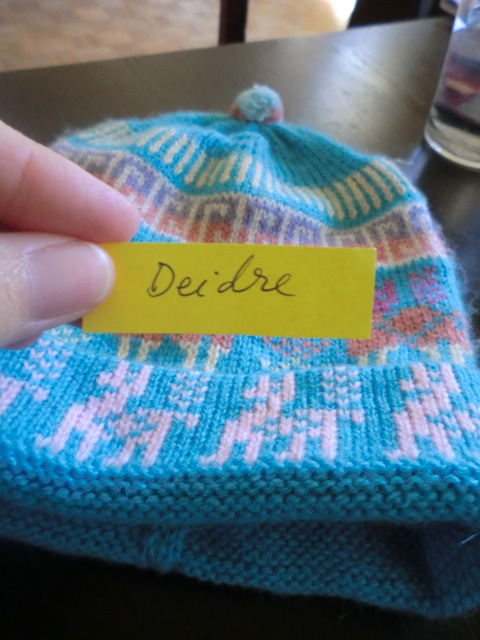
I happen to know Deidre is participating in NaNoWriMo this month and doing very well, with more than 16,000 words written already.  She wrote an excellent post summarising all the research and tips before embarking on this ‘Write a 50,000 word novel in November’ challenge, which you can read here.

She has a great blog which I love reading, especially as she lives here in France as well, so Rebecca will be travelling North and hopefully won’t distract Deidre from her writing endeavour!

Sorry to the other contestants, it was a close call!

Classic Gothic Tale to Give-away

It is thanks to Jo at The Book Jotter that I have now read Rebecca, after she offered copies to readers on World Book Night, one of the conditions being to pass the book on, so what better reason to offer the book as a give-away  If you would like to enter the draw, just make a comment and leave an email address so I can contact you after the draw on Wednesday November 7. You can also assist in selecting the books that will be offered free in the US and the UK for World Book Night 2013 by clicking on the link and nominating your favourite book(s).
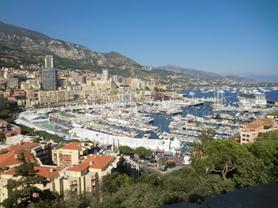
View from the Musée d’Oceanographie, Monaco

As a quiet companion to a wealthy dowager in Monte Carlo, it was hard to imagine how this young woman, who remains unnamed throughout the novel, was going to elevate her station in life by any other means than some chance encounter – and indeed Mrs Van Hopper’s convenient two-week malady provides exactly the opportunity that would likely otherwise never have occurred.

There was nothing for it but to sit in my usual place beside Mrs Van Hopper while she,  like a large,complacent spider, spun her  wide net of tedium about the stranger’s person.

And with the change of location from the calm, sun-filled vistas of Monaco and Italy, we arrive at Manderley, the grand estate of many rooms, corridors, wings, ritual, tradition and an established staff, all haunted by memories, both real and imagined of the previous Mrs de Winter, Rebecca.
Last night I dreamt I went to Manderley again.

In Rebecca, Daphne du Maurier has created an extraordinary character who though never physically present, seems to affect everyone from the dog to the most loyal and disturbing housekeeper, Mrs Danvers to the slightly demented grandmother.

The new bride quickly comes to realise how different she is to her predecessor and perhaps being so young is therefore prone to exaggerated imaginings which add to her feeling of insecurity. All of which does make one wish someone would sit her down for a moment and explain exactly what is what, her sister-in-law comes close, but never quite stays long enough to enlighten her young sister-in-law – although that vivid imagination and neurotic behaviour do add to the suspense and excruciating discomfort of someone who feels most out of place in her new world.

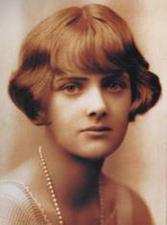
Daphne du Maurier

Du Maurier herself was living in Alexandria at the time she wrote Rebecca and was said to have felt uncomfortable with her life and obligations as the wife of a commanding officer, entertaining other wives while surviving the fierce heat of an Egyptian summer.

Both woman in the novel reflect aspects of du Maurier’s own complex character and the duality of her natural inward inclination versus the more extrovert role she was required to play. No doubt these experiences she was living through on a daily basis continued to feed her imagination and enrich the two female characters who really did seem to have little in common, the author giving away few clues as to why Maxim could have married two such opposite types of women.

Intrigue, tradition, a grand estate, a young naïve protagonist with an over active imagination, all contribute to a fascinating and compelling read – a classic that continues to enthrall readers as much today as it did in 1938 when it was first published, not to mention a Hitchcock film!

Don’t forget to leave a comment and your email address if you would like to enter the draw to receive this copy.

Do you have a Daphne du Maurier favourite?

Summer Reads

I’m not one for compiling lists of what I am going to read ahead of time, because I value too much the freedom and spontaneity of a vast sea of choices each time I finish a book, and often the reading experience will lead me on to the next thing.

Like reading Barbara Kingsolver’s ‘Prodigal Summer’ straight after ‘The Namesake’. How could I know that after listening to the group discussing the book I would have a conversation with a local poet about the beauty of sentences and Jhumpa Lahiri’s essay and that she would tell me I must read Kingsolver’s book.  It was sitting on the shelf unread and thus I abandoned all other reading ideas and jumped straight into it.

100 years on, Titanic Belfast Museum

But I do love looking at the lists, always feeding into the mental TBR list, noting books I might wish to read or to keep an eye out for.

I could say I have intentions for summer, like the two Titanic inspired books I bought on a recent visit to Titanic Belfast, the excellent museum opened in March this year.

‘A Night to Remember’ and ‘And the Band Played On’ also seem appropriate companions to Charlotte Rogan’s ‘The Lifeboat’ which I have on kindle.

To help you decide, I wanted to share this excellent flowchart designed by Teach.com to encourage students to find a book of their choice, there are 101 books shown, inviting readers to consider fiction versus non-fiction, classic or contemporary and many other options.  I keep coming across it and there’s something appealing about viewing images of covers rather than just a list of titles, so enjoy and I hope you find something for your own summer read!


So do you plan your reads or are you open to the spontaneous?
Summer Reading Flowchart

Via Teach.com and USC Rossier Online

The Pearl

I am content as my first foray into the work of John Steinbeck reveals that he too loves a fable, and like the best of them, lets the story speak for itself.

His short novel ‘The Pearl’ is based on a Mexican folk tale about Kino and Juana, a young couple who live a basic existence, their joy of a first baby threatened when it suffers the sting of a scorpion.

Kino is a pearl diver and on the day he most needs a miracle, the discovery of a large pearl appears at first to be the answer to the couple’s prayer. However, its discovery disturbs the community’s tranquil equilibrium, it seems too much to embrace and while it is in their possession, it wreaks only havoc.

There is a sense of inevitability with this kind of tale, we know the pearl is symbolic, and we recognise that desperate grasping, clutch of desire, laced with fear and stalked by paranoia, the fleeting hope it inspires is stifled by the more pervasive greed and jealousy which quickly degenerate into suspicion and violence.

Despite the inevitability, I read with the wilful hope of an optimist, always searching for some altruistic sign, an indication of man’s humanity, the charitable gesture of an honest person. Steinbeck leads us along on this journey, as we develop our own understanding bathing in his glorious prose.

Now Kino’s people had sung of everything that happened or existed. They had made songs to the fishes, to the sea on anger and to the sea in calm, to the light and the dark and the sun and the moon, and the songs were all in Kino and in his people – every song that had ever been made, even the ones that had been forgotten. And as he filled his basket the song was in Kino…

Taking the pearl from its natural habitat changes its symbolism, for in nature it is pure, lustrous, a thing of splendour and inspiration, it represents the transformation of something irritable (the grain of sand) into something of divine beauty (the pearl). But removing it from the sea will corrupt everything that sees, hears of, imagines or touches it; it becomes representative of greed and avarice, the longer it stays in their possession, the greater its destructive power. But will returning it to nature undo its curse?

In addition to this enjoyable story, the book opens with a foreword which reads like a letter from Steinbeck’s wife Elaine. She shares something of the joy of his writing life, his impulsive and creative attempts to construct the perfect writing environment (including building a writing room in the back seat of his Ford Station Wagon) all of which for me, created an almost familiar context from which to begin reading the great man’s work.

Onward to his next oeuvre, Tortilla Flat awaits.