Portrait of a Turkish Family by Irfan Orga

The last of my collection of Turkish literature either brought back from Istanbul or lying on the shelf unread, Portrait of a Turkish Family was hailed as a masterpiece and I have to agree, a timeless classic, capturing a changing way of life as a consequence of war and fire, two of Turkey’s most fearsome destroyers of many families life of peace and tranquility that preceded them.

Orga IrfanIrfan Orga was born in 1908 in Istanbul, his mother only 15 years old, his father 20 and a younger brother Mehmet born two years later. His sharing of the family story really starts at age 5 when he remembers certain events with an amazing clarity, although many memories and conversations are clarified in greater depth later on to him by his mother. His curiosity and gift for eavesdropping apparent early on and perhaps those memories are so clear because life was soon to change dramatically.

By 1913, war was imminent and it was clear that Irfan’s father and only uncle were going to be called up. He sold the family business which hadn’t been doing too well, against his mother’s wishes, before being sent to war, in the hope that there might be something to come back to, a fresh start.

Ottoman uniforms WWI

Imperial Army workshop making uniforms

Once the men left for war, the family, raised and assisted by servants, continued largely in ignorance of what was to come, until food became scarce and their roles began to change.  As time went on, war forced everyone to adapt without realising that life would never again be as it had been before.

As change burrowed permanently into their lives, each would suffer in their own way, the coping mechanism of one often causing suffering in another.  Mother, mother-in-law, and the two boys were forced to move houses, downsizing significantly and rebelling against this change Irfan’s mother ripped the kafes from the windows of the house, insisting on letting the light in.

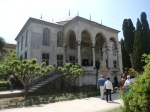
Kafes are the closely latticed harem shutters always used in Ottoman times to prevent passing males from catching glimpses of the women who moved within the house, not so much in evidence today, due to the neglect that makes them a significant fire risk. As back then, even today many families struggle to afford the upkeep required to take care of these houses, thus they crack, peel, rot and deteriorate into an unlivable state, when not consumed by fire first. We were fortunate to see this excellent restored house near Topkapi Palace and its equally neglected counterpart on Heybeliada Island below.

Without giving anything away, because it is so much better to experience the book, Orga captures the events and dramatic turning points of his family life with insight and brutal honesty. It is heart breaking at times, in particular the relationship between the mother and her sons, of which there is more focus than with his younger sister, born later and not always sharing the same experiences as the two boys.

The Orga Family

The Orga Family

Orga left Istanbul in his 30’s after a period in the Air Force to come to England and eventually married his Norman-Irish wife, amid controversy, not least of which it being deemed an illegal act in Turkey at the time, thus apart from one return visit, he was forced to remain living in exile in England.

His son Ateş Orga contributes a heartfelt afterword, sharing something of his father’s life outside the scope of his book, which focuses on those first 30 years of his life in Turkey.

A brilliant read, full of insight into life in a liberal Muslim family at the beginning of the 20th century and their challenges in coping with the effects of war and devastation.

It seems timely to be reading this as contemporary events overshadow historical reflections, provoked by the seizure of one of the last remaining urban parks in central Istanbul, it is being reclaimed to build a shopping mall and the citizens begin to revolt against what they perceive as authoritarian rule.

Ironically, on our last day in the city 2 weeks ago, we tried to find Taksim Square and Gezi Park, but all we found was a corrugated iron fence and a sea of humanity traversing the great shopping street between Taksim and Tunnel. It had been said that you haven’t seen Istanbul if you have not visited this area, but I was at a loss as to what I was supposed to find, all trace of restive beauty hidden and on the verge of replacement.

I am reminded of Pamuk’s Istanbul Memories of a City and the many pages of hüzün, that sense of melancholy that has hung over the city since Ottoman times and can’t help but wonder if the time for silent brooding is erupting into a new age of outspoken demonstration.CIMG4470

And all down the Bosphor, down, down to the Black Sea, ran the tall trees and the old wood houses that suit the skyline so well. If I turned my head to the left there on the hilltop, I could see Dolmabahçe Saray white and artificial as a wedding cake in its peaceful setting. Miniature mosques front the water’s edge and there at the end of all the shining palaces lay Istanbul – my Istanbul that will forever hold something of my heart. Grey it would look from this hill and the smoke from the boats would lie over it like a soft veil and tall and tapering are the minarets that enchant the skyline, and from my hill I would see, being the Mosques, the Marmara like a faint line of thread. Irfan Orga

The Dervish by Frances Kazan

DervishSo what is a dervish you might ask? And why does Frances Kazan use it as her book title?
“Are the Sufis and the dervishes the same?” I asked.

“The two are like the threads on a loom. She replied. “Different colours, varying textures interwoven together to make a single carpet of immeasurable beauty.”

Perhaps it symbolises the unknown aspect, that thing just beyond our rational ideas, the reason we do certain things that can’t be explained. Not quite insanity, but on the way towards it and yet it is also that part of our nature that makes us feel most alive, that promises to make life interesting. When we choose not to indulge it, our lives, in consequence are more predictable, more balanced and much less exciting.

The protagonist of Frances Kazan’s novel Mary is an artist who lives in New York and is looking back on that period in her life just after she became a young widow, her husband was killed in France in WWI in the Battle of the Somme. Restless in New York, she responds to her sister’s invitation to join them in Istanbul where Connie’s husband works for the American consulate. In the last days of her time in Istanbul, the dervish becomes her sole subject to draw and paint, something about these mystical humanists resonating within her psyche and manifesting in her drawings.

220px-Edib_Halide

Halide Edib

The story is set in the dying days of the Ottoman Empire post World War I, the country is occupied by the British which has spawned the establishment of the Turkish Nationalist movement. While the Americans are Allies of the British, they aren’t directly involved and therefore must exercise cautious diplomacy with whom they make friends. They have tentative relations with Turkish nationalists, but political tensions in the city are high and the two sisters have been warned to stay close to the consulate.

Unlike her sister who listens to that advice, Mary refuses to stay behind the protective walls of the embassy; a new city that embraces so many languages and cultures beckons her. These daring excursions result in her becoming witness to the murder by a British officer of the young son of Turkish Nationalist and to her being wanted for questioning by the British Army.

This encounter is a turning point in her visit, after which she befriends the Turkish novelist and feminist political leader Halide Edib Adivar who supported Mustafa Kemal (later Ataturk) in the resistance against the occupation of their country by a foreign power and she will also meet and more than befriend the father of the young man who was killed.

“I was born in the harem, in the same room as my mother and her mother before her. Once upon a time we felt safe within those old walls; I fear we dwelt in illusion.”

Mary’s is with Halide and her husband Dr. Adnan, who has been appointed as Minister of Health in recent elections, when they hear there is to be a coup d’etat, which put them all in danger and forced them to flee. It also resulted in a warrant for Mary’s arrest and set her off on an overland adventure with her friends.

Mustafa Kemal Ataturk

Mustafa Kemal Ataturk

France Kazan has written this story around a subject that is clearly one of her passions in life, the history of the Ottoman Empire and many of the characters are real historical figures themselves. Not just a scholar of Turkish studies and an admirer of Halide Edib, but her late husband the film-maker Elia Kazan, was born in Istanbul. In his book and film by the same title, America America, he tells how, and why, his family left Turkey and moved to America.

It is an entertaining read, not too burdened with political and historical recounting. I found it a little difficult to believe the somewhat complicated relationship between Mary and Mustafa Pasha, and her decision to stay when her sister and husband decided to leave. Perhaps grief makes us less sensitive to risk and more inclined to reckless adventure.

And those whirling dervishes? I will leave the last words to Rumi:

Rumi, the founder of the Mevlevi Order in the 13th century said the dancing dervishes represent the solar system and the planets that revolve around the sun. At the same time that they are immersed in their own microcosmos, they create new worlds and make contact with eternity.

The fact that humans can join the choreography of the cosmos by dancing to its rhythm is an awareness that humanity has had since ancient times. One can say that all dance, in a certain way, is yielding the body to the earth’s movement. Slowly, as the body sways and the blood rhythm changes, consciousness also changes. With the revolution paralleling that of the cosmos, the mind assumes a freedom from the earthly bondage. It would be as though the mind begins to concentrate on the depth of existence on its own, while the body has been given away to the earth.

Note: This book was an Advance Reader Copy (ARC) provided kindly by the publisher via NetGalley.

Patasana: Murder at an Archaeological Dig by Ahmet Ümit tr. Amy Spangler

Patasana

Visiting another country is an opportunity to be introduced to new authors, to read outside one’s preferred genre and to gain new historical perspectives.

So while I am already a fan of the more well-known in the English language writers, Orhan Pamuk and Elif Shafak, Ahmet Ümit was completely unknown to me and while mystery isn’t my preferred genre, a book that introduces us to new places and offers insights into other cultures and their way of life is certainly appealing.

Books from the Basement

I asked in the bookshop in Istanbul for A Memento of Istanbul, another book written by Ahmet Ümit, but it wasn’t available. The only book they had in English by him, had to be retrieved from the basement. I’m not sure if that is significant or not, although having got to the end of the book and knowing the controversy surrounding the treatment of the Armenian population within Turkey, allowing his characters to thrash out their opposing views, may have courted controversy.

In 2012 France tried to make denial of the Armenian Genocide a criminal offence, souring relations between the two countries, however the draft law was struck down.

Review

HIttites
Ancient Hittites

Patasana was the son and grandson of a palace scribe, who wrote his story and that of his father and grandfather onto tablets that were then sealed and are now being uncovered 2700 years later.

Each alternate chapter is a translation of one of the tablets, so while we follow the contemporary story of the archaeological dig of an antique Hittite settlement in southeast Anatolia and it’s team members, we also learn what Patasana lived through, the confessions of a young scribe, his life, love and regrets.

The Hittites

Hittite Chariot
Hittite Chariot

“He was the chief scribe of the palace, a very important government position among the Hittites. These men were extremely well-educated. They knew several languages. Their duty was to compose texts as dictated by the king, not to write down their own feelings, thoughts and memories. But that didn’t keep the scribe Patasana from writing down his own story. That’s why the tablets are so important….We believe what we have here is the earliest documentation of humankind’s non-official history….We think he’s telling the story of the ancient city’s final days. And together with the history of the city, his own personal history as well.”

Unsure whether it is related to the dig or not, a local elder is discovered dead, having fallen, or been pushed from the minaret of the mosque, a man in monks clothes seen fleeing the scene. Esra, the leader of the team is paranoid about upsetting locals and having her first dig cancelled before they have uncovered all the tablets and participated in an important press conference being held to satisfy their funders. Her insistence on knowing everything and getting close to the police captain makes her just as suspicious as virtually every character who at one time or other she imagines as a suspect.

Euphrates River, Anatolia

Whilst it could have done with some editing down, it is an enjoyable and I believe popular book.

It is interesting that the author was born in Gaziantep, southern Antolia and while on a family picnic near the Euphrates River saw an excavation site, an old Hittite city, prompting him to immerse himself in researching the area, its people and customs and then write this book.

Ahmet Ümit, Author

Ahmet Ümit himself sounds like an interesting character straight from a novel and it is clear that his own life has inspired many of the stories and characters he has written. As a young man he was a revolutionary political activist and a member of the Turkish Communist Party and he illegally attended the Academy for Social Science for a while in Moscow.

In an interview with Maria Eliades in Time Out Istanbul in 2011 he said:

“In this land, there’s a problem with history. The Turks came here 1,000 years ago but the land has a history that is 200,000 years old. Generally, the government believes that history began 1,000 years ago. They do not count the history of people who were not Muslim. In my novels, I’m trying to show how these people influenced the history and where their position was. I’m trying to emphasize how the Hittites, the Romans, the Byzantines, the Armenians, Greeks and all the different groups affected it. Turkey needs this: an independent view of people, regardless of their race or religion. That’s the basis of my books. The detective part of the story is a catalyst for explaining the untold part of the stories.”

Istanbul Memories of a City by Orhan Pamuk

IstanbulAlthough I carried the book  to Istanbul and back, there was no inclination to read it while I was there, I started it on the return plane journey, the appropriate occasion to do so, for Pamuk’s Istanbul is laced with more melancholy than the city I visited and I realise with hindsight, the importance of constructing my own unfettered impressions, free of this philosophical consequence of the decline of a grand empire and the inclination of its progeny to feel somewhat bereft at missing out on an era when their prominence was that much greater than it is today.

However, I remain as intrigued about the author now as I did before I started the book, it is a unique form of memoir, more of a nostalgia trip through selective memories of his childhood and his city, sharing anecdotes from both that formed him into the writer he is today.

The imagination features large in Pamuk’s  life from a very young age, when he was five-years-old he was sent to stay with an Aunt on his own and she used to point at a picture of a child and say it was him. He came to know him as the other Orhan and while he knew it was not him, this shadow of himself never left him behind. Neither did he ever leave the city of Istanbul in the fifty years up to writing this book.

CIMG4275“But the ghost of the other Orhan in another house somewhere in Istanbul never left me. Throughout my childhood and well into adolescence, he haunted my thoughts.”

Though he never left the city, he read many works by writers and poets who published impressions of Istanbul, Gustave Flaubert, the poet Gérard de Nerval, Théophile Gautier, Pierre Loti, Edmondo de Amici and laments that in the same period they were writing about the city,  little was written or painted by its own artists and writers, therefore, whilst the work of others is familiar, it remains an outsiders perspective and does not quite capture the essence of how the Istanbullus see themselves.

Pamuk often visualises the city in black and white and throughout the book on nearly every page are photographs depicting the city in monochrome. He spends an entire chapter describing Hüzün, the Turkish word for melancholy explaining how if differs from sadness and finishes by almost convincing the reader that it is something close to a virtue, absorbed with pride and shared by a community.

“the hüzün of Istanbul is not just the mood evoked by its music and its poetry, it is a way of looking at life that implicates us all, not only a spiritual state, but a state of mind that is ultimately as life affirming as it is negating.”

“… hüzün brings us comfort, softening the view like the condensation on a window when a tea kettle has been spouting steam on a winter’s day.”

CIMG4331

Entrance to the Grand Bazaar

I did not come to Istanbul expecting to see sultans, dervishes or crystal chandeliers, though there are traces of them all if you seek them out. I came to see a city that comfortably exists while straddling two sides of a significant divide.

Bosphorus

The Bosphorus with the Castles of Europe and Asia by Thomas Allum

The Bosphorus, that deep channel of powerful surging water and current that separates two continents is deceiving. The reasonably short distance from one side to the other, only 2 to 3 kilometres, the fact that it embraces one city reminds us that there is less than we might think between the people who inhabit each continent.

A deep and powerful separation of continents, yet humanity passes across it with ease. Great divides can indeed be overcome.  The streets of shops and the Grand Bazaar attest to that passage of traders and pilgrims who have entered and passed through the city over hundreds of years.

It takes until the very last chapter before we meet the more mature Orhan who will become a writer, because unlike many born to write, his first love was painting and he shares much through his observation and study of artists who painted his city, something he practiced prolifically in his youth. The demise of this early calling occurred not long after his teenage muse was packed off by her family to Switzerland, his mother’s relentless cautions against pursuing the life of an artist transforming his rebellion against completing his architectural studies into announcing:

“I don’t want to be an artist.” I said. “I am going to be a writer.”

CIMG4495

“I was, as I had begun to discover even then, the sort who could always wear the same clothes and eat the same things and go for a hundred years without getting bored so long as I could entertain wild dreams in the privacy of my imagination.”

A treat for admirers of Orhan Pamuk’s work and those who have had the good fortune to visit his wonderful city, which is not nearly as melancholic to the visitor as it is to a philosophical resident.

Next up, murder at an archaeological dig! Time to leave Istanbul and travel inland with Ahmet Umit.

Ottoman Distractions

Sultanahmet (Blue Mosque)

Sultanahmet (Blue Mosque)

Greetings from a vibrant and bustling Istanbul.

There is too much opportunity to observe, appreciate, participate and marvel at this wonderful city situated where Europe meets Asia and where on every corner there lies evidence of humanity’s incredible vision going back many hundreds and thousands of years, one must put down the books and just dwell in its presence.

So no update on reading, though I do have some reading related pictures to share and I have bought two books to add to my Turkish literature collection. Not far from Sultanahmet (the Blue Mosque) is a bookshop with an enticing window showing off its collection of English translated works, works by Turkish authors written in English and any writer, whose work focuses on the area.

The owner’s brother was quick to recommend Louis de Bernières Birds Without Wings, which I told him was already in my top all-time favourite reads and of course Elif Shafak and Orhan Pamuk’s works are all there.

Portrait of a FamilyHe then handed me Portrait of a Turkish Family and promised with stalwart confidence that this little masterpiece would replace my current favourite. Sales-speak or the truth, I shall soon find out.

PatasanaI was actually looking for a copy of A Memento of Istanbul, by Ahmet Ümit, a writer I have not read before, master of the Turkish thriller and after Turkey’s profile at the London Book Fair, watch out for more from this author. I was interested in this particular book as it is said to highlight seven significant attractions introducing something of the city’s rich culture and history. They only had one book left in English by this writer, Patasana, so A Memento can wait, this is where I shall start. Thrilled already!

Istanbul is a fabulous city to visit and the children and I have totally fallen for the historic part of town. I am sure we will be back and would recommend it to you all if you ever have the opportunity to visit.

Some of the highlights:

The Burgess Boys by Elizabeth Strout

Like many readers, having enjoyed Olive Kitteridge, Strout’s previous book that won a Pulitzer Prize in 2009, I was looking forward to reading her next work. Rather than referencing Olive Kitteridge, which this book has very little in common with, The Burgess Boys arguably has more connections with Strout’s own life, growing up in small towns in Maine, studying law and moving to New York city.

The Burgess BoysJim and Bob Burgess also have little in common except that they both studied law and moved to New York, one achieving notoriety, the other not. Their younger sister Susan never left Shirley Falls, Maine; they are now all late middle age, the trajectory of their lives influenced early on in childhood when Bob(4) and Jim(8) witnessed the death of their father as the car they were in, with their younger sister in the back, rolled forward down the family driveway and killed him.

Two thirds of his family had not escaped, this is what Bob thought. He and Susan – which included her kid – were doomed from the day their father died.

The two boys leave their hometown to pursue careers in New York city and have little to do with their sister, until a thoughtless act by her teenage son Zach, lands him in trouble with the police and the law and looks set to incite racial tension among the citizens of Shirley Falls and their Somali immigrant community.

He thought of all the people in the world who felt they’d been saved by a city. He was one of them. Whatever darkness leaked its way in, there were always lights on in different windows here, each light like a gentle touch on his shoulder saying, Whatever is happening, Bob Burgess, you are never alone.

Prior to the family drama Jim’s star was in the ascendant, he could do no wrong, however an indulged ego wins few favours long term and his good fortune risks changing course.

It is a story of family ties, separation, isolation, of fear and its consequence and the challenges of an evolving community, how newcomers don’t always bring out the best in their hosts, requiring as they do, new understanding and acceptance.

It was an uncomfortable start for me I admit, taking on a story that portrays a small town’s varying and little embracing of an immigrant community and the committing of a disrespectful act against it’s religious beliefs is fraught with danger in itself. Topical perhaps, but difficult to accurately or sufficiently portray balanced points of view.

Somali USStrout presents the family dilemma and while giving them an audible voice, keeps somewhat at a distance from the community Zach Burgess has upset, though at least she does not go so far as to incite the aggrieved community to inflame their response. But the story lacks something for having touched on a community in such an indignant way and failing to give them much of a voice,  the one exception stretching the imagination in authenticity a little too far.

Abdikarim, who had attended only because one of Haweeya’s sons came running to get him, saying his parents insisted he come to the park, had been puzzled by what he saw: so many people smiling at him. To look him straight in the face and smile felt to Abdikarim to display an intimacy he was not comfortable with. But he had been here long enough to know it was the way Americans were, like large children, and these large children in the park were very nice.

Not knowing much about Somali immigration to the US, I found these two articles helpful, particularly the former in it’s comparison between US and European immigrants.

What Makes Somali’s So Different? – an interesting article by Michael Scott Moore on the subject of Somali immigrants to the US.

A ray of hope – Somalia’s Future – an analysis by The Economist in Feb 2012 on the future within Somalia itself.

Note: This book was an Advance Reader Copy (ARC) provided kindly by the publisher via NetGalley.

Me Before You Giveaway

It’s the week for giveaways!

me b4 youThe publisher Penguin is kindly offering a printed copy of Jojo Moyes Me For You to readers based in the US.

If you haven’t read the review, click here.

*

Just leave a comment below to let me know if you are interested in participating.

And if you are interested in Niki Tulk’s Shadows & Wings, click here to read the review and enter the draw.

I will announce the recipients of both giveaways at the end of the week.

Me Before You by Jojo Moyes

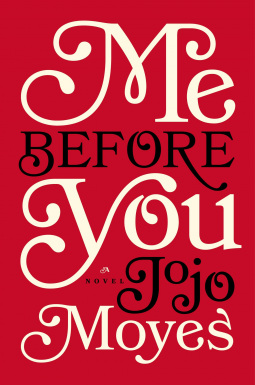
Me Before You US cover

Me Before You US cover

We can’t always judge a book by its cover, but when we do, it’s more likely that we are actually guessing a publishers intention, as they surely are well aware of the stereotypes they buy into when choosing one cover over another.

It’s something I discussed in the review of Elif Shafak’s Honour, a book I was put off reading initially and then tempted again when I saw the US cover. You only have to put a number of books of the same genre together side by side to witness a flash of recognition that it is a certain type of book or genre.

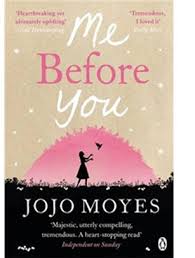
Me Before You UK cover

Me Before You UK cover

The UK cover of Me Before You suggests to me popular, light fiction, something I generally only turn to on holiday or when unable to find my reading mojo. Otherwise my reading inclination steers me towards something that might offer a unique use of language, new words, creative metaphor, unique structure, insight into a foreign culture or hopefully, evoking that elusive transporting magical sense,  something not easy to describe but utter bliss to experience.

So what about the US cover? I think it suggests that readers are already familiar with the author, it’s a bold confident move to use only text.

Maya Angelou’s recent autobiography that I read earlier this month Mom & Me & Mom had a similar text only cover (US version), and one can understand why she is beyond needing to lure readers through an enticing cover. Does this suggest that Jojo Moyes is more of a household name in the US perhaps?

Ultimately I chose to read Me Before You in order not to read too narrowly and because I am sure there will be many people who will be interested to learn more about this much talked about gripping novel.

Lou has worked in the same job for six years serving locals in a café and is more than content with her small life and daily ritual. Things change when her boss closes the café and moves away. Unable to find a suitable job she settles for a six month contract as a companion to Will, a 35-year-old quadriplegic with a number of issues since his accident almost two years previously.

Lou and Will are people who paths would not normally have crossed had they not reached such turning points in their lives concurrently and the six months they spend in each other’s company will allow them both to experience something unique and life-affirming. Well almost.

“Don’t you think it’s actually harder for you…to adapt, I mean? Because you’ve done all that stuff?

“Are you asking me if I wish I’d never done it?

“I’m just wondering if it would have been easier for you. If you’d led a smaller life. To live like this, I mean.”

“I will never, ever regret the things I’ve done. Because most days, if you’re stuck in one of these, all you have are the places in your memory that you can go to.”

It is difficult to say much about the plot without giving it away, however it is unputdownable read once started, both characters are in some way stuck and need something or someone in their lives to move them on from where they are currently.

Will’s issues are clear, though he is a stubborn, somewhat arrogant patient and Lou seems only to be sticking it out because she has to work to support her parents (her Dad has lost his job), her younger sister has a young child out of wedlock and the alternative employment for Lou would have been in some kind of vile chicken factory. Meanwhile her ever distant boyfriend of six years has become obsessed with training for the Xtreme Viking triathlon and shows signs of becoming jealous of a quadriplegic.

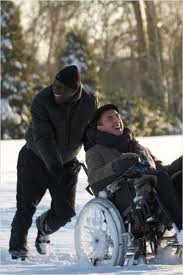
IntouchablesIf you’ve seen the excellent French film Intouchables which was a worldwide hit in 2012, knocking the popular Amelie off its pedestal for most successful French film, and is now to be remade in Hollywood (not enough Americans saw the subtitled version, the US accountable for only $13 million of the $440 million it has made so far) then you may also enjoy Me Before You.

And if you haven’t seen Intouchables, based on a true story, then make sure you see it in the original French version, before it gets done over Hollywood style! It’s brilliant.

Intouchables1The Intouchables – click to watch the trailer (make link)

Me Before You Giveaway – click to enter the giveaway (US residents only)

Note: This book was an ARC (Advance Reader Copy) provided by the publisher via NetGalley.

Shadows & Wings Giveaway

Niki_Tulk_ShadowsAndWings

Niki Tulk
Author of Shadows & Wings

Thank you to author Niki Tulk for offering to provide two readers with a digital version of her debut novel Shadows & Wings.

Synopsis:

Tomas, a cellist and dreamer, denies the devastating changes happening in 1930’s Germany—until he is drafted into Hitler’s Wehrmacht. Many years later, having emigrated to Australia, he raises his granddaughter Lara to love music and birds. He also chooses to hide from her a terrible secret.

When her beloved Opa dies, 22 year-old Lara receives a shadow box of mysterious ornaments that force her to confront his past. Seeking to understand his years of silence, and to find a way through her own grief, she travels to Germany—the objects her only guide.

Shadows & WingsShadows & Wings is a novel of cyclic journeys between hemispheres, the connections between ourselves and those we can never know, and the haunting power of art, love and dreams.

*

If you haven’t seen my review, click here to read it.

If you would like to be in the draw for one of the two digital copies, please leave a comment below.

The draw closes on Saturday 4th May.

Women’s Prize for Fiction Shortlist & Pulitzer Prize 2013

Womens prize logoThe long-list becomes the short-list and it looks like a strong line-up for the Women’s Prize for Fiction 2013. Here is the short list:

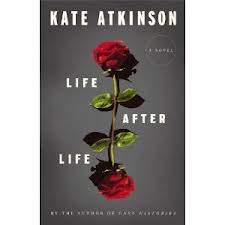
Kate Atkinson Life After Life – my review here

A M Homes May We Be Forgiven

Barbara Kingsolver Flight Behaviour

Hilary Mantel Bring Up the Bodies

Maria Semple Where’d You Go, Bernadette

Zadie Smith NW – my review here

Flight Behaviour (2) NW life after life

Here’s what Miranda Johnson, Chair of the Judges had to say:

‘The task of reducing the list of submissions from over 140 to just 20 books was always going to be daunting, but this year’s infinite variety has made the task even trickier. The list we have ended up with is, we believe, truly representative of that diversity of style, content and provenance, and contains those works which genuinely inspired the most excitement and passion amongst the judges. I don’t anticipate the job becoming easier at the next stage!’

I have managed to read two that made it through, plus others from the long list including Honour, Ignorance and The Light Between Oceans. I am currently slow-reading Barbara Kingsolver’s Flight Behaviour, she won the prize in 2010 with The Lacuna, one of the first books I reviewed here. Zadie Smith is also a previous winner, her book On Beauty won in 2006.

I was sure that Atkinson and Smith would make the list, not only because the stories are engaging, but because they dare to step outside the ordinary and test the boundaries of convention, Life After Life likely to be a more popular read, but both deserving their place here.

I know many will be surprised yet delighted to see Maria Semple’s Where’s You Go Bernadette on the list and of course the inevitable Hilary Mantel, no surprise there. Will anyone be able to knock her off her current perch I wonder?

The winner will be announced at a ceremony at the Royal Festival Hall, London on 5 June.

The Guardian – Women’s prize for fiction reveals ‘staggeringly strong’ shortlist

Pulitzer Prizepulitzer

Amid the terrible news that saddened and horrified us all in Boston yesterday, a day that should have been cause for calm celebration, the annual Pulitzer Prizes for 2013 were quietly announced.

The Snow Child was one of the three finalists for the fiction prize, the winner was The Orphan Master’s Son by Adam Johnson, a timely journey in the heart of North Korea.

It was good to see a non-fiction title I enjoyed and recommended last year Tom Reiss’s Black Count: Glory, Revolution, Betrayal, and the Real Count of Monte Cristo win the biography prize. My review here.