Top Five Uplifting Fiction

Finding Uplifting Fiction that isn’t genre specific like Romance or ChickLit is quite difficult. Since you’re unlikely to have these on your shelves, I’m  including a link to a longer Goodreads List described also described as Uplifting:

When you close these books you feel happy to be alive, secure that life is worth living, and motivated to get out there and live an awesome life.

Some of these books may deal with the dark side of life, but they still convey that overall it is good to be alive and leave you feeling uplifted.

GoodReads Top 100 Uplifting Fiction

A lot of the books on their list are children’s classics or novels by familiar authors such as Jane Austen and Elisabeth Von Arnim (I’ve read Elizabeth & Her German Garden and The Enchanted April); others are more contemporary and were popular when they were published like The Guernsey Literary and Potato Peel Society, The Life of Pi, The Secret Life of Bees, The Goldfinch, The Shipping News, The Unlikely Pilgrimage of Harold Fry, A Short History of Tractors in Ukrainian and Eleanor Oliphant is Completely Fine.

None of my choices are on that list, but these five below are my personal favourites.

Top Five Uplifting Fiction

1. Two Old Women by Velma Wallis

Inspired by an Alaskan legend, this is a wonderful short read featuring the original inhabitants of the interior of Alaska; nomads they moved about in search of food according to the weather.

During a particularly harsh winter the group makes a decision regarding the two old women, which results in a sudden change in their attitudes and demands that they recall and put into practice everything they have learned over their long lives. It’s a wonderful, inspiring story, an ode to the importance of sharing experiences through friendship and community and a warning against complacency.

2. Their Eyes Were Watching God by Zora Neale Hurston

This book is a modern classic in America, so I expected it to be a slower read than usual, but I was totally hooked right from its opening pages.

Not only is it a compelling story of a woman’s search for fulfillment, it is an elevating study of character and consciousness emphasized by the use of dialect that draws the reader into the narrative as if it’s being read to you. A unique and exciting reading experience once you get into the rhythm of it.

3. The President’s Hat by Antoine Laurain

Antoine Laurain is a French author who writes whimsical, humorous novellas and this was the first translated into English. They’re a guaranteed light, uplifting read. The President’s Hat is about what happens when President Mitterand leaves his hat behind in a restaurant and someone else picks it up. That person too leaves it behind, and so on, it is a nod to the nostalgia of Parisian life told as a kind of fairy tale, with its connection to a revered hat-wearing President of the 1980’s, whom Laurain describes as being like a noble Florentine Prince. Also inspired by the loss of a much loved hat and an active imagination!

His other books are similarly uplifting, The Red Notebook, Vintage 1954, or the slightly darker Smoking Kills.

4. The Woman Next Door by Yewande Omotoso

This is a wonderful story of octogenarian neighbours Hortensia and Marion, living in a suburb in Cape Town, South Africa. They’ve both had successful lives, run their own businesses and are on the same neighbourhood committee, but their similarities act as a reason to divide them rather than support each other. One day an unforeseen event forces the women together. Could this long-held mutual loathing transform into friendship?  Is it really possible to love thy neighbour? Easier said than done.

It’s a story that reminds me a little of A Man Called Ove, except I didn’t like Ove and wouldn’t put that book on my list, but this one definitely, these two are far more interesting to hang out with than Ove ever was! And this novel was nominated for the Women’s Prize for Fiction in 2017, a worthy contender in my opinion.

5. The Italian Chapel by Philip Paris

Inspired by a true story, this is a tale of Italian prisoners of war, transported from the North African desert to the freezing cold of Orkney, (an archipelago off the northeastern coast of Scotland), at the beginning of winter 1942.

In a testament to the wonders of the human spirit, despite insufferable conditions they build a chapel, one of the most enduring icons of hope and peace to come out of WWII.

The novel introduces us to key characters and imagines them achieving this incredible feat. It is a story of optimism, resourcefulness and the things men do to keep their spirits up when the circumstances are against them. An easy, light read, moving without being overly sentimental, knowing this wonderful refuge still exists today makes it all the more special.

Philip Paris has also written a non-fiction account of the true story behind the chapel. Orkney’s Italian Chapel: The True Story of an Icon. In my review he wrote a comment, saying that he and his wife had returned for the 70th anniversary of the chapel’s completion and met up with several family members of the key artists who built the chapel, as well as 94 year old Gino Caprara, an ex Orkney POW who travelled from Italy for the event. There were many tears shed during those few days together.

Further Reading Lists

Top Five on MyTBR

Top Five Spiritual Well-Being Reads

Top Five Nature Inspired Reads

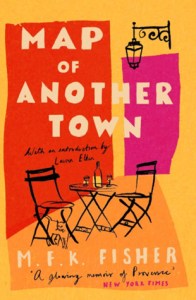
Map of Another Town by M.F.K. Fisher

Essays on Aix en Provence

While I usually steer clear of memoirs set in France, M.F.K.Fisher (1908-1992) is a writer I’ve long intended to read. She was an American nonfiction writer whose wrote about food, considering it from many aspects: preparation, natural history, culture, and philosophy.

Since no-one can visit Aix-en-Provence right now, here is another way to visit the town, through the imagination and evocative style of this talented writer, a specialist in evoking the senses.

Fisher lived in Dijon for a few years as a young bride, but now it is 1954 and she is a widow with two young daughters spending a year in Aix-en-Provence at a time when France is still reeling from the effect of the second world war. Fisher too is recovering from raw emotional wounds.

While being in Aix makes her feel alive, a sense of frustration seeps through the pages as she describes feeling largely invisible and worse, looked down upon.

She is keenly aware that the grand dames consider her an ‘outlander’, an emissary from a graceless, culture-less people.

Living here has given her a thick skin, a confidence and an extra sense with which to navigate the world.

Over the years I have taught myself, and have been taught, to be a stranger. A stranger usually has the normal five senses, perhaps especially so, ready to protect and nourish him.

Then there are the extra senses that function only in the subconsciousness. These are perhaps a stranger’s best allies, the ones that stay on and grow stronger as time passes and immediacy dwindles.

It is with these senses that she creates her map of the town, Aix-en-Provence.

Le Cours Mirabeau

She finds just the right words to describe the near indescribable, whether it’s the cafes, the main street or the people, and though all of the characters she writes about have long gone, the edifices remain and it is easy to imagine how this place we live in was back when she inhabited it. In reality, little has changed, except that today it is a ghost town.

After reading the initial chapters, I stopped reading for a couple of months just after the chapters The Gypsy Way and The Foreigner, which were somewhat xenophobic. Then I picked this up again and was relieved to find the next essays as delightful as the debut and way more humorous. I found that Fisher was more entertaining when observing herself than she was observing others.

My favourite essay ‘A Familiar’ didn’t even take place in Aix, it’s a stream-of-consciousness narrative of six hours spent in the train station of Lucerne after being sold a ticket for a non-existent train. Refusing to allow herself to venture outside, she orders a vermouth-gin in the station restaurant to ease her awkwardness.

I would have liked to order at least two more,  but although I had to laugh at myself I was afraid that the maid, already somewhat alarmed at my ordering such a potion … a woman alone … would report me to the police who must be somewhere handy in the enormous station.

And in the essay ‘The Unwritten Books’, she visits a cake shop, asking the pastry chef to make a cake, one drawn by her young daughter, a cross cultural hilarity, not to mention the proprietors constant refusal to hear her other request, to provide her with a calendar of culinary events, for which there is only ever one reply, an(other) invitation to visit the calisson factory? Priceless!

A must read certainly if you know and love Aix-en-Provence, this is an outsiders insight into the old city, one who has fallen for its charm, cursed by her inability to meld completely into it. Humorous in some parts, cringworthy in others, overall a delight and superbly descriptive.

This new edition with an introduction by Lauren Elkin, was re-released in 2019 by Daunt Books. Thank you to the publisher for sending me a review copy.

Top Five Nature Inspired Reads

Nature Inspiration

Welcome back to my Reading Lists for Total Confinement. Today I’m sharing my Top Five Nature Inspired reads.

It’s not winter, however we are in period of hibernation and just as bees pollinate flowers, somehow we humans are spreading a virus around the world.

Without pollination, plants cannot create seeds. For now, it’s difficult to see what good will bloom from Covid-19 but lets hope something positive will come from what we learn in solitude and while locked in lets hope the bees can get on and do their job out there.

When it’s too cold to be out in nature or when I feel like a break from the books I’ve been reading, I love to read compelling nature essays or stories inspired by nature. A form of quiet escapism, they are a unique appreciation of nature.

The choices below are a mix of essays, fiction, memoir and poetry. If you like the sound of a book, click on the title to read my review.

Top Five Nature Inspired Reads

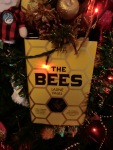
1. The Bees by Lalline Paul

I’m starting with a novel, because this was an incredible feat of the imagination as well as being a compelling read. It’s the story of The Hive narrated by Flora 717, a worker bee. Flora is a lowly sanitation bee and we meet her as she is becoming aware of her surroundings and the hierarchy within which she lives.

Not only was the author inspired by bees, but she models the fictional landscape of The Hive on a Bronze Age Minoan Palace. Stunning, I was completely bowled over by this story. A thrilling read!

2. Under The Sea Wind by Rachel Carson
Many know Rachel Carson for her groundbreaking work Silent Spring that launched the environmental movement and brought about revolutionary changes in laws governing air, land and water use.

But Carson’s own personal favourite and a book I absolutely loved was her debut Under the Sea-Wind. I’d read a few excellent creative non-fiction nature titles and was wondering whether anyone had written in a similar lyrical way about the sea. And here it is, the masterpiece, what a unique and incredible insight she gives of it.

Divided into three parts,  it’s written from the perspective of three creatures she knew well (she was a zoologist), Part One is the life of the seashore, seen through the eyes of a sanderling she names Silverbar; in Part Two we experience the ocean with Scomber the mackerel, and Part Three takes us into the deep dark, fathoms, following Anguilla the eel out of a river into the Sargasso Sea. Absolutely inspired, informative, stunning.

3. The Turquoise Ledge Leslie Marmon Silko

I had to include this here even though I’m doing a separate list about Memoirs, because it was such a fascinating read and introduction to the Arizona desert and its wildlife. The way Silko talks about the rattlesnakes that inhabit her property will almost convince you that under similar circumstances we too might live harmoniously with these creatures!

Alongside the critters, she recalls ancestral Laguna stories of her childhood, talks of Star Beings, collects turquoise rocks in the arroyo (dry creek bed) and shares her fascination with the Nahua people, their language and Tlaloc, the Nahua God of Rain to whom she occasionally chants her own rain prayer.

I discovered it the same way I found Under the Sea-Wind, this time I was looking for a creative non-fiction title set in the desert near Tuscon; I found this stunning memoir and snapped it up straight away.

Silko too is an author many know for her bestselling novel Ceremony, I enjoyed Gardens in the Dunes and the slim collections of letters with poet James Wright The Delicacy & Strength of Lace. Yes, I was hooked and read whatever I could get my hands on after reading her inspired memoir. Fortunately I still have Storyteller and Yellow Woman and a Beauty of the Spirit on my shelf.

4. When Women Were Birds, Fifty Four Variations on Voice by Terry Tempest Williams

Terry Tempest Williams wrote Refuge: An Unnatural History of Family and Place in 1991 about a personal loss and the dangers confronting Great Salt Lake. Twenty years later, now 54 years old, she was the age her mother attained when she departed this world and thus reflects anew on life, as a woman, a conservationist and activist in another arresting memoir.

Referring to ancient crow etchings of women in China that were read by women she thinks of her own bird marking, a scar above the eye made by a falcon on a river trip. She speaks of the Mormon tradition of keeping journals, of a gift her mother left her, the collection of carefully preserved, beautiful cloth bound journals and the shock of what she finds within their pages. This is one you’ll want to slow read, to ponder, cherish, and even re-read.

5. A Thousand Mornings by Mary Oliver

And to finish a short collection of poetry from Pulitzer Prize winning poet Mary Oliver who passed away in January 2019. Her poetry oscillates between the natural world and worldly experiences and in this collection she goes down to the shore, dances for joy, falls downs the stairs of the Golden Temple on a trip to India and in my favourite of the collection lets us know, as if she too has been told to self-isolate, that she has accepted her fate.

I HAVE DECIDED

I have decided to find myself a home
in the mountains, somewhere high up
where one learns to live peacefully in
the cold and the silence. It’s said that
in such a place certain revelations may
be discovered. That what the spirit
reaches for may be eventually felt, if not
exactly understood. Slowly, no doubt. I’m
not talking about a vacation.

Of course, at the same time I mean to
stay exactly where I am.

Are you following me?

Do you have a favourite nature-inspired read to share?

Further Reading Lists Featured

My Top 5 TBR

My Top 5 Spiritual Well-Being

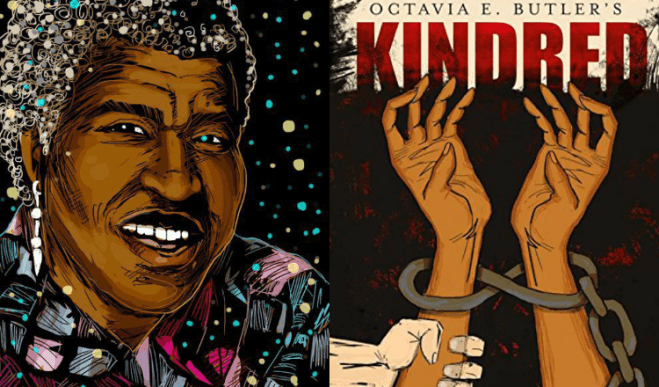
Kindred by Octavia E.Butler

I have been wanting to read Octavia E. Butler for some time, she was one of the most well-known African-American science fiction writers, with a reputation akin to the likes of Alice Walker, Toni Morrison, Maya Angelou who sadly passed away at the age of 58 in 2006.

I guess it was the science-fiction label that stopped me reading her until now, having read Kindred her best-known work, I understand why Butler refers to this particular novel not as science fiction, but fantasy. She uses that element of fantasy to transport a character back to that historical period.

The novel begins with a shocking revelation, that immediately puts the reader on guard. After reading the first line, I was ready for something brutal to occur. It did, but not what I expected.

I lost an arm on my last trip home. My left arm.

It is 1976 and Dana is remembering everything that happened leading up to that moment. She is a Black woman writer married to a white man, a writer named Kevin. On her 26th birthday, something strange happens, she feels dizzy and nauseated, the room blurs and darkens around her, symptoms she will come to recognise with horror, signalling she is about to be transported back in time.

I was at the edge of a woods. Before me was a wide tranquil river, and near the middle of that river was a child splashing, screaming …

Drowning!

The child is Rufus, it is 1815 in Maryland and Dana has time-travelled (without explanation) to an era where her liberties are severely constrained, to save the life of an ancestor. She must try and survive while she is there and figure out how to return to her own life. Until the next time his life is danger and she is called back again.

It’s a riveting account, putting a modern woman into an era where her attitude, education and way of being in the world are a danger to herself. It reminded me of Andrea Levy’s story of slavery in the Jamaican plantations Long Song both writer’s had a similar objective, to get inside the world of their ancestors, to imagine those voices that hadn’t been able to record their perspectives and feelings.
Levy looks at slavery through the eyes of a slave and does so with both humour and distaste. Butler transports a modern women, someone like her in fact, back in time, and makes us feel what life was like in 1815, showing us how someone from our own time might cope if sent back there, knowing what we know now. It’s an interesting predicament.

The longer Dana stays, the more she begins to feel part of the household, familiar and accepting.

That disturbed me too when I thought about it. How easily we seemed to acclimatize. Not that I wanted us to have trouble, but it seemed as though we should have had a harder time adjusting to this particular segment of history – adjusting to our places  in the householder of a slaveholder.

Rufus is the son of the plantation owner, the person Dana is connected to, as he ages and becomes more like his father, she struggles to rationalise her feelings towards him.

I looked at him again and let myself understand. It was that destructive single-minded love of his. He loved me. Not the way he loved Alice, thank God. He didn’t seem to want to sleep with me. But he wanted me around – someone to talk to, someone who would listen to him and care what he said, care about him.

And I did. However little sense it made, I cared. I must have. I kept forgiving him for things…

It’s a thought-provoking novel that uses that element of fantasy to place a woman of the 1970’s into the 1800’s to look at that life and legacy from the inside out. We can imagine how that would have stretched the imagination of the author and the challenges that created for her, grappling with what she discovered there, with what she was becoming aware of.

Highly recommended.

Top Five Spiritual Well-Being Books

Well-Being Inspiration

Welcome to today’s new list, my top five spiritual well-being reads . This is Day 2 in my series of Reading Lists for this period of total confinement. Yesterday I shared the Top 5 Reads on My TBR.

There is a tab above with links to more authors and books in this category and a short intro to the author and what they specialise in.

Many of my suggestions are Hay House authors. Hay House is a publishing company founded in 1984 by Louise Hay when she was 58 years old. In the 1970’s she wrote a pamphlet known as ‘Heal Your Body’ which later became the bestselling book ‘You Can Heal Your Life’.

I have an affinity for Hay House authors as I often listen to their free radio HayHouseRadio.com when I’m cooking dinner. Many authors have a weekly radio show where they interview interesting people and invite callers to ask questions. Ordinary and extraordinary life questions that receive spiritually enlightened answers from what I perceive as pretty grounded, high functioning empathetic teachers, with open-minded perspectives on the Divine.

Top Five Spiritual Well-Being Books

1. Raise Your Vibration by Kyle Gray

I came across Kyle Gray thanks to Christiane Northrup, a protégé of Louise Hay, she invited him to present at an I Can Do It event (gatherings of kindred souls to share similar experiences, expand awareness and reach higher levels of consciousness) when he was 22-years-old. It’s so heart-warming to see a young man inspiring so many in such a grounded, reassuring and confident way.

Raise Your Vibration is the perfect bedside read and daily practice. Vibration is a similar term to energy, we all vibrate energetically at a particular frequency. The lower the frequency, the denser your energy, and the heavier your problems seem. The higher the frequency of your energy or vibration, the lighter you feel in your physical, emotional, and mental bodies. We experience greater personal power, clarity, peace, love, and joy. You have little, if any, discomfort or pain in your physical body, and your emotions are easily dealt with.

Kyle refers to his practices as vibes. So raising our vibe is good. It’s not necessary to read more than one per day and we benefit more by doing this as often the day will show us something that relates to what we’ve read. I loved this book because it opens us up to serendipitous events and makes us more aware of them. It’s informative, uplifting and can be life changing.

2. Making Life Easy: A Simple Guide to a Divinely Inspired Life by Christiane Northrup

Christiane Northrup is great. A woman with a foot in both camps, a medical doctor, OB/GYN physician who specialises in women’s wellness and has published lots of health related books (with terribly unappealing covers) I’ve never read on menopause, physical and emotional health & healing, ageing, mother-daughter genetic health legacies and more.

I had heard her often on the radio but only began to read her after she wrote Making Life Easy, the book in which she “comes out of the spiritual closet” and shares many of the alternative, more spiritual practices that have guided her through the years.

3. The Four Insights – Wisdom, Power and Grace of the Earthkeepers by Alberto Villoldo

I came across Alberto via Colette Baron-Reid, they have worked together and produced a Mystical Shaman Oracle deck, which is a great way to learn about this ancient wisdom, Alberto writes wonderful books which really help deepen one’s knowledge. A medical anthropologist who thought he knew a lot (PhD’s etc), he spent years investigated the effects of energy healing on blood and brain chemistry and spent years in the company of shamans, a humbling experience that changed the course of his life and views. He writes with simplicity and gives examples from his own experience as well as those of clients.

The Four Insights is an excellent introduction to this ancient wisdom and energy medicine, explaining the four levels of perception with suggestions as to how we can how we can alter our own reality, by shifting perception into a higher realm. It is a pre-requisite to Shaman Healer Sage, How to Heal Yourself and Others with the Energy Medicine of The Americas

4. The Grief Recovery Handbook, The Action Program for Moving Beyond Death, Divorce, & Other Losses updated to include How Grief Recovery Addresses Trauma & PTSD by John W. James & Russell Friedman

I haven’t reviewed this book for obvious reasons (My Long Absence Explained), but I have to include it on the list as it is a real gem and totally resonated for me when I needed it. Ironically, I bought this for research and had it sitting unread on my shelf, when the day arrived that I needed and was thoroughly comforted by it.

“Recovery from loss is achieved by a series of small and correct choices made by the griever. This book takes on the the specific challenge of reeducating anyone who has a genuine desire to discover and complete the emotional pain caused by loss.”

5. Big Magic, Creative Living Beyond Fear by Elisabeth Gilbert – I include this because I believe creativity is an essential key to unlocking or releasing suffering. Once we understand it, we find that creativity lies at the centre of our calling or purpose in life. I don’t mean the often quoted traditional form that some take to mean art, that’s one form, not do I mean a career. I mean that thing within us that yearns for expression, the thing that we like to do that makes us feel good. That keeps us sane.

“Possessing a creative mind, after all, is something like having a border collie for a pet: It needs work, or else it will cause you an outrageous amount of trouble. Give your mind a job to do, or else it will find a job to do, and you might not like the job it invents.

It has taken me years to learn this, but it does seem to be the case that if I am not actively creating something, then I am probably actively destroying something (myself, a relationship, or my own peace of mind).”

Tell me, do you have a favourite read for your spiritual well-being? Share it with us, I’m always looking for inspiration!

Further Reading Lists in the Series for Total Confinement

Top 5 on My TBR

Top 5 Nature Inspired Reads

Reading Lists for Total Confinement

Health and Well-Being

Our bodies are affected by what we eat, the air we breathe, how much we move and the strength of our immune systems. When these things are in balance they have a positive effect on the mind.

When we are told to stay at home, whether that’s due to recovering from an ailment or like now, to protect us from one, we risk becoming out of balance, physically and mentally.

We are discovering alternative ways to continue activities in unique ways, whether learning, exercising, preventing boredom or coping with the effect of the over abundance of panic/fear inducing news stories out there.

Some are creating suggestions for the #StayAtHome period, so when Paula at Book Jotter in her Winding Up the Week post asked if anyone was creating therapeutic reading lists, I thought I might create a few, I have shared a few of these titles with people already this week, being worthy titles that might assist or entertain us during this crisis.

I believe that what we consume affects our state of mind and that applies to our reading material as much as food. In order to bring balance, we can refer to books that have a positive effect on the mind, that allow us to stay in a calm, neutral state, an antidote to the excess of material and media that triggers fear, panic and other states of disequilibrium.

So over the next few days, I’ll be making a few suggestions from books I’ve read, according to the following themes, which I’ll link back to this page:

Top 5 Spiritual Well-Being Reads

  • books that suggest how to move to a perspective that fosters calm, helps prevents trigger inducing states, moves us out of drama and protects us from negative energies. And how to have fun doing it.

Top 5 Nature Inspired Reads

  • since we can’t all go there, these books put you in nature and allow you to appreciate it, going to places you’ll probably never visit, bought alive and evoking the senses without ever getting bored.

Top 5 Uplifting Reads

– they are few and far between in my opinion, books that actually make you laugh or feel good about humanity, the no drama, no trauma zone, feel good factor.

Top 5 Translated Fiction

– a sample from the millions that we’ll never read, the few that have made it through to be translated into English, providing us a glimpse into storytelling from parts of the world we probably don’t even know how to ‘Hello’ in.

Top 5 Memoirs

– Not the rich or famous, just glimpses into a slice of life of someone who has experienced something that gave them an interesting insight into life.

Top 5 Popular Fiction

– just a really good unputdownable read.

For today, I’m going to share the Top 5 Books on my TBR (To Be Read) across different genres and themes, which at the moment changes daily!

Top 5 Books On My TBR

1. Courageous Dreaming – How Shamans Dream the World Into Being (Spiritual) by Alberto Villoldo – I’ve read 3 or 4 books by Villoldo and loved them all, a psychologist and medical anthropologist who studied the spiritual practices of the Amazon and the Andes, he shares more of these ancient wisdom teachings. You can read my reviews of his other works here.

I’ve already read each of the opening chapter quotes, which I find reminiscent of our times, Chapter One, Escaping The Nightmare begins with the following thought-provoking epigram:

“I believe in looking reality straight in the eye and denying it.”

GARRISON KEILLOR

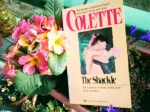
2. The Shackle by Colette (Fiction) – I LOVE Colette, my favourite French classic author, a woman with attitude, totally outside her time, read Introduction to Colette (my review)here. I bought this novella because Vivian Gornick discusses The Shackle and The Vagabond in her new book Unfinished Business – Notes of a Chronic Re-Reader. I can’t read that till I’ve at least read The Shackle!

I have also read The Complete Claudine, (my review) a series of four novellas that can be read as one and I have Earthly Paradise, a selection of extracts from her  memoirs, notebooks, and letters which together provide an insight into her life.

3. The Book of Harlan by Bernice L. McFadden (Historical Fiction)– Last year I read Praise Song for the Butterflies,(my review) my first novel by McFadden and it was excellent. She seems to write well researched, easy reading novels that teach us something interesting, that earlier novel was inspired by a tale told her by two women she met when visiting Ghana concerning a practice called trokosi.

The Book of Harlan is historical fiction set during WWII about black American musicians in Paris invited to perform in a Montmartre, affectionately referred to by them as “The Harlem of Paris”. Also based on extensive research, it blends the stories of her actual ancestors and imagined characters.

4. Surfacing by Kathleen Jamie (Nature Essays) – One of my favourite nature essayists, Kathleen Jamie is a poet and an astute observer of sensory detail no matter what she is studying. Surfacing is her latest blend of memoir, cultural history, and travelogue of her visits to Alaska, Orkney and Tibet. From the thawing tundra linking a Yup’ik village in Alaska to its hunter-gatherer past to the shifting sand dunes of the preserved homes of neolithic farmers in Scotland, she explores the natural world, considering that which surfaces and that which connect us with the past.

My reviews of her debut collection Findings and Sightlines here.

5. Plainsong by Kent Haruf (Fiction) – There’s nothing like a good trilogy and I’ve read a couple of excellent ones, such as Sandra Gulland’s excellent historical fiction of the life of Josephine Bonaparte: The Many Lives & Secret Sorrows of Josephine B, Tales of Passion – Tales of Woe, The Last Great Dance on Earth and Nancy E Turner’s memoirs of her great grandmother Sarah Prine, an astonishing, willful, unforgettable pioneering woman who seeks a living in the harsh, untamed lands of the Arizona Territory circa late 1800’s, These is My Words, Sarah’s Quilt, A Star Garden.

Kent Haruf’s Plainsong trilogy follows the lives of a cast of characters in a small farming town in Colorado.

Ursula K. Le Guin said when he passed away in 2014 that Haruf’s

“courage and achievement in exploring ordinary forms of love – the enduring frustration, the long cost of loyalty, the comfort of daily affection – are unsurpassed by anything I know in contemporary fiction”.

I’ve just finished Octavia E. Butler’s excellent novel Kindred, so tonight I’ll start one of these. Watch this space!

Please take care everyone, don’t take unnecessary risks, stay at home and be safe.

What exciting read do you have on your TBR to read next?


The Situation and the Story by Vivian Gornick

The Art of Personal Narrative

A deliberate slow read for me as I wished to absorb the teaching, while researching and writing my own work, something definitely clicked in my understanding which I hope translates across into my writing.

On The Essay
In the first half Gornick dissects a few essays, citing them as evidence of her theory of the narrative that really demands attention and works, because it has been structured, attention being given to understanding the difference between the situation and the story.

A theory that came to her like an epiphany while attending a funeral, where one person in particular moved her more than the others.

Her words had deepened the atmosphere and penetrated my heart. Why? I wondered even as I brushed away the tears. Why had these words made a difference?

She concludes that because the narrator knew who was speaking, she always knew why she was speaking. She had created a ‘persona’ of herself in order to eulogize the deceased. An instrument of illumination.

The unsurrogated narrator has the monumental task of transforming low-level self interest into the kind of detached empathy required of a piece of writing that is to be of value to the disinterested reader.

But getting from the understanding of a theory to being able to apply it in one’s writing was something that eluded her until she analysed her own attempt of personal journalism (part personal essay and part social criticism) when she was invited to go to Egypt and write about the middle class existence in Cairo. Overwhelmed by the energy of the city, the drama of its citizens, the work mimicked Egypt itself. It would take years before she was able to control the material with sufficient composure to see the situation and narrate the kind of story she wished to share.

Every work of literature has both a situation and a story. The situation is the context or circumstance, sometimes the plot; the story is the emotional experience that preoccupies the writer: the insight, the wisdom, the thing one has come to say.

Using examples from different essays and memoirs, she shares extracts to demonstrate the theory in it’s most eminent form e.g. Augustine’s Confessions, Edmund Gosse’s Father and Son, George Orwell’s Shooting an Elephant, Ackerley’s My Father and Myself.

She compares a trilogy of essays that exhibit the way self-implication can shape a piece of nonfiction writing: Joan Didion’s essay on the companionship of a migraine, ‘In Bed’, Harry Crews’s divided feelings about home in ‘Why I Live Where I Live’ and Edward Hoagland’s disturbing urban nature essay, ‘The Courage of Turtles’.

We are in the presence, in each instance, of a mind puzzling its way out of its own shadows – moving from unearned certainty to thoughtful reconsideration to clarified self-knowledge. The act of clarifying on the page is an intimate part of the metaphor.

Joan Didion, perhaps the most practiced of them all, excavated her subconscious regularly, stayed in touch with the times, and wrote right down to the core of her self-examined existence.

“I have tried in most of the available ways to escape my own migrainous heredity … but I still have migraine. And I have learned now to live with it, learned when to expect it, how to outwit it, even how to regard it, when it does come, as more friend than lodger.”

Joan Didion, ‘In Bed’, 1968

On The Memoir

Truth in a memoir is achieved not through a recital of actual events; it is achieved when the reader comes to believe that the writer is working hard to engage with the experience at hand. What happened to the writer is not what matters; what matters is the large sense that the writer is able to make of what happened. For that, the power of the writing imagination is required.

She posits that modern memoir is of value to the reader only if it is able to dramatise and reflect on the experience of transformation or ‘becoming’ as the writer moves away from that person one has been told they should be towards the more authentic version that might be revealed beneath.

Quoting the example of Gosse’s, Father and Son she observes:

That this son must come into his own by making war not on a parent who is willful and self-involved (which he is) but on one filled with the tender regard that alone gives a growing creature the ability to declare itself (which he also is). This is the thing the reader is meant to register; this is the narrator’s wisdom. It is the betrayal of love that is required in order that one become.

These memoirs that succeed are works that record a steadily changing idea of the emergent self.

For each of them a flash of insight illuminating the idea grew out of the struggle to clarify one’s own formative experience; and in each case the strength and beauty of the writing lie in the power of concentration with which this insight is pursued, and made to become the writer’s organising principle. That principle at work is what makes a memoir literature rather than testament.

Ultimately the advice she gives is to aspiring writer’s is to ask oneself certain questions, both in reading and in writing:

What, we would ask of the manuscript,was the larger preoccupation here? the true experience? the real subject? Not that such questions could be answered, only that it seemed vital to me that they be asked.

That exploration of the subconscious might precipitate insights to rise to the surface and spill over onto the page, by digging deeper, one may stumble across the inner context that makes a piece of writing larger than its immediate circumstance.

“who is speaking, what is being said, and what is the relation between the two” had become my single-minded practice”

She ends with an observation about timing, the thing that a writer can rarely predict.

Writing enters into us when it gives us information about ourselves we are in need of at a time that we are reading.

This explains why a worthy book might be overly criticized while one of fleeting value is highly praised, the former, great though it may be, misses the mark because what it has to say can not be absorbed at the moment, while the latter

is well received because what it is addressing is alive – now, right now – in the shared psyche.Which is perhaps as it should be. The inner life is nourished only if it gets what it needs when it needs it.

Her Mother’s Mother’s Mother and Her Daughters by Maria José Silveira (Brazil) tr. Eric.M.B. Becker

Just brilliant.

What a perfect way to navigate through 500 years of history of a country, without ever getting bogged down in the detail, to follow the lives of daughters, a matrilineal lineage, whose patterns are affected if not dictated by the context of the era within which they’ve lived.

An omniscient narrative begins with the daughter of a native tribeswoman, who leaves her village and family on the arm of a Portuguese ship hand, and moves to the many generations living on sugarcane plantations, to the era of daughters of wealthy business owners living off the profits of those ancestors; from the bitter to the sweet, the uncaring to the revolutionary, five centuries of women, interlaced through stories.

Each chapter follows one young woman and though some of their lives are short-lived, they at least give birth to one daughter, even if some don’t live to raise them. Though unlikely in reality that so many generations would all produce at least one daughter who survives long enough to reproduce, this construct provides the framework for telling the stories, weaving together the historical threads, allowing only us as readers to see what they often don’t, that they are, that we all connected if we look back far enough, or inside deep enough.

Translator Eric M. B. Becker, the winner of a 2014 PEN/Heim Translation grant, produces an excellent translation. By leaving particularly Brazilian terms such as “emboaba” and “cafuzo” untranslated, Becker manages to make readers of English understand the untranslatable within its context. The novel maintains a casual, dreamlike quality, as if the narrator were telling these stories to a friend. Each character is given their own original voice, emotions, and musicality. If some syntax feels unexpected, it is almost always for the benefit of sound.

L. E. Goldstein, Harvard Review

Their stories are grouped into five parts:
A Shortlived Romance – Inaia (1500 – 1514) and her daughter Tebereté (1514 -1548)
Desolate Wilderness -six daughter descendants, the slave years (1531 – 1693)
Improbable Splendour – five daughters, the commercial trading years, accumulating wealth (1683 – 1822)
Vicious Modernity – four daughters, revenge, jealousy, naivety, the elite upper classes (1816 – 1906)
A Promising Sign – three daughters, working class, equality, human rights, exile, freedom (1926 – present)

There are so many stories, it is difficult to retain them all and remember them, and for this it’s necessary to slow-read this book to really take in the breadth of storytelling, which implicitly tells the greater story of a country’s evolution, growth, pain and development. But what better way than to inhabit the lives of one family and follow them over the course of time, recalling the fates of each character and the essence of the life they lived, was enabled or disabled by the time they lived through.

The narrator makes an appearance from time to time, like the hand that threads the needle, they are threadbare and unintrusive, like a pause in reading to make a cup of tea, they don’t disturb the reader, if anything we are comforted by the presence.

I absolutely loved it, I read this because I seek out works by women in translation to read in August for #WITMonth and finding a book like this is such a joy, for it gives so much in its reading, great storytelling, a potted history of Brazil, a unique multiple women’s perspective and an introduction to an award winning author, the writer of ten novels, this her first translated into English.

The variety of their personalities, and the pain, beauty, and strength they display shows that genetics alone does not make a person who they are. In this book, the characters’ environments form them, from the people with whom they interact to the great changes taking place in the pulsing heart of Brazil itself.

L. E. Goldstein, Harvard Review

I wrote most of this review back in August last year, and as you know, I wasn’t capable of sharing anything for some time after that. I passed the book on to a wonderful friend who came to be with me during that time, and for that reason too I’m unable to share any quotes.

It was one certainly of my favourite reads of 2019. A real gem.

Thank you to Enrico for his excellent review that made me get my own copy of the book to read. Read his review, it’s more of an incisive literary criticism that looks at the challenges of writing a novel like this and how Silveira overcomes them.


Where The Crawdads Sing by Delia Owens

I absolutely loved this, a surprise read, it was a gift from a friend who spends more time living in the wilderness than with humanity. When I read the bio of the author and saw she was a nature writer and wildlife scientist, with a degree in Zoology and a PhD in Animal Behaviour, I was even more attracted to the potential this might infuse, what looked like a murder mystery novel.

Delia’s research on the importance of female grouping in social mammals influenced her fictional writing. Where the Crawdads Sing explores the behavioral impact on a young woman who is forced to live much of her young life without a group.

It’s a slow burning, pleasurable observation of Kya, a girl as a fledgling, one pushed from the nest of family and abandoned before fully formed. And so she develops in a way not like others, highly observant, ultra sensitive to her surroundings, the marsh. They call her the marsh girl.

The marsh did not confine them but defined them and, like any sacred ground, kept their secrets deep. No one cared that they held the land because no one else wanted it.

Like any weak female species, she knows she is prey to the predator, and so acts in ways that might seem strange to other humans, who live within the security of a home and a community (although this is the 1960’s in North Carolina, so not all humans are treated equally).

When cornered, desperate, or isolated, man reverts to those instincts that aim straight at survival. Quick and just. They will always be the trump cards because they are passed on more frequently from one generation to the next than the gentler genes. It is not a morality but simple math. Among themselves, doves fight as often as hawks.

The story is told via twin narratives; the present day when a young man Chase Andrews is found dead at the base of a tower, and the question being asked is whether he fell or was pushed, and if pushed by who; and the past, the story of Kya, her abandonment, her survival, her friendship with Tate, with Chase, with Jumpin’ and Mabel, and how her feelings of rejection affect her relationships.

Her father stays long enough to teach her how to fish and navigate the channels with a boat, but when he leaves she has to learn to feed herself and make money to keep the boat in fuel.

The way the author makes the reader see Kya through the lens of biology and the behaviour of different species is stunning. When she described certain species behaviour, they were like clues to what was coming, I loved that she used nature as a guide.

Observing fireflies, she notices that each species has its own language of flashes to attract a mate. The males recognise the signals and fly only to the females of their species. But the female is capable of changing codes.

First she flashed the proper sequence of dashes and dots, attracting a male of her species, and they mated. Then she flickered a different signal, and a male of a different species flew to her. Reading her message, the second male was convinced he’d found a willing female of his own kind and hovered above her to mate. But suddenly the female firefly reached up, grabbed him with her mouth, and ate him, chewing all six legs and both wings.

Kya watched others. The females got what they wanted – first a mate, then a meal – just by changing their signals.
Kya knew judgement had no place here. Evil was not in play, just life pulsing on, even at the expense of some of the players. Biology sees right and wrong as the same colour in different light.

Loneliness leads her towards trouble and lessons. The marsh and its inhabitants always reward her. Humans disappoint her and she withdraws more than ever. Fortunately her one friend Tate, teaches her to read and her knowledge of the marsh becomes more academic and her appetite for learning about and within her natural environment are insatiable.

Sitting outside the old cabin, she picked up a scientific digest. One article on reproductive strategies, was entitled “Sneaky Fuckers.”

:

Kya dropped the journal in her lap, her mind drifting with the clouds. Some female insects eat their mates, overstressed mammal mothers abandon their young, many males design risky or shifty ways to outsperm their competitors. Nothing seemed too indecorous as long as the tick and tock of life carried on. She knew this was not a dark side to Nature , just inventive ways to endure against the odds. Surely for humans there was more.

She tries to understand life through the biology she reads about and observes, but the community don’t tolerate difference and will create a narrative of their own in order to seek justice for one of theirs.

Ultimately Nature will decide.

A brilliant way of exploring human nature and our ecosystem, the culmination of a long career of observing wildlife and nature, now in that stage of life where she can share it perhaps more widely in the fictional form.

Delia Owens was born in southern Georgia and grew up with a close relationship to nature. After her studies, she and her husband drove over the central Kalahari in Botswana and set up camp there for 7 years studying lions and hyenas, co-authoring the book Cry of the Kalahari. From there they moved to Zambia, where they studied elephants and established a program offering jobs, loans, and other assistance to local villagers so they would not have to poach wildlife for a living. They lived 22 years in Africa before returning to to the US.

She wants to continue writing fiction, especially mysteries that explore how our evolutionary past on the savannas influenced our current behavior in a world less wild.

She has won the John Burroughs Award for Nature Writing and has been published in NatureThe African Journal of Ecology, and many others. Where the Crawdads Sing is her first novel.

Celestial Bodies by Jokha Alharthi tr. Marilyn Booth

Celestial Bodies won the 2019 International Booker Prize, a literary prize open to newly translated works of fiction into English.

Jokha Alharthi is from Oman and her novel was originally written in Arabic. She is the first female Omani novelist to be translated into English and the first author from the Arabian Gulf to win the prize. The judges had this to say:

“It’s less flamboyant than some of the other books, there’s a kind of poetic cunning to it. It starts feeling like a domestic drama in a fascinating world, but with the layers of philosophy, psychology and poetry, you are drawn into the prose, through the relationship between the characters. It encouraged us to read in a slightly different way.”

It is a read that requires just letting go and going with the flow, allowing the characters to lead us wherever it is the author is taking us. I say that because it is a non-linear narrative, that moves its narrative perspective often from one character to another and also across time seemingly randomly, as events trigger memories and take the story back to their origin.

There is a family tree in the opening pages, which I did refer back to often, though perhaps it wasn’t really necessary, sometimes just knowing it is there is an excuse to refer to it, but it’s not really necessary for a story that follows no chronological order, that moves from the present to the past and back generations according to the feelings, thoughts and behaviours of its characters.

Abdullah’s thoughts occupy us more than most, and they often refer him back to a childhood memory, that turns into a recurring adult nightmare of being suspended by ropes in a well, a punishment for taking his father’s rifle to shoot magpies with the boys who lured him out to join them. Only they beat him.

He is married to Mayya, who he loves, since the first day he saw her – and because he was a man, he could have her as his wife. The feelings aren’t reciprocated and love doesn’t flourish there. Unbeknown to him there is another ‘celestial body’ orbiting in his universe that intends to reel him in.

For me, this felt like a novel that centred around the lives of those connected with ‘The Big House’ whether they were descendants of the one who built it, to contain his family, slaves, to be place friends could visit. For some it is a sort of prison, not necessarily the slaves, for they have certain freedoms not given to those who are part of the family, especially those who have no memory of being stolen.

It is useless, Zarifa, to try telling this man that no one stole you. That you were born a slave because your mother was a slave and that’s the way life is. That slavery passes to you from your mother. That no one stole you, and al-Awafi is your place, its people are yours.

Her husband remembers and shouts when she says such things.

The second child of his mother who had five boys in all, he remembers everything: the local gangs that attacked their village wanting money, or perhaps to pay old scores; the merchants, a jumble of Baluchs and Arabs, who bought them, there on the plains, the filthy crammed ships those merchants crammed them into; the eye disease that spread fast from one child to the next on shipboard; his mother’s screaming for her other children, who’d been shoved onto other boats; the nursing baby who died of smallpox while on her breast, so the slave traders snatched him away and threw him into the sea.

Her son also sees things differently:

He spoke through clenched teeth. Listen to me. Merchant Sulayman raised me and, yes, he put through me through a little schooling, and he found me a wife, but it was all for his own self-interest, all because he meant me to serve him, and to have my wife as his servant too, and then my children later on.

Even those who leave, (to Cairo), when tragedy strikes, in their upset they return to this small town of The Big House, forever connected to those who reside there.

At certain points in their domestic history, there are things that are changing in the external and international world, like the abolition of slavery, though those affected by it here, seem immune to the changes, their lives don’t change, they are not even aware of their rights. Change here happens slowly, in the rebelliousness of each new generation, challenging what came before in some way.

Time changes them, multiple generations must live together in understanding and be misunderstood. Some things are never understood and leave some always seeking the truth, to the point of obsession.

Do you see the way people move life – and I mean, just the bits of their lives you can see? Most of their movement through life is invisible, it goes on inside of them, so for us it exists beneath the surface. Their own private worlds, their imaginations. When I liberated myself from living through my father’s head I created my own imagination with a paintbrush.
.
My art saved me from acting out the image my father had made for me.
.
When I could finally shake myself loose, when I managed to no longer live inside the image of me he had in his head, I finally found out what freedom tastes like….How liberated a person feels when it’s finally no longer a question of being just an extension or embodiment of someone else’s fancy, even if that someone is your father.

It doesn’t follow a conventional plot and just as in life, the voices of the household come through chapters almost haphazardly, just as thoughts do, and yet over the span of 240 pages we have a sense of this extended family and community of the pressure of time moving on, of lives changing and challenging old perceptions.

As I look back at the book, I see so many passages highlighted and randomly opening to any of them I immediately see what it was that attracted me and understand why this book elevated itself above the rest, to win the Man Booker International Prize in 2019. There is a richness to it, a complete immersion, a gathering of influences, duty alongside rebelliousness, tradition nestled with change, love and loss, history and modernity.