Boulder by Eva Baltasar tr. Julia Sanches

Boulder is another portrait of a woman, the second of a triptych.

The narrator of Permafrost never quite cut the strings of family, choosing the path(s) of least resistance, while lamenting not having made more independent choices in her formative years.

Assured Prose Who Art in Metaphor

If the narrator of Permafrost is somewhat unsure, that of Boulder is more certain. The prose is assured, the narrative has pace, the protagonist moves towards what suits her, to freedom – until things change.

The avid descriptions and bold metaphors have me rereading and highlighting passages, like the creation of foam as a wave crashes on itself, they are as natural to the text as the paragraphs within which they roll.

An itinerant cook, she moves from place to place, island to ship, working in the kitchen. Life on the cargo ship suits her, she’s at home in turbulent seas, around those that neither desire nor reject her, a place where there was no need to pretend life had a structure. Rootless, drifting and free.

Freedom In Its Many Forms

I think I’ve discovered what happiness is: whistling the moment you wake up, not getting in anyone’s way, owing no explanations, and falling into bed at daybreak, body addled from exhaustion, and mind free of every last trace of bitterness and dust.

The boat sails up and down the coast of Chile, she rarely disembarks, the only temptation in Chaitén, for a hot shower, fresh linen, and a lurking lust for a lover. That’s where she meets Samsa.

I look at her and she fills every corner of me. My gaze is a rope that catches her and draws her in. She looks up, sees me. She knows.

They begin to see each other, though it is often months between visits. Her lover renames her Boulder.

Photo by Bren Pintelos on Pexels.com
She doesn’t like my name and gives me a new one. She says I’m like one of those large, solitary rocks in southern Patagonia, pieces of world left over after creation, isolated and exposed to every element. No one knows where they came from. Not even they understand why they are still standing and why they never break down. I tell her I’ve seen rocks like those in the middle of the ocean.

Compromise, Commitment, Cohabitation

Samsa leaves for Iceland and asks Boulder to join her, she says yes. Samsa makes decisions and Boulder adapts to them. She observes the island, the islanders, the things she doesn’t like, she finds work that gives her an escape. She observes the different way they love each other, the pull of the boats when she walks the dock alone at night.

There’s a restlessness. She starts her own business, a food truck, no boss, no employees, a small but significant and necessary freedom. Something of her own. A coping mechanism.

It’s Not An Elephant in the Room

Photo by Sindre Fs on Pexels.com

Then it happens. Samsa wants to have a baby, Boulder knows that refusing her will mean the end, so asks for more time.

The novel charts this turning point in the relationship, where one woman will become pregnant and give birth while the other tries to support and be part of something she does not feel.

It is an alternative navigation of an age old dilemma, seen through the lens of a queer relationship, a couple struggling with avoidance issues.

It’s not difficult to imagine where it is headed, or what might happen, when one person isn’t quite committed to the idea and desires freedom so strongly. Is the love of another enough sufficient when events propel their lives forward faster than the communication of important feelings around them?

Boulder’s observations and experience are like that of an outsider who can’t quite enter the familiar, of trying to overcome an obstacle of the mind, when the heart is resisting, when self destructive tendencies threaten to communicate what the voice has been unwilling or unable to.

Boulder was shortlisted for the International Booker Prize 2023.

Further Reading

Read an Extract from ‘Boulder’

Eva Baltasar International Booker Prize interview: ‘I wrote three versions of Boulder and deleted two’

“My protagonists are mirror images of myself, only more precise and always veiled. I try to discover who they are by writing, travelling to their darkest, most uncomfortable corners, which is like travelling to the darkest corners of myself, corners that are often repressed and at times denied wholesale. Being able to embark on this journey aboard a novel is as exciting as it is unsettling. It’s as if the novel had transformed into a caravel and the seas were vast but finite, teeming with monsters on the edge of the earth.” Eva Baltasar

Permafrost by Eva Baltasar tr. Julia Sanches

A Poet’s Prose

On the back page in the first sentence that describes the author, it says Eva Baltasar has published ten volumes of poetry. Permafrost is her debut novel, the first in a triptych which aims to explore the universes of three different women in the first person. It clear from the beginning this is the prose of an assured poet.

Julia Sanches triptic #1 catalan translation

I love the title, Permafrost. That deep, but necessary layer in the earth, cold and hard, it creates a foundation layer and stability, as long as conditions remain the same. Kathleen Jamie writes about it in her excellent essay collection Surfacing.

The narrator of Permafrost destabilises the reader on the opening page, with these opening lines…

It’s nice, up here. Finally. That’s the thing about heights: a hundred metres of vertical glass. I’ve settled on an edge, I live on this edge and wait for the moment when I’ll leave the edge, my temporary home.

Not only thinking about heights, but observing all the minutae that surrounds her. It seems like a suicide attempt, a theme that recurs throughout the 122 page novella, only she appears to be distracted by an ever present curiosity around the details of the new experience, something that seems incongruent with wishing to take a life.

I’ve settled on an edge, I live on this edge and wait for the moment when I’ll leave the edge, my temporary home.

Living On the Edge Creates Curiosity

The Thomas Bernhard epigram warns us ‘To be born is to be unhappy, he said, and as long as we live we reproduce this unhappiness.’

So I am surprised by the humour. Despite her melancholy nature and existential awareness, the living in the shadow of family, she makes us laugh.

She tells us her family all self-medicate. Not her, she prefers the edge.

Not for me though – best to keep moving wildly to the edge, and then decide. After a while, you’ll find that the edge gives you room to live, vertical as ever, brushing up against the void. Not only can you live on it, but there are even different ways of growing there. If surviving is what’s it all about, maybe resistance is the only way to live intensely. Now, on this edge, I feel alive, more alive than ever.

A promising child, her first crisis is graduation, after five years, there’s nowhere to go, few clues as to how to put this learning to use. So she lives in her Aunt’s apartment and rents out rooms to different women, providing herself an income and an effortless source of lovers. She spends her days reading, observing, pondering death, too curious to pursue it.

Birth and Children are Grounding

Photo by Pixabay on Pexels.com

Her meandering is interrupted by her pregnant sister and her mother, their insistence to stay close, involved, drawing her back in, keeping her that person she was. The Aunt’s phone call, she’s selling the apartment.

An au pair in Scotland, a marriage proposal in Belgium, childhood memories, fantasies, churning through relationships, occasionally one that lasts a chapter, dialogue with the sister, the mother.

A mole grows and changes form, she makes a doctor’s appointment then cancels it for a year, then follows up.

Life Can Be Insistent

Each chapter is less than two pages, sometimes the narrative skips a chapter and picks up the thread again later on. It’s an inner voyage of discovery and an outer journey of experiences to unravel what was formed by others and discover the essence of, to know who she is. As that realisation occurs, life throws an even greater challenge and responsibility her way.

I’ve realised I know myself by heart…

It is a unique work, recognisably the work of a poet, unruly, impulsive, it makes light of heavy subjects, never quite proselytising, both giving into and resisting convention, forging a way through, trying different things on, breaking out and being pulled back in. One is left wondering if she is floating with the tide or pushing through it.

Permafrost received the 2018 Premi Llibreter from Catalan booksellers and was shortlisted for the Prix Médici for Best Foreign Book in France (2020).

Next up, book 2 in the triptych, Boulder, which was recently shortlisted for the International Booker Prize 2023.

Of Cattle and Men by Ana Paula Maia tr. Zoë Perry

Charco Press Brazilian Literature novellaBrazilian author, Ana Paula Maia’s Of Cattle and Men, was an interesting and confronting story that in parts was hyper realistic in a visceral way, and fable-like in other ways. It is the fourth book I’ve read this year from the Charco Press Bundle 2023.

Set in a place where there is a one-man owned slaughter-house, not far away a hamburger processing plant, the author creates a small world that concerns men and their relationship to meat and their relationship to the beings who provide it.

Two enclosures, one for cattle and one for men, standing side by side. Sometimes the smell is familiar. Only the voices on one side and the mooing on the other distinguish the men from the ruminants.

Humanity has been able to consume meat in part because they are separated from the process of how to turn something sentient into something edible.

Man’s Need for Ritual

Here, we meet Edgar Wilson, stun operator, who has ritualised his occupation and believes that it has an effect on the animal.

Edgar picks up the mallet. The steer comes up close to him. Edgar looks into the animal’s eyes and caresses its forehead. The cow stomps one hoof, wags its tail and snorts. Edgar shushes the animal and its movements slow. There is something about this shushing that makes the cattle drowsy, it establishes a mutual trust. An intimate connection. With his thumb smeared in lime, Edgar Wilson makes the sign of the cross between the ruminant’s eyes and takes two steps back. This is his ritual as a stun operator.

He has a dark history and holds little compassion for men who are carelessly cruel. It brings out his own.

Milo decides to keep quiet. He knows Edgar Wilson’s loyalty, his methods, and he knows that Zeca really was useless. No one had reported him missing, and if anybody came looking for the boy, he would simply say he never showed up for work again. That he doesn’t know where he’s gone off to. Just as no one questions death in the slaughterhouse, the death of Zeca, whose rational faculties were on par with the ruminants, would surely be ignored. Senhor Milo knows cattlemen, he’s cut from the same cloth. No one goes unpunished. They’re men of cattle and blood.

Recently the animals waiting in the holding area have become unsettled and strange, unexplained happenings have been occurring. The men stay up into the night to investigate and try to find the suspected predator that is disturbing the animals and worse.

How Language Eviscerates and/or Exposes

I thought this novella was quite incredible and it evoked all kinds of memories and thoughts, that may not be like many other readers.

Firstly, the realism of the slaughter house. Although this novel concerns what seems like a small scale operation, the attention to detail in its execution and the evocation of all the senses in that environment immediately reminded me of memories I would rather forget.

When I was a university student, one summer I needed to find a job allied to the agricultural industry. I wrote to a family friend who was a ‘stock agent’ asking if he knew of an opportunity. He suggested a “freezing works” (an interesting choice of name used in New Zealand and Australia to describe a slaughterhouse at which animal carcasses are frozen for export) and so I began my summer working in this enterprise’s pay office, transferring data from daily timesheets into a ledger that would eventually be input into a computer to generate their pay. Far from the action, except that one of my roles was to go and collect those time sheets from the different departments. And that is where and how, I witnessed, with every one of my senses, everything.

Benevolent Bovines and Other Sentient Beings

of cattle and men Ana Paula Maia

Photo by Pixabay on Pexels.com

Secondly, the question of what an animal intuits and feels. Being raised on a 1,600 acre sheep and cattle farm, I can acknowledge that as humans, we are conditioned to accept certain realities and often made to participate in them, until the age of free will. Within childhood, in my case, we occasionally had access to a ‘farm animal’ as a pet – the relationship building that can occur between the human and the animal is undeniable, but equally, not every human will allow that relationship to occur.

Our pet lambs (after the annual school pet day) were put back into the flock; my pet calf, I rescued from one fate (slaughter), to have her destined for another (to become the ‘house cow’), providing daily milk to the family; she could therefore keep her offspring for six months. There was on occasion, an attempt to ‘mother’ one newborn (orphan) onto another, an act that could result in the false mother killing the strange newborn, despite it being dressed in the skin of her own dead lamb.

There is indeed a knowing.

For a few moments, Edgar Wilson yields to the late afternoon sun that has not yet fully set, but that is rushing headlong into a moonless, starless night. He knows how to listen in silence, even when others are just sighing or snorting. Life in the country has made him like the ruminants, and being a cattleman, he is able to strike a perfect balance between the fears of irrational beings and the abominable reverie of those who dominate them. He sinks two fingers into the paint can and marks the foreheads of the four cornered cows.

In Of Cattle and Men, Ana Paula Maia shows man’s inhumanity to man and his denial that an other meat-producing species might have awareness, consciousness or feeling. So the men are confused by what is occurring and they look only towards what they know, that which man is capable of; therefore they suspect other men, each other. They disbelieve what is in front of them, what they see.

Because what if those animals had agency?

Certainly not my usual kind of read, but I read this novella in one sitting, intrigued by the premise and captivated by the writing. Brilliantly portrayed, evocative of place and confronting to humanity’s blindness, I’d definitely read more by Ana Paula Maia.

Ana Paula Maia, Author

Ana Paula Maia (Brazil, 1977) is an author and scriptwriter and has published several novels, including O habitante das falhas subterráneas (2003), De gados e homens (2013), and the trilogy A saga dos brudos, comprising Entre rinhas de cachorros e porcos abatidos (2009), O trabalho sujo dos outros (2009) and Carvão animal (2011). Her novel A guerra dos bastardos (2007) won praise in Germany as among the best foreign detective fiction.

As a scriptwriter she has worked on a wide range of projects for television, cinema and theatre. She won the São Paulo de Literatura Prize for Best Novel of the Year two years in a row: in 2018 for her novel Assim na Terra como embaixo da Terra, and in 2019 for Enterre Seus Mortos.

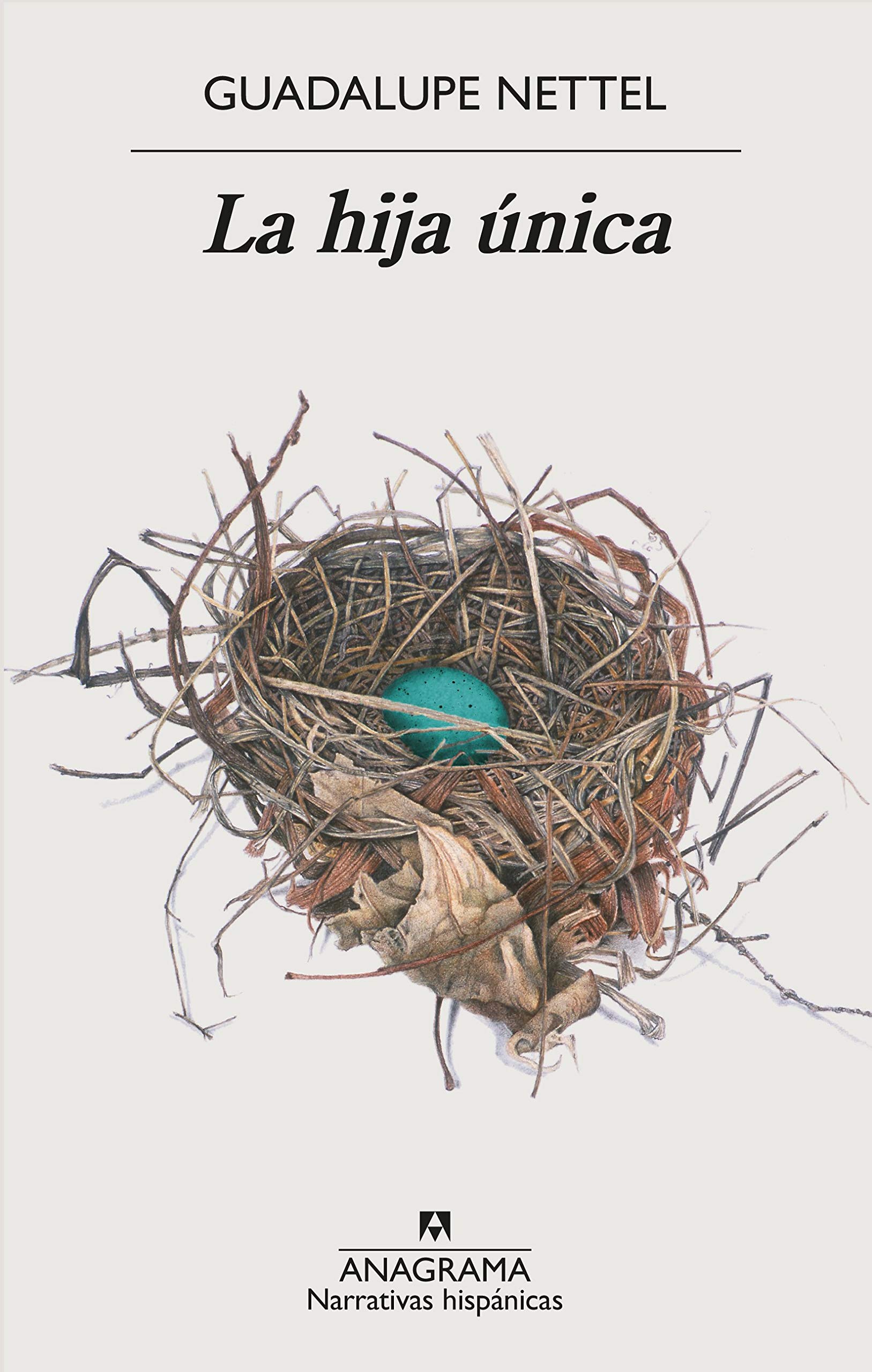
Still Born by Guadalupe Nettel tr. Rosalind Harvey

Shortlisted for the International Booker Prize 2023, Still Born is the fourth novel by Mexican writer Guadalupe Nettel, and one that stood out for me to read. It was a book that once I turned the very first page, I was unable to put it down. A fiercely compelling narrative around a highly emotional subject, told in a neutral linguistic style that demands attention.

To Be or Not to Be

The story covers a short period in the lives of two independent and career-driven women, Laura and Alina, friends who have initially declared they do not wish to have children.

My friends, for instance, could be divided into two groups of equal size: those who considered relinquishing their freedom and sacrificing themselves for the sake of the species, and those who were prepared to accept the disgrace heaped on them by society and family as long as they could preserve their autonomy. Each one justified their position with arguments of substance. Naturally, I got along better with the second group, which included Alina.

Mexican literatureLater, Laura, to ensure pregnancy doesn’t occur accidentally, takes the drastic measure of having her tubes tied, forever removing that risk.

It’s not that kids annoy me altogether. I might even find it entertaining watching them play in the park or tearing each other apart over some toy in the sandpit. They are living examples of how we would be as humans if the rules of etiquette and civility did not exist.

Alina changes her mind, now in a committed relationship, she becomes pregnant.

What follows each of these decisions is not what either woman expects.

Of Fledglings and Changelings

Guadalupe Nettel Still Born

Photo by Kati Tuomaala on Pexels.com

Laura finds herself increasingly involved with the care and in the company of her depressed neighbour’s son, surprised by the awakening of a protective and nurturing aspect.

Alina is given all kinds of dire expectations from medical specialists who pronounce on her unborn baby, a genetic condition they say will not allow it to live. This causes her and her partner great distress, without reckoning on the will of a tiny life-form that desires against all prediction and preparation otherwise – to exist.

There is a word to describe someone who loses their spouse, and a word for children who are left without parents. There is no word, however, for a parent who loses their child.

The descriptions of the medical encounters are delivered in such a black and white, scientific manner, that we feel profoundly that which is unspoken; the confusion and emotional turmoil of two people who should be feeling ecstatic, being crushed by words delivered as if they were already true. Devastation. Probabilities delivered as facts. In hindsight, lies.

The style of language employed by the writer, in mimicry to the attitudes of the medical staff is neutral, impersonal. Presented as objective, it avoids any personal opinion or emotion. Doctors. Highly trained in precise linguistic delivery, the reader experiences acutely how inhumane it is.

The narrative is so straightforwardly delivered and was so familiar to something I have experienced first-hand, that it felt like I was reading nonfiction. I am sure that any woman who has spent weeks in a post-natal ward will read this and feel a similar sense of deja-vu. I am sure there must be a personal experience(s) wrapped behind this text somewhere.

Brood Parasites

La hija unica Mexican literary fictionMeanwhile, outside Laura’s apartment a pair of pigeons with two eggs in their nest (a refuge she tried to destroy without success), appear to have been subject to a brood parasite.

Brood parasitic birds such as the cuckoo, lay their eggs in the nests of others, sparing themselves the inconvenience of rearing their own young.

Alina too brings in a young woman as a nanny to help with the needs of her newborn daughter, a woman whose role at times usurps the natural mother, giving rise to both appreciation and resentment.

It is a story of the complexity of birthing and raising offspring and the unconventionality that certain circumstances bring about, that can potentially create hybrid parenting situations, where one steps in for the other. It also highlights the little explored experience of a pregnancy that doesn’t follow expected patterns, that delivers an anomaly, something few imagine or are ever prepared for.

Maternal Instinct & Survival

Choosing Laura as the narrator of the story, one who is often at a distance from the more turbulent and harrowing events that Alina is going through, is another way that the author softens the impact of her experience. We are not close enough to be brought down by it and the urgency of her own situation, from which she is also one step removed, keeps the reader from dwelling too long on any on situation. It is like the maternal, survival instinct. The mother keeps busy and active to avoid the slippery slopes of sadness or despair.

I found this novel stunning, shocking, brilliant and in many ways familiar. It was a riveting read, a visceral encounter of all that surrounds the decision or not to become a mother, a carer and how the most insistent of intentions can mould, evolve and change according to our nature and circumstances.

Highly Recommended.

Guadalupe Nettel, Author

Still Born La hija única

Guadalupe Nettel ©Lisbeth Salas_slice

Guadalupe Nettel was born in Mexico and grew up ‘between Mexico and France’.

She is the author of the international award-winning novels The Body Where I Was Born (2011), After the Winter (2014, Herralde Novel Prize) and Still Born (2020). She has also written three collections of short stories. Nettel’s work has been translated into more than 15 languages and has appeared in publications such as Granta, the White Review, El País, the New York Times, La Repubblica and La Stampa. She currently lives in Mexico City.

Rosalind Harvey is a literary translator and educator from Bristol, now based in Coventry in the West Midlands, UK.

‘Many demands weigh on mothers. They are always compared to an unattainable stereotype, one that has made women feel inadequate. Not to mention those who decide to remain childless, who are rarely represented in literature up to now. To me, Still Born is a novel which affirms female choices and which challenges patriarchal ideas of motherhood and maternal instinct.

‘I would like this novel to help readers realise that human diversity – especially that of children with neurological conditions and women of all kinds – is always beautiful and interesting and that there is no reason to fear or reject it.’ Guadalupe Nettel

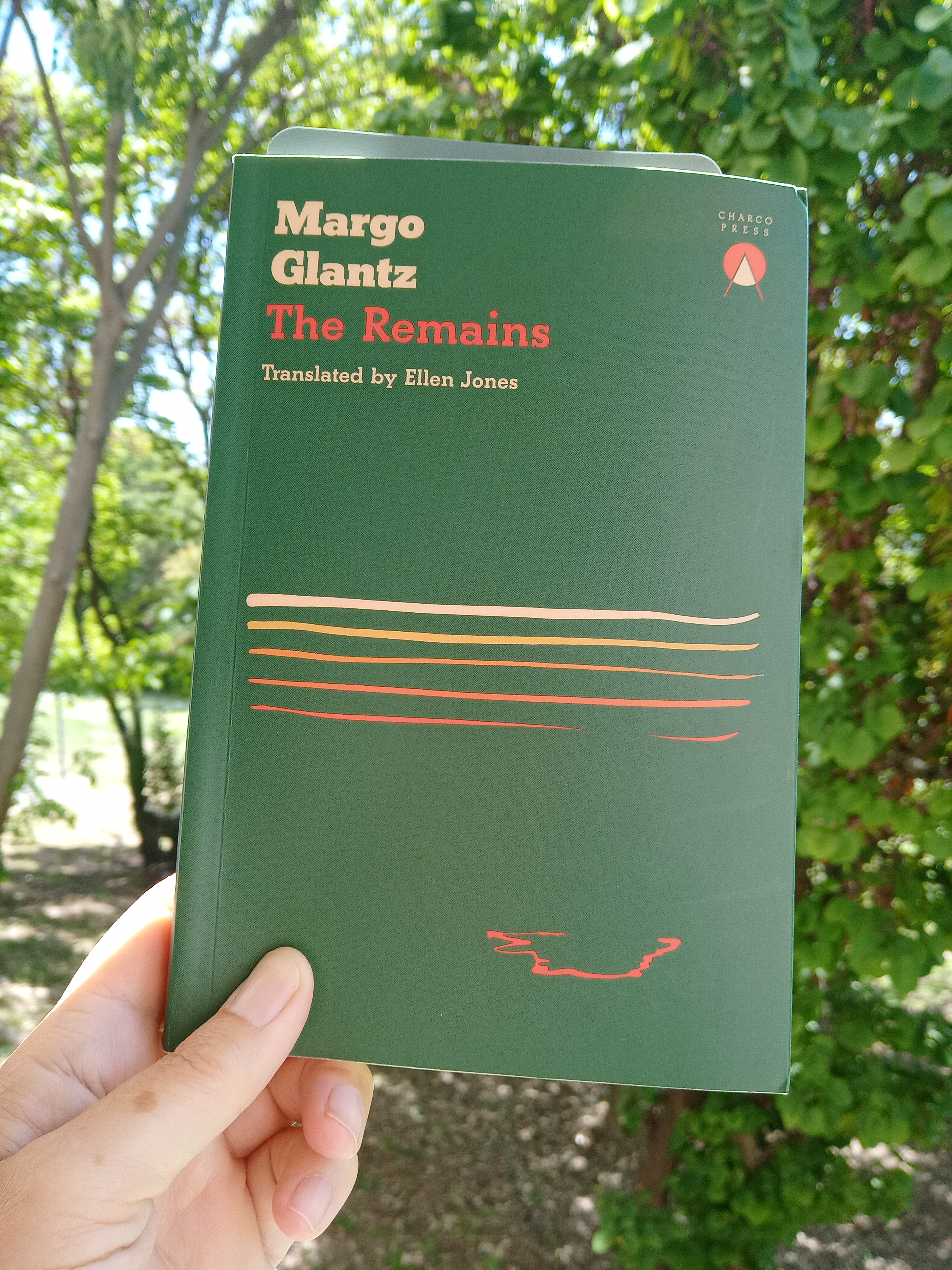
The Remains by Margo Glantz tr. Ellen Jones

How to describe this incredible literary masterpiece. A lyrical elegy of tempo rubato.

A Symphony of Reluctant Grief

Translated Allen Jones Mexican Jewish literatureA divorced woman, Nora Garcia (a cellist), returns for her deceased ex-husband Juan’s, (a pianist and composer) funeral; back to a Mexican village from her past, through the art and music they played and navigated together.

A lyrical and rhythmic form of elegy that, rather than speak about the person who has passed, we experience something of a past version of that person; they are almost present, seen through the distorted lens of a reluctant, grieving ex. We can almost hear his continuous and relentless explanations to his often-time audience of one.

It felt like listening to a symphony in words, as like with music, thoughts and conversations repeat with slight changes over time.

Revelatory thoughts of the woman who knew a man best, observing the body, imagining the isolation and neglect of a heart, that brought this death about. The incantation going into detail of the functions and dysfunctions of the heart, both as the pump that irrigates the body and the metaphor for feelings of love and neglect.

The heart has impulses that reason doesn’t know.

A Different Kind of Garden Party

El rastro Margot GlantzThe novel is set in the present, on the afternoon that the body is displayed in the coffin in a room, and our narrator is a guest like many others, who aren’t sure to whom, they ought to offer condolences. She overhears snippets of conversations, adding to the cacophony of her own reflections.

Its not like death goes around whispering in our ear, though, does it? It just arrives, suddenly, when we least expect it. Silence falls and I move away – he’s right, I think, death doesn’t whisper in our ear, it just arrives, alone, without warning us in advance. I don’t care how simple dying or anything else is for that matter, even if it was that simplicity that made his heart explode, made it shatter into pieces (mine too), yes, life, the absurd wound that is life, yes, it’s true, the heart is only a muscle that irrigates the body, keeping it alive, a muscle that one day fails us.

Bach, Beethoven, Gould & Open Heart Surgery

Margot Glantz The Remains

Photo by Gimmeges on Pexels.com

Scenes and topics of conversation from the past circulate through her mind as she observes all around her. Much of it is about music, about their preferences, their differences told through how revered pianists played the music of Bach, Beethoven and more.

In her grief, she writes intense descriptions of a person talking to her, observing visual elements, lips moving, facial gestures, drifting off and away, out of her own body, hearing nothing of the tedious chatter. Her thoughts range from music, pianists, the genius castrati voices of eighteenth century Italian opera, to the intricacies and origins of open-heart surgery.

Grief arrives unbidden, tears overflow, the intellect refuses it, reprimands her, convinces her she doesn’t care. The body does not comply. She recalls evenings spent listening to great pianists, their heated arguments, wondering if it was due to their diametrically opposed ways of seeing the world.

Though I don’t profess to know too much about the world of classical music or the work of all the names mentioned – the way Glantz takes the reader on a voyage through these subjects, venturing into them in depth, returning again in brief, then jumping into subjects of the heart – was compelling to read, in a mesmerising way.

Her reassessing of her relationship, observing the many people come to farewell the man she doesn’t know whether she loved or despised, while in the throe of grief, bewilderment and loss, showing us how lives intersect and continue to have a presence in the mind of another, long after separation.

“Life is an absurd wound: I think I deserve to be given condolences.”

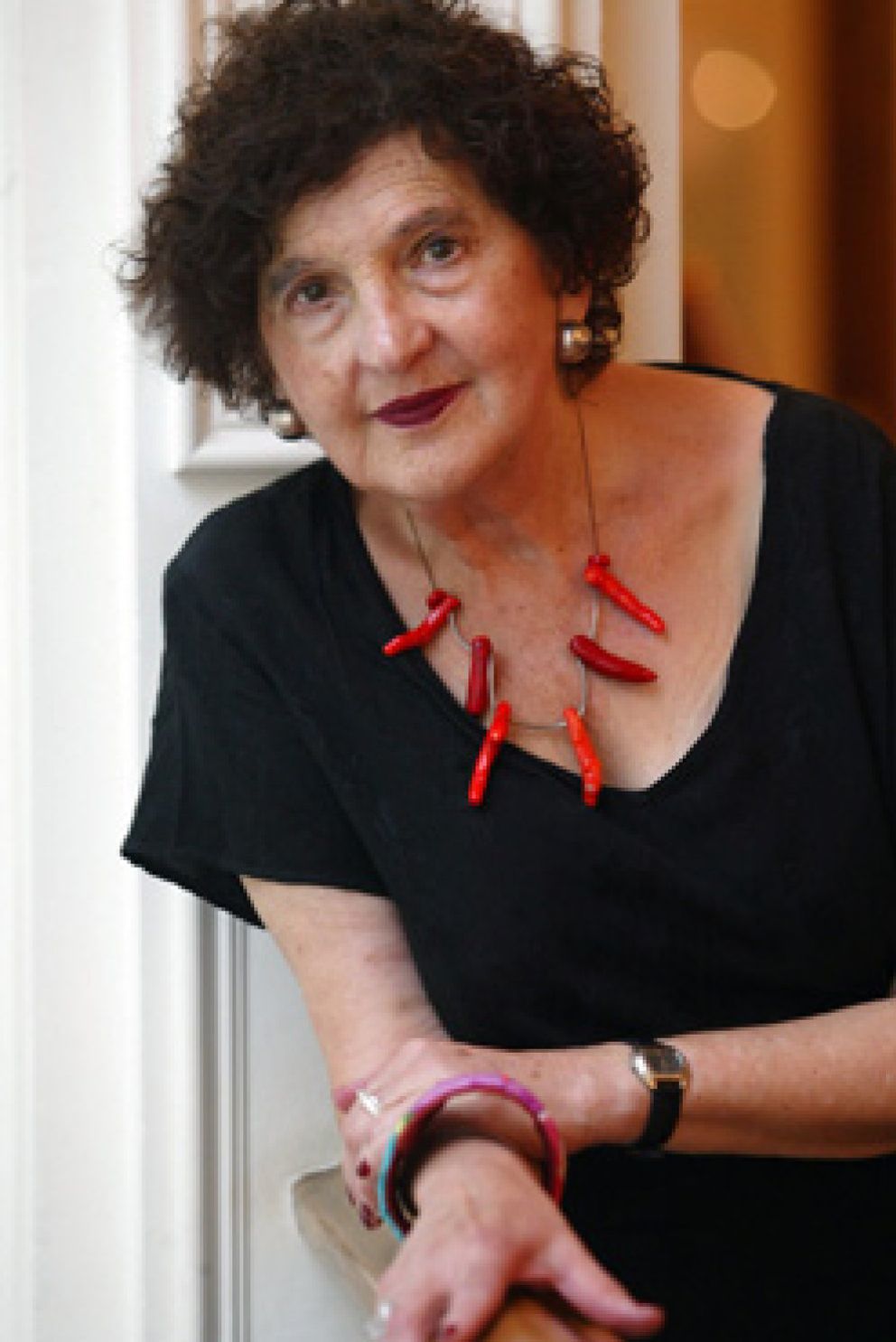
Margo Glantz, Author (1930- )

Margo Glantz fused Yiddish literature, Mexican culture, and French tradition to create experimental new works of literature.

Margot Glantz Author MexicanA prolific essayist, she is best known for her 1987 autobiography Las genealogías (The Family Tree), which blended her experiences of growing up Jewish in Catholic Mexico with her parents’ immigrant experiences. She also wrote fiction and nonfiction that shed new light on the seventeenth-century nun Sor Juana Inés de la Cruz. Among her many honors, she won the Magda Donato Prize for Las genealogías and received a Rockefeller Grant (1996) and a Guggenheim Fellowship (1998).

Glantz demonstrates tremendous versatility as an individual and as a writer in the creative ways in which she blends her multiple cultural, religious and literary affinities. She unabashedly resists classification or categorisation of any kind and therefore identifies herself neither as a Jewish writer nor as a composer of personal narrative, nor as a Sor Juanista, the term used to refer to those scholars who devote themselves to the study of Sor Juana Inés de la Cruz. Belonging to no single one of these groups or schools of thought, she is an enigmatic amalgam of all of them. Glantz’s multiplicity is what makes her unique, and failure to recognize any component of her being would diminish her diversity.

Despite being one of the most iconic figures in Latin American literature, her work is little known in English. Charco Press now bring her work to a new audience with this excellent translation by Ellen Jones.

The Remains was longlisted for the Warwick Prize for Women in Translation 2023.

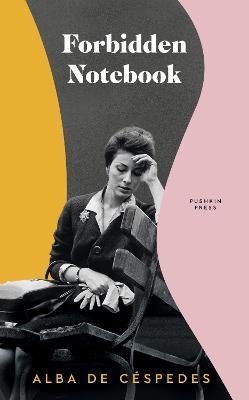
Forbidden Notebook by Alba de Céspedes (1952) tr. Ann Goldstein

I absolutely loved reading this, what a discovery! And brilliantly translated by Ann Goldstein.

Transgressive Writing

Italian feminist writing classic 1940s 1950ssValeria Cossati is a 42 year old Italian working wife, married with two children; one Sunday she is drawn to want to purchase a notebook in a local grocery store, a shop that is only permitted to be open on a Sunday, to sell tobacco. This purchase is her first act of transgression, the shopkeeper will allow it, but insists she hide the notebook in her coat.

The FORBIDDEN NOTEBOOK.

As if tainted by this scurrilous act, the notebook becomes something she must hide, for within its pages, she reveals her innermost thoughts, something she has not shared with anyone for years.

A Drawer Of Her Own, A Name of Her Own

From the first day she has the notebook in her home, she no longer feels safe, her husband, or one of her children might find it. She realises there is no place in her home that is private to her. In front of the family she tells her daughter she disapproves of her having a drawer she keeps locked.

Mirella responded energetically that if she studies so much, it’s because she wants to start work, to be independent, and to leave home as soon as she’s of age: then she’ll be able to keep all her drawers locked without anyone being offended.

Asking why she might want a drawer, at the suggestion that perhaps she too might like to keep a diary, the family laugh at her:

“What would you write, mamma?” said Michele.

Michele, her husband, since his mother died, he has started to call Valeria Mamma, a habit she enjoyed at first but increasingly resents.

Now I see it was a mistake; he was the only person for whom I was Valeria.

In Solitude I Meet Myself, A Stranger

For

Photo by Pixabay on Pexels.com

She writes late at night or at a time when the family aren’t at home, she wills them to leave (buying them tickets to a football match saying it was a gift from clients), so she can have time with her thoughts on the page.

Through her journal entries we discover that the words she speaks aloud to her family are often the opposite of what she is thinking. She never admits to resting, upholding the image of hard-working mother and wife.

I never confess it. I’m afraid that if I admitted I’d enjoyed even a short rest or some diversion, I would lose the reputation I have of dedicating every second of my time to the family. No one would remember the countless hours I spend in the office or in the kitchen or shopping or mending but only the brief moments I confessed I’d spent reading a book or taking a walk.

She criticizes and judges her daughter’s behaviour. Mirella is almost finished her law degree and starts working part time for a prominent lawyer, she is seeing an older, successful and sophisticated man – still a minor, she is reminded so by her mother – yet in the notebook, Valeria admires the independence her daughter is developing, the confidence she exhibits.

Mirella challenges her mother, when Valeria makes her take dinner to her brother who must have been tired after studying all day, she reminds her that they too have been working all day.

When she returned, she said “That is what disgusts me mamma. You think you’re obliged to serve everyone, starting with me. So, little by little, the others end up believing it. You think that for a woman to have some personal satisfaction, besides those of the house and the kitchen, is a fault, that her job is to serve. I don’t want that, you understand? I don’t want that.” I felt a shiver run down my spine, a cold shiver that I can’t get rid of. Yet I pretended indifference to what she said. I asked her ironically if she wanted to start being a lawyer in her own home.

I Am My Own Worst Enemy

In contrast, the lazy son Riccardo, who wants to go to Argentina, who neglects his studies, who speaks to his girlfriend in an authoritative manner, can do no wrong. When he makes an error of judgement, his parents laugh it off. Valeria is resentful when she realises her son is gaining a form of strength from his girlfriend that she couldn’t give him.

I wonder how – with her meager words, her motionless face – she can have bestowed on him such happy confidence…Michele says it’s always like that: the only thing that can spur a man is love for a woman, the desire to be strong for her, to win her.

Meanwhile, when her daughter displays the strength she yearns for in her son, she will have the opposite reaction.

I had to intervene, as when they were children, but, as then, I had the impression that Mirella was the stronger, and for that reason alone I would have liked to hit her.

The Cage Opens, My Inner Self is Overpowering Me

denial silence inability to express forbidden

Photo by Kat Smith on Pexels.com

The manner in which she writes begins to affect her appearance to others, for it injects an atmosphere of fear into her life, it is as if this activity of daring to write her feelings is highly subversive.  For someone usually so cool on the outside, so conformist to what a wife and mother in the 1940’s is perceived to be, the act of writing ignites a disturbing consciousness raising of a deep, inner, feminist desire for expression. Daily, she will explore this on the page, it will morph into an increased awareness, understanding and ultimately change her behaviour.

Her domestic discontent, the suppression of her innermost thoughts, having awakened and found a dangerous outlet, will escape their rigid enclosure and infect everything. She will become at odds with herself.

A Slow Rebellion, A Feminist Awakening

It is compelling and strange, the act of writing begins to have an effect on her relationships at home and at work, it precipitates a kind of mid-life crisis. The stirring up of long suppressed emotions and the witnessing of how a new generation of youth are entering adulthood, awakens a wave of desire and revolt that she both resists and can’t hold back, as her dissatisfaction with her life creates a restlessness that threatens to disrupt and erupt their imperfect equilibrium.

It is a subject explored by Virginia Woolf and others, a subject equally important today, the need for a safe space, time, a notebook – for women to connect to that aspect of themselves that isn’t in service to others, to their inner creativity, expression, joy – to arrive at the place of realising that they too deserve that.

Highly Recommended.

Alba de Céspedes, Author

Feminism Journal writing Womens Rights Italian LiteratureAlba de Céspedes (1911-1997) was a bestselling Italian-Cuban novelist, poet and screenwriter. The granddaughter of the first President of Cuba, who helped lead Cuba’s fight for independence, she was the daughter of a Cuban diplomat and his Italian wife, raised in Rome, Italy. She kept alive her family’s political commitment, often running afoul of Italy’s Fascist regime.

Married at 15 and a mother by 16, she began her writing career after her divorce at the age of 20. She worked as a journalist throughout the 1930’s while also taking an active part in the Italian partisan struggle and was twice jailed for anti-fascist activities, in 1935 and in 1943 after she had joined a resistance radio program, broadcasting from Bari under the pseudonym Clorinda.

By the 1950s, she was known throughout Italy. For years she wrote a popular advice column, tackling questions about marriage, infidelity and love with meditations on art and philosophy. These columns steered readers toward a modern, more secular morality, one that stressed women’s equality.

After the fall of fascism, she founded the literary journal Mercurio and went on to become one of Italy’s most successful and widely translated authors.

The New York Times reviewer called de Céspedes “one of the few distinguished women writers since Colette to grapple effectively with what it is to be a woman.”

Forbidden Notebook was longlisted for the Warwick Prize for Women in Translation 2023.

Further Reading

New York Times Review, Jan 2023: The Transgressive Power of Alba de Céspedes by Joumana Khatib

Washington Post Review, Feb 2023: ‘Forbidden Notebook’ is a slyly subversive novel by a writer once banned by Roxana Robinson

“While I am writing, I confine myself to occasionally reading books that keep me company not as entertainment but as solid companions. I call them books of encouragement, like those by Alba de Céspedes.” Elena Ferrante

N.B. Thank you to the publisher Pushkin Press for providing me with a review copy.

The Art of Losing by Alice Zeniter tr. Frank Wynne

Most Popular Library Book of 2022

The Art of Losing by Alice Zeniter was the winner in 2022 of the Dublin Literary Award, an award where all books nominated are chosen by librarians around the world. As a result, this book went on to become the most borrowed book in Ireland, though it was nominated by the Bibliothèque publique d’information, France.

Three Generations of Family From 1930’s Algeria to Present Day Paris

Spanning three generations, beginning with Ali, born in a mountain village of the Kabyle region of northern Algeria, his son Hamid, also born there but whisked away to France with his parents in 1962, when threats and violence arrived in the village, endangering their lives, to Naima, born in France – the one who seeks answers to questions about who they are, why they had to leave and the stigma that surrounds their identity.
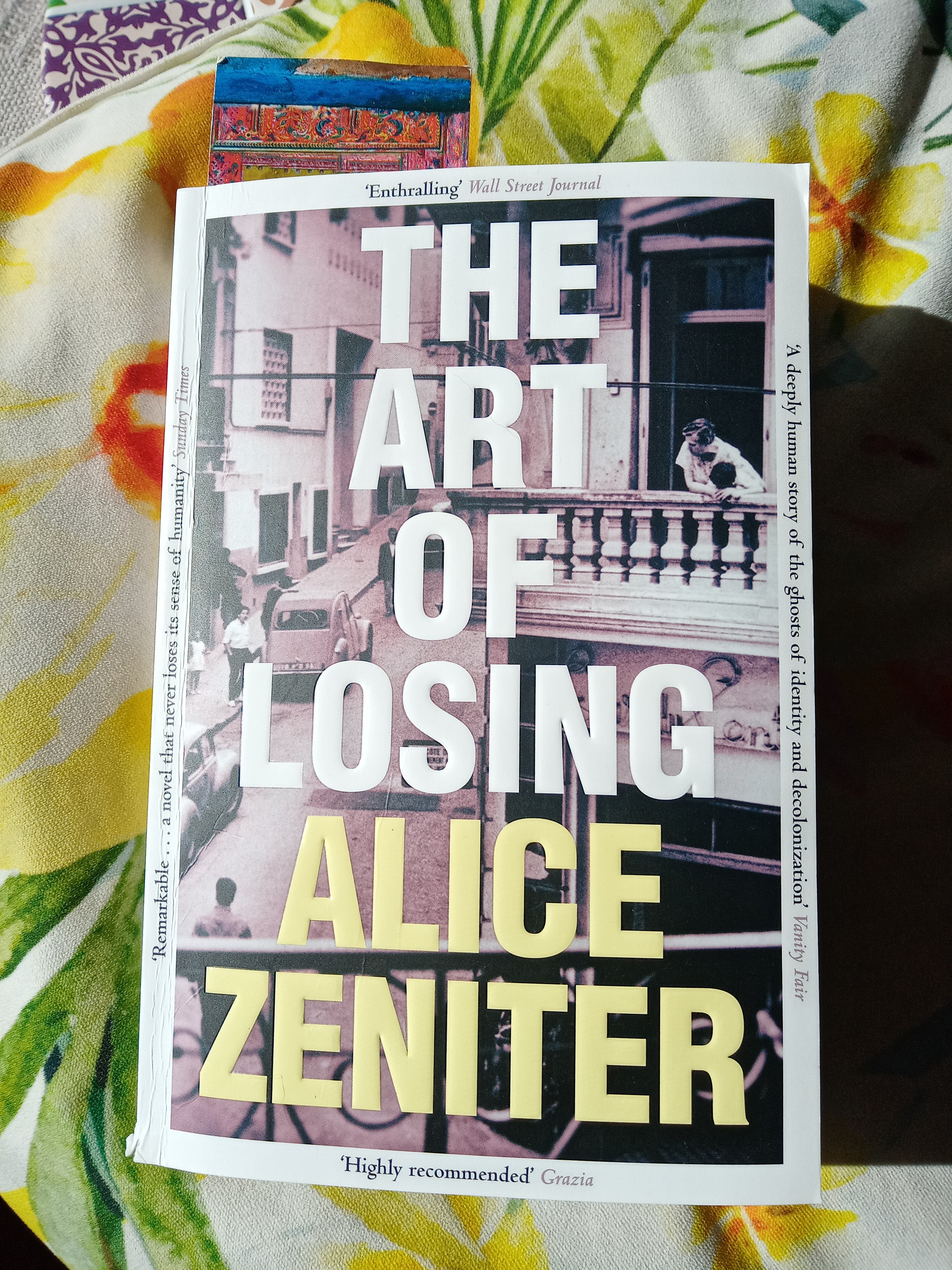
wp-1676027504150Written in three parts, each is an immersion in that era and life, showing how swiftly families change when they cross into another culture, how foreign they become to their own, how important it is to heal the wounds of the past, to acknowledge, understand and have tolerance for differences; how fear passes down ancestral lines, how connection is important.

The prologue begins on a day near the end of what is to come. Naima has a hangover, a phrase repeats in her mind, her cousin’s words, demanding ‘Have you forgotten where you come from?’ She is preparing for an exhibition, an event that will take her back to her roots in Algeria.

As with many that use a prologue, it is a good idea to reread it after finishing the book, it has little context in the beginning. To be honest, I don’t find its placement at the beginning either helpful or intriguing. The book didn’t need it.

A Kabylian Mountain Village

And so we return to the 1930’s, a better place to begin the story.

In the 1930’s, Ali is a poor adolescent boy from Kabylia. Like most boys in his village, he is hesitating between breaking his back in small family fields dry as sand, tilling the lands of a colonist or some farmer richer than he is, or going down to the city, to Palestro, to work as a labourer.

olive press

Photo by Alin Luna on Pexels.com

The family fortune changes, first when their father dies in a rockslide, then when Ali and his brothers are caught in a flash flood and manage to not only save themselves, but trap a floating olive press that almost drowns them.  It becomes key in changing their circumstance and before long they buy olive groves of their own.

The wealth of Ali and his brothers is a blessing that rains down upon a wider circle of cousins and friends, binding them into a larger, concentric community. It takes in many of the villagers, who are grateful. But it does not make every one happy. It overthrows the erstwhile supremacy of another family, the Amrouches, who, it is said, were rich back when lions still roamed.

Though it is 100 years since the colonisation of Algeria by the French, life in the mountainous hamlets still runs according to clannish loyalties. Rifts exist between villagers, each sides with their own clan, it brings no hatred or anger, in the early days it is simply a matter of pride, of honour. However, whenever there is a debate or decision, they naturally take opposite views.

A qaid (local leader appointed by the French) warns them of bandits, men who say they are fighting for the independence of the country, said to have been manipulated by Egyptian revolutionaries and Russian communists. When the freedom fighters appear, they will tell them they are not outlaws, ‘we are Kabyles, Muslims, like you’.

The villagers waver between exaltation and fear.  Exaltation because everyone here  believes that the French have no right to what the mountain lands offer to the Kabyles. Fear because of the word ‘we’, used so casually by this man that no one here has ever seen.

Things hot up and eventually they will be warned against listening to French propaganda and threaten those affiliated with them, (WW2 war veterans) should they continue to claim their war pension. This group become referred to collectively as harki. As will be their descendants, anyone who admits their family left in 1962.

First Generation Transition

Camp de Rivesaltes 1962 FranceWhen they flee to France, they are initially housed in the ‘Camp de Rivesaltes‘ and subsequently sent to a social housing community in Normandy. Hamid is the eldest of what will soon become a family of 10 children. He is the go-between, the first to receive the French education, to learn what is expected of them, to encounter racism, to want to escape the entrapment of a family that will always be seen as outsiders.

Perhaps if his childhood had been like Clarisse’s, he would have done something else, he would have taken the time she suggested to to discover what he truly loves, what he wants to devote his days to doing, but he has not been able to shake off entirely the obligation of the utilitarian, the efficient, the concrete, nor has he been able to shake off a notion of the civil service as a grail where he is fortunate to be allowed to work.

At night, as he sets his alarm clock, he sometimes thinks that it takes much longer than he expected to escape, and that if he has not put as much distance between himself and his childhood as he would have liked, the next generation can carry on where he left off. He imagines that what he is really doing in the stifling little room that serves as his office is amassing shares in freedom that he will be able to pass on to his children.

He is free to marry for love, but he carries a legacy of silence into it. Outside the country of his birth, he is not judged like his father was for initially not producing a son. Hamid will raise only girls. One of them, Naima will tell their story.

“Every family is the site of a clash of civilizations.” Pierre Bourdieu, Sociologist, Algeria 1960

A Mystery of Identity and Repercussion for Multiple Generations

On discovering her father and therefore her family are referred to as harki, Naima sets out to discover what exactly this means and what her grandfather and others like him might have done to be so distrusted by their own. Despised at home and unwelcome in the country that has given them citizenship due to their efforts and support during WW2 – and left them stranded thereafter.

The path to acceptance is a lonely road and an almost impossible one without losing one’s identity completely; something must be let go, given up – each successive generation moves further away from their roots, knowing less and less about who they were.

The War That Made Heroes of Some & Traitors of Others

Naima’s investigation into her grandfather Ali’s past, reminds us of others who joined the cause to fight in WW2, of the Battle of Monte Cassino, in Italy. Like men from other colonial countries, he fought, yet as a consequence, for defending France, for being a war veteran, became perceived by many in his own country as a traitor.

As I read about this, I stopped and went to check a few of my own ancestral documents and sure enough, my grandfather too fought in the Battle of Monte Cassino, a raw subject he never talked of, that gave him nightmares for years. He lost his best friend there. In his division alone 1,600  New Zealanders lost their lives. These men were always regarded as heroes.

Looking Back, Healing Wounds, Learning Whose Version of a Story?

The Art of Losing brilliantly portrays these lives over three generations to bring Algerian history alive in a way that is rare to come across. Though there is a depth of research behind it, the pace never slows, in the hands of this storyteller, artfully using her characters, their relationships and circumstances to present an historical perspective and explain why sometimes silence and burying ones pain seem like the only way to survive, to manage disappointment. But then successive generations are challenged in relationships to break old patterns and heal wounds they may have inherited without even knowing the cause.

The novel ends with a retrospective art exhibition of a man Lalla, named in homage to Lalla Fatma N’Soumer (1830-1863) a Kabylan leader of resistance against the French, an Algerian Joan of Arc.

History is written by the victors, Naima thinks as she drifts off to sleep. This is an established fact, it is what makes it possible for history to exist in only one version. But when the vanquished refuse to admit defeat, when, despite their defeat, they continue writing their own version of history right up to the last second, when the victors for their part, write their history retrospectively to show the inevitability of their victory, then the contradictory versions on either side of the Mediterranean seem less like history than justifications or rationalizations sprinkled with dates and dressed up as history.

Perhaps that is what kept former residents of Bias so close to the camp they loathed; the could not bring themselves to break up a community that had reached an agreement on the version of history that suited them. Perhaps this is a foundation of communal life that is too often overlooked yet absolutely essential.

The original French version l’art de perdre was published in 2017, the English translation in 2021, and in Sept 2021 the French president Emmanuel Macron, made an official apology and asked for forgiveness for the French treatment of Algerian Harki fighters, for abandoning them during their home country’s war of independence. Trapped in Algeria, many were massacred as the country’s new leaders took brutal revenge. Thousand of others were placed in camps in France, often with their families, in degrading and traumatising conditions.

A Must Read novel. Highly Recommended.

Alice Zeniter, Author
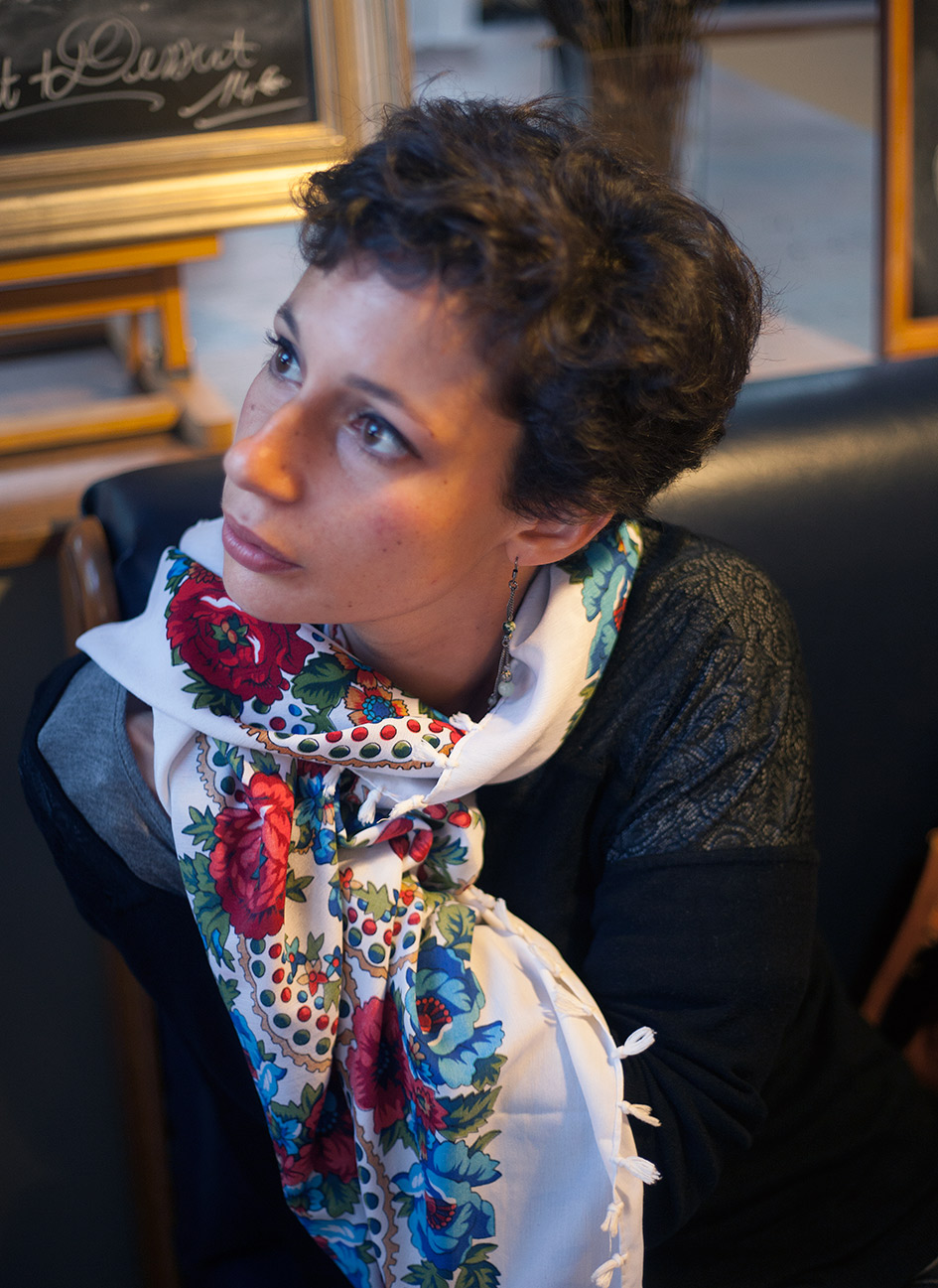
l'art de perdre harki AlgerianAlice Zeniter was born in 1986. She is the author of four novels; Sombre dimanche (2013) won the Prix du Livre Inter, the Prix des lecteurs de l’Express and the Prix de la Closerie des Lilas; Juste avant l’oubli (2015) won the Prix Renaudot des lycéens.

l’art de perdre (2017) won the Prix Goncourt de Lycéens and 5 other French literary awards, in translation as The Art of Losing (2021) it won the Dublin Literary Award (2022) and was among the 20 top-selling Francophone books for two years in a row.

“I decided I wanted to learn more, but I wasn’t particularly interested in doing all this research for myself. My own self isn’t of huge interest to me, whereas anything that taps into the collective, and the political, this I care about.” Alice Zeniter

On her Inspiration from French sociologist Nicole Lapierre (author of Sauve qui peut la vie)

“…in it, she says that we need to learn how to tell their story like we do Odysseus’s. That migrant’s stories aren’t about pity, no, they’re about a never-ending journey, a story of craft and resourcefulness, of strength and beauty, of repeated departures, and until we manage to tell these stories in that way, we are abandoning them, leaving them to at best be pitied, and at worst be hated and feared. And that’s when I realised that the story I was researching, which dated from the early 1960s, completely echoed these current events. It is the story of populations locked in camps built far from urban centres, hidden away so that many will be able to say they didn’t know, that they don’t want to know or bother with these realities, with typhus and lice… This is when I realised that there might be an emergency to write about this motif, focusing on the fact that any migration is first an emigration, and removing that part from the story amputates people, it condemns them to misunderstandings. And that’s also when I decided to write this story in three acts. The emigration, the arrival which never really arrives and the third generation which, despite knowing nothing about the land of origin, has never been able to fully arrive either, as French people.”

Alice Zeniter is a a French novelist, translator, scriptwriter and director. She lives in Brittany.

Child of Fortune by Yuko Tsushima tr. Geraldine Harcourt

‘Hark, my distant, quiet friend, and feel
Your breath still enriching this emptiness.’
RilkeSonnets to Orpheus

Such a thought provoking novel.

Child of Fortune begins inside Koko’s dream. Dreams appear often in the narrative, as do memories, not exactly nightmares, they make her uneasy, leave her feeling unsatisfied.

The dream consisted simple of staring at the ice mountain. It had no beginning and no end. When she opened her eyes the mountain was there, and when she closed them it was gone. Cold and abrupt, it wouldn’t allow her emotions free play like any ordinary dream.

Japanese literature literary fiction36 year old Koko raises her 11 year old daughter Kayako alone, she works part time teaching piano, though the way she is obliged to teach it pains her. Since she bought her apartment (thanks to a partial inheritance) she has also become independent of her family, something her sister Shoko constantly criticizes her for.

Shoko chose to stay living in the family home after the death of their mother, using her money to upgrade their lifestyle, the children’s schools. She is full of judgement. Undermining Koko, she lures the daughter away, to the point where Kayako only spends Saturday’s with her mother.

Koko was in fact proud of the way she and her daughter lived in their apartment – with no frills, and entirely on her own earnings – and she wanted Kayako to share that pride, but the cousins in their setting made a too-perfect picture.

Not wishing to nag and risk losing her completely (as she had done with the father and her lover), she allows her this freedom to come and go. She suspects the visit is a way of her sister keeping an eye on her. Her daughter confirms it.

That’s right. She said we can’t let your mother out of our sight or there’s no telling what she’ll get up to next.

Child of Fortune Dreams Ice Mountain Yuko

Photo Simon Berger @ Pexels.com

Koko begins to feel unwell.

She remembers her marriage to Hatanaka and how ill-suited they were, her husband so focused on his studies, never working, all his women friends, the loss of the few of her own, because they didn’t like him.

Though she has no memory of it, her father died when she was young, she knew he had gone to live elsewhere before she was born. Her mother too had raised her children alone.

Koko suspects she may be pregnant. She ignores it.

Three people. Koko was strongly attracted by the number’s stability. Not two, not four, but three. A triangle: a full, beautiful form. There was something to be said for the square, too, but the triangle was the basis of all form. The dominant.

She remembers her affair with Doi, three years before, how attentive he had become when he became a father himself. Then in the fall, she began seeing Osada, a friend of Hatanaka, stirring up old, deep regrets.

He reminds Koko of her brother who died, a child who found happiness in making others happy. The loss of this childhood connection is deep, profound, forgotten, almost non-existent. He had been Kayako’s age.

She was sure there could be no happiness for her without her brother. For the first time, Koko knew a kind of joy that had nothing to do with the intellect. The boy’s emotions were unclouded: what pleased him meant joy, what displeased him meant anger; but he experienced his deepest joy in enduring what displeased him for the sake of those he loved. She wondered why. Though he lacked intelligence, he was endowed with love, which was another kind of wisdom.

The sister arranges an interview for Koko’s daughter at the school her cousins attend. Koko isn’t comfortable but allows it. Kayako is worried about what to say about her father, having heard a lot of people are turned down because of their home background.

Koko’s dreams are like insights into a state of mind she can’t quite grasp. She is passive, the consequences of which threaten to overwhelm her, the potential loss of her daughter, the pending arrival of a baby, the secrecy around it. She thinks of everything, except what she must do, make a decision, confront reality. She has become somewhat paralysed.

She could hear her sister’s voice now, drawing gradually closer: so you’ve finally begun to understand what a bad mother you’ve been, how little sense you’ve shown? And hear herself protest; no, that’s not it – don’t think I’ve liked choosing a different world from other people. I know I’ve been stubborn – but not about Kayako alone. All my life, though often I haven’t known which way to turn, I have managed to make choices of my own. I don’t know if they were right or wrong. I don’t think anyone can say that.

Because of the insight into her mind, her thoughts, dreams, her past, we see all aspects of Koko and we hear the damning, irresponsible voice of her sister, the judgement that wears down what little self-worth remains. There is no recognition of her pain, of her depression, neither seen within nor by others. It is never mentioned, never thought of, yet it is obvious.

One thing, though, was certain: that she had never betrayed the small child she’d once been; the child who had pined for her brother in the institution; the child who had watched her mother and sister resentfully, unable to understand what made them find fault with her grades, her manners, her languages. And she was not betraying that child now, thirty years later. This, she had always suspected, was the one thing that mattered. And although she was often tempted by a growing awareness of the ‘proper thing to do’ once Kayako was born – not only in the harsh advice she was constantly offered by others, but within her own mind – in the long run her choices had always remained true to her childhood self.

Tsushima explores this in a powerful stream of consciousness narrative that invites all kinds of reactions from readers, many sit in judgement, casting Koko as the bad mother, the unconventional mother, the selfish woman pursuing her own desires.

And yet, she is the new woman, safeguarding the home, choosing to do something she loves without it stealing all her time, so she has time for her daughter and herself. She is independent and does not aspire to that which accrued wealth can buy.

It is a reflection on the many manifestations of grief, of events, moods and emotions that arrive unbidden; often unseen, rarely unexplained, but very present; and how little patience our society can have for understanding, how punitive we can be in our insistence on conventionality, how intolerant of depression, of weakness, of prolonged grief.

Rather than stand for any one view, Tsushima presents her character Koko and shows us the effect of her struggle for freedom.

As I finished the book, which was originally published in 1978, I was struck by the relevance of a quote by the French author Constance Debré, author of Love Me Tender translated by Holly James; in the Guardian on 14 Jan, 2023:

“There’s always a price to pay for freedom. To me, that’s a happier, livelier way to see things: rather than saying there are injustices or blows raining down on you, you realise it’s all because you’re living life in the way you want, seeking out an existence … trying to give life some shape. That’s why life and literature are so connected: it’s the quest for form.”

Yuko Tsushima, Author

Japanese literature feminismYuko Tsushima (1947-2016) was a prolific writer, known for her stories that centre on women striving for survival and dignity outside the confines of patriarchal expectations. Groundbreaking in content and style, Tsushima authored more than 35 novels, as well as numerous essays and short stories.

Like her protagonist in Child of Fortune, Tsushima’s childhood was marked by the death of her disabled brother. Her father, Osamu Dazai was one of the most celebrated Japanese writers of the 20th century, who passed away when she was a year old.

Tsushima’s 1978 novel Child of Fortune  won the 1978 Women’s Literature Prize in Japan, it was published in English in 1986 by The Women’s Press, earning the translator Geraldine Harcourt the Wheatland Foundation’s translation prize in 1990.

Further Reading

New York Times: The Overlooked Autofiction of Yuko Tsushima By Abhrajyoti Chakraborty

Three by Valérie Perrin tr. Hildegarde Serle

From Flowers to Friendship

Valérie Perrin’s Fresh Water for Flowers was the final book I read in Dec 2020 and one of my favourite reads of that year. It is a novel that has stayed with me since, due to a strong sense of place in various locations in France, the unique character of Violette Touissant and her unforgettable choice of careers; she moves from being a level-crossing keeper to cemetery keeper.

“If life is but a passage, let us at least scatter flowers on that passage.”

The Ties That Bind

French literature fiction Europa Editions

Valérie Perrin’s latest novel Three, (a 575 page chunkster) is something of a coming-of-age tale of three young people in a small provincial French town, intersecting with the mystery of why they no longer speak to each other, 30 years on.

“They were united by the same ideal: leaving when they were grown up. Quitting this hole to go and live in a city full of traffic lights, noise, and frenzy, of escalators and store windows, with bright lights everywhere, even in the middle of the night. With crowds on the pavements, of strangers, of foreigners one can’t gossip about.”

Set in 1986, the years they were at high school together and 2017 – the year a car is retrieved from the bottom of a lake with the remains of human bones in the back seat – the novel glides back and forth over time, scene by scene, recounting a kaleidoscope of episodes among the three that slowly reveal the depth of their relationships to each other and how they were torn apart.

“Étienne was the leader, Nina the heart, and Adrien followed with never a complaint.”

Unconventional Families

Nina was raised by her grandfather and never knew her single mother. She is both curious and resentful about Marion, with good reason. Having such loyal friends as Adrien and Étienne and the assurity of her grandfather’s presence, she feels secure.  He is worried about her, she exhibits signs of taking after her mother, traits he is determined to stamp out.

“He panics. Like lightning in his eyes. He’s brought straight back to his daughter, Marion. His punishment. She was the same. Something like misfortune running in their veins. The mother has contaminated the daughter. An affliction.”

coming of age french novel

Photo by iOnix on Pexels.com

Adrien lives with his mother Josephine. He sees his father occasionally, a man married to another, who will never leave his wife. He becomes the victim of a bullying teacher at school, the same year he becomes part of the Three. The school year that gave him two friends and took away his innocence.

“Sometimes, he would reappear. Like some public-works inspector, or cop. He barely rang the doorbell before coming in. He would glance around the apartment, at the paintwork, the plumbing, Adrien’s school report, leave yet another cheque on the table in the sitting room, and leave. No doubt his conscience clear.”

When the car is dredged from the bottom of the lake, a fourth voice, the only first person narrator in the novel appears. Virginie is a journalist, clearly someone who was at school with the Three. This character is something of an enigma, never mentioned in the adventures of the Three.

“They had no friends but themselves.They were almost stuck to each other, like puppies from the same litter. And yet, they in no way resembled each other. Neither physically, nor in their attitudes.”

Creating Suspense and Intrigue

Three Valérie Perrin Europa Editions

Photo Quang Nguyen VinhPexels.com

Valérie Perrin is quite the master at withholding and timing revelations, drip feeding events, turning points and characters to increase the intrigue, leading the reader down various paths of speculation, until further scenes reveal a bigger picture.

As major events occur, we witness how the three respond, how their dreams are both pursued and thwarted, how secrets eat away at them and ultimately how the strength and belief in their friendship can help them, if they can overcome their inner obstacles.

Ultimately, while there is an engaging plot and a multitude of minor intrigues layered around the central mystery, it is a novel that dissects friendship, its random formation and sense of belonging, its source of support to each person and potential for envy and destruction by those outside of it.

Over thirty years, they will make their mistakes, drift apart, come together, indulge resentments, forgive each other and come to realise that acceptance and truth can set them free from pain and longing, that personal histories matter and those who were part of them can help each other to heal.

A Feast of Issues, A Famine of Depth

It is an entertaining and enjoyable novel, the way the text goes back and forth, the slow reveal, felt very much like something written for the screen, not surprising given that the author is a photographer and screenwriter.

My criticism  would be that there is an attempt to pack too much into the novel; weighty issues, each of which could have been a central theme of the novel. The sheer number of significant issues it raises, in some way dilutes them and compromises the authenticity of some of the secondary characters. The author has ambitious ideas and an interest in social issues, but as a result some are dealt with too lightly, or used to create intrigue, which at times felt inauthentic, a disservice. It’s neither a conventional mystery/thriller or literary fiction, it sits somewhere between the two, something of a hybrid.

Valérie Perrin, Author

Fresh Water for Flowers, ThreeValérie Perrin is a photographer and screenwriter who was born in the Vosges in 1967, grew up in Bourgogne and settled in Paris in 1986, then Normandy in 1995.
Her novel The Forgotten Sunday (2015) won the Booksellers Choice Award. Her English language debut Changer l’eau des fleurs (Fresh Water for Flowers) (2020) was translated into 30 languages, it won the Prix Maison de la Presse 2018 and the Prix des Lecteurs au livre de poche in 2019 and was longlisted for the Dublin Literary Award 2022.

Figaro Littéraire named Perrin one of the 10 best-selling authors in France in 2019, and in Italy, Fresh Water for Flowers was the best selling book of 2020.

N.B. Thank you to the publisher Europa Editions, for providing me a review copy of the novel.

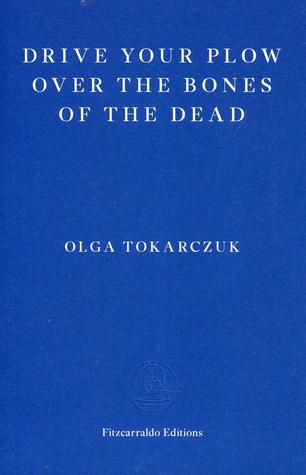
Drive Your Plow Over the Bones of the Dead by Olga Tokarczuk tr. Antonia Lloyd-Jones

Polish Literature Novel Prize Winner Blake AstrologySomewhere on a plateau above a small forested village in Poland, near the border with the Czech Republic, lives Janina, except she doesn’t like that name, she insists on being called Mrs Duszejko.
An astute observer of things around her, she is more of a winter type, has knowledge and interest in the influence of planets and houses, likes to translate Blake’s poetry and read his letters, has great respect for all sentient beings, except perhaps those who hunt Animals for sport and take joy in it.

The novel opens as her neighbour whom she refers to as Oddball knocks on her door very early one morning to inform her that their mutual neighbour Big Foot is dead. The two visit his home and do what they think good neighbours should do, respectfully arranging the contorted corpse, though Oddball’s son Black Coat (a policeman) later tells them off for moving the body.

Our Feet Connect Us

Mrs Duszejko observing his feet:

They astonished me. I have always regarded feet as the most intimate and personal part of our bodies, and not the genitals, not the heart, or even the brain, organs of no great significance that are too highly valued. It is in the feet that all knowledge of Mankind lies hidden; the body sends them a weighty sense of who we really are and how we relate to the earth. It’s in the touch of the earth, at its point of contact with  the body that the whole mystery is located – the fact that we’re built of elements of matter, while also being alien to it, separated from it. The feet – these are our plugs into the socket. And now those naked feet gave me proof that his origin was different. He couldn’t have been human. He must have been some sort of nameless form, one of the kind that – as Blake tells us – melts metal into infinity, changes order into chaos.

Referring to her Little Girls draws attention to another mystery, and while she doesn’t share the story of what happened to them initially, they are an absent presence throughout the story, a conundrum that will eventually be revealed, including its connection to the death of the neighbour.

brown deer under trees

Photo by Devon Rockola on Pexels.com

Described as reclusive, unconventional and eccentric, she might well be the most sane person in the village, certainly she is one of the more interesting. An intellectual and a mystic, a lover of nature, philosophy, astrological influences, animals and wildlife, surviving in a village that reveres hunting, an activity undertaken by the Commandant of Police, the local priest, the village President and other dominating types puts her in the firm minority – despite her isolation, she finds her circle within the community.

Unhappy at the way the authorities are conducting their investigation, convinced by clues she has observed – ominous deer tracks – she writes to the police bringing their attention to her theory of revenge by wildlife against the actions of hunting humans. And recalls her earlier reports to them about Big Foot’s poaching activities. Death brings another element to her theory, the effect of astrological shifts and patterns.

I could also tell that he didn’t understand everything that I was saying – firstly for the obvious reason that I was using arguments alien to him, but also because he had a limited vocabulary. And that he was the type of Person who despises anything he can’t understand.

A Community of Soul Mates

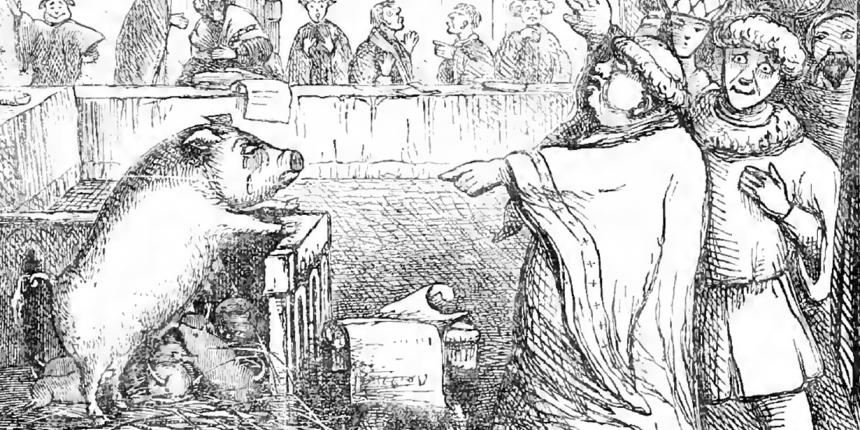
A sow on trial in at Lavegny in 1457 from The Book of DaysDizzy, a former student, now her 30 year old friend, helps with the Blake translations, though is unconvinced by some of her  theories concerning astrology and the revenge of animals, bolstered by her having discovered real animal trials, which peaked in 14th to 16th century Europe.

It was believed by many medieval authorities that ‘crimes’ committed by animals were the devil’s work and letting them go unpunished would provide an opportunity for the devil to take over human affairs.

Dizzy, who’s prone to effusive digressions on the topic of Blake’s symbolism, has never shared my passion for Astrology. That’s because he was born too late. His generation has Pluto in Libra, which somewhat weakens their vigilance. And they think they can balance hell. I don’t believe they will manage it.

Drive Your PLow Over the Bones of the Dead Olga Tokarczuk PolishWhen he challenges her for going around telling people about those Animals, concerned for her reputation, she  is outraged.
‘One has to tell people what to think. There’s no alternative. Otherwise someone else will do it.’

Another of the villagers is the young woman who runs a vintage clothing shop, a place Janina discovered one day when she was frozen through and hungry. The characters she befriends represent hope in an otherwise worrisome society.

The whole thing was a mixture of socialist café, dry cleaner’s and fancy-dress costume hire. And in the middle of it all was Good News.

That’s what I called her.  This name suggested itself irresistibly, at first sight.

Mrs Duszejko (Janina) is fed up and no longer young, she says what she thinks and doesn’t care what others think of her. She reads the signs and takes action. She’s an unexpected delightfully, transgressive heroine, of her own existential thriller.

I absolutely loved it and was surprised at how accessible a read it was, given this is an author who recently won the Nobel Prize for Literature. Her power to provoke by telling a story is only heightened by the suggestion on the back cover that her ideas presented here caused a genuine political uproar in Poland.

Further Reading

The Guardian: Interview – Olga Tokarczuk: ‘I was very naive. I thought Poland would be able to discuss the dark areas of our history’ by Claire Armitstead

Olga Tokarczuk, Author

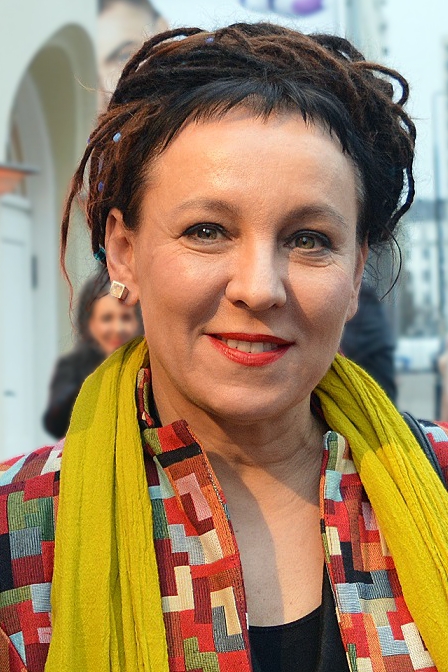
Polish literature Nobel Prize LiteratureOlga Tokarczuk is an Aquarian, a Psychologist and Jungian expert, a Polish essayist and author of nine novels, three short story collections and her work has been translated into forty-five languages.

Her novel Flights won the 2018 International Booker Prize, in Jennifer Croft’s translation. In 2019, she was awarded the Nobel Prize in Literature. Primeval and Other Times (1996) was her first work translated into English in 2010.

Her most recently translated novel, written over six years, The Books of Jacob (2014) was published in English in Nov 2021.