La petite fille de Monsieur Linh by Philippe Claudel tr. Euan Cameron

This month our bookclub chose a slim novella by the French author Philippe Claudel to read, La petite fille de Monsieur Linh; an interesting and somewhat ambiguous title because it can be interpreted in two different ways, already a dilemma for the translator no doubt, because petite fille is the expression used for grand-daughter, but it can also be read as petite ‘little’ and fille ‘girl’.
Something I have often wondered – why is it that there is only one word fille that means both girl and daughter, whereas there are two words for the male equivalent fils meaning son and garçon meaning boy?  The same thing happens with woman and wife, the French word is femme, whereas man is homme and husband is mari.
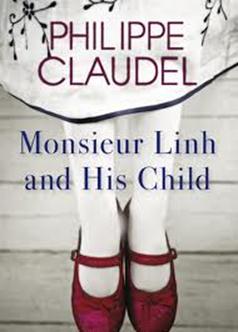
So did the English translation go with grand-daughter or little girl you might ask? Actually neither, the English title as shown is Monsieur Linh and His Child.  I’m not sure why they stay with Monsieur rather than Mr, I was not under the impression that he spoke in French.  It becomes clear how much of a task translating a novel must be, so many decisions to make or discard with the title alone, already certain ambiguities are lost while other insinuations are made.

Our English speaking bookclub has an international membership, so while we all read the book in French, the discussion is in English. For those of us reading French as a second language, the experience was quite different from reading a book in English.

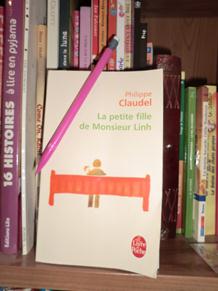
We all went through a similar experience, starting out with a dictionary close at hand and looking words up, until we got fed up with that and decided to continue reading without stopping, some of us underlining words to come back to.

As you can see, I had my pencil ready and I also downloaded the English version to my kindle and started reading concurrent chapters, only to discover I really was just repeating myself and it wasn’t necessary to do that. But enough of the process, what a stunning novella!

Monsieur Linh has no choice but to flee his country of birth due to tragedy and destruction around him, war or some kind of tyrannical regime have made it impossible for him to stay, and so he takes a boat with his grand-daughter Sang diu, arriving as a refugee in a country across the water somewhere.

In the Shadow of the BanyanThe author does not say where he came from or where he arrives at, making this part of the reading experience, in fact we all had various impressions of where the story may have taken place, my own impression very much influenced by my recent reading of Vaddey Ratner’s novel In the Shadow of the Banyan and my own travels in that part of the world.

Monsieur Linh doesn’t leave the refugee dormitory at first, but when he does he befriends Monsieur Bark and so begins a regular coming together, a special friendship despite the incomprehension of each other’s language. In a sense we are as uninformed as Monsieur Linh, we follow him into the unknown, share his anxieties and fears for Sang diu and feel the deep and mutual appreciation of the gestures of new-found friendship.

Lorsque Monsieur Bark parle, Monsieur Linh l’écoute très  attentivement et le regarde, comme s’il comprenait tout et ne voulait rien perdre du sens des mots. Ce que sent le vieil homme, c’est que le ton de la voix de Monsieur Bark indique la tristesse, une mélancolie profonde, une sorte de blessure que la voix souligne, qu’elle accompagne au-delà des mots et du langage, quelque chose qui la traverse comme la sève traverse l’arbre sans qu’on la voie.

When  Monsieur Bark speaks, Monsieur Linh listens to him very attentively and looks at him, as if he understood everything and did not want to lose any of the meaning of the words.  What the old man senses is that the tone of Monsieur Bark’s voice denotes sadness, a deep melancholy, a sort of wound the voice accentuates, which accompanies it beyond words and language, something that infuses it just as the sap infuses a tree without one seeing it.

When I bought this book, another reader cautioned me against reading any reviews because there is a twist at the end of the book, so I did as mentioned and kept the reading experience pure. There is so much more I could share about how we invest ourselves in characters as readers, wishing things to happen and just as in life, ignoring the niggling instinct.

Irène Némirovsky’s Ida & La comédie bourgeoise

It is a beautiful story and I urge you to read it in English or in French, it is a testimony to kindness, tolerance, suffering and the small but heartfelt joys that friendship brings. Not just a wonderful story, but it has inspired me to be brave and try another short book in French. So I have my pencil ready loving that the novella form is so popular and inexpensive in France, so here is my next foray, – no rush mind you.

So do you read in a second language or like to read foreign fiction?

Summer Reads

I’m not one for compiling lists of what I am going to read ahead of time, because I value too much the freedom and spontaneity of a vast sea of choices each time I finish a book, and often the reading experience will lead me on to the next thing.

Like reading Barbara Kingsolver’s ‘Prodigal Summer’ straight after ‘The Namesake’. How could I know that after listening to the group discussing the book I would have a conversation with a local poet about the beauty of sentences and Jhumpa Lahiri’s essay and that she would tell me I must read Kingsolver’s book.  It was sitting on the shelf unread and thus I abandoned all other reading ideas and jumped straight into it.

100 years on, Titanic Belfast Museum

But I do love looking at the lists, always feeding into the mental TBR list, noting books I might wish to read or to keep an eye out for.

I could say I have intentions for summer, like the two Titanic inspired books I bought on a recent visit to Titanic Belfast, the excellent museum opened in March this year.

‘A Night to Remember’ and ‘And the Band Played On’ also seem appropriate companions to Charlotte Rogan’s ‘The Lifeboat’ which I have on kindle.

To help you decide, I wanted to share this excellent flowchart designed by Teach.com to encourage students to find a book of their choice, there are 101 books shown, inviting readers to consider fiction versus non-fiction, classic or contemporary and many other options.  I keep coming across it and there’s something appealing about viewing images of covers rather than just a list of titles, so enjoy and I hope you find something for your own summer read!


So do you plan your reads or are you open to the spontaneous?
Summer Reading Flowchart

Via Teach.com and USC Rossier Online

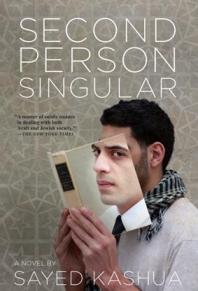
Second Person Singular

It is likely that there will be different perceptions of Sayed Kashua’s  ‘Second Person Singular’ not only due to the literary devices he uses, but on account of ‘where we are coming from’ and perhaps too, where we come from.

I am intrigued by the questions it raises, which require some discussion to make sense of, which may never be resolved or agreed upon because of that earlier dilemma, perspective. They concern how identity affects behaviour and opportunity, the interactions of and between people who possess subtle differences, some of which are merely perceived and not necessarily seen, a surname, religious preference, education.

The story concerns ‘the lawyer’, an educated and ambitious man regarded as one of the most successful Arab criminal attorneys in Jerusalem. One day he picks up a second-hand copy of Tolstoy’s novella ‘The Kreutzer Sonata’, recognising it as a volume his wife has mentioned in the past with enthusiasm, only to discover what he perceives as a love letter between its pages, in his wife’s handwriting. Discovering the name Yonatan on the inside cover, between bouts of violent and paranoid thoughts regarding his wife, he sets off to hunt the culprit down.

The unveiling of the truth behind the note, is revealed before the end and what follows is a dissection of the two male characters behaviours, as we await the final confrontation. The lawyer, whose name we never learn , lacks emotion and seems aloof, suited to his role, until the discovery of the letter when it is revealed just how delusional and extreme his emotions can be, left unchecked by reality. The culprit, in some ways is similarly deluded, but in a more intriguing and interesting way.

As a reader I found the characters of more interest through their observations of the city and society they worked within, the villages they lived in and the consequences of their identity. It is this that would generate an interesting discussion, particularly as the two characters the story follows represent different faces of that same society.

They are Arab-Israeli’s, non-Jewish Israeli citizens whose cultural and linguistic heritage is Arab. A matter of geography and politics, those who live in the Occupied Territories (otherwise known as the West Bank and Gaza) are of the same ethnic origin but refer to themselves as Palestinian, they of the same family as Arab-Israeli’s, they just carry a different legal status, which affects their education and employment opportunities and much more.
Creating strict country borders is a relatively modern idea and none more controversial than this ever-changing one, the enforcement of borders then gives rise to terms such as immigrant and refugee. The lawyer and other young educated men like him from villages in the North upon becoming doctors, lawyers and accountants in Jerusalem move to a suburban part of the city, where they were referred to by locals as immigrants, they are in fact the emerging middle class and we are given an interesting insight into what this means and how it manifests for this new generation of young people.

Perhaps it is a consequence of language and therefore thinking processes, but it reminds me that here in France the word for country ‘pays’ is the same word as region, so we can begin to understand how someone might be regarded as an immigrant in their own country.

Much of what this novel leaves me thinking about is how identity, borders and names can shape and influence opportunity and destiny, a universal dilemma for many or if we are fortunate, chances that we don’t even realise are so much more of an advantage than what some must confront by virtue of birth.

An interesting story and an exceptional insight into a world few really know or understand.

Note: This book was an Advanced Reader Copy (ARC), provided by the publisher via NetGalley.

Other People’s Stories

Recently someone asked as I live in France, was I reading any French authors, which prompted me to look on my shelves and reflect on this question. There were the two Irène Némirovsky books, ‘All Our Worldly Goods’ and ‘Fire in the Blood’ I read earlier this year and after discovering one of my French students was reading Dostoevsky’s ‘The Idiot’, one of my favourite classics and an excellent study of character, we exchanged books, he lending me Stefan Zweig’s ‘le voyage dans le passé’ (in French and an Austrian author so translated from German) while I gave him Paul Durcan’s epic poem ‘Christmas Day’.

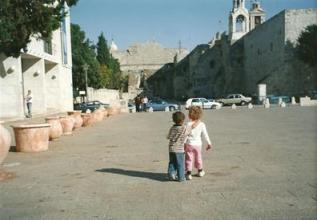
Manger Square, Bethlehem, Nativity Church beyond

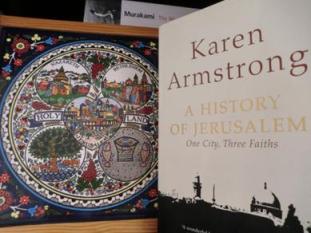
I have read a couple of Amélie Nothomb books, ‘Fear and Trembling’ a factional account of her year spent in Japan, which was very funny in an excruciating way and I adored Gustave Flaubert’s ‘Madame Bovary’, a book I’d put off reading for years and finally read it during a two month visit to Bethlehem, a welcome reward following Karen Armstrong’s
excellent but gruelling ‘A History of Jerusalem’
– One City, Three Faiths after which I had a feeling of absolute awe that there were ANY people left living in that part of the world, having endured one crusade after another as successive peoples carried out their quest to occupy that Holy Land. I also became more wide awake as to how this current generation of people carry the blue eyed gene.

I digress. Back with contemporary literature, my book buddy had mentioned Emmanuel Carrère’s ‘lives other than my own’ to me a few times and her creative writing class are about to be introduced to it, so I found a window of opportunity to read it this week. And what an extraordinary thing it is. Familiar with the phrase ‘truth can be stranger than fiction’; here I am left with the feeling that ‘truth can be as compelling as fiction’.

Emmanuel Carrère was on holiday in Sri Lanka with his girlfriend when the tsunami struck, they had been considering separating and then found themselves in a whirlwind period where the relative significance of these reflections was crushed by that incoming wave and the devastation it wreaked on others.

“Everything that has happened in those five days and was ending then, at that precise moment washed over us. A dam opened, releasing a flood of sorrow, relief, love, all mixed together.

I hugged Hélène and told her, I don’t want to break up anymore, not ever.

She said, I don’t want to break up anymore either.”

The couple return to France only to learn that Hélène’s sister is on a downward spiral with the return of a cancer that she had thought she was rid of when she was a teenager. Juliette, now in her thirties, is a juge d’instance (a judge of small claims and grievances) and has three girls, the youngest only fifteen months old. Through Juliette, Carrère meets her colleague Etienne, a cancer survivor, who shares with the author an insight into both the world of being a cancer survivor and their realm as judges in the small town of Vienne, where they strive and indeed succeed to make a difference.

What makes this recount all the more extraordinary is the sense of the author’s narcissism, long time chronicler of the tormented self, he readily admits this and while I wouldn’t say that being witness to these events resulted in an absolute cure, it certainly lead him, as the book title suggests, to explore and find some empathy in lives other than his own.

While on the French theme, I would like to mention Patricia Sands, author of ‘The Bridge Club’, another story inspired by the lives of others, Patricia is an advocate of the premise that everyone has a story to tell and she does this not only through her novel but via her blog. Each Friday she posts about France and this week, she has very kindly written a post about this blog, which you can view here. So thank you Patricia and do check out her book.

A Rhyme for the Odes (Mu’allaqat)

No one guided me to myself. I am the guide.

Between desert and sea, I am my own guide to myself.

Born of language on the road to India between two small tribes,

adorned by the moonlight of ancient faiths and an impossible peace,

compelled to guard the periphery of a Persian neighbourhood

and the great obsession of the Byzantines,

so that the heaviness of time lightens over the Arab’s tent.

Who am I? This is a question that others ask, but has no answer.

I am my language, I am an ode, two odes, ten. This is my language.

I am my language. I am words’ writ: Be! Be my body!

And I become an embodiment of their timbre.

I am what I have spoken to the words: Be the place where

my body joins the eternity of the desert.

Be, so that I may become my words.

No land on earth bears me. Only my words bear me,

a bird born from me who builds a nest in my ruins

before me, and in the rubble of the enchanting world around me.

I stood on the wind, and my long night was without end.

This is my language, a necklace of stars around the necks

of my loved ones.

– extract from ‘A Rhyme for the Odes’

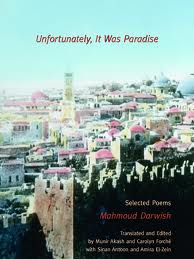
by Mahmoud Darwish, from the collection ‘Unfortunately, It Was Paradise’

(13 March 1941 – 9 August 2008)

All Our Worldly Goods by Irène Némirovsky

This is the second novel I picked up from the library, the first being ‘Fire in the Blood’ a tale of the consequence of indulging forbidden love. ‘All Our Worldly Goods’ has a similar theme but with different circumstances and this is more a story of what happened in the early 1990’s to those who preferred to make their own decisions regarding matrimony rather than follow the sage advice of their parents or in this case Grandfather. It is also a prelude to Némirovsky’s masterpiece ‘Suite Francaise’.

This is an era where marrying for love can be serious enough an outrage to find oneself disinherited. When there is only one son and heir and the family fortunes are dwindling, it is necessary that said son marries a woman with a significant and esteemed dowry. Pierre Hardelot follows his heart rather than his head and becomes estranged from his family just before being conscripted into the army to fight in the First World War.

Returning to the ruins of home © IWM (B7688)

With the onset of war, their families are forced to abandon the village, some fleeing by car, others on foot, only to eventually return to ruins, which they set about rebuilding in the hope that something as horrific and terrible as this war they have experienced can never be repeated.

However history has a habit of repeating itself, and so it does in both love and war. Another generation and an heiress banished by her family due to long standing interfamily resentments, and another son called up to war.  Fortunately death, destruction and shared traumatic experiences can provide the necessary ingredients for forgiveness, especially when strong, capable, male resources become a scarce commodity.

It is an interesting story depicting the lead up to the forced evacuations by families from the cities and provinces to find safety from the advancing invading armies, though it is dealt with lightly and there is nothing of the terror that one assumes must have consumed Némirovsky herself, knowing what her own family went through. In this story we are never confronted with the invaders and neither do we have a very real feeling for how war must have changed Pierre.

First published in 1947, five years after her death at Auschwitz, this book can now seen in context with the more recently published collection of Némirovsky’s works, unearthed by her biographers.

Fire in the Blood by Irène Némirovsky

It is interesting that I should plunge straight into this story after reading Edith Wharton’s ‘Ethan Frome’. I picked this up in the library; Irène Némirovsky novels becoming a bit of a sensation after lost manuscripts hidden and deposited with friends during WWII resurfaced recently to be published to great acclaim, including the wonderful masterpiece ‘Suite Française’ which I very much enjoyed and also recommend.

I found a similarly themed story of the consequence of forbidden love, the bind of marriage and sacrifice, only this is a Ukrainian born French woman writer, so in accordance with cultural differences, as discussed in the recently reviewed ‘La Seduction’, in this story there is less holding back, the suffering occurs on account of having indulged the emotion rather than from refraining in following it through and burying it deep.

Moulin à Eau by Madeleine Merlin

The title ‘Fire in the Blood’ could be said to be an apt theme in both novels, though Ethan’s fire was dampened somewhat in its manifestation, through societal expectations and the cooling effect of a frigid New England winter.  It is a reference to youth and daring, the thing that can incite recklessness.

We enter the lives of a family in Issy-l’Evêque, a village where young women marry to escape their circumstances, where

everyone lives in his own house, on his own land, distrusts his neighbours, harvests his wheat, counts his money and doesn’t give a thought to the rest of the world.

The narrator Silvio, is a man who observes the young and recalls his own restless and chequered youth, he is reminded how little things change yet how impossible that was to accept back then, especially when one had fire running through the veins. He watches events unfold and resists involvement as slowly the implications of his own youthful behaviour are revealed.

Irène Némirovsky’s family fled the Russian revolution in 1918 when she was a teenager and she became a bestselling novelist in France until forced to hide out with her husband and two daughters in the village at the centre of this novel during the 1940 German occupation. She was arrested and deported to Auschwitz where she died in 1942. Her daughters remained in hiding and survived and it is thanks to them and the efforts of Némirovsky’s biographers, that her previously unpublished manuscripts are now being read.

The story of Irène Némirovsky’s life and the gift of her manuscripts are as compelling as her fiction, now experiencing a deserving revival in French and in English.

Do you have a favourite French author?

The Housekeeper + The Professor

Having recently discovered and read Yoko Ogawa’s
‘The Diving Pool’, I was further intrigued when I saw this novella displayed in my local bookshop and couldn’t resist another of her works with its beautiful cover and the promise of an alluring story about a woman who visits an eccentric mathematics professor each day to clean his home and cook his meals.

Reading ‘The Housekeeper and the Professor’ is a little like a meditation in mindfulness; although we might escape into the book, we are held in its present, for each day is a repeat of the previous and follows a pattern, such as we might too if our memory were constantly erased after eighty minutes, the habits we would continually follow, because we have been reduced to the very core of our nature, without the accumulation of memory from yesterday, last week or last year.

The Professor is a mathematics genius, whose memory ceased functioning after an accident some years before, so while he retains his mathematical genius and his long term memory before the accident, he has lost his short term memory.  It lasts only eighty minutes and so he has devised crude methods to remember things, such as pinning small pieces of paper to his suit to remind him of important facts, otherwise he starts every day anew.

The housekeeper arrives each morning and introduces herself as if they have never met. Slowly, she and her ten year old son, whom the Professor refers to as Root – a reference to the square root sign and his hair, are drawn into the Professor’s reduced world where numbers reign supreme and the two visitors begin to understand the magic and meaning behind what they had always thought of as ordinary numbers.

Whether you hated mathematics at school or loved it like I did, you will find yourself attracted to the arithmetic secrets the Professor unveils, which stir more than a mild curiosity in the significance of certain numbers and the challenge of elegant equations, as both the housekeeper and her son discover to their own delight.

Eternal truths are ultimately invisible , and you won’t find them in material things or natural phenomena, or even in human emotions.  Mathematics, however, can illuminate them, can give them expression – in fact, nothing can prevent it from doing so.

In essence, it is a meditation on the simplicity of life and an introduction to the complexity and significance of numbers; it is about letting go and accepting things the way they are and deriving small pleasures from the mundane.

Yoko Ogawa’s writing and storytelling flows like a sparkling river, it draws you in and carries you along; there are few surprises just gradual awakenings. There is a vulnerability to each of the main characters that we pick up on, which forewarns us, characters we become sympathetic to, whom I was sad to leave behind but will be revisiting again for sure.

If on a winter’s night a traveller

If you have never read Italo Calvino this may be a misleading book to start with, it’s certainly not reminiscent of his short stories and I believe it is unlike his other novels, but it has a kind of cult status in that it is was an original and much talked about experimental work.
‘If on a winter’s night a traveller’ starts out as a conversation, Calvino entering and leaving the exchange within the pages of his novel in an unpredictable fashion. This is not a book to lie back and lazily escape into, it requires your attention and concentration to stay with where you are at and to understand what is going on and then just as you are spirited away by his seductive prose and enjoying the ride into the depths of one of his stories, you turn the page and Monsieur Calvino is back.

I enjoyed the diversions, although I was disappointed that he was unable to find a way to leave the sex of the reader neutral, having been almost convinced he might well be speaking to me, it becomes clear he is speaking to his male readers, political correctness not in full swing in the early 1980’s when this was published. But I readily forgive him, especially when assured by Lorna Sage, author of the memoir ‘In Bad Blood’ who wrote in the Observer:

‘devastating, wonderfully ingenious parody of all those dreary best-sellers you buy at the airport…It is a “world novel”: take it with you next time you plan to travel in an armchair’

Chapters are interspersed with stories, the titles of which are referenced in each preceding episode, the stories are the beginning of novels and you the protagonist are searching for the rest of the story while listening to Calvino expound on readers, reading, and writing. Best described in an extract from one of the stories themselves, where he writes:

I’m producing too many stories at once because what I want is for you to feel, around the story, a saturation of other stories that I could tell and maybe will tell or who knows may already have told on some other occasion…I see something like a forest that extends in all directions and is so thick that it doesn’t allow light to pass…so it is not impossible that the person who follows my story may feel himself a bit cheated, seeing that the stream is dispersed into so many trickles, and that of the essential events only the last echoes and reverberations arrive at him…’

Playful, impossible to label, is it a…, it is a question, a poem, a collection of stories, a novel and a conversation with Italo Calvino. The author imposes himself and his voice within the pages and we as the reader also become involved in the action as Calvino switches into the second person narrative. If I were an academic I would probably be littering this text with a lot of technical terms describing the literary tools Calvino plays with, literature students are likely to come across it, or at least they did in the past, as David Mitchell, author of ‘Cloud Atlas’ reminisces about here, when he rereads it for a second time.
It’s an oeuvre that defies categorisation, which plays with the reader and will entertain some while annoying others, myself I am content that it has now stopped taunting me from the bookshelf, my curiosity sated, it can now be talked about with some knowledge of its interior. That curiosity won’t rest long however, no doubt it will soon find another dusty volume to settle on, another book I haven’t read by that author I have often read about but have yet to enter their imagined world.