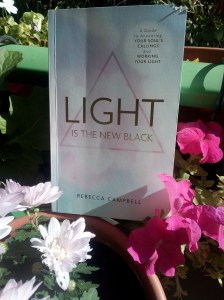
The Mother of All Questions by Rebecca Solnit

Rebecca Solnit writes reflective, thought-provoking essays, which often connect her intellectual curiosity with where she is in her life now. In an earlier work Wanderlust, she ponders the history of walking as a cultural and political experience; facing the unknown, in A Field Guide to Getting Lost; her mother’s Alzheimer’s, regression and how she spent that final year in The Faraway Nearby.

Now a new collection of essays, the title The Mother of All Questions, from an introductory piece on one of her pet frustrations, that all time irrelevant question that many professional women, whether they are writer’s, politicians or humble employees too often get asked.

But it is the timely and questioning opening essay ‘A Short History on Silence’ that  binds the collection together and should be the question being asked. It is an attempt at a history of silence, in particular the silencing of women, the effect of patriarchal power, the culpability of institutions, universities, the court system, the police, even families, their roles in continuing to ensure women’s silence over the continual transgressions of men.

Rebecca Solnit has been writing about this issue for many years, trying to create a public conversation on a subject that many continued to insist was a personal problem – yet another form of silencing.
As she wrote in Wanderlust (2000)

“It was the most devastating discovery of my life that I had no real right to life, liberty, and pursuit of happiness out of doors, that the world was full of strangers who seemed to hate me and wished to harm me for no reason other than my gender, that sex so readily became violence, and that hardly anyone else considered it a public issue rather than a private problem.”

She makes a distinction between silence being that which is imposed and quiet being that which is sought.

What is left unsaid because serenity and introspection are sought is as different from what is not said because the threats are high or the barriers are great as swimming is from drowning. Quiet is to noise as silence is to communication. The quiet of the listener makes room for the speech of others, like the quiet of the reader taking in the words on the page…Silence is what allows people to suffer without recourse, what allows hypocrisies and lies to grow and flourish, crimes to go unpunished. If our voices are essential aspects of our humanity, to be rendered voiceless is to be dehumanized or excluded from one’s humanity. And the history of silence is central to women’s history’

The list of who has been silenced goes right back to the dawn of literature, it goes back millennia, classics scholar Mary Beard noted that silencing women begins almost as soon as Western literature does, in the Odyssey, with Telemachus telling his mother to shut up.

It continues through the years with the woman’s exclusion from education, from the right to vote, to making or being acknowledged for making scientific discoveries to campus rape and the introduction of sexual harassment guidelines as law and the unleashing of stories and the wave of voices coming out of silence that sharing on social media has spawned, generating a fiercely lively and unprecedented conversation.

80 Books No Woman Should Read is her response to a list published by Esquire magazine of a list they created of 80 books every man should read, a list of books, seventy-nine of which were written by men, with one by Flannery O’Connor. It speaks of the reader’s tendency to identify with the protagonist, only the books she mentions from this list that she has read, she often identifies, not with the protagonist but with the woman, noticing that some books are instructions on why women are dirt or hardly exist at all except as accessories or are inherently evil and empty.

Not surprisingly, her essay (first published at Lithub.com) elicited a significant online response, prompting a reply from Esquire, admitting they’d messed up, saying their article had rightfully been called out for its lack of diversity, and proactively inviting eight female literary powerhouses, from Michiko Kakutani to Anna Holmes to Roxanne Gay, to help them create a new list. You can see the list here.

And in the essay In Men Explain Lolita to Me she expounds further on empathy:

‘This paying attention is the foundational act of empathy, of listening, of seeing, of imagining experiences other than one’s own, of getting out of the boundaries of one’s own experience. There’s a currently popular argument that books help us feel empathy, but if they do so they do it by helping us imagine that we are people we are not. Or to go deeper within ourselves, to be more aware of what it means to be heartbroken, or ill, or ninety-six, or completely lost. Not just versions of our self rendered awesome and eternally justified and always right, living in a world in which other people only exist to help reinforce our magnificence, though those kinds of books and comic books and movies exist in abundance to cater to the male imagination. Which is a reminder that literature and art can also help us fail at empathy if it sequesters in the Boring Old Fortress of Magnificent Me.’
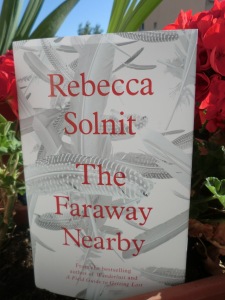
I haven’t read Men Explain Things to Me, although I heard Rebecca Solnit speak about the leading and infamous anecdote it retells when I went to listen to her at the Royal Festival Hall in London.

That talk coincided with the publication of  The Faraway Nearby (link to review) the book that traverses her uneasy relationship with her mother and how the approach of death forces her to contemplate it, how it may have shaped her. I liked the book, but I loved listening to the author in person, she has such an engaging presence, is a captivating speaker, a performer of the reflective and spontaneous.

The Mother of All Questions is a culmination of Solnit’s and many women’s frustrations in the world today, where being a woman living in a patriarchal culture, no matter which part of the world, brings challenges that must reach a breaking point. It is a conversation that is happening everywhere that hopefully will bring change for the better, as many voices come together in solidarity. It is an acknowledgement both of how far we have come and how much we have still to do, to change the culture of silence we have inhabited for too long, to safely be ourselves.

I highly recommend picking up one of her works, if you haven’t yet read her.

Granta 141: Canada – Mangilaluk’s Highway by Nadim Roberts

Granta 141 Canada

The first Granta journal of 2018, issue number 141 is focused on Canadian literature, whether it’s fiction, memoir, reportage, poetry or photography, each issue combines something of each of those categories, with new writing/work by known and little-known talent, around a common theme.

As guest editor and author of Do Not Say We Have Nothing, Madeleine Thien shares in the opening introduction, (and fellow guest-editor Catherine Leroux, writing in French), their only parameter for submissions was ‘What is being imagined here, now?’

Canada being a land with sixty unique Indigenous language dialects and more than two hundred languages reported as a mother tongue or home language, it was a wide-ranging brief.

Language becomes its own landscape in this issue of Granta. Language falls apart, twists, reformulates, shatters and revives itself. Animal and self, unfinished history, land and waterways, colonisation and dispossession, settlement and refuge – all these nouns are part of the truth of this place.

Apart from Leroux’s introduction, all the work is either in English or has been translated from English, however all work in translation is available to read on Granta.com in the original French.

It features writers such as Margaret Atwood, Lisa Moore (her novel February reviewed here), Alexander McLeod, Krista Foss, Naomi Fontaine, Kim Fu, Anosh Irani, Paul Seesequasis, Anakana SchofieldJohanna Skibsrud,  and many more…

I’m reviewing here the first story and may share other’s with you as I select randomly from the journal over the coming months.

Mangilaluk’s Highway

The opening story is a mix of reportage and a retelling of the story of Mangilaluk Bernard Andreason, who when he was 11 years old, slipped out of the Inuvik residential boarding school he’d been sent to, along with two friends Jack and Dennis, to avoid being punished for stealing a pack of cigarettes, and spotting newly hung power lines, decided to follow them home to Tuktoyaktuk.

Nadim Roberts writes about Bernard’s journey in the present, interspersed with narrative reports on his own visit to Tuk in June 2017, forty-five years after Dennis, Jack and Bernard began walking that 140 kilometre stretch home. Robert’s by contrast, completes the journey from Inuvik to Tuk in thirty minutes by plane.

He tells of successive attempts by the government to build a road across the Arctic Circle, to facilitate oil and gas exploration and a stretch of highway that would connect Inuvik to Tuk.

 From the plane I could see occasional glimpses of a new, near-finished road. This was the long awaited Inuvik-Tul all-season highway that would open in a few months.

Chief Mangilaluk

We learn that Tuk was a town founded by survivors from Kitigaaryuit, an Inuit settlement, that in 1902, after contact with whalers was cursed with a measles epidemic which drastically decimated their population. One young man, Mangilaluk, departed and went looking for a new place to live. His choice, a site on the edge of a harbour, would become what is now known as Tuk. He became chief and is still talked of today. Some believed he was a shaman who could shape shift into a polar bear.

In July 1961, two decades after he died, Mangilaluk’s granddaughter Alice Felix, was eight months pregnant. While home alone one evening, she heard a knock on the door. She wasn’t sure if she was awake or dreaming when the door swung open. A three-metre-tall polar bear stood in the doorway. It walked up to her, put its snowshoe-sized paw on her pregnant belly, and began to speak: ‘If it’s a boy, you name it after me.’

The story reminded me immediately of Doris Pilkington Garimara’s Rabbit Proof Fence, a tale of indigenous Aboriginal children removed from their parents (following an Australian government edict in 1931, black aboriginal children and children of mixed marriages were gathered up by whites and taken to settlements to be assimilated) and put in  a boarding school. The three girls in this true story followed a fence built to keep rabbits out of farming land, knowing that it passed close to their home.

Before 1955, fewer than 15 per cent of school-aged Inuit were enrolled in residential schools. Most children still lived on the land with their families, learning traditional skills and knowledge.

By 1964, more than 75 per cent of Inuit children attended residential schools. Their values, language and customs were supplanted overnight by a culture that saw itself as benevolent and superior, and saw the Inuit as primitive beings in need of sophistication.

Nadim Roberts interweaves Bernard’s story, his grandfather’s story and the current issues facing indigenous and local people in the region, in an evocative portrayal of one boy/man’s courage against the odds to make something better of his chance at survival.

Nadim Roberts Source: Author Provided

It’s an excellent piece of writing and combination of narrative and reportage, bringing attention to this one man’s story and the plight of both his people and the environment in which they live.

You can read Nadim’s story for free at Granta, just click on the link below:

Mangilaluk’s Highway by Nadim Roberts

Nadim Roberts is a journalist from Vancouver whose work has been published in Walrus, Maisonneuve and the Globe and Mail.

Further examples of his work can be viewed on his website NadimRoberts.com

Have you read any recommended works by any of the authors mentioned or others featured in Granta 141?

Raise Your Vibration – 111 Practices to Increase Your Spiritual Connection by Kyle Gray

Raise Your Vibration is a book I read in 2016, but hadn’t reviewed as I read over a long period of time. I’ve since read another book by him, his latest called Light Warrior.

Kyle Gray is an inspiring (and by his own admission, ‘flawed’ as we all are) Scottish, best-selling author. He is published by Hay House, an expert in archangels, ascended masters, goddesses and many other characters in mythology, religious stories and other enlightened souls of ancient wisdom traditions, as fields of spiritual energy in the universe.

I came across him, when I read Christiane Northrup M.D.’s book, Making Life Easy – A Simple Guide to a Divinely Inspired Life. In her book, she made a number of recommendations regarding authors and people whose work she is interested in and follows, and Kyle Gray was one of those who I followed up on, in particular because it was the period just over a year ago, when I was about to spend ten days in hospital with my daughter, who was undergoing surgery to straighten her spine, I was going to be bringing as many spiritual resources as I could muster with me, from the traditional to the more esoteric!

I’ve loved all Kyle Gray’s books, which I read little by little, he’s one of my preferred reading choices on public transport thanks to a few free ebook offers from Hay House.

I read this particular title over a number of months and I’m sure I have benefited from it significantly, and I know I will continue to do so as I use it in a more random fashion going forward, it’s one to keep nearby and dip in and out of.

With it’s 111 vibes or spiritual practices, it’s designed not to be read in one sitting, but daily or randomly. I found often that the vibe for the day was often something that really resonated with my day, it’s also like an energising, elevating pick me up or start to the day, it sets the tone for the rest of the day.

Originally I read an electronic version on my kindle, but then bought a physical copy so I could use it in a random way, and during the second reading, I was drawn to the practices relating to the seven chakras, which dovetailed perfectly with a 21 day meditation I was doing, by Deepak Chopra, called Finding Your Flow.

This particular meditation practice  was divided into three 7 day sections designed to activate the seven energy centres of consciousness, also known as chakras. In the first week, we find and become aware of them, week two we activate them and week three is focused on expressing them. Regardless of whether you relate to the system of chakras or not, it’s just about changing patterns of thoughts and behaviour that affect our energy, so listening to someone speak about how to do this, and/or reading, is beneficial to us all.

Kyle Gray’s work in this area, through this book extended the efficacy of the meditations and understanding of the energies in each of these areas.

I have since bought copies of this book as gifts for friends and family members who are open to a little spiritual inspiration and guidance. It’s one of the gems.

In conclusion, as I go back and reread my review on Christiane Northrup’s book, that lead me to Kyle Gray, I share this extract as it encapsulates much of my motivation for choosing this kind of reading input to accompany my other more literary tastes:

She also discusses thoughts and inputs, the effect of what we are constantly exposed to and how it should be managed in order to avoid overdosing on negativity and the toxic, fear-enhancing effect of the media for example. She discusses the positive power of affirmations, meditation, gratitude, the power of giving and receiving, connecting with nature, tapping and much more.

And in her own words:

“No human being has nervous, endocrine, and immune systems that were designed to process the negative news from all over the planet that’s being piped into their living room on a daily basis.”

“On a purely physical level, fear lowers our vibration and makes us far more susceptible to viruses and bacteria. The biochemical state that fear creates in our bodies adversely affects our immunity and increases our susceptibility to the pathological viruses and bacteria that are all around us.” Christiane Northrup M.D.

Buy Your copy of Raise Your Vibration via Book Depository

Note: This book was an Advance Reader Copy (ARC) kindly provided by the publisher.

P.S. I just tuned into Hay House Radio now, as I finish this review and, no surprise, Kyle Gray is speaking live!

Sightlines by Kathleen Jamie

The second volume of essays by Kathleen Jamie that I’ve read, more encounters with birds on lonely, windswept islands that have long been abandoned by humans, though traces remain of their earlier occupation.

If you have not yet read Kathleen Jamie, do check out my review of her first collection Findings, which I adored. It talks a little more about her writing and the difficulty her publisher had in describing her work, which defies categorisation, not exactly travel writing, not quite autobiography, a more accessible form of nature writing than we’ve seen before, seen through the eyes and in the prose of a poet.

In her trademark lyrical style, she travels with experts from whom she gleans bits of information, fascinating trivia, or alarming statistics that tell of a significant drop in population of certain species, but mostly she continues her mission of acute observation, of trying to see in the simplest terms something of the lives and patterns of behaviour of majestic winged creatures, who make long migrations each year and return to these islands to continue their heritage.

We learn more of her beginnings, of the archeological dig where she developed a fascination for uncovering secrets hidden beneath. She muses on microscopic observations in a science lab, writing about wind, light, the moon. We accompany her to the Arctic, witnessing giant icebergs on the move, the green lights of the aurora overhead. She visits to a museum in Norway where ancient whale bones dating from the mid 1800’s will be cleaned, restored, rehung, the melancholic weariness of their demise emitting an odour even after years of inhabiting this dusty dry interior.

The Gannetry

Jamie and friend take a picnic and visit a gannetry during mating season, they see much of what is expected, they’ve been there before, Jamie observes, looking for the unusual, she spots it in the sea, a straight line, something she doesn’t recognise until she does. A pod of orcas lead by the matriarch, she reflects on her role as mother, as her own children approach the age of leaving the nest.

The Woman in the Field

Jamie recalls being 17 years old, leaving school and rather than her mother’s suggestion of a library job or secretarial school, she delivers her to an archeological dig, to uncover a ‘henge’, a circle of stones seen from the air, where they’ll find a Bronze Age burial cist containing the skeleton of a woman and a well preserved pot, findings that will inspire a poem ‘Inhumation‘.

Aurora borealis
Source: Wikipedia M.Buschmann

Aurora

Polly asks Jamie what brings her to the Arctic north, to the freezing cold, to float alongside unleashed icebergs, watching green light phenomena in the sky.

It is the birds that lure Polly, though the geese have flown, that and an illness which awoke something that continues to push her to seek these experiences, while they remain possible.

For 30 yrs Jamie sat on cliff tops looking at familiar horizons.
Now she wishes to change her map.
Something is changing.

The Hvalsalen

The Bergen Natural History Museum in Norway houses the largest whale skeleton installation known. No one knows how they got there, whether they were hunted or stranded, they date from 1867.

About to close for 4 years for renovation and repair, Jamie is invited to return during the conservation work, she will spend hours sitting in the bones, smelling the still present odours, imagining, contemplating their previous majesty.

Pathologies

Musing in frustration on nature clichés: ‘nature takes it course’, (death of her mother) ‘reconnecting with nature’ (environmental activists) Jamie makes an appointment with a clinical consultant in pathology to observe the inner workings of the human body ‘nature’ and its mutations, tumours, cancer cells, infections, seen to the naked eye and under the microscope. She sees landscapes, shorelines, marshes. Looking at the lining of someone’s stomach, searching for bacteria, she notes the following:

Between the oval structures were valleys, if you like, fanning down to the shore. Frank wanted to show me something in one of those valleys and I couldn’t find it at first; it took several patient attempts – this microscope didn’t have a cursor device to point at things. It was a very human moment, a collusion of landscape and language when one person tries to guide the other’s gaze across a vista. What vistas I’d seen. River deltas and marshes, peninsulas and atolls. The unseen landscapes within. You might imagine you were privy to the secret of the universe, some mystical union between body and earth, but I dare say it’s to do with our eyes. Hunter-gatherers that we are, adapted to look out over savannahs, into valleys from hillsides. Scale up the absurdly small until it looks like a landscape, then we can do business.

‘There!’ said Frank. ‘Isn’t that a pastoral scene? They’re grazing!’

I had it: six or seven very dark oval dots, still tiny, despite the magnification, were ranged across the blue valley, like musk oxen on tundra, seen from far above.

Kathleen Jamie’s first collection of nature essays ‘Findings’

Her easy reading essays will also cover a lunar eclipse, three attempts to visit St Kilda, Neolithic caves and the passage of time in her own life, marked by the growth of her children into adolescence, on the threshold of young adulthood.

Fascinating and cosy reading to discover freezing cold, wind blown parts of the world that hold fascinating secrets that only the hardy voyager will venture to uncover. Enjoy reading them about from a more comfortable vantage point.

To buy one of her books, click the link below.

Kathleen Jamie’s essays via Book Depository

Light is the New Black by Rebecca Campbell

If you have achieved things because you were capable, but they left you feeling unfulfilled, if you’ve ever felt as though there is something else you are supposed to be doing in this life but didn’t know exactly what, if you enjoy the feeling of being guided by your intuition when it proves to be spot on, if you sense that we are more than just a physical body here for one lifetime, then this book will appeal to you.
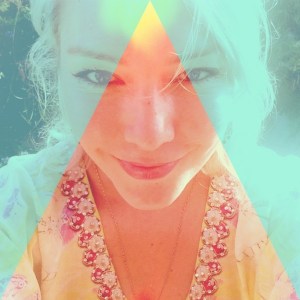
Rebecca Campbell was born in Australia and had a traditional upbringing and education before moving to London to pursue a career in creative direction in the advertising industry.

Since she was young, she had always been interested in a more spiritual perspective of existence, thus while gathering her more traditional qualifications, she took every opportunity to read, study and attend events related to that interest.

She had only one friend her own age Blair, whom she could speak candidly about her  spiritual life and in 2011 she received a call to say he had been diagnosed with an incurable leukaemia. It was one of a series of events that occurred at that time, that would trigger her to quit her job and seriously begin to put her heartfelt callings of the soul ahead of her ego-lead rationalisations of the intellect. Once she’d decided not just to listen to this yearning, but to act on it, doors opened and opportunities arose, as if they’d all just been waiting for her to show up and become available to them.

“My inner light was burning bright. I was home. Now that I had found it, there was no way I was going to let it go. I vowed to say ‘YES’ to every little call from my soul, regardless of how much logical sense it made. I vowed to do everything I could, never to turn my back on myself again.”

In Light is the New Black, she shares what happened around her when she decided to stop ignoring those signs and synchronicities and followed the quiet inner voice of her intuition to make the shift which has led her to become the inspirational writer, speaker, spiritual mentor and intuitive guide and teacher she is today.

What began as a collection of Rebecca’s Thoughts that she shared on Instagram, morphed into this book, where she shares moments of her life that she now recognises as being part of the invitation to make a shift, of her awakening to a more soul centred way of being in the world.

“There is a shift happening right now where anything inauthentic can no longer survive. The things in our lives that don’t serve us are crumbling. Relationships, jobs, social structures, or anything built on shaky ground is destined to tumble down. It’s happening to bring  us back home to who we truly are, so we can live a life that is in alignment with who we truly are, and who we came here to be.  But when you’re in the thick of it, it can feel like a personal attack from the Universe.”

In effect, listening to that voice within, developing it, following its guidance and surrounding ourselves with others who understand it, is about taking steps towards raising our own consciousness to a higher vibration and when we do that there is a ripple effect, on others around us, which in turn helps raise the consciousness of the planet.

We all know that feeling of despair at the problems of the world, of the planet and our own obstacles and challenges, and while we may think there is little we can do to help the planet, raising our consciousness and listening to our intuition from a viewpoint of doing no harm and having intentions for the highest good of all, is indeed something.

It is not necessary to know what our purpose is, or even to know what steps we must take, we have to learn to get out of our own way, to stop trying to decide and force the outcome, quiet the mind and allow that voice of intuition to guide us to the next step.

Rebecca Campbell #LightIsTheNewBlack

“You can’t hear the calling of your soul if you don’t create space in your day to listen to it.”

The best way to create the space for listening with a quiet mind is to have a regular meditation practice, any meditation practice, you start with something and if it suits you stick with it, if it feels hard and isn’t conducive to you wanting to do it every day, find another one. The important thing is to show up. Every day. Rebecca Campbell (and many other intuitives) see meditation as one of their non-negotiables. I totally agree. Meditation is a mind medicine, it’s a little bit magic.

Personally I never sit in the lotus position, I sit in a chair, lie on my bed, I can be anywhere, just close my eyes , open my meditation app, allow thoughts to come and go, opening to the allure of emptiness, that space that opens the channel to guidance.

“Don’t be attached to the outcome. Your job is to work out the what. The Universe’s job is to work out the how.”

This is an excellent book, with so many snippets of advice for learning how to get more into alignment with your life purpose, in other words, just being who you really are, not hiding your light under a bushel, breaking off the straight-jacket of conformity in the eyes of our culture, society and other people’s expectations, which we so often conform to at the expense of being ourselves.

“When we are in alignment, everything flows. When we are out of alignment, there’s a feeling that something isn’t quite right.”

I loved this book, I can relate to making a significant change in how I wanted to live my life and spend my working days, leaving behind my traditional education (a degree in Commerce/Marketing/Economics) and corporate job in my twenties to pursue a year of studies (in London) in things that I loved and wanted to be doing and learning forever; I studied Traditional Chinese Medicine & Aromatherapy, Therapeutic Massage, did a course in Creative Writing and another in Setting up a Small Business. I followed what lit me up and tried hard to let go of the expectations attached to the traditional education I’d had. And then spent years trying to fully embrace it, I wish I’d read this book back then.

Perhaps living far from home makes it easier to do this, I remember that I kept my interests and studies hidden from my family during this time, mainly because I could only afford to ingest encouragement and not fear or questioning about what I was doing or where it was leading. I just knew that I had to do it, that I wanted to do it and that all would become clearer as I progressed. I needed the freedom to pursue this mix of interests without anyone feeding negative or fear driven thoughts into it. And I didn’t want to be doing a job just because I was capable of it. I’m still learning that lesson!

Highly Recommended!

I’m definitely going to read her next book, Rise Sister Rise: A Guide to Unleashing the Wise, Wild Woman Within which focuses more on the rise of the feminine, on those aspects of women that have been long suppressed by the patriarchal model we have lived under for eons and how the world is beginning to change as more women connect and together begin to heal those ancient wounds, to value once more that innate wisdom of the feminine.

“It’s about co-creating a whole new archetype of woman – a woman who does not keep herself small in order to make others feel more comfortable.”

Buy a Copy of One of Rebecca Campbell’s books via Book Depository

The Spiral Staircase, A Memoir by Karen Armstrong

Before I went to visit and spend two months in Bethlehem, Palestine some years ago, I wanted to read something about the history of the area, not a religious book, but something historical that went beyond the recent familiar history since the British abandoned those residing in these lands to their fate. I wanted to understand the wider context of how people came to be living here and what they’d had to endure to survive.
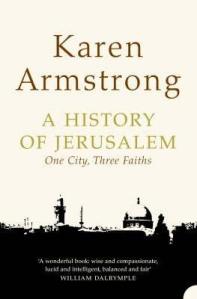
I chose to read Karen Armstrong’s A History of Jerusalem: One City, Three Faiths and read it while in situ. It was a history of multitudes of power shifts and massacres and when I finished it, I said to my husband (born in Bethlehem), somewhat in awe, “Congratulations, you survived,” and I wondered who these people really were, who had survived such a long, brutal history and come to be living in these towns of Jerusalem and Bethlehem today. One thing was for sure, they were survivors and most likely had traces of every people who had ever passed along the pilgrim trail within them.

Recently I was recommended a couple more Karen Armstrong books A History of God: The 4,000-Year Quest of Judaism, Christianity, and Islam and The Great Transformation as background to the conditioning that underpins much of humanity’s belief system of the past millenia, however I decided to add to this collection by first reading her memoir The Spiral Staircase, about her life after leaving the convent, where she spent seven years leading up to her becoming the well renowned author she is today.

I wasn’t interested in her life as a nun, or the details of her leaving the convent, I was interested in how she had used what she learned in rejecting her faith to inspire her towards immersing herself in the history and identifying that catalyst of humanity’s desire to embrace organised religion.

This memoir thus starts as she is trying to finish her university education and doctoral thesis, then her foray into becoming the partial carer of an autistic child, her teaching, her involvement with Channel 4 and the BBC in producing a series of programs on St Paul and then the crusades, and finally launching herself into a writing career when it appeared all other options were closed to her.

Every venture she went into, except the writing career, followed a similar trajectory, where she did the thing she’d convinced herself was what she should be doing, only to eventually lose hope, which became the turning point, or the spiral in the staircase, where she changed direction, it always seemed dramatic and quite often was, however my perspective on those turning points is that they were a course correction, she went along a path for as long at it had something to teach her and then she’d be literally thrown out of it – this kind of thing usually happens when we know we need to change a circumstance but we do nothing, and seven years in the convent had conditioned her to ignore any kind of inner guidance or intuition, making these changes when they did occur seem more dramatic than they might have been, had she transitioned earlier.

Boarding School

I loved reading about her journey and couldn’t help but remember the nuns from my secondary school education, apart from a couple who taught they were elusive figures on the periphery of our lives, we lived on the same premises, for us a boarding school, for them in a separate wing, it was more like a retirement home, they were very, very old and the only time we saw them was in the chapel on Sundays.

They were shadows of whoever they had been and we had no real interaction with them, except the ancient, tough 90 something Sister Conway who still worked in the scullery plunging her gnarled, arthritic hands into boiling hot water as if it were tepid, while we waited for the cutlery to cool before lifting it to dry.

Karen Armstrong took years to undo the conditioning of seven years in the convent and even then likely will never do so completely. An intellectual unsuited to academia, she eventually finds her place studying the great religious and spiritual practices looking for common threads, she’s less interested in differences than in commonalities.

As she researches and learns how to use empathy and compassion to inhabit the minds of those she seeks to understands, she comes closer to a spiritual experience than anything she experienced as a Christian. She has let go of God as objective fact and of belief as being a necessity, discovering instead ‘practice’ and compassion to be the one significant practice of all the faiths that succeeds in managing the ego sufficiently to create peace and harmony.

I enjoyed her honest, though often self deprecating account of this period in her life and particularly loved what she experienced when she visited Jerusalem, the cross cultural encounters and being told to drop the small talk and niceties:

“Karen! You are not in England now. There is no need to be a polite English lady here in Israel. We are not formal people. There is no point to speak if there is nothing to say.”

It becomes even more humorous when she is invited to do the same:

“Do not be a polite English lady. If you think I am unreasonable, tell me to get lost, to shut up- whatever you like!”

at which she surprises herself in doing after a particularly charged day when tensions were high and Joel had snapped at her rudely. His response is excellent, he is proud of her!

The other amusing experience in reading my second hand copy of this book, was the presence of the previous reader in the margins, who not happy to have merely marked up the pages, shared her thoughts more vociferously, clearly not nearly as impressed as I was with the work, deciding to rant and share snippets of her own experiences, which were mostly entertaining, often annoying, and ultimately unwelcome! Here are some of them, since no one else will have had this reading experience!

page 123 After speaking about how her years as a nun had broken something in her, and affected her eating habits, Karen Armstrong writes:

“And I did not want to nourish myself. What was the point of feeding my body, when my mind and heart had been irreparably broken?”

And my interlocutor writes:

“as I was after the divorce”

Armstrong mentions that she isn’t going to write about her failed love relationships, seeing no reason to dwell on episodes that didn’t develop into anything significant and writes:

“Just as I was prevented from becoming an academic, so too I have never been able to achieve a normal domestic existence, and this, like my epilepsy, had also ensured that I remained an outsider in a society in which coupledom is the norm”

to which my interlocutor responds:

“oh do stop feeling sorry for yourself!”

and even adds later on

“perhaps you are just unloveable”

which is a mild example of the kind of comportment (at different levels of societal power clearly) that nevertheless can lead to disharmony, conflict, war even, for if there is a conclusion to what Karen Armstrong has learned, it is a lesson she gifts to her readers, known as Hillel’s Golden Rule that all great leaders have taught, Confucius proclaimed it 500 years before him, Buddha and Jesus taught it, it is the bedrock of the Koran:
“Do not do to others as you would not have done unto you”

As one of her advisors Hyam Maccoby said

“It takes more discipline to refrain from doing/saying harm to others than to be a do-gooder and project your needs and desires onto other people.”

Worthy by Nancy Levin

“And the day came when the risk to remain tight in the bud was more painful than the risk it took to blossom.” Anaïs Nin

Nancy Levin is an author, speaker and coach/mentor who used to be an Events Organiser for Hay House until one day she decided she wanted to re-orient her life and fortunately had such a good relationship with her boss, she was able to be open and honest about the need for a change and given the time to prepare for doing so.

He advised her not to do anything rash straightaway, to go away and research what she wanted to do and then when she was ready and prepared for the transition, she could do so with less fear and with their support. Thus she went from being the organiser to being a coach herself, for people who could identify with where she had been, the kind of constraints she had confronted and were ready for her to inspire them to do the same.

That transition she made and the mentoring she received became the subject of her first book Jump…and your life will appear – an inch by inch guide to making a major change in your life.

I haven’t read this earlier book, I came across Nancy Levin via the intuitive coach I regularly listen to Colette Baron Reid whose book Uncharted, I read and reviewed in 2016. As a part of the lead up to reading Colette’s book, I listened to a lot of her ‘real and raw’ conversations she had with people whose work she admired, unscripted conversations talking about their perspectives on spirituality, the universe and the things that were helping them to navigate life, that they shared. All these conversations are really interesting and we find that some resonate more than others.

Nancy Levin’s conversation was particularly interesting because she had been in quite a traditional realm prior to making this jump, so I think she attracts quite a few followers who are not quite ready to jump, who are dependent on an unfulfilling job, their spouse, their family, their home, but who have that feeling that they not entirely fulfilled by what they are doing in their lives and would like some tools or resources to help them make the shift.

During the conversation, they explore how people often put their worth in the hands of others, that worth isn’t related to what we do or do not do, it’s about coming into the right relationship with ourselves first, the subject explored in her new book.

In WorthyBoost Your Self-Worth to Grow Your Net Worth, she takes the jump a step further and analyses what might be behind the reluctance, or resistance as she likes to call it, to change. She tells the story behind the story of her own life, of how she rarely spent money on herself, but often on her husband because she was trying to make him happy. Through coaching, she was able to have greater awareness of her own patterns and see how she was getting in her own way of achieving what she wanted.

However, just having this knowledge isn’t enough to make a change, so in the new book, she takes the reader through a number of exercises to discover our own patterns, habits and inclinations and how they might be limiting our ability to move into that life that we would prefer to be living.

She refers to them as shadow beliefs, a term introduced by her mentor Debbie Ford, beliefs formed when we were so young, they hide outside our conscious awareness. They are nourished by thoughts and situations that confirm their existence, providing further resistance against any desire to change.

Having identified those beliefs (or excuses), she then invites us to prove them wrong, to find the counter belief and phrase it.

“Excuses are actually just well packaged resistance. But our resistance has a lot to do with our self-worth. When we feel worthy, we don’t resist what’s good for us. We feel we deserve what we want, so we find it much easier to step right over our fears and go for it. That’s the blessing of worthiness. If we don’t feel we deserve what we want, we let resistance keep us down.”

She dissects a number of the more common excuses and beliefs and uncovers the real reason for the resistance beneath it, using case studies of clients she has worked with and her own personal story.

The book moves further on, into defining what you want most and how to move from excuses to action, to taking back your power, taking responsibility, practising self-trust and self-respect.
A lot of the messages relate to financial empowerment and how this connects to other aspects of our lives and ability to make decisions. It ends with an exercise to create a list of 50 desires, five of which must be altruistic desires for other people, readying the reader for taking action, getting ready to do the impossible.

It’s a thought-provoking read that’s likely to be uncomfortable at times, digging into one’s own limiting beliefs, but rewarding by allowing us a way to explore the shadow side and then express the opposite, the things that you want to do, that you may not have ever taken seriously or even expressed and daring you to take action and allow those desires to manifest.

“What is now proved was once only imagined.” William Blake

To Buy a Copy of Worthy, Click Here

Note: This book was an ARC (Advance Reader Copy) kindly provided by the publisher (Hay House) via NetGalley.

The Outermost House by Henry Beston #NatureWriting

A Year of Life on the Great Beach of Cape Cod

outermost

Reading Beston on Plage de Notre Dame, Porquerolles Island, France

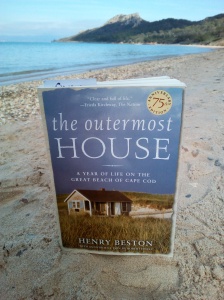
Originally published in 1928, and still in print today, this is perhaps one of the early examples of literary nature writing, an account of a year spent living among the sand dunes of the great peninsula of Cape Cod, living closer to the ‘rough sea nature’ in all her aspects than most humans do and observing all that passes through and by, using all the senses.

Having planned to stay two weeks in his newly built house on the sand dunes, Henry Beston’s fascination with the changes of the dunes, the tides, the sky, the migration of birds and butterflies keep him captivated; thus he keeps extending his stay, observing the minutiae of life and nature, writing it into this book.

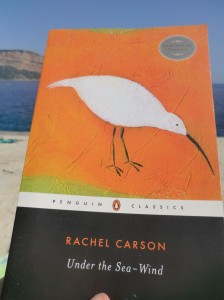
I first came across the title while reading one of my favourite nature writing books by Rachel Carson, Under the Sea-Wind, in which she mentions this volume as one of her inspirations.

Under Sea Wind2And though I enjoyed Henry Beston’s book considerably, Carson’s book for me left a greater impression, for who could not forget being made to see life through the eyes of the very creatures Henry Beston observes. Carson chose to narrate the three parts of her book from the point of view of a sanderling (bird), a mackerel, and a migrating eel. If you haven’t read it and loved this book, I am sure you will enjoy and appreciate Rachel Carson’s personal favourite of all the books she wrote, it is the perfect companion to The Outermost House.
I got the impression Henry Beston may have been something of an insomniac, or perhaps it was because during winter he abandoned the cold bedroom and slept in his front room, where there was the warmth and then cooling of the fire and the changing light of the seven windows he’d included in his simple design. Often throughout the book, he wakes in the night and so making the most of it, seeing these awakenings as an unwitting opportunity, he dresses and goes out to see what’s up. And though we might think that one night must surely be just like another, he always finds something new to observe, reflect on and write about.

He was often visited by the “surfmen” who patrolled the coastline, making sure he’d survived the latest storm, men he said knew the conditions of that coast like no other, not as sailors, but like those who are land based who watch and develop their knowledge and instinct as he learned to, observing how quickly the elements could change and become violent, showing little compassion for floating man-made vessels that attempted to navigate its peripheries.

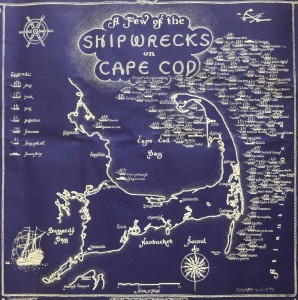
shipwrecksIt was the late 1920’s and no doubt a year like any other, with its share of wrecks, disasters. The pragmatic attitudes of the locals, as likely to come to the rescue and do anything to help, as they are to salvage what is left, not always understood by the families of victims of the many shipwrecks.
“a wreck was treasure trove, a free gift of the sea; even to-day, the usable parts of a wreck are liable to melt away in a curious manner.”

To get a feel for the prose, I’m sharing a few more of the passages I highlighted as I read, they best portray a sense of his experience and lyrical turn of phrase.

He develops a compassion and understanding for birds and animals and insects that he finds at odds with what an education (or perhaps religion) has taught him, he questions the self-perceived superiority of man and wonders that we ought not perhaps rethink this arrogance.

“We need another and a wiser and perhaps a more mystical concept of animals. Remote from universal nature, and living by complicated artifice, man in civilisation surveys the creature through the glass of his knowledge and sees thereby a feather magnified and the whole image in distortion. We patronise them for their incompleteness, for their tragic fate of having taken a form so far below ourselves. And therein we err, and greatly err. For the animal shall not be measured by man. In a world older and more complete than ours they move finished and complete, gifted with extensions of the senses we have lost or never attained, living by voices we shall never hear. They are not brethren, they are not underlings; they are other nations, caught with ourselves in the net of life and time, fellow prisoners of the splendour and travail of earth.”

He attempts to put into words, his great awe and the magnificence of the ocean, implying that of nature’s three great elemental sounds in nature (the rain, the wind and the sound of outer ocean on a beach) the ocean is the most awesome, beautiful and varied.

“For it is a mistake to talk of the monotone of ocean or of the monotonous nature of its sound. The sea has many voices. Listen to the surf, really lend it your ears, and you will hear in it a world of sounds: hollow boomings and heavy roarings, great watery tumblings and tramplings, long hissing seethes, sharp, rifle-shot reports, splashes, whispers, the grinding undertone of stones, and sometimes vocal sounds that might be the half-heard talk of people in the sea. And not only is the great sound varied in the manner of its making, it is also constantly changing its tempo, its pitch, its accent, and its rhythm, being now loud and thundering, now almost placid, now furious, now grave and solemn-slow, now a simple measure, now a rhythm monstrous with a sense of purpose and elemental will.”

He is prone to talk of the sounds of natures as if they were a symphony of his making.

“As I muse here, it occurs to me that we are not sufficiently grateful for the great symphony of natural sound which insects add to the natural scene; indeed, we take it so much as a matter of course that it does not stir our fully conscious attention. But all those little fiddles in the grass, all those cricket pipes, those delicate flutes, are they not lovely beyond words when heard in midsummer on a moonlight night.”

Cape Cod Birdlife by Janet DiMatta

Cape Cod Birdlife by Janet DiMatta

A delightful read that I enjoyed even though I have never visited the area, it does make you wish to see it for yourself, a unique ecosystem and landing point between here and there for so many species, one that Henry Beston has succeeded in depicting so well, it has ensured his book has become a classic, continued to be read, reread and appreciated by multiple generations of readers.

To see some pictures of the house, you can visit the website Outermost House.

Click here to buy a copy of

The Outermost House or Under the Sea-Wind

Jo Malone, My Story #JoLoves

Although I lived in London through much of the period when the Jo Malone brand was being created and built, I can’t say I was really aware of it in its early days, not until it hit its tipping point and her trademark bags and candles started to become the beautiful gifts others in the know would offer those who didn’t shop in the more exclusive shopping areas of Chelsea and Belgravia where you often find luxury hip and boutique brands.

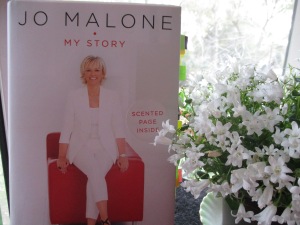
my-storyBut Jo Malone the girl, wasn’t born into luxury. She was an ordinary girl raised in a family that struggled a bit on the good days, and a lot on the bad days, which were often brought on by her doting father’s gambling inclinations, her mother’s over-spending habit and the pressure to work long hours to keep the family afloat.

Her mother returned to the workforce as a manicurist until she was lured away by the eccentric Madame Lubatti, who would become an influential figure in Jo’s early life, an Empress of scent, whose origins we never really discover, just that she spent time in Hong Kong gathering her knowledge.

She would introduce her protegé (mother and daughter) to her laboratory of elixirs and magic ingredients and taught Jo to develop her nose and instinct allowing her to experiment and discover how to create  face mask and cream blends, until they were just right – texture, aroma, perfection – inspiring confidence in her while she was young enough not to doubt her ability to make fragrant, creamy magic.

Madame Lubatti coaxed out my love of fragrance and essentially trained my instincts…She would bring over three unlabelled bottles of different rose oils, remove the stoppers, place each one under my nose and ask:

‘What do you think that smells of?’

I’d close my eyes and sniff; ‘Tea-rose?’

It impressed her that I could tell the difference between the woody muskiness of a garden rose, the clean apple-green notes of a tea rose, and the rich, regal scent of a Bulgarian rose.

She would learn other secrets of scent, of the importance of the whiteness of the room, and allowed her access to the biggest secret of her unrivalled success, a precious, well-thumbed, black leather ledger, filled with four decades if recipes. The elderly Madame Lubatti not only exposed to the secrets of her clinic and laboratory, she also took her on her visits to the homeopathic chemist for pills, powders and oils, the herbalist for herbs, waxes and dried flowers and to Marylebone High Street for chocolate marzipan at the Viennese coffee shop. She imparted to Jo her high standards, stressing ‘If you can’t do something perfectly, don’t do it at all. You must do it brilliantly!’

While she was competent in the home and at the salon where her mother worked and even accompanied her father to sell his paintings in the market during a prolonged period of unemployment, school was not any kind of refuge for Jo. Her undiagnosed dyslexia contributed to her difficulty and she would leave school without any qualifications, but quickly found one job after another through her mother’s contacts, until eventually joining up to work with her mother giving facials to clients and making home-made product to sell to them.

She would go on to attract her own clients and after a series of falling outs with her mother, would go it alone, working from a room in their small apartment, making product from her kitchen. By this time she had married Gary, a young man she met in a period when she joined a bible study class. He was the grounding stability she needed, the strategic businessman to her creative inspiration. From this point on, she rarely mentions her family, though one incident reveals something of the bitterness that existed among those who were close to them. Malone’s response to the incident is to share a little of her life philosophy:

…human nature is divided between those who thrive on, and get easily distracted by, gossip and they tend to go nowhere; and those people who know their purpose, know what they want, and won’t give weight to the chirpings of misinformed tittle-tattle because they know that such things are a waste of focus and energy.

lime-basilWhen she really began to play around with fragrance, demand began to rise more than she could cope with, and Gary suggested they embrace the business, move it to its own premise and open a shop. Her business was beginning to overwhelm their living condition, he recognised the potential and offered to commit himself wholeheartedly it. That would be the beginning of Jo Malone, her signature brand.
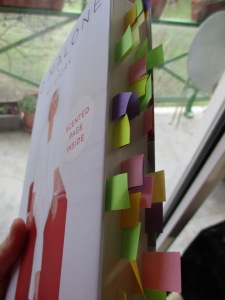
post-itFrom there, a whirlwind of events follow and she will partner up with a perfume house in Paris, turning her instinct into a viable, enduring product. She tried to put into words her creative process and it is fascinating when she does, for it is something that can’t be copied or cloned, it is an insight into the pure magic of creativity, of how she uses image, colour and experience to create a scent.
Those descriptions of her creative process are some of the most exciting and inspirational passages in the book; when she begins to flourish her creativity sings and reading her descriptions of being in the creative zone, of creating a scent, playing with the notes of fragrance my post-it notes were flying. I had to refrain from dog-earring pages and scribbling in the margins as the book was lent to me.

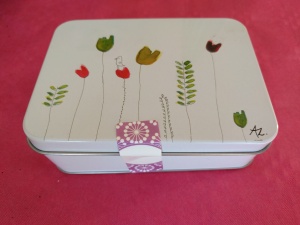
Having become interested in and immersed in the study of aromas and the energetic and therapeutic qualities of essential oils 20 years ago, I too am someone who creates aromatic oils and creams and loves nothing more than to experiment with and create a personalised magic blend for a client or friend, so I totally relate to the bliss Jo Malone felt when she’s doing her thing in a creative sense. (Me with some of my magic potions below).

Though she had her share of fears and trepidation at entering into the unknown, her life has been scattered with signs and synchronicities that propelled her forward, to meet those who would show her the way, encourage her to take the next step, work through the challenges, admit the mistakes, learn from them and move on where possible.

pomeloI absolutely loved this book, from it’s at times heartbreaking accounts of struggle in childhood, to the discovery of her passion, the development of her creativity and the strong work ethic that carried her forward, to finding the perfect mate and the journey they would go on together.
And though she is no longer part of Jo Malone, she is where she ought to be, doing what she loves and still thinking outside the box, creating new scents and new experiences. This one, her new signature fragrance and brand was included in the front of the book, it smells divine!

P A S S I O N  * R E S I L I E N C E   * C R E A T I V I T Y

Highly Recommended!


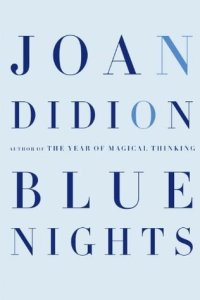
Blue Nights by Joan Didion

This book is called “Blue Nights” because at the time I began it I found my mind turning increasingly to illness, to the end of promise, the dwindling of the days, the inevitability of fading, the dying of the brightness. Blue nights are the opposite of the dying of the brightness, but they are also its warning.

blue-nightsWritten as a reflection on the death of her daughter at 39 years of age, the book begins as Didion thinks back to her daughter’s wedding seven years earlier, which then triggers other memories of her childhood, of family moments, of people and places, numerous hotels they have frequented.

She reflects on her role as a mother, something she hadn’t wanted to be, until suddenly she did, pregnancy had been something to fear, then it became something she yearned for, though it was not to be.

She had difficulty understanding her daughter’s fear of abandonment, knowing how much she needed her child. She displayed little if any understanding or knowledge of common issues that many adoptees often retain within their psyche, issues her daughter presented and was confronted by, including the later presentation of a fully formed family – her birth parents eventually married and had other children.

When we think about adopting a child, or for that matter about having a child at all, we stress the ‘blessing’ part.
We omit the instant of sudden chill, the ‘what if’ the free fall into certain failure.
What if I fail to take care of this baby?
What if this baby fails to thrive, what if this baby fails to love me?
And worse yet, worse by far, so much worse as to be unthinkable, except I did it, everyone who has ever waited to bring a baby home thinks it: what if I fail to love this baby?

Didion examines details of her daughters childhood and life and drawers of photographs and mementos of people who have left her. Not nearly as compelling at her year of magical thinking, and a little too much a collection of names dropped that I found myself skipping over, which all felt terribly sad.

When she speaks of herself, her prose is poetic, mellifluous, at ease. When writing snippets of motherhood and recalling images of her daughter, her language becomes stilted, dissonant, the connections between her thoughts less fluid, the pain too sharp. Ageing has been a long process, one she realises she has seen in her mother, grandmother, but won’t see in her daughter.

joan-didion-and-quintana-rooAlthough the main theme of the book is her daughter’s premature death, nowhere does she analyse or obsess about what actually happened in the way we vividly remember she did about her husband in My Year of Magical Thinking. Rather, the book appears to be as much an acknowledgement of her own ageing and decline, recognising and facing up to her own ‘frailty’, her obsession with her own health scares, recounting every little malfunction or symptom of a thing that never shows up on any of the numerous scans or tests she has. It is as if she writes her own denouement, to a death that never arrives, as the multitude and thoroughness of all the tests she has show how very much alive and in relative good health she is, despite herself.
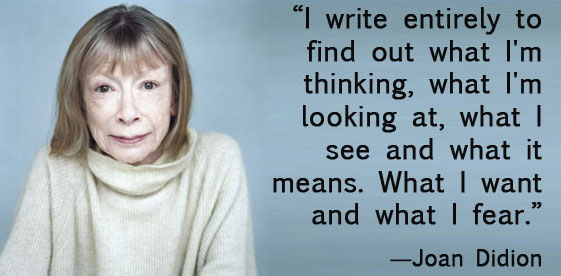
I was curious to know what she might write looking back at this relationship with her only child, a precious adopted daughter and I was honestly quite shocked at how self-centred the entire book was and how little we came to know Quintana. Rather than go on about that, I refer anyone who is interested to this insightful article below.

Lorraine Dusky also gave birth in 1966 to a daughter, the same year Qunitana was born and for a while she actually thought Joan Didion may have adopted her daughter and went so far as to write and ask. It wasn’t the case and she later met her own daughter, who also died relatively young. As a birth mother she has significant awareness of the issues faced by birth parents and adoptees and her review and commentary of Blue Nights goes some way to addressing Didion’s oblivion.

Article – Joan Didion’s Blue Nights is Really an Adoption Memoir by Lorraine Dusky

joan-didion