The Mountain In My Shoe by Louise Beech

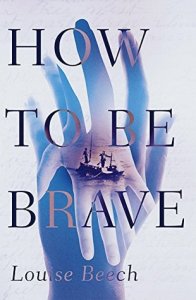
Louise Beech is a unique author who I feel like I have a personal connection with, after the incredible experience of reading her debut novel How To Be Brave in October 2016, which for me included communicating with her as I endured a hellish experience on the 9th floor of Timone Hospital in Marseille. Twitter hashtags truly can bring incredible people into your lives at pivotal moments, both the living and those that have passed on. #LouiseBeech

I originally bought her book because it was an intriguing fictional response, written by a mother whose daughter at the age of nine was diagnosed with Type-1 diabetes, as my daughter had been. Curious, I read that she had used fiction as a conduit for channelling her experience as a distraught mother and the roller coaster journey the two of them went through during those early months of the diagnosis, as it would change them irreversibly.

What made it all the more appealing was the difficulty they had endured, I’d been exposed to too many “good” stories, examples of where children had so readily adapted to this new routine of four injections a day for life, and gone on to do great things, I wanted to read about the opposite, I wanted to hear from those who had found it tough, those who’d rejected it, fought against it, mothers who’d almost been broken by it, and had found a way through; Louise Beech was that mother for me, she still is; an incredible role model, a fabulous writer, unique storyteller and a woman with a great sense of humour.

It was also the story of her grandfather who had been lost at sea for over 50 days when he was a young man.  Both the diagnosis and the story of the grandfather are true stories, however she used her creativity and imagination to write a novel that blends fact and fiction, taking the reader on an emotionally charged, high sea journey towards healing.

If you haven’t already read How To Be Brave, do read my review (linked) and better still buy the book, it is a courageous story and it coincided with a personal experience I will never forget.

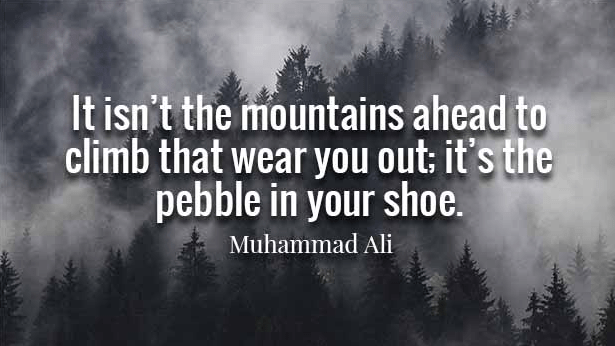
But I digress, for this is a review of her second novel The Mountain in My Shoe beautifully prefaced by the wonderful Muhammad Ali quote displayed below.

The novel begins with a chapter entitled The Book and from then on each consecutive chapter is an extract from this book, which we learn is something called ‘A Life Book’ and as one of the inserts in the book explains:

Lifebook – Principles and Aims

Every Looked-After Child is entitled to an accurate and chronological account of his or her early life. It should have enduring value and can be given to them when they reach adulthood, or sooner if preferable.

It is a book that social workers and foster carers write notes and memories in, and can place mementos and/or photos of important people in their lives.

In chapter two a woman named Bernadette tells us that the book is missing. It is the day she has finally summoned the courage to leave her husband, she’s spent all day preparing and fretting about it, he is a man who values impeccable timing, expecting others to meet his standards, especially his wife Bernadette. She is waiting for him to walk through the door at 6pm like he does every evening before she intends to leave. Only he is late, more than late, he doesn’t come home at all.

Neither does Conor, the ten-year-old boy she has officially befriended for the past five years, whose Life Book she had hidden on the bookshelf, that document that should be preserved until he comes of age. And much to Bernadette’s horror, the book is missing too.

As the narrative progresses we follow Bernadette and Conor’s foster carer Anne on their journey to try to find Conor, we learn more about him from the pages of his Life Book that unfold between each chapter. It is a sad depiction of the inability to nurture, and the damage caused by those who think they can but are incapable, the yearning created by absence and neglect and the profound ability of unconditional love to heal and bring joy.

It’s a compelling, hair-raising read as we get closer to finding Conor and try to ignore that terrible feeling that somehow grows inside of being a little too late. In that respect, it reads like a psychological thriller as Beech cleverly leads the reader to a few false conclusions before the facts are revealed.

While nothing can match the experience of reading her debut How to Be Brave, The Mountain in My Shoe is equally compelling, a heart-felt read that I loved. Fortunately there is a third novel recently published called Maria in the Moon, I can’t wait to read that one too.

Click here to buy one of Louise Beech’s books at Kenny’s

Reading Women in Translation #WITMonth

August is the month when the annual reading challenge #WITMonth or Reading Women in Translation takes place, initially begun three years ago by Meytal at Biblibio.

I’m not a big fan or participant of reading challenges or lists, as I love changing my mind and being spontaneous about what I read next, however I do like to follow this one and read the reviews and keep up with what is being published as well as reading more of those I have discovered. And this is a challenge that is making a big difference in the reading and publishing world, so the more we read and demand books like these, the more expansive the selection will become.

I recently wrote an article about how I have become quite a fan of reading literature in translation, which was published by Tilted Axis Press in their lead up to WIT Month. If you haven’t read it already, you can do so by following the link here. At the end of the article I mention a number of titles I’ve really enjoyed, with links to my reviews. Reading in Translation, A Literary Revolution.

This year I’ll be reading a few titles from my current bookshelves and another title from one of my favourite authors Maryse Condé. Below is a summary of the author, translator, the language translated and what each book promises:

The Complete Claudine by Colette tr. Antonia White (French) – Colette began her writing career with Claudine at School, which catapulted the young author into instant, sensational success. Among the most autobiographical of Colette’s works, these four novels are dominated by the child-woman Claudine, whose strength, humour, and zest for living make her a symbol for the life force.

Selected Letters by Madame Sévigne (Marie de Rabutin-Chantal de Sévigné) tr. Leonard Tancock (French) –  One of the world’s greatest correspondents, Madame de Sevigne (1626-96) paints a vivid picture of France at the time of Louis XIV, in eloquent letters written throughout her life to family and friends. A significant figure in French society and literary circles, her close friends included Madame de La Fayette and La Rochefoucauld, she reflected on significant historical events and personal issues, and in this selection spanning almost 50 yrs, she can be humorous, melancholic, profound and superficial. Whether describing the new plays of Racine and Moliere, speculating on court scandals including the intrigues of the King’s mistresses or relating her own family concerns, Madame de Sevigne provides an intriguing portrait of the lost age of Le Roi Soleil.

Iza’s Ballad by Magda Szabó tr. George Szirtes (Hungarian) – When Ettie’s husband dies, her daughter Iza insists  her mother give up the family house in the countryside and move to Budapest. Displaced from her community and her home, Ettie tries to find her place in this new life, but can’t seem to get it right. She irritates the maid, hangs food outside the window because she mistrusts the fridge and, in her naivety and loneliness, invites a prostitute in for tea.  Iza’s Ballad is the story of a woman who loses her life’s companion and a mother trying to get close to a daughter whom she has never truly known. It is about the meeting of the old-fashioned and the modern worlds and the beliefs we construct over a lifetime.

Troubling Love by Elena Ferrante tr. Ann Goldstein (Italian) – Following her mother’s untimely and mysterious death, Delia embarks on a voyage of discovery through the streets of her native Naples searching for the truth about her family. A series of mysterious telephone calls leads her to compelling and disturbing revelations about her mother’s final days. I’m keen to try this after reading all about it in Ferrante’s nonfiction book Frantumaglia, which I read and reviewed earlier this year.

Maryse Condé

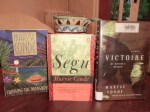
Ever since discovering Maryse Condé via the old style Man Booker International Prize, when it was a two yearly prize for an author’s entire works, I’ve been reading through her novels and stories, as suggested by the author I started with her Tales From the Heart: True Stories from My Childhood, Victoire: My Mother’s Mother, Segu,  and A Season in Rihata.

These are the books I still have on the shelf, and I’m already halfway into the novel the author said at a visit to our local library last year was the favourite of her novels, The Story of the Cannibal Woman, set in Cape Town, and centering on the life of a widow of a multicultural couple, reminding me of the character Hortensia in Yewande Omotoso’s excellent The Woman Next Door, which I just finished reading.

The Story of the Cannibal Woman – One dark night in Cape Town, Roselie’s husband goes out for a pack of cigarettes and never comes back. Not only is she left with unanswered questions about his violent death but she is also left without any means of support. At the urging of her housekeeper and best friend, the new widow decides to take advantage of the strange gifts she has always possessed and embarks on a career as a clairvoyant. As Roselie builds a new life for herself and seeks the truth about her husband’s murder, Conde crafts a deft exploration of post-apartheid South Africa and a smart, gripping thriller.

Crossing the Mangrove – Francis Sancher, a handsome outsider, loved by some and reviled by others, is found dead, face down in the mud on a path outside Riviere au Sel, a small village in Guadeloupe.  None of the villagers are particularly surprised, since Sancher, a secretive and melancholy man, had often predicted an unnatural death for himself.  As the villagers come to pay their respects they each, either in a speech to the mourners, or in an internal monologue, reveal another piece of the mystery behind Sancher’s life and death. Retaining the full colour and vibrancy of Conde’s homeland, Crossing the Mangrove pays homage to Guadeloupe in both subject and structure.

Children of Segu – Sequel to her masterpiece Segu, this fascinating story continues as brother fights brother and the powers of the globe threaten to change their world forever. If you enjoyed Homegoing By Yaa Gyasi, defintiely check out Segu.

Conversations With Maryse Condé by Françoise Pfaff– an exploration of the life and art of Maryse Condé, including conversations about Condé’s geographical sojourns and literary paths, her personality, and her thoughts. Their conversations reveal connections between Condé’s vivid art and her eventful, passionate life. In her encounters with historical and literary figures, and in her opinions on politics and culture, Condé appears as an engaging witness to her time. The conversations frequently sparkle with humour; at other moments they are infused with profound seriousness.

Maryse Condé was born in Guadeloupe, the youngest of eight children and her essays of childhood provide an excellent base for understanding the motivations that underpin much of her writing, firstly to get to know her family influences and aspirations and why she knew nothing of their origins (a past and ancestral pattern her mother was desperate for them to leave behind), her discovery of the turning points in the history of the Kingdom of Segu in Africa and the exploration of racial, gender and cultural issues in a variety of historical eras and locales, often focused on topics with strong feminist and political concerns. As she herself said:

“I could not write anything… unless it has a certain political significance. I have nothing else to offer that remains important.” extract from an interview with Rebecca Wolff

Further Reading

Who, What, When, Where: A Guide to #WITMonth 2017 – via WomeninTranslation.com

8 New or Forthcoming Books by Arab Women – via ArabLit.org

Have you read any of these?

What books have you decided to read for WIT Month?

Do you have a favourite to recommend as I’ll be topping up my shelf for next years reading!

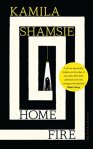
Home Fire by Kamila Shamsie #ManBookerPrize

I read Home Fire in two days, I thought it was brilliantly done, heartbreaking, tragic, essential. It’s been long listed for the Man Booker Prize 2017 and certainly makes my short list! I’m looking forward to reading more of the author’s back list.

Underpinning the novel is the premise of Sophocles’ 5thC BC play Antigone, an exploration of the conflict between those who affirm the individual’s human rights and those who must protect the state’s security.

Before reading Kamila Shamsie’s Home Fire, I downloaded a translation of Antigone to read, she acknowledges herself that Anne Carson’s translation of Antigone (Oberon Books, 2015) and The Burial at Thebes: A Version of Sophocles’ Antigone by Seamus Heaney were constant companions as she wrote, expressing gratitude too, for the children’s book version The Story of Antigone and its author Ali Smith.

In Ali Smith’s version there is a discussion at the end of the book about what stories are, which reads:

“Stories are a kind of nourishment. We do need them, and the fact that the story of Antigone, a story about a girl who wants to honour the body of her dead brother, and why she does, keeps being told suggests that we do need this story, that it might be one of the ways that we make life and death meaningful, that it might be a way to help us understand life and death, and that there’s something nourishing in it, even though it is full of terrible and difficult things, a very dark story full of sadness.”

Kamila Shamsie’s Home Fire is a contemporary retelling of the classic play, set in contemporary London. Even though I knew the premise of the story from having read the play, the story unfolded as if I had no prior knowledge of its likely outcome, it has its own unique surprises and insights, making it a compelling read.

We meet Isma, the eldest daughter of a family, who’ve been raised by their mother and grandmother, as she announces to her twin brother and sister Aneeka and Parvaiz that she is going to the US to complete her PhD studies that were put on pause after the death of their mother and grandmother within the space of a year, leaving her to become the mother to griefstruck twelve-year-old twins. She had briefly known her father, but the twins never.

The rigorous interrogation she is put through on leaving the UK reveal something in her family background that their entire family has tried to keep quiet, just wanting to move on with their lives, that their father had abandoned them and gone to fight as a jihadi in Afghanistan and had died en route to Guantanamo.

While in the US, Isma meets Eamonn, the son of a British politician she detests, setting in motion a litany of events that will have a catastrophic impact on both their families.

“Eamonn, that was his name. How they’d laughed in Wembley when the newspaper article accompanying the family picture revealed this detail, an Irish spelling to disguise a Muslim name – Ayman become Eamonn so that people would know the father had integrated.”

For Parvaiz, the only son, the lack of a father figure created a void, his grandmother had been the only family member willing to talk about him, but her stories were always of the boy, never of the man he became, a subject she was reluctant to be drawn into.

“He had always watched boys and their fathers with an avidity composed primarily of hunger. Whenever any of those fathers had made a certain gesture towards him – a hand placed on the back of his neck, the word ‘son’, an invitation to a football match – he’d retreat, both ashamed and afraid in a jumbled way that only grew more so as the years passed and the world of girls and boys grew more separate, so there were times he was not a twin to a twin but rather the only male in a house that knew all the secrets that women shared with on another but none that fathers taught their son.”

It’s a riveting, intense novel that propels the reader forward, even while something in us wants to resist what we can feel coming. It pits love against loyalty, family versus country, and cruelly displays how hard it is for families to distance themselves from the negative patterns of their ancestral past.

Kamila Shamsie was born in Karachi and now lives in London, a dual citizen of the UK and Pakistan. Her debut novel In The City by the Sea, written while still in college, was shortlisted for the John Llewellyn Rhys Prize in the UK and every novel since then has been highly acclaimed and shortlisted or won a literary prize, in 2013 she was included in the Granta list of 20 best young British writers.

Her novels are (linked to Goodreads):

Note: This book was an ARC (Advance Reader Copy) kindly provided by the publisher via NetGalley.

Click here to Purchase a copy of

Home Fire via Book Depository

The Woman Next Door by Yewande Omotoso

Loved it, this is my kind of popular summer read, it brought to mind the recent Alaskan classic I read and enjoyed immensely Two Old Women: An Alaskan Legend of Betrayal, Courage and Survival by Velma Wallis and another that I didn’t enjoy so much A Man Called Ove.

It’s a story of octogenarian women Hortensia and Marion who are neighbours in a suburb in Cape Town, South Africa. Marion is a white woman, born there, who has lived through political change, though not learned much from it, rather she has tried to keep as much distance as she possibly can from ever having to confront her deeply embedded, never dealt with ancestral shame.

Hortensia is a black woman, whose parents left Barbados for London, where she grew up and was educated, becoming a successful textile designer, and marrying an Englishman, with whom she moved to Nigeria and eventually (not sure why) to retire in South Africa.

Both women have had similarly successful professional lives, both run their own businesses, Marion as an architect, though the birth of her children brought her independence to an earlier close than Hortensia.

Now they are neighbours, on the same street committee and keep each other in check – they represent to the other things about themselves they would never admit, shame or hurt them, rather they take their bitterness out on each other, assuming the other wasn’t capable of understanding their perspective.

Here Marion contemplates her particular shame:
What Hortensia didn’t seem to understand was that sometimes we have to honour our ancestors and side with them. This meant we justified what was horrible and turned away from what needed scrutiny. This life of ignoring the obvious required a certain amount of stamina. The alternative to this was to set on a path to make rubbish of what had gone before us. This approach – of principles – activism and struggle – required stamina too. All the same, she’d chosen the other one.

While grumpy old Ove was just plain annoying and unpleasant to spend a whole book with, these two are actually good company, they have interesting back stories, that are drip fed throughout the narrative, they’re funny and although they are going to learn something when their lives inevitably come closer than they would have wished for, there’s not that sense of over the top, moral victory, I liked that while they overcome something by the end, they don’t change too much.


I picked this book up when it was long listed for the Baileys Women’s Prize for Fiction 2017 and while it didn’t make the short list, it definitely made my list of authors to continue to watch out for and read.

Yewande Omotoso was also born in Barbados, grew up in Nigeria and moved to South Africa where she writes and runs her own architectural practice. This is her second novel. Her debut novel Bom Boy was shortlisted for the 2012 Sunday Times Fiction Prize.

Exit West by Mohsin Hamid #ManBookerPrize

Exit West is Pakistani author Mohsin Hamid’s fourth novel and the first one I’ve read. It is on the Man Booker Prize 2017 longlist. When I read about it earlier in the year, I decided this would the one where I would get on board, and with its themes of refugees fleeing war and the challenges of emigration, it seemed pertinent.

It is a story of a young couple Nadia and Saeed who meet in their unnamed home country, which felt to me while reading as if I were reading about Syria, just before the conflict in their country escalates. They meet in the classroom, he with his “studiously maintained stubble”, she in”flowing black robe”. She brushes off his invitation to have coffee initially, eventually agreeing and slowly they develop a friendship, a relationship.

Interspersed with their narrative are brief snapshots of lives being lived at that moment elsewhere – an incident between and man and a woman happening in Australia, a man nursing his Irish whiskey drink in Tokyo. To be honest, I didn’t get what these intrusions into the story were about – perhaps just that life continues elsewhere, oblivious to the dramas of others?

Saeed lives at home with his parents, Nadia lives alone, her robe is her protection, allowing her to live more freely than the alternatives. However as war approached the city, their lives must change and after hearing about an escape route, the couple decide to flee and to create a life elsewhere.

While they are in their hometown it is a story of a young couple attempting to overcome the lack of trust that exists in a culture where independent women live in fear, once they leave it becomes something else, they lack family, friends and community, they try to recreate those things in an environment that is antagonistic towards them. Their memories of what they have left change shape as the are afflicted by nostalgia, regret, loss. They struggle to find their place and even their relationship morphs into something unrecognisable in foreign lands.

There is no voyage, the journey takes place through a door, a portal to another world, to an island in Greece, to London, San Francisco, but the places they travel to bear little resemblance to those places as you and I might know them. They are inaccessible, frightening, there is a sense of them being hunted, of needing to be ready to run, always, it is a fearful dystopian view of supposed freedom from terror; death may have been a more desired alternative after all. And the slow unwinding of their relationship.

The combination of the real and surreal was a bit much for me, somehow it’s easier to go with at the hand of Haruki Murakami, which in a way this reminds me a little of, but while Murakami feels more like pure fantasy, Moshin Hamid invites us to consider a subject that is very real in the modern world today and succeeds in making it disorienting to the reader. Perhaps that is the point.

I read Hala Alyan’s novel Salt Houses (click title to read review) this year, which was also a novel of displacement, centred around multiple generations of Palestinian refugees, who attempt to make new lives in Jordan, Kuwait, Lebanon and America and the challenges they face, even when they are able to retain certain family connections. It’s a cultural loss that is not apparent on the surface, that Alyan digs deep into to reveal the subtle layers.

It makes an interesting complement to Mohsin Hamid’s perspective of loss and dislocation.

For a more enlightened view of what this novel portends to show the reader, check out the following reviews:

Further Reading:

The AtlanticExit West and the Edge of Dystopia, by Sophia Gilbert

The GuardianMagic and violence in migrants’ tale by Andrew Motion

Note: This book was an ARC (Advance Reader Copy) kindly provided by the publisher via NetGalley.

Man Booker Prize Long List 2017


Swing Time by Zadie Smith #ManBookerPrize

The original Swing Time is a film clip of Fred Astaire dancing on stage at a cabaret, with a giant screen behind him, in which three shadow versions of himself attempt to keep up with his energy, his footwork, his dance. In the end they give up and walk off leaving him alone to continue, enrapturing his audience.

In Zadie Smith’s opening to her Swing Time, the protagonist is sitting in London’s Royal Festival Hall on the South Bank of the Thames, having walked aimlessly from the apartment she’s been hiding out in, opposite Lord’s Cricket Ground in St John’s Wood into the city, crossed the river and spontaneously bought a ticket to an event.

During this “conversation with an Austrian film director” they show this clip, which she is very familiar with from her own childhood obsession, and watching it now, she realises how much she has been a shadow in the lives of others, never taking centre stage in her own life, despite the strong passion for music and dance she has had within her all along.

“I saw all my years at once, but they were not piled up on each other, experience after experience, building into something of substance – the opposite. A truth was being revealed to me: that I had always tried to attach myself to the light of other people, that I had never had any light of my own. I experienced myself as a kind of shadow.”

Structured in seven parts, from Early Days, Early and Late, Intermission, through Middle Passage, Night and Day, Day and Night to Late Days the novel shows the family life and friendship of the protagonist and her friend Tracey, two girls who take dance classes together when they are seven years old, who live on adjoining North London housing estates, with mothers who aspire for their children to have a different experience than their own and while some may judge them otherwise, they do the best they can to make that so.

“At this early stage Tracey and I were not friends or enemies or even acquaintances: we barely spoke. Yet there was always this mutual awareness, an invisible band strung between us, connecting us and preventing us from straying too deeply into relations with others.”

Tracey is outspoken, the more talented dancer and ambitious, she masks her curiosity and disappointments with malice, telling her friend, they had things “the wrong way around”.

“With everyone else it’s the dad” she says, and because I knew this to be more or less accurate I could think of nothing more to say. “When your dad’s white it means…” she continued, but at that moment Lily Bingham came and stood next to us and I never did learn what it meant when your Dad was white.

Jeni LeGon with Bojangles in a scene from the movie, Hooray for Love. [Merlin Archive]

Tracey’s dance ambitions take her to a special school where she can develop those skills, while her friend reluctantly follows the more academic route her mother has paved for her, ignoring her own passion for singing those old-time songs and the early days Fred Astaire and Jeni LeGon (see her in the video clip below) dance moves. She studies media and looks for admin jobs and for a short time is drawn back into Tracey’s world as a stagehand, when Tracey lands a role in a West End musical.

During her first media job, she has a chance encounter with an ambitious Australian pop star, who later requests her to work for her. The singer attempts to bring her out of her reservedness by taking her somewhere where she feels most herself, a bike ride to Hampstead Heath. Her life is thus viewed through the lens of a woman of extraordinary means, who has a certain kind of power to do and to have anything and anyone she wants, a life that is facilitated by those she employs to keep her from the untidy reality of real life.

It reminded me of Elena Ferrante’s My Brilliant Friend in its premise of the female friendship, two girls who’ve known each other since childhood, who are simultaneously attracted and repelled by each other, who separate but never entirely sever their precarious connection, toxic yet familiar, fulfilling an unhealed need to be witnessed in their entirety.

The plot takes our narrator out of London to New York and into an African country where the singer wishes to make a difference to girls’ lives by opening a school. Sending her in advance and on numerous occasions, she sees and experiences aspects of life there at greater depth than her employer and becomes increasingly frustrated by what others fail to see, that which she is unable to adequately communicate.

It has not been her place to be forthright (a weakness that while it stayed that way served her well), however she can’t ignore it, especially not since her mother began to realise her own aspirations, rising up out of her situation, educating herself as an adult and becoming a local politician/activist with strong views on West African dictatorships and celebrities that adopt babies from poverty-stricken countries.

If London was unreal, if New York was unreal, they were powerful stage shows: as soon as we were back inside them they not only seemed real but the only possible reality, and decisions made about the village from these locations always appeared to have a certain plausibility while we were making them, and only later, when one or other of us arrived back here, and crossed this river, did the potential absurdity of whatever it was become clear.”

It’s a rich, exciting, thought-provoking novel, even if being the employee of a pop star may sound unreal. In effect, it is more about whether escaping one’s roots and elevating oneself in or associated with fame or success equates to a sense of fulfilment, or whether one is empowered by finding and following one’s passion. Our narrator is attracted to those who appear to her to be true to themselves, focused and unafraid to express it.

As she did with NW, Zadie Smith creates a strong sense of place and community, and through her choice of characters shares many poignant insights and realities of mothers and daughters and the effect the past exerts on the choices they make in the future.

I admit, I do love this novel all the more for having lived in North London for eight years, and in the latter years, in an estate in Kilburn, so I remember these streets and this community from a period in the late 1990’s that brings it alive more so than if it were set in a city I’d never lived in. It’s not necessary to know it, but if you do, it’s like the icing on the cake! I’ve read all Zadie Smith’s novels except The Autograph Man and I’d say now that Swing Time is my favourite. I hope to see it make the shortlist of the Man Booker Prize 2017.

Brilliantly executed, highly recommended.

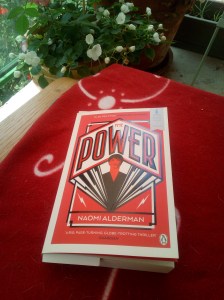
The Power by Naomi Alderman

I’ve been aware of this novel and reading about it for a long time, watching it come through and finally win the 2017 Baileys Women’s Prize for Fiction and I love that this will ensure it is widely read, because perhaps the greatest value to this story is to provoke readers to discuss it, not so much the actual story, but the theoretical constructs behind it and how it exposes the way we think and accept things as they are today and yet when twisted on their head as Naomi Alderman has done in The Power, we become ever more acutely aware of the gravity and depravity of that thinking.

The Power is the story of a manuscript sent from one friend to another, thus it’s bookended by their correspondence, before and after we, along with Naomi (the recipient of the manuscript) read Neil’s historical novel ‘The Power’.

The story follows a period in (and looking back on) the lives of four characters, the first part is entitled Ten Years to Go, finishing with the final part Here It Comes. The characters come from different parts of the world; Roxy, the daughter of a British crime boss, traumatised by the accidental witnessing of her mother’s murder, who finds the safest place to be is among those whom she most fears; Allie, an abused foster child who escapes and changes her identity, guided by an inner voice and destined to lead, who will become the religious leader Mother Eve; Tunde, a Nigerian youth who discovers his calling as the witness and recorder of events as they unfold, leaves his country and follows the rise of women as they assume The Power in one of the most extreme locations, where leadership is more akin to dictatorship and the population becomes more and more extreme in response to the fear and punishments generated by an increasingly corrupt leadership; and finally Margot, an ambitious American politician who is well placed for the transition, whose troubled daughter Jocelyn becomes the recipient of some of her initiatives.

Rather than finding ourselves in the midst of a society already run by women, the story takes place as women are beginning to assume control and the reason they can do so is because of their unique ability to inflict pain, in a way men can not.

Through the experiences of these characters, we witness what happens as power shifts, their narratives coming together in the newly declared kingdom in Moldova, where the President has been deposed by his wife Tatiana.

“And there she declares a new kingdom, uniting the coastal lands between the old forests, and the great inlets and thus, in effect, declaring war on four separate countries, including the Big Bear herself. She calls the new country Bessapara, after the ancient people who lived there and interpreted the sacred sayings of the priestesses on the mountaintops.

It’s a book that keeps the reader guessing, wondering what the impact of this shift in power will be, will we see something different from what we know, or will women turn out to be as similarly corrupted by power as men?

As the path the author has chosen plays out on the page, the reader encounters thought provoking reactions to how they perceive what happens when roles are reversed, for as Naomi Alderman shared when her novel made the shortlist of the Bailey’s Prize:

“I didn’t start from the idea of making a matriarchal society. But the idea did come from a particular moment in my life. I was going through a really horrible breakup, one of those ones where you wake up every morning, have a cry and then get on with your day. And in the middle of all this emotional turmoil, I got onto the tube and saw a poster advertising a movie with a photograph of a beautiful woman crying, beautifully. And in that moment it felt like the whole of the society I live in saying to me “oh yes, we like it when you cry, we think it’s sexy”. And something just snapped in me and all I could think was: what would it take for me to be able to get onto this tube train and see a sexy photo of a *man* crying? What’s the smallest thing I could change? And this novel is the answer to that question, or at least an attempt to think it through for myself. …I just had this idea about women developing a strange new power.”

Overall, I liked the book for its provocation and the conversation it generates, but the story itself and the inner landscapes it explores, the places it takes us, aren’t states of mind or dwellings I prefer to inhabit in literature and because equally in addition to there being a perceived rise in rhetoric against equality for women today, there is simultaneously, depending on what information channels and voices we expose ourselves to, a rise in empathic consciousness – so yes, we are in a time of critical transition and equally many are rejecting the conditioning of the past, embracing a more compassionate, altruistic way of being.

Man Booker Prize Long list 2017

Today the Man Booker Prize long list for 2017 was announced, a prize that was introduced originally to try to get people to read the more literary titles, that often struggled to attain the popularity or success of their bestselling genre cousins, it was promoted as a prize for “the best novel in the opinion of the judges”, an objective that remains true today, and one of the reasons that for me, given its subjectivity, the long list is where the true gems lie!

I have only read one on the list, Exit West and have yet to review it, and I have one on the shelf Zadie Smith’s Swing Time. I’d like to read The Underground Railroad, Solar Bones, and Resevoir 13. I’m also interested to read a Kamila Shamsie novel, not sure if it will be this one or an earlier novel. What are you tempted by from the list?

Here is the list below, with summaries extracted from the Man Booker website:
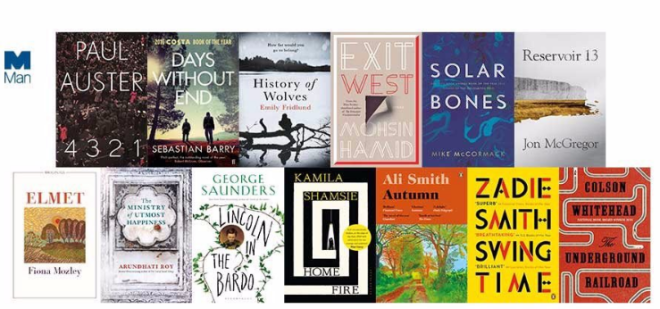
4 3 2 1 by Paul Auster (US) (Faber & Faber) – Archibald Isaac Ferguson, only child of Rose and Stanley is born in New Jersey on March 3, 1947. Ferguson’s life then takes four simultaneous and independent fictional paths. Four Fergusons made of the same genetic material, four boys who are the same boy, go on to lead four parallel, entirely different lives.

Days Without End by Sebastian Barry (Ireland) (Faber & Faber) – After signing up for the US army in the 1850s, Thomas McNulty and John Cole, barely 17 years, go to fight in the Indian wars and, ultimately, the Civil War. Having fled  hardships themselves, they find these days vivid and filled with wonder, despite the horrors they are both witness to and complicit in. Their lives are further enriched and endangered when an Indian girl crosses their path.

History of Wolves by Emily Fridlund (US) (Weidenfeld & Nicolson) – Linda, 14, lives on a dying commune on the edge of a lake. She and her parents are the last remaining inhabitants, the others having long since left amid bitter acrimony. She has grown up isolated both by geography and her understanding of the world, an outsider at school, regarded as a freak.

One day she notices the arrival of a young family in a cabin on the opposite side of the lake. She starts to befriend the mother and son and for the first time feels a sense of belonging that has been missing from her life, until the father arrives home and she fails to see the terrible warning signs.

Exit West by Mohsin Hamid (Pakistan-UK) (Hamish Hamilton) – In a city swollen by refugees but still mostly at peace, or at least not yet openly at war, Saeed and Nadia begin to fall for each amid the sound of bombs getting closer and despite the radio announcing new laws, curfews and public executions. Not safe for a woman to be alone, or to stay any longer, they hear rumours of strange black doors in secret places across the city, doors that lead to London or San Francisco, Greece or Dubai. Nadia and Saeed to seek out one such door, joining the great outpouring of those fleeing a collapsing city, hoping against hope, looking for their place in the world.

Solar Bones by Mike McCormack (Ireland) (Canongate)  – Marcus Conway has come a long way to stand in the kitchen of his home and remember the rhythms and routines of his life. Considering with his engineer’s mind how things – bridges, banking systems, marriages – are constructed – and how they may come apart.

Reservoir 13 by Jon McGregor (UK) (4th Estate) – Midwinter, a teenage girl on holiday has gone missing in the hills at the heart of England. Villagers join the search, fanning out across the moors as police set up roadblocks and news reporters descends on their quiet home. Meanwhile, work must continue: cows milked, fences repaired, stone cut, pints poured, beds made, sermons written, a pantomime rehearsed. The search goes on, as does everyday life. As the seasons unfold some leave the village, others are pulled back, come together or break apart. There are births and deaths; secrets kept and exposed; livelihoods made and lost; small kindnesses and unanticipated betrayals. Bats hang in the eaves of the church and herons stand sentry in the river; fieldfares flock in the hawthorn trees and badgers and foxes prowl deep in the woods – mating and fighting, hunting and dying.

Elmet by Fiona Mozley (UK) (JM Originals) – Daniel is heading north, looking for someone. The simplicity of his  life has turned sour and fearful. Back then, Daniel and Cathy were not like other children at school, and were less like them now. Sometimes Daddy disappeared, and returned with rage in his eyes. But when he was home he was at peace. He told them the little copse in Elmet was theirs alone. That wasn’t true. Local men, greedy and watchful, circled like vultures. All the while, a terrible violence in Daddy grew. A lyrical commentary on contemporary English society and one family’s precarious place in it; an exploration of how deep the bond between father and child can go.

The Ministry Of Utmost Happiness by Arundhati Roy (India) (Hamish Hamilton) – In a city graveyard, a resident unrolls a threadbare Persian carpet between two graves. On a sidewalk, a baby appears suddenly, a little after midnight, in a crib of litter. In a snowy valley, a father writes to his five-year-old daughter about the number of people who attended her funeral. 

A cast of characters caught up in the tide of history. Told with a whisper, a shout, tears and laughter, it is a love story and a provocation. Its heroes, present and departed, human and animal, have been broken by the world we live in and then mended by love – and for this reason, they will never surrender.

Lincoln in the Bardo by George Saunders (US) (Bloomsbury) – On 22 February 1862, two days after his death, Willie Lincoln is laid to rest in a marble crypt in a Georgetown cemetery. That night, shattered by grief, his father Abraham arrives at the cemetery, alone, under cover of darkness.

All evening, Abraham Lincoln paces the graveyard unsettled by the death of his beloved boy, and the grim shadow of a war without end. Meanwhile Willie is trapped between the dead and the living – drawn to his father with whom he can no longer communicate, existing in a ghostly world populated by the recently passed and the long dead. Unfolding over a single night, narrated by multiple voices, Lincoln in the Bardo is an exploration of death, grief and the deeper meaning and possibilities of life.
Home Fire by Kamila Shamsie (UK-Pakistan) (Bloomsbury) – Isma is free. After years raising her twin siblings following their mother’s death, she is studying in America. But she can’t stop worrying about Aneeka, her beautiful, headstrong sister in London – or their brother, Parvaiz, who’s disappeared to prove himself to the dark legacy of the jihadist father he never knew.

Then Eamonn enters the sisters’ lives. The son of a powerful British Muslim politician, Eamonn has his own birth right to live up to – or defy. Two families’ fates are devastatingly entwined in this searing novel that asks: what sacrifices will we make in the name of love?

Autumn by Ali Smith (UK) (Hamish Hamilton) – How about Autumn 2016? Daniel is a century old. Elisabeth, born in 1984, has her eye on the future. The UK is in pieces, divided by a historic once-in-a-generation summer.

Autumn is a meditation on a world growing ever more bordered and exclusive, on what richness and worth are, on what harvest means. This first in a seasonal quartet casts an eye over our own time.  Who are we? What are we made of? Shakespearian jeu d’esprit, Keatsian melancholy, the sheer bright energy of 1960s Pop art: the centuries cast their eyes over our own history-making. From the imagination of Ali Smith comes a shape-shifting series, wide-ranging in timescale and light-footed through histories, and a story about ageing and time and love and stories themselves.

Swing Time by Zadie Smith (UK) (Hamish Hamilton) – Dazzlingly energetic and deeply human, Swing Time is a story about friendship and music and true identity, how they shape us and how we can survive them. Moving from north-west London to West Africa, it is an exuberant dance to the music of time.

Two brown girls dream of being dancers – but only one, Tracey, has talent. The other has ideas: about rhythm and time, about black bodies and black music, what constitutes a tribe, or makes a person truly free. It’s a close but complicated childhood friendship that ends abruptly in their early 20s, never to be revisited, but never quite forgotten, either…

The Underground Railroad by Colson Whitehead (US) (Fleet) –  Cora is a slave on a cotton plantation in Georgia. All the slaves lead a hellish existence, but Cora has it worse than most; she is an outcast even among her fellow Africans and is approaching womanhood, where it is clear even greater pain awaits. When Caesar, a slave recently arrived from Virginia, tells her about the Underground Railroad, they take the perilous decision to escape to the North.

Whitehead’s Underground Railroad has assumed a physical form: a dilapidated box car pulled along subterranean tracks by a steam locomotive, picking up fugitives wherever it can. Cora embarks on a harrowing flight, state by state, seeking true freedom. At each stop, Cora encounters a different world. The narrative seamlessly weaves the saga of America, from the brutal importation of Africans to the unfulfilled promises of the present day. It is a story of one woman’s ferocious will to escape the horrors of bondage and a reflection on history.

Happy Reading!

The Short List will be announced 13 September

Winner announced 17 October

Click Here to

Order one of the books from Book Depository

Reading in #Translation, A Literary Revolution #WITMonth

Sometimes it’s interesting to pause and look back at a reading journey and observe the reading milestones that helped deliver us to where our preferences are today. As many of you who’ve been reading Word by Word for a while will know, I like to read around the world, across cultures and that has led me to read more literature in translation.

It has become easier to find more diverse literature than in the past, thanks to the wonderful community of readers/bloggers who write with passion about books and to initiatives like the annual August ‘Women in Translation’ #WITMonth, also lead by a passionate blogger, Meytal Radzinski who blogs at Biblibio.

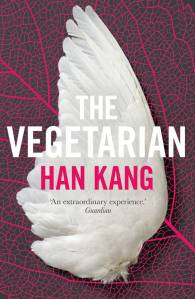
Tilted Axis Press was founded in 2015 by Deborah Smith, translator of Korean literature, while she was completing a PhD in contemporary Korean literature. She translated both of Han Kang’s excellent books, which I’ve read and reviewed here, the incredible Human Acts (my personal favourite) and last years Man Booker International Prize winner The Vegetarian. They are a small, not for profit publisher of works that might not otherwise appear in English, books with

“artistic originality, radical vision, the sense that here is something new”

Recently they asked me for my thoughts on  reading literature in translation, and published my response on their website, which I’ve linked here. It also includes a list of some of my favourite novels in translation and some of the excellent bloggers I rely on to keep me informed. Click on the link below to read the article.

My Thoughts on

Reading in Translation, A Literary Revolution

I hope you enjoy it and find a good book to read in translation during August. Do you have a recent favourite book that you’ve read in translation to recommend? Please let me know in the comments below.


Two Old Women by Velma Wallis

I bought a second-hand copy of Two Old Women, after it was recommended by someone whose reading I follow as one of her favourite books, I remember it being an interesting list of books that I had never heard of and this small book, an Alaskan legend of betrayal, courage and survival intrigued me enough to get it.

Velma Wallis was born in Fort Yukon, a remote village in interior Alaska and grew up in a traditional Athabaskan family. Alaskan Athabaskans are native to Alaska, the original inhabitants of the interior of Alaska, living a culture of inland creek and river fishing, fabricating what they need from the resources that surround them, living by a matrilineal system in which children belong to the mother’s clan.

They are believed to have descended from Asians who crossed from eastern Siberia into Alaska during an early Ice Age.

The People Velma Wallis writes about in this legend, roamed the land and rivers around the area she was born, following trails that ensured they had access to the necessary resources to survive the changing seasons. They depended on the annual salmon runs and large game as well as small animals, using their skins for warmth.

Growing up in a traditional way, the young Velma also lived in different summer and winter cabins and although no longer a child, she enjoyed the nightly stories her mother continue to narrate. One of those stories was about two old women and their journey through hardship and it lead to her mother reflecting on how she had been able to overcome her own obstacles of old age, despite how physically agonising it could be.

The story held such fascination to her that she wrote it down and it evolved into this little book, once a story handed down from generation to generation, now committed to print so that an ever wider audience could learn from its wisdom.

“This story told me that there is no limit to one’s ability – certainly not age – to accomplish in life what one must. Within each individual in this large and complicated world there lives an astounding potential of greatness. Yet it is rare that these hidden gifts are brought to life unless by chance of fate.” Velma Wallis

The story tells of a group of nomads, People of the arctic region of Alaska who are on the move in search of food, but this particular winter they are beset with problems, the game they usually hunt due to the excess cold have become difficult to find and the smaller animals are not enough to sustain the group. Hunters are fed first, meaning there is often not enough for the women and children.

In the group there are two old women whom the People care for, Ch’idzigyaak and Sa’, younger men set up their shelters, younger women pull their possessions, however they are both known for constantly complaining of their aches and pains. One day, the chief makes a sudden announcement, one that the group has heard of from their stories, but never witnessed within their own band.

“The council and I have arrived at a decision.” The chief paused as if to find the strength to voice his next words. “We are going to have to leave the old ones behind.”

The women are shocked, as are the People, the older woman has a daughter and grandson, however no one objects, not even the daughter, though she leaves her mother a parting gift, one that will be intrinsic to their survival.

The group moves away leaving the stunned women sitting by the remains of their temporary camp. Until they awaken to the reality of their situation and find within them the will to move.

“Yes, in their own way they have condemned us to die! They think we are too old and useless. They forget that we, too, have earned the right to love! So I say if we are going to die, my friend, let us die trying, not sitting.”

And so begins a challenging journey, a reawakening and discovery of talents that had lain dormant from lack of use, as the two women set out to prove their People wrong and more, to set an example, though no one is there to witness it.

It’s a fabulous and poignant story about the value of the accumulation of years, and a reminder for those who arrive there not to lapse into laziness and a sense of entitlement, the respect that they deserve should be earned, the wisdom they are able to impart is not just what is spoken, it can be demonstrated by their actions and attitudes. Its’ beautiful illustrations by James Grant bring the story to life and it is equally an ode to the importance of sharing experiences through friendship and community.

Highly Recommended!