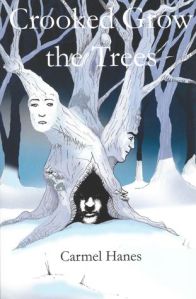
Crooked Grow the Trees by Carmel Hanes

Crooked Grow the Trees is an engaging, insightful and well-informed read that I remain in awe of since I finished reading it. I bought it not long after an online group conversation on Goodreads with Carmel Hanes about Bernice L. McFadden’s Praise Song for the Butterflies.

Since our connection is a little story in itself, I will share the comments that lead to my discovery that she had written a book and my desire to read it.

My comment on Praise Song for the Butterflies read:

Without resorting to a happy ever after cliche, I enjoyed the possibility that the experience of trauma didn’t have to equate to continual suffering, that one’s personal narrative does not have to continue to be that which happened in the past, that it is possible to change, to move on, to find community in another place, to rebuild, to have hope. Perhaps that is what happiness really is, a space where hope can grow, might exist, not necessarily the fulfillment of, but the idea, the expression.

to which Carmel replied:

What an eloquent and delightful summary of what happiness might be. “Hope” being the magnet that pulls one through life’s bitter shavings. Thanks for sharing that perspective….I love it.

What a beautiful, illustrative metaphor of hope being the magnet, pulling one through life’s shavings. I was enamoured by the ease with which her turn of phrase became a metaphor and wondered what else she had been reading, only to learn she was a published author, described as follows:

She hid among the likeable misfit toys she worked with in public schools and detention centers during a thirty year career as a school psychologist. The indelible imprint they left on her insisted on expression in this debut novel, exposing the struggles we all have to overcome early influences.

Well that combination of the spontaneous metaphor, a career of working with misfits and the promise of insights into dealing with young people who had been the victim of trauma was enough to make me curious. And what a find it was!
Review

Crooked Grow the Trees is an intriguing title, one I imagine refers to the impact traumatic events have on the growth and development of young minds, some children are unable metaphorically to grow as straight and tall as they ought to, depending on their influences and experiences during childhood.

The novel is a dual narrative between Sophia’s professional life dealing with the boys in the detention centre and her personal life, which has brought her siblings together as their father awaits death, awakening a past she has long buried.

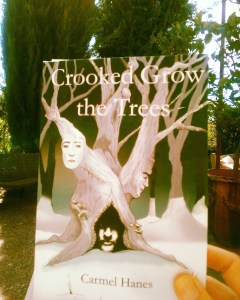
The brilliant cover art depicts the main protagonist Sophia and her brother Marcus, whose way of being in the world has been significantly affected by memories and perspectives of childhood, in particular in relation to their father, the dark element seen in the base of the trunk. Nevertheless, they are survivors, they have used their experience to forge their way ahead (even if they face opposite directions), each attempting to consciously eradicate while subconsciously using to good effect, that which left a mark on them.

Navigating the complex relationship with her father had been like walking through an emotional minefield.  Explosion after explosion had blown so many parts off the relationship there was nothing recognizable left but a spongy mass of raw nerves and charred intentions.

Unfortunately that resulted in them having opposite views in many areas of life, a source of friction that kept them apart, rarely seeing each other, until now circumstances force them to be together again.

They had little in common other than shared ancestry. Marcus held strong opinions that bordered on bigotry, while Sophia was inclined to see people as complex and multi-dimensional, not categorizing as quickly as her brother. They were on different sides of the political divide and rarely agreed on how to solve the social and financial issues the country faced.

What seems like an irredeemable divide proves challenging when it comes to dealing with their father’s affairs, Marcus is inconsolable and Sophia wants to understand why he acted the way he did. Hanes cleverly puts the siblings in a room where unknown elements of their parents lives are revealed, they are able to talk about, clarify and recalibrate events from the past, in a way that helps them understand each other better, healing some of the latent trauma.

A foundational brick in her self-view had been flawed. Years of experience wrapped around this inner core, tendrils of assumptions and beliefs, unraveled as the core foundered. How do you reframe a lifetime of feelings? How do you rewrite decades of misunderstanding?

Similarly in the workplace, when there is disruption, she comes into conflict with the position of staff who take a more punitive approach to dealing with the young. Uninterested in investigating what happened, or any extenuating circumstances, some advocate for severe punishment.

I don’t care what the excuses might be; they simply have to follow the rules regardless of what is happening. WE are in charge not them. The more they get away with these take-it-in-my-own-hands decisions the more at risk we are, not to mention their families and the community when they finally do make it out of here.

Sophia and her colleague appeal for a different approach:

“I think it’s important to understand what led to their decisions and reactions in order to best support them and teach them,” countered Dr Blain. “One cannot separate their actions from their histories, and change only happens when we understand what drives them so we can help them understand that as well. That is our mission, not simply to punish them for wrong actions. We can only gain that understanding through investigating all angles and hear what each person has to say.”
It’s a captivating read, enriched by experience that succeeds in presenting multiple moral viewpoints, forcing the reader to indulge and reflect on all perspectives and attitudes in the various conflicts. The conversations with each of the boys and the situations they respond to are brilliantly depicted, the dilemma feels real, the reader desperately wants them to succeed in being transformed.

Crooked Grow the Trees shows relationships healing through understanding and how those with opposite views can find common ground and forgiveness when memories and events that formed them are shared and discusses. Sadly, it is often not the case that the cause is known or shared or that people have the chance to heal from those traumas that damage them.

I find myself rereading my comment above, seeing how it resonates here too.

Perhaps that is what happiness really is, a space where hope can grow, might exist, not necessarily the fulfillment of, but the idea, the expression.

Buy a Copy of Crooked Grow the Trees via BookDepository

Man Booker International Prize Winner 2019 – Celestial Bodies by Jokha Alharthi

It’s been a couple of days since the winner was announced, view the shortlist here, so if like me you hadn’t heard, the winner of the Man Booker International Prize for 2019, an international foreign language work translated into English is:

Celestial Bodies by Jokha Alharthi translated by Marilyn Robinson

“It’s less flamboyant than some of the other books, there’s a kind of poetic cunning to it. It starts feeling like a domestic drama in a fascinating world, but with the layers of philosophy, psychology and poetry, you are drawn into the prose, through the relationship between the characters. It encouraged us to read in a slightly different way.”

The £50,000 prize celebrates the finest works of translated fiction from around the world and is divided equally between its author and translator.

This was the book I was most intrigued by from the initial list to be honest, it ticks so many boxes in my reading curiosity, it comes from a little known culture, Oman, and it’s history from the other side, focused on women and ex-slaves (slavery is still a taboo subject in Oman, outlawed there in 1970).

“It’s a sensitive subject and kind of a taboo,” Alharthi said in an onstage interview. “But I think literature is the best platform to discuss sensitive issues. And slavery is not exclusive to Oman – it’s part of human history.”

The paperback comes out in five days, I’ve pre-ordered it, so watch this space for a review soon.

Celestial Bodies tells of family connections and history in the coming-of-age account of three Omani sisters. It is set against the backdrop of an evolving Oman, which is slowly redefining itself after the colonial era, at the crossroads of its complex present.

Jokha Alharthi, the first female Omani novelist to be translated into English, is the first author from the Arabian Gulf to win the prize. A Professor with a PhD in Classical Arabic Poetry, she is author of two other novels, two collections of short fiction and a children’s book, her work has been published in English, German, Italian, Korean, and Serbian.  An award-winning author, she has been shortlisted for the Sahikh Zayed Award for Young Writers and won the 2010 Best Omani Novel Award for Celestial Bodies.

Marilyn Booth is an American academic and translator who has translated many works of fiction from Arabic. A fellow at Magdalen College, Oxford, she holds the Khalid bin Abdallah Al Saud Chair for the Study of the Contemporary Arab World at the Oriental Institute.

I love how the judges summed it up:

A reader picking up this book will be absolutely entranced by this new world of human experience that it opens up. This books tells us about the extreme complexity of the emotional relationships that we have and our engagement with history. We were very impressed by the subtlety of the style and the depth of the writing, its intellectual reach. But also its ability to flex moral muscle. It is a precise and also lyrical translation, and it brings in the music of everyday speech and the music of the poetry that it draws in. The extraordinary thing about this book is it talks of a world in transition, philosophically, politically, intellectually, socially, and that is the age that we live in now.
And what better metaphor of a world in transition, on this week that an Omani woman Jokha Alharthi wins this pretigious literature prize, that this morning on May 23, 2019 her Aunt, Nadhira Alharthy was the first Omani woman to reach the summit of Mt Everest!

The morning after the prize was announced, the Sharjah Book Authority in the United Arab Emirates announced the creation of the Turjuman* Award, valued at $350,000, which will go to publishing houses that facilitate the translation of Arabic literature.

Buy a Copy of Celestial Bodies by Jokha Alharthi via Book Depository

*Turjuman comes from an Arabic root for interpreter or guide, a translator.

Have you read it, or any others from the shortlist?

Drawing Lessons by Patricia Sands

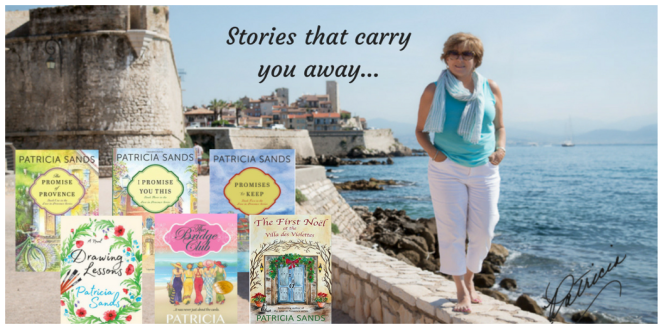
Seven years ago I read The Bridge Club by Patricia Sands, which I loved. Her ability to immerse the reader into the emotional lives of her characters is thoroughly engaging and insightful and the stories of those women characters and the event that brings them all together to share parts of their history together has long stayed with me.

Her latest novel, Drawing Lessons offers something a little different, in that this time the main character, 62 year old Arianna, leaves her Toronto home, family and troubles behind, somewhat reluctantly, but with the blessings and encouragement of those she’s left behind, to try and heal a little from the heartbreak of what she has left behind her.

It is an interesting an provocative premise. Her husband has been diagnosed with a debilitating form of dementia and her family have encouraged her to go on a two week artist’s retreat just outside Arles, the same countryside and landscape that inspired Van Gogh to produce over 300 works of art in the frenzied sixteen months he spent there, until driven out by the locals.

“In his letters to his brother Theo, he said drawing helped him combat his depression. He knew, as we do, that working en plein air, we are able to capture light and images more quickly and from that create our interpretation.”
Arianna hasn’t painted for a long time and is wracked by guilt at leaving. Slowly she will find her way, through the surroundings and with the eclectic band of artists that have come together to reaquaint with their inner muse. And then there is the strange allure of the man from the Carmargue.

The beautiful cover art couldn’t be more appropriate to today, it being May and everywhere you go at the moment, the poppies are in full bloom.

Living in this area and knowing how much the author loves the south of France and how much of her writing is informed by her own experiences of living a few months of every year here, I wasn’t surprised to feel how immersed in the area this book made me feel. She really does capture something of the essence of being in this region of Provence, in the landscape and the town of Arles, adding something of the fantasy of a mysterious artist, horseman, the romance element. Not to mention the markets and the collection and preparation of the food.

“Winding past olive groves, beside vineyards, and through fields dotted with poppies and other wildflowers, from time to time they’d comment on the pastoral beauty. They could imagine artists through the centuries setting up easels along the way.”

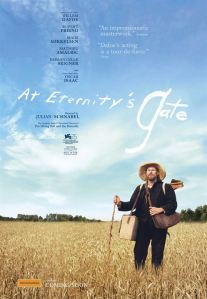
It’s a timely read if you’re interested in Van Gogh, as this year there was the film At Eternity’s Gate that came out and he is also the subject of the new show running from March 2019 – January 2020 at Carrieres de Lumières in Les Baux de Provence, a truly spectacular and original depiction of works of art, set to music, displayed on the inner walls of an old stone quarry.

If you haven’t been here and have an interest in open air painting, it’s a read that transports you to the Provençal landscape, ignites the imagination and all the senses and is likely to make you wish to indulge in a visit to the region yourself.

And although her upcoming tour is now sold out, if you want to imagine what it might be like to visit the area and visualise the area where this story takes place, check out the itinerary of The Memories Tour 2019, run by Patricia and co-host Deborah Bine, The Barefoot Blogger and visit Patricia’s blog, or sign up to her newsletter on France related writing news and tips on visiting the south of France and the culture.

Buy a Copy of Drawing Lessons via Book Depository.

Ceremony by Leslie Marmon Silko

Having recently read Leslie Marmon Silko’s memoir The Turquoise Ledge (2010), I know well how deeply connected she is to the Arizona desert, its landscape, wildlife and climate. To read in the preface to her most well-known and celebrated novel Ceremony, that in 1979 she moved with her husband and two sons to Alaska, I’m not surprised she had difficulty coping, a deeply rooted woman out of place. The lack of sunlight caused her a terrible lethargy and depression. Once she began writing this novel, the depression lifted.

The novel was my refuge, my magic vehicle back to the Southwest land of sandstone mesas, blue sky and sun. As I described the sandstone spring, the spiders, water bugs, swallows and rattlesnakes, I remade the place in words; I was no longer on a dark rainy island thousands of miles away.

She wasn’t just  homesick for the place, she missed the people and the storytelling, so she awakened them by writing them into the novel, narrating a kind of prose poem using powerful mythological women like Corn Woman, Changing Woman, Serpent Women and Thought Woman (the spider), who with her sisters created all life by thinking it into being.  It is she who is thinking this story, the author narrates it.

Ts’itstsi’nako, Thought-Woman,
is sitting in her room
and whatever she thinks about
appears.

This fable-like story frames the novel, interrupting it throughout to remind us of how things were, of the distractions, the suffering and regret, the need to make amends, the value of setting a challenge, going on a quest, the need to make sacrifices and bring back what is necessary for forgiveness and healing to occur.

And in the belly of this story
the rituals and the ceremony
are still growing.

It wasn’t until I had read the novel through that I began to understand the connection between the Pueblo myth and the story, first we encounter it, then we begin to make sense of it. At times while reading, I was on the edge of understanding, informed a little by what I I know of shamanic stories, rituals, signs and traditions, there were many  references I’d encountered from reading Alfredo Villoldo’s Wisdom, Power and Grace of the Earthkeepers.

The story focuses on the character Tayo, a young man whose very existence reminds some of his family members of things they detest. When they look at him they remember. He is always trying to make amends, to win approval, yet he seems destined to disappoint.  He is of mixed blood, stuck in a place where he seems not to be able to inhabit either culture he is connected to, and yet there are expectations of him, both imposed from outside and from within.

“They are afraid Tayo. They feel something happening, they can see something happening around them, and it scares them. Indians or Mexicans or whites – most people are afraid of change. They think that if their children have the same colour of skin, the same colour of eyes, that nothing is changing.” She laughed softly. “They are fools. They blame us, the ones who look different? That way they don’t have to think about what has happened inside themselves.”

He has recently returned from war, traumatized, he is suffering and struggling to find peace, trying to avoid the temptation of oblivion that other young veterans have fallen for. He has nightmares and hallucinates. His grandmother makes a suggestion:

“That boy needs a medicine man. Otherwise, he will have to go away. Look at him.”

The title Ceremony refers to the healing ceremonies based on the ancient stories of the Diné and Pueblo people. The ceremony that Tayo goes through reminds me of the hero’s journey, ultimately he has to leave and go on a quest, which he does, he meets someone from whom he learns things, he fulfills the challenge he set himself and then returns.

At this point the novel I wasn’t thinking in those terms and the ending is quite terrifying, until I reflect that this is indeed all part of the ceremony, and the biggest test of all comes at the end when he must embrace and use all those aspects of himself, the wisdom of all the cultures running through his veins.

He cried the relief he felt at finally seeing the pattern, the way all the stories fit together – the old stories, the war stories, their stories – to become the story that was still being told. He was not crazy; he had never been crazy. He had only seen and heard the world as it always was: no boundaries, only transitions through all distance and time.

It felt almost like an initiation to read this novel, waiting for its meaning to awaken as I read, I loved it and can’t wait to read more of her work, her ability to write the modern story that demonstrates the power of the mythological stories that get handed down through generations is brilliant. It reminds me of the retellings of the Greek myths that are currently popular, bringing the learnings of storytelling into contemporary situations, teaching us their wisdom, showing how their message never ages, the necessity for each person to live through it to understand it.

What She Said:
The only cure
I know
is a good ceremony,
that’s what she said.

A brilliant and gifted storyteller, highly recommended.

Buy a copy of Ceremony via BookDepository

Women’s Prize for Fiction Shortlist 2019

The annual Women’s Prize for Fiction shortlist was announced a few days ago, you may have heard about it already, but if you haven’t here are the six books that made it through, the winner will be announced on 5 June:

For a summary of what each book is about, refer back to my original post on the Women’s Prize for Fiction longlist. Rather than repeat the summaries, I’m going to feature here a little about the author and their work (from the Women’s Prize website). I have read and reviewed Milkman, and the one that attracts me the most is Circe.

The Silence of the Girls by Pat Barker – (Ancient Greek history written from a female point of view – retelling The Iliad – humans, their egos and wars)

Born in Yorkshire, Pat Barker began her literary career in her forties, after taking a short writing course taught by Angela Carter. Encouraged by Carter to continue writing and exploring the lives of working class women, she sent her fiction out to publishers. She has since published fifteen novels, including the Regeneration Trilogy, been made a CBE for services to literature, and won awards including the Guardian Fiction Prize and the UK’s highest literary honour, the Booker Prize.

I have only read one of her books, The Ghost Road, the third in that trilogy and the one that won the Booker, and sadly it was a hard slog for me which I admit has made me reluctant to try anything else. A quick look at Goodreads tells me that the first book in that trilogy has almost double the number of readers, so probably that would have been a better place to start, than the prizewinning novel.

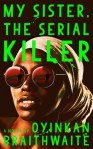
My Sister, the Serial Killer by Oyinkan Braithwaite – (an obsession with black widow spiders leads the author to write a crime thriller about two sisters, one who kills, the other who cleans up after her)

A graduate of Creative Writing and Law from Kingston University, following her degree, Oyinkan Braithwaite worked as an assistant editor and has since been freelancing as a writer and graphic designer. She’s had short stories published in anthologies, in 2014 she was shortlisted as a top ten spoken word artist in the Eko Poetry Slam and in 2016 was shortlisted for the Commonwealth Short Story Prize.

This book was popular among readers as soon as it was published, it’s just not my genre although I’ve really enjoyed a number of Nigerian authors and I’m always interested in seeing what new works are coming out from there.

Milkman by Anna Burns – (a young woman tries to be herself in a community that prefers to categorise its inhabitants and gossip about those who don’t conform)

Born in Belfast though now living in East Sussex, Anna Burns drew on her own experiences growing up in what she called “a place that was rife with violence, distrust and paranoia”. She is the author of two novels, No Bones and Little Constructions, and of the novella, Mostly Hero. No Bones won the Winifred Holtby Memorial Prize and was short-listed for the Orange Prize for Fiction. Milkman won the Man Booker Prize in 2018.

When Milkman won the Man Booker Prize, I wrote this post about reader’s reactions to it and referenced an interesting essay called Gender in Conflict by Dawn Miranda Sherratt-Bado. I bought it immediately and loved it, my review here.

Ordinary People by Diana Evans – (a couple in South London become parents and grow disenchanted with their lives)

A British author of Nigerian and English descent, Diana Evans bestselling novel 26a, won the inaugural Orange Award for New Writers and the British Book Awards deciBel Writer of the Year prize. It was shortlisted for the Whitbread First Novel, the Guardian First Book, the Commonwealth Best First Book and the Times/Southbank Show Breakthrough awards, and longlisted for the International IMPAC Dublin Literary Award. Her second novel, The Wonder is currently under option for TV dramatisation. She is a former dancer, journalist and critic. Ordinary People is her third novel.

An author who I am familiar with and been closely tempted to read, one who is well-known and highly regarded for her evocation of place. It reminds me of Zadie Smith’s NW and her evocation of London through it inhabitants.

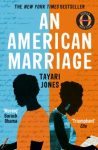
An American Marriage by Tayari Jones – (a young successful couple have their lives disrupted by a false conviction)

Tayari Jones is the author of four novels, including Silver Sparrow, The Untelling, and Leaving Atlanta. Jones holds degrees from Spelman College, Arizona State University, and the University of Iowa. She lives in Brooklyn.

Fortunate to have featured on Barack Obama’s reading list in 2018 and Oprah’s book club making it an instant bestseller, it’s been compared to James Baldwin’s If Beale Street Could Talk read and reviewed earlier this year.

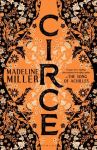
Circe by Madeline Miller – (rewrite/interpretation of Homer’s The Odyssey, from the rise of the feminine perspective)

Madeline Miller is the author of The Song of Achilles which won the Orange Prize for Fiction 2012 and was translated into twenty-five languages. Miller holds an MA in Classics from Brown University, taught Latin, Greek and Shakespeare to high school students; also studied at the University of Chicago’s Committee on Social Thought and at Yale School of Drama focusing on the adaptation of classical texts to modern forms. Her essays have appeared in publications including the Guardian, Wall Street Journal, Lapham’s Quarterly and NPR. She lives outside Philadelphia.

I read and enjoyed her debut novel and this one sounds just as good. The female goddesses and characters from many history books have been lying dormant for centuries, allowing others to portray them as less than powerful, now the unveiling of their message has begun to rise as modern women awaken, remember and begin to share ‘herstory’.

**************

Here’s what the Chair of judges had to say about the shortlist:

It’s a fantastic shortlist; exciting, vibrant, adventurous. We fell totally in love with these books and the amazing worlds they created. These books are fiction at its best – brilliant, courageous and utterly captivating.”

Have you read any of these titles, or are you planning to?

Buy A Copy of Any One of These via Book Depository


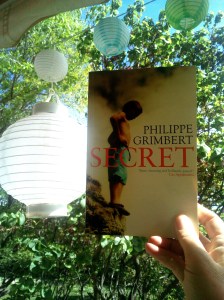
Secret by Philippe Grimbert (France) tr. Polly McLean

Twenty years after his parents jumped from the window of their Parisian apartment to their deaths, Philippe Grimbert decided to write about the secret that had overwhelmed their lives. “I had been in mourning for those 20 years,” says the French psychoanalyst, “which is a lot more than Freud suggests is normal. The Guardian, April 2007

Secret, by Philippe Grimbert, translated from French by Polly McLean, is a haunting story of a boy who senses something held back from him from those around him, it is post-war Paris, he is an only child who imagines he has a make-believe brother, seeing things from his perspective as well as his own, even going so far as to fight with him.

He is aware of his mother’s silences, his father’s sadness, without knowing the reason why, yet knowing not to ask. They are athletic, good-looking parents, but they birthed him, a delicate child they must keep from the jaws of death.

I survived, thanks to the care of doctors and the love of my mother. I would like to think my father loved me too – overcoming his disappointment and finding in care, worry and protectiveness enough to stoke his feelings. But his first look left its trace on me, and I regularly glimpsed that flash of bitterness in his eyes.

Full of fear at school, one day after watching a particularly disturbing documentary about the Holocaust, he is overcome by emotion at the insulting comment of a boy in the class and starts a fight, an act completely out of character for him and yet he had felt an inner rage that compelled him to react violently.

The incident left me with a patch above one eye that I wore around school with great pride. But the injury brought me much more than ephemeral glory – it was the sign for which Louise had been waiting.

The neighbour Louise is the only person he tells the truth about why he got in the fight.

Louise was always my favourite, even though she wasn’t actually part of the family. Perhaps I felt a deeper complicity with her than with my blood relatives. Affectionate as they were, my uncles, aunts and grandparents seemed surrounded by an intangible barrier forbidding questions and warding off confidences. A secret club, bound together by an impossible grief.

He is surprised at how upset she becomes, not at his behaviour, but something else, something greater, the burden of which overwhelms her, something she too has known all these years, and believes now she must reveal to him.

The day after my fifteenth birthday, I finally learnt what I had always known.

He fills in the gaps of the story, imagining the narrative himself, he knows nearly all the characters, except those that have haunted him, but he seems to have known them too. However, he too guards the secret, knowing makes it easier on him, but it can’t change his relationship with his family.

To overcome the final hurdle, he needs to fill in the gaps, to find out the facts.

There remained a gap in my story, a chapter whose contents were not known even to my parents. I knew a way to un-stick its pages: I had heard about a place in Paris where I could find the information I was missing.

The narrator shares the same name as the author, and though he never knew the exact details of what happened before he was born, except by anecdote, he used fiction to explore and build a narrative that hopefully might have let some of the ghosts he had lived with for many years to rest.
Why, I ask him, did he write a novel that would involve fictionalising real events? “Because I had no choice. For me, in reconstituting this story that was so brief in terms of what I had been told, reconstituting it in all its duration, was all I could do. My sole tool was the novel. Perhaps someone else could have made a film, done a painting. Somebody else could have written a history, but I couldn’t. The only way I could pay homage was to write this book.”

The Guardian, April 2007

It’s a compelling, thought-provoking read and all the more so upon finishing when I realised there is indeed a strong link to the author’s own life. In addition to the secrets explored in the book, which I don’t want to give away as they are better left to explore in reading, they also let him grow up thinking he was Catholic, something that I think may have been quite common among survivors of WWII.

“I now think that what they did was an act of love rather than cowardice. They sought to protect themselves and me by doing these things. But discovering that I was really a Jew and not a Catholic made me into a neurotic and then into a shrink.”

The book has also been made into a dramatic French film.

Buy a Copy of Secret via Book Depository

If I Had Two Lives by Abbigail Rosewood

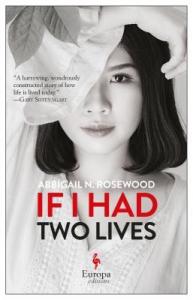
If I Had Two Lives is a story of a child who spends her childhood in Vietnam, her early adulthood in America then makes a return visit to her homeland to confront aspects of her past she wishes to resolve.
In Part One she is escorted by her solider to a secretive military camp where her mother has spent the last four years, she is seven years old and has been separated from her mother for four years.

The mother is distant, busy, under suspicion, she is an energy consultant, the girl tries to please her, get her attention. She struggles to connect with her in the way her heart yearns, becoming overly attentive to trying to please her in a way that children who aren’t able to  take having parents there for them for granted might react.

Whenever she has to travel anywhere she is accompanied by this same solider. She clings to him even though he discourages it. She befriends a motherless little girl she finds playing a game stacking bricks, their time together establishes some of the few memories of childhood they will retain, both haunted by the last time they see each other.

There is a strange, unsafe vibe around the little girl’s father. She develops a desire to hurt something, after killing a fish with her bare hands, her angst morphs into thoughtless cruelty towards the little girl. Suddenly her time there is over, she is again escorted, this time across the China border onto a plane to America.

Years later, I understood that Mother had made sure nobody saw me enter the camp and nobody saw me leave; that the erasure of my records in Vietnam would be complete when I boarded the plane…I told myself that once I got to the US, I would turn around, take a different plane back to Vietnam, go get the little girl so we could leave the camp together for good.  We’d talked about escaping together so many times that being forced to go without her was unthinkable.

In Part Two the girl has been sent to America, her mother having promised (unfulfilled) to follow her there, drifting from the homes of relatives to friends, she outwears her welcome with them all and becomes isolated, alone. Haunted by the memories of her youth, she follows a stranger home because he reminds her of her solider. She befriends a young woman who reminds her of the little girl. Her life is laced with illusion, faces that morph into those who have haunted her past. She is not the only one with a past, living with the effects of trauma and her attempts to reconnect expose her to the nightmares of others, also trying to remember or forget.

“Try telling them some other tales that don’t fit their presumptions. Vietnam” – he dropped his cigarette and crushed it with the toe of his shoe. “Is a war, not a country. Anything besides is irrelevant.”
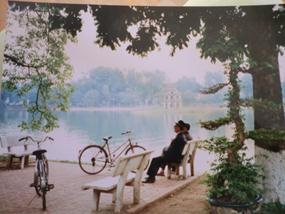
Meeting both these strangers changes the course of her life dramatically and will push her to confront her past, revisit her home country and look for what she has lost. And to make amends.

More and more I resembled my own mother as I with-held facts and became an accomplice in helping my daughters obscure their origins.

It’s a hard book to describe and one that is disturbing in parts to read, laced with a sadness for a girl that it seems was unwanted, although she was given opportunities, just not love or affection, in turn her own life seems without purpose and missing something that can be felt not described. Her return will provide her a different perspective and bring her closer to understanding her mother and her intention for her daughter, realising she has something of that in her as well.

“When you leave the old country at an age not young enough to get adopted into the new and not old enough to know how to reject it, you become this mutant thing: between borders, between languages, between memories.” He pressed his temples. “If you ask me, I think it’s easier to reinvent than to retrace. You’re not the only one, you know. Look at this city and its faces. You’re not the only one with an ungraspable history.”

I’m not sure I could say I enjoyed it, but it was thought-provoking and made me wonder about the inspiration and experience behind writing it and of the number of sad lives being lived by others, neither from one place nor another, without families, trying to make sense of the world. And of effects of unhealed trauma and displacement.

“If I had two lives to live, I would have done it differently,” she said. “Anything worth having requires your sacrifice, even your personal happiness.”

More than storytelling, despite being fiction, this novel is about what happens to those who leave their homeland, a victim in ways to what they have left, how some are able to manage their past experience, using it to try to improve the situation for others, while others remain a victim to forces and feelings they find difficult to live with, causing them to inflict pain on others or when it gets too much, on themselves, without seeming to, or unable to care who gets hurt in the process.

I am reminded of Cambodian author Vaddey Ratner whose family were evicted from their homeland, she uses fiction in her novel In The Shadow of the Banyan to express memories born of her childhood experience, and although it was traumatic, she was determined to take what was a sad chapter in her country’s history and show us something of its beauty and culture.

 It isn’t so much the story of the Khmer Rouge experience, of genocide, or even of loss and tragedy. What I wanted to articulate is something more universal, more indicative, I believe, of the human experience our struggle to hang onto life, our desire to live, even in the most awful circumstances. – Vaddey Ratner

Abbigail N. Rosewood was born in Vietnam, where she lived until the age of twelve.

This novel was born out of the aching pleasure of rearranging memories, reinventing the past – a personal need to solve my childhood’s mysteries, figure out how I arrived here, and to give myself the emotional conclusions that real life doesn’t afford.

N.B. Thank you to Europa Editions for providing me with a review copy to read.

Buy a Copy of this book via BookDepository.

Trout, Belly Up by Rodrigo Fuentes (Guatemala) tr. Ellen Jones

As I mentioned in this recent post, this year I’m reading a selection of contemporary Latin American fiction, thanks to a subscription with Charco Press. The first novella for the year is a collection of interconnected short stories, (reminding me of the Japanese author Yoko Ogawa’s excellent collection Revenge) Trout, Belly Up by Rodrigo Fuentes from Guatemala.

A man named Don Henrik is the connection between the stories, and though he is not the centre of any story until the end, through each tale narrated we come to know the hardships he has encountered as he struggled to run his various business ventures, we learn about the equally difficult life path his brother followed, and how that contributed to his father’s financial difficulties. Though it is not focused on in particular, we also know he is a foreigner, we imagine how his may have contributed to the challenges he and his family have encountered.

Don Henrik seems like a man who wants to live an ordinary life, he has the fortitude to create something out of nothing, he is kind, but he lives in a society where men give in to temptation, and are lead astray by a desire, by greed, by revenge, addiction and so always there are situations to be dealt with. He is an entrepreneur, but still learning the ways of men and nature in his adopted country.

Trout are delicate creatures and can’t handle temperatures over thirteen degrees. That’s why Don Henrik  bought his land right at the top of the mountain, because he wanted icy, cold spring water. But despite being delicate,  they’re completely savage.  They eat meat, even their own.Little cannibals, my Ermina called them.

Photo by The Lazy Artist Gallery on Pexels.com

Set in the Guatemalan countryside and forest, it is a place that appears to offer rest and tranquility and yet is beset with an undercurrent of hostility and violence, infiltrated by merciless entrepreneurs, hitmen, father’s desperate to go straight, endangering their daughters and their dog, and the plain stupid, caught in a gullible web of thinking they can make easy money, only to meet premature death.

What begins as one of the most endearing stories, becomes the one that almost prevents me finishing the book, involving the relationship between a young calf and a dog, it’s when men come between them that things turn despicable, I couldn’t help but see the young cow as a metaphor for women, who are the usual targets for such brutality.

Some will relate to its Hemingway-esque style, for me it was a straight forward, easy read, though I began to feel like I was reading a book likely to be enjoyed more by men readers, as it launched quickly into a tale of infidelity, of a man with a loyal wife and daughters distracted by a young shop girl, willing to sacrifice everything for a few moments of pleasure; men arriving with guns intent on teaching a lesson to other men, taking out their violent intent on an innocent animal, the bond between two men, their lives and friendship endangered by their descent into drugs and recklessly pursuing an activity (involving a boat and diving) while under the influence.

Personally, I find I have less and less tolerance for stories that depict women in this way, even if it represents a reality, it becomes tiresome. As a reader, I find I’m looking for a paradigm shift in the way female characters are depicted, something I am sure is coming, as I know I’m not the only one who feels this way.

Don Henrik isn’t the cause of any of this, is it bad karma, neglect or naivety, he is often absent, trusting his partners and workers to get on with the job, it is here that cracks form, that others seize their malevolent opportunity. He is a good man, he donated a kidney to his wife, he is tired, he’s found another good woman and just wants peace, but he’s a land owner, there are those who covet what he has, his desire for tranquility in this world he inhabits, observed by so much dysfunction, is an impossible ask.

Ist edition cover, Francisco Tún artwork

In an interview Fuentes is asked about his writing of this book while living outside of Guatemala and revealed his observation and interest, having moved abroad in how people spoke and expressed themselves. He viewed an accent as something like a regions ideology, that we assumed ours to be neutral, but that it revealed much about how the speaker saw the world.

I look at Guatemala, and it’s a tiny country, but one with very talented narrators. And each region of the country tells stories in different ways. The way people tell stories in the mountains is very different from how people in the eastern part of the country tell them, or those living by the coast, or in the city, undoubtedly; I paid attention to that. I was always interested in the conversations taking place between the city and rural areas. Living abroad allowed me to pay attention to these conversations from a different vantage point, and a character like Henrik enabled me to move back and forth between those two worlds.

In his excellent, expansive review, Tom Blake provides a political perspective of Guatemalan and Latin American literature, suggesting that much of it has centred around themes of ‘displacement, disappearance, deracination’ suggesting that Fuentes offered a different view, the view of those who remain. He acknowledged that Fuentes held up a mirror to a masculine world, though went a little far in my opinion in suggesting that ‘the women hold immense, almost supernatural power’.

In doing so, he provides insights into why displacement might occur, why humans feel the need to move in their thousands to countries whose promises were exposed long ago as over-optimistic or fraudulent. But that is not his primary concern. These are stories about various types of hardship and conflict, where hardship is unending and conflict is self-perpetuating. His protagonists stick around to meet their difficulties head-on; they create tiny worlds around themselves where bizarre details become normal, where flirtatious cows walk on their hind legs and, frenzied fish turn to cannibalism. Thomas Blake

Rodrigo FuentesConsidered to be one of the most prominent names among the new generation of Guatemalan writers, Rodrigo Fuentes (1984) won the Carátula Central American Short Story Prize (2014) as well as the Juegos Florales of Quetzaltenango Short Story Prize (2008).
Trout, Belly Up was shortlisted for the 2018 Premio Hispanoamericano de Cuento Gabriel García Márquez, the most prestigious prize awarded to short-story writers in Latin America. It has been published in Guatemala, Bolivia, Chile and Colombia, as well as in France. Rodrigo currently lectures at the College of the Holy Cross in the United States, and lives between Providence and Guatemala. This is his first book to appear in English.

Ellen Jones is a researcher and translator based in London. She has a PhD from Queen Mary University of London and writes about multilingualism and translation in contemporary Latin American literature. Her reviews have appeared in publications including the Times Literary Supplement and The Los Angeles Review of Books, and her translations in publications including the Guardian and Latin American Literature Today. She has been Criticism Editor at Asymptote since 2014.

Further Reading

Jumping Between the Urban and the Rural: An Interview with Rodrigo Fuentes by José García Escobar

Review of Trout Belly Up by Thomas Blake

Zuleikha by Guzel Yakhina (Russia) tr. Lisa Hayden

Last year my favourite read Kintu, by Ugandan author Jennifer Nansubuga Nakumbi was published by OneWorld Publications. This year, I enjoyed another of their award winning titles The Baghdad Clock by Shahad Al-Rawi (Iraq) (tr. Luke Leafgren) and now I am adding to that list, this wonderful historical fiction epic, Zuleikha by Guzel Yakhina (Russia) translated by Lisa Hayden.

The Russian Gulag – Labour Camps

April 2019 is the 100th anniversary of the beginning of the Gulags in Russia. Gulag is an acronym for Glavnoe Upravlenie Lagerei, or Main Camp Administration, they were a system of forced labour camp, a kind of re-education in a prison-like environment.

The Gulag was first established in 1919, and by 1921 the Gulag system had 84 camps. But it wasn’t until Stalin’s rule that the prison population reached significant numbers. From 1929 until Stalin’s death, the Gulag went through a period of rapid expansion.

At its height, the Gulag network included hundreds of labor camps that held anywhere from 2,000 to 10,000 people each. Conditions at the Gulag were brutal: Prisoners could be required to work up to 14 hours a day, often in extreme weather. Many died of starvation, disease or exhaustion— others were simply executed. The atrocities of the Gulag system have had a long-lasting impact that still permeates Russian society today.

Kulaks and Dekulakization

The first people to be interned in these camps were known as kulaks (literal translation – fist, as in tight-fisted) meaning affluent peasants – originally the term referred to independent farmers in the Russian Empire who emerged from the peasantry and became wealthy, but the definition broadened in 1918 to include any peasant who resisted handing over their grain to authorities and under Joseph Stalin’s leadership it came to refer to peasants with a couple of cows or five or six acres more than their neighbors and eventually any intellectual who offended him.

Portrayed as class enemies of the USSR, the process of re-education was dekulakization the campaign of political repressions, including arrests, deportations, and executions of millions of prosperous peasants and their families. It is these people, decreed kulaks in the 1930’s, that are the subject of this novel.

Book Review – Zuleikha

As soon as I read premise of this novel, I wanted to get it, one of my favourite books The Industry of Souls by Martin Booth was set in a Russian gulag, though these are very different books. And there is nothing quite like being swept away by those wonderful character-lead novels such as Dostoevsky’s The Idiot and Tolstoy’s, Anna Karenina and the provocative poetry of Pushkin’s Eugene Onegin that have entertained us and demonstrated important aspects of creating characters in literature, and who could forget one of the highest grossing films of all time, Doctor Zhivago.

While we may not quite reach the heights of the masters, we are offered a refreshing and unique perspective in this compelling novel about a Tartar Muslim woman named Zuleikha, whose independent farmer husband has been accused of not having collectivised his property, resulting in her being sent away to be dekulakized.

They encounter the Red Army and their leader Comrade Ignatov as they return from hiding provisions, a meeting that will forever be etched in the minds of both Zuleikha and Ignatov, the latter becoming an equally important protagonist in the novel, which charts the journey and evolution of both characters.

They travel the same paths in opposite roles, one of the ironies of the novel to see how imprisonment in many ways improves the life of Zuleika, and control of the camp significantly diminishes the life of her captor.  Effectively she is rescued from a tyrannical husband and mother-in-law, having been married off at the age of fifteen (he 30 years her senior) where she was little more than a slave in their household, having also given birth and lost all her babies in that period.

Photo by Pixabay on Pexels.com

Unlike some gulag stories, the people in this novel who are sent to be dekulakized are not sent to an existing facility. They spend months on a long train journey, where many will die, some escape, getting to know each other and then just as winter sets in they’re put on a barge, travel up a river and are dumped there. In order to survive, they must build shelter and find food, so their fate also extends to the leader who oversees them, Ignatov.

Although Zuleikha arrives in an emaciated state, she soon attains strong motivation to remain healthy, she finds solace in her role in the kitchen and ultimately strength in her eventual role as a hunter, venturing into the forest every day to set traps and capture wildlife to keep them all from starving.

Whereas Ignatov, who has enjoyed relative freedom and even privilege in his previous role, riding across the country rounding up suspected kulaks, is unhappy with orders to take on the role of Commandant to accompany these people to an unknown destination. His transformation is more of a decline from his lofty position of power, he loses faith and no longer commands the same respect he had, even for himself.

Who was Zuleikha?

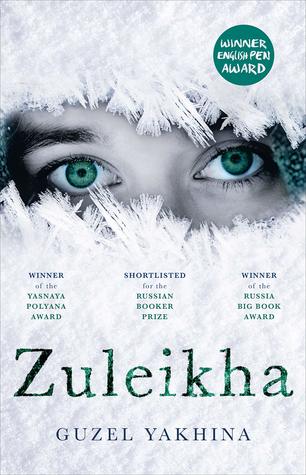
On the cover of the book and mentioned throughout the text, are Zuleikha’s intense green eyes, other versions of the novel are entitled “Zuleikha Opens her Eyes“, this transformation of character through having her eyes opened is one of the themes of the novel, she sees beauty as well as suffering, she will experience true love and profound heartbreak. It’s about a woman who comes out from having been defined and used by men, into finding new strength and her own role. It is a form of emancipation, albeit it a preliminary one.

Yusef runs away from Zulaikha

One aspect of the novel I haven’t seen discussed anywhere is the significance of the names, Zuleikha and Yuzuf. I had a sense that those names somehow went together and I discovered an epic poem of the same name written in 1483 AD by the Sufi poet Jami.

It is an allegorical poem about the pursuit of love and of God, which also covers the allure and the suppression of love, the suffering of slavery and in aspects of this poem, I find aspects of three characters in the novel, Zuleikha, Ignatov and Yuzuf and I end my review with an ambiguous extract that may refer to a lover or a son, from the poem that reminds me of the closing pages of the novel.

The novel is unique in that it is written (and translated) by a woman who makes a young woman the centre of such an epic story, in part inspired by the actual memories of her own grandmother. She hasn’t set out to recreate the dire, conditions and cruelty of the camps, we witness a tale of survival, and through the eyes of a woman who already had a dire life, despite being the wife of an affluent peasant.

Guzel Yakhina’s grandmother was arrested in the 1930’s, taken by horseback to Kazan and then on a long railway journey (over 2,000 miles) to Siberia. She was exiled from the age of 7 until 17 years, returning to her native village in 1947. It was these formative childhood years that were in a large part responsible for her formidable character.

Upon her death at the age of 85 years, the author realised the importance of her early life and thus began her research and determination to understand how her grandmother operated, bringing her back in part through the inspired creation of the extraordinary character Zuleikha.

“I realised it would be impossible to remember the things she said as her stories were not recorded,” Yakhina says. “There was a feeling of guilt.”

A thought-provoking, interesting story and reflection, not at all brutal or hard to read, the author writes with compassion for her characters and brings out something very different from what we have come to expect from stories set in prison-like environments.

Highly Recommended.

 Zuleikha and Yusuf – extract from the epic poem

“The one sole wish of my heart,” she replied,
“Is still to be near thee, to sit by thy side;
To have thee by day in my happy sight,
And to lay my cheek on thy foot at night;
To lie in the shade of the cypress and sip
The sugar that lies on thy ruby lip;
To my wounded heart this soft balm to lay;
For naught beyond this can I wish or pray.
The streams of thy love will new life bestow
On the dry thirsty field where its sweet waters flow.”

Jami, Sufi poet (tr. Charles Francis Horne)

My Reviews of Novels set in Russia

Eugene Onegin by Pushkin

The Kindness of Enemies by Leila Aboulela

The Industry of Souls by Martin Booth

Further Reading

Review: Lisa Hill’s review of Zuleikha at ANZLitLovers

Article: The Calvert Journal: “Learn to live with it, even forgive.”Guzel Yakhina on the traumas of Soviet history

Article: Peninsula, Qatar: Russian novel tells story of survival, love in Stalin’s camp

Buy a Copy of Zuleikha via Book Depository

N.B. Thank you to OneWorld Publications for providing me with an advance reader’s copy of this novel.

Reading Contemporary Latin American Fiction

‘cruzar el charco’

It seems appropriate to begin this post with a word, since this reading and writing adventure takes place word by word, across time and continents. Our word for today is charco which means puddle in Spanish and is also a colloquialism in some Latin American countries referring to the Atlantic Ocean.

And cruzar el charco means crossing the puddle, a way of referring to when someone is leaving the country, taking a trip somewhere far from home, across the ocean.

And this is what I have decided to do in 2019, to take a literary trip across the ocean to Latin America, and I’ll be doing that with the help of Charco Press, a small press based in Edinburgh, creating a bridge of cultural discovery for us to access the richness of that new world with a guide to contemporary literature authors that will likely be unfamiliar to us all.

We select authors whose work feeds the imagination, challenges perspective and sparks debate. Authors that are shining lights in the world of contemporary literature. Authors that have won awards and received critical acclaim. Bestselling authors. Yet authors you perhaps have never heard of. Because none of them have been published in English.

Until now.

Photo by Pixabay on Pexels.com

So this year I have taken a subscription with Charco Press, so I don’t choose the books, I will read whatever they publish in their catalogue in 2019.

This will mean it’s not necessarily going to be something I might ordinarily read, I’ll be reading across borders and outside my comfort zone. But what a journey. No vaccinations required, no need for language classes, although we may still learn a few words along the way.

I have already read the first book and my review will be coming shortly, however, below are summaries of the six books I’ll be reading from this part of the world this year, in case you’d like to join me. As I read them, I’ll link my reviews back to this summary post.

Do let me know if any of these titles interest you, or whether you’ve read any other books published by Charco Press that you have enjoyed.

Click on the title to visit the Charco bookstore.

Trout, Belly Up by Rodrigo Fuentes (Guatemala) (tr. Ellen Jones)

In this highly original collection of interconnected short stories, the Guatemalan countryside is ever-present, a place of timeless peace yet also riven by sudden violence. The stories provide glimpses into the life of Don Henrik, a good man struck time and again by misfortune, as he confronts the crude realities of farming life. Over the course of these episodes we meet merciless entrepreneurs, hitmen, drug dealers and fallen angels, all wanting their piece of the pie. Told with precision and a stark beauty, in a style that recalls Hemingway, Trout, Belly Up is a unique ensemble of beguiling, disturbing stories set in the heart of the rural landscape in a country where violence is never far from the surface.

Feebleminded by Ariana Harwicz (Argentina) (tr. Annie McDermott & Carolina Orloff)

In Feebleminded, Harwicz drags us to the border between fascination and discomfort as she explores aspects of desire, need and dependency through the dynamics between a mother and her daughter, searching through their respective lives to find meaning and define their own relationship.

Written in a wild stream of consciousness narration in the best tradition of Virginia Woolf and Nathalie Sarraute, and embedded in a trend of elusive violence so ingrained in contemporary Latin American fiction, Feebleminded follows the pair on a roller coaster of extreme emotions and examinations into the biographies of their own bodies where everything – from a childhood without answers to a desolate, loveless present – has been buried.

Told through brief but extremely powerful chapters, this short lyrical novel follows Die, My Love (my review here) as the second part in what Harwicz has termed an ‘involuntary trilogy’.  An incredibly insightful interrogation on the human condition, desire and the burden of deep-rooted family mandates.

The Wind That Lays Waste by Selva Almada (Argentina) (tr. Chris Andrews)

The Wind That Lays Waste begins in the great pause before a storm. Reverend Pearson is evangelizing across the Argentinian countryside with Leni, his teenage daughter, when their car breaks down. This act of God – or fate – leads them to the home of an aging mechanic called Gringo Brauer and his boy named Tapioca.

As a long day passes, curiosity and intrigue transform into an unexpected intimacy between four people: one man who believes deeply in God, morality, and his own righteousness, and another whose life experiences have only entrenched his moral relativism and mild apathy; a quietly earnest and idealistic mechanic’s assistant, and a restless, sceptical preacher’s daughter. As tensions between these characters ebb and flow, beliefs are questioned and allegiances are tested, until finally the growing storm breaks over the plains.

Selva Almada’s exquisitely crafted début, with its limpid and confident prose, is profound and poetic, a tactile experience of arid landscapes, heat, squat trees, broken cars, sweat-stained shirts, and ruined lives. The Wind That Lays Waste is a philosophical, beautiful, and powerfully distinctive novel that marks the arrival in English of an author whose talent and poise are undeniable.

Loop by Brenda Lozano (Mexico) (tr. Annie McDermott)

Loop is a love story narrated from the point of view of a woman who waits for her boyfriend Jonás to return from a trip to Spain. They met when she was recovering from an accident and he had just lost his mother. Soon after that, they were living together. She waits for him as a sort of contemporary Penelope who, instead of knitting only to then un-knit, she writes and erases her thoughts in a notebook: Proust, a dwarf, a swallow, a dreamy cat or David Bowie singing ‘Wild is the Wind’, make up some of the strands that are woven together in this tapestry of longing and waiting.

Written in a sometimes irreverent style, in short fragments that at points are more like haikus than conventional narrative prose, this is a truly original reflection on love, relationships, solitude and the aesthetics and purpose of writing.

An Orphan World by Giuseppe Caputo (Colombia) (tr. Sophie Hughes & Juana Adcock)

In a run-down neighbourhood, in an unnamed seaside city with barely any amenities, a father and son struggle to keep their heads above water. Rather than being discouraged by their difficulties and hardship, they are spurred to come up with increasingly outlandish plans for their survival. Even when a terrible, macabre event rocks the neighbourhood’s bar district and the locals start to flee, father and son decide to stay put. What matters is staying together. This is a bold poignant text that interplays a very tender father-son relationship while exposing homosexuality and homophobia with brutal honesty. With delicate lyricism and imagery, Caputo is extremely original and creative producing a tale that harmoniously balances violence, discrimination, love, sex and defiance, demonstrating that the he is a storyteller of great skill.

An Orphan World is about poverty, and the resourceful ways in which people manage to confront it. At the same time, it is a reflection about the body as a space of pleasure and violence. Perhaps above all else, An Orphan World is a brutally honest love letter between a father and son.

Adventures of China IronThe Adventures of China Iron by Gabriela Cabezón Cámara (Argentina) (tr. Iona Macintyre & Fiona Mackintosh)

(* China. Pronounced ‘cheena’: designation for female, from the Quechua. Iron: The English word for Fierro, reference to the gaucho Martín Fierro, from José Hernández’s epic poem.)

This is a riotous romp taking the reader from the turbulent frontier culture of the pampas deep into indigenous territories. It charts the adventures of Mrs China Iron, Martín Fierro’s abandoned wife, in her travels across the pampas in a covered wagon with her new-found friend, soon to become lover, a Scottish woman named Liz. While Liz provides China with a sentimental education and schools her in the nefarious ways of the British Empire, their eyes are opened to the wonders of Argentina’s richly diverse flora and fauna, cultures and languages, as well as to its national struggles. After a clash with Colonel Hernández (the author who ‘stole’ Martín Fierro’s poems) and a drunken orgy with gauchos, they eventually find refuge and a peaceful future in a utopian indigenous community, the river- dwelling Iñchiñ people.

Seen from an ox-drawn wagon, the narrative moves through the Argentinian landscape, charting the flora and fauna of the Pampas, Gaucho culture, Argentinian nation-building and British colonial projects.

In a unique reformulation of history and literary tradition, Gabriela Cabezón Cámara, with humour and sophistication, re-writes Martín Fierro from a feminist, LGBT, postcolonial point of view. She creates a hilarious novel that is nevertheless incisive in its criticism of the way societies come into being, and the way they venerate mythical heroes.

***********

Some promising, diverse explorations across this puddle, I do hope you might join me at one of these destinations!

Further Reading: Exposing the UK to Contemporary Latin American Literature