After looking at the novels on the shortlist for the Women’s Prize for Fiction 2024, I decided to read two of them, Enter Ghost (set in Palestine) and Brotherless Night (set in Sri Lanka) mainly because in addition to enjoying works by women in translation, I also enjoy novels in English set in other countries, written by people who have had some experience of that culture.
Enter Ghost is as much a semi-lived experience as it is a story to be read and understood. I don’t know if every reader will experience it that way, but for me, many of the places that the novel takes place in, elicited memories of being there, travelling [the 5 hr scenic route (irony)] between Bethlehem and Ramallah, visiting a countryside village outside of it, spending a day in Jerusalem (finding someone who had permission to enter the city to accompany me). A day(s) in the life of an ordinary (is there such a thing) Palestinian.
I expected them to interrogate me at the airport and they did.
This novel brings alive the sense of place and the many difficult and challenging encounters local people have to navigate, in trying to travel from one place to another. For some, like the elderly, it is best not to even try.
Sonia Nasir is one of the semi-privileged, she is able to fly into the country. That is, she is does not have to travel overland via Jordan and cross the Allenby/King Hussein Bridge to enter Palestine, as many do.
Enter Ghost is a story of youth, about a desire to stage a play in one of the most difficult places you might try to do that.
People who live in different parts of Palestine, with different ID’s and therefore different freedoms, different fears, vastly different experiences. Gazan’s, West Banker’s and what they refer to as 48’ers. It is as if they are from different countries, how different their lives are based on the geography of birth.
Sonia is half Dutch, half Palestinian and lives in London where she is a successful stage actor. She is connected to Palestine, through family summer holidays spent in Haifa (a Northern coastal town). While visiting her sister Haneen, she meets her friend Mariam, who asks her to fill in for a couple of characters in the play she is staging, while she searches for suitable replacements. They are staging an Arabic version of Hamlet.
The novel depicts the process of rehearsing and pushing actors to develop into the roles they are playing, while navigating an environment where even theatre is seen as a possible revolutionary act. All the while they rehearse, they are never quite sure if they can pull this off, nor are they even sure of whether they can trust each other.
As well as navigating their own relationships, there is an incident at the Al-Aqsa Mosque which further complicates their ability to move about.
Throughout the obstacles, Sonia is coming to terms with her recent past in London, the fraught relationship she has with her sister and with her ancestral home.
The day Michael, the movement director, joined rehearsals, he had examined my body like a tailor; told the directors to leave the room, and proceeded to lecture me about the importance of motivation.
‘Every person,’ he said, looking away, absorbed by his words, ‘every body moves differently from the next person’s body when their mind goes through something. When you’re sad, you,’ he pointed, ‘are going to move differently from the way I move when I’m sad. I can still read your movements, but they’re not going to be the same as mine. But if you make a straight line from emotion to movement – your emotion, your movement – then the audience will not only read you, they will feel you.’
She is 38 years old, mature in one sense and an established actor, and yet it is something of a coming-of-second-age novel, as both the play and the new relationships and the place all act on her and transform her.
As the time this novel was shortlisted for the Women’s Prize, the HOME venue in Manchester, UK cancelled then reinstated (after nearly 100 artists protested and began to remove their work from an exhibition there) a Palestinian theatre performance of Voices of Resilience.
There is reference too in the novel, to a turning point in Palestinian theatre history, the staging of Al-Atmeh, ‘Darkness’, a play which as it begins the lights go out – actors are part of the audience and play out all the elements of dealing with this one of many regular occurrences of life under occupation, trying to fix it.
The titular darkness allows the actors to discuss the darknesses of various interrelated forms of oppression—occupation, social backwardness, patriarchy—and the play ends with the cast and audience holding candles to collectively illuminate the stage. It was a raging hit. The audiences had seen nothing like it and they were ecstatic.
The version of Hamlet that is staged is based on a translation by Jabra Ibrahim Jabra translated back into English for the novel, and the language used and those who use it and how they use it is as important as the text itself.
I am not well versed in the play Hamlet, but the parts of the play that are shared in the novel and the context within which they are staged don’t require that the reader be too familiar with it, but no doubt if you are familiar with Hamlet, it will add another layer of understanding.
I particularly enjoyed it also for the understanding it brought to the process of developing a troupe of actors for a play and how the author captured these performances and the emotion they elicited (or didn’t). That is powerful, dedicated and practiced writing.
Overall, as I said in the beginning, I felt like I lived through this novel, which was exhausting at times, but wholeheartedly worth it.
A new author to me, I became aware of this novel when I saw that it had won Best Novel in the Ngaio Marsh Awards 2023 (an award made for the best crime, mystery, or thriller novel written by a New Zealand citizen or resident, published in New Zealand during the previous year).
Life’s Turning Point
Emily, a middle aged children’s book illustrator, living alone in London, receives a call from her father’s neighbour Raewyn in Tawanui, New Zealand to say she ought to come, that her father Felix’s memory is deteriorating, the dementia much worse than when she last visited. The neighbour has been voluntarily helping him out, her son leases land off him, their families have been close for many years.
Emily is the youngest, her brother and sister though nearer have reasons why they can’t help. Not only does her father not recognise her when she first arrives, but the house is full of notes he has written to himself, an attempt to slow down the fast encroaching disease.
Notes To Self
He held up the envelope. ‘Something for you to look after.’ ‘What’s this?’ ‘Keep it for me, will you? Please, please, don’t open it until the event mentioned on the front. Until then, I’d rather you didn’t let anyone know of its existence. I will undoubtedly forget I’ve give it to you. I’m afraid I’m going doolally.’
Her return coincides with the 25th anniversary since Raewyn’s daughter Leah disappeared without a trace, last seen by Emily who was working in a petrol station where Leah bought something before going into the local bush on one of her conservation research trips, trying to save an endangered snail species from predators, but making a few enemies in the process. She was never seen again.
‘I envy you,’ she says.
She doesn’t. Why would she envy me? She’s Dr Leah Parata, five years older and infinitely, effortlessly superior. Everything about the woman screams energy and competence, even the way she’s twirling that turquoise beanie around her index finger. She’s tall, light on her feet, all geared up for back-country hiking in a black jacket – or maybe navy blue, as I’ll later tell the police.
The Slow Unravelling
Though she had never been close to her father, now that his short term memory is failing and his guard is slipping, she comes to realise there is much about her father she did not know, both in the way he cared and the terrible secrets he has kept.
Emily, I’m lost in the mist, I’m sliding into an abyss. You can’t begin to imagine the terror.’
Determined not to put him into care, as her siblings prefer, Emily decides to stay, reconnecting with her own past and begins to unravel what has been covered up and must decide what to do about it.
It’s an evocative read that brings the reader deep into the east coast North Island setting of a small town in the foothills of the bush covered Ruahine Mountain Range. It creates a strong sense of its locals, both those who stay and those who leave, all of whom have a history and connections, who harbour secrets, fear judgement and maintain strong loyalties, especially when outsiders come into the community.
It’s a slow unravelling of the mystery of Leah’s disappearance and the revelation of who a father really is to his daughter, as time runs out and he begins to forget not just who she is, but who he is himself and the important final task he has set himself.
Author, Charity Norman
Charity Norman was born in Kampala, Uganda, the seventh child of missionary parents, raised in Yorkshire and Birmingham. A barrister specialising in crime, family law and mediation, in 2002 she took a break from law and moved with her family to New Zealand and began a writing career.
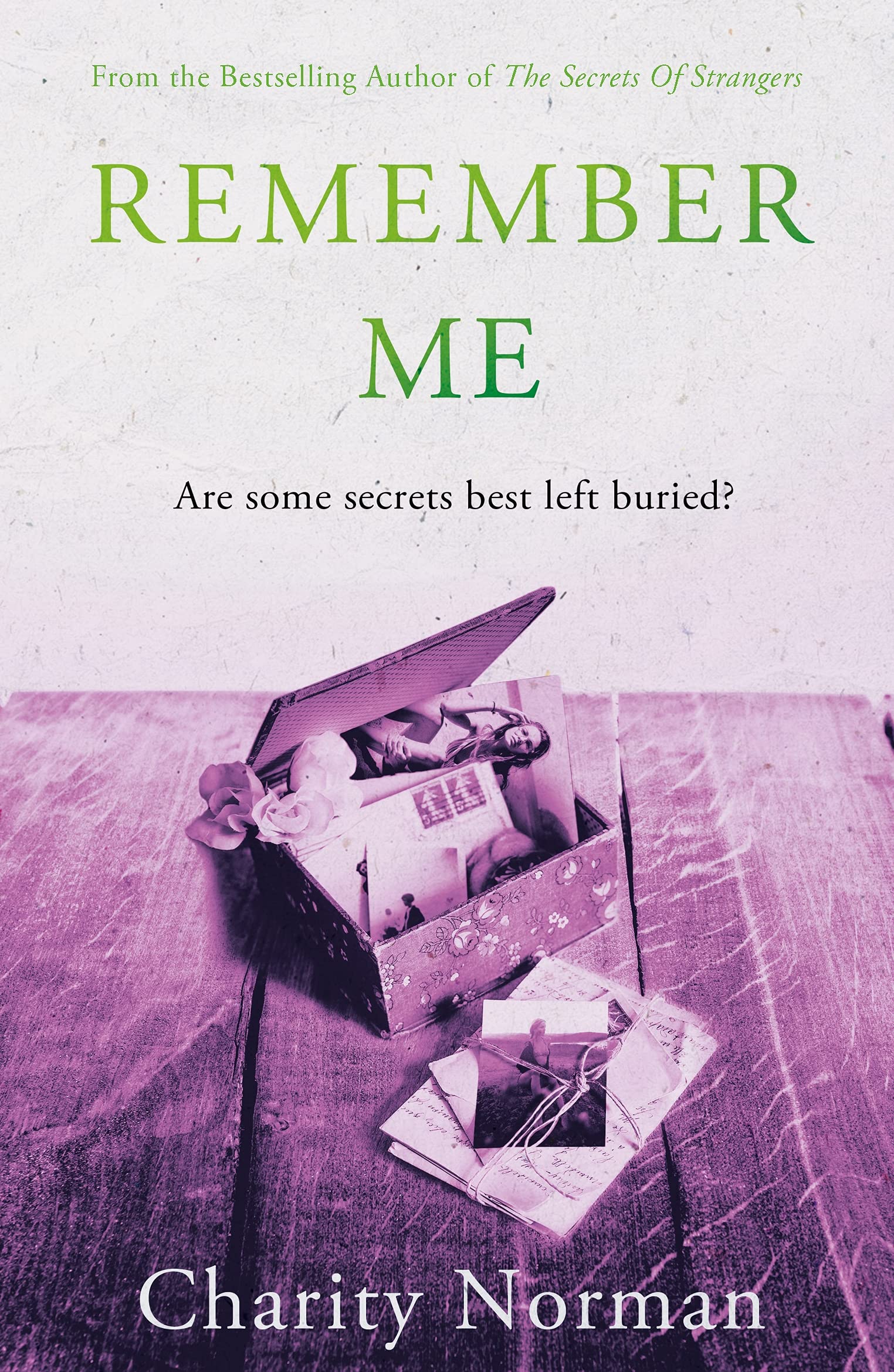
She has written seven novels, See You in September (2017) and The Secrets of Strangers (2020) were both shortlisted for the Ngaio Marsh Award for crime novel. The New Woman/The Secret Life of Luke Livingstone was selected for the BBC Radio 2 Book Club. Remember Me (2022) was a Ngaio Marsh Award winner.
Juliet Greenwood writes immersive historical fiction, often set in Wales or Cornwall around World War II and always featuring women protagonists, who rise to the challenge in difficult times. Her books are a tribute to those women, often unseen, who keep the world turning, even in the most terrible of times.
The Last Train from Paris is set in the period just before and during World War II, moving from Paris, to London to Cornwall and was inspired in part by stories that Juliet’s mother told her about this period.
It’s a story I’ve been longing to write, ever since I was a little girl and my Mum first told me about studying French near Paris on the day war broke out in 1939. I couldn’t imagine then what it must have been liketo have been a 17-year-old English girl, on her own, catching the train to Calais through a country preparing for war and, like Nora, finding herself on a ferry in the middle of the Channel, being stalked by a German submarine. It’s a story that’s haunted me, especially since we found the letters Mum exchanged with my Dad in London, and the scribbled note she sent him when she finally arrived in Dover.
Past Circumstances, Present Lives
1964: Iris is visiting her mother in St Mabon’s Cove, Cornwall, an escape from her life in London. She has been having nightmares of feeling trapped. Her mother has given her a box. She has also been looking at the objects in it that relate to her past. It is awakening something that has become more insistent. She knows she was adopted and that these items have something to do with her original family.
Over the course of the weekend, she will ask her mother questions and begin to learn about the past. And encounter a strange reporter is snooping around the village asking questions, a caller her mother wishes to ignore.
Studying in Paris, 1939
The historical narrative centres around two young women characters in 1939; Nora lives in London, where she has worked as a dish washer in a kitchen since she was sixteen. Sabine, a freelance journalist works in a boulangerie (bakery) in Paris, living with her husband Emil, also a journalist, who is focused on writing the novel that is going to change their lives.
The two women meet when Sabine gives a talk in London, after spending a month gaining work experience at the London Evening Standard newspaper. They maintain contact, writing each letters regularly.
Nora, frustrated with the lack of opportunity in her job, comes up with the idea of going to Paris to do a chef training course at Madame Godeaux’s Cuisine Française, seeing no chance of promotion in her current employment.
Sabine and Emil’s lives are a little precarious due to their reliance on Emil’s brother Albert to subsidise their rent and pending war has contributed to the family boot business suffering. When bad news arrives, Emil, as the second son, is summoned to return to Colmar, to take over from his brother.
When Nora arrives in Paris, she is disappointed to learn that Sabine has already left for Colmar, but she settles into her course and meets other girls, amid a growing wariness of the safety of the city. When one of the girls Heidi tells her the real reason she is in Paris, Nora begins to understand the danger that is not far away.
The novel follows the twin time periods, the present day 1964 where Iris hearing from her mother stories of the past that will lead towards her understanding her identity and circumstances that lead to where she is now and the crossing of paths of two women in the past whose connection resulted in lives being forever changed.
As the story gathers pace, secrets are revealed, dangers confronted and choices made in desperation have long term effects.
There are so many twists and turns in the story, it’s one that you won’t want to put down once started, bt to share any more would be to spoil the joy of discovering and the detective work we begin to do as readers, trying to puzzle out the missing pieces of the jigsaw of these three women’s lives.
A riveting and immersive read, that reminds us just how precarious life is, how stability can be shattered from one day to the next, yet offers hope in its demonstration of the acts of kindness some will make to help others, to make each other safe.
N.B. Thanks you to the author Juliet Greenwood, for providing me a copy of the book to read and review.
I first came across the writer Suhaiymah Manzoor-Khan in 2021, she wrote the opening essay ‘I Am Not An Answer, I Am The Question’ in Cut From The Same Cloth? – Muslim Women on Life in Britain edited by Sabeena Akhtar. Her essay was about the understanding she came to while a student at the University of Cambridge where she encountered a tool for attempting to ‘unlearn’: questioning.
I realised that most feminist and anti-racist politics I had engaged with up until that point were shallowly asking the wrong questions. Most of the questions being asked were not my questions at all. So much of my educational and consciousness-raising work had been the work of answering questions posed by others.
Her book Seeing For Ourselves and Even Stranger Possibilities is an extension to the understanding she shared in that initial essay.
It is interesting to read the opening pages where she is grappling with her purpose for writing and how to begin this book, having just finished reading Annie Ernaux’s nobel lecture, where she reaches back sixty years to a diary entry and finds her opening line (her purpose for writing), in the words ‘j’écrirai pour venger ma race’ (I will write to avenge my people).
Manzoor-Khan writes about ‘the gaze of the other’ and questions whether she has anything to add to a complex and much discussed subject and finds out she does when she turns the topic on its head.
Ernaux was writing from the perspective of a higher educated French working class woman in the closing years of a writing career, while Manzoor-Khan writes from the perspective of a higher educated British Muslim woman at the beginning of hers.
Troubled by such doubts, I started to consider why being a subject rather than an object was the furthest horizon I could dream of. What lay beyond ‘seeing with my own eyes’? What if ‘seeing for ourselves’ wasn’t actually the best way to see? What could transcend the desire to be see-er instead of seen? What if I closed my eyes and did not prioritise seeing at all?
Looking into these stranger possibilities, she contemplates the how to, and finds no easy route than to go forth and try. What results is a combination of prose, poetry and a short play interspersed throughout the text; looking at the question from different angles and so too, using different genres.
Need, Want, Seeing, Overcoming
The book is structured into seven parts:
the need - how I am found
the want - how I find myself
becoming a sight - the portal of objecthood
striving to see - seeking subjecthood is a circle
escaping the cycle - even stranger possibilities
grief is a type of ghaib - love is a type of sight
a note on endings - the impossibility of concluding
The need is about clarifying intention and the want is to bear witness to an existence. This latter section opens with a poignant vignette on hoarding nineteen white IKEA boxes in the author’s room that cause her shame. On further reflection, she discovers their ‘why’, they are evidence of a life.
I am afraid to let on about this in case it becomes obvious how afraid I am to go unseen. In case it becomes obvious how powerful it is to destroy a people’s history. How catastrophic it is to leave them believing they are suspended. To eliminate their past, present and knowledge.
Throughout the text are acts, scenes from a short play. It is how the book opens, Act 1, a conversation between the writer and the book.
the writer: You’re not what I expected you to be.
the book: What did you expect?
the writer: You were supposed to be about seeing and being seen About the different gazes upon us And how to see ourselves without them
the book looks smirkingly at the writer, knowing more than her (as always).
The way these brief interludes are positioned lightens the tone of the book, giving it a different vibe, featuring characters such as the writer, the book, her head, her heart, her fear, her eyes, her soul.
Because of their brevity, the voices of those characters speak more loudly and succinctly than the more existential meanderings of the author on changing her perspective of the gaze, from ‘others’ on her to (even stranger possibilities) just the ‘one’. The many different forms that address her subject, allow the reader to consider, reflect and attempt to understand the perspective being shared.
It is a philosophical read, of short easy-reading vignettes,some that challenge more than others, of poetry and the interspersed acts and scenes of the play featuring the writer, the book, her eyes, her fear, her head, her soul. In another scene, a group of onlookers struggle with the question of being seen, of invisibility, of too much visibility, of how we are perceived by others, by ourselves, by the Divine Presence…
It is a companionable read, though not easy to review, as the author reminds us, this is a book of questions, and it is also a journey, it is not a conclusion or a set of answers, it is observations, reflections, it invites participation, it does not exist in isolation.
It puts into word the frustrations and injustice of invisibility and challenges that which is seen (the blind scrutiny) in its place.
Perhaps rather than the head, the intellect, the eyes, the judgments, we ought to perceive with the soul, if so, what might that look like?
Rather than striving to be seen, approved or understood by gazes that shrink me, all I have to do is that which brings me closer to my Maker, who sees the full context of me. Everything else is either a means to this or a diversion from it.
The Skinny: Review – Suhaiymah Manzoor-Khan’s cross-disciplinary book is a beautiful consideration of devotion to faith, family and politics by Paula Lacey
Suhaiymah Manzoor-Khan, Author
SuhaiymahManzoor-Khan is a poet and writer whose work disrupts assumptions about history, race, violence and knowledge.
She is the author of Tangled in Terror and the poetry collection Postcolonial Banter; a co-author of A FLY Girl’s Guide to University; and a contributor to the anthologies Cut from the Same Cloth? and I Refuse to Condemn.
Her writing has also featured in TheGuardian and Al Jazeera, and her poetry has been viewed millions of times online. She is a co-founder of the Nejma Collective, a group of Muslims working in solidarity with people in prison. She is based in Leeds and is currently writing for theatre.
Soundings is a dual narrative memoir, that recounts two journeys a woman makes, pursuing her dream to see the grey whales that migrate up the coast from Mexico where her journey begins, to the northernmost Arctic town of Utqiagvik.
The Iñupiat have thrived there, in a place periodically engulfed in ice and darkness, for thousands of years, bound closely together by their ancient culture and their relationships with the animals they hunt, most notably the magnificent and mysterious bowhead whale. I hadn’t just seen the whales there, I’d joined a family hunting crew, travelling with them in a landscape of astonishing beauty and danger.
The book is structured so that each chapter alternates the twin journeys, the first one when she is a young BBC journalist on a sabbatical – the trip isn’t a job assignment, she is winging it, not knowing ahead of time where she might stay, or that she might join an indigenous whale hunt – to be in a position to observe the whales.
She is going there to listen, observe and with luck, participate.
The idea was that you could immerse yourself in a place and absorb more than if you were questioning people as a reporter and narrowing the world down into stories. I was supposed to take thinking time away from the relentless news cycle, open my mind and return bursting with creativity and new ideas.
The second trip is more of an escape from her current reality, that of a young single mother awarded sole custody, who can not afford to live in her home (due to high mortgage payments), reluctantly returned to her parents home in Jersey – who then decides she wants to make a return trip and provide her two-year-old son a formative experience of travel and whale watching.
I’d felt so alive then, so connected to other people and to the natural world. If only I could feel that way again and give that feeling to Max.
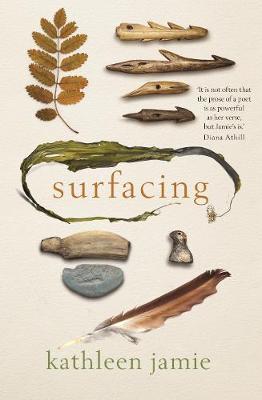
I recalled reading Scottish poet and nature essay writer Kathleen Jamie’s Surfacing, where she visits and brings alive an archaeological site Nunallaq, in the Yup’ik village in Quinhagak, Southern Alaska.
Doreen Cunnningham’s interest in whales and the environment inclines more towards the science, research and a personal desire for a sense of belonging and a large dose of wishful thinking, than the more poetic and philosophical Jamie, who went towards the tundra in search of surfaces that might reconnect us to the past. However, the two books together make informative and astonishing reading.
I told myself I would relearn from the whales how to mother, how to endure, how to live. Beneath the surface, secretly, I longed to get back to northernmost Alaska, to the community who’d kept me safe in the harsh beauty of the Arctic and to Billy, the whale hunter who’d loved me.
Once you realise that the narrative goes back and forth, it becomes easier to stick with it, the chapters in the more recent past focus as much on the logistics of trying to travel with a child, car seat and stroller, finding kindred spirits who might assist getting her on a boat to see the whales, while doing her best to avoid those fellow travellers who look askance at a young mother, attempting the extraordinary.
As they travel, she also shares something of the challenges in the past of reporting on climate change, the reluctance to report on the environment and the habit many broadcasters had of always finding a sceptic to present an alternative view to the facts.
What was going on was that media all over the world had regularly been allowing sceptics o misrepresent science without adequately challenging them, and presenting them as though they carried equal scientific weight to mainstream climate researchers…This ‘insistence on bringing in dissident voices into what are in effect settled debates’ created what the report called ‘false balance’.
In her earlier visit, she takes time to listen to their stories, of the first ships that came in, bringing equipment, alcohol and disease. She hears of the social problems of another indigenous people, of children sent away, of PTSD, of a sense of rage and powerlessness, of a need to educate themselves in order to better represent and protect their culture and ways.
She also hears of the effect of the warming of the ocean first hand, its impact on animals, on the ice, on patterns of behaviours, of the risk to their livelihood and comes to understand the importance differences between a people who live in harmony with their environment and depend on it and those who came intent on exploiting it.
We also learn a little of her childhood experiences, of her wild pony Bramble, of an Irish granny and the songs she still sings that the whales seem to respond to. She injects enough of the personal story to keep the pace going, as the flow risks at times being overwhelmed by the facts and background research. However, as I go back and reread the passages I highlighted, I find it interesting to encounter some of this information a second time around, now that I’ve removed the expectation of a flowing narrative.
There is a something in this book for everyone, it defies genre and shows the gentle, yet vulnerable courage of a young mother persevering against the odds, seizing the reins of her life, following her intuition and going on a grand adventure with a small boy, who is perhaps more likely the greater teacher to her than the elusive whales, on motherhood.
Doreen Cunningham, Author
Doreen Cunningham is an Irish-British writer born in Wales. After studying engineering she worked briefly in climate related research at NERC and in storm modelling at Newcastle University, before turning to journalism. She worked for the BBC World Service for twenty years as an international news presenter, editor, producer and reporter.
She won the RSL Giles St Aubyn Award 2020 and was shortlisted for the Eccles Centre and Hay Festival Writers Award 2021 for Soundings, her first book.
I just love the concept of these works of flash fiction, postcard size stories, that have a geographic connection to a street or location in Northern Ireland, that originated as a story written on the back of a postcard – an alternative restriction to the usual one when writing flash fiction, of keeping it to 100 -150 words – and that the postcard was both sent and retained, a gift and an accumulated collection.
This not quite Ireland proper/ is not the Mainland/ is certainly not Europe in the Continental sense.
When I first picked it up, a little while ago now, I looked at the contents and went to read a few entries from the locations that were familiar to me, Belfast International Airport, Newtownards Road, Holywood Road, Linenhall Street, Holywood, Ormeau Road, but of course that was me thinking of my own story, so it didn’t make much sense. I was looking for something that wasn’t there.
Removing Expectations
So now I read it again, this time from the beginning and just allow it to tell me its own story, its bite sized exercise in writing, the awakening of imagination, the sharing of the craft, its way of thinking of others while being in the act of creation.
The book is thoughtfully illustrated by Benjamin Phillips. You can view the images from the book via the link provided through his name. They are truly evocative.
I read, am entertained and wonder what it must have been like to receive one of these. Is there a connection between the story and the recipient, is it random, did they reply, did they understand the motivation of the author, did it matter? How did you get to be one of the recipients? Does she really have that many friends whose addresses she knows, a database perhaps, or is the postcard sending a fiction in itself?
Here she is practicing using the second person narrative voice from Week 6, February 5th, 2015, Cathedral Quarter, Belfast from a postcard sent to Claire Buswell.
When you were seven years old you threw a dart at a black-haired girl, running away in the garden. The dart lodged and stuck just below her shoulder blade. She fell forward in the grass. The flight on the dart was red and black and white. These were also the colours of the duvet cover in your parents’ bedroom. This was the 80’s. Afterwards the dart came away clean as needles. No harm done. You did not tell and neither did she.
I’ve read Jan Carson’s novel The Fire Starters, I know she is a fan of absurdist fiction. I also know that she works in the community arts sector and has taught creative writing skills to people to help build empathy, using storytelling to show how we can imagine being in the shoes of another. I remember being reassured by this knowledge, because the protagonist in her novel completely lacks empathy, and that is a frightening thing.
Cafés and Markets, Happiness or Disappointment
Susan Picken receives Week 45’s November story from Victoria Square, Belfast:
‘If your drink doesn’t make you happy, we’ll make you another,’ I read aloud, pointing to the sign above the barista’s head. It’s been there, right behind him, with the toastie machine and the coffee syrups, for so long now that he’s forgotten all about it.
It turns out there are only so many free coffees a person can drink before realising a hot beverage cannot cure loneliness, grief or melancholy.
The collection ends in Week 52 at St George’s Market on a sorrowful note, that makes me think I ought to take my own aromatherapy potions to the Christmas market, offering an antidote to the melancholy nature of some of this population.
Every year during the month leading up to Christmas, Eleanor takes a stall at St George’s Market and sells disappointment in small, hand-made bottles…She stocks any number of different disappointments: the disappointment of an unsupportive parent, the disappointment of a homely child, the disappointment of being alone or not nearly alone enough, the disappointment of cats, good wine, box sets and religion, the dry disappointment of Christmas Day evening which is easily the most popular product on her stall.
I have Postcard Stories 2, so I will be hoping that perhaps, as we wander more streets in the year that followed Postcard Stories, there might be reason for more optimism and perhaps we might learn how to get on the postcard list.
Jan Carson is a writer and community arts facilitator based in Belfast. Her debut novel Malcom Orange Disappears (2014) was published to critical acclaim, followed by a short-story collection, Children’s Children (2016), and two flash fiction anthologies Postcard Stories (2017) and Postcard Stories 2 (2020).
Her second novel TheFire Starters (2019) translated into French by Dominique Goy-Blanquet as Les Lanceurs de Feu, won the EU Prize for Literature, was shortlisted for two prestigious French literary awards the Prix Femina and Prix Médicis in 2021 and was also shortlisted for the Dalkey Novel of the Year Award.
The most recent book The Last Resort, a collection of ten linked short stories set in a fictional caravan park, was published in April 2021.
Her work has appeared in numerous journals and on BBC Radio 3 & 4. She runs arts projects and events with older people especially those living with dementia.
A historical fiction novel about words both entices and because of its popularity also made me hesitate.
Background
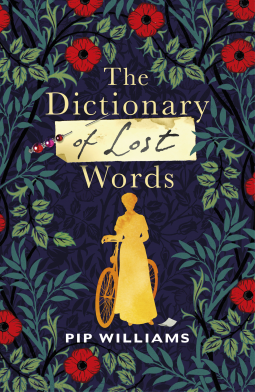
Scottish lexicographer Dr James Murray was the primary editor of the Oxford English Dictionary, published in 1884. The only word Dr Murray ever conceded had been overlooked was “bondmaid”, meaning a girl bound to serve without wages.
When author Pip Williams discovered this omission, the idea for her debut novel, The Dictionary of Lost Words, was born. Jenny Valentish, Guardian
And so I dive in and find myself often using the dictionary feature on the kindle – yes there are a lot of lost words, or words that are no longer in common use, and one of the main words, and locations, the scriptorium had me confused right from the start – a tin shed where a few learned, self-important men are compiling the first edition of the Oxford dictionary? Even as I write these words, the spellcheck has underlined that word in red.
We are introduced to this place and the main character Esme as she is crawling around beneath the table in this scriptorium, we don’t understand a lot about why she is there, as her father appears to be raising her alone without childcare.
A slow build up in the early years, the pace picks up finally when Esme is old enough to go to town and meet a few unconventional women and hears new to her ears, ancient popular but unknown words, and when she meets Tilda, an actor and suffragette her vocabularly and life experience widen even further.
It is the late 1880’s, an era of slow progress, both on the dictionary and on the rights of women.
Esme grows up and begins to work with her father, collecting “slips” and the necessary quotations, that give words the right to be part of this grand dictionary.
The problem being that much of a women’s world is left out, words that have existed, often for centuries, but have either not been written in any notable works or are deemed not appropriate for polite society.
Esme has found her calling.
It’s an interesting journey through a particular period of history, though I found the character of Esme to be a little two-dimensional compared to some of the secondary characters and one of the characters appears mostly through letters, which rather than illuminate some of the mysteries in Esme’s life, just had me asking why this one character if she was so important to her life, wasn’t present. The story seemed to lose pace towards the end or perhaps just went on too long, as I began to lose interest.
There are moments of humour, but also predictability – in Esme’s 30’s her like of words pertaining to women and the poor are discovered by the villainous Dankworth, as the slips flutter to the floor, who should arrive but her literary knight (not yet in armour) Gareth, the compositeur. She ponders the words “manhandled, pillock and git”.
A slow consciousness raising and cast of characters across the class divine in Oxford, with the controlled compilation of the Dictionary at the centre of it.







 I just love the concept of these works of flash fiction, postcard size stories, that have a geographic connection to a street or location in Northern Ireland, that originated as a story written on the back of a postcard – an alternative restriction to the usual one when writing flash fiction, of keeping it to 100 -150 words – and that the postcard was both sent and retained, a gift and an accumulated collection.
 It turns out there are only so many free coffees a person can drink before realising a hot beverage cannot cure loneliness, grief or melancholy.
 And so I dive in and find myself often using the dictionary feature on the kindle – yes there are a lot of lost words, or words that are no longer in common use, and one of the main words, and locations, the scriptorium had me confused right from the start – a tin shed where a few learned, self-important men are compiling the first edition of the Oxford dictionary? Even as I write these words, the spellcheck has underlined that word in red.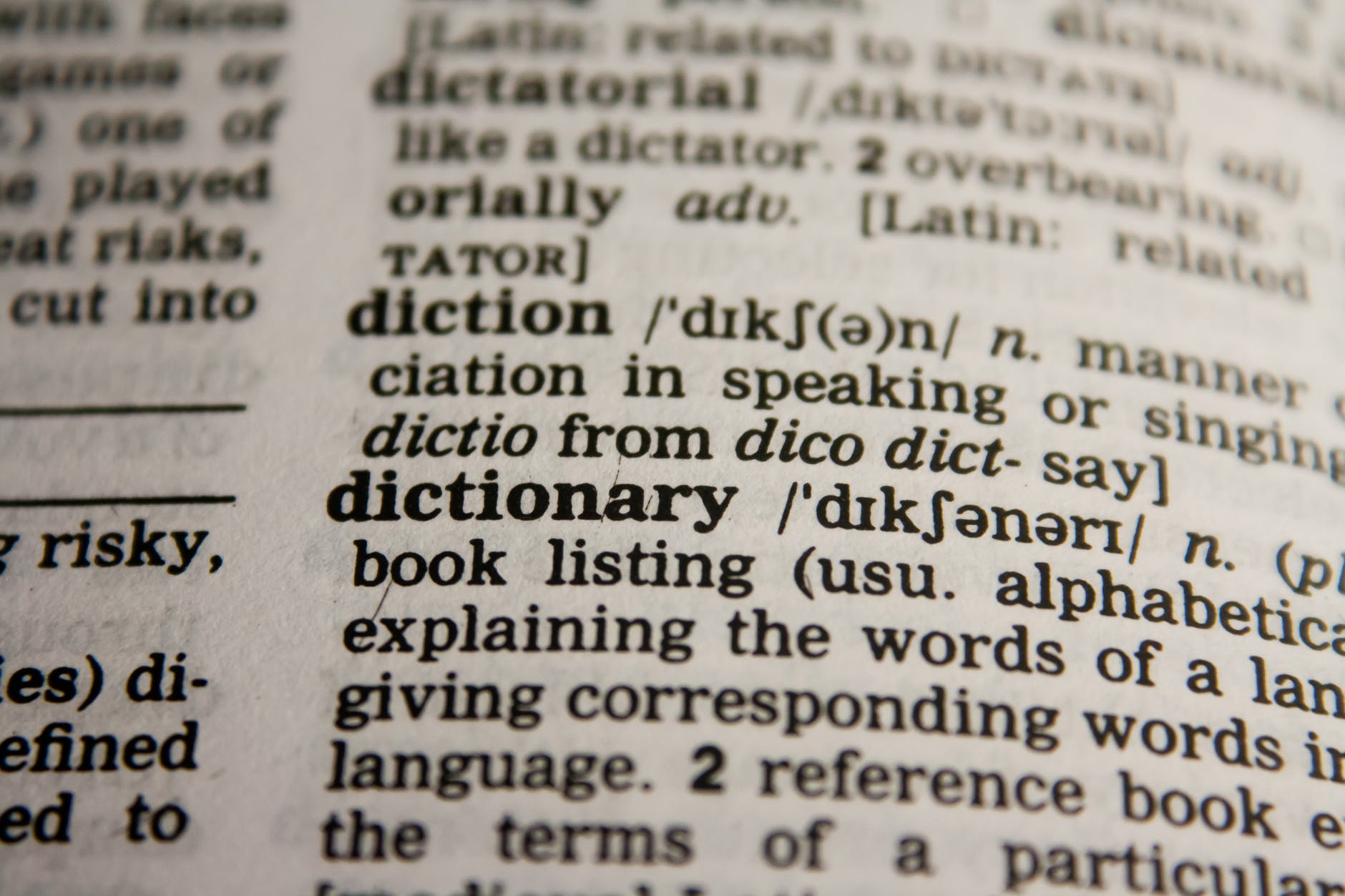
 Word by Word