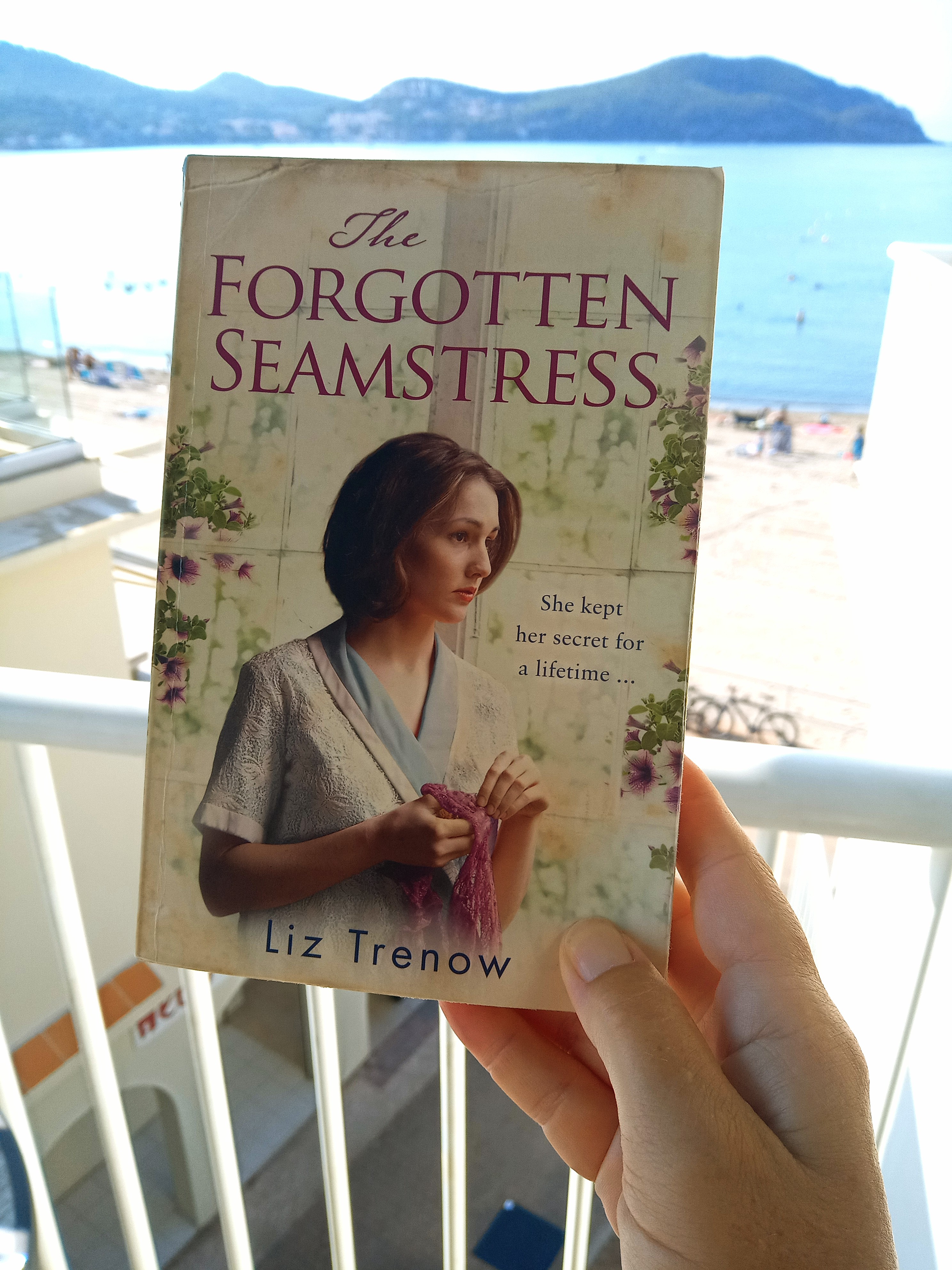
The Forgotten Seamstress by Liz Trenow

The second holiday read work of historical fiction I read was another dual narrative The Forgotten Seamstress by Liz Trenow.

Different timelines and narratives reveal the story of Maria Romano, a young orphan. She and her friend Nora, both adept at sewing, are called in one day after a grand lady visits the East End of London orphanage and admires their work.

She goes on to tell us that the grand lady who came a few months ago is a duchess and the patron of the Needlework Society and was visiting to inspect the work that the convent was doing for the poor children of the city. She was so impressed by the work Nora and me showed her that she is sending her housekeeper to interview us about going into service.

The house they are moved to, they soon discover is a royal household. Maria catches the eye of the young Prince and being young and obedient, responds when he requires her service and is unsuspecting of the trouble ahead for her, when their fun creates a dilemma for her.

A Series of Taped Interviews, 1970

An academic doing a PhD interviews patients in Helena Hall, an institutional asylum where thousands of women dwelled, recording their stories. Some speak of voices or fantasies, at least as the medical establishment puts it. Like Maria who imagined she worked for royalty and knew a prince. They called her Queenie. No one believed her story. And yet…

The transcriptions of the cassettes allow Maria to tell her story and the reader to decide whether she is a reliable narrator or not.

London 2008

In the modern day, Caroline Meadows is left a quilt by her grandmother, who spent a short time at Helena Hall. Either she or someone she knew made the quilt.

The central panel was an elegantly embroidered lover’s knot surrounded by a panel of elongated hexagons, and a frame of appliqué figures so finely executed that the stitches were almost invisible. And yet, for all the delicate needlework, the design of the quilt seemed to be quite random, the fabrics so various and contrasted it could have been made by several people, over a long period of time.

At a crossroads in her life, her relationship has ended, a job recently lost and she is coping with a mother with onset dementia who is becoming a danger to herself. It is the perfect moment for her to throw herself into the mystery of the quilt and reveal the truth behind what happened to the young Maria.

Then there is a journalist Ben, who she’s unsure about when she contacts him, is his interest in her just about the story he is chasing, or might it be something else? When the quilt goes missing, he helps her, though she remains wary.

Royal Secrets, Institutionalising Women, Lives Stolen

This was an enjoyable read of twists and turns, revelations and class punishment, the incarceration of innocent women in order to maintain the reputations of others, and the terrible expendability of babies and illegitimate children, deprived of their identities, heritage and mothers.

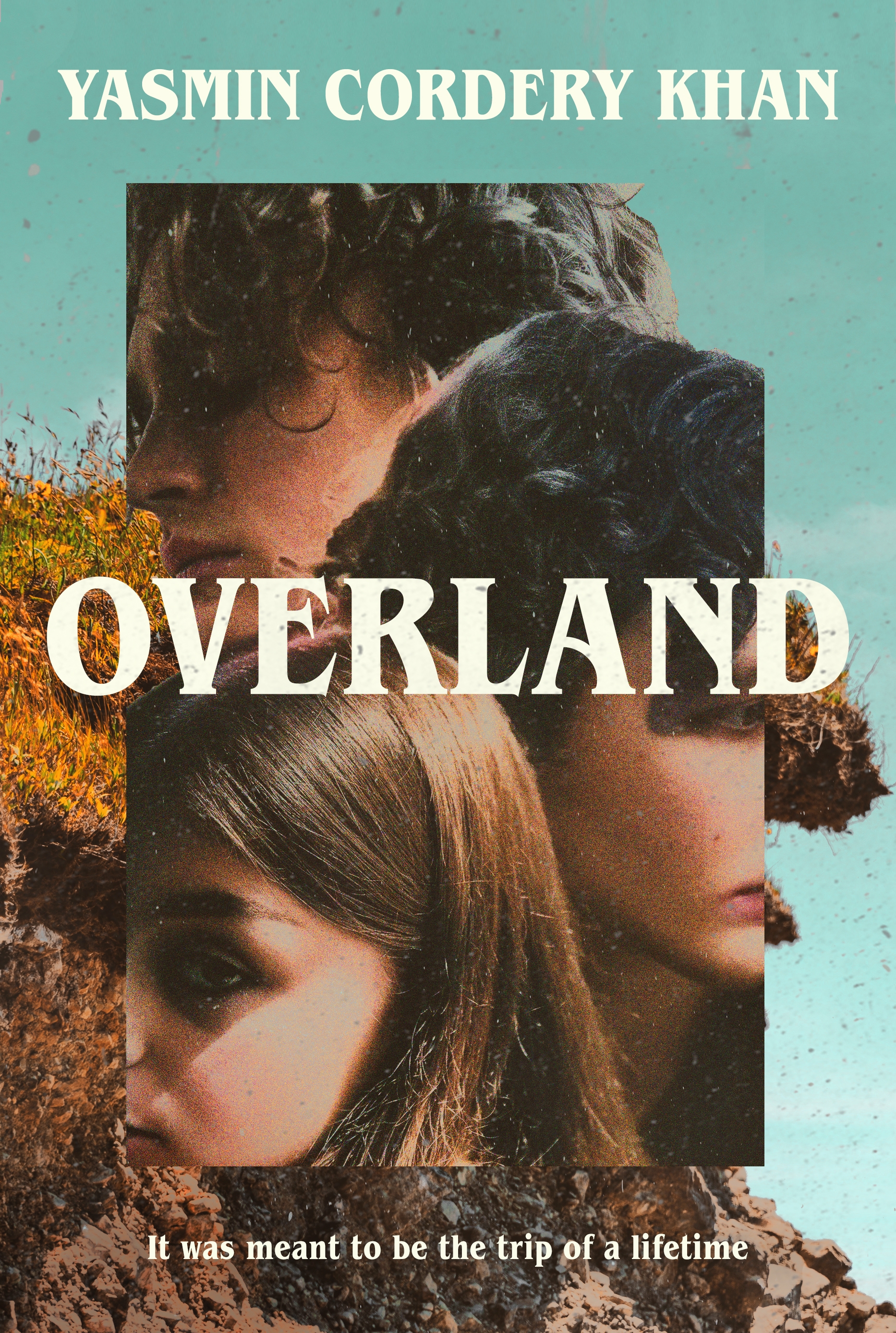
Overland (2024) by Yasmin Cordery Khan

The Overland, the Hippie Trail, the Big OE

I was interested to read this to observe some of this particular overland route that many young people took in the late 1960’s early 1970’s.

While for some it signified the hippie trail, for others, for example, those coming from New Zealand, it was a kind of right of passage, referred to as ‘the Big OE’, the ‘overseas experience’, which that culture accepts is something that every young person might do in their twenties, while still single, and eligible to get a working holiday visa in the UK to help fund their travels.

By the 1990’s when I did my OE, the overland route had changed, it was no longer advisable to take the route that those from the 1970’s had taken. My mini version of the overland, was to spend three months travelling through India, Nepal, Vietman and Thailand.

Employers expected many young in their twenties to leave to take up the two year visa opportunity and gain valuable experience from living in another country and travelling in other cultures. I remember my boss when I told him I was leaving telling me that he learnt more in first couple of weeks travelling in Asia than he had in the previous couple of years in his employment. It did make me wonder what happened in those couple of weeks!

Both of my birth parents travelled a similar route, from different starting points, and reading Overland made me want to know more about their experiences, because they were very different from what I read here.

Both had to find work in foreign countries to fund their travels, and set off on their own, without a vehicle or travelling mate, although as anyone travelling alone soon discovers, it doesn’t take long to connect with other like minded travellers.

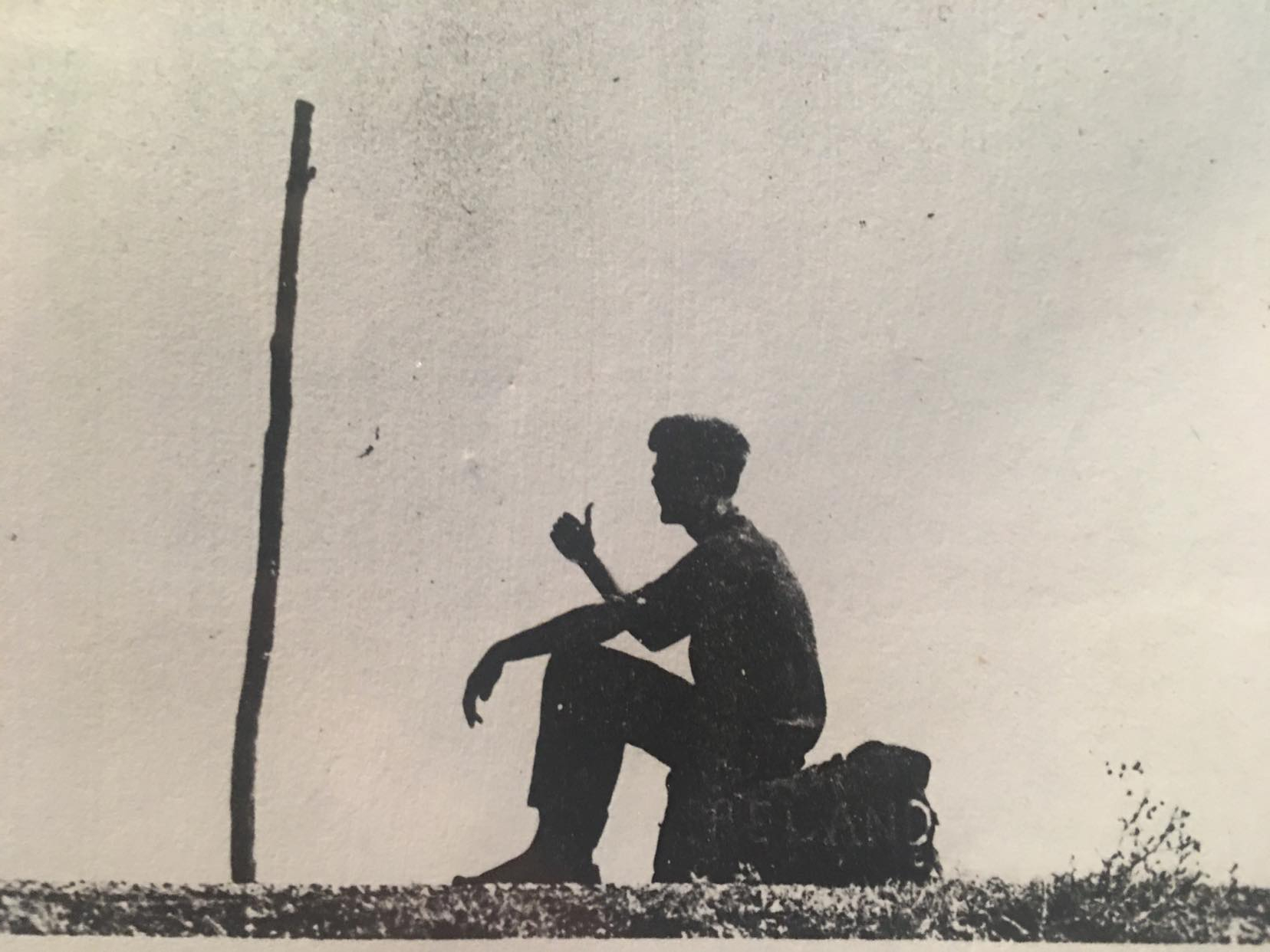
Recently my father found some old photos from that journey he set out on at the age of 18, one of which is depicted above, others show him working on a construction site in Kuwait, interacting with local workers. Not the same route followed as this overland novel depicts, much more of an intrepid journey.

Young Brits Abroad in a Land Rover

Three youth did an overland trip and on the first page of the novel, Joyce, who describes herself as a nobody, is looking back fifty years later after an otherwise uneventful life, recollecting the trip. There had been scandal and controversy at the time of their voyage and she had slipped under the radar. A recent visit to a car boot sale in the grounds of an old country house has awakened memories and now she is reliving the trip.

I saw Persia in the time of the Shah, and the sun set over Kabul and the sun rise at Taj Mahal. I was there too and this is my story.

Overland thus begins with an advertisement in a London newspaper in 1970.

Kathmandu by van, leave August

Share petrol and costs.

Joyce is just out of secretarial college and comes across the ad because she likes reading the miscellaneous section of the newspaper. She goes to Clapham to meet the two boys who are taking the Land Rover on the trip. Friends from boarding school Fred, whose aristocratic family own the vehicle, and Anton, son of an Egyptian Doctor and English mother, who has been supported by Fred’s family since a family tragedy.

From London to South Asia via Istanbul, Turkey, to Tehran, Iran to Kabul, Afghanistan to Pakistan, India, Nepal, Sri Lanka, Bangladesh to Thailand

The Aristocrat, The Son of an Immigrant, A Working Class Girl

It becomes clear that the three travellers are from different socio-economic backgrounds and being confined to a vehicle for a trip through foreign lands is going to bring out aspects of what each of them is either escaping or moving towards. When Anton asks Joyce why she wants to go, she can tell he’s looking for an intellectual response and sceptical of her motives. Reasons she keeps to herself (and from the reader) for a long while.

First impression: arrogant little twit. My face was burning with embarrassment at having been corrected, but he didn’t seem to notice. I might not have all your certificates, but I know about real life, I thought.

There’s No Place Like Home

The three of them go on the journey and have to overcome various challenges they confront in each country, whether cultural, mechanical or human. Over time their characters and back stories are revealed and in Fred’s case his father’s dark history, in one of the countries they will travel to. All of this plays into how they cope with the situations they encounter. And they come to consider their own destiny.

In a nutshell, if I could have articulated it, I’d have said that England was my destiny. Because by that point – although I liked those landscapes and those wild places that we drove through, don’t get me wrong – a realisation was growing in me, more and more, about the sheer beauty of the English countryside.

They will discover the consequences of acting or not acting on their instincts, who they can trust, who they should avoid and what to do when one of them starts experimenting in ways that threaten to derail them from their objective.

“We were all on pretty much the same route, there were only so many digs to stay in. So even though we were crossing the world, there was a small world on the overland, its own little bubble, the same faces and names and rumours recirculated and resurfaced.”

The Memory Trip

I enjoyed the novel for the way it depicted the journey and the places they stopped, mostly unfamiliar until they get to India, then it awakened my own overland journey, particularly the memory of taking the local night buses, with 3 people per seat (no headrest) and trucks/buses driving in the middle of the road in the dark of night. (We soon understood what “HORN PLEASE” on the back of the vehicle in front referred to). Yes, the all night loud music playing to keep the driver awake (ear plugs essential), stopping for sweet roadside chai, meeting young Indian astronomers on their way to view the total solar eclipse in Fatepar Sikri.

Ultimately, the overland is an opportunity to immerse in a culture, live for a period in a different way, encounter different ways of thinking and being, different perspectives, that much of this was missed in their journey taints the possibility of this experience having any meaning.

I enjoyed less the depiction of the dysfunctional character of Fred and the obsessive, slightly unreliable narrator Joyce. Anton was the more interesting character for me, due to his interest in the culture and languages and people, so without giving anything away, the ending was disappointing, but maybe that’s the message, about who in this life gets protected and who falls into the cracks.

So, there is the significance of the roles each of them played, their own histories, that of their families, the different social class they issued from and how that figured in the way they behaved and how they end up.

Alwynne, one of my Goodread’s friends articulates the themes succinctly here, in and extract from her review:

“Khan’s novel’s convincing, beautifully-observed and meticulously researched, making it hard sometimes to remember Joyce is a purely fictional creation. This isn’t a nostalgic glimpse at lost innocence, instead Khan’s narrative gradually constructs a damming portrait of a newly post-colonial world, casually racist, steeped in orientalist attitudes. A place where, for people like Joyce and Fred, nation, the myth of empire, class and identity are still tightly intertwined. Khan’s exploration of these connects to an oblique, underlying series of reflections on history, memory and the legacy of imperialist atrocities – and above all the failure to take responsibility or atone for the evils of the past. But despite the complexity of Khan’s themes, it’s highly readable. An absorbing, fluid piece.”

Highly Recommended.

Yasmin Cordery Khan, Author

Yasmin Cordery Khan is a novelist and historian. Her first book, The Great Partition: the Making of India and Pakistan (2007), won the Gladstone Prize for History from the Royal Historical Society. Her second book was The Raj At War: A People’s History of India’s Second World War (2015) followed by the novel Edgeware Road (2022).

She has written for the New Statesman and Guardian and appeared on BBC radio and television, and is an editor of History Workshop Journal and a trustee of the Charles Wallace India Trust. She lives in Oxfordshire.

Unearthing (2023) by Kyo Maclear

A Story of Tangled Love and Family Secrets

“But what is the point of writing if not to unearth things… Annie Ernaux

I chose to read Unearthing because it was the overall favourite read of 2023 of Shagafta who I follow on Substack and because it ties in to a theme I have been researching, exploring separation, kinship and the discovery of one’s identity.

Of Changing Seasons and Evolving Stories

Unearthing is a memoir of twenty four sekki (節気) or “small seasons” that offers a different way of thinking about the ever changing ground of our personal stories.

Three months after Kyo Maclear’s father dies, looking to know him at a deeper level and curious about his mother’s side of the family, she takes a DNA test.

When my father died and I was his grieving and wondering daughter, I thought of a word. The word, yugen, or what the Japanese call a state of “dim” or “deep” mystery, evokes the unsettled feeling I had at various points growing up as an only child. Our family was a tiny unit with strange ways. My parents acted like criminals on the lam – loading up moving vans, changing house every few years. I was four years old when we left England, shedding backstory and friends overnight. What made a family behave this way, like people drawn to erasure? Why were we always leaving like this, unceremoniously? I did not know. Growing up, I assumed that everyone was shaped and suffused by what they could not perceive clearly, the invisible and voiceless things imparted atmospherically within families.

Ask Your Father

Shocked, when she receives the results she learns that she is not biologically related to her father and that her mother refuses to speak on the subject.

She repeated it three times. Talk to your Dad. As if his death had been a hoax; her voice no longer blurry but brisk with fear.

Though her mother does not wish to talk about it, her daughter perseveres. She will weather this storm, waiting for it to calm, listening between the lines of conversation, picking up on the cues.

When one person leaves, the old order collapses. That’s why we were speaking to each other carefully. We were a shapeshifting family, in the midst of recomposing ourselves. What is grief, if not the act of persisting and reconstituting oneself? What is its difficulty, if not the pressure to appear, once more, fully formed?

Solving the Mystery of Your Life

Photo K. Kaboompics Pexels.com

Becoming a detective in her own life, Kyo assembles the story of her lineage, tied to the seasons and the making of a garden.

Digging was my way out. An impulse born of stubbornness and bred in me by a culture that loves stories of people discovering the truth of their paternity; that champions the idea that concealment is destructive and truth is freeing.

The way the Kyo Maclear takes her time unveiling the truth of her story, the various paths she follows, the thoroughness of her pursuit to know, makes this a thrilling read.

There is something about the long, slow seasons and the process of tending the soil, not trying to rush the end result that resonates in her writing, yet never slows the narrative.

Her observations of her mother, the nuanced noticing, are so well depicted, you can feel the resolution of the mystery getting warmer and warmer, as she regains her mother’s trust and nurtures her into revealing more.

Something

It was all being pulled from some shadowy room. The details she remembered. The broken chain of events. What she spoke arrived in fragments. But there was something else, a hitch and hesitance, that made me alert.

I did not yet understand the need to hold on to an invented story, even a falsified past, at all costs. I did not recognize her dissembling. Usually impervious, I thought she seemed out of sorts. Maybe a little distraught.

She does not want to tell me something, I thought.

Along the way larger questions arise: What exactly is kinship? What does it mean to be family? What gets planted and nurtured? What gets buried and forgotten? Can tending a garden heal anything?

I thought this memoir was brilliant, I highlighted so many thoughtful and thought provoking passages. I admired the way the revelations came slowly and the characters of her family were explored, her search for herself made her realise how little she knew of her own parents. They too, were a mystery to unravel and motivations to explore, before even embarking on the second exploration, the unknown aspect that her DNA revealed.

It also celebrates those that helped, guided and accepted her along the way, new relationships and a deeper understanding of aspects of the self, while never losing her essence.

Highly Recommended.

Kyo Maclear, Author

Kyo Maclear was born in London, England, and moved to Toronto at the age of four. She holds a doctorate from York University in Environmental Humanities.

Her most recent book, the hybrid memoir, Birds Art Life, was published in seven territories and became a Canadian #1 bestseller. It was a finalist for the Hilary Weston Writers’ Trust Prize for Nonfiction and winner of the Trillium Book Award.

Unearthing was an instant bestseller in Canada and winner of the Governor General’s Literary Award for Nonfiction. Her short fiction, essays, and art criticism have been published in Orion MagazineAsia Art PacificLitHubBrickThe MillionsThe GuardianLion’s Roar, The Globe and Mail (Toronto) and elsewhere. She has been a national arts reviewer for Canadian Art and a monthly arts columnist for Toronto Life. She is also a children’s author, editor, and teacher.

She lives in Tkaronto/Toronto, on the traditional territories of the Mississaugas of the New Credit, the Haudenosaunee, Métis, and the Huron-Wendat.

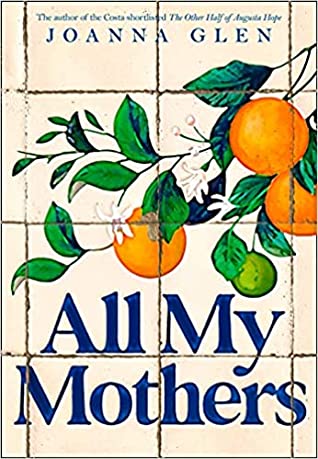
All My Mothers (2021) by Joanna Glen

I picked this book up because of its premise of a child having questions about her early life and origins, sensing she is being lied to by her parents.

A 30 Year Story from 80’s London to Córdoba

Adoption Motherhood Mothers

The book is 480 pages and most of the first half is narrated by Eva as a child or teenager. It begins as she is starting school and beginning to develop friendships. She befriends Bridget Blume and is besotted. Not just by her, but by her entire family, especially her mother who is so unlike Eva’s mother whom she calls Cherie (like her father does).

At school Eva is deeply affected by a book the teacher reads ‘The Rainbow Rained Us’, in which a rabbit throws a stone at the rainbow of Noah’s Ark breaking it apart into hundreds of multicoloured mothers who repopulate the earth with children.

The Many Colours of Mother Love

There Blue Mother stood in a mesmerising cornucopia of blues, at the edge of a turquoise sea, laughing, the wind in her hair, surrounded by her blue family.
‘Blue Mother is free and open and speaks from her heart.’
She sounded exactly like Bridget’s mother – utterly perfect.

From then on she refers to her mother as Pink Mother and Bridget’s mother as Blue Mother.

Pink Mother was sitting upright in a kind of fairy-tale bed, a bit like my mother and father’s, a four-poster, with a roof and curtainy droops around it.
No,no,no.
‘Pink Mother is delicate and feminine,’ said Miss Feast, explaining that delicate meant not strong.

When they are asked to share a baby photo, Eva becomes even more convinced than she already was, that her mother is not her mother, there is no photo of her as a baby, nothing before the age of three and a half.

The novel’s first half follows her through primary school, her developing friendship and first great loss, first the loss of a favourite teacher, then a death that will result in her friend’s family moving to another country and then abandonment by her father, who returns to Spain and rarely if ever makes contact.

Eva’s personality develops and is compromised by these losses and causes her to develop or accept superficial relationships, taking some time to realise what she lost by neglecting what has been meaningful to her.

Hispanic Studies, La Mezquita, A Headless Nun

In the second half of the novel she has started a university degree, changing locations due to the demands of her boyfriend Michael.

The pace really picks up in this half, perhaps because we have left the child narrator behind, so Eva becomes less introspective and more in charge of acting on the questions and thoughts she has and voicing some of the strong opinions she has.

When told they will spend a summer semester in Córdoba, Spain, the separation from all that is familiar and expected of her, marks the beginning of a transformation and a quest into looking for the answer to questions she has about her origins.

la mezquita the grand mosque in Cordoba, Spain
Photo Juan L. Secu on Pexels.com

The second half is something of an adventure as she develops a new friend Carrie who is interested in helping her and the two begin to consider not returning to their previous lives, to stay in Córdoba.

As Eva enters her 20’s her relationships and perspective begin to evolve, although she remains somewhat detached, circumspect and emotionally distant. With the presence of those around her, she begins to understand the complexity of being a mother, of being mothered and that judgments can change, as can people, especially when they find those relationships that are mutually nurturing.

The final third of the jumps into a second person narrative perspective ‘you’ and becomes somewhat nostalgic and didn’t work quite so well as the preceding chapters. It’s like the beginnings of a letter to a little girl who is still a baby, perhaps the thing that she had missed from her own life, being provided for another.

Writing From Experience versus Imagination or Observation

It is an interesting and captivating read, however I couldn’t help but feel as I was reading that this was imagined, rather than felt, because I am interested in books, fiction or nonfiction that come from the experience of separation.

In an interview with Carolyn Ray of JourneyWoman Bookclub, Joanna Glen shared that one of her aims was to explore the question, What is Our Deepest Longing?

I suppose the motherhood theme came next thinking what is our deepest longing that we have right from the beginning and of course a baby’s deepest longing is to gaze into the mother’s eyes and receive the gaze of love back. So I was thinking, what would be the most powerful or perhaps the saddest lack, would be not to feel that connection. That would be a very visceral fundamental lack.

She shares more about her own experience in the interview, which was the opposite of what she explores in the novel regarding the mother child connection, but brings alive the adventure of living abroad, in the town of Córdoba as a young person.

Overall, an enjoyable summer read that is likely to spark an interest in Córdoba, if like me you have never been there and one that celebrates female friendship and connection across different age groups and cultural backgrounds.

Further Reading

TripFiction Review: All My Mothers by Joanna Glen, coming of age novel mainly set in Córdoba. Aug 2021

Author, Joanna Glen

Joanna Glen’s novels include All My Mothers and The Other Half of Augusta Hope, which was shortlisted for the Costa First Novel Award and the Authors’ Club Best First Novel Award.

She and her husband live in Brighton.

The Hand That First Held Mine (2010) by Maggie O’Farrell

And we forget because we must. Matthew Arnold

The Hand That First Held Mine by Maggie O’Farrell was the winner of the former Costa Novel Award in 2010.

I read and really enjoyed O’Farrell’s memoir I Am, I Am, I Am – Seventeen Brushes With Death, the first of her books I encountered and Hamnet, which won the Women’s Prize for Fiction (2020).

I have The Marriage Portrait still to read, however I was curious to discover more of her earlier work and decided to read this one next.

Dual Narrative, Dual Timeline

This novel is narrated as two stories of two couples, one set in 1950’s/60’s that centres around Lexie, a rebellious university graduate who has been asked to apologise for using a door for men, before receiving her degree.

At home in Devon with her parents, she is about to abandon them all, the academic institution and her family for London, after Innes, a 34 yr old sports car driving art dealer, journalist, critic and self-confessed hedonist, breaks down not far from the field where she is sulking.

Innes has been in St Ives, visiting the studio of an artist whose work he’d been hoping to buy. He had found the artist rather drunk and the work far from completion. The whole excursion had been a raging disaster. And now this.

Lexie will move to London, creating an unconventional life and career in 1950’s Soho guided by her pleasure seeking lover, but with the spiteful eye of one who wishes her harm. Inne’s past will come to haunt Lexie’s future, and she will throw herself into her career, doing what she can to maintain her independence.

His father, he tells her, was English, but his mother was a mestizo from colonial Chile. Half Chilean, half Scottish, he explains, hence his Hibernian Christian name and also his black hair.

There’s much more to Lexie’s story, but to share any more of it would spoil the discovery for new readers of this compelling mystery. It is one of those novels where you know the narrative threads are going to connect and so each revelation keeps you guessing, until it eventually becomes clear.

Present Day London, Forgetting

Photo S. Chai Pexels.com

In the present day (2010) Elina, a Finnish woman in London and her boyfriend Ted, have just had a baby boy and she recalls nothing about the birth or the 3 days spent in hospital.

She tests herself, scans her mind. Has she remembered anything? Has it come back to her while she was sleeping? The birth, the birth, the birth, she intones to herself, you must remember, you have to remember. But no. She can recall being pregnant. She can see the baby here, lying in her lap. But how it got there is a mystery.

Not only has their life been turned upside down, but Ted is having memory flashes of childhood, but the images he is seeing are not like what his parents have told him. He knows what happened to Elina, but for now he is not sharing it.

Four days ago, she’d almost died.

The thought has a physical effect on him. One of disorientation and nausea, like seasickness or looking down from a high building. He has to lean his head in his hands and breathe deeply, and he feels the earlier tears crowding into his throat.

Slowly, the two of them begin to piece together the missing elements from their stories. Ted confronts his mother and finds her unhelpful. But since the birth of his son, the flashes of scenes from the past revisit him with increasing frequency.

‘Do you remember…?’ he asks, then has to break off to think. ‘A man came to the house once. And you … you sent him away. I think. I’m sure you did.’

‘When?’

‘Years ago. When I was small. A man in a brown jacket. Sort of untidy hair. I was upstairs. You were arguing with him. You said – I remember this – you said, “No, you can’t come in, you have to leave.” Do you remember that?

When Traumatic Events Awaken the Past

Everyone is being confronted with challenges and O’Farrell deftly carries the reader through them all, and keeps us puzzling over the mysteries underpinning each of their lives.

There is a level of unease and intrigue that is present throughout the narrative, that quickens the pace of readings, as we realise that not all characters are being honest or have good intentions.

Secrets, lies, infidelities, manipulative jealousies, tragedy and the unconditional love of true motherhood. The novel has emotional depth and psychological insight, while keeping up a well thought our plot.

An absolutely riveting read with brilliant storytelling and just enough withholding to allow the slow reveal of mystery and deception.

Highly Recommended.

Further Reading

The Guardian/Observer review: The Hand That First Held Mine by Maggie O’FarrellElizabeth Day enjoys a compelling novel of memory and motherhood, 25 Apr 2010

NPR review: A Moving Look At The Bonds Of Motherhood by Jessa Crispin, 27 Apr 2010

Author, Maggie O’Farrell

Hamnet The Marriage Portrait Shakespeares Wife The Hand That First Held Mine

Maggie O’Farrell is a Northern Irish novelist, now one of Britain’s most acclaimed and popular contemporary fiction authors whose work has been translated into over 30 languages.

Her debut novel After You’d Gone won the Betty Trask Award and The Hand That First Held Mine the Costa Novel Award (2010). She is the author of Hamnet, winner of the Women’s Prize for Fiction 2020, and the memoir I AM, I AM, I AM, both Sunday Times no. 1 bestsellers.

Her novels include After You’d Gone, My Lover’s Lover, The Distance Betwees US, which won a Somerset Maugham Award, The Vanishing Act of Esme Lennox, The Hand That First Held Mine, which won the 2010 Costa Novel Award, Instructions for a Heatwave, This Must Be the Place and The Marriage Portrait, shortlisted for the Women’s Prize. She lives in Edinburgh.

Cairn (2024) by Kathleen Jamie

A Poet Writing Nature Essays

Kathleen Jamie is a poet and writer of creative nonfiction about nature. She has written three wonderful collections that I have adored. Findings (2005), my favourite, included essays about the Hebridean and Orkney Islands near her home in Fife and Peregrines nesting; Sightlines (2012) covers a fascinating archaeological dig, tales of more birds on lonely, windswept islands and a visit to the Arctic and finally Surfacing (2019) which I review here in Surfacing 1 and Surfacing 2.

Making Ripples at 60

creative non fiction essays poetry by Scottish poet and nature writer Kathleen Jamie

In Cairn, we find a collection of writings, fragments, observations and memories. Sometimes an individual observation and other times a collective witnessing of changes in the local environment. Of migratory patterns disrupted, of things once common on the horizon, now departed.

As she arrives at her 60th year, she begins to ask different questions, about the next generation and the one after that, if there will indeed be one as children question whether to bring another generation into this vastly changing world.

There is less a note of wonder and more a tone of trepidation at the precarious situation of the natural world and those being born into what will continue after we have left.

The Bass Rock and Bird Flu

It’s a while since we could turn to the natural world for reassurance, since we could map our individual lives against the eternal cycles of the seasons, our griefs against the consolation of birds, the hills. Instead there’s the sense that things are breaking, cracking like a parched field. There they are, the seabird people, among their beloved birds at the height of the breeding season, wearing hazmat suits as they pile corpses into bin bags.

Photo by Magda Ehlers on Pexels.com

Like a cairn, these short prose pieces are markers, memories, memorials or perhaps even metaphorical or literary burial mounds, tracking the thoughts and observations of an observer over the years of the natural environment, of change in both the natural surroundings and humanity. Testimonies.

‘Stones propose another sense of time, whereby the past, the deep past of the plant, proffers a meagre yet massive support to acts of human resistance…’ John Berger

A thought-provoking collection.

Further Reading

The Guardian: Cairn by Kathleen Jamie review – a wry SOS for the world

The Caught by the River Book of the Month: July 2024 Cairn by Kathleen Jamie With its bursts of beautiful brilliance, it is something akin to lightning, writes Annie Worsley

The Guardian: Scotland’s Bass Rock: world’s largest colony of northern gannets – in pictures

Author, Kathleen Jamie

Kathleen Jamie, Photo by Alan Young

Kathleen Jamie is one of Britain’s foremost writers. In 2021 she was appointed Makar, Scotland’s national poet.

Jamie resists being identified solely as a Scottish poet, a woman writer, or a nature poet. Instead, she aims for her poetry to “provide a sort of connective tissue”.  Influenced by Seamus HeaneyElizabeth BishopJohn Clare, and Annie Dillard, Jamie writes musical poems that attend to the intersection of landscape, history, gender, and language.

Her groundbreaking works of prose – Findings (2005), Sightlines (2012) and Surfacing (2019) – are considered pioneers and exemplars of new nature writing. She lives in Fife.

The Hypocrite (2024) by Jo Hamya

I came across The Hypocrite randomly and was intrigued firstly by the Sicilian setting and secondly by its premise of being a clash of generational perspectives.

I was also intrigued, having recently read Enter Ghost by Isabella Hammad, to discover another novel with a theatre setting. It is a thought provoking novel about the family dynamics of a daughter and her parents, played out one afternoon as she lunches with her mother, while her father watches the play downstairs. It is an awakening of sorts for them all.

A Daughter Creates

A young woman Sophia, has written a play. It is set in a summer holiday house on one of the Aeolian islands of Sicily, a place she spent a month with her father, typing his dictated novel, mostly hanging out alone, quietly observing the women he bedded nightly. That was 10 years ago.

The Father Watches

literary fiction a daughter writes a play about her fathers generation referencing a holiday in Sicily

Today, her father, the (in)famous author, attends a matinee showing of his daughter’s work for the first time. He knows nothing about the play prior to being seated in the theatre. He swiftly realises that much of the set and characters are familiar to him. This might even be about him. About that holiday. He begins to feel uncomfortable.

No stories are entirely imaginary, cherub, he’d said then. Everything is always a little bit real. Sometimes you steal things from other stories and change them until they work how you like.

He wonders if the people sitting either side of him know who he is. He begins to prepare defences in his mind. He decides to interact with the young woman who had been seated next to him.

He thinks, I have never been any good at arguing. I have only ever said what is on my mind. So he asks her, without malice, whether she dislikes him because of what they’ve both watched; does his best to keep his breathing steady in the interval between his question and her answer.

Round Glasses is blunt. She disliked him before, she says. And the play is no great shakes.

The Mother Bitches

a mother and daughter eat in a theatre restaurant
Photo by Rene Terp on Pexels.com

Upstairs in the theatre restaurant, the daughter dines with her mother. She spends most of the meal talking about her ex-husband. She has re-experienced living with him for a period during lockdown. Unaware, she begins to create a scene.

The narrative shifts between the father observing the play unfold, the daughter listening to the mother complain of him and that month long holiday in the past that inspired her to write the play.

In Sicily, Sophia had looked forward to spending the longest uninterrupted time with her father she had ever had. She did not realise that she would spend most of the time alone or in the company of Anto, the nephew of the woman who cleaned the house. Her father would be absent to her, except when dictating his chauvinistic novel. She would observe and learn things.

We Are all Products of Them and Ourselves

The novel explores the unmet expectations of each character in the family trio, their deafness to each other’s desire and the clash of generational perspectives.

The contradiction of the time had been the heightened moral obligation to consider other people as a means to keeping one’s own self-interest afloat. Showing other people care meant avoiding them.

theatre stage play audience in a theatre red curtain
Photo by Monica Silvestre on Pexels.com

The scenes pass in a kind of circumambulation, one after the other, progressing onward.

Revelation comes slowly to the father seeing himself from another’s perspective, through actor’s on a stage, where he cannot interrupt or change the narrative, he is forced to bear witness.

Held To Account, Punished and Portrayed

The mother is witnessed by both the daughter and the waiter, who forces her to account for her deteriorating behaviour. This is not the family home, no dsyfunction permitted.

The daughter equally will be challenged by a random stranger in a public place.

It is not quite a reckoning, but a challenge to each of them to see what they are not seeing, to pause from the habit of inflicting a perspective on others.

The novel puts on stage personal power, public perception and creative potential and asks it audience to consider the responsibility and ambiguity of creating art, mining lives and the sanctity or not (for art) of relationships.

So who is the hypocrite?

Everyone it seems.

Further Reading

The Guardian Review: The Hypocrite by Jo Hamya review – sharp generational shame game by Miriam Balanescu, 12 May, 2024

The Guardian Interview: Jo Hamya ‘Could I just write one massive grey area?’ by Hephzibah Anderson 20 Apr, 2024

Jo Hamya, Author

Jo Hamya was born in London. After living in Miami some years, she completed an English degree at King’s College London and a Masters in contemporary literature and culture at Oxford University. She has worked as a copyeditor for Tatler, edited manuscripts published by Edinburgh University Press and Doubleday UK.

She has written for the New York Times, Guardian and Financial Times. Currently, she works as an in-house writer and archivist for the Booker Prizes and its authors and is a PhD candidate at King’s College London.

Her debut novel was Three Rooms (2021). She lives in London.

Orbital by Samantha Harvey

A Long Perspective of Earth

nature writing from space and an unexpected and profound love letter to life on Earth

Six astronauts from six countries are in a spacecraft at the International Space Station that orbits Earth two hundred and fifty miles from the edge of the planet.

We spend one day, or 16 orbits with them and find out how it is to be living on the job, while falling, though it seems like floating.

We learn about what they are doing, how they are a team and yet not, how much more difficult (or less relevant) it is to obey political allegiances when you are in orbit and look back at Earth and see her for what she really is.

Orbit 1, ascending

One of the astronauts Chie receives a message that her mother has passed away, which makes her feel emotions and reflect in ways that are not typical of the kind of human selected to spend months in space.

Since that news, they find themselves looking down at earth as they circle their way around it (meanderingly it seems, though that couldn’t be less true), and there’s that word: mother mother mother mother. Chie’s only mother now is that rolling, glowing ball that throws itself involuntarily around the sun once a year. Chie has been made an orphan, her father dead a decade. That ball is the only thing she can point to now that has given her life. There’s no life without it. Without that planet there’s no life. Obvious.

hurricane circling earth weather pattern seen from outer space
Photo by Pixabay on Pexels.com

A typhoon warning has been sent and the astronauts track its weather patterned behaviour from afar.

Roman is on his eighty eighth day of this mission. He keeps a tally of the days, to tether himself to something countable, otherwise the centre drifts.

…in this new day they’ll circle the earth sixteen times. They’ll see sixteen sunrises and sixteen sunsets, sixteen days and sixteen nights.

Each orbit passes a different continent, a different part of the ocean.

By day it is as if the Earth is uninhabited, at night, the impact of humanity is more apparent.

Separate or One

The astronauts are supposed to represent different countries and demarcations, but up there the lines are less obvious.

They have talked before about a feeling they often have, a feeling of merging. That they are not quite distinct from one another, nor from the spaceship. Whatever they were before they came here, whatever their differences in training or background, in motive or character, whatever country they hail from and however their nations clash, they are equalised here by the delicate might of their spaceship. They are a choreographing of movements and functions of the ship’s body as it enacts its perfect choreography of the planet.

A rocketship to the moon is about to be launched, these astronauts will travel much further, in a different direction, with a different purpose.

The Problem of Dissonance

Photo by Pixabay on Pexels.com

At first they are enamoured by the night views, the twinkly lights of habitation and the surface dazzle of man-made things.

That soon changes as the senses broaden and deepen and it is the daytime earth they come to love, the humanless simplicity of land and sea, the way the planet seems to breathe, to show itself, clearly.

So then come discrepancies and gaps. They were warned in their training about the problem of dissonance. They were warned about what would happen with repeated exposure to this seamless earth. You will see, they were told, its fullness, its absence of borders except those between land and sea. You’ll see no countries, just a rolling indivisible globe which knows no possibility of separation, let alone war. And you’ll feel yourself pulled in two directions at once. Exhilaration, anxiety, rapture, depression, tenderness, anger, hope, despair.

The Mystery of Las Meninas

A story told in 16 orbits that reflects on man’s inclination to explore the outer frontiers and asks why, how it might affect humanity, if at all. And ponders who is the real subject of Velazquez’s painting, Las Meninas? Above all, it is a nostalgic glance back at what we have that we don’t always seem to see.

It is an interesting and thought provoking read that brings about a single point of focus – the earth. I discovered I am very much a happily earth bound creature. The idea of space or floating in an orbiting capsule holds very little intrigue, except indeed, to further appreciate all that the Earth offers us in terms of her own nature.

Further Reading

The Guardian: Orbital by Samantha Harvey review – the astronaut’s view

Enter Ghost by Isabella Hammad

After looking at the novels on the shortlist for the Women’s Prize for Fiction 2024, I decided to read two of them, Enter Ghost (set in Palestine) and Brotherless Night (set in Sri Lanka) mainly because in addition to enjoying works by women in translation, I also enjoy novels in English set in other countries, written by people who have had some experience of that culture.

Enter Ghost is as much a semi-lived experience as it is a story to be read and understood. I don’t know if every reader will experience it that way, but for me, many of the places that the novel takes place in, elicited memories of being there, travelling [the 5 hr scenic route (irony)] between Bethlehem and Ramallah, visiting a countryside village outside of it, spending a day in Jerusalem (finding someone who had permission to enter the city to accompany me). A day(s) in the life of an ordinary (is there such a thing) Palestinian.

I expected them to interrogate me at the airport and they did.

This novel brings alive the sense of place and the many difficult and challenging encounters local people have to navigate, in trying to travel from one place to another. For some, like the elderly, it is best not to even try.

Sonia Nasir is one of the semi-privileged, she is able to fly into the country. That is, she is does not have to travel overland via Jordan and cross the Allenby/King Hussein Bridge to enter Palestine, as many do.

Enter Ghost is a story of youth, about a desire to stage a play in one of the most difficult places you might try to do that.

People who live in different parts of Palestine, with different ID’s and therefore different freedoms, different fears, vastly different experiences. Gazan’s, West Banker’s and what they refer to as 48’ers. It is as if they are from different countries, how different their lives are based on the geography of birth.

Sonia is half Dutch, half Palestinian and lives in London where she is a successful stage actor. She is connected to Palestine, through family summer holidays spent in Haifa (a Northern coastal town). While visiting her sister Haneen, she meets her friend Mariam, who asks her to fill in for a couple of characters in the play she is staging, while she searches for suitable replacements. They are staging an Arabic version of Hamlet.

The novel depicts the process of rehearsing and pushing actors to develop into the roles they are playing, while navigating an environment where even theatre is seen as a possible revolutionary act. All the while they rehearse, they are never quite sure if they can pull this off, nor are they even sure of whether they can trust each other.

As well as navigating their own relationships, there is an incident at the Al-Aqsa Mosque which further complicates their ability to move about.

Throughout the obstacles, Sonia is coming to terms with her recent past in London, the fraught relationship she has with her sister and with her ancestral home.

outdoor theatre Hamley an Arabic version of a Shakespeare play
Photo by Matheus Bertelli on Pexels.com

The day Michael, the movement director, joined rehearsals, he had examined my body like a tailor; told the directors to leave the room, and proceeded to lecture me about the importance of motivation.

‘Every person,’ he said, looking away, absorbed by his words, ‘every body moves differently from the next person’s body when their mind goes through something. When you’re sad, you,’ he pointed, ‘are going to move differently from the way I move when I’m sad. I can still read your movements, but they’re not going to be the same as mine. But if you make a straight line from emotion to movement – your emotion, your movement – then the audience will not only read you, they will feel you.’

She is 38 years old, mature in one sense and an established actor, and yet it is something of a coming-of-second-age novel, as both the play and the new relationships and the place all act on her and transform her.

As the time this novel was shortlisted for the Women’s Prize, the HOME venue in Manchester, UK cancelled then reinstated (after nearly 100 artists protested and began to remove their work from an exhibition there) a Palestinian theatre performance of Voices of Resilience.

There is reference too in the novel, to a turning point in Palestinian theatre history, the staging of Al-Atmeh, ‘Darkness’, a play which as it begins the lights go out – actors are part of the audience and play out all the elements of dealing with this one of many regular occurrences of life under occupation, trying to fix it.

The titular darkness allows the actors to discuss the darknesses of various interrelated forms of oppression—occupation, social backwardness, patriarchy—and the play ends with the cast and audience holding candles to collectively illuminate the stage. It was a raging hit. The audiences had seen nothing like it and they were ecstatic.

The version of Hamlet that is staged is based on a translation by Jabra Ibrahim Jabra translated back into English for the novel, and the language used and those who use it and how they use it is as important as the text itself.

I am not well versed in the play Hamlet, but the parts of the play that are shared in the novel and the context within which they are staged don’t require that the reader be too familiar with it, but no doubt if you are familiar with Hamlet, it will add another layer of understanding.

I particularly enjoyed it also for the understanding it brought to the process of developing a troupe of actors for a play and how the author captured these performances and the emotion they elicited (or didn’t). That is powerful, dedicated and practiced writing.

Overall, as I said in the beginning, I felt like I lived through this novel, which was exhausting at times, but wholeheartedly worth it.

Further Reading

The Revolutionary Power of Palestinian Theatre, Isabella Hammad Reflects on How Art Can Still Effect Change, Lithub.com, 4 Apr 2023

Remember Me by Charity Norman (2022)

A new author to me, I became aware of this novel when I saw that it had won Best Novel in the Ngaio Marsh Awards 2023 (an award made for the best crime, mystery, or thriller novel written by a New Zealand citizen or resident, published in New Zealand during the previous year).

Life’s Turning Point

Ngaio Marsh Award winner
crime fiction

Emily, a middle aged children’s book illustrator, living alone in London, receives a call from her father’s neighbour Raewyn in Tawanui, New Zealand to say she ought to come, that her father Felix’s memory is deteriorating, the dementia much worse than when she last visited. The neighbour has been voluntarily helping him out, her son leases land off him, their families have been close for many years.

Emily is the youngest, her brother and sister though nearer have reasons why they can’t help. Not only does her father not recognise her when she first arrives, but the house is full of notes he has written to himself, an attempt to slow down the fast encroaching disease.

Notes To Self

He held up the envelope. ‘Something for you to look after.’
‘What’s this?’
‘Keep it for me, will you? Please, please, don’t open it until the event mentioned on the front. Until then, I’d rather you didn’t let anyone know of its existence. I will undoubtedly forget I’ve give it to you. I’m afraid I’m going doolally.’

Her return coincides with the 25th anniversary since Raewyn’s daughter Leah disappeared without a trace, last seen by Emily who was working in a petrol station where Leah bought something before going into the local bush on one of her conservation research trips, trying to save an endangered snail species from predators, but making a few enemies in the process. She was never seen again.

‘I envy you,’ she says.

She doesn’t. Why would she envy me? She’s Dr Leah Parata, five years older and infinitely, effortlessly superior. Everything about the woman screams energy and competence, even the way she’s twirling that turquoise beanie around her index finger. She’s tall, light on her feet, all geared up for back-country hiking in a black jacket – or maybe navy blue, as I’ll later tell the police.

The Slow Unravelling

Though she had never been close to her father, now that his short term memory is failing and his guard is slipping, she comes to realise there is much about her father she did not know, both in the way he cared and the terrible secrets he has kept.

Emily, I’m lost in the mist, I’m sliding into an abyss. You can’t begin to imagine the terror.’

Determined not to put him into care, as her siblings prefer, Emily decides to stay, reconnecting with her own past and begins to unravel what has been covered up and must decide what to do about it.

Photo by UMUT on Pexels.com

It’s an evocative read that brings the reader deep into the east coast North Island setting of a small town in the foothills of the bush covered Ruahine Mountain Range. It creates a strong sense of its locals, both those who stay and those who leave, all of whom have a history and connections, who harbour secrets, fear judgement and maintain strong loyalties, especially when outsiders come into the community.

It’s a slow unravelling of the mystery of Leah’s disappearance and the revelation of who a father really is to his daughter, as time runs out and he begins to forget not just who she is, but who he is himself and the important final task he has set himself.

Author, Charity Norman

Charity Norman was born in Kampala, Uganda, the seventh child of missionary parents, raised in Yorkshire and Birmingham. A barrister specialising in crime, family law and mediation, in 2002 she took a break from law and moved with her family to New Zealand and began a writing career.

She has written seven novels, See You in September (2017) and The Secrets of Strangers (2020) were both shortlisted for the Ngaio Marsh Award for crime novel. The New Woman/The Secret Life of Luke Livingstone was selected for the BBC Radio 2 Book Club. Remember Me (2022) was a Ngaio Marsh Award winner.