Ghost Wall (2018) by Sarah Moss

In 2020 I read the novel Summerwater by Sarah Moss after having listened to the author speak about her work. I didn’t review it because it didn’t work that well for me, but when I saw this slim novella at a book sale I thought I’d try again. It had been longlisted for the Women’s Prize in 2019.

Family Memory or Normalising Terror
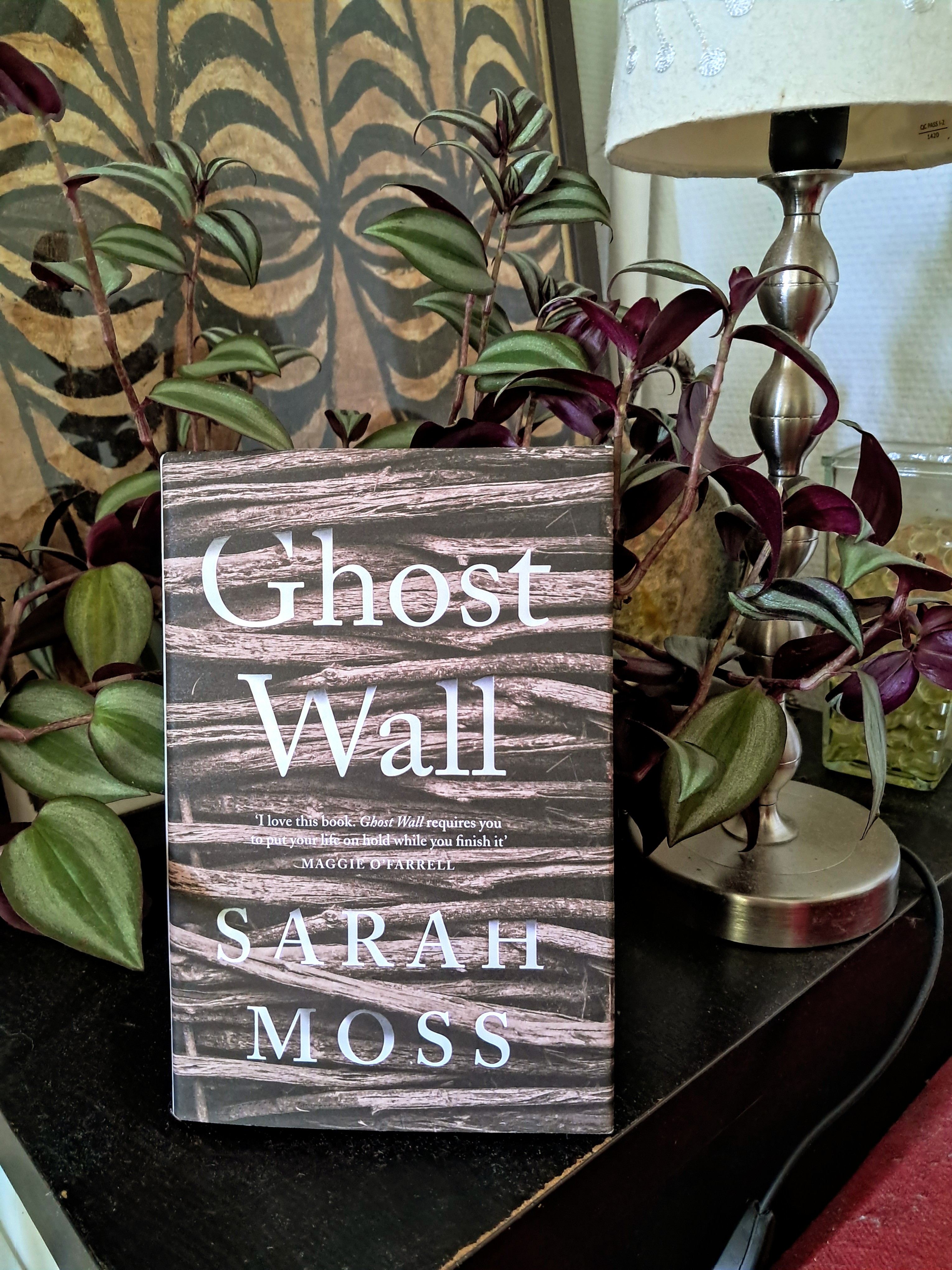
Book cover of novella Ghost Wall by Sarah Moss. The cover shows woven wood that might have been used to recreate an Iron Age hut.

Interestingly, Summerwater was an ‘on-holiday’ novel, a rain soaked 24 hours in the Scottish Highlands, of families stuck in their cabins, inspired by the author’s two week stay under similar conditions, while Ghost Wall is also a tale of a less than salubrious summer holiday.

Teenage Silevia is spending time with her family in an Iron Age re-enactment hut in Northumberland, experiencing what it might have been like to live as they did. There is a Professor and his students also present, whereas Silvie and her father are there because her father, a bus-driver is passionate to the point of obsession about the history of this period.

We were sleeping in the roundhouse, my parents and I. The students had built it earlier in the year, as part of a course on ‘experiential archaeology’, but they had been firmly resistant to my father’s view that everyone should sleep in it together.

The point of the experience was to have a flavour of Iron Age life, a period around 800 BC when people learned how to use iron, which subsequently shifted the way they lived. Still very basic, so much of the holiday is spent foraging for food and for Silvie’s mother, preparing it.

Re-enactment not Reality

Silvie befriends one of the students Molly, who isn’t taking the experience as seriously as the others, who brings a reminder that life is not like this today and challenges some of the things that they do. Silvie admires her rebellious spirit, but is too fearful of her coercive father to defy his requests, finding it impossible to say no and seeing how little it takes for her mother to be punished.

I sometimes think I can tell when two pieces from the same site were made by the same prehistoric person, because the way my hands move is the same. I shivered. Of course, that was the whole point of the re-enactment, that we ourselves became the ghosts, learning to walk the land as they walked it two thousand years ago, to tend out fire as they tended theirs and hope that some of their thoughts, their way of understanding the world, would follow the dance of muscle and bone.

Photo by E. Laperriere Pexels.com

Underlying her experience and in the opening three pages, is the experience of the bog girl who was sacrificed, a story that as we read those pages, it is not clear whether this is a foreshadowing of something that is going to occur, or something from the past that she can imagine and feel, but whatever it is, it starts to feel real, even when she says otherwise.

Silvie, she said, you’re really OK with this, the ghost wall? It’s interesting, I said, I didn’t think it would be but it is. You’re not scared she said. I shrugged. Of what, bones? Of people, she said.

Passion or Persuasion

Photo by Petra Nesti on Pexels.com

The novella is atmospheric and becomes increasingly alarming as Silvie gets swept up in the passion of her father and the history professor, who have convinced themselves that there’s nothing wrong with taking the way these people used to live further. Despite her unwillingness, Sylvie also recognises her father isn’t academic like the rest of the team and part of her wants to support him.

It’s slightly terrifying the further things goes and the ending might have been a little abrupt, but then often conclusions are dramatic when an intervention is required, rather than the ideal of thoughtfully addressing real concerns.

Interviewed for the Women’s Prize for Fiction 2019, Sarah Moss, on her inspiration for the novel shared:

I had a writing residency for the Hexham Book Festival, and became fascinated by Hadrian’s Wall and prehistoric arts and crafts. We think of Hadrian’s Wall as the boundary between England and Scotland but neither of those entities existed then; it was the boundary between the Roman empire and the barbarians. There was and is plenty of reason to be thinking about the borders between civilisation and barbarity, nature and culture, insiders and outsiders.

Further Reading

A Q & A with Sarah Moss: On Iron Age re-enactment camps, barbarity and civilisation and Brexit’s impact on writers

Guardian: Ghost Wall by Sarah Moss review – back to the iron age

Author, Sarah Moss

Sarah Moss has published eight novels, two memoirs, numerous essays, and academic work on Romanticism, travel, food and gender. Her work has been listed for prizes including the Women’s Prize for Fiction, the Royal Society of Literature Ondaatje Prize and the Wellcome Prize.

Her novels are SummerwaterCold EarthNight WakingBodies of Light, Signs for Lost Children, The Tidal Zone, Ghost Wall and Ripeness (2025). A memoir of her year living in Iceland, Names for the Sea, was shortlisted for the RSL Ondaatje Prize and another My Good Bright Wolf (2025) is about growing up in the 1970’s and how excess self-control affects her early adulthood.

Madame Sosostris & the Festival for the Broken-Hearted by Ben Okri

I haven’t read a Ben Okri novel for a long time. He is well known for his third novel, the 1991 Booker Prize winning The Famished Road, the story of Azaro, a spirit child around the time of Nigerian independence; a challenging novel to read as it slips in and out of reality, and one the writer recalls being spooked by, as those spirits he wrote about crashed into his dreams.

There were times, writing at night, when the story I was telling would spook me. Those where nights when I feared for my sanity. I couldn’t shake the feeling that when people read the novel they’d think something was wrong with me. It must have taken a species of madness to write The Famished Road. It certainly took a stronger psyche than I realised I had to work on that taboo-breaking material, and to withstand the horrors involved. Writing about the spirit world at night, for a long period, is dangerous if you come from a land that believes in them. Spirit children, born several times to the same mother, have a special mythology about them, part dread, part magic.

Booker Prize Winner 1991 for The Famished Road Ben Okri Madame Sosostris homage to T.S. Eliot The Waste Land she  can be perceived as the central consciousness of the tale

There is something alluring about Ben Okri’s work, the way he seeks to portray a cultural inner authenticity that embraces the ordinary, the mythical, the poetic and the mysterious. It can feel slightly beyond reach, and then there are moments of universal resonance. A wonderful, considered author, who embraces all literature and forms.

For some time I had known that there is no objective reality that is true for everyone. There is only the reality perceived through culture, traditions, education, consciousness. We don’t see what is there. We see what we are taught to see. Our reality is a product of culture and consciousness. 

After the challenge of The Famished Road, I remember picking up the slimmer Astonishing the Gods, a beautiful fable-like story about being invisible and having the courage to go forth anyway; a man finds himself among invisible beings who live by one principle ‘to repeat or suffer every incident until we experience it properly or fully’ – the sort of book that was ideal to read in youth, one I loved for its magical element and transformative power when I read it in my 20’s.

Madame So So Sad, Sorceress or Alter Ego

ASo where does Madame Sosostris and the Festival for the Broken-Hearted fit? More along the lines of Astonishing the Gods for sure, with a nod in homage to T.S. Eliot’s (1888-1965) character in his epic poem The Waste Land, who may be perceived as this tale’s central consciousness. She comes from the first phase of that poem ‘The Burial of the Dead’, with its themes of sorrow and disappointment, of April and the cruelty in the coming of Spring. Eliot too, is said to have been referencing a character from Aldous Huxley’s Crome Yellow.

Madame Sosostris, famous clairvoyante,

Had a bad cold, nevertheless

Is known to be the wisest woman in Europe,

With a wicked pack of cards. 

The Novel

Okri’s Madame Sosostris is a modern fable, with a touch of cynisism and humour, it is about two upper-class power couples, one of the women has the idea to create a festival for those who have suffered loss but are never acknowledged, the brokenhearted. It has been 20 years since her own major heartbreak.

A Touch of Theatre

Much of this novella length story is dialogue and I couldn’t help but feel like I was watching a play, even the voices seemed louder as if projected out to an audience more so than to each other. We get the feeling that these people don’t much like each other and have long ago left their more authentic aspects of themselves behind.

We spend our lives trying to become ourselves. Few people ever succeed.

Photo by G. PITOIS Pexels.com

The festival will be a masked, costumed event, an idea they hope will allow people to reconnect with something more authentic, since no one will know who they are. This will prove strange to Viv, a member of the House of Lords, who is not used to being encountered by people who do not who she is or the position she holds in society.

But she soon realised that the things they were saying were genuine, that they wanted nothing from her, and had no idea who she was. This was disquieting and charming in equal measure. Disquieting because she was used to people reacting to her because of her money. She was used to the influence of her position in society, the power it gave her. Being liked without that power was new to her. But it did not alter her anxiety.

A Sacred Space in Nature to Unmask

A sacred forest in the south of France, Sainte Baume

It will be for one night only, abroad, in a sacred forest in the south of France. The special invitee is Madame Sosostris, whom they have come across once in the House of Lords (where one of the women works) who will do readings for each guest.

They had come to her weighed down with the dark burdens of their unendurable agonies. They left with a streak of light in their eyes. They were people who had chewed their innards and devoured their own hearts. They were locked in the narrow space of their beings. They were imprisoned for long periods of time in the hell of their own minds, turning over their agonies till they grew and filled their world. What most of them needed was a glimpse beyond themselves, a glimpse of something real, something with the texture of dry bone, the fragrance of a dead beetle, the roughness of a cement wall.

When plans go awry, it becomes necessary to adapt and step out of comfort zones. Some will rise to the occasion, others will be destabilised by it. Ultimately, the couples all experience moments of consciousness raising and are changed in some way by their encounter.

The novel explores identity and personality and how society reinforces these constructs which move further and further away from the authentic, creating a mirage masking the true self. It demonstrates how a shift in perspective and stepping outside oneself can be beneficial to the psyche.

It’s an entertaining read, that plays around with what is real, what is seen and unseen, thought provoking in a theatrical sense and ready for the stage in my humble opinion.

Further Reading/Listening

An Interview: Ben Okri – How The Famished Road was Written on a Magic Tide of Freedom

Listen To: Ben Okri Talking About T.S. ELiot and The Waste Land (16mins)

Guardian: Madame Sosostris & the Festival for the Broken-Hearted by Ben Okri review – a slender fable

Ben Okri, Author

Sir Ben Okri was born in Minna, Nigeria. His childhood was divided between Nigeria, where he saw first-hand the consequences of war, and London.

His writing has used magic realism to convey the social and political chaos in the country of his birth, however no two books are the same exploring themes of reality, unreality, society, storytelling, freedom, magic, consciousness, history, politics, justice.

His books include The Last Gift of the Master Artists (2022), The Freedom Artist (2019); the short story collection Prayer for the Living (2019); the prose-poetry hybrids Tales of Freedom (2009) and A Time for New Dreams (2011); the long poem Mental Fight (1999); the essay collection A Way of Being Free (1997); the poetry collection An African Elegy (1992); and the Booker Prize-winning novel The Famished Road (Anchor, 1991).

He has won many awards over the years, including the Booker Prize for Fiction and is also an acclaimed essayist, playwright, and poet. In 2019 Astonishing the Gods was named as one of the BBC’s 100 Novels That Shaped the World. In June 2023 he was awarded a knighthood in the King’s official birthday honours.

Booker Prize 2025

The longlist for the Booker Prize 2025 will be announced on Tuesday, 29 July 2025. The shortlist of six books will be announced on 23 September and the winner will be announced on 10 November.

Have you read any Ben Okri books? Let us know in the comments below?

N.B. This book was an ARC (Advance Reader Copy) kindly provided by the publisher via NetGalley.

January by Sara Gallardo (1958) tr. Frances Riddle, Maureen Shaughnessy (2023)

January is a slim novella, considered to be a revelatory, pioneering masterpiece about a short period in the life of a 16-year-old Argentine girl living in a rural area, whose life trajectory is radically changed in a day. Now, for the first time, translated from Spanish into English.

Breaking the Silence, Exploring the Consequence

With echoes of Edith Wharton’s Summer , this radical feminist novel broke the silence around abortion to reshape the way women’s bodies and rights were perceived in 20th-century Argentina.

A radical feminist text, January was the first Argentine novel to represent rape from the survivor’s perspective and to explore the life-threatening risks pregnancy posed, in a society where abortion was both outlawed and taboo.

They talk about the harvest but they don’t know that by then there’ll be no turning back, Nefer thinks. Everyone here and everyone else will know by then, and they won’t be able to stop talking about it. Her eyes cloud with worry; she slowly lowers her head and herds a small flock of crumbs across the worn oilcloth.

A 16 year old girl in a predicament, not of her own making discovers she is pregnant, but not by the young man she dreams of. She is the daughter of peasant farm workers and has limited options, but will pursue them all the same, in order to try and avoid the inevitable, forced outcome that awaits her once her secret becomes known.

A pregnant teenager imagines death rather than forced marriage
Photo F.Capetillo Pexels.com

She is just of an age where she begins to notice and feel something for someone around her, but her virtue is stolen by another. Instead of imagining love, she imagines death, and wonders if this might be when her will finally see her.

She no longer cares about anything besides this thing that consumes her days and nights, growing inside her like a dark mushroom, and she wonders if it shows in her eyes as they remain fixed on her worn-out espadrilles, two little gray boats on the tile floor, or in her hands crossed in her lap, or in her hair burned by the perm.

The novella follows her panic, her attempt to find resolution without support, her symptoms, her desperation to seek absolution, her confession, her realisation of the terrible consequence, the life sentence, the marriage plot.

This thought floods her with a tide of anxiety as she remembers her secret. A sense of impotence rises to her throat, as if time has become something solid and she can almost hear its unstoppable current conspiring with her own body, which has betrayed her, tossing her to the mercy of the days.

She lives in rural Argentina, a conservative catholic environment, an unruly place for a young girl.

What will happen to her in this place that reveres the cloth, that judges and shames girls regardless of their innocence?

Further Reading

The New York Review of Books: Nefer’s Mission by Lily Meyer

The New Yorker: The Abortion Plot: A newly translated novel by the Argentinean writer Sara Gallardo provides a missing link in the history of abortion literature, by S. C. Cornell

Sara Gallardo: Recently rediscovered Argentine writer by Jordana Blejmar (University of Liverpool) & Joanna Page (University of Cambridge).

it is perhaps her abiding concern for the ‘Other’ – marginalized, solitary characters, women, animals, monsters, even elements of nature – that gives Gallardo’s literature its most powerful political dimension…

Author, Sara Gallardo

Sara Gallardo was born in Argentina in 1931 to an aristocratic Catholic family. She became a journalist in 1950 and was twenty-seven years old when her powerful debut January was published in 1958.

She grew up in Buenos Aires in a family of men so famous there are streets named after them all over Argentina (all key figures in the constitution of the Argentine nation): her grandfather Ángel Gallardo was a civil engineer and politician; her great-grandfather Miguel Cané was a journalist, senator, and diplomat; and her great-great-grandfather Bartolomé Mitre was president of Argentina from 1862-1868.

By the time she died in 1988 she had published more than a dozen books, including collections of short stories and essays. Gallardo has been compared to Lucia Berlin or Shirley Jackson.

January is considered required reading across Argentina.

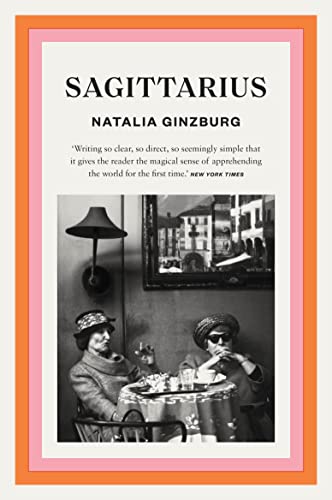
Sagittarius by Natalia Ginzburg (1957) tr. Avril Bardoni

After just finishing Domenico Starnone’s The House on Via Gemito (my review here) featuring a domineering father, it felt appropriate to read another Italian author Natalia Ginzburg and her fictional account of a domineering mother.

The Interfering Parent

However, Ginzburg’s parent in the novella Sagittarius might be considered timid compared to Starnone’s Federico. While she is over invested in the lives of her two daughters, they seem able to pursue their own desires in spite of her interference.

Fed up with life in a small town she moves to the suburb of a city to be closer to her sisters, who run a china shop and her student daughter (who narrates the story), then demands that her second daughter and husband move with her, she has promised to give him money to set up a practice.

What he needed was a practice of his own in a good central location. My mother had promised to give him the money for this as soon as she had won a certain lawsuit against the local council in Dronero, concerning a property dispute; she had made the promise lightly, finding it easy to part with money that was so far away and so unlikely ever to be hers; the litigation had already dragged on for more than three years, and Cousin Teresa’s husband, a solicitor, had told us that our chances of winning were nil.

Photo by Ylanite Koppens on Pexels.com

We learn she disapproves of the husband Chaim, a Jewish Polish Doctor with only one brother left in his family, having lost his family in wartime. She was initially distraught over the one that got away, – a rich, blond, young man her daughter met on holiday, until she became ill and her mother arrived – not realising that her overbearing parental behaviour might have had something to do with it. She had done everything to ensure her daughter would marry well.

Every time she thought about the boy with the blond crew cut my mother became enraged. Not one spark of generosity had he shown! No crumb of comfort had he offered! And to think he had disappeared without even saying goodbye! Without a single word of any kind: The very memory of the blond crew cut and of the afternoon spent with is family now filled her with disgust.

There were days when my mother was almost as bored in town as she had been in Dronero. She already knew the central shopping district like the back of her hand, having walked the length and breadth of it looking for suitable premises, small but attractive, for her art gallery; but the rents were all extremely high and, besides; another problem was beginning to occur to her, that of finding painters willing to show in her gallery. She knew nobody.

Making Friends in the City

Finding it more lonely and isolating than she imagined, she is happy when she meets Pricilla (call me Scilla), a woman who (eventually) listens to her dreams and desires and seems in tune with them and even willing to partner with her on her project to open an art gallery.

My mother was now anxious to talk about her gallery project but was unable to get a word in edgeways because Signora Fontana never stopped chattering for an instant.

In her dogged pursuit of ambition, and desperate desire for a true friend, she overlooks important signs that perhaps all is not as it should be and naively keeps her plans to herself, avoiding criticism or advice from any of her family members that might have lead her to question her association – though probably not.

A Greek Mythology Warning

Photo by Damir on Pexels.com

It is no coincidence that Ginzburg names her character Scilla, that name immediately conjured up for me the creature Scylla lurking in the sea that enticed ships onto the rocks. She is adept at luring men into a perilous and rocky waterway, thus as I read, every person that Scilla was connected to, became for me, a potential villain or obstacle in her path, some perhaps by accident, others by design.

Scilla convinces her friend to wait on the art gallery project and invites her in on another shop idea. They will decide on a name, Scilla’s zodiac sign, Sagittarius, one that could easily be transferred to an art gallery.

Ultimately she will be confronted with her own poor judgement, both those she put her trust in that she should not have and those who she neglected and would be there for her in her downfall.

This novella is often read with the excellent Valentino which I read earlier in the year and loved. Sagittarius is a little more predictable, whereas for me, Valentino was exceptional, my favourite of the two, but I highly recommend them both and look forward to reading more Ginzburg this year.

Further Reading

My reviews of other Natalia Ginzburg works: Family Lexicon (memoir), The Dry Heart (debut novel), Valentino (novella)

JacquiWine’s Journal reviews Valentino and Sagittarius

Author, Natalia Ginzburg

Natalia Ginzburg (1916-1991) was born in Palermo, Sicily. She wrote dozens of essays, plays, short stories and novels, including Voices in the EveningAll Our Yesterdays and Family Lexicon, for which she was awarded the prestigious Strega Prize in 1963.

Her work explored family relationships, politics and philosophy during and after the Fascist years, World War II. Modest and intensely reserved, Ginzburg never shied away from the traumas of history, whether writing about the Turin of her childhood, the Abruzzi countryside or contemporary Rome—approaching those traumas indirectly, through the mundane details and catastrophes of personal life.

She was involved in political activism throughout her life and served in the Italian parliament between 1983 to 1987. Animated by a profound sense of justice, she engaged with passion in various humanitarian issues, such as the lowering of the price of bread, support for Palestinian children, legal assistance for rape victims and reform of adoption laws. 

She died in Rome in 1991 at the age of seventy-five.

Republic of Consciousness Prize for Small Presses 2024

Now in its 8th year, The Republic of Consciousness Prize is an annual literary prize aimed to support small and independent presses in the UK and Ireland. The organisation supports and recognises the work of those presses considered vital to the United Kingdom’s literary culture.

They state their purpose as:

“To advance for the public benefit literary fiction of the highest merit from small presses in the UK and Ireland through a range of reading, speaking and event initiatives, and by providing grants and assistance to practitioners and producers of literary fiction.”

Ground Breaking Experimental Works of Fiction

By their very nature, they are more likely to be ground-breaking experimental works that mainstream publishers consider commercially risky, although when one of these novels takes off, they are often ready to step in.

It is where we are likely to come across innovative forms of writing, therefore you either have to be a brave and adventurous reader, or practice a certain level of discernment, in order to find those titles that might appeal if you are less of a risk taker in reading.

Reading Outside the Comfort Zone

I like to see what titles the prize is considering, though they are generally a little too avant-garde for me. This year, I discovered I had read one title that was on the longlist and then it made the shortlist, so of course I was hoping it would win!

No doubt if you follow me here, you will have guessed which press it was – Yes, it was a Charco Press title. Charco Press publish outstanding works of mostly Latin American contemporary fiction in translation and you can support them by subscribing to their annual 2024 bundle. You won’t regret it!

Another Winner From Charco Press

Yesterday, from a shortlist of five books, the winner was announced, which the judges described as:

“A stunning thriller of sorts. So understated. So powerful. So heartbreaking. Worked for me completely on both the level of a human story and as a warning parable for our times.“

Of Cattle and Men by Ana Paula Maia (Brazil) translated by Zoë Perry (Portuguese)

I read Of Cattle and Men (link to my review here) in May 2023 and it was one I could not put down until I finished. Deeply evocative of slaughterhouse communities and institutions, it opens a channel to consideration of the consciousness of bovines and depicts man in his basest form, driven to paranoia by what he can not understand or control and therefore seeks to destroy.

The writing is compelling and thought provoking, it is suggestive in a way that provokes the reader’s imagination, without being explicit about what might be being suggested. I thought it was excellent. And a year later, it has stayed with me.

When night falls, the residents of Ruminant Valley tend to shut their doors and windows tight. They believe that everything that seems improbable during the day can overcome the darkness. It’s when thoughts that were once impossible become possible; when hushed whispers swell, and above all, when that layer of darkness cloaks anything suspicious. The figures, the voids, the long shadows, all of it brought on by the night, which is immense, and its reaches infinite.

Highly Recommended.

Warning: Not for the squeamish.

Further Reading

Granta: Read an extract from Of Cattle and Men

Guardian: Charco Press wins Republic of Consciousness prize for ‘gut-punch’ novel by Ella Creamer

Human Ecology Research Paper: A Social History of the Slaughterhouse: From Inception to Contemporary Implications (2010) by Amy J.Fitzgerald, Depart of Sociology & Anthropology, University of Windsor, Canada

Valentino (1957) by Natalia Ginzburg tr. Avril Bardoni (Italian), Intro by Alexander Chee

The more I read of the Italian author Natalia Ginzburg, the more I am hooked.

Valentino leads the reader along, thinking you are reading a straight forward story, until you arrive at the point of realising that your reactions are judgements and the book holds up a mirror to our own conditioning. And that is how it feels reading it in 2024. I can’t even imagine the storm it likely raised when published in 1957.

Little Sense or Sensibility

novella Italy parody fiction gender conditioning

Valentino is a short novella narrated by Caterina, who is training to become a teacher. She lives with her father, a retired schoolteacher, her mother, who used to give piano lessons and her brother, Valentino who does very little, but whose medicine studies and equipment cost a lot.

we had to help my sister who was married to a commercial traveller and had three children and a pitifully inadequate income, and we also had to support my student brother who my father believed was destined to become a man of consequence. There was little enough reason to believe this, but he believed it all the same and had done ever since Valentino was a small boy and perhaps found it difficult to break the habit.

Valentino spends his time playing with a kitten, making toys out of scraps of material, dressing up and admiring himself. A string of engagements to teenagers raise false hopes and always end the same way – broken. So when he announces he will be married within the month, naturally the family expect the pattern to continue.

What a Wife Can Be or Not to Be

So when he turned up with his new fiancée we were amazed to the point of speechlessness. She was quite unlike anything we had ever imagined.

We learn of all the family members reactions to this new fiancée, with the exception of the father.

he was about to launch into a long speech about what was the main consideration but my mother interrupted him. My mother always interrupted his speeches, leaving him choking on a half-finished sentence, puffing with frustration.

A Man of Consequence, The Weight of Expectation

Photo by W R on Pexels.com

Valentino is oblivious to the reactions and judgements of his family and continues to act and communicate as he always has, holding nothing back, expecting everyone to be happy for him.

Is he fearless? A truth teller who doesn’t hide things or worry about what others think of him? Is he a narcissist? He is a wonderful character because he is like the mystery at the centre of the story. Who don’t quite know who he is because he isn’t acting as everyone including the reader might expect him to.

His father lost for words, does not understand that what he is witnessing is the incarnation of his desire, his son is indeed becoming a man of consequence, just not in the way he had expected.

Valentino is captivated by his wife, by her look, her intelligence, her culture. She showers him in gifts, he has upended social convention, insulted the patriarchy and all who prop it up.

My father said he would go to have a talk with Valentino’s fiancée, but my mother was opposed to this, partly because my father had a weak heart and was supposed to avoid any excitement, partly because she thought his arguments would be completely ineffectual. My father never said anything sensible; perhaps what he meant to say was sensible enough, but he never managed to express what he meant, getting bogged down in empty words, digressions and childhood memories, stumbling and gesticulating. So at home he was never allowed to finish what he was saying because we were all too impatient, and he would hark back wistfully to his teaching days when he could talk as much as he wanted and nobody humiliated him.

Out of Place

Once they are married, it is his family that feels out of place, ill at ease. Valentino is easily able to be among his wife’s friends and family as well as his own. He does not feel undeserving or unworthy of their company or his newfound social status. Neither is he aware of the dilemmas facing his family.

It is best not to share too much of the storyline, but to discover it yourself, because every page is a wonderful discovery, of thought provoking insights into the human condition and the reaction of those around us when one defies convention and how they too can be displaced when set down inside an unfamiliar environment.

When Caterina finishes her diploma and gets a job, we observe how Maddalena’s offer to house and feed her, though on the surface seems attractive, acts to disempower her, denying her independence and supporting a selfish desire. Through the unconventional marriage, we see the ridiculousness of gender conditioning all the more clearly.

I thought it was absolutely brilliant, the way Ginzburg has created these two characters, upending societal norms and inverting typical behaviours.

Highly recommended.

Author, Natalia Ginzburg

Natalia Ginzburg (1916-1991) was born in Palermo, Sicily. She wrote dozens of essays, plays, short stories and novels, including Voices in the EveningAll Our Yesterdays and Family Lexicon, for which she was awarded the prestigious Strega Prize in 1963.

Her work explored family relationships, politics and philosophy during and after the Fascist years, World War II. Modest and intensely reserved, Ginzburg never shied away from the traumas of history, whether writing about the Turin of her childhood, the Abruzzi countryside or contemporary Rome—approaching those traumas indirectly, through the mundane details and catastrophes of personal life.

She was involved in political activism throughout her life and served in the Italian parliament between 1983 to 1987. Animated by a profound sense of justice, she engaged with passion in various humanitarian issues, such as the lowering of the price of bread, support for Palestinian children, legal assistance for rape victims and reform of adoption laws. 

She died in Rome in 1991 at the age of seventy-five.

Further Reading

My review of Ginzburg’s memoir, Family Lexicon (1963)

My review of Ginzburg’s debut novel The Dry Heart (1947)

Interview with Alexander Chee: On Natalia Ginzburg’s Valentino by Sander Pleij, 6 May 2023

Sambac Beneath Unlikely Skies (2021) by Heba Hayek

Tender, nostalgic vignettes of a childhood growing up in Gaza, often told from the perspective of the twenty-something narrator looking back from the present, now living in exile in London. She is constantly longing for old places while finding new ones, the past never far from being elicited by the present.

Each new chapter has an associated song, vignettes accompanied by a playlist.

The image of the sambac, the tree that filled our back yard with its sweet, creamy scent, appears in my narrator’s attempts to create life where this shrub doesn’t naturally thrive.

short stories Palestinian Literature Gaza Hajar Press

The little stories are so compelling, I finished them in one sitting and was left wanting to read more. I sincerely hope the author is writing more stories, preserving important memories, while there is a terrible war raging in her home town.

These stories are the anti-thesis of that violent incursion, they speak of family outings to the sea, of friendships, of Aunties, though so many are tinged with reminders that it is almost never without some reference to loss.

As the narrator grows into unlikely circumstances away from Gaza, memory is her greenhouse; her way to bring back the voice of the girl who was sacrificed and born in the hands of her identity. At her desk in a flat in Southeast London, she writes of what makes her soul flicker: community love, especially the kind embodied by circles of women and girls.

Guns and Figs

In this vignette, our narrator shares a childhood memory of driving along the Gaza coast with her parents, beside the Mediterranean, in her favourite place, by the window facing the sea, window down, sea breeze rushing in, an unchanging view for the duration of the 20 minute drive.

The song accompanying the vignette is Fairuz ”Nassam Alayna El Hawa’ (The Breeze Is Upon Us)

Photo by Kadir Akman on Pexels.com

My brother and I each had assigned places in the car, until our little sister grew old enough to claim her window-seat rights. Then the rotation became tricky, involving fights that mostly ended with my brother crying in the middle.

I usually sat by the window, facing the sun and the sea, breathing the salty, creamy air and occasionally eating grapes and figs: the ultimate Mediterranean snack.

These drives all felt the same, until the last one.

At a checkpoint, a soldier indicates they should pull over, “I’ll just be a minute” says her father. An hour later he returns, the Friday barbecue trips end indefinitely that day, though she is never told why.

I started to notice Baba paying more attention to the road; it seemed like he was avoiding certain checkpoints. Every so often, he would point out something ahead and wonder aloud whether it was a checkpoint or a fruit cart. As Fairuz sang from the cassette player, Baba drove on, trying to guess the difference between guns and figs.

Friendship, Fear and Foreign Places

Other stories ‘Ask Me Anything’ tell of school days interrupted by explosions, of friendships interrupted by disappearances, ‘A Carry-On Full Of Pictures and Letters’.

We were never trained for emergencies at school. We just knew what to do. We would sit on the floor under our tables each time we heard the recurrent loud explosions – ignore the first two, exchange a few nervous looks, and then, in one swift move, we’d all be in our places by the third. That consistency was comforting. The fact that we had survived the first two was a good enough sign that it’d be worth shielding ourselves from the rest.

In an attempt at reassurance, our teacher would remind the class: ‘The one you hear isn’t the one that kills you.’

One day her best friend Lubna leaves Gaza without telling anyone. She had visited the Al-Shifaa hospital after breaking her arm and never returned.

When she was ten, Lubna’s dad had been one of seven people martyred after the occupation forces targeted a car in the middle of a busy street. She’d been planning her exit for years; I just didn’t think it was really going to happen.

Three years later, she visits her friend in Amsterdam where she now lives.

Song: Lucy Dacus – ‘Yours and Mine’.

That day feels like the oldest memory I have. Yet somehow I can barely remember it at all, or the person I was when I hadn’t yet imagined what it meant to leave.

‘I love my mother, but she couldn’t protect me. I love you, but you couldn’t either. I’m a lot better now, you see?’ She waves her hand in the air, and I look around and nod.

A Moving Tale, Of Family Drama

Song: Nina Simone – ‘I Wish I Knew How It Would Feel To Be Free’

In this vignette, we first hear that our narrator has been kicked out of her flat after secretly hosting an Airbnb guest to help pay the rent. Homeless, she moves into the office where she works and takes on additional responsibilities.

Sometimes, I even feel content in my windowless bunker, stealing bits of people’s lunches from the common lounge – not the entire meal. As I look up flats in my small college town, I think of my first big move.

Here, we learn of when our narrators parents leave the family home, the summer she turns six, after problems around inheritance became intolerable. Their last day living in an apartment above her grandmother Sitti, arrives:

Moving out of the family house was never a casual affair, but rather a statement. It’s like leaving home for the first time – making a point that it’s time to move on. Changes like these usually carried an undertone of wives taking their husbands away from their families and keeping them for themselves.

The move also meant that no one was going to interfere in how to raise us, except for my parents. It was a bit of a slap in the face, especially for Sitti. But I was excited about it; I wanted to be like my other cousins who visited only on Fridays and wore something new each time: a little bag or a hair tie, or even a completely different hairstyle. I was ready to rebel with my parents and become the daughter of a mean woman. I started to imagine what I would wear the next Friday.

Some years later, she visits her grandmother in Belgium, where she now lives and finds her safe, but malcontent.

Song: Idir – ‘A Vava Inouva’

Seventy years since her birth,our Grandma is in a French-speaking town, barely able to move, again a refugee. She tells me she didn’t want to leave Gaza, and that she regrets it.

‘Who leaves at this age?’ she says, slightly ashamed of her attempt at survival. As though there were an age limit to craving life, or to that quiet longing older folks back home often fear expressing.

Photo by u015eeyma D. on Pexels.com

It is a wonderful collection, that preserves childhood memories and shares with the rest of us, a slice of life for a member of a Palestinian family in Gaza, where growing up is fraught with uncertainty, trauma and nothing can be taken for granted.

From afar, the beauty of family and fragmented moments of friendship gain additional significance, as a way of life is slowly and methodically destroyed.

A must read, excellent portrayal of a lonesome yearning for home.

To order a copy of this book, visit Hajar Press here.

Heba Hayek, Author

Heba (she/they) is a London-based, Gaza-raised Palestinian author, creative and facilitator. She completed an MFA in Creative Writing at Miami University, Ohio, and studied for an MA in Social Anthropology at SOAS University of London.

Rooted in anti-nation-state, decolonial, queer, Afrikan feminist thought, Heba’s work navigates topics such as disposability, Global South solidarity movements, land justice, Palestinian drill music, and more.

Heba’s first book, Sambac Beneath Unlikely Skies, won the Creative Award in the 2022 Palestine Book Awards and was chosen as a 2021 Book of the Year by The White Review, Middle East Eye and The New Arab.

The Dry Heart by Natalia Ginzburg tr. Frances Frenaye

I’m planning on reading a few books by the Italian writer Natalia Ginzburg, as mentioned on reviewing her excellent memoir Family Lexicon which I chose to start with, before diving into her fiction.

I start her fiction at the beginning with this brilliant, page turning feminist classic, originally penned in 1947, The Dry Heart.

Captivating right from the opening lines,

“Tell me the truth,” I said.
“What truth?” he echoed…
I shot him between the eyes.

novella Italian Literature

Natalia Ginzburg’s debut novella starts with a shot and then goes into the domestic detail that preceded that moment.

Those first lines begin halfway down the page, just a couple of paragraphs before you turn the page, where not only is the husband shot, but in the last sentence before we turn the page, she tells us,

But for a long time already I had known that sooner or later I should do something of the sort.

She then leaves the house and over the course of the day, she recalls in minute detail how she met Alberto, her husband of four years, their long drawn out courtship, her wavering feelings for him that seesaw between love and hate but never indifference, before deciding what she ought to do now.

I put on my raincoat and gloves and went out. I drank a cup of coffee at the counter of a café and walked haphazardly around the city. It was a chilly day and a damp wind was blowing. I sat down on a bench in the park, took off my gloves and looked at my hands. Then I slipped off my wedding ring and put it in my pocket.

A school teacher living in a boarding house, surrounded by different characters on the periphery of her life, she had a vivid imagination and had fantasized about marriage. Alberto hadn’t fit that image but over time that had changed.

When a girl is very much alone and leads a tiresome and monotonous existence, with worn gloves and very little spending money, she may let her imagination run wild and find herself defenceless before all the errors and pitfalls which imagination has devised to deceive her.

The novel vivdly portrays the roller coaster of her young imagination, the frustration and desire she feels, the willingness to compromise and accept a less than perfect situation, the significant step forward their marriage takes when a child comes into it, until the day she snaps.

There is no mystery, all is laid bare in captivating, enticing prose, that is direct and insistent while exploring the dark aspect of a relationship that can’t be controlled, of characters who are ill-suited yet drawn towards one another, until that spontaneous combustion of their marriage.

It’s a novella, just over 100 pages, one to dive right in, highly recommended. A feminist classic.

Brilliant.

Also reviewed earlier this year by Jacqui at JacquiWine’s Journal and Kim at Reading Matters Blog.

Natalia Ginzburg Italian literature Family Lexicon

Natalia Ginzburg, Author

Natalia Ginzburg (1916-1991) was born in Palermo, Sicily. She wrote dozens of essays, plays, short stories and novels, including Voices in the EveningAll Our Yesterdays and Family Lexicon, for which she was awarded the prestigious Strega Prize in 1963.

She was the first to translate Marcel Proust’s Du côté de chez Swann into Italian.

Her work explored family relationships, politics and philosophy during and after the Fascist years, World War II. Modest and intensely reserved, Ginzburg never shied away from the traumas of history, whether writing about the Turin of her childhood, the Abruzzi countryside or contemporary Rome—approaching those traumas indirectly, through the mundane details and catastrophes of personal life.

She was involved in political activism throughout her life and served in the Italian parliament between 1983 to 1987. Animated by a profound sense of justice, she engaged with passion in various humanitarian issues, such as the lowering of the price of bread, support for Palestinian children, legal assistance for rape victims and reform of adoption laws. 

She died in Rome in 1991 at the age of seventy-five.

Boulder by Eva Baltasar tr. Julia Sanches

Boulder is another portrait of a woman, the second of a triptych.

The narrator of Permafrost never quite cut the strings of family, choosing the path(s) of least resistance, while lamenting not having made more independent choices in her formative years.

Assured Prose Who Art in Metaphor

If the narrator of Permafrost is somewhat unsure, that of Boulder is more certain. The prose is assured, the narrative has pace, the protagonist moves towards what suits her, to freedom – until things change.

The avid descriptions and bold metaphors have me rereading and highlighting passages, like the creation of foam as a wave crashes on itself, they are as natural to the text as the paragraphs within which they roll.

An itinerant cook, she moves from place to place, island to ship, working in the kitchen. Life on the cargo ship suits her, she’s at home in turbulent seas, around those that neither desire nor reject her, a place where there was no need to pretend life had a structure. Rootless, drifting and free.

Freedom In Its Many Forms

I think I’ve discovered what happiness is: whistling the moment you wake up, not getting in anyone’s way, owing no explanations, and falling into bed at daybreak, body addled from exhaustion, and mind free of every last trace of bitterness and dust.

The boat sails up and down the coast of Chile, she rarely disembarks, the only temptation in Chaitén, for a hot shower, fresh linen, and a lurking lust for a lover. That’s where she meets Samsa.

I look at her and she fills every corner of me. My gaze is a rope that catches her and draws her in. She looks up, sees me. She knows.

They begin to see each other, though it is often months between visits. Her lover renames her Boulder.

Photo by Bren Pintelos on Pexels.com
She doesn’t like my name and gives me a new one. She says I’m like one of those large, solitary rocks in southern Patagonia, pieces of world left over after creation, isolated and exposed to every element. No one knows where they came from. Not even they understand why they are still standing and why they never break down. I tell her I’ve seen rocks like those in the middle of the ocean.

Compromise, Commitment, Cohabitation

Samsa leaves for Iceland and asks Boulder to join her, she says yes. Samsa makes decisions and Boulder adapts to them. She observes the island, the islanders, the things she doesn’t like, she finds work that gives her an escape. She observes the different way they love each other, the pull of the boats when she walks the dock alone at night.

There’s a restlessness. She starts her own business, a food truck, no boss, no employees, a small but significant and necessary freedom. Something of her own. A coping mechanism.

It’s Not An Elephant in the Room

Photo by Sindre Fs on Pexels.com

Then it happens. Samsa wants to have a baby, Boulder knows that refusing her will mean the end, so asks for more time.

The novel charts this turning point in the relationship, where one woman will become pregnant and give birth while the other tries to support and be part of something she does not feel.

It is an alternative navigation of an age old dilemma, seen through the lens of a queer relationship, a couple struggling with avoidance issues.

It’s not difficult to imagine where it is headed, or what might happen, when one person isn’t quite committed to the idea and desires freedom so strongly. Is the love of another enough sufficient when events propel their lives forward faster than the communication of important feelings around them?

Boulder’s observations and experience are like that of an outsider who can’t quite enter the familiar, of trying to overcome an obstacle of the mind, when the heart is resisting, when self destructive tendencies threaten to communicate what the voice has been unwilling or unable to.

Boulder was shortlisted for the International Booker Prize 2023.

Further Reading

Read an Extract from ‘Boulder’

Eva Baltasar International Booker Prize interview: ‘I wrote three versions of Boulder and deleted two’

“My protagonists are mirror images of myself, only more precise and always veiled. I try to discover who they are by writing, travelling to their darkest, most uncomfortable corners, which is like travelling to the darkest corners of myself, corners that are often repressed and at times denied wholesale. Being able to embark on this journey aboard a novel is as exciting as it is unsettling. It’s as if the novel had transformed into a caravel and the seas were vast but finite, teeming with monsters on the edge of the earth.” Eva Baltasar

Permafrost by Eva Baltasar tr. Julia Sanches

A Poet’s Prose

On the back page in the first sentence that describes the author, it says Eva Baltasar has published ten volumes of poetry. Permafrost is her debut novel, the first in a triptych which aims to explore the universes of three different women in the first person. It clear from the beginning this is the prose of an assured poet.

Julia Sanches triptic #1 catalan translation

I love the title, Permafrost. That deep, but necessary layer in the earth, cold and hard, it creates a foundation layer and stability, as long as conditions remain the same. Kathleen Jamie writes about it in her excellent essay collection Surfacing.

The narrator of Permafrost destabilises the reader on the opening page, with these opening lines…

It’s nice, up here. Finally. That’s the thing about heights: a hundred metres of vertical glass. I’ve settled on an edge, I live on this edge and wait for the moment when I’ll leave the edge, my temporary home.

Not only thinking about heights, but observing all the minutae that surrounds her. It seems like a suicide attempt, a theme that recurs throughout the 122 page novella, only she appears to be distracted by an ever present curiosity around the details of the new experience, something that seems incongruent with wishing to take a life.

I’ve settled on an edge, I live on this edge and wait for the moment when I’ll leave the edge, my temporary home.

Living On the Edge Creates Curiosity

The Thomas Bernhard epigram warns us ‘To be born is to be unhappy, he said, and as long as we live we reproduce this unhappiness.’

So I am surprised by the humour. Despite her melancholy nature and existential awareness, the living in the shadow of family, she makes us laugh.

She tells us her family all self-medicate. Not her, she prefers the edge.

Not for me though – best to keep moving wildly to the edge, and then decide. After a while, you’ll find that the edge gives you room to live, vertical as ever, brushing up against the void. Not only can you live on it, but there are even different ways of growing there. If surviving is what’s it all about, maybe resistance is the only way to live intensely. Now, on this edge, I feel alive, more alive than ever.

A promising child, her first crisis is graduation, after five years, there’s nowhere to go, few clues as to how to put this learning to use. So she lives in her Aunt’s apartment and rents out rooms to different women, providing herself an income and an effortless source of lovers. She spends her days reading, observing, pondering death, too curious to pursue it.

Birth and Children are Grounding

Photo by Pixabay on Pexels.com

Her meandering is interrupted by her pregnant sister and her mother, their insistence to stay close, involved, drawing her back in, keeping her that person she was. The Aunt’s phone call, she’s selling the apartment.

An au pair in Scotland, a marriage proposal in Belgium, childhood memories, fantasies, churning through relationships, occasionally one that lasts a chapter, dialogue with the sister, the mother.

A mole grows and changes form, she makes a doctor’s appointment then cancels it for a year, then follows up.

Life Can Be Insistent

Each chapter is less than two pages, sometimes the narrative skips a chapter and picks up the thread again later on. It’s an inner voyage of discovery and an outer journey of experiences to unravel what was formed by others and discover the essence of, to know who she is. As that realisation occurs, life throws an even greater challenge and responsibility her way.

I’ve realised I know myself by heart…

It is a unique work, recognisably the work of a poet, unruly, impulsive, it makes light of heavy subjects, never quite proselytising, both giving into and resisting convention, forging a way through, trying different things on, breaking out and being pulled back in. One is left wondering if she is floating with the tide or pushing through it.

Permafrost received the 2018 Premi Llibreter from Catalan booksellers and was shortlisted for the Prix Médici for Best Foreign Book in France (2020).

Next up, book 2 in the triptych, Boulder, which was recently shortlisted for the International Booker Prize 2023.