Slaves and Siblings, Sorcery and Sadness, Strength and Salvation – Isabelle Allende’s Island Beneath the Sea

Isabel Allende.

I well remember being introduced to her debut novel ‘The House of the Spirits’ in my early twenties by a good friend and discovering this wonderful story teller. We became immersed in the lives of members of a Latin American family, following it during a time of political upheaval and personal transformation and though it was far from our own reality, it was pure joy to escape into.

Whenever I came across a new book I read it, including two of her wonderful young adult books ‘City of the Beasts’ and ‘The Kingdom of the Dragon’ and who could forget the heart-breaking but beautiful ‘Paula’. I haven’t read all her books, but I will continue to read those that cross my bookish path, just as ‘Island Beneath the Sea’ did recently, spotted on my book buddy’s shelf while feeding her son’s cat Oscar.

In this gripping novel, Allende takes us on a troubling but engaging journey to the sugar cane plantations of what was the French colony Sainte-Domingue, in one of its most historic and transformational eras during the late 1700’s and ends in New Orleans as Napolean trades terrains as if they are commodities with the Americans.
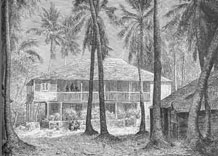
Toulouse Valmorain arrives in the colony from France where the dauphin King has just married Marie-Antoinette and few anticipate the changes to come with revolution in France or the effect that will have on this prosperous Caribbean island where slaves labour on crops that produce a third of the wealth of France and whose usefulness once they set foot on the island averages eighteen months; the fortunate dubbed the Maroons fleeing to the hills, the less fortunate en route to that place they believe all souls go, the island beneath the sea.

Knowing little of changing French laws that might change their status in the colony, many of the slaves find respite through voodoo and belief in men who escaped like the legend Macandal ‘The Black Messiah’. The Maroons will make history as they lead a slave revolt eventually resulting in the first black republic of Haiti.

Valmorain never expected to visit the family plantations but the premature death of his father and the necessity of supporting remaining family in France drive him to the colony where he must take over the family interests. Through him we meet high profile cocotte Violette Boisier, a free woman of mixed African heritage, the teenage slave Zarité, maid to Eugenia the troubled Spanish wife and her brother Sancho, Valmorain’s business partner. The story follows these characters as their fates intertwine and their lives are affected by society’s strictures and historical events.

The characters of Zarité and Violette jump off the page in a way that almost makes me wonder whether the author had her ‘favourite’ characters, we see them in situations and feel their struggles whereas I didn’t get quite the same feeling with the character of Eugenia, I found myself wondering how it really was for her as the drumbeats got inside her head and slowly drove her to madness. She wasn’t a strong character and although she suffered, we learn of it rather than experience it.

I realised towards the end that much of the novel is narrated, which also made me wonder how much longer it could have been if more of the narrative had been portrayed through the events themselves and dialogue, the characters are certainly engaging enough but at 457 pages, it is lengthy already. After being totally engaged with Josephine Bonaparte’s story beginning in another Caribbean plantation in Martinique, I could easily have been tempted by a sequel.

Allende narrates great stories and brings the reader to unforgettable settings during fascinating historic periods; she places interesting characters in this context, constructed with great clarity and insight and history comes alive as if it is the present and the reader is witness to it. For me ‘Island beneath the Sea’ was a real page turner and I was sad to finish it.

What Allende could never have anticipated while writing this book, was the major earthquake in 2010 that would disrupt this country, now known as Haiti, however it is a timely reminder of the previous chapters in the history of this trailblazing republic.

The Forest for the Trees – An Editor’s Advice

Reading books on writing is a little like panning for gold. Most of what we read washes away, some of it is interesting to consider but doesn’t necessarily gel and then occasionally we find a gem.
Unlike gold, one woman’s gem doesn’t necessarily guarantee universal approval and when I recall the books I thought were fantastic ten years ago, I realise now how far I have moved on, now those same inspirational pages from yesteryear elicit nothing more than nostalgic fondness, no longer capturing the thinking place I am at today.

I remember with absolute clarity coming across Dorothea Brande’s 1934 classic ‘Becoming a Writer’ during the period I enrolled in my first creative writing class with writers Maggie Hamand and Henrietta Soames at the Groucho Club in London and how it seemed to speak to me and contain all the questions and doubts I had at the time. There is definitely gold in this book for someone starting out on the writing path, though I have given my volume wings and allowed its pages an airing by passing it on rather than let it languish on the shelf unread.

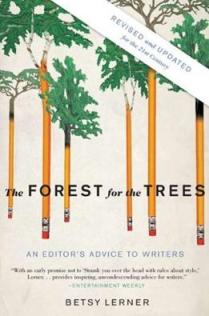
‘The Forest for the Trees’ was recommended on writer Sandra Gulland’s blog and I’d just finished reading the Josephine Bonaparte trilogy, so I jumped in and bought it on impulse. Divided into two sections Writing and Publishing, is a little misleading, the first half reading more like a psychological analysis of writer behaviours, who are the ambivalent, the natural, the wicked child, the self-promoter, the neurotic or touching fire, along with numerous anecdotes to validate these suppositions. Whilst I have no doubt, the author has come across each of these stereotypes, I found the labelling patronising and found myself wondering about the hidden majority who don’t fit so clearly into these headings – or do I just need to get out more to meet these people? Tell me writers, do you identify with one of these labels?
The frequent references to Truman Capote created a distance that was difficult to bridge and too many of the examples seemed like exceptions; I admit I was searching for the paragraph that I could identify with, an example of someone who seemed like an ordinary person, the kind that might convince the reader that to write successfully and be published is possible. It’s the cult of the celebrity factor again, with hindsight one can look back and select anecdotes about writers who were the exception rather than the rule. Disillusioned, I blame my market research background where the anecdote has little credibility and witnessing the propensity of politicians and tabloids to use them in the place of verifiable evidence.

The main message in the second half was: be respectful and patient with your editor and publicist, they’re all juggling multiple balls, you don’t really understand what goes on behind the scenes, if you did, you’d leave us to get on with the job. This debate is likely to continue with the advent of electronic publishing and the industry having to redefine its role and prove its value, however I found this section more insightful and it did highlight many of the strengths and weaknesses of the publishing process.

If you are looking for a tongue in cheek attempt at writer’s psychological profiles, interesting and funny anecdotes and an inside look at one editor’s career path, then this will entertain. We can also learn much about the industry by keeping up with writer’s blogs and online communities, which without a doubt reflect the situation of writers today, whether persevering towards it or already succeeding to be published.

Eerie, Evocative, Engrossing – The Diving Pool

I picked up this slim volume of three enticing novellas during one of my scouts of the excellent Oxfam bookshops in London recently. I was intrigued by the cover and the discovery of an international author I had not read before whose credentials intrigue but I was sold by the quote on the cover by Nobel Prize-winning author Kenzaburō Ōe.

“Yoko Ogawa is able to give expression to the most subtle workings of human psychology in prose that is gentle yet penetrating.”

Yoko Ogawa for those like me who have not come across her before, has published more than twenty works of fiction and nonfiction, she has won every major Japanese literary award and her fiction has also appeared in The New Yorker, A Public Space
and Zoetrope.

From unknown to me until the last couple of months, I wander into my local bookshop this week and see Ogawa’s more recently published novella ‘The Housekeeper and the Professor’ sitting on a small table next to Murakami’s big fat ‘1Q84’ and Jonathan Franzen’s sizeable ‘Freedom’, names that need no introduction. So in anticipation of reading a second of her lovely slim books, I will tell you about the first.

‘The Diving Pool’ is both the title of this collection and the first of three novellas contained within; it introduces us to Aya, an introverted teenage girl with foster orphan siblings who feels distant from her family, yet finds a closeness being in the proximity of and observing her foster brother without his knowledge – she sits in the bleachers and studies his form, watching him with obsessive infatuation as he executes each flawless dive with his smooth, sculpted body. The depths of her infatuation rarely break the surface and spill over into engagement or physical contact though she desires it; she does not provoke, she wills it.

Ogawa depicts the girl’s keen observations and cruel impulse with the precision of a surgeon’s knife, slicing into the mind of a daughter with a disturbing transparency that entices the reader to continue to see just how far she will go.

It is a story that is worth rereading a second time from a writing perspective, not just the carefully crafted words, but what it is that the author does to create that effect of getting under your skin when reading it. I’ll definitely be adding her next book to my collection, her evocative style is addictive indeed.

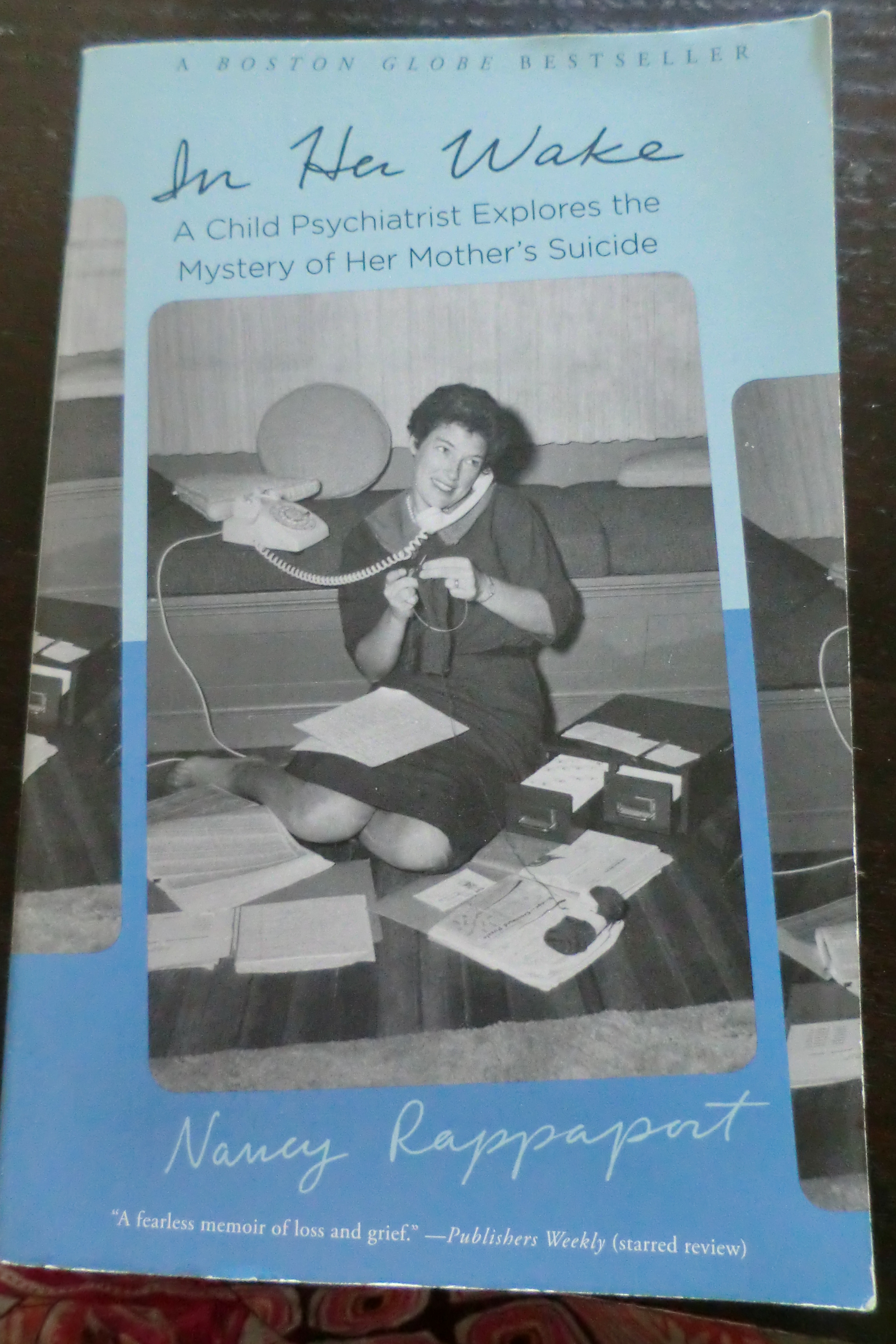
In Her Wake, Nancy Rappaport – exploring the mystery of a mother’s suicide #memoir

In 1963, Nancy Rappaport was 4 years old and the youngest of six children when her mother, an ambitious woman who balanced raising a large family, organising regular society events and political campaigning, committed suicide in the wake of a heart-wrenching custody battle.

Nancy now has three grown children of her own and has written this book both as a daughter needing to find answers and as a professional child psychiatrist, bringing together her education, experience, the wisdom of years and a compassionate perspective to narrate this compelling memoir of an extraordinary life whose end was sad and tragic.

From a childhood in which the nurturing love of a mother was ruptured so abruptly, through adolescence and early adulthood where the subject of her mother appears to have been taboo, it is extraordinary and something of a blessed gift that Nancy comes across a trunk of belongings that has virtually been in hiding or at best forgotten all these years. It is a credit to her father and stepmother that it wasn’t destroyed and so Nancy in her quest to know her mother better, gains access to lists, notes, notebooks, a journal and astonishingly, the manuscript of a complete novel. At last, she begins to gain a first-hand insight into who her mother really was, aside from all that had been written publicly and most importantly she begins to piece together how her mother was thinking in the time leading up to her death.

Rappaport follows leads like a master sleuth hesitating to question herself only briefly in pursuing her mother’s former lover, an estranged best friend and a former confidante of her grandmother, to unearth as much information surrounding the events of that period during her parents’ marriage and subsequent divorce. Little by little, she draws back the carefully drawn veil of secrecy, though not entirely without getting her fingers burnt.

It’s tempting to search for the villain and it could be said that each of the main characters in this true story are tried out and tested in that role, but none endure. Such is the faculty of being human, perhaps we all have the potential if pushed sufficiently but here we find few heroes or villains, just victims, bystanders and those trying to do their best under the circumstances.

It is a bold move to publish a family story when so many are touched by past events and family ties remain tenuous. Nancy suffers the expected consequences to a certain extent though she tries to navigate her way with compassion and empathy as much as she can. It’s a difficult and interesting topic, to write a version of the truth that recalls the faded memories of real life characters, while respecting those who wish to remain silent.

In my reading of this courageous memoir, some of the lessons come not from digging in the past or even from the professional perspective, but from Nancy’s own children, who are a constant reminder of the present that we live in and the role and responsibility of a mother to her children, doing her best, learning as she goes, loving them above all so that they have the best chance to be loving, caring and successful people themselves and that no matter what anyone says or does or whatever the circumstances, a mother will maintain that role whether she is fulltime, part time, at a distance or just a faded memory.

Why People Don’t Read Short Stories

Publishers have difficulty persuading readers to buy short story collections.  Many readers love them, but more readers avoid them, preferring the novel.  Why is this?  Fiction writer Tessa Hadley suggests it is because in our culture, readers have grown used to the habit of the novel, we can pick up a novel and put it down time after time, when it opens we re-enter its world, escaping our own for a while.  There’s something discontinuous about our reading relationship with short stories.  At the end of each story we are thrown out of that world created by the chosen words of the author enhanced by our imagination, back into our surroundings without leaving a thread; we then enter another story and begin to build a new picture of characters, place and situations.

Reflecting on this now, I wonder if that is why I liked Alice Hoffman’s ‘Blackbird House’ so much, because of the subtle connection between the stories which kept me wanting to go back for more.  Or was it the writer’s style? I love this book, a unique set of short stories that traces the lives of various occupants of an old Massachusetts house over a span of 200 years, witnessing change in each family through their loved ones and the lives they live inside Blackbird House.

I like reading short stories, especially in between reading novels or other more lengthy works of non-fiction.  There are some short stories in particular that I adore, like the Italian writer Italo Calvino’s ‘The Enchanted Garden’ from his collection of short stories ‘Difficult Loves’.  Giovannino and Serenella discover an opening in a hedge leading them into a quiet garden of flower beds, eucalyptus trees and gravel paths, it’s like a mini version of Frances Hodgson Burnett’s ‘The Secret Garden, still a favourite today.  And then there’s A.S.Byatt’sStone Woman’ from her ‘Little Black Book of Stories’ the haunting tale of a woman witnessing her own gradual metamorphosis into stone; befriending an Icelandic stone carver she returns to East Iceland, the place that will become her final resting place.

Mini-gateaux, Bechard, Aix en Provence by Maki

For me, an avid reader, short stories are like the contents  of extravagant chocolate boxes or the pick n mix gâteaux at Béchard on the Cours Mirabeau here in Aix en Provence.  When I’m into reading short stories, I don’t just take one collection, I take three or four and then read a story or two from each collection, so I sample more than one writer at a time.

Why do I do this?  Well firstly, because for me short story collections are like ‘1001 Nights’, I don’t want the collections to end, so I slow down the process to savour the stories.  Secondly, I like to sample writers from different countries, so today I might read from Nigerian writer Ben Okri’s collection Stars of the New Curfew’ set in the teeming street of Lagos, or ‘Sandpiper’ Egyptian writer Adhaf Soueif’s collection about women finding themselves in countries other than their own, where language, culture and love create confusion.

The collection I have now remind me that I love to travel through books both to foreign destinations and through the minds of writers from different countries and cultures as well as returning to the familiar vernacular of my country of birth.

In addition to those mentioned I might dip into Elliot Perlman’s (Australian) ‘the reasons I won’t be coming’, Alice Munro’s (Canadian) ‘Friend of my Youth’; Janet Frame’s ‘The Lagoon’, Keri Hulme’s ‘Stonefishand ‘The Stories of Frank Sargeson’ (New Zealand writers), Indian writer Chitra Banerjee Divakaruni’s ‘Arranged Marriage’ and Jhumpa Lahiri’s ‘Unaccustomed Earth’ or Raymond Carver’s ‘What we talk about when we talk about love’ which reminds me I want to read the Japanese writer Haruki Murikami’s ‘What I talk about when I talk about running’. Then there are the slim classics Dubliners’ by James Joyce who needs no introduction and Grace Paley’s ‘The Little Disturbances of Man’.  And I’m happy to say, I’ve almost managed not to finish any of them – except Hoffmann’s ‘Blackbird House’ which reviewers describe as “not quite a novel and not quite a short story collection’ so I guess that one doesn’t count.  And I plan to read it again anyway.

In this time pressed world, one would think that short story collections are poised for a revival; after all, what better antidote for the tired, overworked individual who remembers nostalgically the enjoyment they used to get from a good book – short stories are perfect!

As writer Jonathan Falla said “Good stories are not literary fast food, made on the cheap; they are intense with a flavour that expands to fill the mind.”  The short story allows us in a short space of time to understand and consider momentous things, grand dilemmas.  Short stories pull us into their world and shake us up.

Do you read short stories?  What’s your favourite collection?

www.theshortstory.org.uk

http://www.americanshortfiction.org/

The Lacuna by Barbara Kingsolver

‘Lacuna.’

I love it when a book introduces a new word and uses it sufficiently that you know it’s not fleeting knowledge, something you know for a day and have difficulty recalling a week later.  When that new word is the title of the book, there’s a pretty good chance you will remember it.

Deep water soloA ‘lucuna’ is a space or a void, a deep underwater cave, something hidden, unknown; already we see its metaphorical potential and Barbara Kingsolver puts it to good use in this excellent novel which intertwines the fictional story of 12 year old Shepherd, through historical events of Mexico and the US in the 1930’s and 40’s, including time spent in the household of Diego Rivera and Frida Kahlo and their controversial houseguest Leon Trotsky.

A fan of the film ‘Frida’ beautifully depicted by , I’d met these characters on screen and found them good company in Kingsolver’s story of Shepherd whose socially aspiring Mexican mother ditches her emotionally cool civil servant husband to return to “Isla Pixol” an island off the coast of Mexico.

Shepherd’s skills learned in the kitchen of his island home lead him to mixing plaster for Diego Rivera’s murals “It’s like making dough for pan dulce” where he joins the household as cook and typist for Rivera, his artist wife, Frida Kahlo, and later for their guest, the exiled Communist leader Trotsky.

In this incendiary, revolutionary household, Shepherd listens and observes as egos roar and quake. Baking all day, he records the dramas of this entourage by night, along with his first novel, an epic of the Aztec empire.  In 1940, when Trotsky is assassinated, Shepherd leaves Mexico, spooked by newspaper articles denouncing his employers and friends.

The story unfolds through Shepherd’s diaries and letters as well as actual newspaper cuttings that reflect the selectively reported half-truths and lies used to justify hatred towards “them”: first the fascists, then the Reds.  And it seems anyone can become one of “them.”

Media madness and political upheaval follow,  then Violet arrives in Shepherd’s life to help record his stories.  She chances across a new gap – a long-vanished diary, Shepherd’s excuse for not finishing a memoir.

The Lacuna is multi layered, beautifully written and for me a joy to read.  Though some have struggled to get into it, I recommend you persevere and partake in this extraordinary journey through wonderfully depicted characters, and the conscious landscapes of Kingsolver’s world.

An Ode to Love or a Dear John?

Now that I have taken the bold step to create a blog, I guess it should come as no surprise that I am subsequently contacted out of the blue by a new author who has asked me to review her book, ‘Seven Days to Tell You’ due for publication on June 1st 2011.  So here it is and thanks again Ruby.

‘Seven Days to Tell You’ could be renamed ‘Seven Days to Figure It Out’ except that it is sure to take less than seven days to read because once you start, this book has a way of hooking you in and stirring your curiosity in an unputdownable kind of way.  It shifts and changes in time and point of view, keeping you wondering and guessing through its many twists and turns.

 Ruby Soames first novel succeeded the vote of bookclub readers whose opinion influences which novels are chosen for publication by Hookline Books and I can see why this riveting, page turning novel was enjoyed by so many and undoubtedly hotly discussed.

Kate is a paediatric doctor not given to wild, spontaneous acts, so surprises some and generates envy in others when she marries the wild, charming and mysterious Marc, a Frenchman she meets during a brief encounter at the end of an otherwise disappointing holiday.  She appears to have proven the doubters wrong, until one day three years into their marriage, Marc disappears without trace.

After three fruitless years searching for him, Kate is beginning to rebuild her life when she wakes one morning to find the familiar form of her errant husband in bed beside her.  He asks for seven days to prove his love, seven days to spend together before she makes her inevitable decision.

Soames doesn’t give anything away and is adept in her use of the unusual second person viewpoint in much of the narrative, which makes reading her story a little like reading a private letter or prying into someone’s journal; it’s not written to you the reader, it addresses Marc and like eavesdropping on a conversation, you find yourself trying to fill in the gaps to figure out what’s not being said.  It is only through the more reliable interactions with other characters that the truth begins to emerge. 

Often unpredictable, you will want to discuss this book and the relationship it describes with your friends, the intrigue it arouses continues long after the last page is turned.

Josephine Bonaparte’s Miraculous Life & Words from a Pioneer Woman

Joesphine Bonaparte

Historical fiction doesn’t usually sit on my reading pile, but ‘word of mouth’ great books certainly do and it is due to the latter that I found myself recently devouring not just one but two historical fiction trilogies.

‘These is My Words’ is inspired by author Nancy Turner’s family memoirs of her great grandmother Sarah Prine, an astonishing, wilful and unforgettable pioneering woman who seeks a living in the harsh, untamed lands of the Arizona Territory circa late 1800’s.  She encounters love too briefly and loss too often, wrestles against nature’s wrath and must deal with unpredictable neighbours.  From the oral tales of her great-grandmother Turner has created three volumes which recount the trials and triumphs of Sarah Prine’s memorable life, reminding us of the oft forgotten dreams, challenges and incredible tales of survival of those who came before us.

So ‘Sarah Prine’ is finished but the experience of one courageous woman left a taste for more, so after reading a chance review we (my book buddy and I) decide on the Josephine B trilogy.  Here was a chance to read about a significant period in French history through the eyes of a woman I knew little about – and what an exceptional woman and colourful life to discover.

From humble island roots growing up on a plantation in Martinique, more familiar with village superstition than the courts and noble families of Paris; it is only the forbidden predictions of a Voodoo witchdoctor that hint at the majestic life that awaits Rose Tacher (Josephine Bonaparte).

Written as a collection of journal entries, Sandra Gulland has created a series that sweeps you through the late 1700’s and early 1800’s of Republican and Monarchist France as opinion and favourability flip flop between the two, and it appears as though no one can make up their mind whether indeed it will be a Republic, an Empire or a combination of both.

Each book is as good as, if not better than its precedent and the astonishing amount of research that went into the series and the compassion with which Gulland handles her characters leaves them well etched in your mind.

These is My Words, Sarah’s Quilt, A Star Garden by Nancy E Turner

The Many Lives & Secret Sorrows of Josephine B, Tales of Passion- Tales of Woe, The Last Great Dance on Earth by Sandra Gulland