Shadows & Wings Giveaway

Niki_Tulk_ShadowsAndWings

Niki Tulk
Author of Shadows & Wings

Thank you to author Niki Tulk for offering to provide two readers with a digital version of her debut novel Shadows & Wings.

Synopsis:

Tomas, a cellist and dreamer, denies the devastating changes happening in 1930’s Germany—until he is drafted into Hitler’s Wehrmacht. Many years later, having emigrated to Australia, he raises his granddaughter Lara to love music and birds. He also chooses to hide from her a terrible secret.

When her beloved Opa dies, 22 year-old Lara receives a shadow box of mysterious ornaments that force her to confront his past. Seeking to understand his years of silence, and to find a way through her own grief, she travels to Germany—the objects her only guide.

Shadows & WingsShadows & Wings is a novel of cyclic journeys between hemispheres, the connections between ourselves and those we can never know, and the haunting power of art, love and dreams.

*

If you haven’t seen my review, click here to read it.

If you would like to be in the draw for one of the two digital copies, please leave a comment below.

The draw closes on Saturday 4th May.

Five Favourite Fiction Reads

I recall stumbling across Chalk the Sun and reading many of the posts, Julie had read many books I loved and many more that I aspired to read. The first review I read there was The Buddha in the Attic, the first time I had heard of both the book and its author Julie Otsuka. Since then, I have been an avid follower of Chalk the Sun. Not only is Julie a talented, observant, evocative writer and reader, she is working on her own book set in France, which many of us are waiting to read!
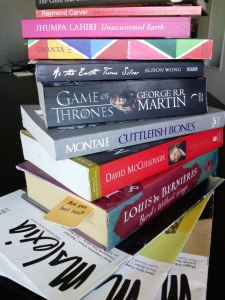
Photo0650Julie tagged me in the Five Favourite Reads challenge, a near impossible task, so I will share 5 favourites that come to mind spontaneously.

Kimberly, a Bostonian writer living in Rome, also nominated me in the Happy Booker Alternative Book Award and since she’s stretched the rules to choose outside the 2012-2013 year, I’m going to combine these two awards and exercise freedom in choosing.

Whenever I visit Kimberly’s blog, she’s either reading, visiting a European city (known to be inspired to write a short story as a result), winning prizes for those excellent short stories, or planning to go to the Women’s Fiction Festival in Matera, Italy. This is a blog to linger in and be inspired by.

Thanks also to writer Deborah Brasket of Living on the Edge of the World for nominating this blog for the Inspiring blog Award and to Red Headed Stitcher who has nominated me in the past for the Sisterhood of Bloggers award and more recently the Liebster Award. I’m not too good at participating in awards, but thank you to all those who passed them on to me, I appreciate every gesture.

First, five out of too many bloggers whose posts I look forward to reading, whose exchanges I appreciate and whose favourite books I’d love to know (no obligation though):

Five Great Blogs

ReadEng Didi’s Press – lives and works in the north of France, loves books and the English language, sound familiar?

Three Hundred Sixty Five – it’s an ambitious challenge guaranteed to improve your writing skills and Fransi is doing it, I’m reading it in awe.

JoV’s Book Pyramid – reading around the world, across genre, an eclectic collection of book gems to be found here.

PB Writes – poet, writer doing the NaMeSitDifStarDaiWri(expletive)Po check her out and be inspired, I was, I wrote 2 poems this week, first in 2 years!

Books Can Save a Life – thoughts on books and how they make us who we are, with an emphasis on the personally meaningful.

My Five Great Fiction Reads
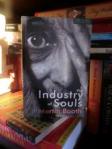
010413_1256_TheIndustry1.jpgThe Industry of Souls, Martin Booth My first read on 2013 was a reread one of my all-time favourite books and one that has stayed with me over the years and stood the test of time. He wrote one other novel Islands of Silence which I also loved and a memoir which I have still to read, Gweilo: Memories Of A Hong Kong Childhood. Sadly, he died in 2004 just after finishing this memoir. My recent review here.
Astonishing GodsAstonishing the Gods, Ben Okri This was a real favourite from my twenties, when life was full of indecision and anything was possible. I love a good fable and this small volume was a surprise read after struggling through Okri’s more infamous, head spinning work The Famished Road.
Birds Without WingsBirds Without Wings, Louis de Bernières When this book was published Loius de Bernières had not published a book for 10 years, so it arrived amidst significant intrigue. He is something of a hit or miss author, Captain Corelli’s Mandolin was a word of mouth sensation, even if was a struggle to get into, however this is his masterpiece. Birds without Wings is a book to read slowly and savour each word, each character, each facet of that tragic and bitter struggle between the Greeks and the Turks during the collapse of the Ottoman Empire. Epic and profoundly humane.
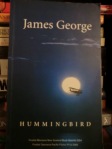
HummingbirdHummingbird, James George In 2006, three New Zealand writer’s, Elisabeth Knox, James George and Vincent O’Sullivan visited Aix-en-Provence and I listened to them read. I had read Knox’s Vintner’s Luck, I knew of Vincent O’Sullivan’s work, but wasn’t familiar with James George. He read from his book Hummingbird and I was entranced. Just those few pages and I knew it was a book I had to read.

Three strangers arrive at a camping ground on a part of the barren, isolated Ninety Mile Beach. They are a former prostitute, a young man just released from prison, and a retired Cambridge don, former Battle of Britain pilot and veteran of the Battle of Crete. Slowly we learn their stories as the author examines their past, lost souls who find solace in this endless sea, sand and sky. It is an incredibly moving, lyrical work from a little known but exceptionally talented writer and poet.
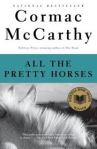
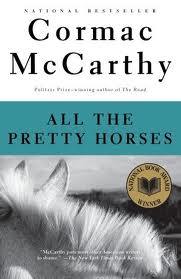
all the pretty horsesAll the Pretty Horses, Cormac McCarthy I picked this up in the library, not realising it was the first in The Border Trilogy, and what a thrill it was to discover that McCarthy, though bleak in his subject writes such pure, lyrical prose.

This coming of age novel and it’s sequel The Crossing are something of the best a book can offer someone like me, a great story, exceptional visual writing, inspiring awe. It’s like unlocking another door to that mystery of what makes us tick, it remains something of a mystery true, but I know that Cormac McCarthy’s way of expressing and describing in words is one of my keys.

So, what are the first books that spontaneously come to mind as your favourites?

Ignorance

It was the book I read following Michéle Robert’s novel Ignorance that gave me something to reflect on regarding the meaning of that loaded word she uses as her title.

In Maya Angelou’s latest autobiography Mom & Me & Mom (review pending), she speaks of ignorance and quotes her mother:

She said, “Ignorance is a terrible thing. It causes families to lose their centre and causes people to lose their control. Ignorance knows no binds. Old people, young people, middle-aged, black, white can all be ignorant .

An apt epigram for this war-time novel set in occupied France.

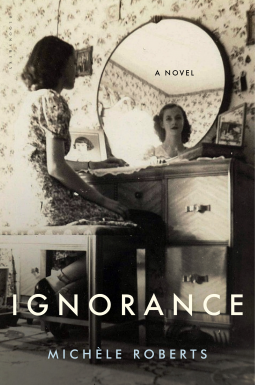
IgnoranceTwo young girls from a rural village are sent briefly to live in a local convent, Marie Angèle because her mother is about to have a baby and Jeanne, because her mother is unwell and in hospital. Marie Angle is the daughter of local middle class grocers, Catholic and raised with something of a sense of entitlement and superiority over her lesser friend Jeanne, whose mother, a widow converted to Catholicism when she married, but lives in a community that rarely allows her to forget her Jewish past. Marie Angèle expects to inherit half of her parent’s shop, she expects that the well-connected young Maurice, the man who can obtain anything during wartime will do the right thing by her.

I could hide my ignorance most of the time, because if he felt like talking he just wanted me to listen. One day, however, parked in the woods, he said : talk to me….I left Jeanne out of these tales. We’d been thrown together as children, purely by accident, we’d had a sort of friendship for a certain time, but we couldn’t mix now. I preferred to concentrate on positive things. That was how we were getting through the war.

Jeanne rarely thinks of her friend, she knows she is loved by her mother, observes their second class status in the way the nuns treat her compared to her friend, their quickness to judge and to listen to gossip as if it were fact. She is not ignorant of the activities that take place in the house where she works, but she like her mother is realistic about her opportunities, she doesn’t allow herself willingly to be taken advantage of, she learns from her past, though it will be insufficient to save her from the consequences of the misguided morals of her childhood friend.

Marie Angèle however, believes  that Jeanne, by working in such an establishment has thus become one of them, a common tart, she believes the village gossip, judges her former friend’s improved dress and appearance.  She portrays her own husband as a man unrecognisable as the same man Jeanne describes as one of the clients of that establishment. Even when confronted with an inkling of this truth, the wife’s inclination is not to question her husband, but to seek revenge against the bearer of the message, a penance that will continue to be paid into the next generation, as Marie Angèle manipulates control of Jeanne’s daughter Andrée and both their futures.

Womens prize logoThe novel is split into sections which view life in overlapping time periods from the perspectives of the two girls which couldn’t be more different, in particular on the part of Marie Angèle concerning not just her friend, but the plight of other families that must go into hiding. Towards the end there is also a section given to Andrée, Jeanne’s daughter and another from Dolly, one of the nuns, complicit in an act of betrayal.

The simple narrative structure exposes the ruinous attitudes, religious hypocrisy and shamelessly uninformed  morality of the ignorant and how it continues to be perpetuated by gossip, fed by jealousy and fueled by ill intention. It reveals that destructive instinct humanity sometimes imposes on the weak and those who are different from the rest. Devastating.

Ignorance is on the long list for the Women’s Prize for Fiction 2013. The short list will be announced on April 16. Will this title be on it I wonder?

Note:  This book was an Advance Reader Copy (ARC) provided by the publisher via NetGalley.

NW, life’s passage via the Kilburn High Road

The back cover of Zadie Smith’s novel NW, recently long-listed for the Women’s Prize for Fiction 2013 mentions This Is The Story Of A City, the north-west corner of city, however that’s not how I think of it. London is something else, as is The City of London.

NW is a community, a fluid changing community, one of London’s many pulses; for some it is a stepping stone to the next stage, for others it is home. It has been a thoroughfare into London since the days of the Romans and in more recent times, the resting place for Irish immigrants fleeing their country for one reason or another, sometimes dramatic, sometimes not. And following the Irish are the many other groups who found NW their starting point to a life in London, that city of promise and unending challenge. NW is the same, the faces that pass through it, indicative of the era we are living within.

NWNW the novel is experimental, its structure changes with each section and after starting the second part which focuses on Felix, I realised that the narrative voice was being used as a metaphor for the state of mind of the character, a brave step or a risk on the authors part by commencing with Leah, who thoughts are all over the place and is suffering from that anxiety of a young, married woman with a successful career and a husband who loves her, who doesn’t understand why she is not content, or why she can’t admit that she isn’t ready to start a family.

So we start with the staccato stream of conscious thoughts of a woman who would benefit from therapy and/or meditation to still that rampant inner chatter, planting the reader in the midst of prose that is challenging for some and uneasy for those listening to the audio version. Not when chapter 7 is shaped like a tree, though that is one of the least challenging pages, one of beauty in fact.

But once we get to Felix’s section, things calm down, Felix’s major life troubles are behind him, the reading is easy and the pace picks up.  Although he’s not entirely immune to temptation, he seems to have moved on from his more despondent days, he’s been clean for 2 years and plans to stay that way. To me, he is the only character who shows real signs of moving on, however he has not moved out of NW,  his mistake perhaps is in staying and trying to convert those around him.

The other female character Keisha, changes her name to Natalie when she becomes a lawyer, an attempt to outgrow her past; she marries and has two children. She and Leah have been friends since their school days and their connection provides the one strong thread throughout the novel. Natalie, like Leah has risen above her past, but can’t seem to resist undermining it, with her strange behaviour, in what was for me, one of the least believable parts of the novel, in part because the author keeps us from knowing exactly what Natalie is up to online and offline, before she gets caught and flips out. I was hoping she might be more influenced by the role model of  Theodora Lewis-Lane, who tries to advise her.

“The first lesson is: turn yourself down. One notch. Two. Because this is not neutral.”  She passed a hand over her neat frame from her head to her lap, like a scanner. “This is never neutral.”

NW6For me personally, it was in part a nostalgic read, Zadie Smith’s writing comes alive when she evokes place and it is a neighbourhood I lived in and around for many years, NW is the most complete and yet complex character of all, embracing so much diversity, inviting everyone in without prejudice and yet claiming some in the harshest terms possible. There are as many reasons to hate it as there are to love it and anyone who has lived there will likely never forget it.

NW is a melancholic novel about four characters trying to escape their past and leaves the reader with few signs of hope for the future, or at least that future is left for us to imagine. Those who focus on the uniqueness of the writing or who have some experience of /interest in these communities may enjoy it, while those looking for the traditional transformation of character, or any kind of escape may be disappointed.

Despondency is the norm and we will not be rescued from it, it merely lessens with time if we survive.

Canada by Richard Ford

A recommendation from my like-minded, book loving Aunt, I was fortunate to pick this up at our library, a wonderful facility, though only a few bookshelves dedicated to works in English, so to find a recently published book was a real find.

Bibliotheque Mejanes, Our Library in Aix-en-Provence

Bibliothèque Méjanes,
The Entrance to our Library in Aix-en-Provence

Richard Ford is a familiar name for many, a Pulitzer prize-winning author for his book Independence Day, however he is an author I was not thus far acquainted with.

Canada is a coming of age novel written from the perspective of Dell, a 15-year-old twin, whose sister Bernie is on the verge of asserting her independence, something she is ready to do, unlike Dell, who is more of a ‘wait and see’ type of individual, though even this more submissive attitude doesn’t occur without serious consideration of all the alternatives. Regardless of whether he is ever likely to pursue those thoughts, he considers them before watching them pass, pondering how they may have changed the course of events, though rarely if ever acting on them.

The course of these siblings’ ordinary lives is altered drastically when their father, aided by their mother, decides to rob a bank to pay a supplier when his middleman status finds him stuck in between having delivered the goods and not having been paid as agreed.

The first part of the book is Dell’s recollection of the events of those weeks surrounding ‘the event that would change their lives’ with a little of the wisdom of hindsight and the knowledge he has gained from subsequently reading his mother’s journal (fifty years later).

Saskatchewan Ghost Town by R Smith @ominocity

Saskatchewan Ghost Town by R Smith @ominocity

In Part Two, Dell is at the mercy of his mother’s plan for the children to go to Canada, while the parents are in prison, only Dell departs alone; he believes he is going to stay with the brother of his mother’s friend Mildred and so begins his life ‘after the event that changed his life’.

No longer attending school, he assists a man named Charley with preparations for goose hunting and cleaning rooms at the hotel owned by Mildred’s brother, while living in an almost ghost town somewhere in Saskatchewan.

Richard Ford is an adept writer, a straight forward storyteller and reading his work reminds me a little of Jonathan Franzen’s way of writing. His use of language is plain, spare and as a consequence there are few sentences or paragraphs that I have highlighted, few metaphors, except perhaps the title, though perhaps being one word it is more of a symbol than a metaphor. Canada is the frontier, another country, another life, another citizen.

Canada1While he doesn’t coat his words with poetic language, Ford in the literary tradition, delves deep into the mind and thoughts of his protagonist, sharing events in a stream of consciousness narration. Dell methodically dissects everything that happens around him referencing the recent past in relation to what happens, the things he may have realised with hindsight but didn’t. It is a psychological journey into the mind of a 15-year-old sharing thoughts of himself and others around him leading up to and during those two events that changed everything.

I can’t make what follows next seem reasonable or logical, based on what anyone would believe they knew about the world. However, as Arthur Remlinger said, I was the son of bank robbers and desperadoes, which was his way of reminding me that no matter the evidence of your life, or who you believe you are, or what you’re willing to take credit for or draw your vital strength and pride from–anything at all can follow anything at all.

As such, not much happens, but the storytelling remains compelling, as he comes to understand the motivations of those around him and who they really are, preparing himself for what they are about to do. In the first part the bank robbery, preparing him for what will happen when he crosses the frontier.

The more we read, the more we come to understand what our preferences are, what we adore, what we find difficult to tolerate and as a result it could be said our reading narrows with age, because we come to know ourselves and our inclinations better, we become a better judge of whether a book is likely to meet that desire or not. That is one of the reasons a book-club can be so interesting, often forcing us to read outside our comfort zone and showing us the many responses to the same book, all equally valid. I know I don’t just read for pleasure, I am often curious to read outside my preferred style of book, and across cultures and language not wishing to be limited to only that which is written in the English language or tradition.

I enjoyed Richard Ford’s Canada and look forward to reading more of his work.

Life after Life after Life…

It was suggested to Kate Atkinson, that the above might be a more apt title for her book, as the lives relived by the protagonist Ursula in Life After Life are many. In this book, the author has written something unlike anything that precedes it, a return perhaps to the kind of books she was writing before she started on her crime series featuring the fictional detective Jackson Brodie.

life after lifeLife After Life presents numerous versions of Ursula’s life story, a life whose course sometimes changes when her response to an event or an encounter is different to how she responded previously. It is not a conscious change, although she does possess a sense of déjà vu at times, however she is more propelled by instinct than any knowledge of having already lived, or perhaps she is responding to the ever strengthening morphic fields (see link below), that ability to tap into our own and the collective consciousness of remembered events, that link across time between the past and the present, which inevitably become stronger in someone who keeps returning, preparing them for future events.

The story begins (or does it end?) in 1930 before going back to her birth in February 1910. Her earliest lives pass quickly, birth at that time being as traumatic as, if not more difficult to survive than war. When the doctor can make it through the snowstorm and unwrap the umbilical cord from around her neck, she will have a better chance of surviving.

St Paul's during the Blitz

St Paul’s during the Blitz

Ursula’s story for its many stops when darkness falls and restarts, takes place predominantly between 1910 and 1941 in England and Germany, with much of the narration taking place during the war, in particular the 57 consecutive nights of bombardment in London from September 1940, “the blitz”, when more than one million homes were destroyed and over 40,000 civilians killed with many more injured.

There are significant turning points in her adolescence connected with the lecherous friend of her brother and a passing stranger with insidious intent, otherwise she makes it to an independent life in London during the second world war in scenes that Atkinson brings alive in unimaginable ways, a city where nowhere is safe from the nightly bombs that will fall, their paths of destruction unpredictable, those who survive, forever changed by that traumatic experience.

WWII_London_Blitz_East_LondonIn the same way that one never knows which choices will lead to life and which to certain death as bombs rain down on London, so too as readers, do we turn each page with similar trepidation, never quite sure when darkness may fall again and our story begin over. Unpredictable, because subsequent experiences don’t necessarily guarantee a longer life, Life After Life has a simple structure, yet leaves the reader aware of the countless possibilities that could manifest.

The BBC interviewer asked a question I had been pondering, suggesting that for a writer, there are numerous outcomes possible when plotting a story and in a sense this book is like stringing together several drafts, however Atkinson says that although you could consider it like that, it is not her method to write like that, it seems that she set out with this structure in mind, that she always knew how it was going to end, although I am unsure whether this story can ever end, you can see how it might go on forever.

BlitzaftermathThe appeal of the story for me is intricately tied to that structure and in fact I find it hard to think only about the story itself, which begs the question, which version of the story is the story? This is not a typical tale of transformation of a protagonist, while we recognise Ursula’s character in the many lives she lives, the story shows just how different our lives could become, based on even insignificant choices we make as well as the random events that can interrupt that path and change its course indelibly.

Life After Life is also a turning point for Kate Atkinson who says she won’t be writing another Jackson Brodie novel for a very long time, having felt some relief at being set free from the intricate plotting involved in crime writing and enjoyed getting back to just writing. She mentioned two possibilities for her next novel, either a companion novel to this one about Ursula’s younger brother Teddy, called A God in Ruins, or an homage to Agatha Christie, about a group of people stranded in a countryside hotel in a snowstorm during a murder mystery weekend called Death at the Side of the Rook.

It is clear that Kate Atkinson refuses to be bound by genre, labels or form, preferring freedom in her approach, she resists categorisation which makes her an exciting and unpredictable writer, even if she risks occasionally losing her readers as she embarks on a course to suit her own writerly desire and imagination and not the expectations of any particular audience. That I truly admire.

So let’s see how the judges of the Women’s Prize for Fiction 2013 respond, this title having just made the long list.

Additional Resources

Morphic Fields & Morphic Resonance – Rupert Sheldrake interviewed by Mark Leviton in The Sun Literature Magazine Feb 2013

Interview – Meet the Author – Nick Higham of the BBC speaks to Kate Atkinson.

Note: This book was an Advance Reader Copy (ARC) provided by the publisher via NetGalley.

The Unlikely Pilgrimage of Harold Fry by Rachel Joyce

627 miles in 87 days

There is something appealing about the idea of making a pilgrimage and reading about it is almost as satisfying on another level, even when the pilgrim in question doesn’t know that is what he is doing.

Unlikely Pilgrimage

Harold Fry was not prepared for a pilgrimage at all, he was on his way to post a letter, a note written in haste that the closer he came to the post-box, the less satisfied he was with what he had composed, as if the letter had somehow come to represent all that he had achieved with his life – showing him up as incapable of stringing together the appropriate words that might express the sentiment he wished to convey – while harbouring his mild but growing discontent, he continues on to the next post-box and then the next and then one thing lead to another…

Harold’s letter is a reply to Queenie Hennessy, an ex-colleague whom he hasn’t seen since the day she disappeared from work, a disappearance that is in some way connected to Harold.  Queenie’s short letter informs Harold of her illness, he learns she is lying in a hospice in Berwick-upon-Tweed, in the very northern tip of England, about as far from Kingsbridge, South Devon as one could possibly be.

The walk to the post-box and an encounter with a young shop assistant in a garage prove to be the tipping point for Harold, he sets off to Berwick, convinced that by making his pilgrimage, he might save Queenie from certain death.

Harolds journey
Harolds journey up England

Harold is propelled by instinct, an urgency to make some kind of difference and as his feet carry him North, little by little he comes to understand the significance of his undertaking, as the layers of his self-protective habits built up over the years, peel away at a similar rate to the soles of his shabby yachting shoes, until eventually even words are no longer required to explain; his purpose and inspiration shine out of him, attracting followers and making him almost unrecognisable to the woman he has lived with for the past forty years, his wife Maureen.

Harold believed his journey was truly beginning. He had thought it started the moment he decided to walk to Berwick, but he now saw that he had been naïve. Beginnings could happen more than once, or in different ways. You could think you were starting something afresh, when actually what you were doing was carrying on as before. He had faced his shortcomings and overcome them, and so the real business of was walking was happening only now.

Rachel Joyce’s debut novel was short-listed for the Booker Prize, however it would be wrong to think of her as a novice writer and as the back pages inform us, she has written over twenty original afternoon plays for BBC Radio 4 as well as drama adaptations to television. It is clear from the first pages that this is a confident and accomplished writer and I couldn’t help but imagine these characters already on-screen, it is as if we have seen Harold before, so much of that reserved part of his character seems so familiar, even if he does appear to fill a stereotype, however he does not remain typecast for long, yet neither does he change completely.

A very English novel, not just the landscape, it is the slow unmasking of Harold, a man who barely made a ripple in his working life, having done his best to keep unpleasant matters from being aired or making a fuss.

He had always been too English; by which he supposed he meant that he was ordinary. He lacked colour. Other people knew interesting stories, or had things to ask. He didn’t like to ask, because he didn’t like to offend. He wore a tie every day but sometimes he wondered if he was hanging on to an order or set of rules that had never really existed.

An enjoyable read, Rachel Joyce is working on a second novel, another “celebrating the ordinary, linking laughter and pain” story, she said.

Further Reading

BBC

Interview – Rachel Joyce discusses how her background writing radio plays informed the novel and how her father (to whom she dedicates the book)and others shaped the character of Harold.

Wild by Cheryl Strayed – my last review of a different kind of pilgrimage, the true story of Cheryl Wild’s hike of the Pacific Crest Trail

Note: This book was an ARC (Advance Reader Copy) provided by the publisher via NetGalley.

Honour by Elif Shafak

US edition cover

US edition cover

Elif Shafak comments in her essay on identity The Happiness of Blond People about the stereotyping or tendency of books written by or about women from the East, that they often sport covers with an image of a veiled woman.

It is something that makes her other books stand out, because they don’t do that. The Bastard of Istanbul and The Forty Rules of Love (at least the editions that I read) have enticing covers that invite you to enter another world, depicting vibrant, warm colours and referencing stunning forms of Eastern architecture, curves, arabesques, spires and sparkling elements.

When I first spied the UK cover of her new book Honour I thought ‘Oh no’, not one of those books – I was disappointed as it looked like it belonged to that genre, the misery tale of a woman’s lot in a society where the veil is used as a symbol of varying degrees of oppression. That was before I read and reviewed the essay I refer to above, in which she cites those books with similar disdain.

It was some comfort to see that the US edition has nothing like that cover, preferring the safe symbolism of the open arches, inviting us in to take a look within its pages, no veils, no dark colours, no fear, no buying into outdated stereotypes. It would be interesting to know which cover  attracts the most readers.

Honour

UK edition cover

There is a plethora of lifestyles among Muslims, a variety of personal stories to consider; and yet only some of these stories come to the fore. They almost always happen to be the most problematic ones: we seldom hear about happy Muslims, in particular about happy Muslim women. Honour killings, female circumcision, child brides, the veil, gender segregation, lack of freedom… Gender is the number-one topic where the so-called Clash of Civilisations is manifest and crystallized. It is no coincidence that a considerable number of books related to Islam have female images on their covers, and in many, if not most cases, these females appear to be sad, silenced, secluded or suffering. Women with their mouths covered, or eyes peeking out from behind their hijab, or heads bowed miserably down… Elif Shafak, The Happiness of Blond People

Book covers aside, this is a very credible story, one that many women who have uprooted their lives and brought up or given birth to children in a foreign culture may relate to. Narrated by her daughter Esma, the story centres around the life of Pembe, identical twin to Jamila and one of eight educated daughters of a family raised in a Kurdish village, the desire and constant striving for a son eventually taking the mother in childbirth.

Life here is a precarious path for young woman, where one wrong step can easily lead to condemnation. One of the twins dreams of a life far away, the other seeks to learn from those around her, from nature and experimentation. Love is the sacrifice that will enable them to attain their so-called dreams.

Their adult lives are lived far from each other, Jamila becoming a renowned village midwife and Pembe, fulfils that desire to live elsewhere, travelling further than she ever dreams, her husband Adem, from Istanbul, brings her to live in East London where they will raise their three children Iskander, Esma and Yunis.

To her the future was a land of promises. She had not been there yet, but she trusted it to be bright and beautiful. It was a place of infinite potential, a mosaic of shifting tiles, now in a seamless order, now in mild disarray, for ever re-creating itself.

To him the past was a shrine. Reliable, solid, unchanging and, above all, enduring. It provided insight into the beginning of everything; it gave him a sense of centre, coherence and continuity.

Through the story, which alternates between 1940’s Kurdistan and 1970’s London, we come to know each of these family members and begin to understand how their individual and collective experiences has moulded them, Pembe and Jamila in their traditional village with its elders, family, traditions, superstitions; Adem with an alcoholic father and angst-ridden mother who eventually abandons her children, unable to cope with the Jeckyll and Hyde character of her husband. Each has been in some way touched by the repercussions of a ‘loss of honour’.

Iskander is raised in London with memories of his early life elsewhere, carrying memories of disappointment like molten rock deep within. He is sensitive to a vibe between his parents he doesn’t understand, something that makes him want to act. When his father leaves home and it becomes clear that his mother is moving on, the pressure of that molten rock within him causes him to explode.

RumiHonour touches on many great themes and then excels in sharing all the familial details, the interactions between its characters, the people and culture around them, to the point where we identify with each character as we spend time seeing things from their perspective and then experience a sense of anxiety knowing that these perspectives are likely to clash and the outcome will not be good.

And then there is Zeeshan, a character who arrives unexpectedly, but one I recognise instantly, knowing of Shafak’s interest in Sufism and the work of the 13th century poet and philosopher Rumi; Zeeshan is a gift and offers a lifeline to Iskender representing hope.

Elif Shafak is a writer with an interesting perspective, as she herself says, she has one foot in Istanbul and the other travels and makes connections in cities around the world.

Writing that crosses cultures and observes characters doing the same invokes a sense of empathy, she is a writer whose work I will be following and whose city I look forward to visiting in May this year.

Elif Shafak speaking in Sophia, Bulgaria Photo courtesy of Tayna Tzvetkova

Elif Shafak speaking in Sophia, Bulgaria
Photo courtesy of Rayna Tzvetkova

Note: This book was an Advance Reader Copy (ARC) provided by the publisher via NetGalley.

Elizabeth and her German Garden, Elizabeth von Arnim

Elizabeth von ArminStaying overnight with friends in England just before Christmas, this book by Elizabeth von Arnim was placed on my bedside table and though there was no chance I would finish it, I was captivated and charmed by Elizabeth’s garden right from those first few pages.

May 7th – I love my garden. I am writing in it now in the late afternoon loveliness, much interrupted by the mosquitoes and the temptation to look at all the glories of the new green leaves washed half an hour ago in a cold shower. Two owls are perched near me, and are carrying on a long conversation that I enjoy as much as any warbling of nightingales. The gentleman owl says, and she answers from her tree a little way off,, beautifully assenting to and completing her lord’s remark, as becomes a properly constructed German she-owl. They say the same thing over and over again so emphatically that I think it must be something nasty about me; but I shall not let myself become frightened away by the sarcasm of owls.

I left without the book, only for it to land on my doorstep late January on my birthday, and in these cold harsh months when the comforts of a garden are not so easy to find, when I have been finding solace instead in the nature essays of Kathleen Jamie and the short stories of Tove Jansson (review to come), this novel was a welcome respite.

Elizabeth von Arnim

Elizabeth von Arnim

It is fiction, though reads very much like an autobiography and was initially published anonymously in 1898. The author (a cousin of Katherine Mansfield) is said to have been born in Sydney, in NZ and in England, I’m not sure about any of that, but her parents did leave Sydney and return to England where she was raised (while her father’s brother and family remained in New Zealand).

Katherine Mansfield

Katherine Mansfield

It seems likely that Katherine Mansfield spent time with these relations when she moved to England herself, I found one reference confirming this, a comment by the journalist (and relation of the two) Louise Ahearn, who is currently researching Elizabeth’s life and it is mentioned in the book that Katherine visited her cousin at the home she built Chateau Soleil, in Switzerland.

On a tour of Europe, while in Rome with her father when she was 23-years-old, her talented piano playing was overheard by Il Conte the German Graf Henning August von-Armin-Schlagenthin, who was travelling to help get over the death of his wife and child the previous year. After a persistent courtship they were married and soon settled into upper-class life in Berlin, where she gave birth to three girls in quick succession.

Nassenheide Schloss, the family estate by Alexander Duncker ex wikipedia

Nassenheide Schloss, the family estate by Alexander Duncker ex wikipedia

Not happy in Berlin and homesick for England, in 1896 she was introduced to the family estate Nassenheide, ninety miles north of Berlin in Pomerania. A seventeenth century-schloss, located at the time near the German border (now in Poland), it had been a convent and had not been lived in for more than 25 years, surrounded by an unkempt, rambling, derelict garden which Elizabeth immediately fell in love with. She insisted on living there and it seems she got her way (at least for the summer months), much to the chagrin of her husband, whom she affectionately refers to in the novel as the Man of Wrath.

The book captures many moments of appreciation of this unorthodox wilderness the character Elizabeth is so content within, and equal moments of candour at the annoyance of those who dare impose themselves to visit. She has difficulty keeping the gardener who often hands in his notice while she somehow convinces him to stay, until events dictate that drastic action is necessary to get rid of him.

The gardener has been here a year and has given me notice regularly on the first of every month, but up to now has been induced to stay on. On the first of this month he came as usual, and with determination written on every feature told me he intended to go in June, and that nothing should alter his decision. I don’t think he knows much about gardening, but he can at least dig and water, and some of the plants he plants grow, besides which he is the most unflaggingly industrious person I ever saw, and has the great merit of never appearing to take the faintest interest in what we do in the garden. So I have tried to keep him on, not knowing what the next one may be like, and when I asked him what he had to complain of and he replied “Nothing,” I could only conclude that he has a personal objection to me because of my eccentric preference for plants in groups rather than plants in lines. Perhaps, too, he does not like the extracts from gardening books I read to him sometimes when he is planting or sowing something new.

The author is at her best when describing her longing for the garden and the simple pleasure it brings her, though equally adept are her recounts of conversations with city ladies of her social standing, capturing their inability to comprehend that it is by her own choice that she spends so much time in this savage wilderness, they are convinced they must feel sorry for her and that she has been deposed there, belonging as they do to that breed of women who absolutely require the regular company of their peers and the invitations to social occasions, something Elizabeth does her best to avoid.

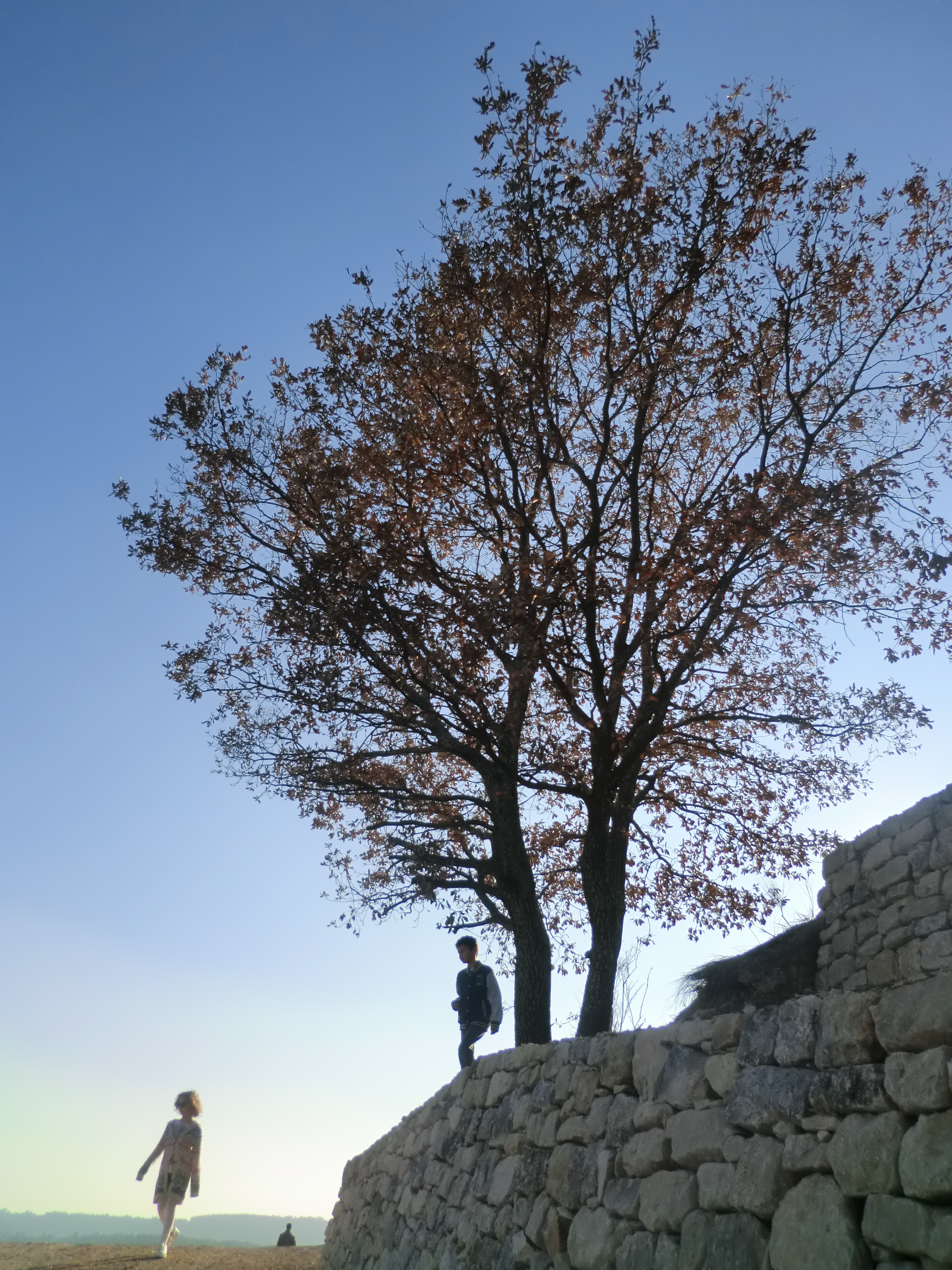
Content with the book, inspired by but lacking the garden, we instead take a drive and a stroll around a much closer abandoned ruin, appreciating its beauty among the weeds.

CIMG3742

Ruins of L’oppidum de la Quille, Puy Sainte Réparade

CIMG3751

The fading winter light of Provence, Puy Sainte Réparade

Revenge by Yoko Ogawa (Japan) – Eleven Dark Tales

RevengeWow! Those of you who have been reading this blog long enough to remember my post on Why People Don’t Read Short Stories may remember that they are something I usually savour, rarely devouring an entire collection in one sitting, but Yoko Ogawa breaks the mould and her newly published book Revenge is full of hooks and devices that stopped me putting it aside and saw me instead ploughing on to read one after the after.

Like a curious sea creature taking the glistening bait, after reading the first story, I dove into the next, caught in the deft grip of Ogawa’s clever and haunting narration, each story carrying the slimmest thread into the next, sufficient to keep the reader interested and more than that, inquisitive to continue and see what she would come up with next.

I first read Yoko Ogawa last year, attracted by her slim collection of three stories contained within The Diving Pool and then her novella The Housekeeper + The Professor, they are very different books, so I was interested in how this collection would compare.

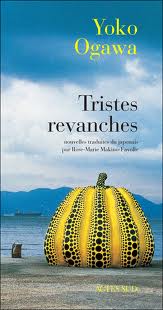
tristes revancesShe has written prolifically over the years and much of her work has been translated into French, very little thus far in English, though perhaps that will change as her short stories are increasingly appearing in contemporary English language publications. The Nobel Prize winning author Kenzaburō Ōe when speaking about her work said:

‘Yoko Ogawa is able to give expression to the most subtle workings of human psychology in prose that is gentle yet penetrating.’

Revenge is an apt title, there are traces of it in every story, calculated revenge, obsessive revenge, inexplicable revenge and cold-blooded revenge. Each story exists on its own, but I read it like a novel, not wanting to pause between titles and feeling right from the end of the first story a tightness in the solar plexus and realisation that I had been holding my breath.

It’s not just the story, it’s awe at how she can write in such an engaging way, where very little actually happens, but we begin to understand more about what is going on in the mind of the character from all the little details she gives, creating a growing image in our own minds, just before she delivers the final blow. And even when we don’t know much about a particular character, someone on the periphery perhaps, not important to the story, chances are we are about to find out more about them in the next story. And so we read on to find out if we guessed right or if she will insert some other connection.

I share this from the blurb, which encapsulates something of these stories in a more concise manner than I ever could:

An aspiring writer moves into a new apartment and discovers that her landlady has murdered her husband. Years later, the writer’s stepson reflects upon his stepmother and the strange stories she used to tell him. Meanwhile, a surgeon’s lover vows to kill him if he does not leave his wife. Before she can follow-through on her crime of passion, though, the surgeon will cross paths with another remarkable woman, a cabaret singer whose heart beats delicately outside of her body. But when the surgeon promises to repair her condition, he sparks the jealousy of another man who would like to preserve the heart in a custom tailored bag. Murderers and mourners, mothers and children, lovers and innocent bystanders—their fates converge in a darkly beautiful web that they are each powerless to escape.

Ogawa is certainly not the first writer to do this, to infuse stories with their subtle threads and connections, Alice Hoffman does it with Blackbird House, Colum McCann did it with Let The Great World Spin and I believe Cloud Atlas (which I have not read) has something that makes it too, more like vaguely connected stories than a novel.

jigsawRevenge isn’t a complicated kind of clever though, there’s no need to question or ponder too deeply over it, the links are clear, but it will leave you wondering how she does it, how she maps out those stories and creates those links. It’s like a jigsaw puzzle with multiple subjects, the letters R E V E N G E scratched across the surface.

Note: This book was an Advance Reader Copy (ARC) provided by the publisher via NetGalley.