
 Sarah has recently left journalism due to her frustration at not being able to do more than just tell a story. The forced abandonment her profession demands, the development of a journalists detachment that enables them to walk away and move on to the next story isn’t in her. She resigns.
In her confusion about what to do next Sarah decides to return to the country where she spent her early childhood, where mysteries about their time there still remain. India.
Protecting Bengal Tigers in India
She joins a tiger protection organisation in Ranthambore National Park and helps raise awareness of the issues of a community, where humans, their animals and wildlife compete for scarce resources, land and water. There is tension between those trying to protect the tigers and those trying to keep their animals alive, where water is scarce and the lake is a forbidden zone to them.
Sarah’s twin bother Marcus died of cholera when they were children, her mother fled with Sarah and her sister Quinn, leaving her husband and returned to America. All three of them have different perspectives on what happened that day, and Sarah’s move back begins to unravel the shadow that has remained with them all.
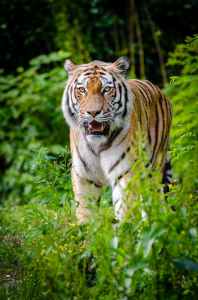
Photo by Flickr on Pexels.com
Sarah provokes controversy after taking a photo of a poacher that becomes evidence and lands him in jail, leaving his wife and children in difficulty and when she rescues a cub that has fallen into the river. Her actions raise her profile in the wider community, in some ways helpful to the organisation but in other ways endangering her.
Her involvement with one of her colleagues creates further complications, highlighting cultural taboos she is determined to overcome. The scheme she comes up with to resolve those issues is well-intended, requiring a stretch of the imagination to accept.
It’s a thought provoking novel that looks at how our environment has changed as species are hunted into extinction, how overpopulation and the need to survive means that humans compete with wildlife for scarce resources and how cross cultural alliances can be sabotaged by those whose worldview favours domination, or nurtured by those seeking partnership.
How We Disappear
Three Ways Humans Disappear – sickness, accident, violence
Three Ways Animals Disappear – hunted, starvation, genetic extinction
I’m still thinking about the meaning of the title as it can be interpreted in a number of ways that aren’t made clear in the text, but it made me think about how humans disappear and how animal species disappear. It seems it remains a mystery to the author as well.
“The title is a bit of a mystery even to me! I originally chose “Three” because the family in the story has three children, and “disappear” because of the threat of extinction to the tiger. But there are so many ways to disappear: for instance, through death, or by withdrawing from relationships. And as time goes by, the meaning of the title shifts a bit. Currently I think one interpretation of three ways to disappear would be physically, emotionally, and spiritually,” Yocom explained.
It took me a while to get into the book and there was some discomfort for me around the white saviour trope and although the main protagonist had spent some of her childhood in India, she didn’t feel natural to the environment, nor was her presence really appreciated, she was seen as another threat, as her first published photograph proved. Equally the love story. Overall it was an enjoyable read despite its flaws.
Environmental Literature
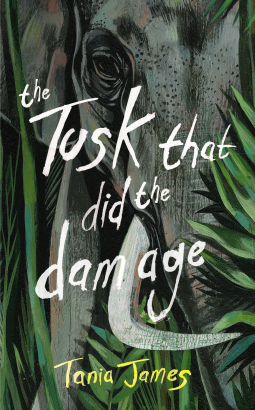
It reminded me of The Tusk That Did the Damage, a novel set in South India that explores the moral complexities of the ivory trade through the eyes of a poacher, a documentary filmmaker and an elephant.
The tigress in this story Machli is based on a real tiger with the same name who lived in the lakes region of Ranthambore and was observed and photographed by the author in 2006.
This book won the Siskiyou Prize for New Environmental Literature and is published by Ashland Creek Press, who publish “books that foster an appreciation for worlds outside our own, for nature and the animal kingdom, for the creative process, and for the ways in which we connect.”
It also won a First Horizon Award, a prize for debut authors bestowed by the Eric Hoffer Book Award. The EHBA honors books from small, academic, and independent presses.
Further Reading
EcoLit Books: An Interview and Q & A with Katy Yocom
N.B. This book was an ARC (Advance Reader Copy) kindly provided by the publisher.
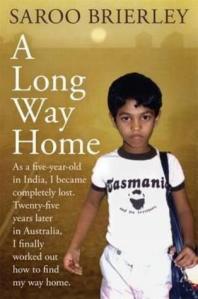 I saw the film when it was on at the cinema about a year ago and like everyone who has seen it, I thought it was extremely moving. If you don’t know the story, it’s about a 5-year-old boy who is out with his teenage brother, who has told him to wait for him at a quiet train station near their home, and feeling tired, he climbs into an empty carriage, falls asleep and when he awakes, it is moving, the carriage locked and he will be transported, far, far from his home, which he won’t see for another 25 years.
 When Saroo really becomes intent on tracking down his family, (another element that is much more vividly portrayed in the film) no one except his girlfriend knows how obsessed he has become, he has had periods of searching in the past, spurred on by meeting other students who grew up in India, who’d make guesses as to where he might come from based on his memories, but when, with the help of Google maps and tracing railway lines out of Calcutta, he began to spend hours every night doing his research, he kept it to himself, in ways and for reasons many adoptees will recognise.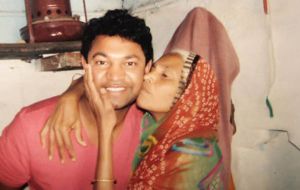

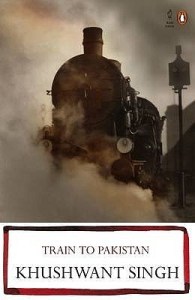 Khushwant Singh takes the Punjabi farming village of Mano Majra, a small village on the border between India and Pakistan, one of strategic importance to the railway system, and narrates the moment when news of this change arrives and shows how it affects this community.
 ‘Why, don’t you people want to be free? Do you want to remain slaves all your lives?
 It is 1947, in the province of Punjab, which sits between India and Pakistan, an area where Hindu, Sikh, Muslim and others live side by side. Tension is mounting as political events cause rifts between friends and neighbours as many of the Muslim population support the area becoming part of Pakistan and many Hindu fear for their lives, while the same tensions exist among Muslims living in the predominantly Hindu parts of India.
 The thing they all fear most, that some desire most happens and Asha’s family leave their past behind and head for Delhi. Firoze helps them to escape and Asha leaves with a secret she has kept from everyone, the future unknown.


 Whether we are conscious of it or not, we all grow up seeking to affirm our sense of personal and group identity, absorbing those questions of Who am I? Where do I belong? Traditionally, the family and the community reflect that notion and it is not until we step outside those comfort zones that we might question it. But for children growing up among worlds and between cultures the awareness comes much earlier.


 However Robert’s luck changes when he is arrested one night and discovers he has unknown enemies with unknown motives and the experience of prison will unleash the darkest aspect of his character. When he is finally released he goes to work with the Bombay mafia, delving into the world of black market drug, currency and false document dealings all the while awaiting that future moment where he can exact revenge against his enemy.
 charming and influential who lacks empathy, and has an intense need to be liked. I don’t think the character in this story is a psychopath, but many in his circle survive precisely because they are not beleaguered by the emotional constraints of sympathy or empathy whether they were born like that or have become that.
 Word by Word