
A Zimbabwean Trilogy
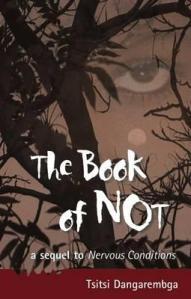
A year ago I read and loved Nervous Conditions the first book written by a Black woman from Zimbabwe to be published in English. The author won the Commonwealth Writers’ Prize with it in 1989, which led to translations in many languages.
Her most recent book, the third in this trilogy This Mournable Body was nominated for the Booker Prize and recently shortlisted. I’m eager to get to it, so this is my first read after WIT month, and I eagerly await what will happen to Tambu, despite the sense of disillusionment.
Most of this second novel takes place in the ‘Sacred Heart’ catholic girls boarding school she is sent to by her uncle, though the tone is uncomfortably set in the opening pages while she is at home with her family. There is a war going on, ever present in the background, setting them all one edge.
They must attend a compulsory village meeting, where a landmine causes her gun-carrying older sister to lose a leg and her Uncle, her educational sponsor and her hoped for ticket out of the village is charged with being:
not exactly a collaborator, but one whose soul hankered to be at one with the occupying Rhodesian forces. Mutengesi. The people in the village said Babamukuru was one who’d sell every ounce of his own blood for a drop of someone else’s.
Mother Daughter Relationships
Tambu’s relationship with her mother is complicated, she finds little solace there, knowing she can never undo her mother’s resentment, unless she fails.
How does a daughter know that she feels appropriately towards the woman who is her mother? Yes, it was difficult to know what to do with Mai, how to conceive her. I thought I hated her fawning, but what I see I hated is the degree of it. If she was fawning, she was not fawning enough. She diluted it with her spitefulness, the hopeless clawing of a small cornered spirit towards what was beyond it. And if she had spirit, it was not great enough, being shrunk by the bitterness of her temper.

Photo by Skitterphoto on Pexels.com
Tambu sets even higher expectations on herself to achieve in her education than her Uncle or anyone else and is frequently self-critical. We know from book one that her sponsorship in education came at the price of her brother’s demise, she wasn’t supposed to be the one to achieve, he was.
Due to her family’s low expectations, she wants to succeed. Due to her Uncle’s sponsorship and high expectations, she needs to succeed. Due to her perceived privilege as one of the few black girls at the mostly white catholic girl’s school, she has to work doubly hard to gain her achievements, with no guarantee of recognition.
As I liked to be good at what I did, I was not afraid of hard work. I would put in what was required to reach the peak I aspired to. It was especially important to be at the top, as it was quite clear to me and to everyone I had to be one of the best. Average simply did not apply; I had to be absolutely outstanding or nothing.
Photo by u0130brahim on Pexels.com
All of these expectations to be and do and know according to a multiplicity of expectations affect her behaviour and attitude, to the point where there is little of her authentic character able to shine forth.
On one level it is the story of a girl from a modest village family trying to become something else and on another level it demonstrates the mutation of an individual, trying to conform to a system that was designed elsewhere, within which she is perceived as being inferior, even though she is the one who is at home, living in her own country and culture. She tries hard to suppress her emotions, fearing they will contribute to her failure.
‘What is the matter?’ Sister was very anxious.
‘I’m fine,’ I told her. My favourite teacher was anxious. But my sister lay first in the sand and then in a hospital bed without a leg. What would Sister do if I told her? What would the other girls do if they heard? They all had their little boxes tight in their chests for their memories of war. There was too much grief here for a room full of girls. Thinking this, I did let go. I forgot about not letting anything out. I kept on wiping so that my tears fell on the cloth sleeve. It was like that when people were kind to you. Sometimes you forgot.
A Colonial Impossibility
It’s a thought-provoking, multi-layered novel and look at an aspect of the effect of colonialism through one girl’s education, her striving to succeed and the systemic prejudice that prevents her from being able to do so in a way that is easier for the Europeans. It’s also about the development of her undu (personhood), something she strives for, that is undermined by the system within which she attempts to develop it.
It is set during the tense and frightening period of fighting against colonial oppression, and the emergence of a new Zimbabwe – news of which occasionally filters in to the school, causing the disappearance of some of the students, and a fear for those like Tambu, who harbour confused, dual loyalties.
Scattered throughout the text are words and phrases in her maternal language, translated at the back, that add to the sense of a cultural insight and a reminder that this isn’t just a coming-of-age story of a young woman in a boarding school, it highlights the increasing dysfunction of one’s ”personhood’ while trying to fit into an alien system that is riddled with a sense of superiority she can never attain, because she is ‘not’.
Further Reading
An Interview with Tsitsi Dangarembga by Caroline Rooney following publication of The Book of Not, June 2007
My Reviews of Zimbabwean Literature
Nervous Conditions by Tsitsi Dangarembga (1988)
This Mournable Body by Tsitsi Dangarembga (2020)
House of Stone by Novuyo Rosa Tshuma (2018)
We Need New Names by NoViolet Bulawayo (2013) shortlisted for Booker Prize & the Guardian First Book Award
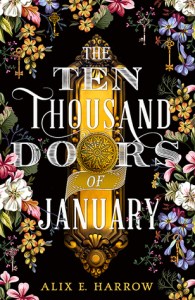 This is the book I took with me on holiday back in January, I’d forgotten about it to be honest. I hadn’t read any fiction for four months and thought perhaps something completely outside my usual genre might ease me back into reading.
 Finding Uplifting Fiction that isn’t genre specific like Romance or ChickLit is quite difficult. Since you’re unlikely to have these on your shelves, I’m including a link to a longer Goodreads List described also described as Uplifting:
 2.
2.  3.
3. 4.
4.  5.
5. 
 I have been wanting to read Octavia E. Butler for some time, she was one of the most well-known African-American science fiction writers, with a reputation akin to the likes of Alice Walker, Toni Morrison, Maya Angelou who sadly passed away at the age of 58 in 2006.
 It’s a riveting account, putting a modern woman into an era where her attitude, education and way of being in the world are a danger to herself. It reminded me of Andrea Levy’s story of slavery in the Jamaican plantations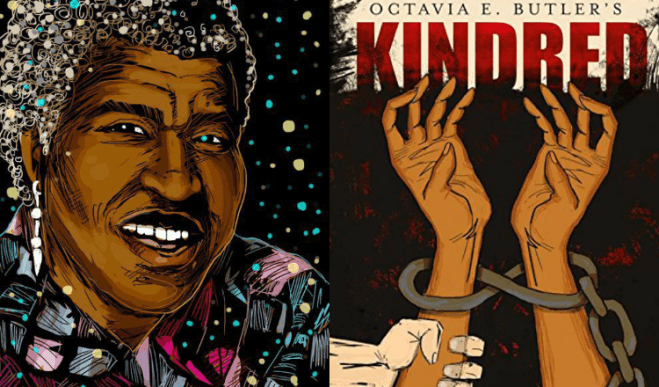


 4.
4.  5.
5. I absolutely loved this, a surprise read, it was a gift from a friend who spends more time living in the wilderness than with humanity. When I read the bio of the author and saw she was a nature writer and wildlife scientist, with a degree in Zoology and a PhD in Animal Behaviour, I was even more attracted to the potential this might infuse, what looked like a murder mystery novel.
 The longlist, or ‘Booker Dozen’, for the 2019 Booker Prize was announced on Tuesday 23 July.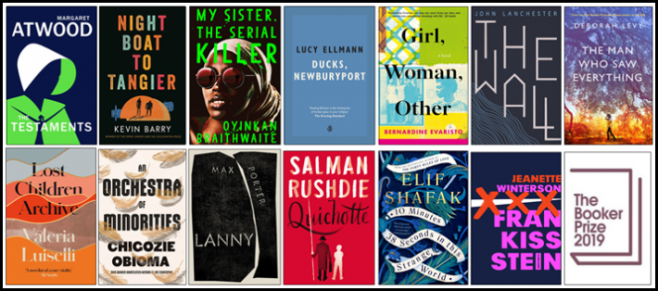
 The Gold Letter is a story of Greek families living in what was then known as Constantinople (later renamed as Istanbul, one of many name changes – The city was founded in 667 BC and named Byzantium by the Greeks ), and how the same twist of fate affects three generations of the same two families, where a young woman and a young man fall in love, only to have the union thwarted by their parents – in each generation it is for a different reason, beginning with them not being of the same wealth and social status, where marriage was more of a contract between families decided by the father’s.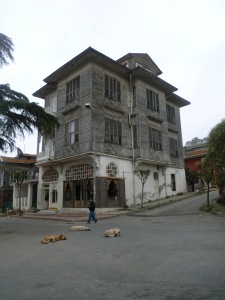
 I was reminded of the wonderful novel about a friendship between two children in the same village, one of Greek and one of Turkish origin by
  Maria in the Moon intrigued from the moment I looked at its beautiful cover and read the title, wondering what the significance of it was. This tender novel hooked me from its opening pages and never let go until I heard that chant ‘maria in the moon’ and understood.
 The story is set in Hull 2007, after their wettest summer on record, when 8,000 homes and 1,300 businesses were flooded.
 Maria in the Moon is one of those books you want to get back to every chance you can, it was gripping until the end, and even the quiet and mundane parts I found riveting. I loved going to work with Catherine and listening to her handling calls, the characters were well formed and contributed to a deeper understanding of the dynamics surrounding her, but also raised questions.
 French Literature
 Monsieur Pierre Chauveau (Julien’s great grandfather) gave a witness statement on 16 September 1954, describing what he had seen. His unusual testimony was classified by the police as follows:
 The four of them have various interesting encounters, Hubert with a long lost relative whose charred diary he finds in the apartment he left empty for 24 years, Julien meets the original Harry MacElhone, founder of the bar he works in and Magalie seeks out her now thirty-one-year old grandmother Odette.
 Word by Word