They’re Reading Thousands of Great Books Here, Cité du Livre – A Local French Cultural Centre and Library

Yesterday via a link on twitter, I read a provocative article in BBC News Magazine by Hugh Schofield entitled Why don’t French books sell abroad? It was an interesting, if superficial article, that made a few observations without going into any depth to understand the contemporary literary scene in France. It asked questions, reminded us of some old provocative stereotypes and did little to enlighten us on the subject of what excites French readers and why the English-speaking world aren’t more aware of their contemporary literary gems.

Kate from BooksKateRates, reads and blog about French literature and wrote an interesting blog post in response to the article and I have been scribbling notes since reading the original article. I plan to share them here, as it is a fascinating subject if one takes the time to research and understand it.

But firstly, I wanted to show you the library, as it offers a glimpse into  how the French absorb literature and culture and it’s one our favourite local hangouts.

Situated in what was a 14,500 sqm match factory, the library, La Bibliothèque Mèjanes, is part of the Cité du livre, a centre for the arts and culture which includes an auditorium for lectures and readings, rooms for more formal lectures, a small cinema showing themed films for 3 week periods (currently Humphrey Bogart films), a music and film lending room, adult and children’s libraries, a press room, an exhibition space (currently celebrating the centenary of Albert Camus), a café and plenty of space for research and study.

Library Press Room

Library Press Room

As we walk in through the enormous sculptures of the covers of Camus’s  L’etranger on one side and Saint-Exupéry’s Le Petit Prince and Molière on the other, we arrive in a long corridor and the reception area for borrowing and returning books.

Turn left and we head towards the reading library where outside the door is a display of books for adolescents. A quick glance at these books shows us that half of them are translated fiction, from South African, German and Hispanic authors.
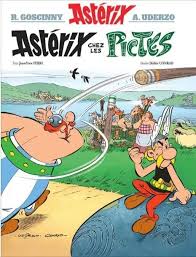
AsterixInside, we walk past displays of translated literature originating from South Africa, a tribute to Nelson Mandela, then the stacks of Bande Dessinée, the very popular hardcover graphic novels, which even today remain at the top of the French bestsellers list, right now its Asterix chez les Pictes, visiting the people of ancient Scotland!

And here are the novels, in French called romans. Rows and rows of books and you might notice something they all have in common, well, in fact, something they all lack. Colour.

Compare it to the shelf opposite which contains the English language novels. It certainly removes that whole likelihood of an impulse buy based on an intriguing cover.
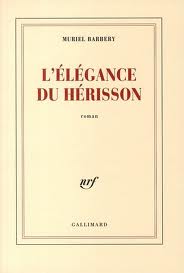
The Elegance of the Hedgehog

The Elegance of the Hedgehog

Most French literary novels are published without fancy colourful covers and while in the bookshop you might find first editions with promotional covers, there are many more with pale or cream covers without images and a black or red text title.

However, after looking around a little more, I discover that there is colour in some sections. Science Fiction and Fantasy are full of dark colours and the books covers in the section entitled Policiers (Crime) are mostly black. However, novels and poetry, even the section called American Literature pale into insignificance among a sea of white. It reminds me of one of the three principles of France l’égalitié and certainly here, all books have the same chance of being found, whether it’s from the library or in the bookshop, not just due to their bland covers, but also due to a government policy called le plan livre and the fixed price of books.

It costs €17.50 to join the library (adult) and its free for children, there is no cost for lending and no fees for late returns. 16 items (books and CD’s) and 3 DVD’s can be borrowed at any one time for a period of 3 weeks and the first renewal can be done online. The library is also full of computers providing free internet access to all members. My only complain is that its closed on Sunday and Monday. C’est la vie en France!

So what kind of books do French people read today? And is it true that nearly half of the fiction read is translated foreign fiction? And why don’t we see more books by French authors in English bookshops?  These questions and more I will talk about in the next post Reading Contemporary French literature.
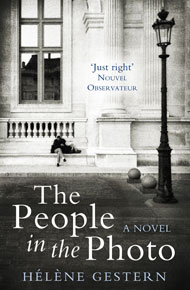
PeopleIn the meantime, if you want to know what’s popular in France and available now to read in English, check out Gallic Books, who offer the best of what’s available in French translated in English with new titles coming out every month.

I’m looking forward to reading The People in the Photo by Hélène Gestern due out in English in February 2014.  If you wish to read it in French, it’s already available with the title Eux sur la photo.

Halloween, The Day of the Dead & The Secret Recipe Book of Frida Kahlo

Ironically, today marks the first day of the Mexican celebration The Day of the Dead, three days in which family and friends gather in many parts of the world, but especially traditional in Mexico, to acknowledge those that have died. Traditions include building an altar or shrine using sugar skulls, marigolds and the favourite foods and beverages of those who have passed, but are still remembered.

Frida KahloThe Day of the Dead has a special significance in the Mexican writer Francisco Haghenbeck’s novel The Secret Book of Frida Kahlo. Upon learning that several notebooks were found among Kahlo’s belongings, he imagines that one of them was given to Frida by her friend Tina Modotti and in it will capture recipes, memories and ideas that are inspired and connected to some of the noted people she spends time with.

“Among Frida Kahlo’s personal effects, there was a black book called “The Hierba Santa Book”. It contained a recipe collection for offerings on the Day of the Dead. According to tradition, on November 2 the departed have divine permission to return to earth, and they must be received with altars filled with Aztec marigolds, sweet pastries, photographs from long ago, religious postcards, mystically scented incense, playful sugar skulls and votive candles to illuminate their path to the next life.”

Frida Kahlo’s life story, her tomboyish, rebellious youth, her not so blind and yet all-embracing obsession with Diego Rivera, her accident, her art, her circle of friends both at home in Coyoacán, Mexico and those she fraternised with in the US and Europe are fascinating from almost any point of view, whether it’s the film Frida with Salma Hayek’s convincing role or Barbara Kingsolver’s fictional account of her in The Lacuna or this latest account with its superstitious bent.

The book started slowly, covering familiar ground and read a little like a summary of her early life, each chapter culminating in a recipe, like a tribute to the character who inhabited that episode. What makes it engaging and unique are Frida’s encounters with Death, who manifests as a man riding a horse and who visits her in the first few pages, before we even know who he is.

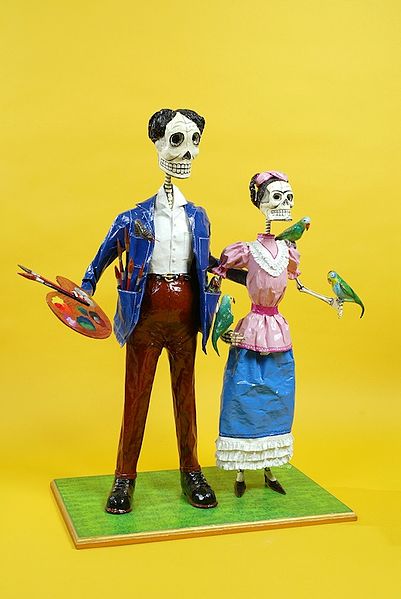
Kahlo Rivera Day of the Dead sculpture by Miguel Linares Source: Wikipedia

Kahlo Rivera Day of the Dead sculpture by Miguel Linares
Source: Wikipedia

As well as this apparition of the carrier of death, it’s warning manifests through the presence of a woman she refers to as the Godmother, Empress of the Dead, one with whom Kahlo makes a pact, after the trolley-bus accident that almost kills her. She will live, but with a constant reminder of that which she has circumvented – death. She will extend her life and avoid death but must embrace pain. And thus she becomes even more superstitious than she might have been, carefully marking the annual Day of the Dead with her shrine and offerings, keeping that man on the horse from her door until she is ready for his presence.

“The pact she had with her Godmother had given her the courage to tell stories. She liked to joke about Death. She dared it, taunted it, knowing that somewhere, Death was listening.”

She possessed a fearless personality, though susceptible to pain and expressed it in her artwork with an intensity that some would find disturbing.

Pain is the recurring metaphor in Kahlo’s life, sometimes it was so physically present it disabled her for periods of time when painting was her only release. When it wasn’t physical pain she experienced, it was emotional, for even her husband Diego, the love of her life was a manifestation of pain, one she tried to eliminate, briefly divorcing him for a year, despairing of his continuous infidelities and then just as she accepted physical pain, she accepted her flawed husband and remarried him, deciding it was better to live with than without him.

Suicide of Dorothy Hale by Frida Kahlo  Source : Wikipedia

Suicide of Dorothy Hale by Frida Kahlo
Source : Wikipedia

Channelling her experiences onto canvas, she developed a unique style and following. She became as well-known and sought after as Diego, from New York to the surrealists in Paris, meeting people such as Georgie O’Keefe, Salvador Dali and back home in Mexico, she and Diego would become hosts to the exiled Leon Trotsky and his wife.

Each encounter in the book leads to a favourite dish she might have made for or shared with her friends and it is as if each dish is also a sacrifice to the Godmother, constantly fulfilling her pact to keep Death from her door.

An excellent addition to the collection of work that exists, with its unique focus on local tradition, superstition and Frida Kahlo’s pact with Death, remembered every year when she and Diego come visiting, as they will perhaps this November 2nd.

Note: This book was an Advance Read Copy (ARC) provided by the publisher via NetGalley.

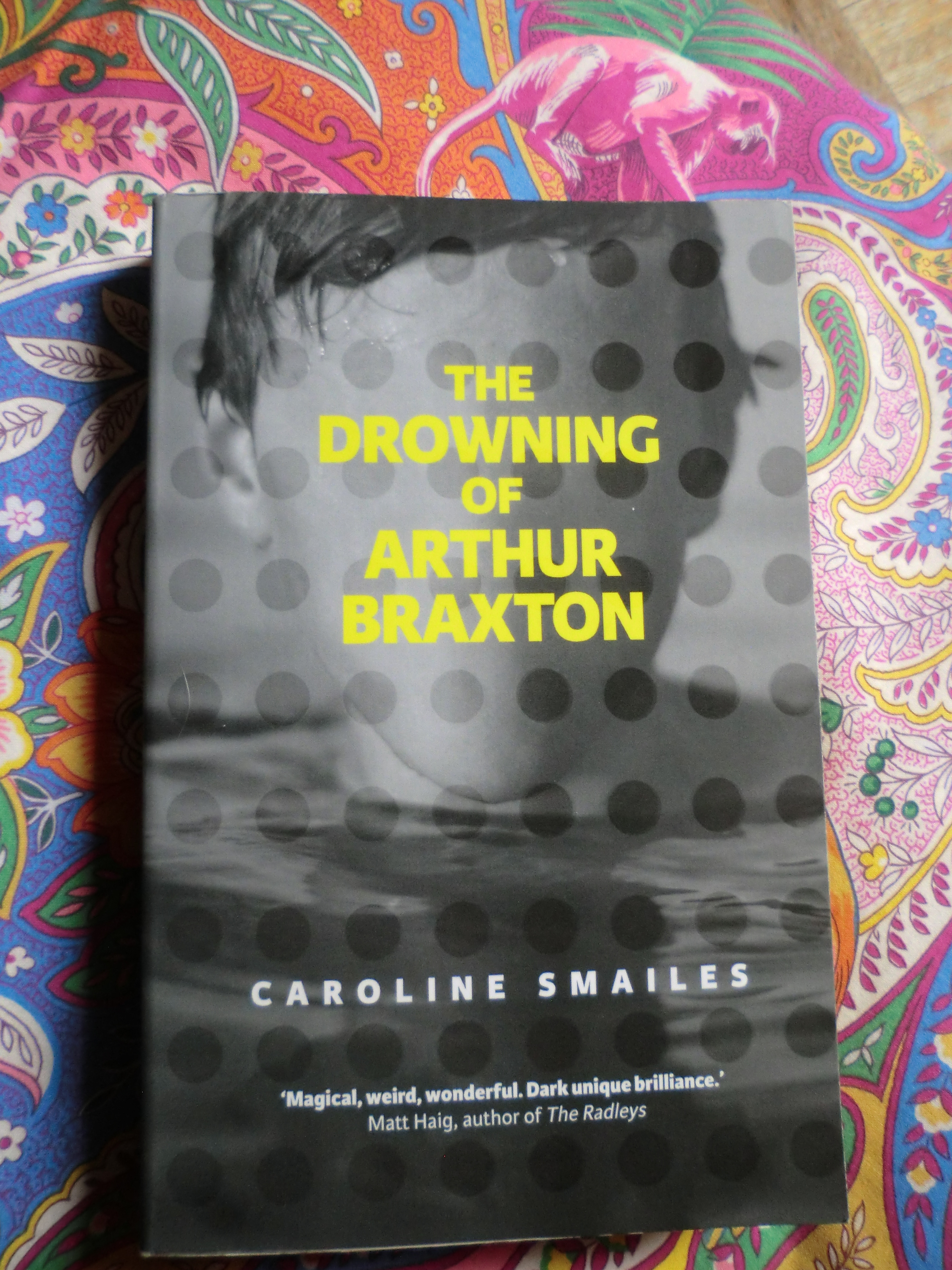
The Drowning of Arthur Braxton by Caroline Smailes

Completely off the wall, a sliver of magic realism, a stunningly original voice, Caroline Smailes The Drowning of Arthur Braxton is the best work of fiction I have read so far this year.

Arthur BraxtonRight from the beginning it hooked me and I couldn’t wait to get back to it every time I put it down, because I could not guess what the author was going to do next and somehow she made me very interested to want to know.

I’m still not quite sure how she managed that, but at a guess I would say it is a combination of an incredible imagination and a very close observance of reality. That might sound hypocritical, and that those two things should really negate each other, however she uses a sprinkle of magic realism firmly rooted in the mundane world, just as Eowyn Ivey did in The Snow Child, making the reader question whether they are reading fantasy or realistic fiction without alienating them in the process.

The protagonist Arthur Braxton can’t quite make out what is going on either and we are right there with him, going back for more to try and make the unexplained logical – and to find out more about that girl in the pool.

Arthur Braxton lives in a town in the North of England, so if you have never been there or known any young people from up that way, be warned about the vernacular and remember he is a teenager, so many of the things he says and does are appropriate to his age and the area he comes from. I don’t know whether that makes him authentic, but it makes his voice unique and his story compelling to read.

Victoria Baths

Victoria Baths, Manchester

Arthur’s Mum left he and his father for another bloke and neither of them have heard from her since, although she continues to support them financially, so they’re not making a fuss, on the contrary they are keeping a very low profile. Arthur’s Dad isn’t taking it all very well, so Arthur is parenting himself and almost at his wit’s end when he is drawn towards the old abandoned swimming baths, fenced off and due for demolition. And what he finds there keeps drawing him back repeatedly. If you choose to read the book, you’ll also be intrigued to follow him and find out.

“And that’s why I’m now pushing a shopping trolley, with my dad in it, up the hill and away from the sea front in the twatting rain. Dad’s huffing and puffing, like he’s a fucked-up steam train, and I don’t know why ’cause it’s me breaking my back trying to get the fucker up the hill. The wind’s not helping, the rain’s not helping and mainly I’m wondering what the fuck I was thinking. I mean, like owt can cure my dad. I’ve told him I’m taking him to his doctor’s appointment, he has to have a review every couple of months to see if he’s still ill. Usually the doctor takes one look at him and then, no shit, Sherlock, says that Dad’s unfit for work. Dad never even has to speak, which mainly pisses me off, ’cause I can’t remember the last time I heard him talk. I miss his voice.”

I am happy to know there is a bit of a backlist, that Caroline Smailes has written other novels and though some deal with dark subjects, her writing has an allure and originality that I am keen to explore further.

At the end of the book, the author mentions that the inspiration for this novel started with a place – Victoria Baths in Manchester, opened in 1906 and a proud icon of that city and its people. The council decided to close it in 1993 and a campaign to prevent its closure ‘Friends of Victoria Baths’ became a charitable trust and managed to save and restore the building, a venue all the public can visit today, though it does not look like any swimming takes place there.

Victoria Baths

Victoria Baths

Looking at their website today, I discovered serendipitously that this weekend 13 – 15 September 2013 the pool is open and for the first time in many years, full of water to mark the 10th anniversary since the Victoria Baths won the BBC Restoration Project.  Since then more than £5m has been spent restoring the front of the building, stained glass windows and the roof of the gala pool.

A well-known synchronised swimming group Aquabatix entertained the supportive crowd with a spectacular performance Arthur Braxton would have been proud of! Learn more at www.victoriabaths.org.uk

An Interesting Fact: The pools were divided up for first class males, second class males and females. Men in the first class pool had the pleasure of swimming in the water first before it would be drained into the other two pools.

CIMG4752

The Magic of Water

Note: Thank you The Friday Project, an imprint of Harper Collins for sending me a copy of the book.

The Spinning Heart by Donal Ryan

Reading Donal Ryan’s The Spinning Heart is to wake up in the heart of a struggling suburban neighbourhood where overnight the fate of a significant proportion of its population has changed.

Spinning HeartLittle time elapses between the pages of the novel, sufficient to penetrate the perspective of 21 residents of this neighbourhood, a chapter each.  Rather than a plot, this one event is more of a turning point from which we survey each character from their own and multiple perspectives, gradually creating a picture of this community, where perceptions often outweigh and overrule reality.

That event is the discovery that Pokey Burke has disappeared after a dodgy property deal in Dubai halts all work on his property developments in this Irish suburb.  He has absconded from his responsibilities including all those in his employ (at least they thought they were in his employ), those who thought they were doing okay in these hard times find out that not only do they no longer have a job, they have never been registered as employees.

Donal Ryan unmasks his characters in the single chapter he gives them each to speak (ironically, no chapter is given to Pokey Burke), this is no slow build up to revealing a characters inner thoughts, they are not characters prone to thinking about various options, this is a neighbourhood in which its men rarely ponder anything, their thoughts are often aggressive, misogynistic and raw, many of them are of the act now, think later persuasion. They make for uncomfortable reading and have the reader yearning for a fictional reprieve; could we have one character to latch onto to get us through this discomfort please?

And if we find it partially, it is with Bobby, the foreman whom we meet in the first chapter, on his daily walk to check whether his father is dead yet, something he wishes for that we will come to know more about as threads of his story snake through other chapters, so that we do meet him again and are able to follow his destiny.

“But the things Dad said, and the way he said them, were so scarily unlike him, so cutting, so cruel. That’s just the way he was reared, Ger reckons. She says people’s thoughts, when their upbringing is mired in dogma, aren’t really their own. Their opinions are twisted, not reflective of what’s in their souls; their words are delivered obliquely, like light being refracted through water – you can’t see their real feelings, just as you can’t see the true position of an immersed object.”

So much of what we experience is illusion, many people and situations hide another reality, nothing is what it seems.  Deception is normal, no one wishes to dig too deep to understand, empathy is an unknown concept, we too often ignore instinct, judge quickly and crush the weak and sensitive.

A disturbing read, unputdownable at the same time as not wanting to pick it up, the anticipation that maybe there is some good that can come of the situation, keeps us reading on. These are tough times and perhaps the bad karma of a financial crisis brought about by those who practice greed, corruption and a lack of empathy brings out the worst at every layer of society. It is certainly difficult to navigate the mire and find the seeds of hope.

Booker Longlist

Man Booker Longlist 2013

Donal Ryan is one of three Irish authors longlisted for the Man Booker Prize 2013 and a debut author, who is becoming as well-known for his perseverance (his manuscript was rejected 47 times) as he is for this contemporary work which digs under the skin of small town rural Ireland.

Note: This book was an ARC (advance reader copy) kindly provided by the publisher via NetGalley.

Fetish or Inspiration, Uplifting Shoe Art

manolo blahnok drawings

I mentioned in my recent review of Deborah Batterman’s Shoes Hair Nails that it had reminded me of a book lurking on my daughter’s shelf, a gift from a family member who is a designer.

The book is manolo blahník’s drawings, a small pocket-book of 120 original sketches and quotes that create a visual history of the talent of one of Spain’s most creative and alluring shoe designers. Being a book full of hand drawn images, there isn’t much to say about the content, because it just must be seen and appreciated.

Manolo Blahník

Born in the Canary Islands, he has been sketching shoes since the age of seven and had hopes of becoming a set designer, before fashion editor Diana Vreeland suggested he concentrate on shoes. No surprise that there is a theatricality to his designs and a sense of the artist at work.

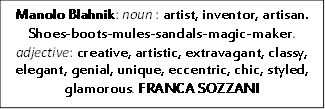
One of the best quotes, this definition of Manolo Blahník, expressed by Franca Sozzani, Editor-in-Chief of Vogue Italia:

Manolo Blahnik

Manolo Blahník

While I am not a great fan of shopping for and trying on shoes, I do love looking at and admiring them and these designs are pure inspiration, going beyond any practical requirement and into the realm of art which is more likely the reason I was so keen to visit the Shoe Gallery when it opened in London a couple of years ago.

These are some of my favourite images from the book.

Manolo speaks through his shoes. For him, the foot, the shoe, implies the whole nature of a person, and expresses a story. ANNA PIAGGI

The day we bought the book (from Liberty’s in London) was also the day of the opening of the Shoe Gallery in Selfridges in London.  A gallery of shoes and in 2010, while the middle class were keeping a low profile in the gardened suburbs due to the recession, it seems the creative younger generation of London were being inspired to flaunt shoe art!

Selfridges Shoe Gallery

Designed by the architect Jamie Fobert and the largest shoe department in the world, it contains 6 salons, 11 brand boutiques and more than 4,000 pairs of shoes. And what an outrageously joyous wander around that was, a gallery with none of the pressure of a shoe shop, one is free to wander around and admire the masterpieces of the many diva’s of shoe design. There was even a Shoe Booth, where you could have a photo taken with your favourite pair, how generous is that!

Instead of one large department, you enter six different zones, each space a character in itself. The line of Spanish alabaster plinths modelling their shoes in regal splendour, give it a real feeling of a gallery, the shoe taking pride of place and unlike in a gallery or museum, all available to buy. The architects only managed to convince Selfridges to go with concept of plinths, having proven that sales of shoes displayed on them, far outstripped sales all other pairs. It seems we all aspire to the pedestal, no matter who or what sits on top of it!

Shoe Cerise

So does anyone own a pair of Manolo’s and is it true that some like Anna Wintour will wear no other?

Champ Harmonique MP2013

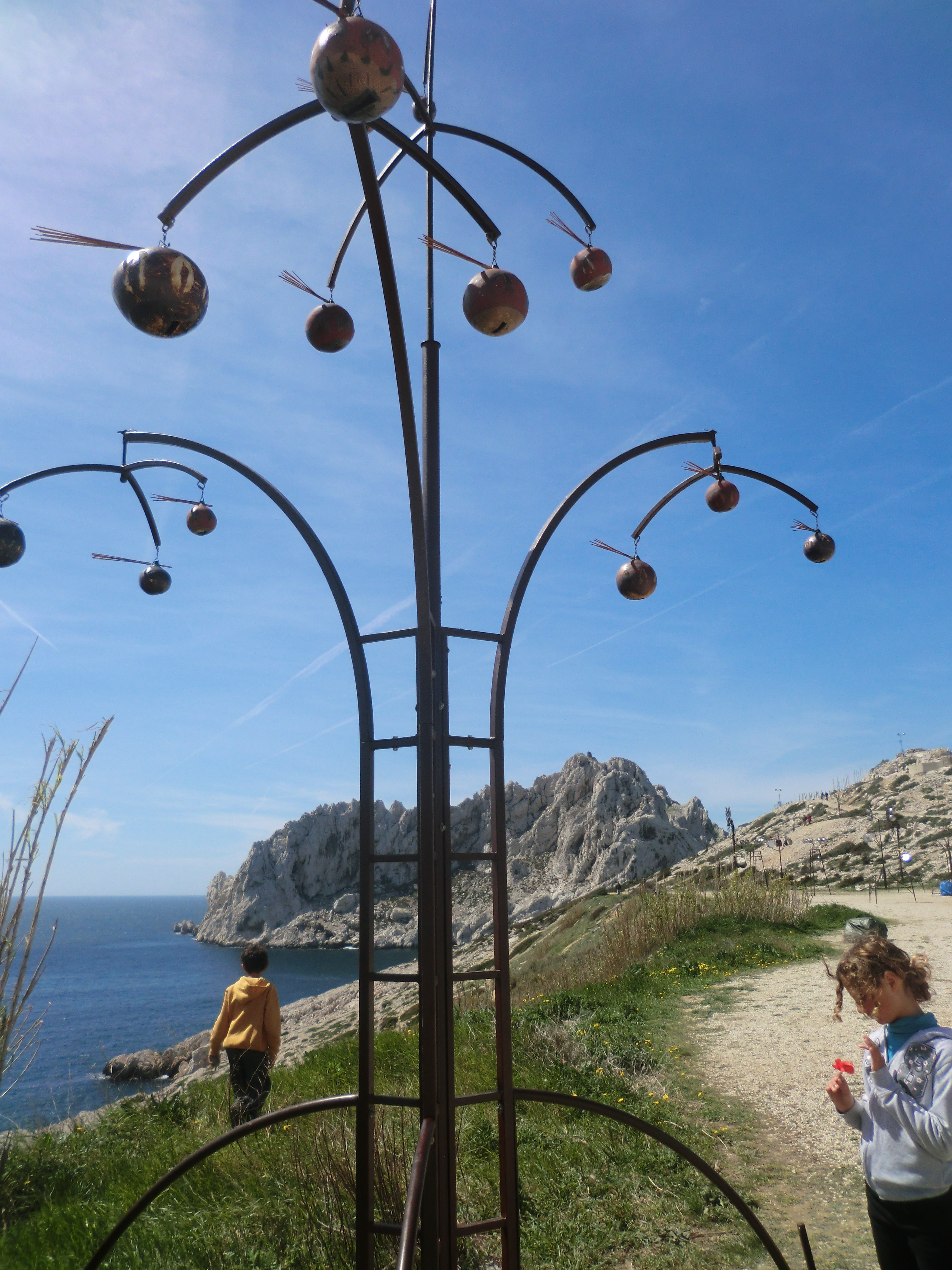
This poetic musical installation, entitled Harmonic Fields in English, came to my attention three months ago when I was searching for something interesting to write in the ‘To Do’ section of the destination guide on Marseilles I (used to) write for a magazine.

I knew it wouldn’t be too hard to find something spectacular, as Marseilles has been designated cultural capital of Europe for 2013, a prestigious event on the cultural calendar and one that has resulted in much-needed expenditure giving this seaside city something of a facelift.

I will save the wondrous changes in the city for another post, but yesterday my children and I drove into Marseilles and along the corniche to Les Goudes. I do love that word corniche , the English equivalent doesn’t evoke quite the same warm, exciting, air of anticipation feeling as corniche.

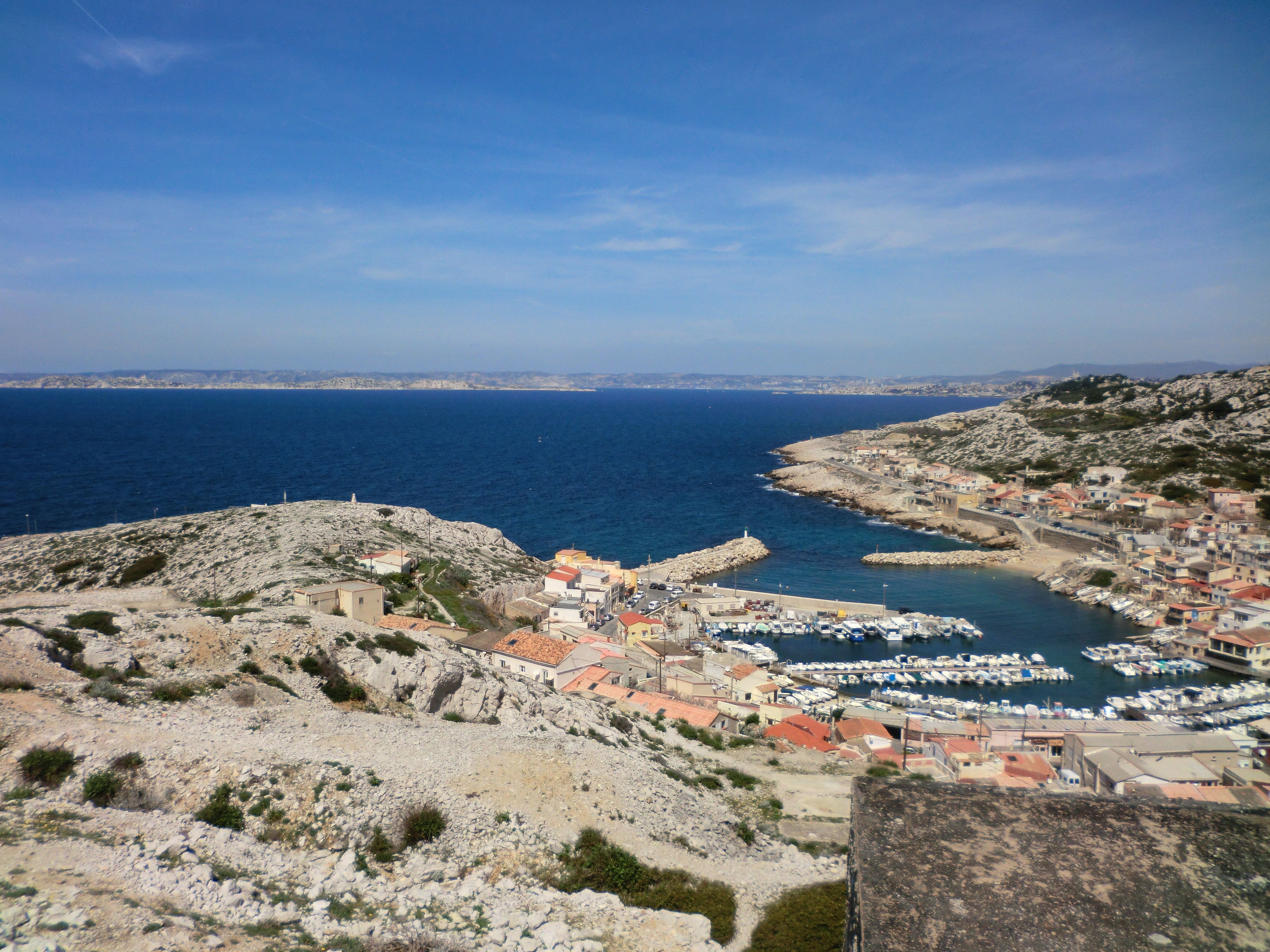
The village of Les Goudes, Marseilles

The village of Les Goudes, Marseilles

The corniche (roughly translated as ledge, more naturally translated as cliff road or coast road) winds its way from the centre of Marseilles, La Vieux Port past all the beaches and seaside restaurants, beach parks, cafes, cliff-front residences, joggers, sun-seekers and finishes in Les Goudes, which signals the beginning of Les Calanques, huge limestone cliff faces which make it nearly impossible to access the coastline between Marseilles and Cassis, except by boat or on foot. But the rewards for doing so are spectacular.

CIMG3832

The beginning of Les Calanques

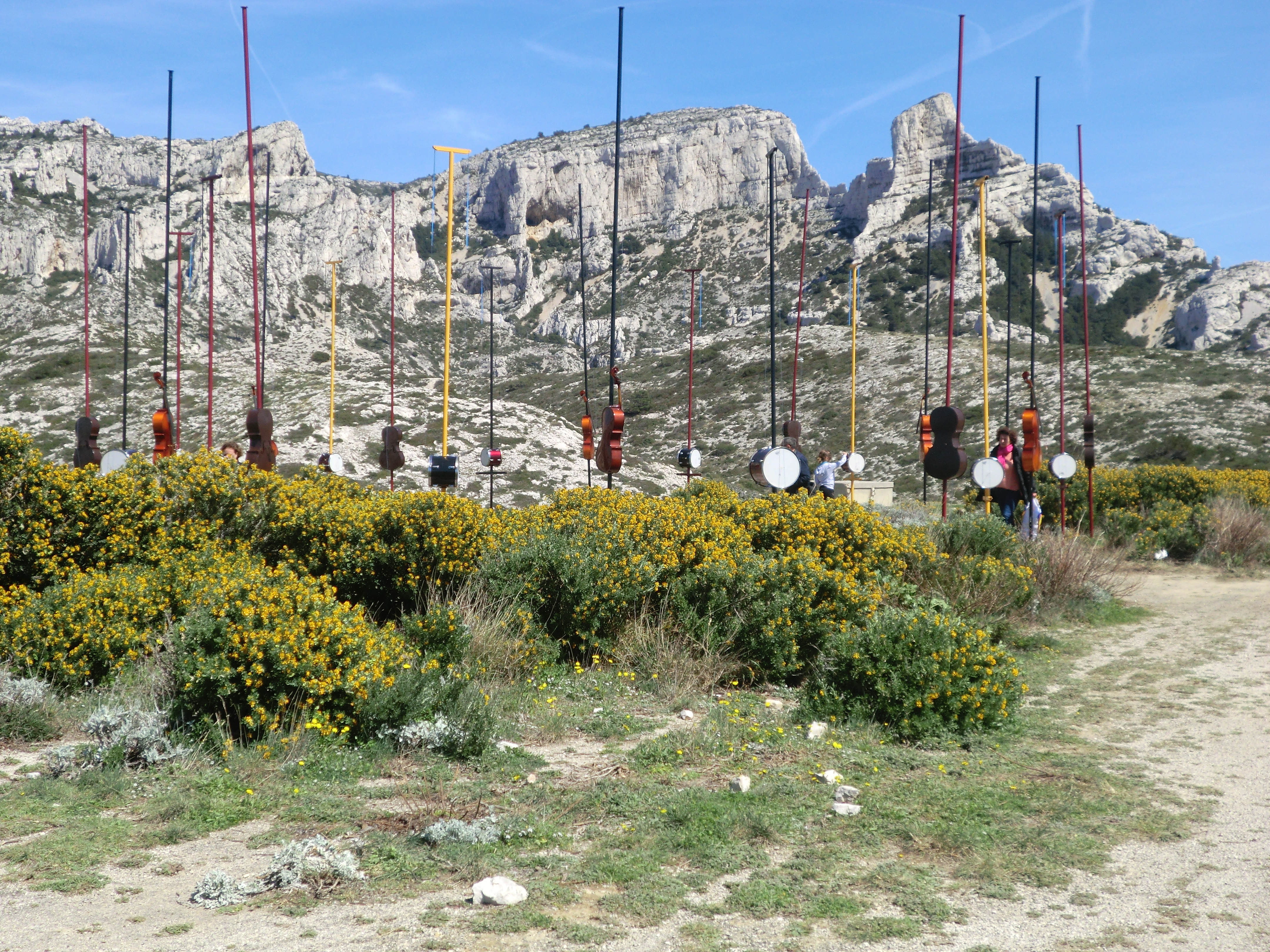
Champ Harmonique is the brainchild of Pierre Sauvageot, inspired by the wind and natural instruments of Indonesia, which require no player but the wind and can hang from trees or be placed in nature, allowing her to be playful, moody or melodramatic.

The coastline of Marseilles in the region of Provence could not be more perfect, natures favourite elements here are the sun and the wind, the one we know best from the north-east is the Mistral, but there are many others and yesterday we had a less dramatic, more playful wind, speeding up, then slowing down, her presence never more known and her subtleties never more appreciated than when given something like this spectacular installation to play with.

Nature gets to play here with cellos, drum shakers, glockenspiels, bamboo poles that sing, spinning music boxes, and a lot of other things I can’t even begin to translate like hélices-sirènesépouvantails balinais, tepees chromatiques, graals pentatoniques, arcs sonores, arbres à flûtes, cannes à pêche à lacrotale… 500 instruments in total.

It is a poetic symphony to experience and cannot (and should not says Pierre Sauvageot) be captured easily on film, but the stunning environment must be shared and if you have the occasion to visit the south of France during 2013, this is merely a taste of the events happening during the Marseilles Provence cultural capital celebrations.

CIMG3841Champ Harmonique is open until the 28th April in Les Goudes, Marseilles. It’s free to enter and the installation is supervised on Thursday, Friday and Saturdays and although it is open and accessible at all other times, some of the instruments are disabled during the unattended periods.

In true French style, (a sit down leisurely lunch remains a significant priority here for all), the installation is closed every day from 12–2pm.

And there will be a special open air concert on the evening of the 25th, the night of the full moon!

To imagine what the experience might have felt like and to see the view, here’s a three minute video, captured during the time it was open.

The Hare with Amber Eyes, A Hidden Inheritance

The Hare with Amber Eyes

What a story this hare could have told should he have possessed the gift of speech. Instead we see him hunched there, ears pinned back, quivering, stunned by the journey he has taken, the events that have occurred around him, surprised to have survived when so many of his companion artifacts, the more sturdy furnishings, grand paintings and even other ceramics, did not.

The Hare With Amber Eyes is a Japanese netsuke, a miniature sculpture (though they can be wood or ivory) invented in the 17th century, not just as an objet d’art, but a functional kind of toggle to attach to the end of a cord for a pouch that a man might carry, since most of the garments they wore did not contain pockets (the two Japanese characters ne+tsuke mean “root” and “to attach”).

The hare is part of a collection of 264 netsuke purchased by the third son of an aspiring and ambitious Jewish family, Charles Ephrussi (son of Leon).

By 1860 the family had become the greatest grain-exporters in the world. In 1857 the two elder sons were sent out from Odessa to Vienna, the capital city of the sprawling Hapsburg Empire. They bought a huge house in the city centre, and for ten years this was the home to a shifting population of grandparents, children and grandchildren as the family moved backwards and forwards between the two cities. One of the sons, my great-great grandfather Ignace, was tasked with handling Ephrussi business in the Austro-Hungarian Empire from this Vienna base. Paris came next: Leon, the older son, was tasked with establishing the family and business there.

Hare Amber EyesBeing the third son, Charles was spared the obligation of being groomed for the financial sector in the family business (though it may well be he was not cut out for it either as de Waal speculates), preferring to frequent the cafes, salons and a certain boudoir of an older, married woman, attaching himself only ever temporarily to that which he admired – having already lived in three large cities, with his languages, wealth and a passionate interest in the arts, he had plenty of time to indulge his many passions.

It was through his pursuits in the arts, the start of his own collection, mingling with artists, other collectors and art dealers, writers about the arts, that he became interested in Japonisme, a rarity when it began appearing and so desirous. He would purchase a large collection of netsuke from the Parisian art dealer Philippe Sichel who travelled to Japan in 1874.

There is a wonderful connection to Proust throughout this part of the book, one that was a pleasure to discover, without the necessity of having read him, if anything it is an interesting introduction to that group of intellectuals of the 1880’s – 1900’s, Charles Ephrussi himself one of the models for Proust’s depiction of Swann in Swann’s Way.

The author of the book, Edmund de Waal is a descendant of the Ephrussi family and has inherited the 264 netsuke. He is a ceramic potter himself and spent two years studying in Japan, after many years as an apprentice in England. It was in Tokyo, while visiting his Uncle Iggie (another Ignace) that he first laid eyes and hands on the family netsuke that would eventually become his, learning a little of their journey from Paris to Vienna, London and back to Tokyo. Eventually he would spend five years researching what would become this incredible book.

He too, is the third son, though his is no longer a global banking family with the same expectations of its protege. Although he shares similar characteristics to his ancestors, those who did manage to escape the family business and were able to develop that appreciation and eye for a work of art, going beyond casual observation; it is as if he converses with these objects and reads them as if they have living, human qualities.

DeWaalThrough this book, he traces the history of these netsuke and his family, as they rise in ascendancy and are undone by the events leading up to the second world war. We come to know many of the family members and Edmund’s grandmother Elizabeth, a poet and a lawyer is a wonderful woman to learn about, the first woman to receive a doctorate from the University of Vienna and passionate about her poetry, she corresponds regularly with Rilke.

This book was so fascinating and so sensitively handled, it was with an almost palpable sadness that I finished it and felt bereft, wondering where on earth I could go to from here, reading-wise, after such a story.

And then I remembered it has been two years since publication and so I consoled myself with following the work of De Waal, who has been rather prolific since 2010 and I was not surprised to see his recent exhibition A Thousand Hours, showing works behind vitrines, evidence of the longer term effect of his immersion into all that research and study of netsuke and other artifacts his family had preserved.

I leave a link to him commenting on that most recent exhibition and a wonderful article in the Telegraph, in which I learn that De Waal has recently returned from a trip to Jingdezhen, home of the purest clay in China, where porcelain has been made for 1,000 years. This was a research trip for his next book and for a collaboration with the Chinese porcelain collections at the Fitzwilliams Museum for an upcoming exhibition:

De Waal is animated, inspired, gesticulating with his long fingered hands; there is a hum of creativity around him. You can almost see the words fizzing in his head, feel the ideas taking root, springing up out of nothing and arranging themselves in little groups, to form stories, dramas, like his pots.

The Netsukephotos of some of the Ephrussi collection + family pictures

Article Edmund de Waal on his new exhibition, A Thousand Hours by Jessamy Calkin

Video Watch Edmund De Waal transform clay into beautiful works of art

Episode 10: The Move Down Under and a Shocking Diagnosis

Thinking that a move would give us more family time and offer a less stressful lifestyle, we left London behind and travelled half way around the planet to New Zealand, where most of my family still live today. I had been away for many years and hadn’t expected to return, however now that I was back, everything looked and felt familiar and it wasn’t long before we had moved into a house in the city and I had found a full-time job.

Not quite that large an island, Allia’s interpretation of somewhere very far away.
Putting New Zealand on the Map!

Initially we spent time staying at my parent’s home on the sheep farm they had lived for twenty years. It was wonderful to be there with Allia, for her to spend time around her grandparents and for them to get to know and love her.

Being a long way from the nearest town and a very windy road to get in and out, the forced isolation was a little more difficult for my husband to endure, but he was fascinated by the workings of the farm and in particular the shearing shed when it was in full working motion. Not so for me, years of spending school holidays working in that intense, stinking, hot and competitive environment (shearers get paid per sheep shorn, not by the hour) sweeping away wool, dags (sheep shit) and the occasional maggot were something I felt no nostalgia for at all.

It seemed to be good timing to have returned at this time as my mother was unwell, so I was able to go with her to her appointments and provide support. Good timing was an under-statement; she had lost a lot of weight and was having problems with her balance. She was only 59-years-old but seemed to have entered what looked like old age in an awful hurry.

Of course it wasn’t old age. By the time it was understood that it also wasn’t asthma or some diet related weight loss and she had been for a follow-up MRI scan, we found ourselves sitting in an office, opposite an oncologist who mumbled something that sounded like “three weeks”.

“Excuse me”, what did you say? I blurted out.

“The cancer is in the lungs, but it has spread to the kidneys and other organs and those lumps in the neck and brain are tumours. In the state that your mother is in now, I would say that three weeks is being optimistic.”

“But isn’t there anything we can do?”

“Yes, we can start chemotherapy to try to slow down the rapid advance of the cancer and the radiation treatment should be able to remove those tumours so you should actually start feeling better and get your balance back” he said looking at my mother.

We were both stunned. I wanted to protest and say hey that’s not fair, you can’t wait all this time knowing something isn’t quite right, you know it was more than three weeks that we have been worrying about this and we survived that, only to hand out a three-week life card as if you are prescribing community service. This is an unfair sentence being handed out for absolutely no crime!

Completely and utterly helpless, we sat and listened to what would happen in the next few days. I don’t recall much of what he said, but I remember my mother turning to me with that familiar, uncompromising look in her eye and saying, “I’m going to fight this.”

Yes, she would fight death as she had fought life; like every other great challenge that had faced her, she never gave up without a fight. But I looked at the thin frame of a woman she had become and knew that this was a fight she was not going to win. Not this time.

Next Up: in A Silent Education: Our Quiet Challenge in Provence

Episode 11: Adapting to a New Rhythm and Creating Lasting Memories

Previous Episodes

Episode 9: She Speaks the Language of Birds

Apart from mild surprise when reading my mother’s entries in the baby book she kept for me, which lists the number of words I could say at 12 months and various intervals beyond that, I never really noticed too much that Allia didn’t speak words that could be recognised. Because she talked non-stop. She communicated incessantly with much enthusiasm and wasn’t shy.

She spoke a language tongue that we referred to as bird-talk, it was long streams of dialogue that went up and down in intonation which I was just on the verge of understanding if I listened hard enough, I was sure. Like listening to Italian or Arabic, languages that incorporate much body language and expression which communicate mood, tension and excitement without the need to understand their words.  It was very much like listening to the French language on the television or the radio in my early days of living here – somewhat familiar sounds with that feeling that surely if I did listen hard enough, it was just a matter of time before something in my brain clicked and “poof” I would understand everything.

It wasn’t until her brother arrived on the scene a year later and started using recognisable words in his rambled dialogue very early on that the contrast became noticeable – I think he understood the bird-talk because they would chatter away to each other and to us without hesitation. I wondered then if something was perhaps amiss, I say perhaps, because I am against making comparisons between children, they develop at their own pace and depending on what they are working on developing, other aspects can lag behind.

When people started suggesting we video her speaking like this, I realised it really was a little out of the ordinary, it was almost as if she had her own language, something like a twin language – but no twin. Unlike today when making a piece of film footage is child’s play, I wasn’t comfortable filming her as a kind of spectacle, I was more concerned with just interacting with her and giving her the freedom to express herself, waiting for her language to become something like one of the three languages she was hearing at home.

Next Up: in A Silent Education: Our Quiet Challenge in Provence

Episode 10: The Move Down Under and a Shocking Diagnosis

Previous Episodes

Episode 8: Ten Months of Bliss and Facing a Return to Work

Once over that initial hurdle, Allia blossomed and apart from that long scar, there was nothing to indicate there had ever been a problem. She was a happy, contented baby who loved to smile and engage with those around her, especially the band of eight and nine-year-old girls who lived in our apartment building and were frequent visitors.

For the first ten months I was able to stay at home with her, working a little, practicing aromatherapy, however I knew it was going to be necessary to find another full-time job, living in London demands it, all the more so when there is an extra mouth to feed.

Until this precious little girl came into my life, I never really questioned working long hours or weekends and I had thrived on the opportunity to travel with work. Now, I couldn’t think of anything worse – to leave this child behind, absolutely not, she had extinguished my desire to seek out the unknown, I found myself dreaming of safer pastures, the more familiar.

For the first time in eight years of living in London, the city that I thought had become my second home, I thought the unthinkable – maybe it was time to return to New Zealand?

P.S. This is what Allia came up with when I said this episode was about us having 10 months of fun times hanging out together, going to the park etc, I just love this picture, although my husband says that first one isn’t true! But her imagination is brilliant. Enjoy.

Next Up: in A Silent Education: Our Quiet Challenge in Provence

Episode 9: She Speaks the Language of Birds

Previous Episodes