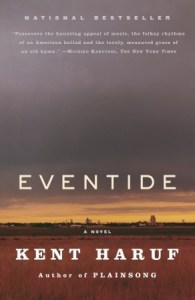
Eventide by Kent Haruf

In Eventide, the second book in the Plainsong trilogy, we meet some of the same characters and a few more from the community of Holt, Colarado. There are again the quiet observations of the lives of people in this town, seeing them from the inside, the different challenges they each face and how they cope (or not) with them.

There’s that trademark humour that creates a number of laugh out loud moments, for which we are grateful. Because some of it is sad, realistic and may bring tears.

There’s a small boy named DJ who lives with his elderly grandfather Walter Kephart, DJ makes supper for his grandfather every evening and befriends two girls who live next door, in particular Dena. He cleans the yard and works on the vege garden for their mother Mary Wells. Their father is working in Alaska and returns rarely. And then not at all.

We again meet the McPheron brothers Raymond and Harold and the girl Victoria who has been living with them since she became pregnant. Now she has a little girl Katie and is about to move into an apartment and resume college studies.

It is a challenging transition for all of them, as they have become used to each other and the brothers have become much more perceptive about themselves and their “like a daughter” Victoria. She calls one night, for no particular reason and they discuss afterwards the things she didn’t say.

The way she sounded. The way her voice was.
No, it wasn’t money that made her voice sound that way. It was the rest of it too.
Well, I reckon she’s kind of lonesome, Raymond said. I’m going to say she kind of misses being here.
I guess maybe she does, said Harold.

Rose Tyler is a social worker and through her, we meet a loving but vulnerable family, a couple with special needs, struggling to raise two children, while finding several aspects of their lives difficult to manage. Their story is painful to read as they become prey to a predatory relative whom they are unable to eject from their lives and will be judged for.

Photo by Deneen LT on Pexels.com

And though each family has it’s struggles and hardships, somehow people’s paths cross and sometimes good wins over bad, a closed heart opens, someone is in a position to be there for another just at the right moment, even when they don’t have the words.

Beside her Guthrie stood watching the old man. He wanted to think of words that would make some difference but there were none in any language he knew that were sufficient to the moment or that would change a single thing. They stayed quite for some time.

And an old man who has never done it before, learns to dance and find joy once again.

She moved backward and he followed her. She backed again and he stayed with her, moving slowly. Can you hear the beat? she said.
No ma’am. I can’t think about that and not step on you at the same time.

I recognised that feeling about halfway into Eventide of becoming completely enamoured and invested in the characters, wanting the best for them, feeling afraid for them. In their own small worlds they struggled separately, not knowing, but discovering that part of the solution to their moving out of one state and towards an improved one was about making that connection with others, being open to the kindness of people, finding those who were genuine in that offering, being prepared to take that risk.

Beautifully written, incredibly moving, a wonderful book.

Further Reading

My review of Book One Plainsong
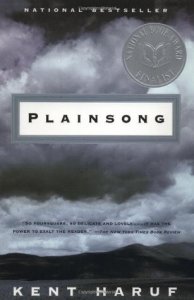
Plainsong by Kent Haruf

Plainsong is a what I’d call rural town domestic fiction, it reminds me of reading Anne Tyler, they’re like the yin and yang of small town America storytelling.

The language is plain speaking and goes beyond what is said, sharing those unspoken moments that come from people who spend more time in proximity to the land and with animals and nature than humans.

We are introduced to a few members of the Holt, Denver community, each chapter headed with a name starting with the school teacher Tom Guthrie and his sons Ike and Bobby. Tom takes care of his nine, ten-year-old boys because their mother is upstairs in her darkened room, disinclined to come out.

They visit cattle ranchers, the McPheron brothers Raymond and Harold, to help out with the cows when they need an extra pair of hands. The brothers have never married, live alone in the house they grew up in, left suddenly when both parents were killed in a car accident. After helping out they pay the boys ten dollars each, against the wishes of their father.

That’s too much, their father said.
Should we give it back?
No, he said. He took his hat off and scratched the back of his head and put his hat back on. I guess not. That would be an insult. They want you to keep it. They enjoyed having you out there.
But Dad, Ike said.
Yes?
Why didn’t they ever get married? And have a family like everyone else?
I don’t know, Guthrie said. People don’t sometimes.

Photo by NEOSiAM 2020 on Pexels.com

Victoria is a pregnant teenager whose mother locked the door on her. She finds refuge first with Maggie, then with the McPheron brothers. Maggie  envisages the ideal solution, that could help each other out, something that would never have happened without her intervention. Victoria doesn’t tell anyone who the father is, but she tells Maggie that he was nice to her.

He told me things.
Like what for instance?
Like once he said I had beautiful eyes. He said my eyes were like black diamonds lit up on a starry night.
They are, honey.
But nobody ever told me.
No, Maggie said, they never do.

There are the innumerable kindnesses by some in the community and many cases of abandonment by others. Those who are quick to judge and those who care enough to help find solutions.

Haruf quietly explores the intricate ways of his diverse set of characters, whose lives traverse through quiet, mundane moments and dramatic turning points, showing how necessary a community is to all the individuals within it.

Photo by Pixabay on Pexels.com

Victoria asks Maggie again for help, to navigate the silence in the McPheron household.

It’s so quiet out there, the girl said. I don’t know what I’m supposed to do. We eat supper. They read the paper. I go into my room and study. And that’s about it. Every day it’s like that.
Is everything else all right?
Oh, they’re kind to me. If that’s what you mean. They’re nice enough.
But they don’t talk, Maggie said.
I don’t know if they even want me out there, the girl said. I can’t tell what they’re thinking.

There is humor in the simplicity of it all, of people coming out of their shells, of the learning and there is pain, the suffering inflicted by those who need to act out on how bad they feel inside.

You’re not talking to her, Maggie Jones said. You and Raymond don’t talk like you should to that girl. Women want to hear some conversation in the evening. We don’t think that’s too much to ask. We’re willing to put up with a lot from you men, but in the evening we want to hear some talking. We want to have a little conversation in the house.

And then there are those moments of renewal, of something new that awakens, when the good that comes from making the change begins to bear fruit, to make a difference in someone’s life, knowing they are not alone, that they are loved, that humanity can shine through.

It’s a quiet comfort read, perfect for this extended period of confinement and it is the first novel of a trilogy, so next up  is Eventide, then Benediction.

Top Five Memoirs

Non Fiction Memoir

Continuing with reading lists, next are my Top Five Memoirs.

It was hard to whittle this list down to five, I could easily have included many others I’ve read and reviewed such as Jeanette Winterson’s gut-punching, exploration of an ill-fitted adoption Why Be Happy When You Can Be Normal, Helen MacDonald’s grief-laden obsession to train a goshawk H is for Hawk, Jacqueline Woodson’s charming, free verse of childhood and old family stories Brown Girl Dreaming, and Tove Jansson’s Finnish island tales and escapades The Summer Book & A Winter Book.

I’ve chosen five lesser known, equally brilliant memoirs, all books that when I look at the titles and covers, take me straight back to the remembered joy of their individual reading experience.

In pondering what it is that elevates some memoirs to that level of something universally understood, I recall one of Vivian Gornick’s insights from The Situation and The Story: The Art of the Personal Narrative

Truth in a memoir is achieved not through a recital of actual events; it is achieved when the reader comes to believe that the writer is working hard to engage with the experience at hand. What happened to the writer is not what matters; what matters is the large sense that the writer is able to make of what happened. For that, the power of the writing imagination is required. As V.S. Pritchett once said of the genre, “It’s all in the art. You get no credit for living.”

Top Five Memoirs

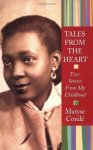
1.Tales From the Heart, True Stories of My Childhood by Marsye Condé tr. Richard Philcox (Guadeloupe/Paris)

Memoirs that succeed record a steadily changing idea of the emergent self, “a flash of insight illuminating the idea grows out of the struggle to clarify one’s own formative experience” and I can think of no better place to start than with Maryse Condé, one of my favourite authors.

The youngest of eight children, by the time she was born her mother was 43, her father 63, thus there were many family stories and life experiences she wasn’t present for, tales she would rely on oral retellings of her siblings and extended family to fill in. In these stories are planted the seeds of her future works, the lack of knowledge of her cultural history and her subsequent research into it, will manifest in her future historical masterpiece Segu, her desire to understand her mother and know her deceased grandmother will inspire Victoire, My Mother’s Mother, her first visit to Africa leads to her debut novel Heremakhonon about a young West Indian woman’s quest for roots.

This short collection of short tales is a beautiful introduction to the life and inspiration of an extraordinary woman and author who has given us so much through her stories and her persistent research and desire to understand what lies behind the lives we lead.

2. Brother I’m Dying by Edwidge Danticat (Haiti/USA)

After reading her novel Breath, Eyes, Memory I became aware of this memoir and I was particularly intrigued because of it’s focus on the author’s father and Uncle. I have an affinity for books written by women born in or having a strong connection to the Caribbean, I love their storytelling tradition, their connection to a sometimes magical matriarchal force and nature.

This book was unique because it was the first time I’d read something that delved into the masculine. It straddles both a traditional life in Haiti and a new life in America, a unique story of a family trying to improve the lives of their loved ones, narrated by a woman who successfully straddles both, witness to a love between brothers. As Cristina García, author of Dreaming in Cuban (one of my Top 5 Fiction Reads of 2015) put it:

“Edwidge Danticat’s moving tale of two remarkable brothers – her own father  and her beloved Uncle Joseph, separated for thirty years – is as compelling and richly told as her fiction. Politically charged and sadly unforgettable, their stories will lodge themselves in your heart.”

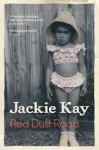
3. Red Dust Road by Jackie Kay (Scotland/Nigeria)

Jackie Kay is a wonderful Scottish poet and has written a heart-warming story of her connection to her adoptive Scottish family and to her slow-burning desire to uncover the mystery behind her existence. That journey begins at the University in Aberdeen, taking her to a suburb in Milton Keynes and a village in Nigeria, a place she has dreamed of and imagined but had no connection with until she arrives there and walks the red, dust road that will awaken something deep inside her.

It’s a unique cross cultural story, exciting in its revelations and profound in it’s understanding as she learns what family and belonging really mean to her, expressed with the beautiful incantation of a poet.

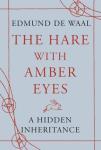
4. The Hare With Amber Eyes: A Hidden Inheritance by Edmund De Waal (Vienna/Tokyo/Paris/London)

Remember this? What an incredible family memoir the artist, ceramic potter Edmund De Waal put together here, telling part of the story of his extended family though the voyage of a stunning collection of netsuke (miniature Japanese sculptures) and a family history that begins in Odessa, grows and is almost destroyed in Vienna, takes side journeys to Tokyo via that netsuke collection, now sitting in London.

It’s hard to describe the experience of reading this book, except that it’s a lot more interesting to read the history through the eyes of a hare with amber eyes than one man looking only at himself. In this way we learn something about the art, culture and society of the places these sculptures have inhabited as well as the family history over a tumultuous century. Truly unique, engaging, educational, and a deserving winner of a number of literature prizes.

5. Unbowed One Woman’s Story by Wangari Maathai (Kenya)

I finish with the story of a remarkable woman who I wish had stayed around longer and become more well-known, though reading her story shows us how much of a difference she did make to other woman’s lives in her native country Kenya. She won the Nobel Peace Prize in 2004 and passed away in 2011.

Wangari Maathai was one of a group of young people from East Africa given scholarships and brought to the US in the ‘Kennedy Airlift’ of 1950 & 1960, who gained a degree in the US then returned to Kenya for her PhD. A scientist, initially she worked a veterinarian but her desire to do something practical and far-reaching moved her to found The Green Belt Movement and become involved in sustainable development. She would empower many women to create sustainable enterprises and won many battles to preserve public parks from being given over to urban development. An amazing, inspiring woman and a role model for our times.

Have you read any inspiring memoirs recently?

Further Reading

Top 5 on the TBR (To Be Read)

Top 5 Nature-Inspired Reads

Top 5 Spiritual Well-being Reads

Top 5 Translated Fiction

Top 5 Uplifting Fiction

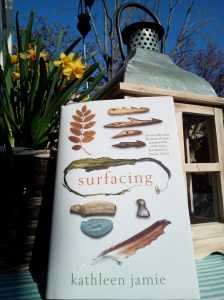
Surfacing II by Kathleen Jamie

In the second half of Kathleen Jamie’s latest nature writing essay collection, Surfacing, she writes about an archaeological dig on the the island Orkney in Scotland, remembers a trip to a Tibetan town in China in her twenties, and tries to recall voices of her own female ancestors that are beginning to fade from her memory.

Links of Noltland I, II, III

The author spends time at another dig, one whose archaeology has been buried for five thousand years on the Scottish island of Orkney.

‘What’s happening is significant really to…well, to archaeology, but also to us, the human race.’

It is a Neothilic and Bronze Age settlement, a site that has been in operation for a number of years and could go on for many more, if they had surety of funding. They do not.

‘There’s enough here for thirty PhDs on bone alone,’ said Graeme, ‘Decades worth of work.’
‘If HES really pull out what will happen?’
‘We’ll have to look elsewhere and make all kinds of promises. We can’t look to the EU anymore.’

There is not just the work on site, but a Victorian building stacked with their findings, she visits and is shown beads bones and stones and ponders who those people might have been.

For a moment, out of the twenty-first-century plastic boxes stacked in the gloomy Victorian store, there emerged a vision of people clothed in animal hides, bearing spiral-designed pots, with hair braided, hanging with beads, people crazy about cattle, young people prematurely old, as we would think now.

The most famous find, discovered in 2009, is kept in the Heritage centre, where they have a small section, most of the centre given over to more recent Viking finds.
The ‘Westray wife’ is the earliest representation we have of a human, in the UK, and she has become a motif for the site, almost a tourist attraction, if tourists can be drawn to a sandstone figure not four centimetres high on a faraway island.

Jamie asks about local interest in their ancient dig and is surprised by the response.

‘They’re interested but not connected. It’s only the Viking they’re interested in. It’s the Vikings the Orkney and Shetland islanders identify with. They’re not British, not Scottish, they’re Norse. Not prehistoric. Viking.’
‘But the Vikings are so recent, relatively.’
‘The Vikings “won”,’ said Hazel with a shrug.
‘What do you mean the Vikings “won”?’ I asked reluctantly, thinking of the ancient burial mound I could see from my window, which the Vikings had chosen to use as a fishing station.
‘Just that. After the Vikings arrived, all traces of the older culture ceased. That’s what the archaeology is suggesting.’

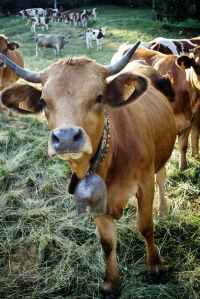
Some years before the team found cows’ skulls set into the walls of one of the buildings they’d excavated, a complete ring of cattle skulls, all placed upside down with the horns facing into the room. The wall had been built up over them, no longer visible, but presumably their presence had been felt by whoever built it.

There are other sites over Europe where cattle skulls have been found and often a rush to come to conclusions, resulting in dramatic headlines of massacre or sacrifice, but this team have a different take on it, believing them to have had symbolic or aesthetic significance.

‘Remember’, said Graeme, ‘these animals would have had biographies. They would have been known as individuals. As personalities. Spoken about.’
‘Named?’
‘Maybe.’
‘You think they revered their cows?’
‘Worshipped!’ Hazel Laughed.

Photo by Flickr on Pexels.com

She meets a couple who are organic cattle farmers, it seems like the only living link to the Neolithic people. They moved onto the farm one day and ploughed up the ryegrass the next, to plant a species-rich herbal lay, with thirty varieties of grass, which has seen a great increase in insects and wormcasts. They now have a herd of twenty-three milking cows. With names. And personalities. And a bull named Eric.

‘Lots of bulls here are called Eric. I think its a Viking thing.’

The couple make an artisan cheese in the style of alpine French cheeses called ‘Westray Wife’ a little picture of the Neolithic figurine features on their labels.

In the second part of the essay she returns for the end of the season, the closing of the site and in the third part she writes the story of the Neolithic people, the culmination of observation and imagination.

Surfacing

Although ‘Surfacing’is a metaphor which aptly describes the book’s theme and is appropriate for narratives about archaeological digs, it is also the title of a vignette about the author’s mother and grandmother.
Your losing their voices. When did that happen? You’re forgetting the sound of your mother’s voice,and your grandmother’s. They died within eighteen months of each other a decade ago and today you realise you can’t quite bring their voices to mind.

A Tibetan Dog

A wonderful little essay that recounts an experience with a little terrier in a Tibetan town and his return in a dream many years later, a symbol she interprets on awaking, like a message from the subconscious she immediately understands.

The Wind Horse

Photo by Arti Agarwal on Pexels.com

The final longer essay is one pulled from old notebooks and memories of her twenty-seven-year old self, travelling far from home, a woman who wanted to become a writer, starting out.

It is notably different to the earlier essays, more of a travelogue, less present, more self-conscious, there’s a passivity to travelling through a place without purpose, looking at it from the outside.

I could look and smile, but what did I learn of their lives, the prostrating Tibetan pilgrims, the stallholder deftly working an abacus, the ice-cream girl with her barrow, who sat with her chin in her hands when business was slack? Nothing at all.

A tall monk who wore brown robes and a topknot staying at their hotel.

He may have been a Taoist, he may have been Japanese, I don’t know, and I regret that I didn’t try to speak to him.

This reticence highlights what has become one of her strengths, prominent in the earlier pieces. What has also surfaced is Jamie’s generosity and respect for those she interacts with, she gives voice to others, her observations are an amalgam of her own observations and insights and those of the many other passionate participants or locals she encounters in her meanderings. She is not the lone observation, she is a gatherer of insight.

I so enjoy and value how the essays draw you in to her experience, she achieves just the right balance of nature and humanity, of observation and interaction, of imagination and reality. Her work is like a patchwork quilt, made up of different colours and textures, bringing in all the elements that make a community, whether its 5,000 or 500 years old or from the present day.

This could well be her best collection yet.

Surfacing I by Kathleen Jamie

Kathleen Jamie writes creative nonfiction. Some people call it nature writing, some travel writing, others describe it as lyrical prose.

In her first book of essays Findings, she talks about her attempts to observe better, to stop naming things, to really see. She wants to move away from labelling and identifying, towards painting a picture with words.

Surfacing is her third collection and it’s brilliant, practiced in the art of observation she takes us with her on a voyage, helps us see with the eye of a naturalist, sharing her experience with respect for the environment, acknowledging the privilege.

A poet and bird watcher from Scotland, her essays are compelling and engaging, they draw you in as if you were there.

I’m writing about Surfacing in two parts, because the third essay, the longest, is 86 pages and deserves it’s own post, the majority are short vignettes of 3-6 pages. There are three essays of significant length and I’ll write about the reminder in Surfacing II.

The Reindeer Cave

Photo by Pixabay on Pexels.com

In the first essay, written in the second person ‘You‘, the author has hiked up a glen to the cave, thinking about the Ice Age and the preciousness of life, as she observes six red deer on the hillside opposite, equally startled no doubt.

Not half an hour ago you were walking beside the burn in a narrow ravine further up the glen. You heard something, glanced up to see a large rock bounce then plummet into the burn twenty five yards in front of you. The echo faded but your heart was still hammering as you backed away.

Deep within the hillside, in the passage of an underground stream, the bones of a bear were found by cave-divers. Carbon dated, they were found to be forty-five thousand years old.

A long sleep, even for a bear: sixteen million days and nights had passed in the upper world. Long enough for the ice to return, then yield again, then return in one last snap, then leave for good – or at least for now.

At the cave mouth she wonders whether the ice will ever return, a natural cycle, or if we’re too far gone with our Anthropocene.

Next to the last page is a black and white photograph of a valley, mist in the distance; as I look closely I see something  appear out of the mist. This is a book you must read the printed version, or you will miss the apparition.

A Reflection

Photo by Johannes Plenio on Pexels.com

The second essay begins as Jamie is taking a train north (in Scotland), sitting on the landward side she watches wintry fields pass by, passengers on the opposite side have a sea view. Drifting in and out of daydreaming she notices the sea superimposed over fields of brown earth. Then disappear.

A moment later it flashed back again, a stretch of sea, silvery over the land, but only for a few seconds. By now I was sitting up, interested in this phenomenon. The fields on the left gave way to pinewoods, the train tilted a little and, yes, the sea’s reflection flashed on again, this time above the trees. If I narrowed my eyes I could see both sea and trees at once. And now there was a ship! A ghostly tanker was sailing over the pine trees.

She continues to Aberdeen and visits a museum. Interested in Arctic artefacts, it is at the Aberdeen University museum she first hears about archaeologist Rick Knecht and his work in Alaska, the subject of the next essay.

In Quinhagak

Jamie takes a six-seater plane from a small airport in Alaska, where pilots enter the waiting area, call out the name of their village then lead passengers across the tarmac. Nervous because the name is so unfamiliar, she hears the call for Quinhagak and follows two other passengers behind the pilot to the plane.

The pilot had long red hair tied in a loose bun with a biro stuck through it. In the plane she readied herself, then half turned in her seat.

‘You guys definitely going to Quinhagak? Just checking! Okay. There’s emergency supplies in the back.’

Photo by Pixabay on Pexels.com

The village is the home of the Yup’ik, indigenous people of the circumpolar north; an archaeological site Nunallaq (meaning old village) sits at the edge of the tundra, a couple of miles away near the beach. As the sea erodes the land, it is slowly revealing the 500 year old village and its cultural heritage, its resilience.

The dig is in it’s fifth season, at the end of every season all the finds are air freighted to Aberdeen to be cleaned, preserved and catalogued.

At the end of the excavation, however, there would be a great return. All the thousands of artefacts would go home to the Yup’ik land where they belonged, legally and morally.

The dig is revitalising traditional skills that had been lost, local people interested in the items found are beginning to make replicas, relearning old techniques.

They are people who have learned to adapt. Their houses stand on stilts due to thawing of permafrost. Nothing can be buried. Any warm structure on the ground would cause the ground to melt and heave, collapsing the structure.

Between walks with her binoculars and helping out at the dig, sometimes facing seaward, other times landward, she observes life. At the end of each day people gather at the shed to view the days finds; on the last day of the season there will be a grand ‘show and tell’.

I noticed that people notice. George had noticed me looking.  They notice the bog cotton and its passing, an influx of owls, that there are bears around. The whole place must be in constant conversation with itself, holding knowledge collectively.

Near the end of her stay, she is invited to a birthday party with a couple of others. They arrive, there are introductions, they gave their names.

As we did so, Sarah looked at us from head to toe appraisingly, and then bestowed on each of us a Yup’ik name several syllables long. It seemed to delight her, matching us to these names by I don’t know what qualities.

I understood that these names, which we now bore as well as our own, were the names of family members who had died. So it was as revenants, rather than strangers that we were welcomed into Sarah’s home.

Later when they are introduced to one particular elder with their new Yup’ik names, the mention of those lost people affects the old lady deeply, she hugs them each warmly.

I so enjoy and value how Jamie’s essays draw you in to her experience, she achieves just the right balance of nature and humanity, of observation and interaction, of imagination and reality.

This could well be her best collection yet.

Further Reading

My Review Of: her 1st collection Findings, her 2nd collection Sightlines

Article: Why Thawing Permafrost Matters

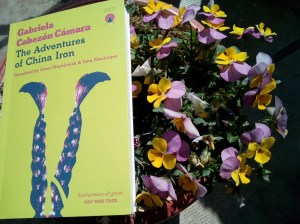
The Adventures of China Iron by Gabriela Cabezón Cámara

translated by Fiona Mackintosh and Iona Macintyre

Wow. This is quietly revolutionary. And funny. Educational. Expansive. Luminous. Brilliant.

I want it to win.

Drawing inspiration from other texts that have in turn been inspired by a life, or experience lived in Argentina, whether the epic poem ‘the gaucho’ Martin Fierro by José Hernández (a lament for a disappearing way of life) or the autobiography Far Away & Long Ago of the naturalist  William Henry Hudson, The Adventures of China Iron is a beautiful elegy (for there will be consolation), a brilliant feat of the imagination that takes readers on an alternative journey.

Review

China Iron, wife of Martin Fierro, who in the original version was given just a few lines, is now the lead and is about to awaken to all that is and can be.

Her adventure is a heroine’s journey from dystopia to utopia, from naive to knowledgeable, from woman to young brother to lover, from unconscious to awakened, from surviving to aware to thriving.

While I was writing I felt I was describing the mind-blowing experience of being a newborn since in China’s eyes everything is new and has the shape and shininess of a new discovery. She is trying out her freedom, travelling for the first time, leaving the tiny settlement in which she had spent her whole life. She is discovering the world, the different paths through it, love. Gabriela Cabezón Cámara

Part One – The Pampas

China was passed over to Martin Fierro in holy matrimony in a card game. She bore him two children before he was conscripted, what a relief. Scottish Liz had her husband Oscar taken in error, so she packs a wagon to go and find the land they’ve procured, taking China and the dog Estreya with her. This is the beginning of China’s awakening, she will learn from Liz and being in nature, on the move.

Who knows what storms Liz had weathered. Maybe loneliness. She had two missions in life: to resuce her gringo husband and to take charge of the estancia they they were to oversee.

Liz informs China about the ways of the British Empire, clothing, manners, geography, Indian spices, African masks. Some things she understands, others take longer to reconcile. She discovers ‘a birds eye view’ from up there on the wagon.

And I began to see other perspectives: the Queen of England – a rich, powerful woman who owned millions of people’s lives, but who was sick and tired of jewels and of meals in palaces built where she was monarch of all she surveyed – didn’t see the world in the same way as, for example a gaucho in his hovel with his leather hides who burns dung to keep warm.

For the Queen the world was a sphere filled with riches belonging to her, and that she could order to be extracted from anywhere; for the gaucho, the world was a flat surface where you galloped around rounding up cows, cutting the throats of your enemies before they cut your own throat, or fleeing conscription or battles.

China leaves behind neglect and enters the realm of non-violent company, nourishment and knowledge. She comes to think of the wagon as home and falls for Liz’s charm. They track Indians by examining the dung of their animals. When they see it’s fresh, they stop and change.

I took off my dress and the petticoats and I put on the Englishman’s breeches and shirt. I put on his neckerchief and asked Liz to cut my hair short. My plait fell to the ground and there I was, a young lad.

Photo by Juanjo Menta on Pexels.com

They encounter a lone gaucho (cowboy) Rosario and his herd of cows, he becomes the fourth member of their party. We learn his tragic backstory as well. He laughs at China’s clothing, but says it’s a good idea and that all women should carry a knife the way men do.

We knew he was talking about his mother and how he’d have preferred her to have grown a beard if it meant she’d have stayed a widow with him by her side instead of that monster.

They make slow progress, in part due to China’s desire that this in-between peaceful co-existence, the happiest she’s ever experienced, never ends.

Part Two, The Fort

They arrive at the estancia run by Hernandez, they dress in their chosen uniforms Liz had allocated from the stores inside the wagon;

uniforms for every kind of position on the estancia according to the imagination of the aristocrat and his stewards, Liz and Oscar.

Here they come across the opposite of what they’d found in the plains, here is a world run by the self-righteous Hernandez, who runs his estancia like a dictatorial regime, with strict rules and regulation, reward and punishment, inspiring hatred and allowing revenge. Seeing himself as the seed of civilisation, others as savages with no sense of history and the gauchos as his protegé, he sets out to retrain them in his ways, with a whip and a rod.

Photo by Artem Beliaikin on Pexels.com

Part Three – Indian Territory

In the final part they come into contact with the indigenous population and even the air feels easier to breathe. Here the language changes, perception changes, there is acceptance, equilibrium, reunion.

This whole section reminded me of the shape-shifting shamans, of a higher perception or consciousness, living with the indigenous people allows them to let go of all expectations and see with different eyes.

“Although we have been made
to believe that if we let go
we will end up with nothing,
life reveals just the opposite:
that letting go is
the real path to freedom.”

– Soygyal Rinpoche

I absolutely loved this, I hope it wins the International Booker 2020 thoroughly deserving in my opinion.

Ever since I had the idea of giving China a voice, I had one thing clear in my mind: I wanted her tale to be an experience of the beauty of nature, freedom in body and mind; a story of all the potential and possibilities in store when you encounter other people, of the beauty of light. I wanted to write an elegy to the flora and fauna of Argentina, or whatever is left of it, an elegy to what used to be here before it all got transformed into one big grim factory poisoned with pesticides. I wanted to write a novel infused with light. Gabriela Cabezón Cámara

Further Reading

Interview: International Booker Prize 2020 Interview with author and translators

Sunday Morning Haiku


Spring Morning I

Sun rays pass through boughs

Petals wave back with longing

The lantern waiting.

Spring Morning II

Small branches in leaf

Bow to and fro in union

A family of trees.

Haiku of Life

A haiku is a form of poetry that generally consists of three lines, where the first and last contain five syllables and the middle line is made up of seven.

The subject is usually the natural world, a topic that tends to awaken people to their sense of oneness with nature and the divine.

Every morning at the moment I am reading a chapter of Courageous Dreaming by Alberto Villoldo and this morning I read Chapter Six, Courage As Action, which ends with this exercise to create your own haiku.

He suggests to:

Observe the trees, the grass, the birds and the insects, then write a few poems.  Let go of any judgments such as I can’t do this or I have no talent for writing. Just do it.

At the beginning of each chapter, he shares a thought-provoking quote, I shall end with that. I hope you feel inspired to write a Haiku for yourself too.

Courage doesn’t always roar. Sometimes

courage is the quiet voice at the end of

the day saying, “I will try again tomorrow.”

– MARY ANNE RADMACHER

On Earth We’re Briefly Gorgeous by Ocean Vuong

I loved listened to Ocean Vuong talking about writing, he’s an incredibly articulate speaker and an accomplished poet, his writing sophorific and it is easy to be lulled into it’s cadence and rhythm. I am the kind of reader who often prefers a poet’s prose to their poetry, easily swayed by the poet’s promise of enrapture in the long form.
I loved the premise of this novel, a letter to an illiterate mother, a lofty intellectual promise, a notion that allows for a lack of self consciousness, a daring fearlessness of judgment, knowing she can and will never read it.

This was my second attempt to read fiction after a long pause, and with hindsight, it was not the best choice. I was lured into reading it looking for something other than what I found, or did it lose sight of itself and its intention, a letter to a mother, is it fair that we come to it with expectations? I can only ask that question now with some distance from the narrative because at the time of reading, it was too raw.

For me, it too often felt like the letter writer, the narrator was looking at himself, reliving intimate experiences and I wondered why it was he felt a mother needed to be witness to all of that, in such detail. Yes, it is a beautifully written account, and many have and will read it with little recollection of its purpose and find only beauty in its construction.

The parts I enjoyed most were the recounting of aspects of Ma (Rose’s) and Lan’s lives, the comparison of the nail salon to the tobacco fields, the sacrifices one generation makes for another, the divide between the educated and the uneducated, families fragmented by an internal cultural divide, a sense of loss, the necessity of letting go.

Somehow he managed to survive his proximity to drugs and addiction, thanks perhaps to his intelligence or ambition to express himself, perhaps I wanted less poetry and more story around community and the connections that lifted him out of becoming another statistic. I look forward to seeing what comes next, how he chooses to uses his gift. It is beautifully written, in a lyrical flow, a coming of age incantation, an author to watch.

I was sad to read that the author’s mother passed away in November 2019 at the tender age of 51, Ocean Vuong shared this news and a photo of her on his Instagram page, honoring her, and all working class mothers who had put their heads down through decades of back breaking work so their children could hold their heads up.

Born in war but having lived in peace, she now begins her journey through the bardo. What can a son say to the great loss from which he owes his own life? Only that my world has changed forever. it can never be what it was. it is absolutely less—and yet perennially more because of what you have given me, Ma. you taught me that our pain is not our destiny—but our reason. you gave me all the reasons. thank you. i bow to you. i will see you again. every word was always for you. every sentence a life (- giving) sentence. Ocean Vuong

Further Reading

The 10 Books I Needed To Write My Novel – Ocean Vuong on Herman Melville, Theresa Hak Kyung Cha, James Baldwin, lê thị diễm thúy, and More

Interview: War Baby: the amazing story of Ocean Vuong, former refugee and prize-winning poet by Claire Armistead, Guardian

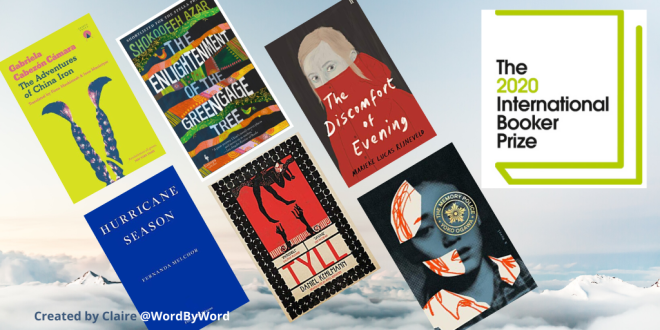
International Booker Prize Shortlist 2020

Today something different as the shortlist has been announced for the Booker International Prize 2020. If you missed the long list click on the link, containing summaries of the original 13 books, as it’s often from the long list that we find the gems! Long List of International Booker Prize 2020

All these books have been translated into English from another language and culture. The judges have gathered and continued their discussion from their respective homes in Lyon, Bangalore, New York, Los Angeles, London and Scotland.

The shortlist features titles translated from five languages: Spanish, German, Dutch, Farsi and Japanese. The shortlisted authors represent six countries and their books examine humanity’s need to understand the world through narrative, either through sharing our own stories, through understanding our histories and origins, or through processing trauma and grief.

Three of the novels, The Enlightenment of the Greengage Tree by Shokoofeh Azar (Iran), The Adventures of China Iron by Gabriela Cabezón Cámara (Argentina) and Tyll by Daniel Kehlmann (Germany) were inspired by their nations’ histories – namely the 1979 Islamic Revolution in Iran, gaucho culture in 1870s Argentina, and the Thirty Years’ War in Germany.

Each of these books borrows existing myths, legends and origin stories but reinterprets these tales with modern sensibilities, celebrating the pursuit of intellectual freedom, the exploration of sexual identity, and survival in the face of political unrest and sweeping illness.

The other three shortlisted titles, Hurricane Season by Fernanda Melchor (Mexico), The Memory Police by Yoko Ogawa (Japan) and The Discomfort of Evening by Marieke Lucas Rijneveld (The Netherlands) all touch on how trauma, whether through violent acts or emotional loss, shape our experiences and approach to the world.

Here is what each of the judges said today in their collective announcement:

We were looking for novels that had a really clear and potent voice. That haunted us and stayed with us. We were looking for novels that were incredibly well translated. Ted Hodgkinson, Head of Literature & Spoken Word, Southbank Centre, Chair of Judges

I think it’s a brave shortlist. We’ve picked books that are daring,  experimental, not at all conventional. This moment that we are living, it has forced each of us to slow down and think about the things we usually take for granted. Valeria Luiselli, Award Winning Author

This shortlist is electric and resonant and absolutely meaningful. It’s a list that each one of us is proud of. Jeet Thayil, Author, Poet & Musician

It was so hard to narrow it down from such an incredibly wonderful long list. Each of them is so expertly crafted and so beautiful.  Jennifer Croft, Translator & Winner of International Booker 2018

It will be just as exciting, just as challenging to narrow this down to the one winner. And I feel that collectively we all believe that each book on this shortlist of six could potentially be a winner. Lucie Campos, Translator, Cultural Director of La Villa Gilet

I had already read two of the titles before the long list was announced, The Memory Police and The Enlightenment of the Greengage Tree. Both are excellent reads and very thought provoking. I’m really happy to see that they’ve both made it through to this stage, which means more people are likely to read them.

I have The Adventures of China Iron on my shelf to read, a result of my Year of Reading Contemporary Latin American Fiction and subsequent subscription to Charco Press, so I might make that my next read, since its piqued my interest further. It’s about a 19th-century woman who flees a gaucho encampment and takes off with a friend on a journey across the countryside. The book, told in verse, is a parody of one of Argentina’s most important historical texts.

Have you read any of these titles on the shortlist?

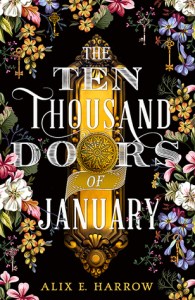
The Ten Thousand Doors of January by Alix E.Harrow

This is the book I took with me on holiday back in January, I’d forgotten about it to be honest. I hadn’t read any fiction for four months and thought perhaps something completely outside my usual genre might ease me back into reading.

I chose it because it seemed like a fun, escapist read, and I was intrigued by the use of doors as portals into other worlds. It reminded me of my childhood reading adventures into Narnia, an era when I devoured fantasy and loved to enter those other worlds outside my own.

I wondered how fantasy had moved on in the 21st century, whether it had the ability to suspend belief in the same way that it had in the past.

Goodreads describes the novel like this:

In a sprawling mansion filled with peculiar treasures, January Scaller is a curiosity herself. As the ward of the wealthy Mr. Locke, she feels little different from the artifacts that decorate the halls: carefully maintained, largely ignored, and utterly out of place.

Then she finds a strange book. A book that carries the scent of other worlds, and tells a tale of secret doors, of love, adventure and danger. Each page turn reveals impossible truths about the world and January discovers a story increasingly entwined with her own.

Today I definitely see and read it through older eyes and I am aware of the underlying commentary about our own world, it’s halls of power, it’s attitude towards otherness, difference, it’s dislike of magic or of those who look as though they don’t belong.

Some of the transitions were vaguely executed which removed a little of the escapist journey I was on, but otherwise I enjoyed it and would recommend it for a light, escapist read, if you like to occasionally read fantasy.