Top Reads 2016

In 2016, I read 55 books, just over my ongoing intention, to read a book a week.

I managed to read books by authors from 26 different countries and 19 of them, just over a third, were translations. My absolute favourite book of the year, was written by an author from Guadeloupe, translated from French into English, and 3 of my top 5 fiction reads were translated.

Outstanding Read of 2016
Bridge of Beyond

The book that has stayed with me, that I loved above all else was Simone Schwarz- Bart’s The Bridge of Beyond, a novel that touched on the lives of three generations of women from the French Antillean island of Guadeloupe, narrated by the granddaughter Telumee as she grows up on the island, learning from experience and the traditions of her culture, guided by the wisdom of her grandmother Toussine, ‘Queen Without a Name’. A masterpiece of Caribbean literature, “an unforgettable hymn to the resilience and power of women,” translated from French, republished as a New York Review of Books (NYRB) classic.

Top 5 Fiction Reads

Human ActsHuman Acts, Han Kang (South Korea) tr. Deborah Smith

As much a work of art as novel, Human Acts is an attempt to understand a despicable act of humanity through story telling, Han Kang was one of the most thought provoking authors of 2016 for me, equally incredible was her novel The Vegetarian, which won the Man Booker International Prize in 2016.

What Lies Between UsWhat Lies Between Us, Nayomi Munaweera (Sri Lanka)

Like The Bridge of Beyond, Munaweera’s work is evocative of place and she brings a childhood in the gardens of Sri Lanka alive. A woman remembers her past from behind the walls of a cell, and as she reveals her upbringing and the changes that brought her family to live in America, we wonder what went terribly wrong, that caused her to lose everything. And best book cover!

zoraTheir Eyes Were Watching God, Zora Neale Hurston (USA)

I finally read this great American classic and it was absolutely fantastic, another story that touches on multiple generations of women and how the lives of each affects the other, as they all wish a different life for the future generation. Janie is determined to live her life differently, but some lessons have to be lived thought and not told. The prose is astounding, melodic and the whole reading experience one I’ll never forget.

FirdausWoman at Point Zero, Nawal El Saadawi (Egypt) tr. Sherif Hetata

An internationally renowned feminist writer, activist, physician, psychiatrist and prolific writer, I’d been wanting to read her for some time and during August, reading books by Women authors in translation #WITMonth was the perfect opportunity. And what a novel! Inspired by real events, after she was given the opportunity to interview a woman who had been been imprisoned for killing a man and due to be executed, she retells this story of Firdous, too beautiful and poor to pass through life unscathed, who finds the desire to lift herself and others out of oppression and will pay the ultimate price. Haunting, beautiful, a must read author and book!
Days of AbandonmentDays of Abandonment, Elena Ferrante (Italy) tr. Ann Goldstein

The year wouldn’t be complete without Elena Ferrante, the reclusive Italian author whose identity was outed this year, although I didn’t read any of the reports, preferring she remain as unknown to me now as before. Days of Abandonment was published before her popular tetrology which began with My Brilliant Friend and is a compelling, searing account of one woman’s descent into semi madness following abandonment by her husband, in the days where the hurt prevents her from seeing things objectively and her rationality leaves her. It’s full of tension, as she has two young children and Ferrante uses her incredible talent to make the reader live through the entire uncomfortable experience of this roller coaster ride of temporary insanity.

Top Non Fiction Reads

Memoir

Brother Im DyingBrother I’m Dying by Edwidge Danticat (Haiti)

A beautiful memoir of her father and his brother, alternating between Haiti and America, it is a tribute to a special relationship and an insight into the sacrifices people make to better the lives of others, whether its family or their community. I’ve read her novel Breath, Eyes, Memory she is a wonderful writer with a gift for compassionate storytelling.

why-be-happyWhy Be Happy When You Could Be Normal by Jeanette Winterson (UK)

Wow, this is the adoption memoir that tops all others, a literary tour de force, an entertaining, horrifying account of a young girl’s childhood, survived by a strong passion for life and literature that gets her through some tough moments and develops an iron will to pursue the joy that appeals so much more than the conformity her mother sought. Brilliant.

woman-on-the-edgeA Woman on the Edge of Time by Jeremy Gavron (UK)

Less a memoir of the son, than one of his obsession to understand why his mother, when she appeared to have everything a young woman would ever want, decided to end it all. Having never asked questions about his mother’s suicide, Jeremy Gavron, now a father of two girls becomes obsessed with knowing who she was and what pressures lead her to her end. Early 1960’s insight.

The Blue Satin NightgownThe Blue Satin Nightgown by Karin Crilly (US)

A reading highlight of the year for me, I’ve seen Karin’s book go through many stages leading to publication this year, in my review you’ll read how I was involved a little in its development. I knew it would be a success, as we sipped champagne together in Aix after she won the Good Life in France short story competition for the first chapter, Scattered Dreams. Last seen, Karin and her friend Judy were in China continuing their adventures, which age will never hamper and there’s a mysterious new man appearing in her recent Facebook posts, suggesting she may be writing a sequel perhaps?

Soul Food

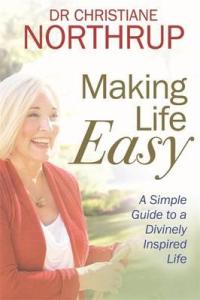
This year, in particular after the harrowing experience accompanying my 14-year-old daughter through back surgery to correct a curvature of the spine, I read a few books by authors published by Hay House, whose radio show I often  listen to. I’m already a fan and follower of Colette Baron-Reid and her book Uncharted came out this year, and through her I discovered, listened to and read What if This is Heaven by Anita Moorjani, Making Life Easy by Christiane Northrup and I’m still slow reading a few others. During challenging times, these authors are a soothing balm, reminding us of much we may already know, offering an alternative perspective on how we see things and tips for remaining grounded and healthy in body, mind and spirit.
Special Mentions
how-to-be-braveUnforgettable Reading Experience Ever: How to Be Brave, Louise Beech(UK)

I couldn’t let the year pass without mentioning the extraordinary reading experience of Louise Beech’s How to Be Brave. I read this book while I was in the hospital with my daughter and it was surreal, a captivating, incredible story, based partly on true events, both those of the author and her daughter, who are both coming to terms with a recent diagnosis of Type1 diabetes and a retelling of her grandfather’s epic journey lost at sea, after their ship was destroyed.

Bonjour TristesseBest Translations: Bonjour Tristesse(France) & The Whispering Muse (Iceland)

Two fabulous novellas, from Iceland, Sjón’s The Whispering Muse was my first read of the year for 2016 and I loved it, it’s a kind of parody of The Argonauts and had me looking up references to the Greek classic and enjoying both the story and its connections.

Bonjour Tristesse is an excellent, slim summer read, of a young woman’s regret, a heady summer on the French Riviera, engaging as she has a deft ability to portray her minds workings and see herself interacting with the others, aware of her own manipulative ability and yet unable to stop herself. Brilliant.
GeorgiaBest Fictional Biography: Georgia, A Novel of Georgia O’Keeffe, Dawn Tripp (US)

I love the work of the artist Georgia O’Keeffe, she’s probably my favourite artist in fact. And she was an incredible woman, who lived a long time and had an intriguing relationship with her husband, who discovered her as one of his protege, the photographer and gallery owner Alfred Steiglitz. Dawn Tripp has done an outstanding job of researching her life, bringing to this novel, insights from new material available and succeeds in doing what hasn’t really been done before, channelling the voice of the artist, providing a perspective that is loyal to the artist and how she may have thought.

Brief HistoryBiggest, Most Satisfying Challenge: A Brief History of Seven Killings, Marlon James (Jamaica)

Written a large part in Jamaican patois, with a wide array of characters, this 700+ page book won the Man Booker Prize in 2015 and was my summer chunkster for 2016. I gave it 5 stars for sheer effort, even though it’s not really my style of book, I tend to prefer the stories by women writers from around the Caribbean, Marlon James is perhaps too modern for me, he moves his story out of generational tradition and into the cold, dark, masculine front lines of survival, jealousy and ambition in a trigger happy, drug induced frightening world that is far from sleepy villages I prefer to inhabit.

Biggest Disappointment: The Fox Was Ever the Hunter, Herta Muller (Romania)(DNF)

It wasn’t on my reading list and I should have listened to my instinct, but since I was reading books by women in translation and I’d been sent this by the publisher (unsolicited), and it was a novel by a Nobel Prize winning author I attempted it. Impossible. Incomprehensible. Stop. Prize winning authors and books should be looked at like any other book I tell myself, forget about what a committee of 18 Swedish writers, linguists, literary scholars, historians and a prominent jurist with life tenure think, they are not you.

Well that’s it for 2016, another great reading year!

What was your outstanding read for 2016?
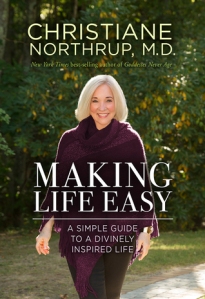
 

Making Life Easy, A Simple Guide to a Divinely Inspired Life by Christiane Northrup, M.D.

making-life-easyThis was my first read of Christiane Northrup, despite the fact she’s written lots of books, with titles like: Goddesses Never Age: The Secret Prescription for Radiance, Vitality, and Well-Being, The Wisdom of Menopause: Creating Physical and Emotional Health and Healing During the Change and Women’s Bodies, Women’s Wisdom: Creating Physical and Emotional Health and Healing (39 editions published).
In this newest title however, she say’s she’s ‘coming out’ in relation to her spiritual beliefs in a way she has not done before, relying on the banner and weight of credibility of her medical qualifications, which has allowed her to write about more mainstream subjects related to health, ageing and women’s afflictions. Now she reveals another side to her rituals and practises, bringing oracles, angels and raised vibrations into her mainstream medical world.

The first section where she speaks about her spiritual life and the lessons and courses she did to learn the things she has made part of her life was the stand out part of the book for me and a strong affirmation to come across a women from such a traditional profession being so open and honest about her beliefs and experiences beyond the five senses.

“We’re here to develop faith – faith in things that our five senses can’t see, touch, hear or feel and that our intellects can’t prove…clinging to logical, rational, linear thinking is what keeps life hard.”

In essence her message comes down to a basic premise, her philosophy about living an easy life:

“To live an easy life, you have to align with the Divine part of yourself? In fact, you have to let it lead your life. This is not the same thing as waiting for some kind of Divine force outside of you to come swooping in to rescue you from your life. That’s not how it works. You have to make changes.”

She warns that the logical left-brain may find the information she shares challenging, the part that’s always looking for scientific proof, something that is increasingly being discovered in the metaphysical world, which means that many more people are seeing these kinds of developments as more mainstream than they were 20 or 30 years ago.

Christiane Northrup shares the turning point in her life that lead her to develop an interest in the true nature of self – of ego, spirits, souls and combined with her medical knowledge she developed a more holistic way of regarding the health of our emotional and spiritual bodies.

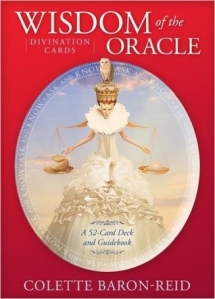
wisdom-oracleThe health and sexuality sections held less interest to me, probably because I was attracted to the book after listening to her speak in a ‘raw and real’ conversation with my favourite ‘intuitive’ Colette Baron-Reid, in that conversation it was the more spiritual aspects that were under discussion, particularly as Colette’s book Uncharted: The Journey through Uncertainty to Infinite Possibility had been published in October 2016. Northrup is a fan of Colette Baron-Reid and mentions that she uses her Wisdom of the Oracle card deck as one of her spiritual tools for guidance.
In fact, she makes quite a number of recommendations regarding authors and people whose work she is interested in and follows, so there is plenty for readers to follow-up on if interested.

“The connection between our thoughts, our emotions, our beliefs, and our biology has now been thoroughly documented by many, including Dr. Bruce Lipton in his book The Biology of Belief and Dr. Mario Martinez in his book The Mind Body Code – a book in which he also describes the devastating biological effects of shame, abandonment, and betrayal.”

She discusses astrology, prayer, ego, soul, medical mediums, communication with the divine, practises to raise your vibration and clear energies, signs and symbols, angels and synchronicity, dreams, oracle cards, tarot readings, psychics, explaining each thing and how people use them, sharing her own experience. She demystifies everything in a grounded, common sense way.

making-life-easy2She also discusses thoughts and inputs, the effect of what we are constantly exposed to and how it should be managed in order to avoid overdosing on negativity and the toxic, fear-enhancing effect of the media for example. She discusses the positive power of affirmations, meditation, gratitude, the power of giving and receiving, connecting with nature, tapping and much more.

“No human being has nervous, endocrine, and immune systems that were designed to process the negative news from all over the planet that’s being piped into their living room on a daily basis.”

“On a purely physical level, fear lowers our vibration and makes us far more susceptible to viruses and bacteria. The biochemical state that fear creates in our bodies adversely affects our immunity and increases our susceptibility to the pathological viruses and bacteria that are all around us.”

I think this will make a significant contribution to bringing a wider and more mainstream audience into the realm of the spirit and the divine, showing us alternative ways to navigate life’s mysterious pathways with faith, confidence, patience and compassion, providing us with small easy practises to help raise our vibration, reduce fear and be open to messages and signs.

“Inspiration from a higher source can’t reach you when you are in the low vibration of states like anger, sadness, and fear. To make life easy, we have to get out of our own way as we seek to get in touch with the Creator.”

souls-tribe

Click Here to Buy a Copy of Making Life Easy via Book Depository

Note: This book was an ARC (Advance Reader Copy) kindly provided by the publisher via Netgalley.

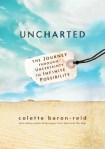
Uncharted, The Journey Through Uncertainty to Infinite Possibility by Colette Baron-Reid

livia-unchartedI’ve been listening to Colette Baron Reid’s insights for a while, I often look up her wisdom cards online and follow her YouTube channel weekly forecast of the prevailing energies, something she calls a ‘prescription‘ for thinking about and working with our thoughts, feelings and beliefs as they encounter the energy that is presenting for the week.

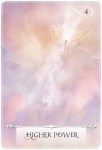
She’s down to earth, has a sense of humour and doesn’t take herself too seriously. Her insights help us focus on whatever is happening in our life today or this week in a more healthy and objective way, it’s a kind of weekly wake-up call. Here’s an example of her cards, each one comes with an explanation, you can select them yourself on her website here. You’ll either relate to them or not, only use them if you find they resonate, if not, something else might work for you.

She’s continuously learning from others and sharing her insights and admits to having regular bouts of ‘spiritual narcolepsy’, her term for knowing what it is you should be doing to stay in equilibrium in your life, but falling asleep at the wheel.

“when you temporarily fall prey to fear or subconscious triggers that cause you to forget that you have a co-creative partnership with spirit, that you are in fact, a part of spirit. You forget that the material world is not the primary reality and start to look at outer conditions as a way to orient yourself, instead of tuning within to get where you’re at.”

I was intrigued to read her book and pre-ordered it in Sept 2016, giving me access to an incredible gift of ‘real and raw’ conversations she had with people whose work she admires like Gregg Braden, Joe Dispenza, Anita Moorjani (their conversation linked here), Dr. Cristiane Northrup and others. Those conversations provide an excellent pre-text for reading the book, because we understand more thoroughly where she is coming from and where she is currently at in her own evolution on the path of co-creation with spirit.

Anita Moorjani

Anita Moorjani

You may recall I reviewed Anita Moorjani’s book What if THIS Is Heaven? shortly after listening to their conversation. Anita Moorjani is an excellent speaker, and has a remarkable life story (which she writes about in her inspirational memoir Dying To Be Me, she is especially beneficial for anyone with health issues, or confronting a recent diagnosis, and for those in good health, how to stay there! Her tips aren’t what you usually hear from the medical profession, but make a lot of sense.

Uncharted isn’t as easy to absorb as those conversations are, because it forces the reader to participate and consider certain things while reading, whether you wish to or not. And a conversation contains questions and answers that we can perhaps more easily relate to, it’s more engaging to see people presenting a subject in conversation than writing about it. It is a book you’ll want to reread, it provides a way of looking at reality and preparing for the unknown in front of us, or the “uncharted” as she calls it.

Many people approach the unknown with fear, others with anticipation, regardless of how you perceive it, Colette offers a process of approaching that uncharted, unknown future reality, with more calm and greater confidence, through developing a relationship with spirit – by learning how to “co-create” with spirit, by following a process.

This process takes the reader through five realms of co-creation, the realm of spirit, of mind, of light, of energy and form. She talks about how mostly within our five senses (our small self), we spend most of our time and energy in that last realm of form, of action, of intellect, of making things happen. Co-creation takes a step back and considers another way of doing things, of seriously training and developing what some refer to as the sixth sense, but which she refers to as the first sense, intuition.

“Intuition is an inherent primary skill, our first sense, and a gift from the Realm of Spirit that we discover and use in the Realm of mind to access insights, information and energy the intellectual part of the mind can’t conceive.”

how-to-train-your-dragonIt’s a consciousness raising view of reality, one that will resonate with enlightened readers, empaths, those familiar with working with energies and the open-minded.

If you want to learn how to tame your dragons, this is a great place to start.

Highly Recommended!

Click Here to Buy a Copy of Uncharted


A Woman on the Edge of Time: A Son’s Search for His Mother by Jeremy Gavron

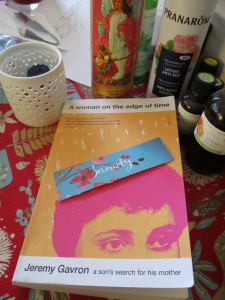
img_0485A Woman on the Edge of  Time is a memoir that reads like a mystery, as Jeremy Gavron, a journalist, interviews family, old school friends, neighbours and colleagues of his mother Hannah Gavron, whom he has little memory of.
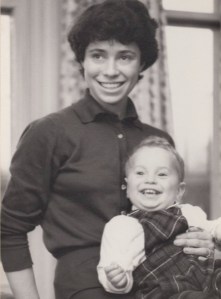
It documents his long-delayed search for a greater understanding of why she took her own life at 29 years of age, a married, working mother of two boys aged four and seven, living in Highgate, London.

It was 1965, she had been on the cusp of publishing a manuscript encapsulating the findings of her sociology research into the conflicts faced by young housebound mothers in North London, The Captive Wife. It was two years since another mother of two young children Sylvia Plath, had done the same thing.

Hannah Gavron was an out-going, confident child, an accomplished, confident teenager, popular and desirous of growing up. She wanted to do something with her life, to share her views with the world, but she also wanted freedom, to leave the constraints of family, to be in love, to claim her place in a rapidly changing society. She married at 18, went to RADA drama school for a year, quit, had two children, then realising her prospects were limited, went back to university to study sociology, attained a PhD and then a teaching post at the “iconic British art institute”, renowned for its experimental and progressive approach, Hornsey College of Art.

It seemed she had everything going for her, and yet at that tender age of 29, when her youngest son Jeremy, was 4 years old, she took her own life, shocking everyone around her.

Now the father of two girls himself, having previously just accepted the subject of his mother was a taboo subject never raised, he is seized by an urgency to know and understand the mystery, for how could it happen that a woman with so much going for her, two small children and a manuscript about to heighten her career, could suddenly end it all?

He interviews an extraordinary number of people and succeeds in recreating the jigsaw of Hannah’s life in incredible detail and begins to understand the multiple forces that may have played a part in leading up to that tragic decision.

As gripping as any mystery, it reads like a pageturner providing an interesting insight into the subject Hannah Gavron wrote her thesis about, ‘The Captive Wife’ and the struggle of women in the early 1960’s, a period just prior to the second wave of feminism, an era whose attitudes and dilemmas were encapsulated in Doris Lessing’s powerful account of a woman searching for her personal and political identity, The Golden Notebook, published in 1962.


Looking back from our own times, the subject seems an obvious one, still relevant today, but in 1960 it was neither obvious nor easy for her to get past her academic supervisors. For all the advances gained by the suffragette movement, and the opportunities the war had given woman to work and experience life beyond family,  the woman’s movement was in retreat in the 1950’s and early 1960’s. in the post-war period, emphasis had been put on the role of motherhood in rebuilding Britain. The Beveridge Report, the basis for social reforms, spoke of how ‘housewives as mothers have vital work to do in ensuring the adequate continuance of the British race and of British ideals in the world’.

A woman attempting to forge an academic career in sociology at the time and proposing studies which focused on women as the subject, was provocative and a gesture not ready to be accepted by many in power in academia.

In Her Wake, Nancy Rappaport

In Her Wake, Nancy Rappaport

It reminded me of reading Nancy Rappaport’s In Her Wake: A Child Psychiatrist Explores the Mystery of Her Mother’s Suicide, she too was 4 years old when her mother, who was raising a large family as well as being involved in organising society events and political campaigning, suddenly committed suicide. That drama took place in 1963 in Boston.

They are tragic stories and serve to create a more substantial memory for the authors, piecing together the lives of these woman who should have been able to contribute so much more than they did.

It left me wondering about the author himself, as he keeps himself well out of the narrative, not shining any light on how it had been for him to grow up under this shadow, this absence. How was it for him to accept the love of another mother, how might this turning point have influenced who he would become. Rather he shines his light outward and builds an incredibly detailed vision of his mother, leaving just a hint of suggestion that within her, we may also finds parts of him.

Further Reading

The Guardian, Nov 2015 – Jeremy Gavron: ‘My mother was a woman who looked for solutions. Suicide was a solution’

The Guardian, Apr 2009 – ‘Tell the Boys I Loved Them’

Buy a Copy of A Woman on the Edge of Time Here


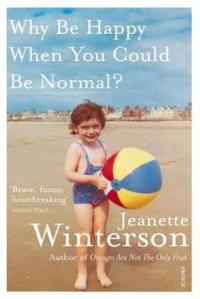
Why Be Happy When You Could Be Normal? Jeanette Winterson

why-be-happyThis stylised memoir, set in the working-class north of England, is the book Jeanette Winterson wasn’t ready to write back in 1985 when at 25 years of age, she wrote the novel Oranges Are Not the Only Fruit, a book that plunged the reader into her universe, one that provided the author the liberty of narrating freely, without the confines of the story having to have been exactly as she had lived it – it was fiction, an imagined story, and she named the main character Jeanette, a provocative gesture for sure.
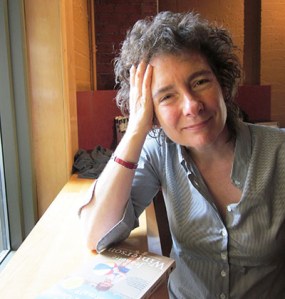
It was indeed inspired by her own experience, as we discover when she braved it and published this memoir nearly 30 years later (her adopted mother no longer living or able to be disapproving of her work), providing for the title, a quote from the mother who had been unable to shape the little human she acquired into her version of a normal daughter.

In her memoir she allows the real life characters to reveal parts of themselves, in particular Jeanette and the woman who raised her, whom she refers to as Mrs Winterson (her adoptive mother), a telling detail in itself, that she reserves the title of mother for the woman who is a shadowy illusion for most of the narrative; not there, not looked for, a vague presence in her psyche that she continuously rejects the thought of, her biological mother. I did wonder whether this was a literary invention or whether she actually did refer to her adoptive mother as Mrs W. It makes quite a statement.

‘I do not know why she didn’t/couldn’t have children. I know that she adopted me because she wanted a friend (she had none), and because I was like a flare sent out into the world – a way of saying  that she was here – a kind of X marks the spot.

She hated being a nobody, and like all children, adopted or not, I have had to live out some of her unlived life. We do that for our parents – we don’t really have any choice.’

Despite what was likely to have been a desperate desire for a child, Mrs W. dolled out punishments and criticisms more than any form of affection or love for her chosen child. When her mother was angry with her, Mrs W. often repeated one of her preferred biblical phrases “The Devil lead us to the wrong crib”. The Church was like family (though unsuccessful in helping them make friends) and the Bible one of only five books in the house, the one referred to most often. The most regular punishment however, was to lock her in the coal-scuttle or out on the door stoop – for the whole night.

‘Dad’s on the night shift, so she can go to bed, but she won’t sleep. She’ll read the Bible all night, and when Dad comes home, he’ll let me in, and he’ll say nothing, and she’ll say nothing, and we’ll act like it’s normal to leave your kid outside all night, and normal never to sleep with your husband. And normal to have two sets of false teeth, and a revolver in the duster drawer…’

It is a collection of anecdotes, written in a way to make the reader present, it’s not like reading an account of the past, it’s reliving days in the life of this fierce little battler, a girl who had a zest for life, who used her locked up time to invent imaginary characters, who made up stories, who forged her own personality through, who would not be tamed, who left home while still at school, taught herself to drive, lived in a car for a while and remarkably pushed herself forward as one of the ‘experimental’ working-class contenders for a place at Oxford University and succeeded.

Jeanette Winterson Photo by Sanhita SinhaRoy

Jeanette Winterson, Photo by Sanhita SinhaRoy

Jeanette Winterson writes her own story, forged over a past she didn’t know, that she tried to convince herself wasn’t important until driven almost mad and finally would follow through to unravel the missing link.

Her experience with Mrs Winterson is told with as much compassion as is possible, the facts related in a way that leaves the reader to judge and most will wonder why Mrs Winterson desired a child or was deemed fit to be given one at all.

It is an extraordinary account of childhood and growing up, of what home is, of how we perceive and learn love, of adoption, of how those formative years contribute into making us what we will become and that mysterious ‘other life’ that might have been, when you’ve been switched to alternative parentage post birth.

I never wanted to find my birth parents – if one set of parents felt like a misfortune, two sets would be self-destructive. I had no understanding of family life. I had no idea that you could like your parents, or that they could love you enough to be yourself.
I was a loner. I was self-invented. I didn’t believe in biology or biography. I believed in myself. Parents? What for? Except to hurt you.

It is also a tribute to literature and to the power of stories to influence lives, whether they are an escape for those who need refuge and to understand the world around them, or whether they are the occupation of the oppressed, a creative outlet for someone with nothing but their imagination to keep them entertained while enduring their struggle.

Buy Why Be Happy When You Can Be Normal? via Blackwell’s

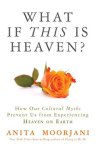
What If THIS is Heaven? How Our Cultural Myths Prevent Us From Experiencing Heaven on Earth by Anita Moorjani

anita-moorjani-heavenAnita Moorjani wrote her first book Dying to Be Me: My Journey from Cancer, to Near Death, to True Healing after being tracked down by the late Wayne Dyer, who’d come across her story on the internet and wanted to know more about what she had experienced on the day she had been expected to die but miraculously returned from stage four cancer to heal totally and live.
Prior to Wayne Dyer’s intervention and guidance Anita hadn’t really wanted to share her story anymore after she came under the intense focus of doctors and the medical community all trying to understand the science behind how she recovered – because it wasn’t attributed to any medical intervention and defied all medical logic. She found these engagements emotionally stressful, and energetically draining – all she could really tell them was what she had felt and experienced – something not one of those medical experts had ever experienced themselves, yet despite the proof of her living self in front of them, they seemed to not want to accept it, because they had no paradigm within which to explain it. So she stopped sharing the story and refused all further invitations.

She wrote one description of what happened to her and posted it with just her first name on the internet and went back to her life. Some long time after, a friend asked her to speak at an event for people interested in healing and she explained again the reasons why she had to say no. Within those reasons, lay the very essence of what this friend wanted her to share with the group and with a little persuasion, albeit reluctantly, she agreed. She went to the event and was surprised at the difference in the reception, a very different group of people and energy, those who had some inkling of what she had experienced and were open and eager to hear about it without judgement. The day after she opened up to this welcoming group Wayne Dyer’s assistant contacted her and that became the beginning of her sharing her story more widely and led to the publication of that first book mentioned above.

I haven’t read her first book, I came across her after listening to a one hour conversation between her and Colette Baron-Reid (one of my favourite intuitives to listen to). Colette has a book coming out at the end of September Uncharted: The Journey through Uncertainty to Infinite Possibility which I’ve pre-ordered and can’t wait to read and in the lead up to her publication, she recorded 12 conversations with very interesting and enlightened people working in the spiritual/quantum physics world, in a ‘real and raw’ series of unplanned conversations. After listening to Anita Moorjani talk, I decided to get this, her new book, What if This is Heaven to read more about how what had happened to her had changed her life in this second phase – after the focus on her NDE (near death experience) had cooled and how the things she learned have continued to manifest and inform her life today.

And it’s brilliant – it reads like just the beginning of the gifts she has been given in terms of insights into how reality really is and how she is called to respond to them, because the reality is that she is back living in the material world, where we perceive little of the other dimensions that exist but aren’t able to be perceived with the 5 senses of the physical self – and our 6th sense, intuition (or as some call it – the 1st sense) while well-developed at birth and during childhood has often by adulthood been drowned out by culture, system, society, parental direction, media, politics, Fear + noise.

The most significant truth she experienced in that state between life and death was the connectedness of everything and everyone and the great power of unconditional love, a phrase that is often used and little understood, but one that by the end of this book, we understand better than ever and in particular the importance of first applying it to ourselves, before we are ever able to apply it to others.

You can’t love another unconditionally until you love yourself unconditionally, and when you truly do that achieve that, you will never allow anyone to use you or abuse you.

Here she takes just a few of what she calls myths and offers an alternative truth through first describing her own experience or an encounter she has had with someone who highlighted that truth. The myths, which we have learned or been conditioned by in our society/culture/family that she explores are:

Anita Moorjani

Anita Moorjani

‘You get what you deserve.’
‘Loving Yourself is Selfish.’
‘Real Love Means Anything Goes.’
‘I’m not Ok, You’re Not Ok.’
‘It’s Just a Coincidence.’
‘We Pay for Our Sins at Death.’
‘Spiritual People Don’t Have Egos.’
‘Women Are the Weaker Sex’
‘We Must Always Be Positive.’

Ultimately, she is a woman who doesn’t set out or even believe she is here to inspire, she is following her heart and attempting to live an authentic life and through sharing her story and the things she has learned, does inspire people and help make us see things we feel intuitively but may not practise in our lives.

Authentic unconditional love means wanting for another what that person wants for themselves and allowing that person to be who they truly are – even if it requires setting them free – instead of expecting them to change to fit our ideas of who we want them to be.

Highly recommended.

Click Here to Buy a Copy of What If This is Heaven? now!

The Blue Satin Nightgown by Karin Crilly #memoir

Tell me, what is it you plan to do with your one wild and precious life? Mary Oliver, Poet

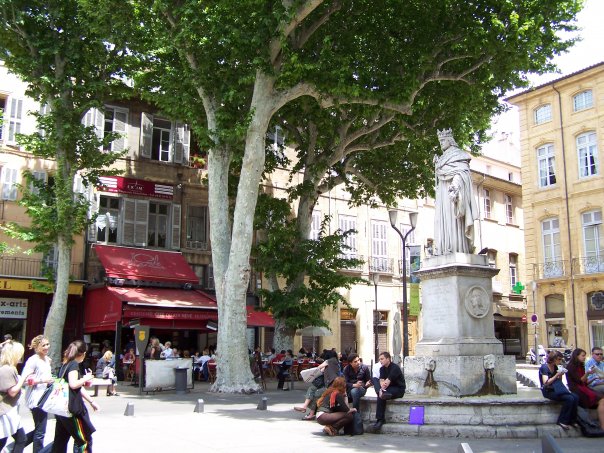
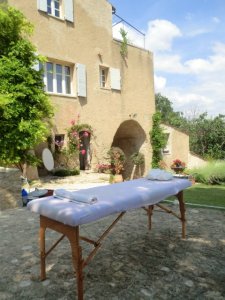
Outdoor MassageA few years ago a lady who had recently moved here to Aix-en-Provence contacted me in relation to Flairesse, my aromatherapy therapeutic massage business. She became a regular client and over time I got to know her well, discovering a mutual interest in culture, books and writing. She had a strong passion for travel, the lives of others and the excitement of discovery, which was the name of a blog she’d set up to keep a record of her adventures while living in France.

I learned that she was writing a book, which had initially been planned to be a collection of a dozen or so stories she had related to her clients over the years, (she had been a Marriage and Family Counsellor for 30 years in Southern California) these stories had been her way to illustrate a particular teaching, something she had found that people absorbed more easily through storytelling than being given the lesson directly.

However, and given her adventurous spirit, it came as no surprise to me, once she sat down to write it, she realised that looking back and recounting the past, the stories she had spent 30 years narrating, no longer excited her, so she decided to change direction and push her focus forward, towards the unknown lifescape before her and share this grand adventure she had embarked on, three years after her retirement, at the unstoppable age of seventy-eight.

Every month, I would hear how the book was progressing and I’d also hear about Karin’s latest travels, culinary adventures, her move to a quieter apartment, her daily five Tibetans rites of rejuvenation ritual, and always that infectious laugh and sense of fun she had about life. I lent her a few writing books and then suggested she might like to enter The Good Life France writing competition, 1,000 words about France – about memories, a favourite place, or something you love about France.

good lifeExcited about the opportunity to put her writing skills to the test, Karin took the first chapter of her book, moulded it as much as she could to meet the criteria, sent it to me to look over and to make recommendations on how to whittle it down further without losing any of the content and then sent it off! We came up with the title ‘Scattered Dreams’ and a few weeks later heard the fantastic news, a confirmation if ever any was needed of how realistic this dream was in coming to fruition, that she had won first prize! She was now published and on her way to fulfilling that goal of becoming an inspirational author.
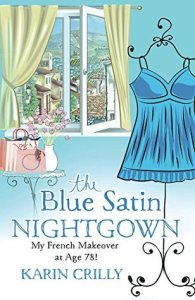
And so, today I am delighted to be able to introduce you now to published author Karin Crilly, and the book that made its first chapter appearance in The Good Life France where it was so fabulously awarded the recognition it deserved – The Blue Satin Nightgown, My French Makeover at Age 78.

I had to share this photo which Karin sent me one night as I was scribbling notes over one of her chapters in the book, (after that first success, I read all her manuscript and tried to concentrate on making notes for feedback, which was difficult, as her stories were so entertaining and often had me open-mouthed in surprise).

She’d told me she was going to an Elton John concert earlier in the evening and then later this picture arrived, showing her accepting a lift home from Xavier – the husband of her friend Marie-Paule, a couple who became like family to her –  it so depicts the excitement and sense of adventure Karin was always up for and no wonder her book is so full of laughs and the pure delight of living life to the full.

The Blue Satin Nightgown is an enchanting, easy reading memoir of Karin’s two years based here in the small town of Aix-en-Provence, taking us through both the trials and delights of her attempt to integrate into French culture, finding an apartment, discovering the markets, learning French cuisine – though she is already an excellent cook, and shares some new and favourite recipes throughout the book.

She attracts men without trying and there are many entertaining chapters of close encounters and demonstrations of what we might refer to as, the French culture’s ‘art of seduction‘, a term that doesn’t have the same meaning in English, more of a natural charm that often surpasses the boundaries of the Anglo-American experience and is practised by young and old.

One of the endearing aspects of Karin’s writing and of her character is her ability to look at herself and see how she reacts in certain situations, to talk to herself as if she were one of her own clients. She brings a natural and gracious wisdom to the page and often thought back to wonder how her late husband Bill, to whom she dedicated the book, would have responded to what she had experienced and often asked herself what lesson she needed to learn. She finds wisdom not just in her own encounters, but by maintaining a strong and positive link to her loved one, a memory that never held her back, one she found a way to help push her forward and kept at her side, without ever succumbing to grief or self-pity.

Karin is not just an inspiration to those in their seventies or those who have lost a life partner, she is an inspiration to all of us, who have ever thought about doing something a little adventurous or extraordinary.

When my husband died from complications of Parkinson’s disease, I wondered if I could still be extraordinary. I had expended so much energy being his caregiver for eighteen years, the last five years of which demanded my entire being. After grieving for several years, I retired from thirty years of counselling. I needed to reinvent my life. I believed what I have always known: that the true self is presented  with ideas that it is capable of fulfilling.

When I received the call at age seventy-eight, I remembered my clients and my advice to them.  And I said YES!

Karin Crilly, Introduction, The Blue Satin Nightgown

Buy a copy of Karin’s The Blue Satin Nightgown via Book Depository here (affiliate link)

or Buy a Kindle E- book version here

*****

Aix

Into The Magic Shop, A Neurosurgeon’s Quest to Discover the Mysteries of the Brain and the Secrets of the Heart by James R. Doty

Into the Magic ShopJames Doty never really set out to write this book, but he told his story to so many people with whom it resonated and being one of the founding creators of CCARE (The Center for Compassion and Altruism Research) he was eventually convinced how many more people could be inspired by his story and learn about the amazing work being undertaken, that he agreed to share his experience.
Doty came from a poor background, raised in a dysfunctional family, his mother was frequently depressed and had suicidal tendencies, his father, who when he was sober he adored, often disappeared after one of his drinking bouts and when he did return was violent and abusive. Consequently, as a child he lived in a constant state of fear, in anticipation of when the next bad thing was going to happen, it made his heart race, his body tense and constantly made him dwell in anger and sadness.

The first major turning point in his life occurred in his early teens when he went to the local magic shop looking for a replacement thumb tip and there he met the mother of the owner, a woman named Ruth. Ruth recognised something in him and invited him to come to the shop every day that summer, promising to teach him a kind of magic he could use all his life. So he did.

She talked to him about different feelings and the emotions they stem from and taught him:
Trick 1. to Relax the Body,
Trick 2. to Tame the Mind,
Trick 3. to Open the Heart (the only one he didn’t learn) and
Trick 4. to Clarify your Intent.

She taught him to visualise and to never accept that something was not possible. He took the lessons and they enabled him to attain goals he believed would not have been achieved without the insights and practices that Ruth taught him. He went to university, to medical school and despite absences and the lack of excellent grades, became a doctor, a successful businessman and entrepreneur, a husband and father. But at a price, something he wouldn’t learn until many years later when he finally understood what the third lesson that he had failed to learn and practice was about and began to live and work in accordance with it.

Ruth was helping me form new neural connections in my brain. It was my first experience with neuroplasticity, well before the term was commonly used….Not only was Ruth training me to change my brain by creating new neural circuits but she was also training me to regulate the tone of my vagus nerve and, by doing so, affect both my emotional state and my heart rate and blood pressure.

James Doty became a neurosurgeon and shares a little of what he learned about the brain and uses it to explain how those early interactions with Ruth were changing and remapping his brain in a way that would help him in the future.

Neuroplasticity

In another turning point in his life, later when he has risen to great heights and achieved the great material success he believed was all he desired, he would come to learn how much more he was capable of with an open heart, he would bring together a group of people to scientifically research the effect of compassion and altruism on the brain.

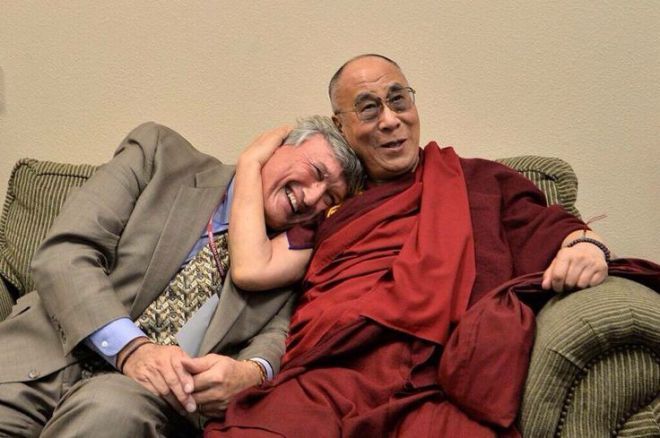
As well as great scientific minds, he would meet with the Dalai Lama, who on listening to Doty explain his research and answering a number of questions, decided to support and sponsor the research with a significant and unprecedented financial donation, so impressed was he with the project.

When our brains and our hearts are working in collaboration – we are happier, we are healthier, and we automatically express love, kindness, and care for one another. I knew this intuitively, but I needed to validate it scientifically. This was the motivation to begin researching compassion and altruism. I wanted to understand the evolution of not only why we evolved such behaviour but also how it affects the brain and ultimately our health.

It is a wonderful, honest account, a compelling and easy read. Doty shares his story, flaws and all, sharing the beneficial effect on his life of the rare gift of meeting someone who shared those simple life resources with him at an early age, and importantly where he got it all wrong. Through this book he and many others hope that more people will have access to them, or at least become interested enough to find out more.

It is fascinating and heartening to see the increasing scientific development in the 21st century into understanding the effect of compassion, altruism and meditative practices on the brain through science, something that ancient Buddhist cultures have known, experienced and passed down the generations through practise for thousands of years.

Dr James R.Doty, MD Stanford University and His Holiness The Dalai Lama

Dr James R.Doty, MD Stanford University and His Holiness The Dalai Lama

Note: This book was an ARC (Advance Reader Copy) kindly provided by the publisher via Netgalley.

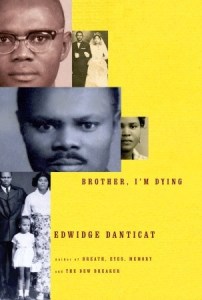
Brother, I’m Dying by Edwidge Danticat

Brother Im DyingI first read Haitian author, Edwidge Danticat last summer, her novel Breath, Eyes, Memory (review linked below) about a young girl living with her Aunt in Haiti, while her mother lived in New York, a little like the life of the author herself, much of which is revealed in this non-fiction title, Brother, I’m Dying where we learn more about her life, though the primary focus is on her father Mira and in particular, her Uncle Joseph.
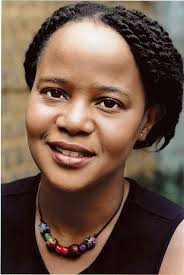
After having read a number of books in the Caribbean tradition recently, it is both unique and a gesture of deep reverence to read about the special connection between a daughter and her two fathers, for she sees both these men, and rightfully so, as her fathers.

The novel opens on the day of two discoveries, the author learns she is pregnant with her first child and hears that her father has been diagnosed with a terminal illness. The pulmonary disorder had required him to take medicine (containing codeine) resulting in his taxi licence being revoked. The medicine did nothing to alleviate his symptoms, worse it lost him his job and his dignity.

The chapters alternate between their present life in America and the author’s early life in Haiti, recounting the lives of the two brothers. We come to understand the lives they create from the choices they made, how they reinvent themselves, the obstacles they face, whether it’s family, work, the establishment, or navigating the political and legal demands of the countries they inhabit.

Mira leaves Haiti to create a better life in America for his family, a departure the author has no memory of, though her Uncle Joseph’s adopted daughter Marie Micheline shared stories with her, in a tradition common to people like her, anecdotes of poignant memories for those that have been left, to serve as reassurance that they were and are loved.

“Unfortunately I wasn’t told many stories like that. What I did often hear about was the future, an undetermined time when my father would send for my mother, Bob and me.”

Life was difficult for her mother and she often left the children with her brother-in-law to ensure the children had a decent meal. Then two years after her father left, when she was four and Bob was two, her mother’s visa was approved and she too departed, alone.

The two children became very attached to their Aunt and Uncle, while they waited out the nine long years before they too could make their eventual transition to join their parents in New York. Finally happening when Edwidge was twelve years old, it would be an even greater emotional challenge, not least because they had two younger brothers born in the US, one of whom believed he was the rightful, elder child of the family.

Back in Haiti, Joseph’s voice had begun to quiver, it worried him so he travelled to a hospital where US doctors were visiting, learning of a suspected tumour that would block his airways and suffocate him if not removed. It could be extracted in the US, but so too with it, would be his voice, reduced to a bare whisper, a death-knell for a pastor.

Almost like a miracle, on a subsequent visit for a check-up, he is shown a contraption he can use to amplify his whispers and allow people to hear him.

“My father took my uncle’s hand and led him to a lamp in a corner of the room, so he could better see the machine and its interaction with my uncle’s neck. This was their first two-sided conversation in many years and they both seemed to want to move it past the technicalities to a point of near normalcy.”

Edwidge Danticat

Edwidge Danticat

The one thing that remains constant throughout their long separation, is their love and respect for each other, as witnessed and shared through the eyes of their daughter and niece.

Edwidge Danticat writes in such an honest and compassionate way, you can’t help but become drawn into their story and feel concern at the various dramatic points that arise, willing things to turn out for the best – except that’s not what happens in real life – in reality, not everything will turn out as we will it to, but the memories will remain and the experiences contribute to forming the characters that we become.

It is a credit to the author to have chosen to share something of her life, her early childhood, without elevating herself as the main character of interest, it is both a story and a tribute to the extended family and the men who tried to lead them to live in safety.

The brothers chose different paths, one deciding to leave, the other to stay and though they were separated for 30 years their relationship remained strong, seeing each other as often as they could and keeping this strong connection between all the extended members of the family and their birth country.

As Cristina García, author of Dreaming in Cuban (one of my Top 5 Fiction Reads of 2015) put it:

“Edwidge Danticat’s moving tale of two remarkable brothers – her own father  and her beloved Uncle Joseph, separated for thirty years – is as compelling and richly told as her fiction. Politically charged and sadly unforgettable, their stories will lodge themselves in your heart.”

Breath Eyes Memory

A wonderful book, an honest portrayal of lives, where joy and struggle go hand in hand, where fear is never far from the front gate and sadness its companion, yet full of hope and spiritedness as an eighty-one-year old man refuses to let thugs take all that he has, and even though he risks his life, he will continue to pursue with righteousness, what is necessary in his own country to ensure justice. Which only serves to make what follows so immensely tragic.

A 5 star must read for me.

Further Links:

Edwidge Danticat, my review of Breath, Eyes, Memory

Cristina García, my review of Dreaming in Cuban

Happiness is an Inside Job by Sylvia Boorstein and the joy of reading books by The 14th Dalai Lama

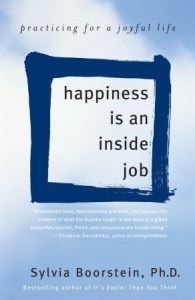
Sylvia Boorstein’s Happiness is an Inside Job is an easy-reading distillation of the key components of Buddhist thought and practise shared through a lifetime of experiences.

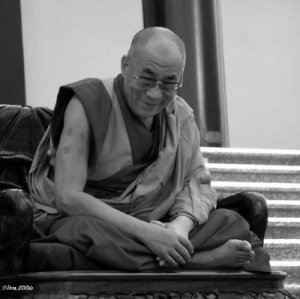
The Dalai Lama

The Dalai Lama

“We’ll start as the Buddha did in his declaration of what is fundamentally true about life, with the premise that challenges in life are inevitable and that suffering, the mind in contentious mode with its experience, is the instinctive response of the untrained mind.

These premises are the first two of the famous Four Noble Truths regarded as the summation of the Buddha’s teaching.

The third truth is the definite promise that a peaceful mind, one not in contention with anything, is a possibility for human beings.

The fourth truth is the Buddha’s training program for developing that kind of mind.”

That training is basically about how to cultivate what we call ‘equanimity’, that ability to be in a situation and at the same time, be outside the situation observing it happening and our response to it, learning to use that ability to shape how we respond, from one of the great Buddhist intellects living today.

Boorstein’s book (reviewed below) talks us through the various components of developing and nurturing that wisdom, using examples from her and her friend’s lives. Before reviewing that text, and to give it context from my own personal reading, I share below a few enlightened books I’ve read over the years that penetrate this wisdom with clarity, insight and offer helpful and realistic suggestions for their practical application.

The 14th Dalai Lama

Some of my favourite books are those written by the 14th Dalai Lama, spiritual leader of Tibet, holder of the Nobel Peace prize, philosopher, intellectual, a genuinely altruistic man of great wisdom and compassion.

Many of them I pass on to others as they are too full of penetrating insights and ideas for changing our thinking in a positive way, to let waste away on a dusty shelf.  I thought I’d share three that come immediately to mind, because they each had a significant impact when I read them:

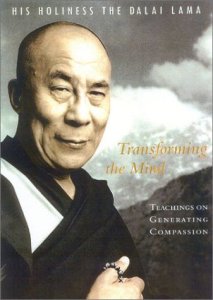
Transforming the MindTransforming the Mind: Teachings on generating compassion – this one is based on an edited series of lectures and is full of excellent practical advice and mind training on how to modify our perceptions to create a more compassionate view. This is his most important work in my opinion, it has some philosophical sections that are a little harder to grasp, but it is so worth persevering to get to the real wisdom within.
I remember when I read it, how well it resonated and how much I learned and was able to apply, it was quite a revelation the first time I read it. Such a gift.

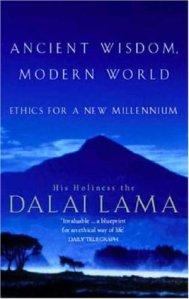
Ancient WisdomAncient Wisdom, Modern World Ethics for the New Millennium was published just before the millennium, a beautiful, small hard-cover book that reached out to all beings, not just those interested in Buddhism, addressing the spiritual void in a non-religious way and bringing attention to ethics and to finding new ways of living that avoid destroying nature and the environment, protecting our shared inheritance.

I remember that this was the first book of his, that I felt completely comfortable handing on to almost anyone, it surpassed belief and spoke to us all, no matter what our faith or spiritual inclination, this is an important and accessible message for humanity.

How to See YourselfHow to See Yourself As You Really Are – this book is a lighter, practical guide to understand the nature of self, examining how many of the things we currently believe to be solid are an illusion and that by appreciating this, we can learn how to minimise suffering.

His older books tend to be more philosophical and can at times be a challenge to understand the way of thinking, all of which is encouraged in Buddhist thought – that we should question in order to understand – however this book is more of a modern interpretation, written not for the scholar or practitioner but for anyone with an interest in self-improvement and understanding the mind.

By the time I read this one, I recognised much of the message, it wasn’t so new to me, I was already living it, but we always need reminding and encouraging, as the path is littered with obstacles!

Review: Happiness is an Inside Job

HappinessThis book was a delightful Christmas gift I was promised I would enjoy, described by Publishers Weekly as:

‘a small, polished gem of a book’

I had not heard of Sylvia Boorstein, one of the co-founding teachers at Spirit Rock Meditation Centre in California. She has written a number of books on Buddhist thinking, meditation, mindfulness and kindness.

In Happiness is an Inside Job, she shows how mindfulness, concentration, and effort–three elements of the Buddhist path to wisdom–can lead us away from anger, anxiety, and confusion, and into calmness, clarity, and the joy of living in the present.

Split into sections on equanimity, wise effort (and speech), mindfulness, and concentration it uses anecdotes and examples in everyday life to illustrate how to put this philosophy of compassion into practice.

It sounds like common sense and indeed it is, however the mind often loses track and imagines, worries, obsesses and does everything but choose the path of common sense and we often need to be reminded of the most simple observations to declutter it.

She reminds us that much that happens in our lives is external to us and beyond our control, but that our response to it is within our ability to manage and there is much we can do to help ourselves by learning how to respond in a way that will calm and nurture us, that we can choose to respond in a way that veers more toward the path of happiness.

‘Speech that compliments is, by definition, free from derision, which clouds the mind with enemies and makes it tense. Kind speech makes the mind feel safe and also glad.’

It’s a book to read a chapter at a time, not all at once, an alternative to the demands of fiction, more nourishing than television, food for the soul. Recommended as an introduction to Buddhist thought and the benefits of practising compassion.

“My practise is remembering that although whatever is happening, including my emotional response to it, is the lawful consequence of myriad causes that are beyond my control, the relationship I hold toward it all is within my control. I can choose on behalf of happiness.”