After looking at the novels on the shortlist for the Women’s Prize for Fiction 2024, I decided to read two of them, Enter Ghost (set in Palestine) and Brotherless Night (set in Sri Lanka) mainly because in addition to enjoying works by women in translation, I also enjoy novels in English set in other countries, written by people who have had some experience of that culture.
Enter Ghost is as much a semi-lived experience as it is a story to be read and understood. I don’t know if every reader will experience it that way, but for me, many of the places that the novel takes place in, elicited memories of being there, travelling [the 5 hr scenic route (irony)] between Bethlehem and Ramallah, visiting a countryside village outside of it, spending a day in Jerusalem (finding someone who had permission to enter the city to accompany me). A day(s) in the life of an ordinary (is there such a thing) Palestinian.
I expected them to interrogate me at the airport and they did.
This novel brings alive the sense of place and the many difficult and challenging encounters local people have to navigate, in trying to travel from one place to another. For some, like the elderly, it is best not to even try.
Sonia Nasir is one of the semi-privileged, she is able to fly into the country. That is, she is does not have to travel overland via Jordan and cross the Allenby/King Hussein Bridge to enter Palestine, as many do.
Enter Ghost is a story of youth, about a desire to stage a play in one of the most difficult places you might try to do that.
People who live in different parts of Palestine, with different ID’s and therefore different freedoms, different fears, vastly different experiences. Gazan’s, West Banker’s and what they refer to as 48’ers. It is as if they are from different countries, how different their lives are based on the geography of birth.
Sonia is half Dutch, half Palestinian and lives in London where she is a successful stage actor. She is connected to Palestine, through family summer holidays spent in Haifa (a Northern coastal town). While visiting her sister Haneen, she meets her friend Mariam, who asks her to fill in for a couple of characters in the play she is staging, while she searches for suitable replacements. They are staging an Arabic version of Hamlet.
The novel depicts the process of rehearsing and pushing actors to develop into the roles they are playing, while navigating an environment where even theatre is seen as a possible revolutionary act. All the while they rehearse, they are never quite sure if they can pull this off, nor are they even sure of whether they can trust each other.
As well as navigating their own relationships, there is an incident at the Al-Aqsa Mosque which further complicates their ability to move about.
Throughout the obstacles, Sonia is coming to terms with her recent past in London, the fraught relationship she has with her sister and with her ancestral home.
The day Michael, the movement director, joined rehearsals, he had examined my body like a tailor; told the directors to leave the room, and proceeded to lecture me about the importance of motivation.
‘Every person,’ he said, looking away, absorbed by his words, ‘every body moves differently from the next person’s body when their mind goes through something. When you’re sad, you,’ he pointed, ‘are going to move differently from the way I move when I’m sad. I can still read your movements, but they’re not going to be the same as mine. But if you make a straight line from emotion to movement – your emotion, your movement – then the audience will not only read you, they will feel you.’
She is 38 years old, mature in one sense and an established actor, and yet it is something of a coming-of-second-age novel, as both the play and the new relationships and the place all act on her and transform her.
As the time this novel was shortlisted for the Women’s Prize, the HOME venue in Manchester, UK cancelled then reinstated (after nearly 100 artists protested and began to remove their work from an exhibition there) a Palestinian theatre performance of Voices of Resilience.
There is reference too in the novel, to a turning point in Palestinian theatre history, the staging of Al-Atmeh, ‘Darkness’, a play which as it begins the lights go out – actors are part of the audience and play out all the elements of dealing with this one of many regular occurrences of life under occupation, trying to fix it.
The titular darkness allows the actors to discuss the darknesses of various interrelated forms of oppression—occupation, social backwardness, patriarchy—and the play ends with the cast and audience holding candles to collectively illuminate the stage. It was a raging hit. The audiences had seen nothing like it and they were ecstatic.
The version of Hamlet that is staged is based on a translation by Jabra Ibrahim Jabra translated back into English for the novel, and the language used and those who use it and how they use it is as important as the text itself.
I am not well versed in the play Hamlet, but the parts of the play that are shared in the novel and the context within which they are staged don’t require that the reader be too familiar with it, but no doubt if you are familiar with Hamlet, it will add another layer of understanding.
I particularly enjoyed it also for the understanding it brought to the process of developing a troupe of actors for a play and how the author captured these performances and the emotion they elicited (or didn’t). That is powerful, dedicated and practiced writing.
Overall, as I said in the beginning, I felt like I lived through this novel, which was exhausting at times, but wholeheartedly worth it.
The International Booker Prize shortlist celebrated six novels in six languages (Dutch, German, Korean, Portuguese, Spanish and Swedish), from six countries (Argentina, Brazil, Germany, Netherlands, South Korea and Sweden), interweaving the intimate and political in radically original ways. All the books were translated into English and published in the UK/Ireland.
The winner for 2024 of the International Booker Prize is Kairos by Jenny Erpenbeck (Germany) translated from German by Michael Hofmann. Jenny Erpenbeck was born in East Berlin in 1967, and is an opera director, playwright and award-winning novelist.
Kairos is an intimate and devastating story of the path of two lovers through the ruins of a relationship, set against the backdrop of a seismic period in European history.
Berlin. 11 July 1986. They meet by chance on a bus. She is a young student, he is older and married. Theirs is an intense and sudden attraction, fuelled by a shared passion for music and art, and heightened by the secrecy they must maintain. But when she strays for a single night he cannot forgive her and a dangerous crack forms between them, opening up a space for cruelty, punishment and the exertion of power. And the world around them is changing too: as the GDR begins to crumble, so too do all the old certainties and the old loyalties, ushering in a new era whose great gains also involve profound loss.
What the International Booker Prize 2024 judges said
‘An expertly braided novel about the entanglement of personal and national transformations, set amid the tumult of 1980s Berlin.
Kairos unfolds around a chaotic affair between Katharina, a 19-year-old woman, and Hans, a 53-year-old writer in East Berlin.
Erpenbeck’s narrative prowess lies in her ability to show how momentous personal and historical turning points intersect, presented through exquisite prose that marries depth with clarity. She masterfully refracts generation-defining political developments through the lens of a devastating relationship, thus questioning the nature of destiny and agency.
Kairos is a bracing philosophical inquiry into time, choice, and the forces of history.’
Read An Extract From the Opening Chapter
Prologue
Will you come to my funeral?
She looks down at her coffee cup in front of her and says nothing.
Will you come to my funeral, he says again.
Why funeral— you’re alive, she says.
He asks her a third time: Will you come to my funeral?
Sure, she says, I’ll come to your funeral.
I’ve got a plot with a birch tree next to it.
Nice for you, she says.
Four months later, she’s in Pittsburgh when she gets news of his death.
I haven’t read Kairos though it has had mainly positive reviews. I have read one of her novels Visitation some years ago and didn’t get on with that one too well, so I haven’t picked up any more of her work. I have no doubt that it is well written, I’m just not that interested in the premise.
Have you read Kairos? Or any other novels by Jenny Erpenbeck? Let us know in the comments below what you thought.
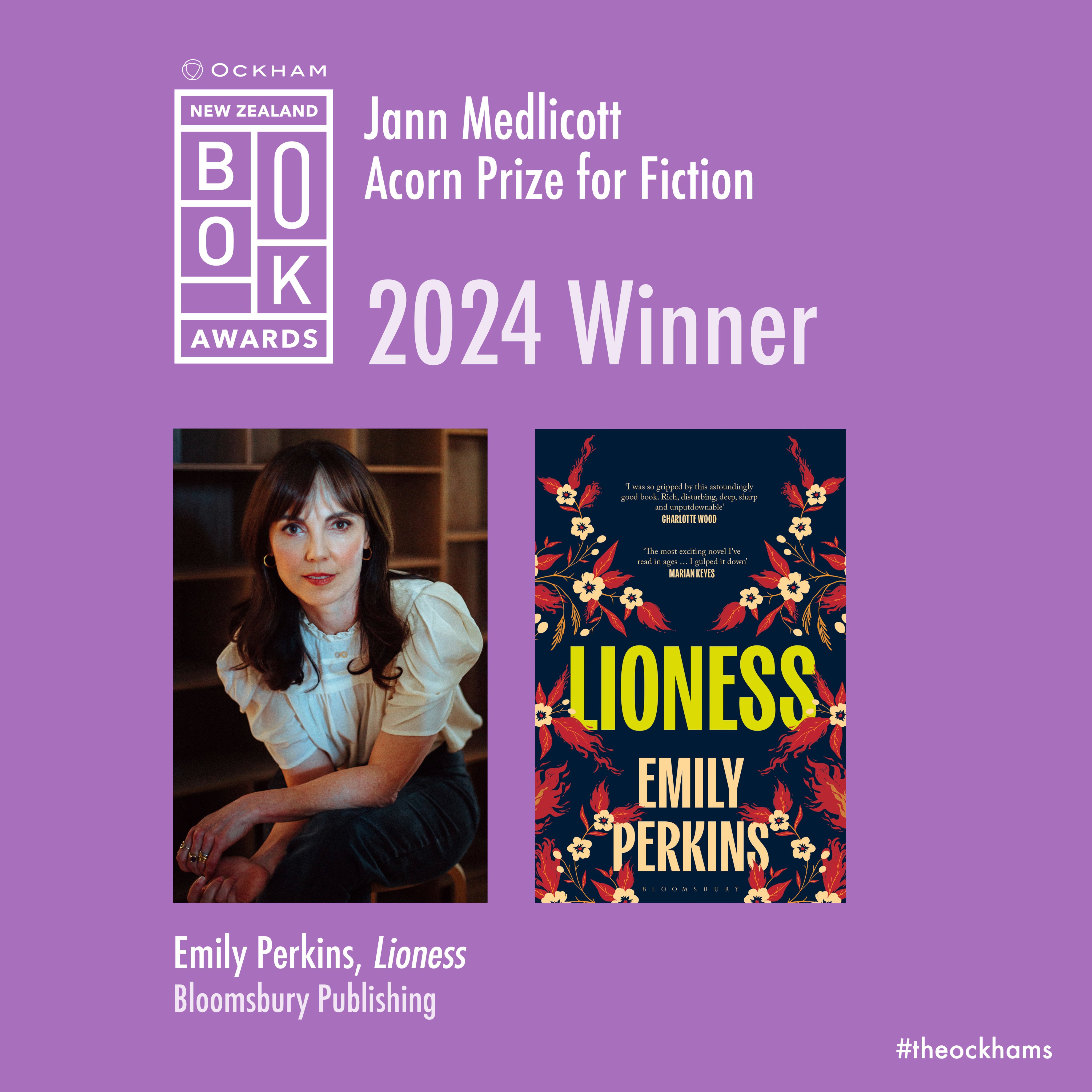
Today the New Zealand Book Awards 2024 announced their winners. Known as The Ockham’s they are regarded as the country’s premier literary honours for books written by New Zealanders.
Awards are given for Fiction (the Jann Medlicott Acorn Prize for Fiction), Poetry (the Mary and Peter Biggs Award for Poetry), Illustrated Non-Fiction (the Booksellers Aotearoa New Zealand Award for Illustrated Non-Fiction) and General Non-Fiction.
There are also four awards for first-time authors (the Mātātuhi Foundation Best First Book Awards) and, at the judges’ discretion, Te Mūrau o te Tuhi, a Māori Language Award.
Auckland Writer’s Festival | Waituhi O Tāmaki 2024
The announcement of the winners, hosted by Jack Tame coincided with the beginning of the annual Auckland Writer’s Festival, running from 14 – 19 May, 2024.
A searing and urgent novel crackling with tension and intelligence, Lioness starts with a hiss and ends with a roar as protagonist Therese’s dawning awareness and growing rage reveals itself.
At first glance this is a psychological thriller about a privileged wealthy family and its unravelling. Look closer and it is an incisive exploration of wealth, power, class, female rage, and the search for authenticity.
Emily Perkins deftly wrangles a large cast of characters in vivid technicolour, giving each their moment in the sun, while dexterously weaving together multiple plotlines. Her acute observations and razor-sharp wit decimate the tropes of mid-life in moments of pure prose brilliance, leaving the reader gasping for more. Disturbing, deep, smart, and funny as hell, Lioness is unforgettable.
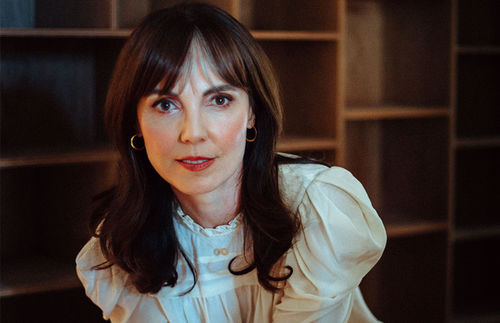
Author, Emily Perkins
Emily Perkins is an award-winning writer living in Aotearoa, New Zealand. Her books include the Women’s Prize longlisted The Forrests, Novel About My Wife, winner of the Believer Book of the Year Award and the Montana Medal for Fiction, and the short story collection Not Her Real Name, winner of the Geoffrey Faber Memorial Prize.
She also writes for theatre, film and television, including the original play The Made and an adaptation of Henrik Ibsen’s The Doll’s House, both with Auckland Theatre Company. With director Alison Maclean, she co-wrote the feature film The Rehearsal, adapted from Eleanor Catton’s novel.
Emily has taught creative writing and was the host of TVNZ’s books programme The Good Word. She is a member of the UK’s Folio Academy, an Arts Foundation Laureate, and a Member of the New Zealand Order of Merit for services to literature.
Other Category Winners
The winner of the Booksellers Aotearoa New Zealand Award for Illustrated Non-Fiction was Gregory O’Brien for Don Binney: Flight Path, an illustrated account of the life and work of one of NZ’s most iconic artists.
The Mary and Peter Biggs Award for Poetry went to Grace Yee for her fusion of Cantonese-Taishanese and English collection that moves between old newspaper cuttings, advertisements, letters, recipes, cultural theory, and dialogue, evoking the unsettledness of migration, Chinese Fish.
The General Non-Fiction Award went to Damon Salesa for An Indigenous Ocean: Pacific Essays and the Maori Language Award went to Tā Pou Temara (Ngāi Tūhoe) for Te Rautakitahi o Tūhoe ki Ōrākau.
I read Lioness in the summer of 2023 and found it a compelling thought provoking read, where there is as much going on beneath the surface of scenes depicted, in the spaces its protagonist inhabits, observing those around her, as there was in their reality. While reading, it felt like I hadn’t read anything that had done this before, it provoked hyper-vigilant observations, readers will likely have strong opinions about the characters, it’s almost impossible not to.
I’m happy to see Emily Perkins‘ work being celebrated, there is often a frisson of excitement around one of her novels coming out, her readership extending much beyond NZ.
The Last Interview is a series of books each entitled, The Last Interview and Other Conversations that offers a fresh look at some of the world’s leading innovative writers and edgiest cultural figures by gathering conversations from throughout an artist’s career and collecting them in one volume. There are currently 41 books in the series and the next one coming will feature Sinead O’Connor.
Having read two of the books in bell hooksLove trilogy, All About Love and Salvation (the third book Communion, I have – but yet to read), I was interested to read these interviews. They provide more background on the author and allow for the greater understanding and depth in a subject that conversation can bring. They include an exploration of her affiliation and interest in Buddhist thought.
Overall, while the interviews are interesting, I think it is great to read the work of bell hooks, as she was quite prolific on a number of topics and a very engaging writer and thinker. If you have read all her work, this will be a bonus read and if you haven’t these interviews, some of which you can find online are a great introduction.
Meet and Read bell hooks
bell hooks (born Gloria Jean Watkins) (1952-2021) was an African-American author, feminist, and social activist. Her writing focused on education, political theory, the interconnectivity of race, class, and gender and their ability to produce and perpetuate systems of oppression and domination.
The pseudonym she used, was the name of her great-grandmother, to honour female legacies, spelling it always in lower case letters, to focus on her works and message, about ideas and not herself.
She published over thirty books and numerous scholarly and mainstream articles, appeared in several documentary films and participated in various public lectures. Primarily through a postmodern female perspective, she addressed race, class, and gender in education, art, history, sexuality, mass media and feminism.
The bell hooks theory
She is most well known for her feminist theory that recognizes that social classifications (e.g. race, gender, sexual identity, class, etc.) are interconnected, and that ignoring their intersection creates inequality and oppression towards women and changes the experience of living as a woman in society.
On Love
In her book All About Love, bell hooks perspective is heart lead, her definition of love leaves behind conditioned perceptions of romance and desire and the traditional roles of carer, nurturer, provider – and suggests that it might be ‘the will to do for oneself or another that which enables us to grow and evolve spiritually’ love becomes a verb not a noun.
“All too often women believe it is a sign of commitment, an expression of love, to endure unkindness or cruelty, to forgive and forget. In actuality, when we love rightly we know that the healthy, loving response to cruelty and abuse is putting ourselves out of harm’s way.”
I find her work particularly interesting as it sits alongside the work of another cultural commentator, Riane Eisler’sThe Chalice and the Blade and Nurturing Our Humanity in addressing those systems of domination such as class, gender and race that interfere with our ability to commune with one another.
One of the interviews addresses the controversy of her decision to appear on a live talk show, something she did as a way for her to reach a different, wider audience. It was a strategy that in one sense did not work that well for her, due to the hard time she was given on the show. However, despite the public take-down, her aim was still achieved, as the silent majority who watched it from their homes, will have become more aware of who she was and the message she was trying to portray, in particular to Black women.
In the collection of seven interviews, stretching from early in her career until her last interview, she discusses feminism, the complexity of rap music and masculinity, her relationship to Buddhism, the “politic of domination,” sexuality, and love and the importance of communication across cultural borders.
Dominator culture has tried to keep us all afraid, to make us choose safety instead of risk, sameness instead of diversity. Moving through that fear, finding out what connects us, reveling in our differences; this is the process that brings us closer, that gives us a world of shared values, of meaningful community. – Teaching Community: A Pedagogy of Hope, 2003
Whether she was sparking controversy on campuses or facing criticism from contemporaries, hooks relentlessly challenged herself and those around her, she inserted herself into the tensions of the cultural moment, and anchored herself with love.
For me, forgiveness and compassion are always linked: how do we hold people accountable for wrongdoing and yet at the same time remain in touch with their humanity enough to believe in their capacity to be transformed? – in conversation with Maya Angelou, 1998
On Tough Love, Loving Environments and Community
This was an interview by Abigail Bereola for Shondaland in December 2017 on self-love, discussing why we know so little about it or how to even cultivate it, and how a lack of it has played into the patriarchal culture of workplace abuse and assault.
I think that societies begin with our small units of community, which are family — whether bio or chosen. I am often amazed when I meet people that I see have been raised in loving families because they’re so different and they live in the world differently. I don’t agree that every family is dysfunctional — I think we don’t want to admit that when people are loving, it’s a different world. It’s an amazing world. It’s a world of peace. It’s not that they don’t have pain, but they know how to handle their pain in a way that’s not self-negating. And so I think insomuch as we begin to look again at the family and challenging and changing patriarchy within family systems, irrespective of what those families are, there’s hope for love.
I have enjoyed her books considerably and the interviews extend her work into the joy of what conversation can bring. Though some of her work is clearly targeted at Black women, I believe there is value in it for all, indeed, it is necessary to read outside one’s own race, gender, culture, ethnic group and language, to understand other perspectives and the issues that others face. Sometimes we find resonance, other times, we pay attention, listen, read and learn. There is plenty to learn and consider in the writings and conversations of bell hooks.
N.B. This was an ARC (Advance Reader Copy) kindly provided by the publisher via NetGalley.
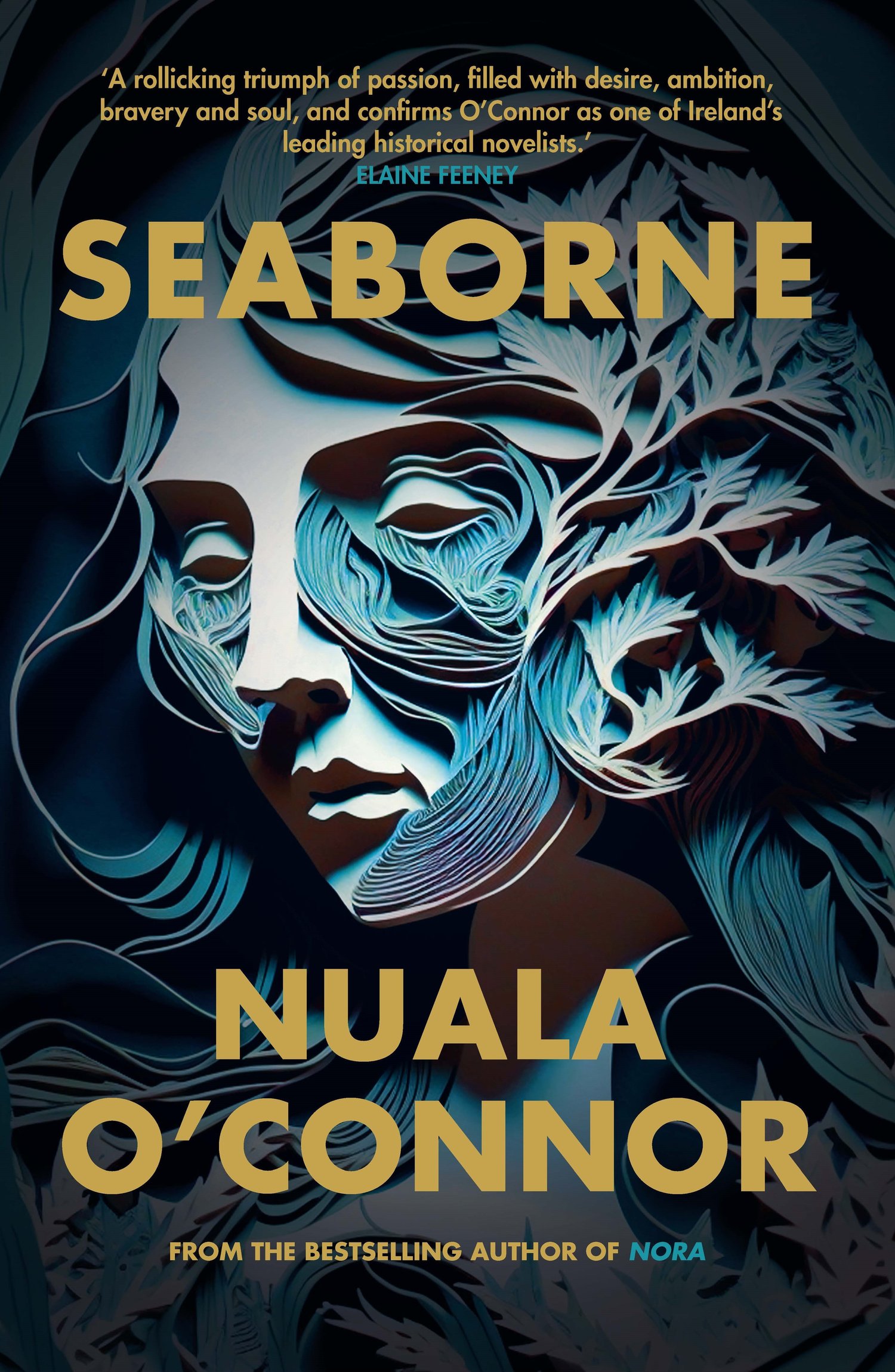
Seaborne is an adventure story about a young girl born in Kinsale, Cork to a maid, who, in order to keep her with her, styles her as a boy growing up, so she can stay in her father’s house (a local lawyer) and be apprenticed to him.
Anne becomes Anthony in her childhood and loves nothing more than going out on the boat with her father, being at sea.
Eventually, in order that her parents can be together, the man abandons his wife and family, and travels with Anne and her mother to the Carolina’s where he will run a plantation.
Life As A Girl is Restricted
But Anne having had significant freedom as a boy is none too pleased by the restrictions and rules that presenting as a girl puts upon her.
‘Three times trouble, girl, with your red hair, and your forward manner, and your obsession with water and boats. For a lady, one is ill luck and the others are ill conduct. The three do not match well.’
And I give my ever honest reply. ‘They match the finest with me, Father.’
Finding a Way to Seascape
She finds solace and much more, with her friend and servant Bedelia and finds a way to have the occasional sea journey thanks to a young man they hear of, Gabriel Bonny, who for a few coins will take a person to sea. At first he declines to take her, she will visit a tailor and have a set of clothes made, more suitable for seafaring, eventually she wins him over, he can not refuse her.
I woke this day knowing only one thing: I wanted to hire a boat, row it out, and feel saltwind about my face and hair. I desired to have nothing but the sway of the sea under my body and I determined to make that happen.
Seeing him as a way to escape her destiny and to a life at or near the sea, she elopes with him, taking Bedelia with her.
In the town where they settle Anne discovers that her husband isn’t so keen to let her pursue her dream to be at sea. She becomes restless and rebels against the wifely life and in her restless wanderings, she comes across someone who will.
Captain Calico Jack will allow her to follow him and his crew into dangerous territory and a life she had never imagined but finds passion and excitement in.
I crave a chance to wave my sword, to fire a shot. I want to know how it feels to own such power. And I think of the riches that await us, and the wandering sea-life Jack and I will have when we have plenty of money.
They will sail around the islands of the Caribbean, looking for opportunity, trying to avoid those in service to Governor Rogers, a man with a mission to suppress piracy and protect trade, who was hell bent on apprehending the infamous pirate and his men.
A Maverick Maiden
Set in the 1700’s, Anne Bonny is a real character, though much about her is legendary and not easily verifiable. Nuala O’Connor has familiarised herself with facts and read the fictions and re-imagined a version of a deeply unconventional life for Anny Bonny, told in a lilting, of its era prose.
It is narrated in a way that allows the reader to easily visualise the life and surroundings she inhabits and the high sea adventures she participates in, even if they are shortlived. It’s a fun, imaginative read, of a woman before her time, who gave herself freedoms and lived fearlessly, despite the era she lived in and the culture she came from.
Nuala O’Connor is a novelist, short story writer and poet, and lives in County Galway with her family.
She is the author of four previous novels, including Nora: A Love Story of Nora and James Joyce (2021), Becoming Belle (2018) and Miss Emily(2015), a reimagining of the life of Emily Dickinson, and six short story collections, her most recent being Joyride to Jupiter (2017) and Birdie (2020).
She has won many prizes for her short fiction including the Francis MacManus Award, the James Joyce Quarterly Fiction Contest and the UK’s Short Fiction Journal Prize and been nominated for numerous prizes including the Edge Hill Short Story Prize, the Kerry Group Irish Novel of the Year Award, the Irish Book Awards Novel of the Year and the International Dublin Literary Award. Nora was shortlisted for the 2021 An Post Irish Book Awards RTÉ Audience voice Award. She is editor-in-chief at flash e-zine Splonk.






 Word by Word