Istanbul Memories of a City by Orhan Pamuk

IstanbulAlthough I carried the book  to Istanbul and back, there was no inclination to read it while I was there, I started it on the return plane journey, the appropriate occasion to do so, for Pamuk’s Istanbul is laced with more melancholy than the city I visited and I realise with hindsight, the importance of constructing my own unfettered impressions, free of this philosophical consequence of the decline of a grand empire and the inclination of its progeny to feel somewhat bereft at missing out on an era when their prominence was that much greater than it is today.

However, I remain as intrigued about the author now as I did before I started the book, it is a unique form of memoir, more of a nostalgia trip through selective memories of his childhood and his city, sharing anecdotes from both that formed him into the writer he is today.

The imagination features large in Pamuk’s  life from a very young age, when he was five-years-old he was sent to stay with an Aunt on his own and she used to point at a picture of a child and say it was him. He came to know him as the other Orhan and while he knew it was not him, this shadow of himself never left him behind. Neither did he ever leave the city of Istanbul in the fifty years up to writing this book.

CIMG4275“But the ghost of the other Orhan in another house somewhere in Istanbul never left me. Throughout my childhood and well into adolescence, he haunted my thoughts.”

Though he never left the city, he read many works by writers and poets who published impressions of Istanbul, Gustave Flaubert, the poet Gérard de Nerval, Théophile Gautier, Pierre Loti, Edmondo de Amici and laments that in the same period they were writing about the city,  little was written or painted by its own artists and writers, therefore, whilst the work of others is familiar, it remains an outsiders perspective and does not quite capture the essence of how the Istanbullus see themselves.

Pamuk often visualises the city in black and white and throughout the book on nearly every page are photographs depicting the city in monochrome. He spends an entire chapter describing Hüzün, the Turkish word for melancholy explaining how if differs from sadness and finishes by almost convincing the reader that it is something close to a virtue, absorbed with pride and shared by a community.

“the hüzün of Istanbul is not just the mood evoked by its music and its poetry, it is a way of looking at life that implicates us all, not only a spiritual state, but a state of mind that is ultimately as life affirming as it is negating.”

“… hüzün brings us comfort, softening the view like the condensation on a window when a tea kettle has been spouting steam on a winter’s day.”

CIMG4331

Entrance to the Grand Bazaar

I did not come to Istanbul expecting to see sultans, dervishes or crystal chandeliers, though there are traces of them all if you seek them out. I came to see a city that comfortably exists while straddling two sides of a significant divide.

Bosphorus

The Bosphorus with the Castles of Europe and Asia by Thomas Allum

The Bosphorus, that deep channel of powerful surging water and current that separates two continents is deceiving. The reasonably short distance from one side to the other, only 2 to 3 kilometres, the fact that it embraces one city reminds us that there is less than we might think between the people who inhabit each continent.

A deep and powerful separation of continents, yet humanity passes across it with ease. Great divides can indeed be overcome.  The streets of shops and the Grand Bazaar attest to that passage of traders and pilgrims who have entered and passed through the city over hundreds of years.

It takes until the very last chapter before we meet the more mature Orhan who will become a writer, because unlike many born to write, his first love was painting and he shares much through his observation and study of artists who painted his city, something he practiced prolifically in his youth. The demise of this early calling occurred not long after his teenage muse was packed off by her family to Switzerland, his mother’s relentless cautions against pursuing the life of an artist transforming his rebellion against completing his architectural studies into announcing:

“I don’t want to be an artist.” I said. “I am going to be a writer.”

CIMG4495

“I was, as I had begun to discover even then, the sort who could always wear the same clothes and eat the same things and go for a hundred years without getting bored so long as I could entertain wild dreams in the privacy of my imagination.”

A treat for admirers of Orhan Pamuk’s work and those who have had the good fortune to visit his wonderful city, which is not nearly as melancholic to the visitor as it is to a philosophical resident.

Next up, murder at an archaeological dig! Time to leave Istanbul and travel inland with Ahmet Umit.
Women’s Prize for Fiction Shortlist & Pulitzer Prize 2013

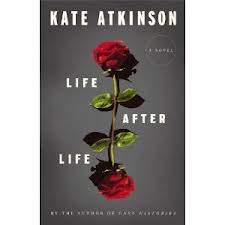
Womens prize logoThe long-list becomes the short-list and it looks like a strong line-up for the Women’s Prize for Fiction 2013. Here is the short list:

Kate Atkinson Life After Life – my review here

A M Homes May We Be Forgiven

Barbara Kingsolver Flight Behaviour

Hilary Mantel Bring Up the Bodies

Maria Semple Where’d You Go, Bernadette

Zadie Smith NW – my review here

Flight Behaviour (2) NW life after life

Here’s what Miranda Johnson, Chair of the Judges had to say:

‘The task of reducing the list of submissions from over 140 to just 20 books was always going to be daunting, but this year’s infinite variety has made the task even trickier. The list we have ended up with is, we believe, truly representative of that diversity of style, content and provenance, and contains those works which genuinely inspired the most excitement and passion amongst the judges. I don’t anticipate the job becoming easier at the next stage!’

I have managed to read two that made it through, plus others from the long list including Honour, Ignorance and The Light Between Oceans. I am currently slow-reading Barbara Kingsolver’s Flight Behaviour, she won the prize in 2010 with The Lacuna, one of the first books I reviewed here. Zadie Smith is also a previous winner, her book On Beauty won in 2006.

I was sure that Atkinson and Smith would make the list, not only because the stories are engaging, but because they dare to step outside the ordinary and test the boundaries of convention, Life After Life likely to be a more popular read, but both deserving their place here.

I know many will be surprised yet delighted to see Maria Semple’s Where’s You Go Bernadette on the list and of course the inevitable Hilary Mantel, no surprise there. Will anyone be able to knock her off her current perch I wonder?

The winner will be announced at a ceremony at the Royal Festival Hall, London on 5 June.

The Guardian – Women’s prize for fiction reveals ‘staggeringly strong’ shortlist

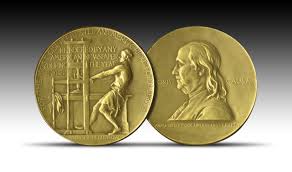
Pulitzer Prizepulitzer

Amid the terrible news that saddened and horrified us all in Boston yesterday, a day that should have been cause for calm celebration, the annual Pulitzer Prizes for 2013 were quietly announced.

The Snow Child was one of the three finalists for the fiction prize, the winner was The Orphan Master’s Son by Adam Johnson, a timely journey in the heart of North Korea.

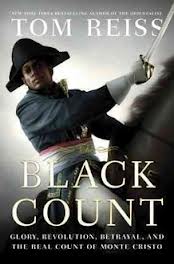
It was good to see a non-fiction title I enjoyed and recommended last year Tom Reiss’s Black Count: Glory, Revolution, Betrayal, and the Real Count of Monte Cristo win the biography prize. My review here.

Lost Cat, Found Humour

There’s little enough humour in our lives and when there is, we don’t always appreciate it or even get it. I admit there is a lot of humour that doesn’t work on me, it’s not enough to know the English language, the cultural  and political context is critical and as for French humour – way too difficult! – however I do admire anyone able to write with humour, speak with it or just be it!

012413_1956_LostCatFoun1.jpgCaroline Paul has something of the gift, in a kind of self-deprecating way, and her book Lost Cat, allows us to have a few laughs at her expense, although they are situations that could equally apply to many of us and especially cat and dog owners.

She has written this light and entertaining tale which will appeal to all ages, a story of love, desperation and the many tools available to obsessed animal lovers in search of a missing pet. It is a true story which comes with a caveat, three in fact, (1) painkillers, (2) elapsed time, (3)normal confusion for people of a certain age.

Knowing that the author has previously written a book about her job as a fire-woman,  it came as less of a surprise to learn that she was involved in a light plane crash in an ‘experimental plane’. Her sense of humour is established not long after this revelation when hospital staff inform her that she has broken her tibia and her fibula.

“The Tibia and Fibula?!” I said, tasting the blood in my mouth, feeling the bruises on my arm, laughing through my morphine haze. When I explained that these were my cats, the staff just nodded, expressionless; to them, I was just another numskull hallucinating on a gurney. But it was true. Two thirteen –year-old tabbies, affectionately nicknamed Tibby and Fibby, were now wondering where the heck I was and why I hadn’t come home.

The accident leads to a period of enforced convalescence and a bout of the blues ; she is unable to venture out, most likely taking up too much space, both mental and physical in what had been the cats’ territory. The home dynamic has also changed since the author became involved in a new relationship, her partner not exactly a cat lover, although as a graphic artist, she has contributed sketches to the book that add to its entertainment value.

Then, a month into her recovery, without warning, something terrible happens. Tibby disappears.

Caroline panics and in the aftermath of his disappearance indulges every possible theory to find out where he is, from walking the neighbourhood to visiting the pound, from prayer to consulting a psychic. Then five weeks after his disappearance, Tibby returns, just like that.  In perfect health.  He’d even gained half a pound and his coat was as shiny as silk.

Confusion. Jealousy. Betrayal. I thought I’d known my cat of thirteen years. But that cat had been anxious and shy. This cat was a swashbuckling adventurer back from the high seas. What siren call could have lured him away? Was he still going to this place, with its overflowing food bowls and endless treats.

012413_1956_LostCatFoun3.jpg

Allia’s cat Noisette

Rather than accept the fact he is safe and has returned, the author then turns detective to try to figure out where he has been, some place he’s clearly still visiting as he is no longer interested in his food. This when I discover things about animal behaviour and the obsessions of animal owners that have me laughing out loud and wanting to tell everyone about  all the crazy things it is possible to spend your hard-earned cash on when you are under the influence of an animal obsession.

And then I quieten down, remembering I have a ten-year-old who is heading in that direction, big time. I’m just thankful that dinosaurs are extinct or he’d be begging for a pet one of those too! I’m afraid of what will happen when he becomes financially independent, the ‘overflowing with life’ rooms, in the virtual home he has created online, possess no furniture or accessories, unless you call a peacock in the living room an accessory.

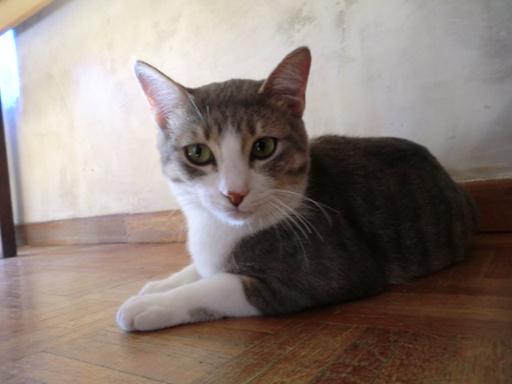
Camping Neighbours cat – can you believe this cat goes camping!

Where do our pets go and what do they do, when we’re not around? And why? Aren’t we enough for our furry companions? For animal lovers, these are the ultimate questions. And so began a quest familiar to anyone who has realised that the man in their life isn’t who he seems: the quest to find out where Tibby had been for those five weeks.

This book landed on my lap in a busy work period a little while ago and was the perfect antidote, even if you are not a fan of animals, it is worth reading for the enlightenment of the lengths people will go to, to understand their animal.  I wish this book had been available just before Christmas, it’s the perfect gift. There’s always next Christmas! I’ll be buying multiple copies.

Highly recommended.

Note: This book was an Advance Reader Copy provided by NetGalley on behalf of the publisher.

Mom & Me & Mom by May Angelou

Maya Angelou starts her conversation book by mentioning something people often ask, how it is that she became the women she is, a question she says she has been tempted to respond to using lines quoted from Topsy, the young black girl in Uncle Tom’s Cabin who said, “I dunno, I just growed.”

Mom Me MomInstead, Angelou has written this thought-provoking tribute, sharing a slew of matriarchal experiences among the many others already shared in her remarkable series of autobiographies, to highlight a little of how she did become that brave, sensitive, adventurous and caring women she is, in part due to the grandmother she loved and the mother she came to adore.

It is a story written with utmost compassion and forgiveness, for this is a woman whose mother admitted when she and her husband separated that she could not mother young children, so sent them to live with their grandmother for ten years. Angelou closes the prologue reminding us that love heals and throughout the book will prove that kindness is the greatest gift we can ever give and foster in others.

Love heals. Heals and liberates. I use the word love, not meaning sentimentality, but a condition so strong that it may be that which holds the stars in their heavenly positions and that which causes the blood to flow orderly in our veins.

Vivian Baxter, Maya Angelou’s mother, was the eldest of a large family of mostly boys, for whom threats, intimidation and violence were a part of their way of their life and this petite force was often at the forefront of their skirmishes. Their father encouraged tough boy talk and tasked his daughter with ensuring the boys didn’t soften. Little wonder that after falling in love, marrying and realising that it was a mistake, they were also unable to agree on who should raise their toddlers, they separated and sent the children to their father’s mother in Stamps, Arkansas. Maya was three and Bailey five-years-old.

Ten years later, when their grandmother felt that Bailey had grown too old for Arkansas, when he had reached a dangerous age for a black boy in the segregated South, it was arranged for them to return to their mother in California. Bailey was enthusiastic, Maya much less so. It would be difficult, but for all her flaws, their mother knew how to communicate with her children and didn’t push her mother status on them. Maya decided she would call her ‘Lady’ and her mother’s response to this is one of many small pleasures Angelou offers up in her book.

Maya has a baby very young, without the foundation of a loving relationship, however with the love and support of her mother, this event in no way prevents her from pursuing her life’s dreams and ambitions.

I thought about my mother and knew she was amazing. She never made me feel as if I brought scandal to the family. The baby had not been planned and I would have to rethink plans about education, but to Vivian Baxter that was life being life.

Some years later deciding to marry Tosh tested the mother daughter relationship, Vivian didn’t try to stop her daughter from making what she thought was a mistake, but she chose to leave San Francisco, not wishing to witness the fallout. Like any young women living off the heady ambiance of newly married love, Maya wished to prove her mother wrong.

To begin with she continued doing all the things she loved, the things that made her Maya Angelou, seeing her friends, attending a dance class, going to church and speaking freely about God. However her activities slowly became issues between the young couple, so she stopped them in an attempt to maintain peace between herself and her husband.

At first the dimness is hardly noticeable but not alarming. Then with a rush, the light is vanquished by darkness.

This gem of a book, complete with gorgeous photos, is a wonderful addition to her already masterful collection of autobiographies and chronicles that one relationship that runs through our entire lives, that with our mother. It may not always be easy, but Angelou shares those moments that tested and ultimately strengthened the love and respect they had for each other. She accomplishes it with incredible honesty and selflessness, something that shines through in the brief interview I have linked here. What a wise and loving soul she is.

Interview – Learning to Love My Mother: Maya talks about her mother with a BBC interviewer.

“Exercise patience with yourself first, so you can forgive yourself for all the dumb things you do. Then exercise patience with your children.”

Buy a Copy of Mom & Me & Mom via Book Depository

Note: The book was an Advance Reader Copy (ARC) provided by the publisher via NetGalley.

Howard’s End is on the Landing, A Writer’s Reading Journey

There is much to love in books about a reading journey, just as there is in an exhibition of a well-known painter’s own personal collection, especially when those collections include the work of their friends and personal anecdotes.

Susan Hill certainly comes up with many personal anecdotes of interactions with some of her favourite writers as well as some ‘I almost met…’ which made me laugh because with each of those non-encounters, she says the same thing, that most likely she would have had nothing to say anyway. I am sure that would not have been the case, being so widely read, she would be able to find common ground with almost any great writer, though ever humble a writer be of their own work perhaps in the presence of an idol.

Susan Hill Reading YearHoward’s End is On The Landing is Susan Hill’s account of a year spent reading from home, her collection easily the size of a small library from the way I read it, one bookshelf alone contains 743 books and this a country house of many rooms where books have snaked their way up the stairs across the walls and had bespoke shelves made to measure for hard to fit nooks and crannies.

At the end of the book, she includes a list of the final forty; it’s a page I refer back to often as her journey of short chapters includes picking up an author’s many works and often struggling to decide which one should go on the list. She loves her Victorians, perhaps more than anything, so Charles Dickens, Thomas Hardy, Anthony Trollope, George Eliot and Emily Bronte are all there.

I have spent a long time among the Victorians this winter but the year is on the turn, the first spring crocuses are pushing up through the grass. It is not yet warm, there are no leaves on the trees but just perceptibly the nights are drawing out.

I am restless for the twentieth century again. Upstairs then, to the landing. Why Forster sits next to Graham Greene, or Anita Brookner is tucked in beside V.S. Naipaul, let alone why they are interspersed with odd volumes of the Finn Family Moomintroll, is one of the mysteries of the reading life.

It doesn’t really matter whether I have read the books or not, it is not only recognition of similar books we may read, it is as much about sharing the joy of reading, its ability to provoke, to uplift, to question. It is the consequence of reading and the confirmation of how different we all are in these observations that continues to prove the reality, that somewhere out there that same book will have been both adored by one person and despised by the next.

Just this morning I read a passionate review by Vishy the Knight of Nicole Brossard’s Yesterday, At the Hotel Clarendon in which he describes the effect of reading prose that to him was sublime, lush, delightful, transcendent, luscious, intoxicating. Well, I don’t know about Brossard’s prose, but I was enjoying Vishy’s. He went on:

After reading a particular passage and falling in love with it, I thought that this was it. Now Brossard will get back to business and get on with the story. And then followed another intoxicating passage. And then another. And another. It was the kind of intoxication that one gets while listening to classical music, the kind which is pleasurable but on which one never gets drunk. Nicole Brossard is also a poet and it shows in her prose. I want to read this novel again just for Brossard’s prose.

Then, at the end of his review, he mentions he was able to find two other reviews of the book in Canadian literary magazines and only one review on Goodreads, which said “I just can’t stand this book anymore.”  Just like films, the only way to really know is to see or read it yourself! And as I alluded to in my previous post, books and reading tell us and others who we really are. As for me, I trust Vishy’s judgement, I love lyrical prose.

Susan Hill’s book is very much influenced by the English tradition and I feel compelled to balance that a little by mentioning another book in a similar vein which I adored, Pat Conroy’s A Reading Life.

Conroy Reading LifeI have only read one of Pat Conroy’s books, The Prince of Tides, but would not hesitate to read more, especially as a summer read –they do tend to be big, bold, compelling books, great for a summer read. His reading life unfolds by the chapter in a mesmerising, delightful way, his storytelling and anecdotes within the book are captivating.

He is loyal to certain influential bookish people in his life and they often reappear throughout the chapters. The chapter on the influence of his mother and references to both the book and film of Gone With the Wind is a great story in itself. But my favourite chapter and one that has stayed with me in the years since I first read this, was Chapter Eleven A Love Letter to Thomas Wolfe, because he is so honest and appreciative, ignoring intellectual snobbery and sharing what he describes as a pivotal event of his life – his reading of Look Homeward, Angel and though not knowing it at the time, entering into “the home territory of what would become my literary terrain”.

I have read very good reviews of Will Schwalbe’s book The End of Your Life Bookclub and know that one day I will venture into its pages, but have been warned, this one is a real tearjerker, so timing is important. There is no rush, just many future reading pleasures that will lead to even more.

And the one stand out book from Susan Hill’s reading year, that made me decide I must have a copy? Well, it’s not even on the list, but that’s because it seems to be permanently at her beside and I see Persephone Books have reissued a copy of it as well. It was Virginia Woolf’s A Writer’s Diary.

I have never exhausted  A Writer’s Diary, and never will.It gave me what I needed at 16, and it continues to give.

Have you read any of these books, or do you have another favourite book of a writer’s reading journey?

Brain On Fire – My Month of Madness

Susannah Cahalan was twenty-four-years old when something in the way she perceived things changed. It started with an obsession over bedbugs and descended into hallucinations, seizures and unpredictable acts of bizarre behaviour. Blood tests, scans, numerous procedures, initially all the tests came back negative, her Doctor (a renowned neurologist) insisting it was stress and alcohol consumption. It was neither of those things and if there is one stand-out learning to be gained from this incredible story, it is to ensure always to obtain a second opinion.

Brain on FireThis true story provides a fascinating insight into a rare autoimmune disease which causes the body to attack itself and in this case – the brain. It truly is a story that can and has already changed people’s lives; the writer, a reporter on the New York Post observes her own physical and mental decline and then as her mind descends into chaos, she recalls nothing. Her account is pulled together from interviews, hospital video footage and the journal of her family, until her brain begins to regenerate memory.

It is a path that many will have followed who end up spending the rest of their lives in an institution, if they actually survive it.  Susannah Cahalan, with the help of a supportive and determined family who won’t give up until they find a treatable diagnosis, is fortunate to be seen by the tenacious and talented Dr Najjar, and one final test later, a simple pen and paper exercise, leads him to the all-important diagnosis and her to the path of eventual recovery.

It was his focus on non-psychiatric causes that prevented her from a much more disastrous outcome.  His continuous ground-breaking research posits  that some forms of schizophrenia, bipolar disorder, obsessive-compulsive disorder and depression are actually caused by inflammatory conditions  in the brain.  This research may eventually help to break down barriers between immunology, neurology and psychiatry.

Lower Manhatten from Staten Island Ferry by Diliff

Lower Manhattan from the Staten Island Ferry by Diliff

Before writing this book, the author published an article for the New York Post about her experience, prompting an outpouring from many people who had a family member with an inexplicable brain disease – her case highlights the very real possibility that there are thousands if not more people out there descending into a similar madness.

StrokeHer story reminds me of  ‘My Stroke of Insight’, the extraordinary story of the brain scientist, Jill Taylor’s experience when at 37 years a blood vessel exploded in her brain and she too observed her mind deteriorate to the point where she could not walk, talk, read, write, or recall any of her life. She recovered and used her incredible insight and knowledge to share that experience with the world – creating an important resource for the sufferers and carers of stroke victims. She gives an excellent TED talk on the subject here. Interestingly, she became a brain scientist herself due to her brother’s diagnosis of a brain disorder, schizophrenia.

A gripping, unputdownable memoir that shows how little we really know about the workings of the brain and how difficult it is to diagnose. It’s thanks to books like this that more diagnoses can and are being made helping sufferers to find the right path to recovery.

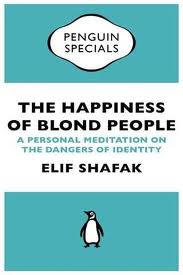
The Happiness of Blond People – A Personal Meditation on the Dangers of Identity by Elif Shafak

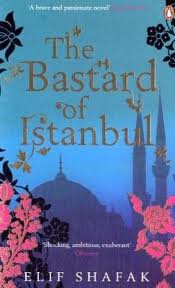
011312_1324_TheTigersWi2.jpgBastard of IStanbulElif Shafak writes great stories and as this essay illustrates, she both lives and has already lived an interesting life between East and West; experiencing different cultures and absorbing the influence of a high achieving, single parent mother and her superstitious, story-telling grandmother in a untypical but enriching, matriarchal upbringing.

ElifShafak Ask EbruBilun Wiki

Elif Shafak, Publicity shot by Ebru Bilun – wikipedia

As a young pupil she learnt what it means to be on the receiving end of prejudiced comments, introducing her to the clichéd stereotypes cast about by those who might never have experienced but seemed “to know” what it meant to be Turkish, that false responsibility, those who leave will all take on, for the actions of government or other citizens, on behalf of their maternal country and people.

Elif Shafak has inherited and nurtured a healthy imagination and studied many of the great philosophers, with a particular interest in Rumi, sometimes witnessed through her novels and now combines her knowledge with first-hand observations of how cultural differences are perceived in this short book.

The title of the essay was inspired by a conversation overheard at the Rotterdam airport in the Netherlands between Turkish fathers, one despairing of the difficulty of living in proximity to his downstairs neighbour.  She developed a habit of calling the police each time his children made too much noise playing in the apartment, causing his family much stress and anxiety, because the police invariably arrived with sirens blazing – makes me wonder what story she told the police, and thankful that my neighbour isn’t so bad after all!

The man finishes by asking his friend in earnest, how it is that blond children are so quiet and well-disciplined, introducing us to Shafak’s reflections on identity, cultural difference and the inherent, almost unavoidable angst of first generation immigrants worldwide.

The immigrant must be prepared to swallow his share of humiliations every day. He has to accept that life will treat him with disrespect and that he’ll be smacked and jostled with undue familiarity.

Happiness of Blond PeopleShe discusses the perception that happiness can be found in the West, less likely to have to deal with war, warlords, tribal conflict, poverty, corruption, human-rights violations or major natural disasters and the equally ingrained counter-assumption that life in the East is more real and less degenerate than in the West: where society is so selfish and individualistic that communal and family ties have virtually disappeared, unable to support a person, especially the elderly, in a time of need.

A secondary-school student I met in Ankara during a literary event put this to me in a slightly different way. “If you are young, it is better to live in the West than in the East,” he said. “But if you are old, then it is better to be in the East than in the West, because we respect our elders, whereas they don’t. In Europe I have seen old ladies in supermarkets buying one courgette, one carrot, one tomato, one bunch of parsley. Have you ever seen a Muslim woman doing that? No! We always buy at least half a kilo, if not more, because we cook for the entire family.”

What seems to be missing in the immigration experience is often lack of community, the lack of acceptance or gesture of kindness and therefore difficulty in integration, families are often not made to feel welcome (except among their own kind) which then encourages them to live separately and to maintain their own traditions and cultural perceptions and habits, rather than merging with the new country and culture. It can also breed resentment, particularly if it wasn’t a mutual decision to leave or even a choice, as in times of war.

It is often true that it must take at least one generation to normalise integration, but in more closed communities whose occupants themselves have little curiosity for the outsider or have not travelled and come to understand how and why things are done differently, with an altogether different logic elsewhere, this separation is at risk of continuing into multiple generations, especially where there are clear physical differences between people that can provoke prejudice, judgement or even worse, racism.

HonourFor me, most of the time I enjoy being confronted with those genuine mind-bending situations that require one to figure out how people came to see or do something in a way so different from our own – with the exception of violent or inhumane acts, but even behind those practices, there is a story to be told and a history to be understood, which doesn’t make it right, but can assist us to at least consider these practices in context, something Elif Shafak explores in her latest gripping novel ‘Honour‘.

An immigrant myself, I understand many of the isolating factors inherent in such a status, especially when it is necessary to learn a new language. Whilst it is not easy to participate in a traditional society with its many rituals and social codes, it is more likely that an immigrant will find success and contentment in creating a business or activity of their own, something unique that is or will be valued, than putting themselves up against their compatriots and being disappointed time after time, especially if living outside the larger multicultural cities.

This is a short read and a refreshing, open-minded perspective, from a woman who interacts with people in both the East and the West, always interesting to read and listen to.

In this life, if we are ever going to learn anything, we will be learning it from those who are different from us. It is in the crossroads of ideas, cultures, literatures, traditions, arts and cuisines that humanity has found fertile grounds for growth.

Episode 8: Ten Months of Bliss and Facing a Return to Work

Once over that initial hurdle, Allia blossomed and apart from that long scar, there was nothing to indicate there had ever been a problem. She was a happy, contented baby who loved to smile and engage with those around her, especially the band of eight and nine-year-old girls who lived in our apartment building and were frequent visitors.

For the first ten months I was able to stay at home with her, working a little, practicing aromatherapy, however I knew it was going to be necessary to find another full-time job, living in London demands it, all the more so when there is an extra mouth to feed.

Until this precious little girl came into my life, I never really questioned working long hours or weekends and I had thrived on the opportunity to travel with work. Now, I couldn’t think of anything worse – to leave this child behind, absolutely not, she had extinguished my desire to seek out the unknown, I found myself dreaming of safer pastures, the more familiar.

For the first time in eight years of living in London, the city that I thought had become my second home, I thought the unthinkable – maybe it was time to return to New Zealand?

P.S. This is what Allia came up with when I said this episode was about us having 10 months of fun times hanging out together, going to the park etc, I just love this picture, although my husband says that first one isn’t true! But her imagination is brilliant. Enjoy.

Next Up: in A Silent Education: Our Quiet Challenge in Provence

Episode 9: She Speaks the Language of Birds

Previous Episodes

Episode 7: The Verdict, the Recovery and Home in time for Christmas

Waking up the day after the birth and the operation was difficult but waking up without our baby there next to us was gut-wrenching. We returned to the hospital as quick as we could and it would become my resting place for the next three weeks. I was kitted out with a mobile, electric breast pump, not too different from the contraption we see in a cowshed, only this cow had to be milked every three hours. I saw how little they survive on in those first few days, poor starving babies, but I also saw the rich colour of that life-giving, nutritional start a newborn needs, colostrum. Seeing that invoked a determination to ensure I ate in the most healthy way possible.

Allia spent three days in intensive care and apart from being asked to leave when they removed the respiratory equipment, the days passed with little drama. We learned that she had an Ileal Atresia, basically an obstruction in the small bowel, which required 35cm of it to be removed, leaving 130cm. Reading the notes of the operation and procedures in the Intensive Care Unit, I completely understand why some things are best not witnessed or even read about at the time one is going through them. I recently came across the discharge summary and actually have no recollection of ever having read it before, it’s not pleasant reading and I feel thankful to have a healthy daughter who shows no sign whatsoever of this challenging start to her life except the scar across her middle.

As if making up for that initial separation, we were then gifted with something few mothers experience I am sure, three uninterrupted weeks of constant companionship, the two of us sharing a room that became our world,  three weeks in which I learned that this small being was connected to me in a way I had never imagined possible.

Apart from when the nurses struggled to find a vein when doing blood tests, Allia never cried. She slept, she awoke, she rested in my arms as we waited for that all important organ, the bowel to commence its function. That would be one of the first signs of recovery. She was given milk through a line, so it had to happen soon and if everything functioned well, I would be able to start feeding her.

I would slip downstairs to the cafeteria for my breakfast when I saw she was sleeping and she was always quiet on my return, I would then read the notes to check if anything had occurred while I was away and it was via this I learned that this blissful sleeping baby was aware of my absence. The nurse had noted that Allia had cried and next to this note, that the mother had left the room to have breakfast. That the two events were connected was something of a shock initially, but so reassuring, to come to understand and experience something of the magic of the bond between mother and child. It is something I remain in awe of.  The next time I left for breakfast, I made sure to tell her where I was going.

Once she recovered and was feeding and putting on weight, we were ready to go home. We were discharged on December 18th and re-entered a city transformed by the approach of Christmas. A festive celebration it was indeed and the perfect time to be coming home and preparing for the season of joy and hibernation.

épisode7

Next Up: in A Silent Education: Our Quiet Challenge in Provence

Episode 8: Ten Months of Bliss and Facing a Return to Work

Previous Episodes

Top Reads 2012

A near impossible task. I read so many fabulous books this year and hate to choose, however there was one outstanding read for me, that pushed all my buttons in terms of use of language, enticing me into the story, reading in wonderment at the writer’s ability to exceed my greatest reading desires.

Outstanding Read of the Year

123112_1428_TopReads2011.jpgThat book was Eowyn Ivey’s The Snow Child and coincidentally, just today our Scottish friend over at TheOnlyWayIsReading wrote a magnificent review, especially poignant for male readers. Inspired by a Russian fairytale of an older childless couple who cut family ties and move to the Alaska wilderness, it is a journey of navigating the internal elements and external forces in life, where love, hope and the imagination are equally necessary for survival as the more practical resources.

Top Fiction

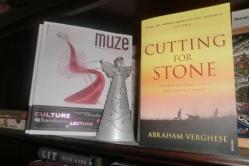
010212_1323_CuttingforS1.jpgThe year started on a high note and I’ll never forget New Year’s Day 2012 gripped by the powerful and realistic storytelling of Abraham Verghese, in his epic Cutting for Stone, absolutely brilliant.

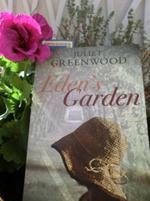
123112_1428_TopReads2013.jpgEden’s Garden is a wonderfully inspired novel set in Cornwall and Wales, following the lives of two women a decade apart, Carys returns to her hometown in Wales to take care of her mother and becomes drawn towards the garden and statues of Plas Eden and a man from her past, while Ann in Victorian London, is at a turning point in her life, destitute, far from her aristocratic past.

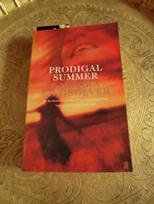
123112_1428_TopReads2014.jpgProdigal Summer was a fantastic and hot summer read, I can’t believe this book sat on my shelf for years and circumnavigated the globe with me before I finally turned its pages.

In the Shadow of the Banyan, is a fictionalised account of a period in the life of Vaddey Ratner, difficult childhood years in Cambodia under a tyrannical regime, losing members of her family, she recalls them in this heart-breaking but uplifting story which pays tribute to those who never made it and shows tremendous compassion in doing so.

Rebecca was my classic treat of the year, thanks to Joanne at The Book Jotter who sent me a copy as part of World Book Night, this has to be the most compelling, page turning classic I have read and I look forward to following it up with watching the Hitchcock film sometime soon.

Top Non-Fiction

Red Dust Road crossed my path after reading a captivating interview about the poet Jackie Kay in The Guardian, inspiring me to read this memoir about the discovery of her birth parents, who could not have been more different from the liberal, Scottish open-hearted parents she was raised by. A fabulous story, so eloquently shared and a joy to learn that it has made the World Book Night list for the UK in 2013.

The Black CountThe Black Count was a surprise read, as I prefer historical accounts fictionalised, they tend to be more compelling and the learning aspect easier to remember than non-fiction accounts, however Tom Reiss keeps the reader interested and has written an excellent account of the revolutionary hero, General Alex Dumas – the son of a San Domingan(Haitian) slave and French nobleman. Sold into slavery himself by his father, he eventually makes it to France and rises to become a General in the French revolution, a contemporary of Bonaparte (though no friend of his), his story inspiring his son to write countless novels, including The Count of Monte Cristo.

123112_1428_TopReads2019.jpgWhen Women Were Birds – Fifty Four Variations on Voice was my introduction to the work of Terry Tempest Williams, recommended by Cassie (whose review was so great, it prompted a response by the author), and gifted to me by my best book buddy and very dear friend CKC. The author is 54, the age her mother was when she passed away and left her daughter her journals. In this book, Tempest writes 54 short vignettes, trying to understand the enigma of that maternal gesture.

123112_1428_TopReads20110.jpgIf This Is A Man: A Truce – it seems appropriate to finish with this book, recommended by our Scottish friend who has just finished The Snow Child, he wrote a moving review, that left me with no other choice than to get hold of this book and read this all important humane work by Primo Levi, writing of that inhumane experience, a concentration camp and leaving us with much to think about.

There were so many memorable others, La Petite Fille de Monsieur Linh, my first read of an adult book in French; Murakami’s trilogy 1Q84, the Titanic anniversary books, my late discovery of the joys of John Steinbeck and Ray Bradbury, the tribute to Edith Wharton’s 150th anniversary with Ethan Frome and Summer, a couple more from firm favourites Susan Hill and Irène Némirovsky.

And for you? What books stood out for you in

2012?