A Monster Calls by Patrick Ness

I read a wonderful review of The Crane Wife by Patrick Ness over at Annabel’s House of Books and I asked if it was YA(Young Adult) fiction, a genre I admit to being a little reluctant to read, not because there aren’t excellent books, but because part of the joy for me in reading is to be exposed to and learn, uncommon new words, adding to my private lexicon, words that would seem pretentious in teen fiction.

The_Crane_Wife__pentaptych_by_Crooty

There are always exceptions however, recently I loved Margarita Engle’s novel-in-verse The Wild Book and when a book sounds like it has qualities that intrigue me, a review by any blogger on my reading wavelength is sufficient for it to lodge in my mind and be called off a shelf when I spot it.  Annabel replied telling me that this was Ness’ first adult novel and recommended his YA trilogy Chaos Walking for a thought-provoking dystopian adventure and described A Monster Calls as phenomenal. That one lodged itself immediately in my mind.

On Saturday I went looking for the original version (French) of Ru by Kim Thuy at the library after reading an excellent interview by BookDragon only to discover that all copies were out.

A Monster CallsNaturally I couldn’t leave without a quick glance at the English language bookshelves and there it was, the beautiful hardback, fully illustrated copy of Patrick Ness’ A Monster Calls. I picked it up and headed for the exit, so as not to be tempted by more, since I have too much to read already, but as I left, my eye caught the display shelf where I spotted Quelques Minutes Apres Minuit, a familiar book cover in the same colours, yes, the same book with its French title and cover. As you can see, I brought them both home.

The idea for A Monster Calls came from the writer Siobhan Dowd, who was unable to complete the book tragically due to a terminal illness. Patrick Ness was asked to write the story, a remarkable challenge that somehow he managed to achieve without, ironically, the shadow of expectation or any other writerly monster hanging over or haunting him.

Conor O’Malley is thirteen-years-old and lives with his mother; his parents are divorced and his father remarried and now lives in America with his wife and baby daughter. Conor’s mother is in the latter stages of a terminal illness and Conor is coping with doing more things on his own, while becoming distant from his school-friends and attracting the attention of a school bully. On top of all this, his life is complicated by the nightly appearance of a tree monster, who doesn’t really scare him, as he tells it, he’s seen worse.

The monster wants something from him and Conor can’t or won’t offer it and yet he won’t be left alone until he does.

It is as if the extraordinary circumstance that brought this book about, invoked something magical that inspired Patrick Ness beyond what he might otherwise be capable of, because the book transcends the usual storytelling and creates a dialogue someplace between a brutal reality that is, and the unwanted but unstoppable future that will be, where an apparition takes on the role of enticing the traumatised teenager towards that excruciating path he must follow.

The entrance to the wonderful Mejanes Library in Aix-en-Provence

The entrance to the wonderful Mejanes Library in Aix-en-Provence

It is a breathtakingly raw journey that the author maps out, navigated with the extraordinary insight that only a vivid, courageous and mature imagination could channel.

It will leave you in awe.

Stunned.

A rare 5 stars from me.

Recommended for all ages.

The Summer Book by Tove Jansson

I promised myself to read this in summer, after a series of other seasonal reads like Susan Hill’s In the Springtime of the Year,  Tove Jansson’s A Winter Bookand Edith Wharton’s Ethan Frome. I seem to have skipped autumn, so perhaps that will next, maybe Irene Nemirovsky’s Snow in Autumn or Albert Camus’ Fall.

The Summer BookThe Summer Book is a novel that reads more like non-fiction, an invocation of the spirit of its author Tove Jansson, who like the Grandmother and Sophia the grand-daughter in her book, spent all her summers on the small family island off the coast of Finland, doing just the kind of things young Sophia does and eventually feeling the constraints of the older woman, so that she herself comes of age (at 77) and no longer has the strength nor confidence to brace the unpredictable sea after a storm destroys their boat, she sensibly retires to the mainland for the rest of her days.

Esther Freud writes a captivating foreword, including sharing parts of her own visit to the island to meet the real life Sophia, who is Tove Jansson’s niece. She visits both the island of Jansson’s childhood and Klovharun, a place of pilgrimage today (see the video below), the island she later moved to with her partner when their own island became too crowded with relatives and friends.  Freud ponders:

“What kind of person could live here? Someone so fuelled by their imagination, so stimulated by the sea, so richly creative that they could find solace and inspiration in what to others might seem a barren rock.”

This short video clip helps us imagine just what it might be like.  As for me, I could well imagine living like this for the summer.  And you?

In the book, we meet Sophia, who has prematurely lost her mother and so with her father will spend spring and summer on the island with her grandmother. While the father is present, whenever he is mentioned, even when in the same room, he is working or busy and so given background status, though in reality on such a small island, his existence would no doubt be more noticeable, however in the story he is a reassuring but not interfering presence, just like the island itself.

Sophia on the island with her grandmother (Tove's mother) in 1968

Sophia on the island with her grandmother (Tove’s mother) in 1968

The pages turn like days of summer, governed by the moods of the elements, the creatures that inhabit its shores and the occasional visitor. Underneath or implicit within all that passes is the perplexity of death, that absence, prematurely confronted by a young girl and sensitively explained by her older companion. The chapter entitled Playing Venice is especially poignant, the loss of the hand-made palace necessitates Grandmother staying up all night to replace it, Sophia unable to cope with another loss of something so special and close to her heart, even if it is only a small sculpture.

In both the chapter Berenice, which is about Sophia’s friend who comes to stay for a while and The Cat, Sophia has to deal with the paradox of really wanting something, then discovers she no longer does and finally must learn to appreciate both her friend and the cat, just as they are.

“If only she were a little bigger, Grandmother thought. Preferably a good deal bigger, so I could tell her that I understand how awful it is. Here you come, head-long into a tight group of people who have always lived together, who have the habit of moving around each other on land they know and own and understand, and every threat to what they’re used to only makes them more compact and self-assured.

An island can be dreadful for someone from the outside. Everything is complete, and everyone has his obstinate, sure and self-sufficient place. Within their shores, everything functions according to rituals that are hard as rock from repetition, and as the same time they amble through their days as whimsically and casually as if the world ended at the horizon.”

Like A Winter Book, this is not a volume to be rushed, it is best savoured and enjoyed slowly, it reminds us of the joy of simple things, that there is value even in those things that sometimes irritate us and above all that we ought to respect and pay attention to natures elements. This is one you’ll want to gift to another or even read again. A literary gem.

Further Reading:

A Biographical Essay on Tove Jansson

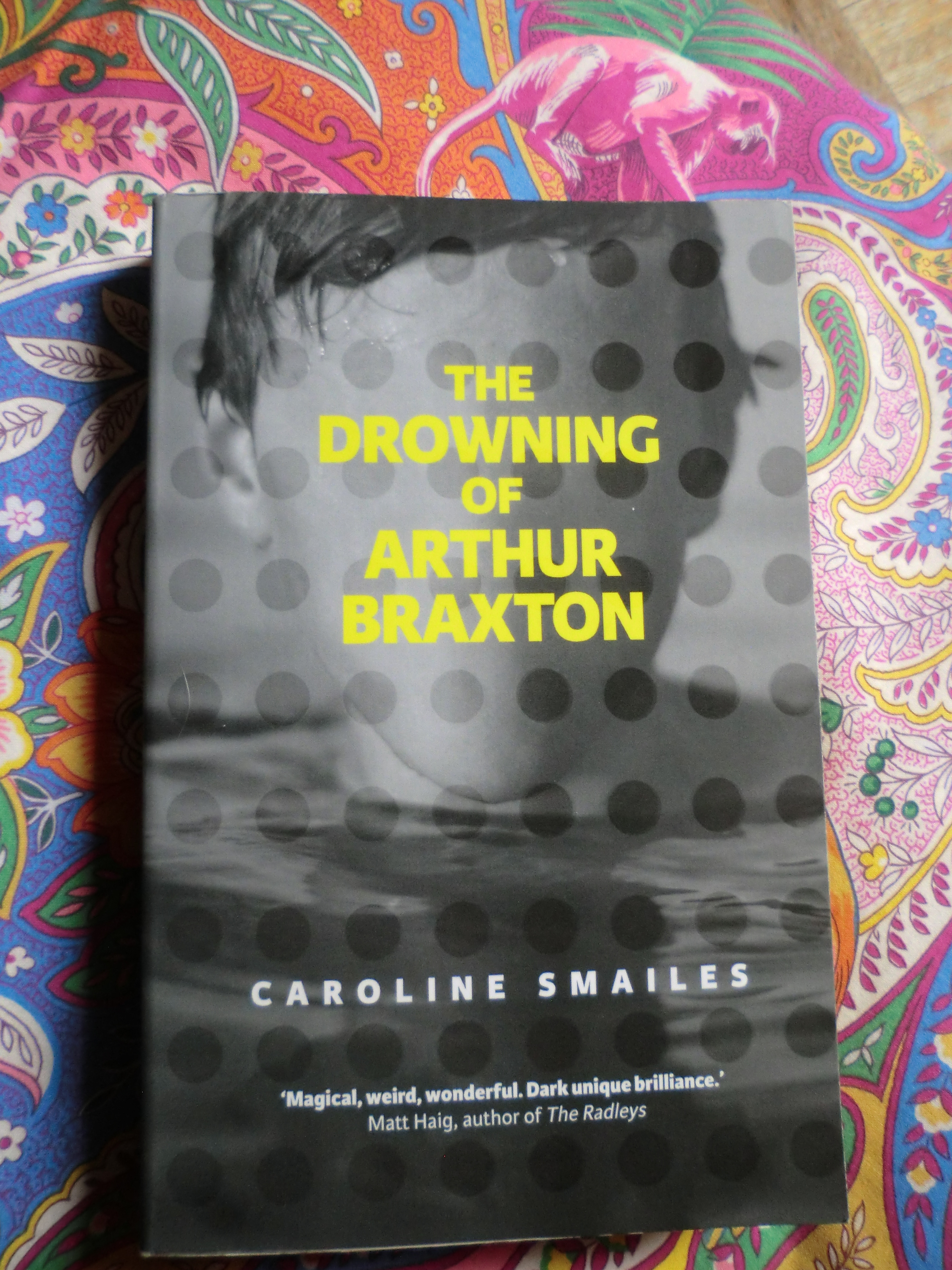
The Drowning of Arthur Braxton by Caroline Smailes

Completely off the wall, a sliver of magic realism, a stunningly original voice, Caroline Smailes The Drowning of Arthur Braxton is the best work of fiction I have read so far this year.

Arthur BraxtonRight from the beginning it hooked me and I couldn’t wait to get back to it every time I put it down, because I could not guess what the author was going to do next and somehow she made me very interested to want to know.

I’m still not quite sure how she managed that, but at a guess I would say it is a combination of an incredible imagination and a very close observance of reality. That might sound hypocritical, and that those two things should really negate each other, however she uses a sprinkle of magic realism firmly rooted in the mundane world, just as Eowyn Ivey did in The Snow Child, making the reader question whether they are reading fantasy or realistic fiction without alienating them in the process.

The protagonist Arthur Braxton can’t quite make out what is going on either and we are right there with him, going back for more to try and make the unexplained logical – and to find out more about that girl in the pool.

Arthur Braxton lives in a town in the North of England, so if you have never been there or known any young people from up that way, be warned about the vernacular and remember he is a teenager, so many of the things he says and does are appropriate to his age and the area he comes from. I don’t know whether that makes him authentic, but it makes his voice unique and his story compelling to read.

Victoria Baths

Victoria Baths, Manchester

Arthur’s Mum left he and his father for another bloke and neither of them have heard from her since, although she continues to support them financially, so they’re not making a fuss, on the contrary they are keeping a very low profile. Arthur’s Dad isn’t taking it all very well, so Arthur is parenting himself and almost at his wit’s end when he is drawn towards the old abandoned swimming baths, fenced off and due for demolition. And what he finds there keeps drawing him back repeatedly. If you choose to read the book, you’ll also be intrigued to follow him and find out.

“And that’s why I’m now pushing a shopping trolley, with my dad in it, up the hill and away from the sea front in the twatting rain. Dad’s huffing and puffing, like he’s a fucked-up steam train, and I don’t know why ’cause it’s me breaking my back trying to get the fucker up the hill. The wind’s not helping, the rain’s not helping and mainly I’m wondering what the fuck I was thinking. I mean, like owt can cure my dad. I’ve told him I’m taking him to his doctor’s appointment, he has to have a review every couple of months to see if he’s still ill. Usually the doctor takes one look at him and then, no shit, Sherlock, says that Dad’s unfit for work. Dad never even has to speak, which mainly pisses me off, ’cause I can’t remember the last time I heard him talk. I miss his voice.”

I am happy to know there is a bit of a backlist, that Caroline Smailes has written other novels and though some deal with dark subjects, her writing has an allure and originality that I am keen to explore further.

At the end of the book, the author mentions that the inspiration for this novel started with a place – Victoria Baths in Manchester, opened in 1906 and a proud icon of that city and its people. The council decided to close it in 1993 and a campaign to prevent its closure ‘Friends of Victoria Baths’ became a charitable trust and managed to save and restore the building, a venue all the public can visit today, though it does not look like any swimming takes place there.

Victoria Baths

Victoria Baths

Looking at their website today, I discovered serendipitously that this weekend 13 – 15 September 2013 the pool is open and for the first time in many years, full of water to mark the 10th anniversary since the Victoria Baths won the BBC Restoration Project.  Since then more than £5m has been spent restoring the front of the building, stained glass windows and the roof of the gala pool.

A well-known synchronised swimming group Aquabatix entertained the supportive crowd with a spectacular performance Arthur Braxton would have been proud of! Learn more at www.victoriabaths.org.uk

An Interesting Fact: The pools were divided up for first class males, second class males and females. Men in the first class pool had the pleasure of swimming in the water first before it would be drained into the other two pools.

CIMG4752

The Magic of Water

Note: Thank you The Friday Project, an imprint of Harper Collins for sending me a copy of the book.

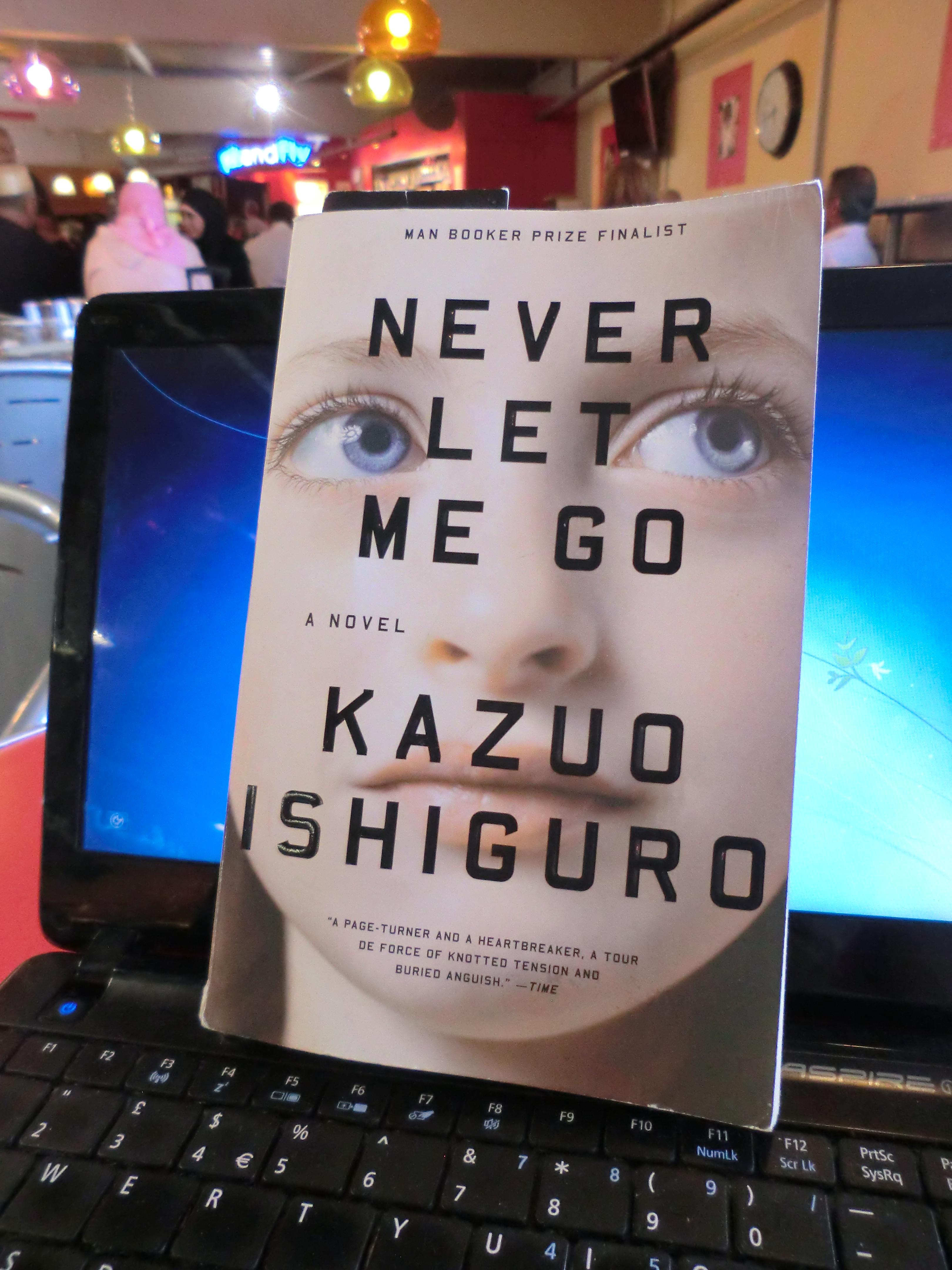
Never Let Me Go by Kazuo Ishiguro

IshiguroI find Kazuo Ishiguro unpredictable, which could be why I am always intrigued to read his work, I loved his recent collection of short stories Nocturnes: Five Stories of Music and Nightfall, yet I could not finish and had to abandon The Unconsoled and sadly I feel ambivalent about Never Let Me Go, though I do want to see how it was put to film.

It is not a book to share much about the plot, as virtually anything said might spoil the reading experience, but it is effectively a coming of age story centred around the character of Kathy, from her teenage into young adult years, from the last year she and others lived in a boarding school until the early days of her first job as a carer.  She looks back and analyses that time in an effort to understand the significance of minor details and events in their lives and her friendships with Ruth and Tommy.

I think my ambivalence stems from what seemed like restraint from delving into the depths of the characters, which could be a consequence of both the plot and the narrative form, however in my opinion, this constituted a weakness and I remained far too conscious of this lack all the way through reading. The repetitive nature of the narrative style also contributed to this and I found it annoying, it was a tool that could have intrigued, but when it didn’t succeed to do that for this reader, it became frustrating.

It is telling that I did not highlight any paragraphs or phrases as I read and that it took two weeks to read it. As you can see from the photo above, taken at the airport in Marseille, I finally finished it during a two-hour flight!

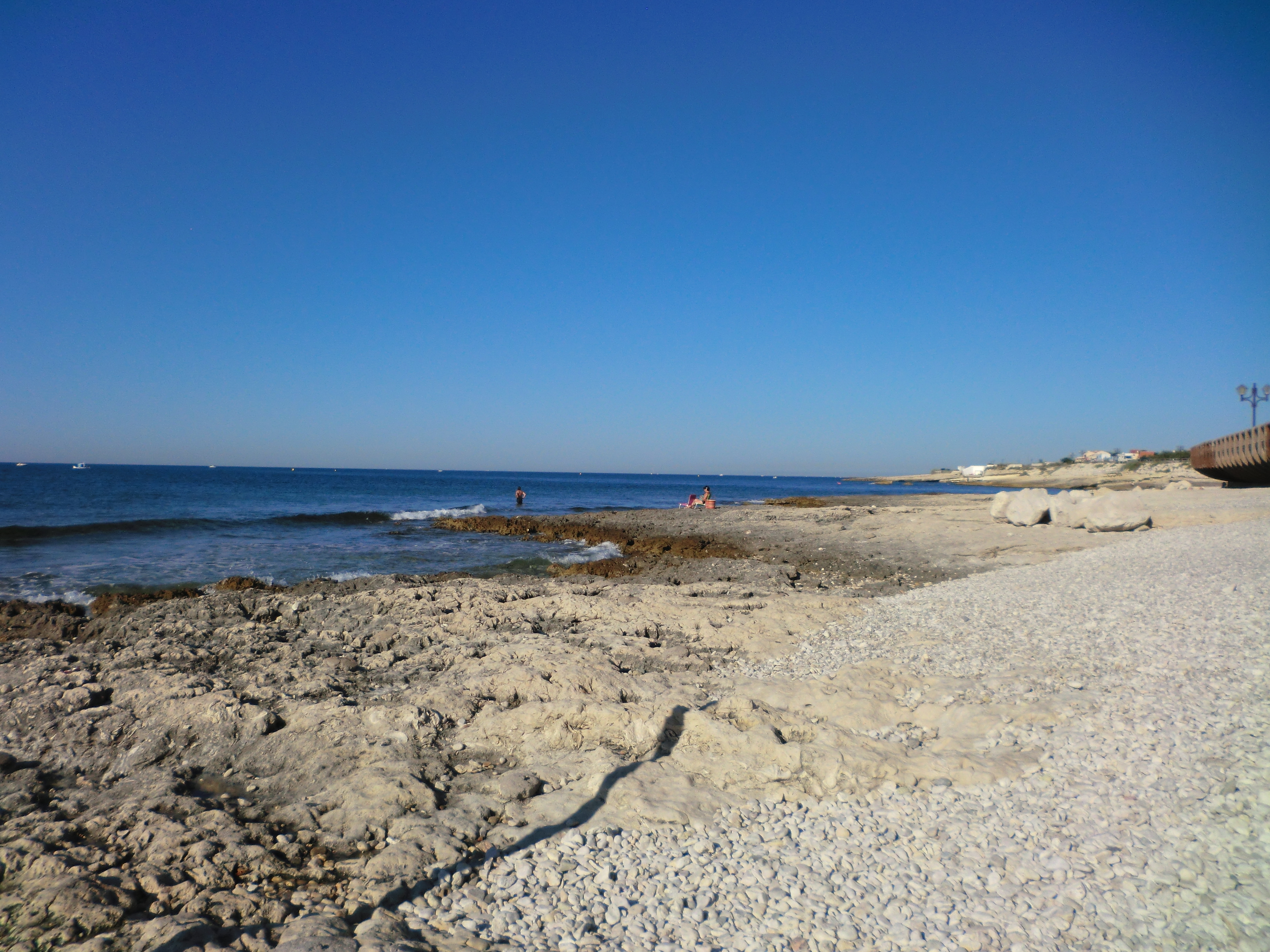
Just Dive In - My early morning dip at Sausset-les-Pins this summer

Just Dive In – My early morning dip at Sausset-les-Pins this summer

However, do not let me put you off. I recommend if you are a fan of Ishiguro that you just dive in and read it without referring to any reviews and remember that the majority of readers who have already read this book, rate it highly. I am an anomaly. I am looking forward to his next work and still have fond memories of that short story collection and am reassured in the knowledge that he is capable of work that is much more my kind of thing.

The Cleaner of Chartres by Salley Vickers

Cleaner of ChartresI could not miss the opportunity to read Salley Vickers new book set in the region of Beauce in central France and the well-known town of Chartres with its famous cathedral, its mysterious labyrinth (which has inspired many authors to pen stories) and an intriguing blurb of the redemptive power of love and community in the famous French town.

Agnès is found as a baby wrapped in a basket by a peasant farmer, the only clue to the parentage of the young nursling, a single turquoise earring lying in the bottom of the basket. The farmer, unsure what to do with the infant, but knowing it beyond his capability to take care of a newborn, deposits her at a convent, leaving the nuns to take care of her. Which, in their own way they do, though it does not prevent her from being judged and misunderstood by the pious community, even though it might be inferred that it was they who made her vulnerable to the events that would follow.

“Agnès is the saint to whom young women pray for husbands, and, since Jean Dupère, who had found the baby, presumed the foundling’s mother had none, he named the anonymous woman’s daughter after the saint.”

chartres_labyrinthe

The labyrinth of Chartres

The story is narrated simultaneously during two different time periods in Agnès’ life, as a young girl during her various stays in mental health institutions and as an adult in the town of Chartres, where she lives an independent life cleaning the still famous Notre-Dame cathedral as well as various other local villagers homes, characters who bring the pages to life with their flaws, foibles and fantasies, whom Vickers just manages not to let fall into becoming cliché.

There is an underlying sadness to the story, as it seems that Agnes attracts bad luck and as a reader, we can’t help wishing for a lucky break or that people around her could just be kinder or more observant of who she is as a person and not to judge people on how they look or what has been said of them.  Like Deborah Batterman’s character Charlotte in her excellent short story, Crazy Charlotte, Vicker’s shows the potential destructive power of that evil tongue, community gossip.

“Agnès had no clear idea why she had fled to the crypt, but for her, unlike Father Bernard, it was the very opposite of the haunt of the diabolical. On the contrary, it had always seemed to her a hallowed place. Old and still and unjudging.  Unjudging was what she most craved.”

Chartres CathedralWhile The Cleaner of Chartres is no comedy, Vickers depiction of a French town/village reminded me a little of Julia Stuart’s delightful book The Matchmaker of Perigord, a fabulous light read that also excels in depicting the essence of local French villagers. Some of the most enjoyable moments in reading are in the simple narration of everyday life, the interactions between two people, in particular where those meetings bring about a small positive change. So many of Agnès’ interactions have the potential for this, the fact that so few of them eventuate, makes them all the sweeter when they do.

Overall, a pleasant read, although I was a little disappointed with the ending, which I felt should have revealed more than it did.

Note: This book was an ARC(Advance Reader Copy) kindly provided by the publisher via NetGalley.

Man Booker Prize Shortlist 2013

The Man Booker Prize shortlist was announced today and looks like an interesting and diverse offer, with two previous nominees*, four fabulous women writers and stories that will transport us to many far reaches of the world.

One of the judges, Robert Macfarlane had this to say:

‘Global in its reach, this exceptional shortlist demonstrates the vitality and range of the contemporary novel at its finest. These six superb works of fiction take us from gold-rush New Zealand to revolutionary Calcutta, from modern-day Japan to the Holy Land of the Gospels, and from Zimbabwe to the deep English countryside. World-spanning in their concerns, and ambitious in their techniques, they remind us of the possibilities and power of the novel as a form.’

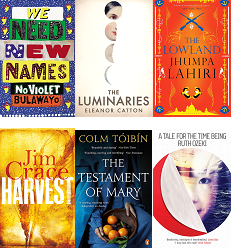
The shortlist comprises:

2013

NoViolet Bulawayo We Need New Names                  my review here

Eleanor Catton The Luminaries

Jim Crace Harvest

Jhumpa Lahiri The Lowland

Ruth Ozeki A Tale for the Time Being

Colm Tóibín The Testament of Mary

I have only read Bulawayo and I’m happy to see her on the list and I’m also ecstatic to see a fellow New Zealander make the list. I can’t help but hope that Eleanor Catton wins and I’m really looking forward to reading her novel The Luminaries, which has had some fantastic reviews.

The judges have one month to re-read the shortlist and the winner will be announced on 15 October 2013 at a ceremony at London’s Guildhall.

So have you read any from the list and any guesses for a winner?

*Colm Tóibín was previously shortlisted for The Blackwater Lightship in 1999 and The Master in 2004 while Jim Crace was shortlisted in 1997 for Quarantine.

Americanah by Chimamanda Ngozi Adichie

My big fat summer read and it was just what I like, to get lost within pages that will attempt to navigate the slightly messy lives of flawed characters that feel like they could be real. And most of them here come close to attaining that reality.

Americanah (2)Ifemula and Obinze are university sweethearts who slip into a relationship that seems to have it all, though they have yet to conquer the career survival path of their simple lives thus they are separated in Nigeria during their studies and then by the continents of  North America and Europe as they try to establish their careers. Hardship is the one thing they seem not able to share and it drives them apart like the distance of the ocean that separates them, spanning a distance they seem unable to traverse.

Just as many young people have been doing so and continue to today, they eventually return to their home country and their roots and will re encounter each other.  Although they find their way home, will  they be able to ignore those untravelled waters they did not share? This is one of the themes the book explores.

“Somewhere in a faraway part of her mind, she wanted to lose weight before she saw Obinze again. She had not called him; she would wait until she was back to her slender self.”

I loved the book for many reasons, firstly because I remember reading and enjoying her first book Purple Hibiscus, enhanced by seeing her speak in person at a Readers Festival in Auckland where she talked about the next book she was planning to write, about a subject few at the time seemed to want to talk about – the Biafran War – that research and effort to understand a chapter in Nigerian history manifested in her Orange prize-winning novel Half of a Yellow Sun, which has since been made into a film (not yet released). Since then I have looked forward to reading her other work and interviews, as she is more than just a writer of stories.

Secondly, having a good friend from Nigeria, who made the move back after a similar number of years living abroad, who did so successfully and visiting there, participating in her marriage ceremony makes me even more curious to read the work of those who have attempted the same. There is something universal about the experience and yet unique at the same time.

Chimamanda Nogozi Adichie easily engages an audience with her observations, insights and view of the world and with Americanah it is as if she sends out another version of herself, Ifemulu, a young woman who grows up in urban Nigeria and through her studies has an opportunity to live, work and study in America.

Ifemulu’s disappointments distance her from her closest relationship because she doesn’t share them. In an effort to be heard she writes an anonymous blog and shares her experiences and observations both in America and again on her initial return to Nigeria.

She tries to remain an impartial observer, though those who know she is the author challenge her and she discovers that life often finds a way to throw at us, that which we condemn in others. But therein the greatest lessons lie and Ifemulu will do much soul-searching on her journey to fulfillment. The blog posts are interesting to read and provocative and it is great to see the form being represented in a novel, and a WordPress blog at that.

In a Lagos cafe

In a Lagos cafe

For me, books whose characters cross cultures are always interesting, just as travelling in another country and witnessing the different ways people live and interact and perceive is interesting. Whilst I could never begin to know what it would be like for a young Nigerian woman to move to live in America, I enjoyed the experience of inhabiting Adichie’s imagination, viewing Ifemulu’s life and how she tries to interpret the foreign culture she and many others have long dreamed of.

My visit to Nigeria was too short to gain any real perspective about what it might be like to live there, but the challenges are undoubtedly equally great, though completely different in nature.

It doesn’t matter which country we grow up in to think of as our own, almost any other country we immigrate to or spend time living in will invoke a feeling of strangeness, of being an outsider.

“The only reason you say that race was not an issue is because you wish it was not. We all wish it was not. But it’s a lie. I came from a country where race was not an issue; I did not think of myself as black and I only became black when I came to America.”

Twice whilst reading this novel, I felt tears well up, surprising myself at how deeply this character got under my skin, some of the burdens she carries, only gaining full recognition in the moment they are healed and those moments are powerful when they come off the page. Surprising and brilliant.

Related Reads

Stay With Me by Ayobami Adebayo

Under the Udala Trees by Chinelo Okparanta

Freshwater by Akwaeke Emezi

Red Dust Road by Jackie Kay

The Spinning Heart by Donal Ryan

Reading Donal Ryan’s The Spinning Heart is to wake up in the heart of a struggling suburban neighbourhood where overnight the fate of a significant proportion of its population has changed.

Spinning HeartLittle time elapses between the pages of the novel, sufficient to penetrate the perspective of 21 residents of this neighbourhood, a chapter each.  Rather than a plot, this one event is more of a turning point from which we survey each character from their own and multiple perspectives, gradually creating a picture of this community, where perceptions often outweigh and overrule reality.

That event is the discovery that Pokey Burke has disappeared after a dodgy property deal in Dubai halts all work on his property developments in this Irish suburb.  He has absconded from his responsibilities including all those in his employ (at least they thought they were in his employ), those who thought they were doing okay in these hard times find out that not only do they no longer have a job, they have never been registered as employees.

Donal Ryan unmasks his characters in the single chapter he gives them each to speak (ironically, no chapter is given to Pokey Burke), this is no slow build up to revealing a characters inner thoughts, they are not characters prone to thinking about various options, this is a neighbourhood in which its men rarely ponder anything, their thoughts are often aggressive, misogynistic and raw, many of them are of the act now, think later persuasion. They make for uncomfortable reading and have the reader yearning for a fictional reprieve; could we have one character to latch onto to get us through this discomfort please?

And if we find it partially, it is with Bobby, the foreman whom we meet in the first chapter, on his daily walk to check whether his father is dead yet, something he wishes for that we will come to know more about as threads of his story snake through other chapters, so that we do meet him again and are able to follow his destiny.

“But the things Dad said, and the way he said them, were so scarily unlike him, so cutting, so cruel. That’s just the way he was reared, Ger reckons. She says people’s thoughts, when their upbringing is mired in dogma, aren’t really their own. Their opinions are twisted, not reflective of what’s in their souls; their words are delivered obliquely, like light being refracted through water – you can’t see their real feelings, just as you can’t see the true position of an immersed object.”

So much of what we experience is illusion, many people and situations hide another reality, nothing is what it seems.  Deception is normal, no one wishes to dig too deep to understand, empathy is an unknown concept, we too often ignore instinct, judge quickly and crush the weak and sensitive.

A disturbing read, unputdownable at the same time as not wanting to pick it up, the anticipation that maybe there is some good that can come of the situation, keeps us reading on. These are tough times and perhaps the bad karma of a financial crisis brought about by those who practice greed, corruption and a lack of empathy brings out the worst at every layer of society. It is certainly difficult to navigate the mire and find the seeds of hope.

Booker Longlist

Man Booker Longlist 2013

Donal Ryan is one of three Irish authors longlisted for the Man Booker Prize 2013 and a debut author, who is becoming as well-known for his perseverance (his manuscript was rejected 47 times) as he is for this contemporary work which digs under the skin of small town rural Ireland.

Note: This book was an ARC (advance reader copy) kindly provided by the publisher via NetGalley.

The Mussel Feast

Revolutionary Moments

Mussel FeastThe first novella of the Peirene Press 2013 collection is Birgit Vanderbeke’s The Mussel Feast, a reference to an evening meal of a family for whom a mussel feast signifies a special celebration and provokes a familiar family ritual.

This evening however, is a an event (or a non-event) of angst-ridden anticipation, as the mother and her teenage son and daughter prepare the feast and wait for their father to return from work with news that was supposed to have been a given.

There is little action or plot, though much is revealed throughout the course of the evening via the reflections of those present, who, as the minutes and hours pass, become emboldened in their thoughts as they are allowed to run on unchecked and unchallenged by he who normally acts as judge.

Just observing how the words fill up entire pages of this novella, creating a seamless run of sentences without pause or paragraph is admirable and makes me pause in my reading to check if every page is formatted the same, And it is. The constant stream of words is synonymous with an outpouring of frustration, the way the words are presented on the page like a revolutionary act itself. No dialogue, no action, a stream of consciousness charting the psychological passage of a family through the familiar acts of a routine that will manifest in wilful rebellion.

The Mussel Feast should be a cause for celebration when the routine is adhered to. When a crack opens in the routine and the feast is spoiled, who knows what uncharacteristic behaviour may follow.

An original and thought provoking read, one I devoured easily, as promised by Peirene, it is unique in its ability to keep the reader engaged while using a narrative style that is less popular today and yet succeeds in captivating its audience.

The first of her 17 novels, I look forward to reading more of her work and would love to hear any recommendations from others who have read her work.

“I wrote this book in August 1989, just before the fall of the Berlin Wall. I wanted to understand how revolutions start. It seemed logical to use the figure of a tyrannical father and turn the story into a German family saga.” Birgit Vanderbeke

Next up in Peirene’s Revolutionary Moments series is Mr Darwin’s Gardener  by Kristina Carlson, which from the reviews I have read, already sounds just like my kind of book…

CIMG4717

A Regular Fix of Contemporary European Literature

While no slave to social networking, I do appreciate those needle in a haystack gems of information that twitter occasionally throws out. It’s a little like a child knowing that there is a lolly scramble going on behind a door that opens once a day and if you stand in one spot with your hand out, you might just catch something. Much of it passes us by, but the one that lands in the hand, is appreciated all the more for the scant chance it had of being captured.

Which is what this little tweet I caught in late May did.

I remembered that when I wrote about Deborah Levy’s Booker short-listed novel Swimming Home and mentioned the subscription based publisher And Other Stories, that @MarinaSofa mentioned Pereine Press. I looked at their website and started following them on twitter.

CIMG4717Pereine Press publish contemporary European literature, in the form of novellas, a new book coming out every 3 months. So they provide an opportunity to introduce readers to new authors, outside what we might normally read in English and a book that doesn’t require a long time to read, each book can supposedly be read in an afternoon. No 400+ page tomes here.

So the tweet reminded me that I did want to read their books and there’s nothing like the threat of a price increase to motivate one to act. So now I am a Pereine Press subscriber and I have the first two books from this years series on the shelf.

Mussel FeastEach year has a theme, in 2013 it is Revolutionary Moments and the first book is the German classic The Mussel Feast by Birgit Vanderbeke which I have now read and will tell you about very soon. Very well-known in Germany I am sure and a gripping read, I devoured as hungrily as I would moules frites.

Not only does this subscription mean there will be European literature arriving regularly, but subscribers are invited to participate and attend literary events with the authors whose books have been published, including the revival of a literary salon, which sounds intriguing. The events take place in London and I hope one day I might coincide a visit to be able to attend one. I love that this type of event is coming back into vogue.

So more contemporary European literature reviews coming here soon…