The Hired Man by Aminatta Forna

Aminatta Forna

Aminatta Forna

Aminatta Forna has written two previous novels, The Memory of Love and Ancestor Stones both set in Sierra Leone where she was raised. She has also written an investigative memoir delving into the political events around the seizure and execution of her father on false charges of treason entitled The Devil that Danced on the Water that I plan to read.

After reading The Memory of Love last year and seeing her interviewed, it is clear she is a writer of courage and I knew I would be reading whatever she produced next.

The Hired ManJust as with The Memory of Love which is set in the aftermath of conflict of that disconcerting type where civilians mysteriously disappear and terrible unspoken things happen, in The Hired Man, we find ourselves following in the footsteps of 46-year-old Duro, an unmarried man living alone with his two dogs, his sisters and mother having already fled whatever horror occurred in their home town of Gost, a fictitious town caught between opposing sides in the former Yugoslavia.

“They have taken up a position south of the town opposite the army in the north. In between lies Gost. The army want to reach the coast but we stand in their way. Each side has roadblocks you have to pass through, on the road north and on the rods south out of Gost. Same questions, but different answers to each.”

For much of the early part of the book, we don’t know what has happened there, but Forna a somehow infuses the story with that sense of knowing yet not knowing, creating an underlying, slow building tension and unwillingness to trust any of the characters we come across. The events may be long in the past, but their memories feel as though they are not far from the surface and that anything could happen. And strange things do occur.

Into this undercurrent arrive an English woman Laura and her teenage son and daughter. Seemingly oblivious to the effect of their presence on the local villagers, they hire Duro and set about making improvements to the home they have purchased from with a view to doing it up and selling it on.

“I realised I’d upset the balance of thing. That I was a hired man and she was my employer made Laura relaxed in having me around the house. A mistake to take a day away without explanation: it made her feel she wasn’t the boss.”

Territory that made up the former Yugoslavia

Territory that made up the former Yugoslavia

We read the story through the eyes of the hired man Duro and interestingly Forna has chosen to narrate the story around Laura and her children in the past tense while Duro’s reflection on the past are written in the present even though they occurred many years before. It has that effect of making the past feel more present and could be how she succeeds in creating that tension, we read about the past as if it happened only recently.

“Vinca Pavic is an angry woman and her anger shows in the set of her teeth, the lines around her mouth into which her lipstick bleeds, the way she folds her arms. When she laughs it is to mock and in this she finds an ally in her son. But Anka, Anka was born with joy in her soul, to which they feel she has no right. Behind it all, as with so many things in life and in death, lies envy. In the end it gets the better of them.”

The Hired Man is a brilliant, quiet portrayal of the aftermath of conflict on a community, it goes some way towards explaining the meaning behind the silences, about why some can’t bear to stay and others can not bear to leave. It reminds us that nothing is forgotten and is a warning to outsiders to take care, that ignorance or indifference are sometimes deemed sufficient to warrant punishment.

Additional Reading:  Aminatta Forna: A Life in Writing provides excellent background reading and context to the book.

Note: This book was an Advance Reader Copy (ARC) provided by the publisher via NetGalley.

and the Man Booker Prize winner is…

Catton2

The Luminaries by Eleanor Catton

I have just put it aside on page 508 to watch the presentation and I could not be more pleased!

Congratulations to our young and so talented novelist, from whom we will no doubt see much more.

The book is still alive and rather than cower under the threat of the alternative entertainment available to people today, they are taking the book to the masses.

According to the Man Booker Prize website, there is to be a free event at London’s Regent Street Apple Store, where Eleanor Catton will discuss her book and what it means to win the prize.

I hope Apple are offering the books for sale and not just their own devices to read them.

Ok, a big event is about to take place in the book too, so I’m off back there to find out what’s happening.

#ManBookerLive at the SouthBank Centre

Listening to Six Shortlisted Authors Read

Last night the six shortlisted authors of the Man Booker Prize came together at the SouthBank Centre in London’s Royal Festival Hall and thanks to seeing a tweet from someone present I discovered that it was streaming live from the Man Booker website.

So instead of reading another 200 pages of Eleanor Catton’s The Luminaries, I listened to her, NoViolet Bulawayo, Jim Crace, Jhumpha Lahiri, Ruth Ozeki and Colm Tóibín read from their books and answer questions from the host Mark Lawson and the audience.

2013

It was a wonderful evening and risks making us want to read all the books, to see the writers presenting their works and sharing their private anecdotes about the journey to publication.

Today the live event has been uploaded to YouTube, so if you are interested to hear more about these excellent books, before tomorrow evenings announcement of the winner, here is the link to watch it yourself.

The event starts at 28 minutes 20 seconds.

Don’t expect it to help you decide, I think they are all winners and have no idea who the judges will choose. The bookmakers and the BBC are backing  Jim Crace, the quintessential English vote.

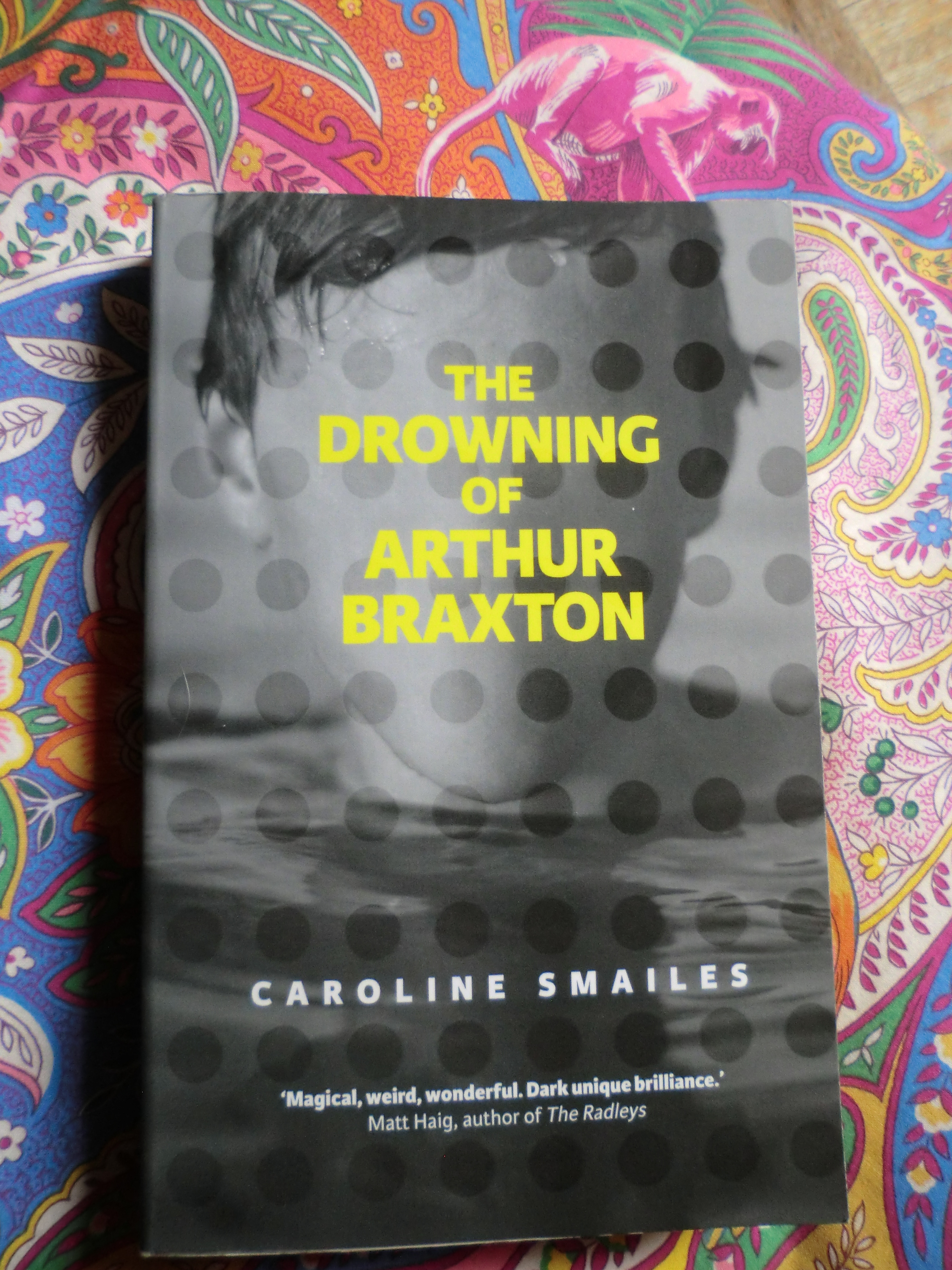
The Drowning of Arthur Braxton by Caroline Smailes

Completely off the wall, a sliver of magic realism, a stunningly original voice, Caroline Smailes The Drowning of Arthur Braxton is the best work of fiction I have read so far this year.

Arthur BraxtonRight from the beginning it hooked me and I couldn’t wait to get back to it every time I put it down, because I could not guess what the author was going to do next and somehow she made me very interested to want to know.

I’m still not quite sure how she managed that, but at a guess I would say it is a combination of an incredible imagination and a very close observance of reality. That might sound hypocritical, and that those two things should really negate each other, however she uses a sprinkle of magic realism firmly rooted in the mundane world, just as Eowyn Ivey did in The Snow Child, making the reader question whether they are reading fantasy or realistic fiction without alienating them in the process.

The protagonist Arthur Braxton can’t quite make out what is going on either and we are right there with him, going back for more to try and make the unexplained logical – and to find out more about that girl in the pool.

Arthur Braxton lives in a town in the North of England, so if you have never been there or known any young people from up that way, be warned about the vernacular and remember he is a teenager, so many of the things he says and does are appropriate to his age and the area he comes from. I don’t know whether that makes him authentic, but it makes his voice unique and his story compelling to read.

Victoria Baths

Victoria Baths, Manchester

Arthur’s Mum left he and his father for another bloke and neither of them have heard from her since, although she continues to support them financially, so they’re not making a fuss, on the contrary they are keeping a very low profile. Arthur’s Dad isn’t taking it all very well, so Arthur is parenting himself and almost at his wit’s end when he is drawn towards the old abandoned swimming baths, fenced off and due for demolition. And what he finds there keeps drawing him back repeatedly. If you choose to read the book, you’ll also be intrigued to follow him and find out.

“And that’s why I’m now pushing a shopping trolley, with my dad in it, up the hill and away from the sea front in the twatting rain. Dad’s huffing and puffing, like he’s a fucked-up steam train, and I don’t know why ’cause it’s me breaking my back trying to get the fucker up the hill. The wind’s not helping, the rain’s not helping and mainly I’m wondering what the fuck I was thinking. I mean, like owt can cure my dad. I’ve told him I’m taking him to his doctor’s appointment, he has to have a review every couple of months to see if he’s still ill. Usually the doctor takes one look at him and then, no shit, Sherlock, says that Dad’s unfit for work. Dad never even has to speak, which mainly pisses me off, ’cause I can’t remember the last time I heard him talk. I miss his voice.”

I am happy to know there is a bit of a backlist, that Caroline Smailes has written other novels and though some deal with dark subjects, her writing has an allure and originality that I am keen to explore further.

At the end of the book, the author mentions that the inspiration for this novel started with a place – Victoria Baths in Manchester, opened in 1906 and a proud icon of that city and its people. The council decided to close it in 1993 and a campaign to prevent its closure ‘Friends of Victoria Baths’ became a charitable trust and managed to save and restore the building, a venue all the public can visit today, though it does not look like any swimming takes place there.

Victoria Baths

Victoria Baths

Looking at their website today, I discovered serendipitously that this weekend 13 – 15 September 2013 the pool is open and for the first time in many years, full of water to mark the 10th anniversary since the Victoria Baths won the BBC Restoration Project.  Since then more than £5m has been spent restoring the front of the building, stained glass windows and the roof of the gala pool.

A well-known synchronised swimming group Aquabatix entertained the supportive crowd with a spectacular performance Arthur Braxton would have been proud of! Learn more at www.victoriabaths.org.uk

An Interesting Fact: The pools were divided up for first class males, second class males and females. Men in the first class pool had the pleasure of swimming in the water first before it would be drained into the other two pools.

CIMG4752

The Magic of Water

Note: Thank you The Friday Project, an imprint of Harper Collins for sending me a copy of the book.

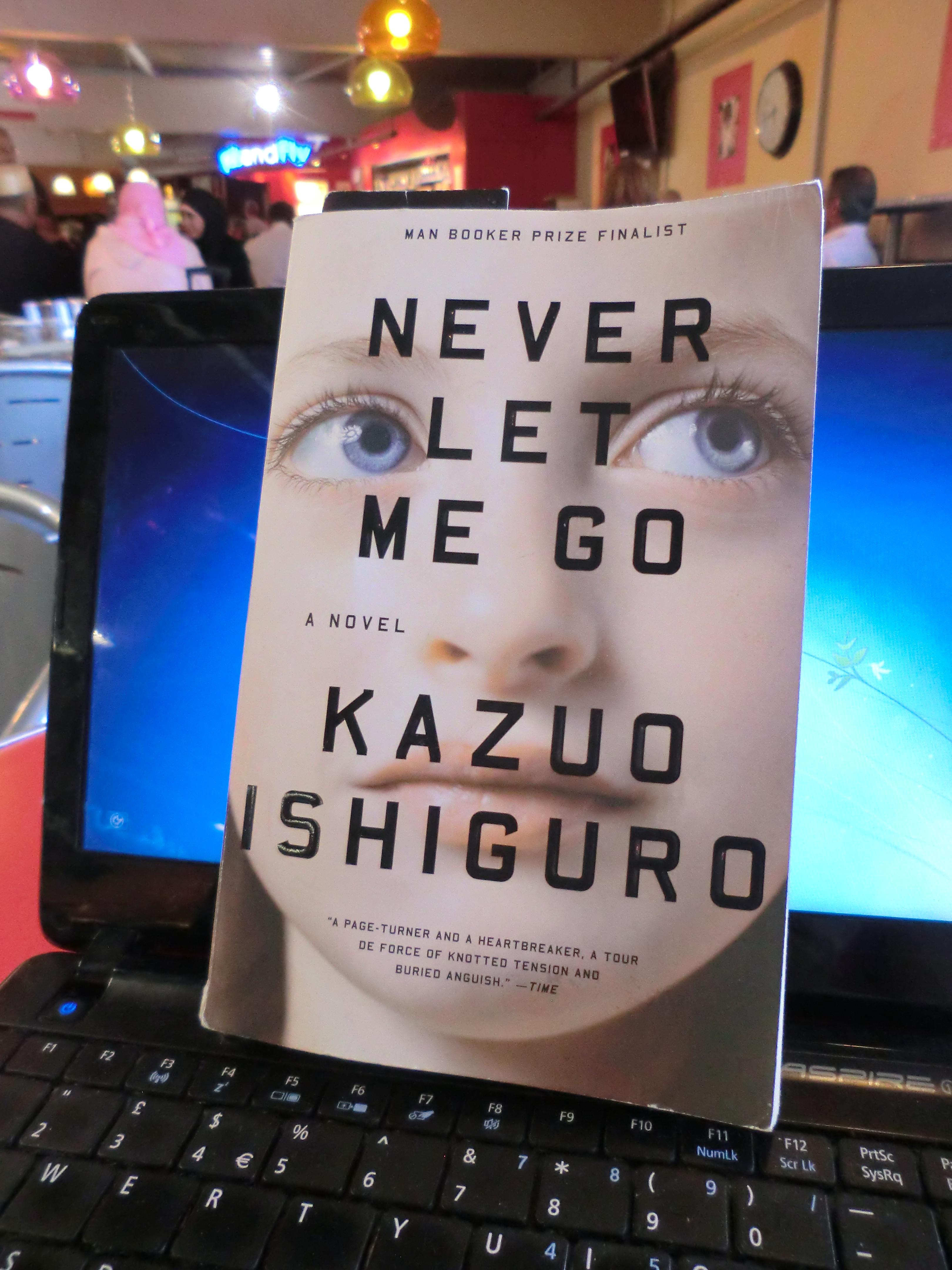
Never Let Me Go by Kazuo Ishiguro

IshiguroI find Kazuo Ishiguro unpredictable, which could be why I am always intrigued to read his work, I loved his recent collection of short stories Nocturnes: Five Stories of Music and Nightfall, yet I could not finish and had to abandon The Unconsoled and sadly I feel ambivalent about Never Let Me Go, though I do want to see how it was put to film.

It is not a book to share much about the plot, as virtually anything said might spoil the reading experience, but it is effectively a coming of age story centred around the character of Kathy, from her teenage into young adult years, from the last year she and others lived in a boarding school until the early days of her first job as a carer.  She looks back and analyses that time in an effort to understand the significance of minor details and events in their lives and her friendships with Ruth and Tommy.

I think my ambivalence stems from what seemed like restraint from delving into the depths of the characters, which could be a consequence of both the plot and the narrative form, however in my opinion, this constituted a weakness and I remained far too conscious of this lack all the way through reading. The repetitive nature of the narrative style also contributed to this and I found it annoying, it was a tool that could have intrigued, but when it didn’t succeed to do that for this reader, it became frustrating.

It is telling that I did not highlight any paragraphs or phrases as I read and that it took two weeks to read it. As you can see from the photo above, taken at the airport in Marseille, I finally finished it during a two-hour flight!

Just Dive In - My early morning dip at Sausset-les-Pins this summer

Just Dive In – My early morning dip at Sausset-les-Pins this summer

However, do not let me put you off. I recommend if you are a fan of Ishiguro that you just dive in and read it without referring to any reviews and remember that the majority of readers who have already read this book, rate it highly. I am an anomaly. I am looking forward to his next work and still have fond memories of that short story collection and am reassured in the knowledge that he is capable of work that is much more my kind of thing.

Man Booker Prize Shortlist 2013

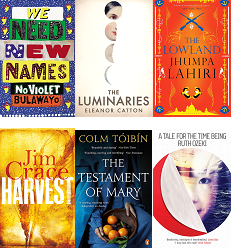
The Man Booker Prize shortlist was announced today and looks like an interesting and diverse offer, with two previous nominees*, four fabulous women writers and stories that will transport us to many far reaches of the world.

One of the judges, Robert Macfarlane had this to say:

‘Global in its reach, this exceptional shortlist demonstrates the vitality and range of the contemporary novel at its finest. These six superb works of fiction take us from gold-rush New Zealand to revolutionary Calcutta, from modern-day Japan to the Holy Land of the Gospels, and from Zimbabwe to the deep English countryside. World-spanning in their concerns, and ambitious in their techniques, they remind us of the possibilities and power of the novel as a form.’

The shortlist comprises:

2013

NoViolet Bulawayo We Need New Names                  my review here

Eleanor Catton The Luminaries

Jim Crace Harvest

Jhumpa Lahiri The Lowland

Ruth Ozeki A Tale for the Time Being

Colm Tóibín The Testament of Mary

I have only read Bulawayo and I’m happy to see her on the list and I’m also ecstatic to see a fellow New Zealander make the list. I can’t help but hope that Eleanor Catton wins and I’m really looking forward to reading her novel The Luminaries, which has had some fantastic reviews.

The judges have one month to re-read the shortlist and the winner will be announced on 15 October 2013 at a ceremony at London’s Guildhall.

So have you read any from the list and any guesses for a winner?

*Colm Tóibín was previously shortlisted for The Blackwater Lightship in 1999 and The Master in 2004 while Jim Crace was shortlisted in 1997 for Quarantine.

We Need New Names by NoViolet Bulawayo

I came across this title by NoViolet Bulawayo when it made the long list for the Man Booker Prize 2013.  A new voice and it comes across as fresh, bold and unique. Though I was disappointed not to see Americanah on the list, I was curious to read this book, as it had been suggested it had a similar premise, narrated from a younger character’s point of view and a different country, the protagonist, Darling, is from a rural Zimbabwean village (Ifemulu came from the Nigerian city of Lagos in Adchie’s book).

NoVioletIf there are similarities, it is that they both describe a life before and after they traverse an ocean to live in the new land, however in Darling’s case, her overstaying means that unlike Ifemulu in Americanah, she will not return, for to return having broken the rules is to limit one’s future options – all this despite the grand sacrifices that will be made, in order to live in the land of dreams, they refer to as Paradise.

Their styles are very different though, the only similarity being that geographic shift and the associated perception of another culture as an outsider.  In terms of the reading experience, I find something more in common between the voices Donal Ryan channels in The Spinning Heart and NoViolet Bulawayo’s voice of Darling.  They both have a way of portraying their characters that invokes a feeling  like someone standing too close to your face, they make you feel like you need to step back to get a better view, somewhat difficult when reading for the first time.


Review

We meet Darling with her friends as they are heading over to Budapest (a wealthier neighbourhood) to pick guavas, to relieve a few trees from the burden of their fruit, to steal.  The first half of the book follows this group of friends and their daily life in a small village, where they now live in much rougher conditions despite the promises of independence, due to the destruction of homes by a government set on destroying what is deemed unsightly or was it an act of revenge against the tide of discontent. Either way, their home is now one room, their father is absent but they have each other.

“If you’re stealing something it’s better if it’s small and hideable or something you can eat quickly and be done with, like guavas. That way, people can’t see you with the thing to be reminded that you are a shameless thief and that you stole it from them, so I don’t know what the white people were trying to do, stealing not just a tiny piece but a whole country. Who can ever forget you stole something like that?”

Running alongside the events of the children’s’ lives are the undercurrents of a changing political situation, an increasing frustration with the democratic process, the heightened anger of communities and mobs; eventually Darling is sent to America to live with her Aunt.

“When things fall apart, the children of the land scurry and scatter like birds escaping a burning sky. They flee their own wretched land so their hunger may be pacified in foreign lands, their tears wiped away in strange lands, the wounds of their despair bandaged in faraway lands, their blistered prayers muttered in the darkness of queer lands.”

zimbabwe mapAn American Dream?

America isn’t what she expects, her cousin is not like her friends, the snow and coldness are not like the village, the sky is not like the sky, her thin Aunt pacing the room exercising in front of the TV is not like her mother and her Uncle who comes home, watches sport and shouts Touchdown, unlike her father or the men from the village either.

They are  invited to a wedding, a day that might be a metaphor for the entire immigrant and cultural experience, all the misunderstandings and reminders of a past life wrapped up in one anecdote after the other, they manifest in the drive there, the interactions with guests, and those unspoken rules of engagement in a foreign culture, which Darling will be reminded of before the night is over.

Darling misses her friends and family and wishes to visit them, a topic that her Aunt either avoids or addresses in a vague manner. She will come to understand what she couldn’t know when she left, that it is unlikely she will ever return home. She consoles herself by calling.

“Well, what is happening over here is that your mother is finishing cooking istshwala and macimbis, and Sbho is standing there watching her and eating a guava. When Chipo announces this, I get a strange ache in my heart. My throat goes dry; my tongue salivates. I am remembering the taste of all these things, but remembering is not tasting, and it is painful. I feel tears start to come to my eyes and I don’t wipe them off.”

BulawayoNoViolet Bulawayo creates an unforgettable voice in her protagonist, a lens through which we witness part of what feels like an at times frightening and yet exhilarating childhood, with a naive awareness of the greater political events that will affect their futures.

The life they live is not an easy one, and it may never be as appreciated as it will become through the act of leaving it all behind, as so many do, believing they are heading towards Paradise.  But even in America, when there is a lack of guidance and care, something similar occurs, the only difference being the kinds of activities unsupervised teenagers get up to in a modern city compared to a rural town or village.

Raw and in your face, each chapter is like a scene playing out as you read from the branch of a tree,  just out of danger.  Bulawayo invokes fear and dread in the reader as we encounter each episode and in the end, we are unsure which is preferable, a half lived life in  Not Really Paradise or that volatile, explosive community, still trying to find itself in Zimbabwe.

Further Reading

Interview NoViolet Bulawayo talks to Irenosen Okojie about being a writer in diaspora, her writer’s process and the importance of the Caine Prize.

My Reviews of Zimbabwean Literature

Nervous Conditions by Tsitsi Dangarembga

The Book of Not by Tsitsi Dangarembga

This Mournable Body by Tsitsi Dangarembga

House of Stone by Novuyo Rosa Tshuma

Note:  This book was an ARC (Advance Reader Copy) provided by the publisher via NetGalley.
The Spinning Heart by Donal Ryan

Reading Donal Ryan’s The Spinning Heart is to wake up in the heart of a struggling suburban neighbourhood where overnight the fate of a significant proportion of its population has changed.

Spinning HeartLittle time elapses between the pages of the novel, sufficient to penetrate the perspective of 21 residents of this neighbourhood, a chapter each.  Rather than a plot, this one event is more of a turning point from which we survey each character from their own and multiple perspectives, gradually creating a picture of this community, where perceptions often outweigh and overrule reality.

That event is the discovery that Pokey Burke has disappeared after a dodgy property deal in Dubai halts all work on his property developments in this Irish suburb.  He has absconded from his responsibilities including all those in his employ (at least they thought they were in his employ), those who thought they were doing okay in these hard times find out that not only do they no longer have a job, they have never been registered as employees.

Donal Ryan unmasks his characters in the single chapter he gives them each to speak (ironically, no chapter is given to Pokey Burke), this is no slow build up to revealing a characters inner thoughts, they are not characters prone to thinking about various options, this is a neighbourhood in which its men rarely ponder anything, their thoughts are often aggressive, misogynistic and raw, many of them are of the act now, think later persuasion. They make for uncomfortable reading and have the reader yearning for a fictional reprieve; could we have one character to latch onto to get us through this discomfort please?

And if we find it partially, it is with Bobby, the foreman whom we meet in the first chapter, on his daily walk to check whether his father is dead yet, something he wishes for that we will come to know more about as threads of his story snake through other chapters, so that we do meet him again and are able to follow his destiny.

“But the things Dad said, and the way he said them, were so scarily unlike him, so cutting, so cruel. That’s just the way he was reared, Ger reckons. She says people’s thoughts, when their upbringing is mired in dogma, aren’t really their own. Their opinions are twisted, not reflective of what’s in their souls; their words are delivered obliquely, like light being refracted through water – you can’t see their real feelings, just as you can’t see the true position of an immersed object.”

So much of what we experience is illusion, many people and situations hide another reality, nothing is what it seems.  Deception is normal, no one wishes to dig too deep to understand, empathy is an unknown concept, we too often ignore instinct, judge quickly and crush the weak and sensitive.

A disturbing read, unputdownable at the same time as not wanting to pick it up, the anticipation that maybe there is some good that can come of the situation, keeps us reading on. These are tough times and perhaps the bad karma of a financial crisis brought about by those who practice greed, corruption and a lack of empathy brings out the worst at every layer of society. It is certainly difficult to navigate the mire and find the seeds of hope.

Booker Longlist

Man Booker Longlist 2013

Donal Ryan is one of three Irish authors longlisted for the Man Booker Prize 2013 and a debut author, who is becoming as well-known for his perseverance (his manuscript was rejected 47 times) as he is for this contemporary work which digs under the skin of small town rural Ireland.

Note: This book was an ARC (advance reader copy) kindly provided by the publisher via NetGalley.
Man Booker Prize Longlist 2013

Man Booker 2013 logoToday judges announced the Man Booker Dozen that have made it onto the long list for 2013. Last year Hilary Mantel won it for the second time and with a sequel, Bring Up the Bodies, which is the 2nd book in the Thomas Cromwell trilogy.

StetI have just finished reading Diana Athill’s excellent book Stet, An Editor’s Life arguably the person with the longest active memory of the history of books and publishing today, she won the Costa Prize for her most recent memoir Somewhere Near the End in 2009, when she was 93 years old. Stet, she wrote at the sprightly age of 80 shortly after retiring.

In the book she mentions the launch of the Booker Prize, mentioning that in the sixties, it was becoming more and more costly and less profitable to publish books and to compete against the bigger publishing houses. It was becoming difficult to sustain a publishing house that appealed to the more literary reader. She describes the two kinds of reader that existed, still relevant today:

People who buy books, not counting useful how-to-do-it books are of two kinds. There are those who buy because they love books and what they can get from them, and those to whom books are one form of entertainment among several. The first group, which is by far the smaller, will go on reading, if not for ever, then for as long as one can forsee. The second group has to be courted. It is the second which makes the best-seller, impelled thereto by the buzz that a particular book is really something special; and it also makes publishers’ headaches, because it has become more and more resistant to courting.

The Booker Prize was instigated in 1969 with the second group in mind: make the quality of a book news by awarding it an impressive amount of money, and hoi polloi will prick up their ears.

WBN 2013It worked for the books named, but the underlying aim to convert more people to reading did not. Not much has changed. The latest attempt to convert the population into reader, we could say is World Book Night, where publishers print thousands of books for free and they are given out on one night in the year, to people who don’t really read. Has that worked? Unlikely I think.

But onto the prize for 2013, this year’s long listed titles and authors are:

Eleanor Catton, The Luminaries

Jim Crace, Harvest

Eve Harris, The Marrying of Chani Kaufman

Jhumpa Lahiri, The Lowland

ColmTóibín, The Testament of Mary

Colum McCann, TransAtlantic – my review here

Donal Ryan, The Spinning Heart – my review here

NoViolet Bulawayo, We Need New Names – my review here

Tash Aw, Five Star Billionaire

Richard House, The Kills

Alison MacLeod, Unexploded

Charlotte Mendelson, Almost English

Eve Harris, The Marrying of Chani Kaufman

Ruth Ozeki, A Tale for the Time Being

Congratulations to all those authors and good luck to anyone hoping to read the list, I’ve only read one and I do have The Spinning Heart, so I guess that will next.

The shortlist will be announced on 11 September and the winner on 16 October.

Time to get reading!

Women’s Prize for Fiction Winner Announced

CIMG4526Excellent timing, the women’s prize for fiction is announced during the London Literature Festival at the Royal Festival Hall on the South Bank, which I had the opportunity to visit on Saturday (more on that excitement later!).

A strong list, and some equally strong and divided opinions about the books that made the list and a bit of a surprise result, it has to be said.

So to remind you, the six shortlisted authors and their books were:

*

In the opinion of the judges the book chosen mostly ably fulfilled the criteria of the award, being originality, accessibility and excellence.

And the winner was:

May We Be Forgiven by AM Homes

A first book award for her 10th book, a career spanning 25 years and a dream fulfilled at last. The author paid tribute to her father who sadly passed away a month ago, knowing that his daughter had made the short list and also to her grandmother who lent her the money for her first typewriter and made sure she paid it back.

“… this book really struck all the judges, partly because of just the pure quality of its writing, it has this incredible energy, at times its very vicious and very bleak, but it also has this warmth that comes through at the ending… it is one of those books that speaks to people in different ways and really is something that begins conversations and begins thoughts…” Natasha Walter, Judge

The new sponsor has also been announced and there was plenty of the beige drink being served from all accounts, so from next year expect to hear about the Bailey’s Women’s Prize for Fiction

Well done AM Homes, up against strong contenders, including the almost invincible Hilary Mantel.

Let’s hope that it’s a good omen for her publisher Granta, after the rapid departure of most of their management team, the publisher/magazine currently having to rebuild itself from scratch.

Looks like I have yet another book to add to the list!