Mrs. Hemingway by Naomi Wood

Four wives and an addiction to marriage. Despite the difficulty he had remaining faithful, Hemingway didn’t like being single, he liked his women to be contracted to him and then to have his liberty.

Though not a huge fan of his work, being more of a Steinbeck admirer than Hemingway, his connection to France and that group of Americans referred to as the lost generation, those who stayed or returned to Europe after the war, has ensured another kind of following and spawned an entire collection of literature, that which reimagines the lives of the artists, writers, their wives, mistresses and hangers-on. So I am one of those who enjoys reading more about him, than reading his actual work.

Thus far, I enjoyed meeting Hadley Richardson, Hemingway’s first wife through Paula McLain’s novel The Paris Wife, Zelda Fitzgerald, F.Scott Fitzgerald’s wife in Therese Anne Fowler’s Z: A Novel of Zelda and Gertrude Stein and others in Hemingway’s A Moveable Feast. He even made an appearance in Francisco Haghenbeck’s The Secret Book of Frida Kahlo while she was hanging out in Paris with Salvador Dali, Georgia O’Keefe and the Surrealists.

Mrs HemingwayNaomi Wood joins the club of authors channelling the voices of expat writers wives who lived in Paris, fascinating not just because they were the wives of men who wrote famous stories, but because they are women who made the decision to abandon the comfortable and familiar, to leave their country and family behind.

Both Hadley Richardson and Zelda Fitzgerald arrived in the shadow of their husbands dreams, without any ambition other than to be a faithful and supportive wife. As such, they encountered innumerable challenges in trying to create a satisfactory home life in a foreign country.

All of Hemingway’s wives spent time living in Paris, both the city and the man the thread that bound them together. Of the four, Martha and Mary perhaps fared better, both working journalists living there on their own terms, with their own purpose outside of marriage.

The book is structured in four equal parts, each dedicated to one wife and starts by portending the end, scenes that evoke the sense of an ending while they also contain the feminine distraction that signals the introduction of the next potential marriage candidate. Not one of the wives will be immune to the repetitive Hemingway pattern. It is a pattern he repeats all his life until the brutal ends.

With each end, we witness the beginning and each wife is witness to the new arrival and a foreshadowing of her demise. The novel centres around how he entered and exited these relationships without dwelling on the mundane, the structure keeping up the pace and instilling a sense of anticipation in the reader, wanting to know what could have happened in between times to change things.

“Sitting beside this woman to whom Ernest as already dedicated a poem, Martha recognizes Mary suddenly for what she is: her ticket out of here. This morning she saw that Ernest won’t let her break things off if there’s any chance he’s going to be alone. What he fears is loneliness, and whatever brutish thoughts he has when he is left untended. Only is he is assured of another wife will he let his present wife go.”

Like a poem, there is symmetry to the four wives and while they all love their husband and support him, none can prevent his inclination towards self-destruction, his propensity for excess. It is an insightful book in the way it presents the four relationships, carefully chosen scenes depicting the emergence and decline of their relationship.

We witness the relationships come and go like waves rising out of the ocean, resplendent at their peak, despite containing the knowledge of their inevitable destiny, to crash, disappear and reform anew. Hemingway rode the waves for as long as he could, writing prolifically, often using his own experiences as his subject matter. Perhaps he finally made it to the foreshore and saw the metaphoric waves for what they are, water rising and falling until it inevitably reaches the shore and destroys itself.

Ernest Hemingway,1923 Source: Wikipedia

Ernest Hemingway,1923 Source: Wikipedia

A worthy addition to the collection of literature that imagines the lives of Hemingway, his wives and the lost generation.


Family Heirlooms by Zulmira Ribeiro Tavares

My first read of Brazilian literature, read while the World Cup Football was playing out, though I admit to watching very few of the games, and none after my 11-year-old son left for a holiday with his Grandparents, no longer here to insist I stay up and watch the game with him. But Brazilian literature, why yes please!

Family HeirloomsFamily Heirlooms was written by Zulmira Ribeiro Tavares, translated by Daniel Hanh. Born in 1930 in Sao Paulo, she wrote both fiction and non-fiction and was the recipient of many literary awards including the highest honour, the Jabuti Prize for this novella, now available for the first time in English.

It is the story of Maria Bráulia Munhoz, a widow whose nephew Julião is acting as her secretary, though not entirely trusted by his Aunt and especially after the news he brings her in the opening pages about her family heirloom.

The family heirloom brings back the memory of her husband, the judge, who brought it to impress her and her family. It is symbolic of their relationship, an item of great beauty and admired by all, though deceptive, multi-faceted, rarely seen for what it truly is.

Pigeon blood ruby

Pigeon blood ruby

Regardless of the deception, Maria maintains her honour, dignity and the illusion of her marriage long after her husband has departed. She uses her naiveté as a tool for her own survival, for as long as she continues to live with the perception of normalcy, so it continues to reign in her life. Like the emperor in his new clothes, she wears her heirloom with pride.

Maria reminds me a little of the mother figure in Carmen LeForet’s Nada, attempting to retain her bourgeois respectability despite evidence to the contrary, though she never allows us to feel sorry for her, for she makes of her situation exactly what she wishes it to be and insists that everyone sees it her way too. She is indeed a survivor.

An enjoyable, thought-provoking read of illusion, deception, acceptance and survival.

Good Morning, Mr Mandela by Zelda la Grange #Memoir #Giveaway

Good Morning

Thanks to the publisher Viking, Penguin-Random House, one lucky US reader can win a copy of Zelda la Grange’s memoir Good Morning, Mr. Mandela, an in-depth account of her 20-year dedication to her employer Nelson Mandela.

Win a Copy!

To enter the draw, leave a message below or on the book review post here. Only US readers with a valid postal address are able to enter sorry. Entries close Sunday 3 August.

An Additional Entry!

Share one of your favorite quotes from Nelson Mandela to gain an additional entry.

You can find a list of quotes here on Goodreads.

Bonne Chance!


Nada by Carmen Laforet

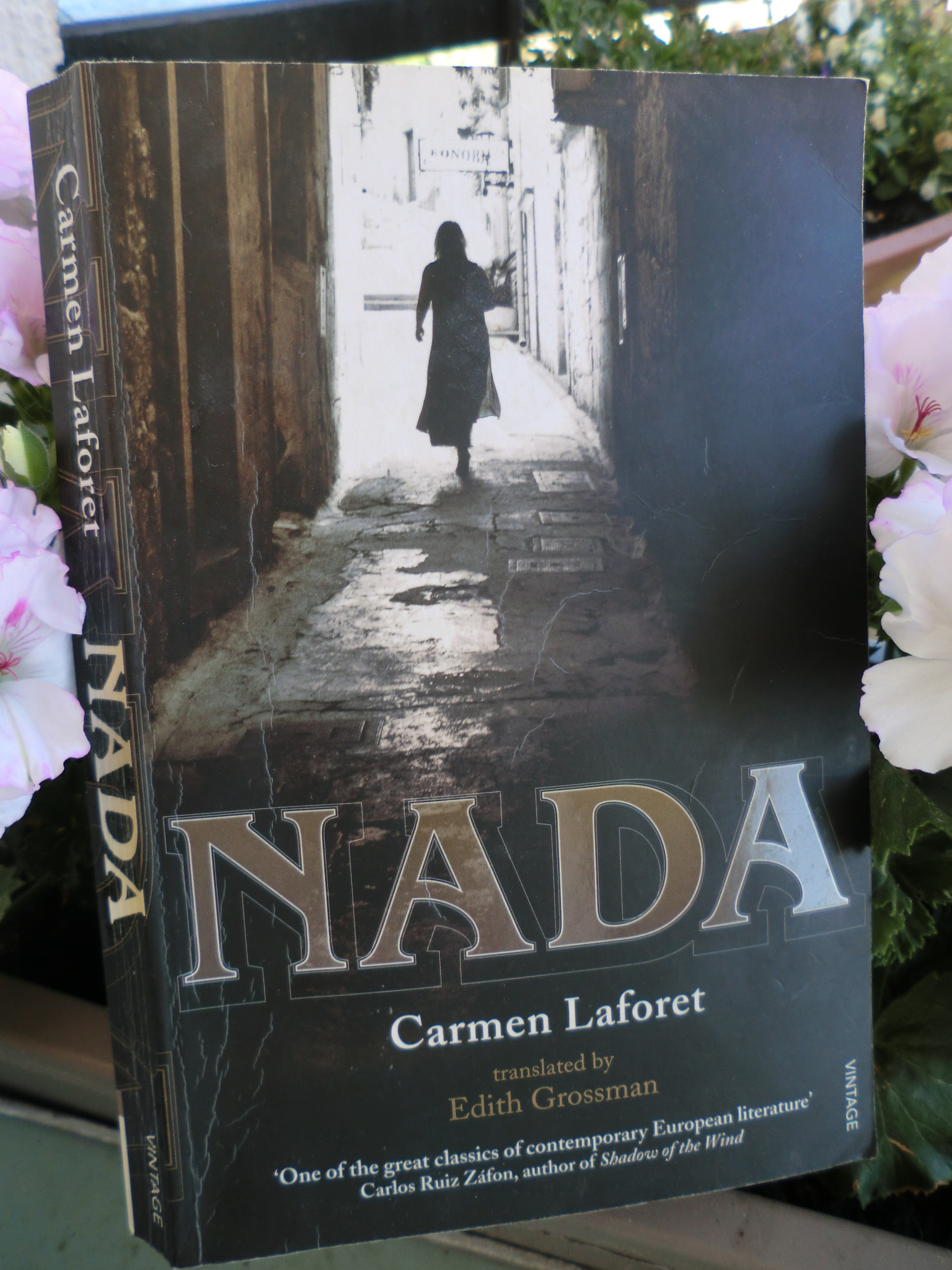
Nada (2)On a recent visit to London, my Uncle was handing this book back to the friend who lent it to him and I listened intrigued as they discussed its merits. “Isn’t it brilliant?” she said.

Book envy hardly had time to rear its head before my Uncle said “but Claire, you must read this too” and rather than it returning to its owner, this book came home with me, delighted to be off the shelf once more, this time travelling closer to the territory where it was conceived.

Nada was written by Carmen Laforet when she was 23 years old and first published in Spanish in 1945. Born in Barcelona, she moved to Las Palmas in the Canary Islands when she was 2 years old and like her protagonist Andrea, moved to Barcelona when she was 18 to study literature and philosophy.

Edith Grossman, who also translated Gabriel Garcia Marquez and Mario Vargas Llosa (who writes a brilliant introduction in the opening pages) puts Nada into English in what Alberto Manguel describes as “a fluid translation”, one that I read as if it has been written in English as its first language. The book was finally published in 2007, three years after the death of its author.

Andrea has spent a dreamy summer in her hometown, looking forward to coming to Barcelona to study and spend time with her family she hasn’t seen in years and barely remembers. She arrives three hours late and thus finds her way to the Calle de Aribau alone in the dead of night, arriving at the dilapidated apartment to be met by an apparition, a strange gathering of eccentric characters.

gothic barcelonaHer family, weathered by years of neglect, corruption and psychological torment, live in a claustrophobic environment that causes Andrea to develop her own eccentric behaviour in an effort to escape theirs. The house is inhabited by her two uncles, Juan and Roman, her aunt Angustias, the maid Antonia, and Juan’s wife, Gloria, plus a menagerie of cats, an old dog and a parrot.

“That illuminated twinkling of stars brought back in a rush all my hopes regarding Barcelona until the moment I’d entered this atmosphere of perverse people and furniture. I was afraid to get into the bed that resembled a coffin. I think I was trembling with undefinable terrors when I put out the candle.”

Though never mentioned, the city and its people are in the shadow of the recent civil war which has pushed the population to its extremity, people are either starving or drowning in excess, oblivious to the plight of the depleted middle class, who grasp onto whatever they can, the more practical selling the candelabra and curtains no longer given occasion to flaunt their long-lost beauty.

“The memory of nights on Calle de Aribau comes to me now. Those nights that ran like a black river beneath the bridges of the days, nights when stagnant odours gave off the breath of ghosts.”

Carmen Laforet 1921 - 2004

Carmen Laforet 1921 – 2004

Carmen Laforet writes in a way that makes the reader experience the brutality of each encounter, while instilling in us something of the toughness of Andrea, we seem to know she will handle it all, despite her growing thinner by the day as she observes the decline into madness of her extended family.

The depth of the prose is extraordinary and intriguing, the kind of work that makes a reader want to listen to the writer talk about what inspired them and what was going through their mind when these words flowed onto the page.

Carmen Laforet has created a heroine who is witness to a decline, who is oppressed by it and at the same time somewhat oblivious to it, captured it with an intensity that causes us anguish, the story sits uncomfortably with the reader but compels us to turn the pages ravenously. An utterly absorbing and spellbinding read, what a treasure that took so long to be shared with the English reading world.

“She achieved this, and half a century after it was published, her beautiful, terrible novel still lives.” Mario Vargas Losa


Further Reading

Elena’s Books and Reviews – an excellent review by Spanish blogger, Elena Adler. Studying literature and humanities, her insights add much value to our reading and comprehension of the underlying tensions and dysfunction of society post the civil war.

The GuardianAlberto Manguel hails the first appearance in English of the modern Spanish classic Nada.


Scattered Dreams by Karin Crilly

On March 4th I sent an email to Karin Crilly about a competition being run on The Good Life France. I saw this competition mentioned on twitter  @lifefrance and thought of Karin as I knew she was writing a memoir about her year in Aix-en-Provence and I thought it would be a good idea for her to send something out into the world.

The Good Life France is an independent online magazine that celebrates life in France and attracts a number of writers and contributors who write on a wide range of subjects, keeping visitors and residents informed about France and all things French. The competition was to celebrate the 2nd anniversary since their inception and they invited contributions of work up to 1000 words on France or French related.

Good Life

Karin replied and said she would be very interested in entering the competition and asked if I would like to read the extract she had chosen, from the first chapter of her book.

Unbeknown to us both at the time, it was the beginning of the two of us working together. I read her work, made some suggestions and she polished her already excellent prose into a shape resembling 1000 words of an evocative experience in Paris that did indeed wow the judges, moving some of them to tears yet uplifting them at the same time.

Earlier this week, to our great joy, we learned that Karin had won the competition, ahead of more than 100 other entries and her story Scattered Dreams in Paris has now been published on The Good Life France.

You can read the story here by clicking on the title.

Winner of 2014 Writing Competition The Good Life France!

Scattered Dreams in Paris by Karin Crilly

CIMG2976


Congratulations Karin and  Bonne Continuation!

Update: Karin’s memoir has now been published, you can find out more by reading my review here: The Blue Satin NightGown by Karin Crilly.

Aimless Love by Billy Collins

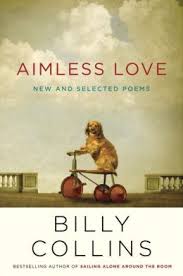
Aimless LoveI am a relative newcomer to the poetry of Billy Collins, but thanks to an admiring fan, I was lent a copy of his collection Sailing Alone Around the Room which was an extremely readable, entertaining and at times even hilarious read and so when I saw this new collection was coming out I requested it.

Who even knew that one could study for a PhD in Romantic Poetry? Does that make him of Doctor of Love I wonder?

His poems speak of ordinary things but steer clear of cliché, and Aimless Love as a title for this collection of collections as well as some new poems, seems perfectly apt for all manner of common things he appreciates and shares with us.

Aimless Love brings together selected poems from previous collections as well as some new poems

Here are a few extracts from moments of pure joy in reading Billy Collins Aimless Love:

The Country

I wondered about you

when you told me never to leave

a box of wooden, strike-

anywhere matches

lying around the house because

the mice

might get into them and start a fire.

But your face was absolutely

straight

when you twisted the lid down

on the round tin

where the matches, you said, are

always stowed.

Who could sleep that night?

Artwork by our Allia

Artwork by our Allia

Who could whisk away the thought

of the one unlikely mouse

padding along a cold water pipe

behind the floral wallpaper

gripping a single wooden match

between the needles of his teeth?

And who could not be tempted to read and understand more of this familiar relationship between the poet and his parents in:

No Time

In a rush this weekday morning,

I tap the horn as I speed past the

cemetery

where my parents lie buried

side by side under a smooth slab

of granite.

And this line from a poem called

Monday

Just think –

before the invention of the window,

the poets would have had to put on a jacket

and a winter hat to go outside

or remain indoors with only a

wall to stare at.

There are other fabulous poems like The Great American Poem, Horoscopes for the Dead, and Ode to a Desk Lamp.

But just as good as reading his poetry is listening to him read aloud, he has a melodic voice that lulls the listener into a kind of warm familial comfort, his words caress like a gentle tide of steaming bath water with the scent of Cedarwood. Well, perhaps if you close your eyes while listening, like I do.

Here he is reading just a few days ago, the title poem to this collection Aimless Love, so sit back, close your eyes, listen and be soothed:

Note: This book was an Advance Reader Copy, provided by the publisher via NetGalley.

A Hundred Thousand White Stones: An Ordinary Tibetan’s Extraordinary Journey

Kunsang Dolma might have had a more ordinary life, if it hadn’t been her turn to be the family representative at the annual ten-day prayer session at their local village temple when she was 15 years old. An event peripheral to that obligation changed the path she was on, which would have been an arranged marriage to a local boy and raising children to help with the farm work. For those of us reading it however, this is no ordinary life, but an insight into an ancient culture and one courageous woman who survives its harshness, revels in its deep, spiritual wonders and travels outside all that she knows to become the wife of an American citizen.

A Hundred Thousand White StonesThe consequence of that event sets her on the path towards becoming a Buddhist nun, something she had previously considered but had been rejected by her parents, so she and a friend decided to run away from their village to ensure it happened, without parental consent.

While she doesn’t remain a nun all her life, ironically the second major turning point in her life that moved her away from being a nun towards marriage and a life in America was not dissimilar to that which motivated her action towards pursuing a monastic life in the beginning. This is a true story, however I am reminded of all those turning points in the life of the fictitious character Ursula’s in Kate Atkinson’s Life After Life and the significant power that one event can have to alter the direction of a young woman’s life.

Tibetan farmersKunsang shares her upbringing with a quiet, practical, honest voice and it is a childhood and adolescence we see as difficult, though in the context of where she lived, a small Tibetan village, it was quite like many other villagers and something she now looks back on with appreciation and an incessant longing, having left it all behind. It is in leaving a difficult way of life and family behind us, in making it no longer attainable that the deepest yearning for that which was willingly fled, is often felt.

Her parents married at 15 which is not uncommon, however they were unable to conceive until they were 28 years old, something that came as a relief as being farmers, children are essential to their survival as future workers. Kunsang was the youngest of 8 children and by the time she was born, there were sufficient children to manage the farm work; it was this fact that enabled her to have an education.

At the time, there was no birth control, so after thirteen years without a child, it looked like they definitely weren’t going be able to have any children, which are essential to help with work on the farm. My father’s sister already had two kids and felt sorry for my parents’ situation, so when she was pregnant a third time she told my father, “Look, this is my third child. I’m going to give him to you.” The baby was twenty-two days old when my parents took him home. After that, my mother started to have her own babies. My parents always thought that my adopted brother Yula had brought them good luck.

Tibet mapKunsang eventually makes a pilgrimage to Dharamsala to see the Dalai Lama and during her time here she meets her future husband, narrating the heart-breaking, tedious administrative process they must overcome to be together and the struggles she will face even when they succeed. It is a moving story of a life we can hardly imagine and a journey that crosses many boundaries most of us will never have to traverse, to hike over terrain while risking one’s life, to encounter a revered spiritual leader, create a way to support oneself financially in a foreign country alone and to raise your children in yet another country which will become their home, but never yours.

CIMG3772Reading stories like Kunsang’s is not just an eye-opener into another culture and way of life and another way of dealing with life’s issues, it invites us to practise empathy and patience in the way we interact with foreigners in our own country. Kindness and compassion are there in abundance if we choose to offer them to others and it is stories like Kunsang’s that motivate us to want to extend it.

Note: This book was an ARC (Advance Reader Copy) provided by the publisher via NetGalley.

Stet, an Editor’s Life Diana Athill

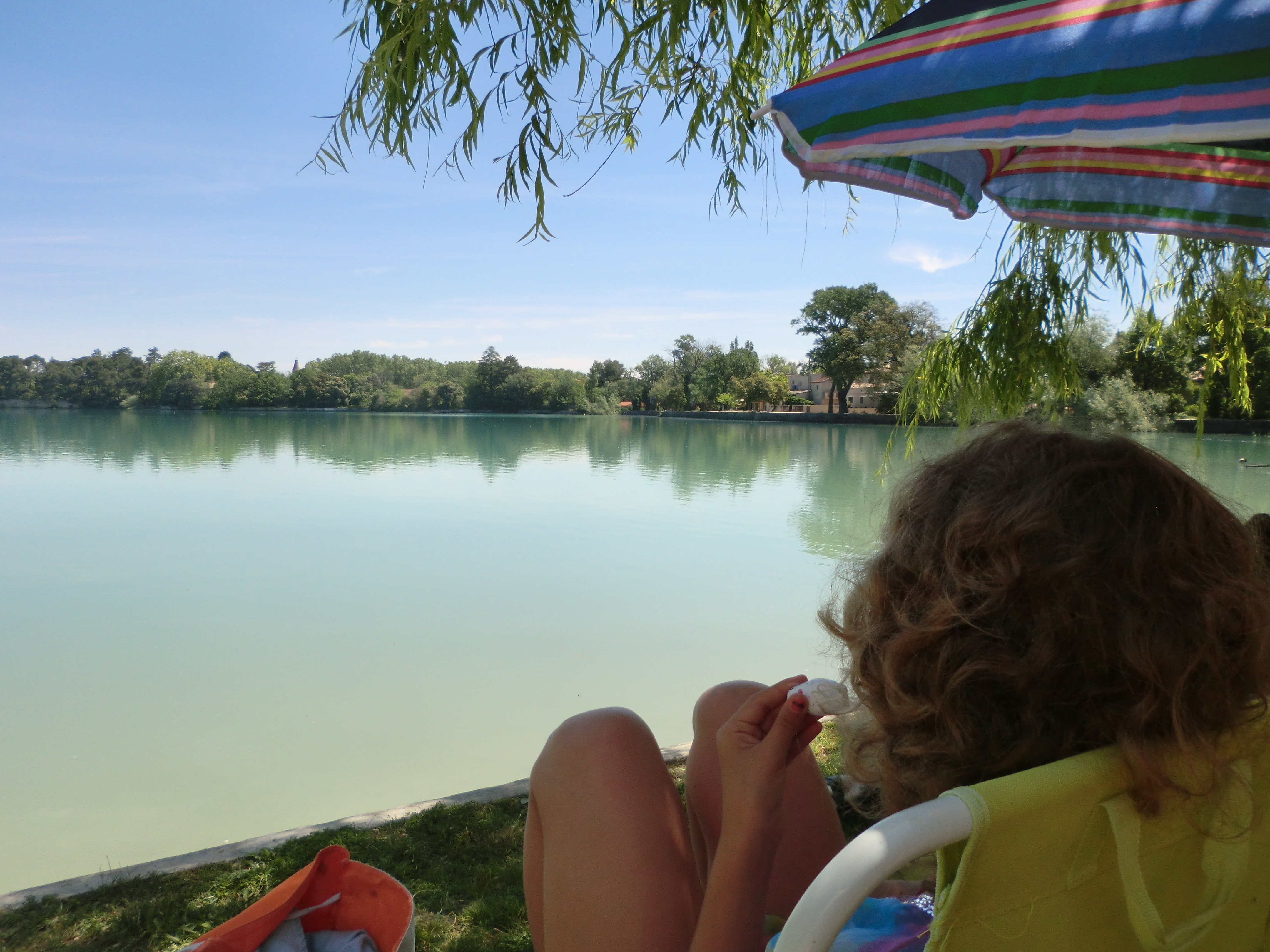
LakesideI read most of Diana Athill’s book in two afternoons, sitting under a willow tree beside the lake L’étang de la Bonde as the children swam continuously, refusing to get out until it was time to leave. Despite the fact that we were outdoors, I felt as if I had just spent two days in Athill’s living room, listening to her share this particular segment of her life, that as Editor at André Deutsch, the publishing house where she worked for four decades.

Stet is not a common word and I am perhaps only familiar with it because, back in the old days, when I was a 23-year-old Market Research Assistant without typing skills, I used to write reports and had a secretary to type them. I even had my own office with a door that could be closed. Using the word stet meant I’d changed my mind after I’d crossed something out, wanting it left in. The Concise Oxford Dictionary tells us :

Not the first of Athill’s memoirs, but the one I was attracted to, since it offers a glimpse inside an Editors office. I had already read and reviewed Betsy Lerner’s The Forest For the Trees, which this book made me recall, you could say they complement each other in a certain respect, though they are very different books, as one might expect when comparing the perspective of an English Editor to that of an American Editor. Both equally interesting and insightful in their own way.

In Part One, Athill shares how she fell into publishing as a career, knowing she would have to find a job, while her great-grandparents generation had made or married into money, her father’s generation had lost it and she talks about many aspects of the job, the decisions that were made, the dramas that were lived and worked through.

“The story began with my father telling me: ‘You will have to earn your living.’ He said it to me several times during my childhood (which began in 1917), and the way he said it implied that earning one’s living was not quite natural. I do not remember resenting the idea, but it was slightly alarming…Daughters would not, of course, have to earn their livings if they got married, but (this was never said) now that they would have to depend on love unaided by dowries, marriage could no longer be counted on with absolute confidence.”

Diana Athill

Diana Athill

The start to her career was disrupted by the onset of the Second World War, however she was fortunate to have a friend working in the recruitment office of the BBC and found an information/research position in the Overseas News Department. She and a friend lived in a small apartment in London and had a good social life, at one of the parties she met the young Hungarian intellect André Deutsch, the start of a lifelong friendship and she would eventually leave her job to join him as a shareholder and working Director when he decided to start his own publishing firm.

Not the easiest of employers, Athill shares some interesting insights about working for an often disagreeable and intolerant man whom she respected despite his deficiencies. She is also quick to point out her own flaws and it is perhaps the counterbalance of their personalities that made them such a successful pair and helped keep the publisher in business for as long as it was able. She also shares her continued love of literature, reading and writing.

Stet“They brought home to me the central reason why books have meant so much to me. It is not because of my pleasure in the art of writing, though that has been very great. It is because they have taken me so far beyond the narrow limits of my own experience and have so greatly enlarged my sense of the complexity of the life: of its consuming darkness, and also – thank God – of the light which continues to struggle through.”

In Part Two, she expounds on her relationship with a small selection of writers, providing a chapter each and very frank accounts of what transpires between Athill, the publishing house and the following authors: Mordecai Richler and Brian Moore, Jean Rhys, Alfred Chester, V.S.Naipul and Molly Keane. One is left with the impression that there was a lot more drama and pandering to personalities in the past than there can be in today’s less nurturing publisher – author relationships. Eye opening indeed!

As I mentioned in the Man Booker Prize longlist post, Diana Athill won the Costa Prize for her most recent memoir Somewhere Near the End in 2009, which she wrote in her nineties, a book which is sure to be equally enlightening and one I look forward to indulging, knowing as I did with this book, it is bound to offer delightful company for future afternoon reading.

CIMG4553

Shoes Hair Nails, Fragments of the Whole

In October 2012 a pair of Marie Antoinette silk slippers were put up for auction on the anniversary of her execution.

Marie Antoinette silk slippers

Marie Antoinette silk slippers

I knew about it because I use BBC News texts rewritten for learning purposes to teach English to mature French students; it keeps the lessons interesting and relevant, no more “Brian is in the kitchen” or “Michelle is at the swimming pool”, now we can introduce rich new vocabulary such as guillotine, opulent, goes under the hammer, scaffold, artefacts and tyranny and more importantly, improve competence and confidence in the art of conversation and communication.

Knowing that the author Deborah Batterman had written a collection of short stories with Shoes in the title, I tweeted her a link to the Marie Antoinette story. She offered me a copy of her book and though I warned her shoes, hair and nails weren’t my thing, if she was willing to risk sending me her book, I’d read it. While I was keen to read the stories, I admit that I hesitated at the Cinderella type image on the cover, which may explain why in my reading, I began to rename the stories as I went, partly to help remember them, but also to reclaim them and give them the credit I believe they deserve.

Shoes Hair NailsThe stories are like vignettes, fragments, captured moments in time and life that feel familiar, even if the experiences are not what we know. Because in reading we inhabit the character and Batterman has a cathartic way of writing that puts us in the shoes of her protagonist, we understand implicitly what it was like to be there and to live through that experience.

She articulates instinctive, feminine sensitivities, fears, and concerns we will all recognise and yet struggle to put into words ourselves, and why bother when one can sit back with this gentle, funny and considerate collection of stories which take us to those places without the struggle to explain ourselves and may even help us feel better about facing similar issues.

Here is a glimpse into a few of the stories:

Vegas or as I think of it Last Trip to Vegas – Not wishing to acknowledge, even less to accept that Norman is at the stage where he needs care other what he can provide himself, his son Kevin takes him and the family off for a weekend trip to Las Vegas, hoping that the familiar experience will reignite those no longer charging cells in his decrepid body and somehow turn back the clock.

“Kevin argues with the doctors, reminds them of studies showing how physical stimulation helps not only the body, but the mind too. He knows Norman cannot live with us, refuses to think of any alternative. Except this one. He will take his father to Las Vegas, the place he loved more than any place on earth. The place that bombards the senses every which way you turn, every hour of the day… If the body has memory, Kevin reasons, this is the place to bring it back.”

It’s an entertaining trip and not on account of the expected offering of the casino city. It’s like Norman’s last stand and he has a whale of a time, as his family come to the realisation that they have up until now been avoiding. That there is no going back, the body is not a machine we can put in reverse, or slow motion, or pause. I loved this story and think it would make a better movie than that one about those three blokes who go to Vegas – and anyone experiencing mixed emotions with their parents going through the ageing process will appreciate the laughs and the stark realities of this tale.

kittens learningCrazy Charlotte – I think of this story as The Innocents, about a girl who wants to befriend a family living outside accepted social circles, who are the subject of gossip. She is intrigued by them all, Charlotte the mother is unlike anyone she has ever met and wants to give her children a broader education even if that means occasionally keeping them at home so they can visit an exhibition or see the birth of kittens. Charlotte isn’t crazy, but she allows one little girl to see the world through different eyes.

Nails, I think of as The Unfortunate Inheritance and it is appropriate that it also features in the title, because it is a deeply memorable story that reads like a novel and one that I could easily have kept turning the pages for and delved even deeper into all those characters with their Shimmering Reds or Deathless Velvet or whatever it was they wore on their nails, the references to nails actually reminded me a little of that “Where’s Wally?” character, the way they turned up in the most unlikely places, with regular consistency.

The protagonist moves on from a relationship and into an apartment on the 8th floor, already populated by complex, interconnected characters, whose lives and jealousies and pasts we begin to learn something of. Everyone arrives or is already ensconced with their baggage, physical and emotional, created or inherited, a stray dog, a piano, memories of a previous relationship, a past job. And sometimes an inheritance doesn’t make life any easier at all, in fact it can be lethal.

Deer Crossing2In Defensive Driving or as I recall it, Lesson 1 : The Many Effects of Deer, a woman and her husband find themselves in a random group of people, some of whom are there for similar reasons to their own, others because they have no choice. Regardless of their reasons, they all bring their many perceptions, which will be altered significantly by what occurs in lesson 1.

An inspiring collection of stories I recommend.  And even though I said I’m not into shoes, this post inspired me to seek out another book I’m going to revisit and share with you soon, more about shoes as art and inspiration, coming soon…

She Left Me the Gun

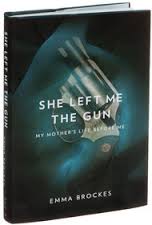
The GunNeither the title nor this book cover would normally attract me towards picking up this book, however it was through neither of those avenues that I came to hear about the book. It was a random tweet that included the following:

Any sentence that contains the words “Maya Angelou and Emma Brockes, who both…” works for me.

I was reading Maya Angelou’s Mom & Me & Mom at the time and so wondered who Emma Brockes was, intrigued by the reader’s comment implying she’d enjoy curling up with both books. I saw that Brockes had published a memoir about her mother and then read an excellent article in The Guardian, where it turns out Emma Brockes works (in the New York office).

Emma Brockes was born in England, her mother leaving her own country of birth South Africa in her early twenties. After some years living in London, she met her husband and they moved to an English village. She was a mature mother, having her only child later in life and lived a quite routine-lead life with her small family and had a job doing accounts for a jeweller in a neighbouring town.

Brockes recalls her mother mentioning that she’d one day tell her about her life in South Africa before coming to England, however the daughter didn’t press her mother and that moment of revelation never arrived. Apart from a couple of offhand comments hinting at some dark past and a court case, any opportunity to quietly share her past with her daughter in her later years was cut short by her illness and premature death, a time when the days seemed better spent just appreciating each other’s company.

It seemed absurd at this stage to ruin what time we had left with painful and long-avoided subjects.

Whether it was the journalist instinct or some kind of closure in making an effort to understand her mother more fully, Brockes decides to find out what it was that drove her mother to abandon her family and her country and never look back.

Jo'burg High Court

Jo’burg High Court

Knowing there was a court case against her grandfather and using her journalistic knowledge and access to resources, she searches archives, only to discover an earlier judgement, one that preceded his marriage to her grandmother, a murder conviction.

She requests the file to be sent to her and then discovers the second court case, in which mother is named in bringing a charge against her own father. The file is too large, so she makes plans to visit South Africa to do her research and to meet the numerous family members, her mother’s half sisters and brothers, the seven aunts and uncles who live there.

When she was in her mid-twenties, she said, she’d had her father arrested. There had been a highly publicized court case, during which he had defended himself, cross-examining his own children in the witness-box and destroying them one by one. Her stepmother had covered for him. He had been found not guilty.

Emma Brockes

Emma Brockes

This is a book that once started is hard to put down, the way Emma Brockes writes, it is as if you are on the same journey, with the same feeling of curiosity tempered by an instinct not to get too involved.

In fact, for me there was a turning point somewhere in her travels, just when she starts to become part of a local crowd of journalists, when she begins to become part of the weave of family fabric, when it felt like it was time to get out. That while she was there and had a clear purpose and was fulfilling some kind of tribute to her mother, all was well, but that getting any further involved might in some way rub something into her that her mother had spent a lifetime trying to protect her from.

She was right to leave when she did.

And the gun? Well you know whenever a gun is mentioned, a shot must be fired and so it was, yet while the title stretches the truth somewhat, all must be forgiven, since it was suggested to the author by the late Nora Ephron, another fitting tribute.

Note: This book was an ARC (Advance Reader Copy) provided by the publisher via NetGalley.