Brother, I’m Dying by Edwidge Danticat

Brother Im DyingI first read Haitian author, Edwidge Danticat last summer, her novel Breath, Eyes, Memory (review linked below) about a young girl living with her Aunt in Haiti, while her mother lived in New York, a little like the life of the author herself, much of which is revealed in this non-fiction title, Brother, I’m Dying where we learn more about her life, though the primary focus is on her father Mira and in particular, her Uncle Joseph.

After having read a number of books in the Caribbean tradition recently, it is both unique and a gesture of deep reverence to read about the special connection between a daughter and her two fathers, for she sees both these men, and rightfully so, as her fathers.

The novel opens on the day of two discoveries, the author learns she is pregnant with her first child and hears that her father has been diagnosed with a terminal illness. The pulmonary disorder had required him to take medicine (containing codeine) resulting in his taxi licence being revoked. The medicine did nothing to alleviate his symptoms, worse it lost him his job and his dignity.

The chapters alternate between their present life in America and the author’s early life in Haiti, recounting the lives of the two brothers. We come to understand the lives they create from the choices they made, how they reinvent themselves, the obstacles they face, whether it’s family, work, the establishment, or navigating the political and legal demands of the countries they inhabit.

Mira leaves Haiti to create a better life in America for his family, a departure the author has no memory of, though her Uncle Joseph’s adopted daughter Marie Micheline shared stories with her, in a tradition common to people like her, anecdotes of poignant memories for those that have been left, to serve as reassurance that they were and are loved.

“Unfortunately I wasn’t told many stories like that. What I did often hear about was the future, an undetermined time when my father would send for my mother, Bob and me.”

Life was difficult for her mother and she often left the children with her brother-in-law to ensure the children had a decent meal. Then two years after her father left, when she was four and Bob was two, her mother’s visa was approved and she too departed, alone.

The two children became very attached to their Aunt and Uncle, while they waited out the nine long years before they too could make their eventual transition to join their parents in New York. Finally happening when Edwidge was twelve years old, it would be an even greater emotional challenge, not least because they had two younger brothers born in the US, one of whom believed he was the rightful, elder child of the family.

Back in Haiti, Joseph’s voice had begun to quiver, it worried him so he travelled to a hospital where US doctors were visiting, learning of a suspected tumour that would block his airways and suffocate him if not removed. It could be extracted in the US, but so too with it, would be his voice, reduced to a bare whisper, a death-knell for a pastor.

Almost like a miracle, on a subsequent visit for a check-up, he is shown a contraption he can use to amplify his whispers and allow people to hear him.

“My father took my uncle’s hand and led him to a lamp in a corner of the room, so he could better see the machine and its interaction with my uncle’s neck. This was their first two-sided conversation in many years and they both seemed to want to move it past the technicalities to a point of near normalcy.”
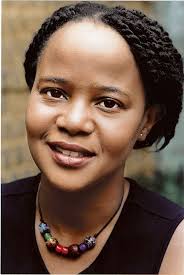
Edwidge Danticat

Edwidge Danticat

The one thing that remains constant throughout their long separation, is their love and respect for each other, as witnessed and shared through the eyes of their daughter and niece.

Edwidge Danticat writes in such an honest and compassionate way, you can’t help but become drawn into their story and feel concern at the various dramatic points that arise, willing things to turn out for the best – except that’s not what happens in real life – in reality, not everything will turn out as we will it to, but the memories will remain and the experiences contribute to forming the characters that we become.

It is a credit to the author to have chosen to share something of her life, her early childhood, without elevating herself as the main character of interest, it is both a story and a tribute to the extended family and the men who tried to lead them to live in safety.

The brothers chose different paths, one deciding to leave, the other to stay and though they were separated for 30 years their relationship remained strong, seeing each other as often as they could and keeping this strong connection between all the extended members of the family and their birth country.

As Cristina García, author of Dreaming in Cuban (one of my Top 5 Fiction Reads of 2015) put it:

“Edwidge Danticat’s moving tale of two remarkable brothers – her own father  and her beloved Uncle Joseph, separated for thirty years – is as compelling and richly told as her fiction. Politically charged and sadly unforgettable, their stories will lodge themselves in your heart.”

Breath Eyes Memory

A wonderful book, an honest portrayal of lives, where joy and struggle go hand in hand, where fear is never far from the front gate and sadness its companion, yet full of hope and spiritedness as an eighty-one-year old man refuses to let thugs take all that he has, and even though he risks his life, he will continue to pursue with righteousness, what is necessary in his own country to ensure justice. Which only serves to make what follows so immensely tragic.

A 5 star must read for me.

Further Links:

Edwidge Danticat, my review of Breath, Eyes, Memory

Cristina García, my review of Dreaming in Cuban

The Immortal Life of Henrietta Lacks by Rebecca Skloot

Henrietta LacksIn the same way we sometimes debate whether the story should be seen as an entirely separate entity to the writer, so too scientists perceive a sample of cell tissue as separate to the human body it was extracted from.

Except that it is not possible to extract a story from a writer’s imagination without their consent. 

Henrietta Lacks was a young mother in her early thirties when she was diagnosed with an aggressive form of cancer that would quickly take her life. She was fortunate to live close to John Hopkins hospital, built in 1889 as a charity hospital for the sick and poor, to ensure equal access to medical care for all, no matter their race, status, income or any other characteristic that might have otherwise given cause to discriminate in many of the hospitals at the time.

Before undergoing treatment, one of the Doctors took a tissue sample of both her healthy cells and the cancerous cells, as he had been doing to most patients, in an effort to try to find cells that would continue to replicate without dying – searching for the elusive “immortal” cell. It had never been done successfully with human cells.

He succeeded and the cells became known the world over – as he gave them away freely – as HeLa cells, immortal human cells that never died and could be used over and over to test for cures to disease and to observe how cells react to numerous variables, furthering science in ways unimaginable previously.

‘In culture, cancer cells can go on dividing indefinitely, if they have a continual supply of nutrients, and thus are said to be “immortal”. A striking example  is a cell line that has been reproducing in culture since 1951. (Cells of this line are called HeLa cells because their original source was a tumour removed from a woman called Henrietta Lacks.)’

Few paused to ask about the woman behind these cells, what was her story, how her family felt about the multi million dollar research industry that made great strides in science , yes, but also made entrepreneurial types wealthy in the process.

Rebecca Skloot first heard of the HeLa cells in 1988, she was 16-years-old, sitting in her biology class listening to a lecture on cell culture by her instructor Donald Defler. He described the many things that have been learned by being able to grow cells in culture, indicating that much we knew today was due to the proliferation of cells made available thanks to Henrietta Lacks.

‘HeLa cells were one of the most important things that happened to medicine in the last hundred years, ” Defler said.

Henrietta_LacksSkloot made Henrietta the subject of her research for 10 years in the creation of this thorough, respectful account of the life of Henrietta Lacks and her journey to uncover the events of the time within the context of what was the norm in her day.

In much of her location research, when she travelled to meet and interview people, she was accompanied by Henrietta’s daughter Deborah, a passionate woman, unable to find peace in her own life, until she had helped bring her mother’s story to light.

Henrietta Lacks was born in Roanoke, Virginia in August 1920, in a small shack overlooking a busy train depot, where freight cars constantly shunted to and fro. She lived there with her parents and 8 older siblings until 1924, when her mother died giving birth to her tenth child.

Her father lacked the patience for raising children, so took them all to his family in Clover, Virginia, where they farmed tobacco and split the children between those who could take them. Henrietta went to live with her grandfather, Tommy Lacks and her nine-year-old-cousin Day, left there after his birth, by his mother.

‘A twelve year old cousin and midwife named Munchie delivered him, blue as a stormy sky and not breathing. A white doctor came to the home-house with his derby and walking stick, wrote “stillborn” on Day’s birth certificate, then drove his horse-drawn buggy back to town, leaving a cloud of red dust behind.’

Their life there, became one filled with chores, waking at 4 o’clock in the morning, feeding animals, tending the family garden and then off to the tobacco fields to work.

Skloot finds out about her childhood, her marriage to Day, the 10 years they were married and had their children and the diagnosis that she kept from everyone, until it became obvious she was going to die.

It is tragic, sad and yet also a brilliant and informative story and piece of scientific medical history that reads like a novel and brings our awareness to the many who unknowingly make sacrifices for the better of others and that always present aspect of commercial vultures, hovering in the wings, recognising an opportunity to profit.

It rightly reveals and celebrates the life of the little-known woman behind those cells, Henrietta Lacks, who died at a young age from a ravaging cervical cancer, her children’s struggle, the family’s history and all that is kept from them in the name of science.

The Immortal Life of Henrietta Lacks was one of my Top 5 Non-Fiction Reads of 2015.

The Story of the Lost Child by Elena Ferrante tr. Ann Goldstein

The final book in the Neapolitan Novels tetralogy that began with Elena Ferrante’s My Brilliant FriendThe Story of the Lost Child continues the saga of two compelling woman, Elena and Lila, childhood friends and now single mothers, back living in the neighbourhood of their humble origins.

At the end of Book 3 Those Who Leave and Those Who Stay, Elena was in the midst of a crisis, unable to think or act in anyone’s best interests, rather, she was lead by the wild palpitations of a lust driven heart and appeared to be prepared to risk all she had fought so hard and for so long to rise above and gain.

Now with everything collapsing around her, she returns to her roots, where things are as likely to be in disorder and chaos, but in a place where she feels safe, it is familiar, known.

Elena’s daughters must adapt to a less pampered life, although their mother wishes that they, like her, acquire sufficient education to allow them choices about where and how they might live. Elena and Lila’s children present them both with significant challenges, causing them to move closer together in some respects and further apart when tragedy strikes hard.

As with the previous books, Elena is never quite sure of Lila’s intentions, questioning her motives when she appears helpful and suspicious of her intentions when she informs her of gossip. It is a characteristic of their friendship that has existed since the beginning, an aspect Elena never fully unravels and keeps her always on guard.

‘I went home depressed. I couldn’t drive out the suspicion that she was using me, just as Marcello had said. She had sent me out to risk everything and counted on that bit of fame I had to win her war, to complete her revenge, to silence all her feelings of guilt.’

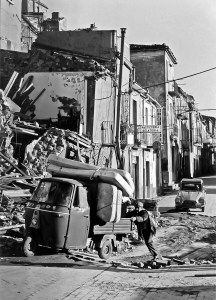
Naples Earthquake 1980It is the 1980’s and one of the turning points in Lila’s deterioration is the earthquake that occurred on November 23, 1980 killing 3,000 and rendering 300,000 of Naples inhabitants homeless. It is used as a powerful metaphor for the destabilisation that occurs in Elena and Lila’s lives.
‘It expelled the habit of stability and solidity, the confidence that every second would be identical to the next, the familiarity of sounds and gestures, the certainty of recognising them. A sort of suspicion of every form of reassurance took over, a tendency to believe in every prediction of bad luck, an obsessive attention to signs of the brittleness of the world, and it was hard to take control again. Minutes and minutes and minutes that wouldn’t end.’

Elena has always sought her independence and intended to create a career as a writer, it is only when she moves back to the neighbourhood that she realises with greater urgency that she must be autonomous.

‘It was then that a part of me – only a part – began to emerge that consciously, without particularly suffering, admitted that it couldn’t really count on him. It wasn’t just the old fear that he would leave me; rather it seemed to me an abrupt contraction of perspective. I stopped looking into the distance, I began to think that in the immediate future I couldn’t expect from Nino more than what he was giving me, and that I had to decide if it was enough.’

Book Four brings the girls full circle into the adult world where the relationships of childhood and dramas of their youth play out in a more dangerous playground, where boyhood pranks have evolved into criminal activities and the annoying habits of children transform into the damaging actions of adults with far-reaching and destructive consequences.

They are no longer observers of the world around them, they are perpetrators of events and circumstances that will affect the next generation, their children. Though they never wanted it and put all their energy into trying to prevent it, in many ways, they have begun to resemble the already departed, those they worked so hard not to become.

Book Four brings Elena and Lila’s stories back to where it all began, reacquainting us with the story’s beginning, of memories and possessions that have endured, that contain within them that sense of unease alongside the familiar, the two coexist and can not be separated, even in maturity. It is a conclusion of sorts, as thought-provoking as we have come to expect previously, not quite giving in to that alternative literary tradition of tying things up neatly.

I read the first three books in close proximity, each volume adding to the compulsion to want to re-enter their lives and discover what would happen next.  The longer gap in awaiting this final novel meant it took a little longer to pick up the pace, suggesting it might be a series best read consecutively.

If you haven’t read Elena Ferrante yet, here are links to reviews of the first three books in this series:

The Neapolitan Novels Reviewed

Book 1: My Brilliant Friend

Book 2: The Story of a New Name

Book 3: Those Who Leave and Those Who Stay


Note: This was an Advance Reader Copy (ARC) thank you to the publisher Europa Editions for kindly providing me with a review copy.


God Help the Child by Toni Morrison

Toni MorrisonBride is young, in her twenties, but has learned early the importance of a word, a gesture, a look that can change people’s perception of you, as long as you stick to it, you become known for it, unforgettable, and that one thing can change your world.
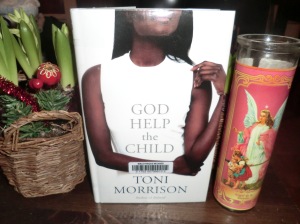
God Help the Child is mostly told through the life experience of Bride, a name she chose for herself as she launched herself into a successful and glamorous career in the perfume/fashion world.

It is far from the memory of neglect and disapproval that was her constant companion throughout childhood, channeled through the eyes, words and gestures of a mother unable to move beyond the disappointment of the blue/black tone of her daughter’s skin.

‘I told her to call me “Sweetness” instead of “Mother” or “Mama”. It was safer. Being that black and having what I think are too-thick lips calling me “Mama” would confuse people. Besides, she has funny-coloured eyes, crow-black with a blue tint, something witchy about them too.’

Before her second interview for the job she covets, she consults a designer called Jeri, who convinces her to only ever wear white, accentuating both her new name and because of the effect it had on what he described as her licorice skin.

‘At first it was boring shopping for white-only clothes until I learned how many shades of white there were: ivory, oyster, alabaster, paper white, snow, cream, ecru, Champagne, ghost, bone.’

Bride waits in a prison parking lot for a convicted felon to emerge on the last day of their sentence. She comes with a gift and a different form of naivety than that she possessed when her testimony put this person away for 20 long years.

Her current boyfriend Booker has just left her, and now this. She excels in acquiring knowledge to help her scale the ladder of success, but there is a gaping hole within that pushes her to put all else aside and find answers to questions she can barely articulate to herself.

On a whim, she tries to track down the man who disappeared without a goodbye and after a car accident and injury, finds herself living with a couple and a girl in self-imposed poverty; a stark contrast to her lifestyle. As she pursues those unclear questions, strange but noticeable things begin to happen to her body, as if it is regressing towards childhood.

Each subsequent part tells of an encounter of someone she meets or has met previously and although their stories differ there is a common thread that ties them all and demonstrates in various ways the effect these childhood experiences have on a person subsequently, how they shape who we become, how we react to things, how they affect one’s perception.

Toni Morrison

Toni Morrison

The characters enthrall, each one introduced fleetingly, intriguing and hinting at the depths that their own stories have led them to become. Morrison makes us wait and slowly reveals those experiences for the select few deemed important to the narrative. It is perhaps through this hinting at and omission, that much is left to the reader to contemplate, but then Morrison isn’t known for having to spell it all out or writing sagas, and there is enough divulged to create a balance and equal contribution between the four parts of the novel.

It is a thought-provoking, evocative novel that deserves more than one reading, demonstrating the ease with which Toni Morrison and her narrative skill are able to skate into the 21st century, to pick up and explore the nuances of another of society’s dysfunctional aspects, that the things you do and say to children in their early years really matter and will impact their adult perceptions, actions and relationships. However, there are moments, that if grasped, can and do lead one out of that.

Brilliantly told, subtle and yet powerful, Morrison’s final words at the end of the book, reminded me of the closing words of Maya Angelou in an interview she gave to the BBC near the end of her life, after a lifetime of addressing issues that manifest throughout life, her final words too, speak of children.

“Exercise patience with yourself first, so you can forgive yourself for all the dumb things you do. Then exercise patience with your children.” Maya Angelou

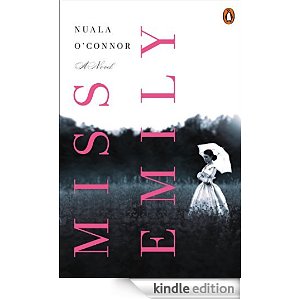
Miss Emily by Nuala O’Connor

Nuala O’Connor is the Irish author I discovered in 2014 thanks to the Irish Times Book Club.

You may remember last year, I read and reviewed her novel The Closet of Savage Mementos which she wrote under her Irish name Nuala Ní Chonchúir. That novel was about an Irish girl who left Dublin for a Scottish seaside town after the death of her boyfriend and to escape her mother’s dramas. In Scotland she encountered her own drama and was forced to make a life-changing decision.

Emily Dickinson and an Irish Maid

Now, writing as Nuala O’Connor for US and UK  readers, she pens the story of another Irish woman, the feisty but hard-working Ada, who also leaves Dublin, destined to become housemaid to the Dickinson family. It is a fictional account of the friendship between the Irish maid and the poet Emily Dickinson.

Ada Concannon, the eldest of 7 children, possesses an energetic zest for life that was unappreciated by her previous employer; upon being demoted to scullery maid she decides to seek her fortune elsewhere, taking a passage on the boat to New England where her Aunt Mary, Uncle Michael and a couple of not too friendly cousins reside.

She lands on her feet with the job at the Dickinson household, a family of four with their spinster sisters Vinnie and Emily, neighbours to their gruff brother Austin and his wife Sue, whom Emily appears to (not very convincingly) pine for.

The American Frugal Housewife

The Frugal Housewife

Emily is reluctant to leave the house, preferring words to company and attaches herself to Ada, the kitchen being one of her preferred refuges, thus friendship with the housemaid most important.

Her friendship with the maid flouts convention and is a kind of quiet rebellion within the home that the poet rarely steps out of.

“When I talk too much, everything I think and feel is wrung from me. I have nothing to write about when all is spent. It takes me so long to restore myself. It is as if I must heal a wound after each party where all is chitchat and glances and fun.”

Ada is adept in the kitchen, devoted to the family and the book The Frugal Housewife that Mrs Dickinson has lent her.

“Think of this as your second Bible,” she said.

Ada is charmed by the quiet and unassuming Daniel Byrne, her stay marred only by the creepy presence of the nephew of Daniel’s boss, Patrick Crohan.

Chapters alternate between Miss Emily’s and Ada’s perspective to reveal brief but eventful encounters in the kitchen and rooms of the Dickinson home, between Ada, Miss Emily and those around them.

Although Ada is outgoing and attractive, she still has something of the Irish reserve and tendency to silence when there is trouble. And trouble there will be. Ada and Emily must attempt to navigate the narrow space between their classes to deal with the trouble, without compromising their reputations.

Miss Emily is a lively, charming read, she brings her characters to life, especially the Irish and creates a world we can quickly imagine and inhabit. There is something comfortable and reassuring in her prose and novels that makes you want to abandon all else until the last page is turned. Just as she did with Savage Mementos, so too she achieves with Miss Emily. My only regret is that it all ends too soon, I’m still wondering about Ada and could easily follow after her into a sequel.

“For now I need the solace of words. Words bracket silence. That quiet gives propulsion to the words and all that they say. Words smoulder, they catch fire, they are volcanic eruptions, waiting to explode. I like to start small. With the fewest words I can manage. If the words run away, I trip them up and pull them back – they are elastic. If they do not cooperate, I obliterate them.”

Miss Emily audio

Man Booker Prize 2015 long list

The long list for the Man Booker Prize 2015 was announced today, Wednesday 29 July.

The ‘Booker Dozen’ 13 novels feature three British writers, five US writers and one each from the Republic of Ireland, New Zealand, India, Nigeria and Jamaica.

Marlon James, who currently lives in Minneapolis, is the first Jamaican-born author to be nominated for the prize. Laila Lalami, now based in Santa Monica but born in Rabat, is the first Moroccan-born. There are three debut novelists, the literary agent Bill Clegg, Nigerian Chigozie Obioma and New Zealand author Anna Smail.

The longlist is:

Bill Clegg (US) – Did You Ever Have a Family

– On the eve of her daughter’s wedding, June’s life is devastated when a disaster takes the lives of her entire family, all gone in a moment. June is the only survivor.

The Green RoadAnne Enright (Ireland) – The Green Road

– Spans 30 years, 3 continents and narrates the story of Rosaleen, matriarch of the dysfunctional Irish Madigan family and her four children. Sounds promising.

Marlon James (Jamaica) – A Brief History of Seven Killings

– a fictional exploration of the attempted assassination of Bob Marley in the late 1970s, featuring assassins, journalists, drug dealers, and even ghosts.

Tom McCarthy (UK) – Satin Island

– A “corporate ethnographer,” narrator, U. is tasked with writing the “Great Report,” an all-encompassing document that would sum up our era. A big essay of a novel.

The Moor's AccountLaila Lalami (US) – The Moor’s Account
– the imagined memoirs of the first black explorer of America, a Moroccan slave whose testimony was left out of the official record, historical fiction from 1527.

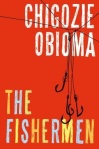
Chigozie Obioma (Nigeria) – The Fishermen

– In a Nigerian town in the mid 1990’s, four brothers encounter a madman whose mystic prophecy of violence threatens the core of their close-knit family.

Andrew O’Hagan (UK) – The Illuminations

– Anne battles dementia, her grandson Luke is in Afghanistan, on his return they set out for an old guest house where they witness the annual illuminations, dazzling artificial lights that brighten the seaside resort town as the season turns to winter. Love, memory, war and fact.

Marilynne Robinson (US) – Lila

– Revisiting characters and setting of Gilead and Home; Lila, homeless and alone after years of roaming the countryside, steps inside a small-town Iowa church—the only available shelter from the rain—and ignites a romance and a debate that will reshape her life.

Anuradha Roy (India) – Sleeping on Jupiter 

– a young girl ends up in an orphanage run by an internationally renowned spiritual guru, before being adopted abroad, haunted by memories, she returns to the temple town of Jarmuli to tie up loose ends and keep promises made long ago, intertwined with the stories of three women she meets on the train.

Sunjeev Sahota (UK) – The Year of the Runaways

– an unlikely family thrown together by circumstance, three men – Tochi, Randeep and Avtar – live together with other migrant workers in a house in Sheffield, all fleeing India and in desperate search of a new life, the woman, Narindar, is married to Randeep but barely knows him and lives in a separate flat.

The ChimesAnna Smaill (New Zealand) – The Chimes

– set in a reimagined London, a world where people cannot form new memories, the written word forbidden and destroyed. In the absence of both memory and writing is music. Simon Wythern has a gift that could change all that.

Anne Tyler (US) – A Spool of Blue Thread  (see review)

Hanya Yanagihara (US) – A Little Life

– follows the complicated relationships of four young men over decades in New York City, their joys and burdens, Jude’s journey to stability, having been scarred by a horrific childhood with its prolonged physical and emotional effects.

***

The only one I have read is Anne Tyler’s A Spool of Blue Thread, the book I’ve been hearing the most about recently, is Hanya Yanagihara’s A Little Life (albeit in a big fat book), a little too hyped for me and I’m already committed to my #chunkster for summer, which I started today, Chilean Roberto Bolano’s epic 2666.

One of the titles that intrigues me most from the list, that I have also read a few excellent reviews of recently is debut novelist Chigozie Obioma’s The Fishermen.

I’ve also listened to Anne Enright being interviewed and I’m sure The Green Road will be a great read. Based on the blurb alone, I like the sound of Laila Lalami’s historical novel, The Moor’s Account, particularly being a voice and perspective from outside the established literary quarters.

No predictions, but the shortlist of six books will be announced on Tuesday 15 September and the winner on Tuesday 13 October.

So which of these titles appeals to you, or  would you like to read?


Mayumi and the Sea of Happiness by Jennifer Tseng

“I am a quiet lady, but my imagination is wild and busy.” Isobelle Ouzman

Livia and TsengFrom one island to another, having left the four holidaymakers from elsewhere on Little Lost Island in Brenda Bowen’s Enchanted August, I find a not so little, but lost islander in Mayumi, a 41-year-old librarian and resident of another New England island.

With a demanding 4-year-old daughter who has claimed a place in the marital bed, an emotionally and physically distant husband and finding solace between the pages of the books she reads, Mayumi’s life seems to lack something she isn’t aware of, until someone arrives at the library counter to ignite it.

She develops a fixation on a 17-year-old boy, seducing him and slotting him timetable-like in her already routine, controlled life, as if forbidden love is just another aspect of a carefully planned existence, something that be contained.

In addition, she can’t help but allow a friendship to develop with the boy’s mother, her equal desire for friendship and understanding crossing neurotic wires that seem destined to create an emotional explosion.

Publisher, Europa Editions describe the book as:

“With echoes of  The Giant’s House and shot through with literary references, the debut novel by Asian-American poet Jennifer Tseng is a book that leaves a lasting impression.”

and Kirkus Reviews:

Tseng explores time and place, isolation and connection, and veers more toward the lyrical than the lurid.”

while the author herself said:

“I love the premise of someone in a mundane setting, then a stranger walks in, and everything changes.”

Jennifer Tseng

Jennifer Tseng

It was a strange read for me and while many authors succeed in bringing the reader inside a perspective that might be counter-intuitive to their own instinct, it felt as though I remained on the outside of this narrative, never able to crossover into the world Muyumi inhabits, through her narcissistic obsession.

I haven’t read The Giant’s House, although reading the blurb of it I can see why comparisons might be made.

orhan-pamuk-the-museum-of-innocenceThe only reading experience I can compare this too is Orhan Pamuk’s The Museum of Innocence, which is a very long treatise on the experience of obsession, it is so long that you can’t help but experience the tedium of an unrelenting obsession.

Tseng’s exploration is unique by virtue of it being a female obsession, confusing the roles of mother, lover, friend and wife.

It is a reminder that in the quietest of environments, the imagination is actively at work and you never know when inspiration or obsession might alight.

I leave you with a quote from the book, where Mayumi is feeling frustrated by the pending departure of the young man for a couple of weeks over the summer:

“You know I didn’t come here to mix with your sort. If anything I came here to escape such excitements.”

What had in it the seed of a compliment came off sounding like a snub. He drew back slightly as if I had just hit him.

“What I meant to say,” I persisted, determined to salvage the moment and bolster his confidence, “is that this is a highly unusual circumstance. I’ve lead a very sheltered life, sheltered from good as much as from bad. I’ve minded my own business. I never sought thrills. I’ve been content to avoid the company of youth and beauty. Before you, I had no desire.”

“With all due respect, May, I find it hard to believe,” he finished in iambic pentameter, “that a woman with your brain and your appetite came halfway across the world in search of nothing.”

He was well-mannered yet restless; his eyes studied me as though I were a page in a book. I had the sense of being one among many, of being read intensely but fleetingly by a reader who would soon turn the page.

In addition to being a poet and fiction writer, the author Jennifer Tseng is a librarian on Martha’s Vineyard, a New England island.

Pumpkin Island Maine

Note: This book was an ARC (Advance Reader Copy) kindly provided by the publisher.

Tales From The Heart, True Stories From My Childhood by Maryse Condé

I came across Maryse Condé recently via the Man Booker International Prize 2015 list of 10 nominated authors. She is third from the left in the picture below.

FinalistsNot a book prize as such, it is an award conferred on an author who has a significant body of published work, regardless of the original language it was written in, though some of it must have been translated into English.

It is from such long lists the gems are found I say, and having read about all 10 thanks to this excellent Interview: The Finalists Speak in The Guardian, I spotted my potential winner immediately. A winner in the sense that I intend to read a few of their books. The Indian writer Amitav Ghosh was the only author I’d read on this list.

One writer jumped out at me straight away and I pursued her works with little consideration for the pending award result. Maryse Condé didn’t win the prize, the Hungarian writer László Krasznahorkai did, a writer whose books intellectuals rave about, but who I’m not sure I’m ready for yet.

Tales Maryse CondéSo I took Maryse Condé’s advice and started by reading this slim volume of essays of her childhood in Guadeloupe, Tales From the Heart, True Stories From My Childhood.

She takes us right back to the beginning, to the day of her birth. Being the youngest of 8 children, the family possessed an extended collective memory and she was fortunate to have heard the story of her birth from other perspectives.

Her appearance was both a source of pride and shame for her then 43-year-old mother and 63-year-old father, proud that her body remained robust enough to support the creation of a child and shame that it publicly displayed evidence of their continued indulgence in carnal pleasures.

The first chapter Family Portrait describes her parents relationship with France:

“For them France was in no way the seat of colonial power. It was truly the Mother Country and Paris, the City of Light that lit up their lives.”

World War II wasn’t considered dark on account of all the dreadful atrocities that occurred:

“but because for seven long years they were deprived of what meant the most to them, their trips to France.”

She recounts an anecdote of a waiter in a café complimenting the family on their excellent French pronunciation, to which her parents felt indignant, considering themselves just as French as a Parisian waiter, even more so because of their higher education, manners and regular travel.

Not understanding why it mattered so, she asked her brother Sandrino:

“Could he explain my parents behaviour?” to which he replied “Papa and Maman are a pair of alienated individuals,”

a mysterious word that would rest a long time in her consciousness until she came to understand it. She realised that not only did they take no pride in their African ancestry, they knew nothing of it, however:

“They believed they were the most brilliant and most intelligent people alive, proof positive of the progress achieved by the Black Race.”

Maryse Condé

In their neighbourhood all the mothers in their circle held a profession and with it contempt for the manual work they believed had been the undoing of their own mothers. They employed a servant who, though she raised 6 children of her own would begin work at 5am to take care of the needs of the family.

We meet her best friend Yvelise, two girls who did everything together, their friendship almost destroyed by the unfortunate intervention of one of her teachers, causing a temporary rupture.

Maryse’s mother Jeanne, knew the life she didn’t wish to lead, nor her children either, she had succeeded in breaking the cycle endured by her mother and grandmother and a good education was key (and perhaps being married to a successful and much older husband). Jeanne was a school teacher, revered and feared in equal measure by those around her. Her eldest son Sandrino and her youngest child Maryse the only two children who weren’t afraid to stand up to her, the others too terrified to challenge her.

On her birthday, her favourite pupils recited compliments, gave her roses, her husband bought her jewellery and the day would culminate with a family play, a short piece of theatre written themselves, in her honour.

‘Beneath her flamboyant appearance, I imagine my mother must have been scared of life, that unbridled mare that had treated her mother and grandmother so roughly…Both of them had been abandoned with their “mountain of truth” and their two eyes to cry with.’

10-year-old Maryse asked if she could read one of her compositions for her mother’s birthday.

‘I had no idea what I wanted to write. I merely sensed that a personality such as my mother’s deserved a scribe.’

If a book of essays can reach a crescendo, this is the moment when we reach it. The moment when Maryse learns that not all lessons come from one’s parents and school teachers, some come from life itself and often when we least expect it.

In the chapter School Days , she is at school (lycée) in Paris when her French teacher asks her to present to the class a book from her island. It is a watershed moment.

‘This well intentioned proposition, however, plunged me into a deep quandary. It was, let us recall, the early fifties. Literature from the French Caribbean had not yet blossomed. Patrick Chamoiseau lay unformed in his mother’s womb and I had never heard the name Aime Césaire. Which writer from my island could I speak about? I resorted to my usual source: Sandrino.’

Sugar Cane Alley

Sugar Cane Alley

Sandrino introduces her to to a treasure. La Rue Case-Negres (Black Shack Alley) by Joseph Zobel and his hero José Hassan. It was made into an award-winning film titled Sugar Cane Alley.

It was her first introduction to a world no one up until that moment had ever mentioned; a world that highlighted slavery, the slave trade, colonial oppression, the exploitation of man by man and colour prejudice.

‘I was scared to reveal how José and I were worlds apart. In the eyes of this Communist teacher, in the eyes of the entire class, the real Caribbean was the one I was guilty of not knowing.’

These glimpses into the more significant and memorable aspects of childhood that shaped the author Maryse Condé are insightful, engaging and honest. Just as her consciousness is awakened, the vignettes finish and leave the reader desperate to know more.

I had intended to read this volume over time, but once I started reading I couldn’t stop, it is almost like reading a coming-of-age novella and at its conclusion, the writers fiction will begin. For Condé’s first novel Hérémakhonon is about a character raised in Guadeloupe, educated in Paris, who then travels to Africa in search of a recognisable past, just as she did.

‘Veronica has spent her childhood in Guadeloupe and, after a period as a student in Paris, wants to escape that island’s respectable black bourgeoisie, which she regards as secretly afraid of its own inferiority. She travels to an unnamed West African state and, while there, seeks an authentically African past with which she will be able to identify.’

Tales From The Heart is an excellent read and an intriguing introduction to the writer and her influences and will certainly make you want to read more of her work. I am very happy I have these three novels on the shelf to follow-up with only I am missing that debut novel which I really want to read now too! Very highly recommended.

Literary Works of Maryse Condé

My Other Reviews

Victoire, My Mother’s Mother 

Segu

The Story of the Cannibal Woman

A Season in Rihata

Click Here to Buy a book by Maryse Condé


Ladder of Years by Anne Tyler

Reading Anne Tyler’s 20th novel  A Spool of Blue Thread, reviewed here, first felt a little like turning to the back of the book before reading it through. This is how it ends, three generations upended, we found out how they came to be and what their origins were at the end.

ladder of yearsI wanted to try another Anne Tyler novel to have a better sense of her work and so I asked around for recommendations and eventually decided on Ladder of Years.

What a great book!

Still set in the same small town Baltimore, another family, this time we are inside the mind of Delia Grinstead, the youngest of three adult sisters, daughters of a local GP who has recently passed away. He had been living with Delia and her husband, who is also a GP, one who took over the practice from her father where Delia remained the administrator, first to her father, then to her husband, never leaving home.

A smooth transition from daughter of the Doctor to wife of the Doctor, the same home, raising three children, taking the same holiday year after year, viewing the same holiday neighbours over the fence year after year, speculating about their family members, having never spoken a word to them.

Delia doesn’t appear disgruntled, but one day while on holiday she walks off down the beach (a bit like our Harold Fry) in her husband’s beach robe and just keeps going.

What follows is something like the winding back of the clock, a version of what her life might have been, had her husband chosen sister number 1 or sister number 2 and not sister number 3, Delia.

It’s not dramatic, it’s almost sensible, if we can use that word about someone who just walks out on their life like that. She expresses no hatred, disappointment or loss, she thinks only about herself in the present and responds always to the requests of others – rather than see fault in her own actions, she interprets others confusion or hurt with, “if they had only asked”, she offers little proactively and yet will respond to anything if asked.

ladderShe is something of an enigma and at first I wondered how she could so easily leave behind her children without much thought, then I wondered if she was menopausal, because at that time women lose a lot of that hormone that makes them so fiercely protective and maternal towards their children, or were they just more grown up and less in need of her?

She doesn’t have a lot to say about her motives, it is as if she acted without understanding the deep need inside her to move. Another reader commented she reminds me of a spoiled youngest born who does just about everything without motivation

I don’t have much of an insight into youngest borns as a type, but Delia was certainly quietly mysterious, I found the novel compelling, without any clear or stated motivation, she was unpredictable and yet ever so conservative.

Brilliantly constructed, a compelling read, I really enjoyed Ladder of Years and was intrigued right up until the last page. And bizarrely, there is also a spool of blue thread in this book, a small detail written twenty years ago(published in 1995), that would one day grow up to become an entire novel of its own.

A Spool of Blue Thread by Anne Tyler

Anne Tyler is an author that is well-known to many and A Spool of Blue Thread is her 20th published novel, said perhaps to be her last.

If like me you haven’t read Anne Tyler before (am I the only one?), you can get an idea of what she’s about from this succinct, sound-bite like feature 10 Things you Need to Know about Anne Tyler by Shelley Marks via The Pool, a hip, online writing, audio and video resource for women, that launched just before Easter. Click on the image below to visit.

The Pool

Anne Tyler writes about family and domestic life in suburban America (Baltimore) and this new novel opens with something of an anti-drama when Abby and Red Whitshank receive a confusing telephone message from their son Denny, who has left home but not exactly settled into whatever it is he intends to do. Abby swings between wanting to just leave him be and being over-anxious to find out what’s going on.

A SpoolThe novel dwells on certain periods when members of the family return home, the four children are all adults in the opening pages and as the back story is filled in, we observe petty grievances, old resentments, current mysteries and a family coming to term with changes as their parents age and may need to move on from the family home.

The book is separated into four parts, starting with Abby and Red in their later years in 1994, sliding back to 1954 just before they began dating, and then even further back to the period when the family home was built by Red’s father Junior, the most intriguing chapters of the book for me, where we hear about how he and his wife Linnie met, the book then returns to the present in Part Four.

The family home could almost be considered a character in itself, the novel concerning the minutiae of family life and events related to that house that was originally built by Red’s father Junior Whitshank, a home he constructed for Mr and Mrs Brill, but one he tended with a love and obsession to detail one would normally reserve for one’s own home. For deep inside, he knew he was building it for himself, he would just have to wait the necessary years – a patience he knew well, and sure enough the opportunity came around when he would indeed reclaim it.

“It was nothing but an architect’s drawing the first time he laid eyes on it. Mr. Ernest Brill, a Baltimore textile manufacturer, had unfurled a roll of blueprints while standing in front of the lot where he and Junior had arranged to meet. And Junior glanced first at the lot and then down at the drawing of the front elevation, which showed a clapboard house with a gigantic front porch, and the words that popped into his head were ‘Why, that’s my house!’ “

Over the years and generations that followed, that home became the repository of memories, events and upbringings whose recollections were as present as the fixings that held the structure together, every inch of the house infused with the presence of family past and present. It is not until we arrive at Part Three that we really understand the significance of the house and what it meant for Junior to have arrived there, thus allowing the next generations to live as they do, in blissful ignorance of their past.

This narration of the present before the past adds an unexpected surprising element to what is otherwise a fairly straightforward domestic saga, the Whitshank’s don’t know much about their origins and the reader too won’t learn what the family will never know until later in the book. It reminds us not to make assumptions about people, not to judge a family by the size of their porch, a book by its cover, and so many other outward appearances that make it easy to create a false image of what lies within.

Spool Blue ThreadA Spool of Blue Thread reminded me in some ways of Jonathan Franzen’s The Corrections, I guess that is the book that comes to mind, when I try to recall if I’ve read anything similar to this.

Ironically, after finishing this book, I read Anne Tyler’s Ladder of Years to get more of a feel for her work and about two-thirds the way through, came across another spool of blue thread, which although a causal reference, did make me wonder if this story had been gestating a long time.

A Spool of Blue Thread is long listed for the Baileys Women’s Prize for Fiction 2015.