The Hen Who Dreamed She Could Fly by Sun-mi Hwang tr. Chi-Young Kim

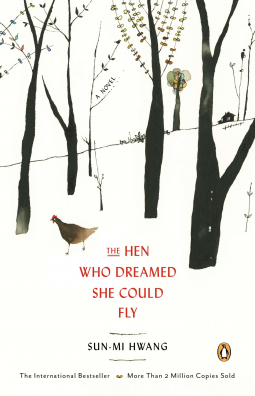
This book is proof that it is not just reviews and the recommendations of friends that help us choose which book to read next, that an excellent cover and title coupled with an alluring blurb can suffice to motivate that impulse.

The HenThe cover made me pause and the promise of an inspiring fable in a short piece of internationally acclaimed translated fiction sounded enticing enough, but the discovery that the author Sun-mi Hwang had herself overcome the obstacle of childhood poverty and found a way to educate herself to achieve her dream to read and write sealed it.

Like Margarita Engle’s novel in verse The Wild Book and Tove Jansson’s Summer and Winter Book’s, sometimes a mood enhancing book is just what we need to bring ourselves back to life’s simple values for encouragement and reassurance.

The story revolves around ‘Sprout’, a battery hen frustrated with her caged life laying eggs in a sloping wire cage which causes her eggs to roll away, enabling the farmer to conveniently collect them to sell. She hatches a plan to escape, seeking a life outside the barn where others animals appear to roam free and where she feels it most likely to be able to achieve her dream of nurturing an egg to life.

Along the way we meet the old dog that guards the barn, the rooster who crows in the morning, the yard hen, a community of ducks and the lone hungry weasel.

“Whenever she saw the yard hen, Sprout couldn’t stand it – she felt even more confined in her wire cage. She too wanted to dig through the pile of compost with the rooster, walk side by side with him, and sit on her eggs.”

010113_1257_AMonthinthe2.jpgSprout escapes the coop and directs all her energy into survival. She learns who her friends are and who to be wary of.

She discovers the perceptions that govern the role each animal is set to play.

“Yes, you’re both hens, but you’re different. How do you not know that? Just like I’m a gatekeeper and the rooster announces the morning, you’re supposed to lay eggs in a cage. Not in the yard! Those are the rules.”

No fairy tale, this is fable at its best, confronting the reality of stepping outside the role society has dictated (even if nature has not divined) and showing that while achieving the goal can be possible, it is a route fraught with challenges. Reminiscent of Orwell’s Animal Farm or Adams Watership DownSun-mi Hwang brings us her perception of society through characters that we recognise with our own interpretation and reminds us that even the most far-fetched dreams are worth pursuing, no matter what the odds.

We read with trepidation and a strong desire, not so much for Sprout to succeed in her quest, but to survive. It is a delightful and touching story, deserving of its success.

Note: The book was an ARC (Advance Reader Copy) provided by the publisher via NetGalley.

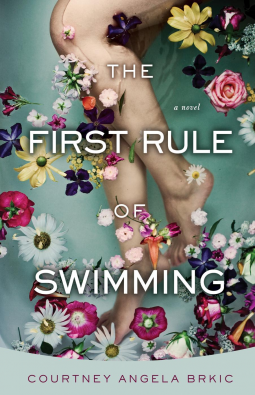
The First Rule of Swimming by Courtney Angela Brkic,

Without planning it, I have just read one book after another set in Croatia, one set in the fictitious village of Gost on the mainland the other on a small island.  Aminatta Forna’s The Hired Man and Courtney Angela Brkic’s The First Rule of Swimming portray different lives and paths, but complement each other in portraying contemporary life, where the past is ever-present and no one likes to speak of those who are absent.

First RuleThis is the first work of Courtney Angela Brkic I have read though I see she has published a noted collection of short stories entitled Stillness and a memoir The Stone Fields, short-listed for the Freedom of Expression Award.

The prologue of The First Rule of Swimming starts on the fictitious island of Rosmarina, Croatia in 1982 when 8-year-old Magdalena is reading a letter from her cousin Katarina, a letter that has clearly been opened and resealed.

“Katarina’s family had left when Magdalena was only two, a shadowy period that she tried hard to recall. But she was never sure if the faces she sometimes pictured were real or simply her imagination.”

When she writes the return postcard, her grandfather writes one as well, gluing it to hers – a message – to which they receive a cryptic reply about a cat, which causes Magdalena some confusion and her grandfather immense physical pain.

The book setting then moves to the present, with Magdalena taking care of her grandparents, her grandfather now in a stroke induced coma, but refusing to let go. Though most of the island’s youth leave to find jobs on the mainland, her strong connection to the island keeps her there pursuing a teaching career and ignoring any pressure to do otherwise, even at the expense of what seems like pending spinsterhood.

NY harbourBut when her sister Jadranka leaves for New York and disappears without trace a few weeks after her arrival, she leaves the security of the island to go after her, followed soon after by her estranged mother.

“It was as if a cord connected her to Rosmarina, and only for Jadranka did she have the will to fight against it. This attachment was both habit and biology. In her childhood a researcher had studied the islanders’ sense of direction. It was a capability he explained in terms of the Inuit in the far-off Arctic, who could find their way even through blizzards.

“It’s a rare genetic gift,” he had explained to her grandfather. The scientist had concluded that not everyone possessed the skill – which he termed innate nautical orientation – but she belonged squarely to the group that did. “

Behind these events is the slow revelation of what happened to certain members of the family including the girl’s Uncle and the truth about their father, something their mother has always kept from them and that appears to be connected to Jadranka’s disappearance. It reveals an era of suspicion, denunciation, false imprisonment and vendetta. Life was dangerous for anyone associated with those who held opinions not deemed favourable.

“Grudges went back generations, and children were judged by things their parents had done, some of them years before their birth. Small wonder, Magdalena sometimes thought, that her sister preferred places where nobody knew her.”

The two girls know little of the past, but will come to learn how much it has affected their present, the journey to New York will help them find answers.

It is a compelling read that like The Hired Man, will leave the reader curious and disturbed about the recent past and that tendency for humanity to brush things under the carpet as if they never happened.

Note: This book was an ARC (Advance Reader Copy) provided by the publisher via NetGalley.

Helium by Jaspreet Singh

I doubt this book would have crossed my path, had it not been sent to me by The Guardian in recognition for an extract quoted from my review of Caroline Smaile’s The Drowning of Arthur Braxton, one of my outstanding reads of 2013.

Helium2However, I am glad that it did, as it is an example of important fiction that crosses between cultures and provides us with insights into other worlds and perspectives, lessening our ignorance of events which often account for the unspoken attitudes and undercurrents present in countries that visitors, travellers and outsiders rarely gain access to. We are seeing more novels written in English from immigrants written from outside their country, alluding often to tragic events that have happened in their home country; for many, the reason they have fled.

Last year one of my favourite reads was one such book, Vaddey Ratner’s In the Shadow of the Banyan, based on a true story of the survival of seven-year-old girl of royal descent under a despotic regime in Cambodia and fictionalised as a tribute to those who were lost, in particular her own father. It is a stunning portrayal seen through the eyes of a child with both a chilling and hopeful view of humanity.

Indira Gandhi

Indira Gandhi

Helium centres around one man, Raj, a scientist who was an only child; we learn he left India 25 years before and will discover the reason why, along with his continuous fascination for science, the periodic table and memories. One memory in particular influences his journey and decisions, the attack of his college professor, a Sikh, who along with thousands of others in 1984 are targeted and killed in revenge for the assassination of the Prime Minister Indira Gandhi (daughter of India’s first Prime Minister Jawaharlal Nehru), in what was believed to be a government assisted genocide.

“How wrong Professor Singh was that day on the train when he said that the three most important questions for us concerned the origin of the universe, the origin of life and the origin of the mind. He forgot to add other questions or shall I say he forgot to ask the three really significant ones: Why do people respond differently to traumatic events? How do we remember the past? Why when ‘meaning’ collapses in our lives, do some of us seem to locate a new ‘meaning’?”

Rashtrapati Niwas, built 1888  Source: Wikipedia

Rashtrapati Niwas, built 1888
Source: Wikipedia

Raj, who faces his own challenges as a husband and father back in the United States, returns to India and unable to face his father, whom he suspects of being involved in those events, looks for the wife and children of his Professor and finds her working in an archive at Rashtrapati Niwas, formerly the Viceregal Lodge in Shimla, Himachal Pradesh.

“Clara has her romantic ideas of India and she clings to those ideas and I am a personification of those ideas. I am not allowed to narrate the dark side of that romance – how ugly the collective consciousness of a nation can be.”

Singh references Primo Levi’s The Periodic Table, a novel of science and memory and a man who survived persecution in the concentration camps of WWII and who wrote that outstanding, compassionate masterpiece If This Is A Man: The Truce which I was fortunate to read last year. And the black and white photos throughout the text are a sure reference to W.G.Sebald, another author he admires and relates to. They have the effect of making the reader almost forget that this is a work of fiction, and are a more than subtle reminder that the background events certainly did.

Jaspreet Singh’s character Raj is conflicted, being neither victim nor perpetrator of any crime, except perhaps ignorance, he reads Levi but can’t embrace his humanity or gift for forgiveness. He is angry, as much with himself as anyone else, and must live with the knowledge and acceptance of his role as bystander.

It is a novel that addresses the attempt to escape the past through distance, both physical and cultural and is a reminder that even as many as 25 years will not keep the past from affecting the present when confronted with people, places, books and reminders of that past, that without facing up to our inner demons, they will likely continue to possess and haunt us.

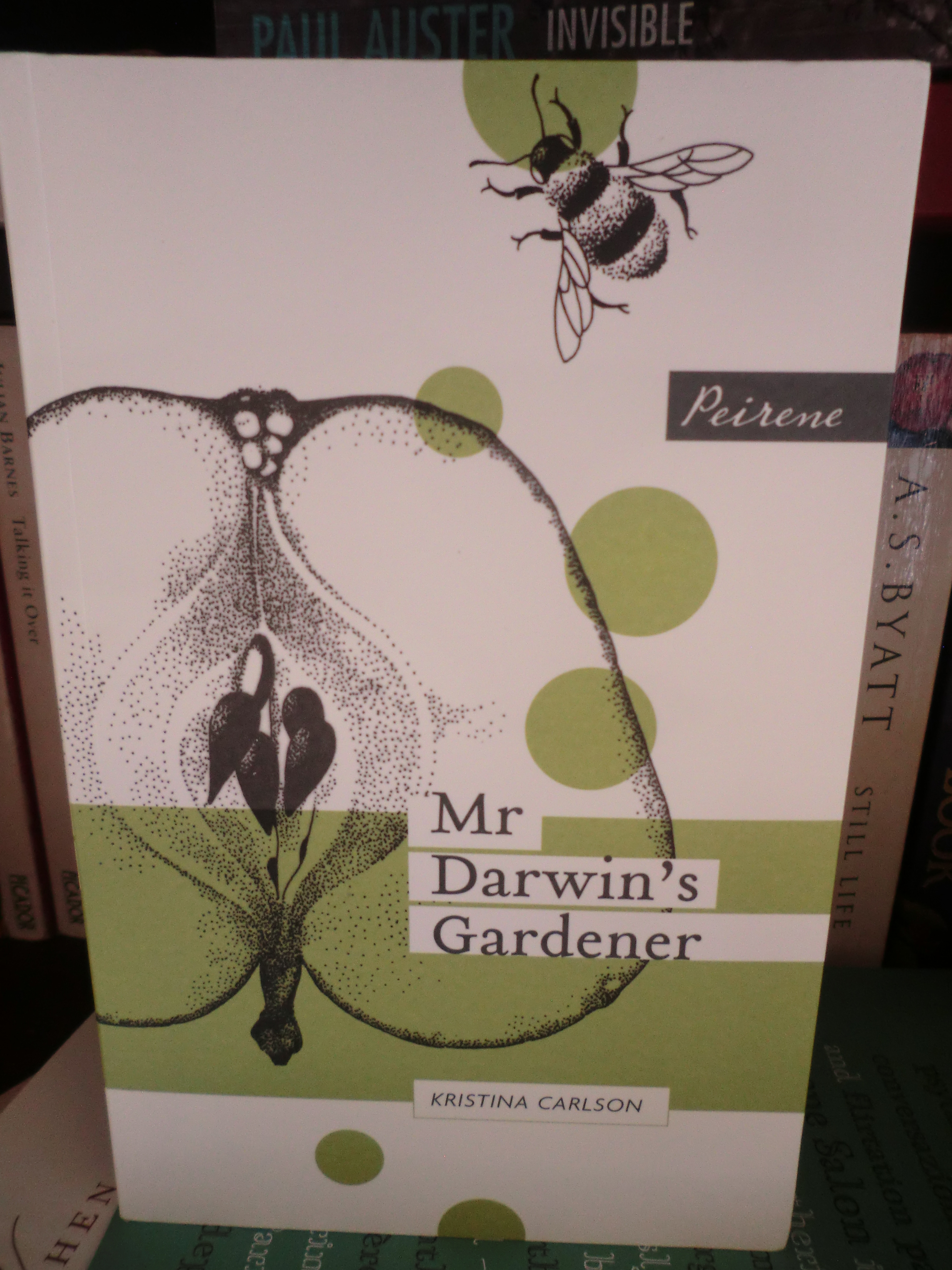
Mr Darwin’s Gardener is Also a Thinker, Kristine Carlson

Darwins GardenerKristina Carlson is a native of Finland and has published 16 books there. Like Tove Jansson, whose work I love, she is known for her children’s stories, but also has a wide adult readership. We are fortunate to be reading the recently published and translated work Mr Darwin’s Gardener thanks to Peirene Press, who describe it as “Peirene’s most poetic book yet“.

“Carlson evokes the voices of an entire village, and through them, the spirit of the age. This is no page-turner, but a story to be inhabited, to be savoured slowly.” Mieke Ziervogel

Less a story than a series of thoughts and observations, though there is one alarming event, it is set in the late 1870’s in the Kentish village of Downe, where Thomas Davies, widower, father of two and the gardener of Charles Darwin, reflects on the dilemma of his life and stays away while the rest of the villagers gather in church.

Just as Mieke Ziervogel suggests, it is a not a book to be absorbed quickly and even when read slowly, it warrants turning back to the beginning and starting over, which is what I did. I read it through twice because once was insufficient for a book whose depth and layers become clearer when we reacquaint with it. To read it once was to see the words on the page and meet the villagers for the first time. To read it again was to begin to understand the collective consciousness of a community and one man who stands outside them, working for another man who is completely out of their reach or comprehension.

Charles Darwin, Author of 'Origin of the Species' Source: wikipedia

Charles Darwin Source: wikipedia

Plants grow, flowers sway, a ray of light streaks through a gap in the clouds, a gardener thinks, women talk, men drink, jackdaws caw, bells ring, a stranger visits and a man writes an article in the newspaper. Like an invisible character hovering over the town, we observe each villager in a random moment just before we inhabit their mind, see what they are thinking and watch what they do, as if we are they. We repeat this sequence from one home to the next and at The Anchor, the local pub where a stranger visits and stays overnight.

The Anchor clinks, clanks, seethes, smokes, susurrates.

The gardener has taken on the role of the village sage,

Though as a rule he barely says good morning.

The tongue is a sort of red carpet. One has to watch what hurries along it.

A gloomy and unhappy man.

But Thomas Davies sits neither in a church pew nor at the bar and he is more often the subject than the purveyor of thoughts, though these are some of his:

Garden at Down House, Darwin's home

Garden at Down House, Darwin’s home

The most beautiful thing about plants is their silence. The second most beautiful thing is their immobility, I wrote when Gywn died. I am reading now, it is evening.

I wrote unscientifically.

Even condolences thundered then, and goodwill would not leave me in peace.

Grief is weighty but it is a stone I bear myself.

Victims of revenge and victims of mercy are in the same position, I believe; other people make their affairs their own.

I may have to read it a third time.

The Summer Book by Tove Jansson

I promised myself to read this in summer, after a series of other seasonal reads like Susan Hill’s In the Springtime of the Year,  Tove Jansson’s A Winter Bookand Edith Wharton’s Ethan Frome. I seem to have skipped autumn, so perhaps that will next, maybe Irene Nemirovsky’s Snow in Autumn or Albert Camus’ Fall.

The Summer BookThe Summer Book is a novel that reads more like non-fiction, an invocation of the spirit of its author Tove Jansson, who like the Grandmother and Sophia the grand-daughter in her book, spent all her summers on the small family island off the coast of Finland, doing just the kind of things young Sophia does and eventually feeling the constraints of the older woman, so that she herself comes of age (at 77) and no longer has the strength nor confidence to brace the unpredictable sea after a storm destroys their boat, she sensibly retires to the mainland for the rest of her days.

Esther Freud writes a captivating foreword, including sharing parts of her own visit to the island to meet the real life Sophia, who is Tove Jansson’s niece. She visits both the island of Jansson’s childhood and Klovharun, a place of pilgrimage today (see the video below), the island she later moved to with her partner when their own island became too crowded with relatives and friends.  Freud ponders:

“What kind of person could live here? Someone so fuelled by their imagination, so stimulated by the sea, so richly creative that they could find solace and inspiration in what to others might seem a barren rock.”

This short video clip helps us imagine just what it might be like.  As for me, I could well imagine living like this for the summer.  And you?

In the book, we meet Sophia, who has prematurely lost her mother and so with her father will spend spring and summer on the island with her grandmother. While the father is present, whenever he is mentioned, even when in the same room, he is working or busy and so given background status, though in reality on such a small island, his existence would no doubt be more noticeable, however in the story he is a reassuring but not interfering presence, just like the island itself.

Sophia on the island with her grandmother (Tove's mother) in 1968

Sophia on the island with her grandmother (Tove’s mother) in 1968

The pages turn like days of summer, governed by the moods of the elements, the creatures that inhabit its shores and the occasional visitor. Underneath or implicit within all that passes is the perplexity of death, that absence, prematurely confronted by a young girl and sensitively explained by her older companion. The chapter entitled Playing Venice is especially poignant, the loss of the hand-made palace necessitates Grandmother staying up all night to replace it, Sophia unable to cope with another loss of something so special and close to her heart, even if it is only a small sculpture.

In both the chapter Berenice, which is about Sophia’s friend who comes to stay for a while and The Cat, Sophia has to deal with the paradox of really wanting something, then discovers she no longer does and finally must learn to appreciate both her friend and the cat, just as they are.

“If only she were a little bigger, Grandmother thought. Preferably a good deal bigger, so I could tell her that I understand how awful it is. Here you come, head-long into a tight group of people who have always lived together, who have the habit of moving around each other on land they know and own and understand, and every threat to what they’re used to only makes them more compact and self-assured.

An island can be dreadful for someone from the outside. Everything is complete, and everyone has his obstinate, sure and self-sufficient place. Within their shores, everything functions according to rituals that are hard as rock from repetition, and as the same time they amble through their days as whimsically and casually as if the world ended at the horizon.”

Like A Winter Book, this is not a volume to be rushed, it is best savoured and enjoyed slowly, it reminds us of the joy of simple things, that there is value even in those things that sometimes irritate us and above all that we ought to respect and pay attention to natures elements. This is one you’ll want to gift to another or even read again. A literary gem.

Further Reading:

A Biographical Essay on Tove Jansson

A Hundred Thousand White Stones: An Ordinary Tibetan’s Extraordinary Journey

Kunsang Dolma might have had a more ordinary life, if it hadn’t been her turn to be the family representative at the annual ten-day prayer session at their local village temple when she was 15 years old. An event peripheral to that obligation changed the path she was on, which would have been an arranged marriage to a local boy and raising children to help with the farm work. For those of us reading it however, this is no ordinary life, but an insight into an ancient culture and one courageous woman who survives its harshness, revels in its deep, spiritual wonders and travels outside all that she knows to become the wife of an American citizen.

A Hundred Thousand White StonesThe consequence of that event sets her on the path towards becoming a Buddhist nun, something she had previously considered but had been rejected by her parents, so she and a friend decided to run away from their village to ensure it happened, without parental consent.

While she doesn’t remain a nun all her life, ironically the second major turning point in her life that moved her away from being a nun towards marriage and a life in America was not dissimilar to that which motivated her action towards pursuing a monastic life in the beginning. This is a true story, however I am reminded of all those turning points in the life of the fictitious character Ursula’s in Kate Atkinson’s Life After Life and the significant power that one event can have to alter the direction of a young woman’s life.

Tibetan farmersKunsang shares her upbringing with a quiet, practical, honest voice and it is a childhood and adolescence we see as difficult, though in the context of where she lived, a small Tibetan village, it was quite like many other villagers and something she now looks back on with appreciation and an incessant longing, having left it all behind. It is in leaving a difficult way of life and family behind us, in making it no longer attainable that the deepest yearning for that which was willingly fled, is often felt.

Her parents married at 15 which is not uncommon, however they were unable to conceive until they were 28 years old, something that came as a relief as being farmers, children are essential to their survival as future workers. Kunsang was the youngest of 8 children and by the time she was born, there were sufficient children to manage the farm work; it was this fact that enabled her to have an education.

At the time, there was no birth control, so after thirteen years without a child, it looked like they definitely weren’t going be able to have any children, which are essential to help with work on the farm. My father’s sister already had two kids and felt sorry for my parents’ situation, so when she was pregnant a third time she told my father, “Look, this is my third child. I’m going to give him to you.” The baby was twenty-two days old when my parents took him home. After that, my mother started to have her own babies. My parents always thought that my adopted brother Yula had brought them good luck.

Tibet mapKunsang eventually makes a pilgrimage to Dharamsala to see the Dalai Lama and during her time here she meets her future husband, narrating the heart-breaking, tedious administrative process they must overcome to be together and the struggles she will face even when they succeed. It is a moving story of a life we can hardly imagine and a journey that crosses many boundaries most of us will never have to traverse, to hike over terrain while risking one’s life, to encounter a revered spiritual leader, create a way to support oneself financially in a foreign country alone and to raise your children in yet another country which will become their home, but never yours.

CIMG3772Reading stories like Kunsang’s is not just an eye-opener into another culture and way of life and another way of dealing with life’s issues, it invites us to practise empathy and patience in the way we interact with foreigners in our own country. Kindness and compassion are there in abundance if we choose to offer them to others and it is stories like Kunsang’s that motivate us to want to extend it.

Note: This book was an ARC (Advance Reader Copy) provided by the publisher via NetGalley.

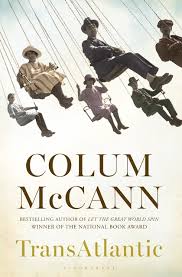
TransAtlantic Journeys, Real and Imagined

Colum McCann’s latest novel did well to live up to my raised expectations and has now become a symbol of a path on the journey of this blog itself. I was always keen to read McCann’s next novel, after the hype of Let the Great World Spin, which I enjoyed although I wouldn’t class it as one of my all-time favourites. TransatlanticHowever, TransAtlantic became a “must read” after I received a hardback copy in the post, in recognition of one of my reviews being profiled on The Guardian’s online book pages, where I occasionally post extracts of reviews and comment under the pseudonym RedBirdFlies. The review that was acknowledged, was Zadie Smith’s NW and you can read what the Guardian had to say about it here.
So thank you to The Guardian Books team for sending me a copy of TransAtlantic, a welcome surprise and wonderful to know that a few of these “word by words” have flown the page and landed elsewhere to an appreciative audience.

Vickers Vimy with Alcock and Brown aboard departs-Newfoundland 14 June 1919

Vickers Vimy with Alcock and Brown aboard departs Newfoundland 14 June 1919

TransAtlantic is a hybrid novel (is that an oxymoron?), in which McCann takes real historical figures, all of whom made a transatlantic journey which subsequently had a bearing on the story of Ireland and re-imagines a part of their story, interspersing the narrative with fictional characters.

He starts with Alcock and Brown in 1919, who ditched their bomb carriers, modifying the Vickers Vimy by taking war out of flight and adding more fuel than had ever been strapped to an aircraft in their attempt to cross the Atlantic non-stop.

The names sounded familiar, but I didn’t know as I began to read who they were, so looked them up and was startled to see Alcock’s date of birth and then death, the same year in which he makes this attempt – are they going to make it I asked? And is it cheating to look up a historical figure in the midst of reading a novel? Brown dies many years later, so I settle back into reading, content they are going to make it. Until I read that Alcock couldn’t swim.

Their preparation and journey are captured by a journalist Emily Ehrlich and her photographer daughter Lottie, who reappear in later chapters, two women whose family have made the crossing many times, the first family member to do so Lily, inspired by meeting Frederick Douglass, who we meet in the second chapter. In a chance encounter with Brown, Lottie asks if he will carry a letter written by her mother to an address in Cork. A letter that survives this entire novel.

Frederick Douglass 1847 by Samuel J Miller (wikipedia)

Frederick Douglass 1847 by Samuel J Miller (wikipedia)

Frederick Douglass visits Ireland while in the throw of becoming a free man, he is spreading the word against slavery, a young abolitionist, a charismatic presence, in awe of how he is received, as an equal, yet disturbed by what he sees outside the warm, accepting rooms of his well-off hosts, the onset of famine in Ireland, people living in more dire conditions, than what he has left, though they are free. It is a humbling experience, as it is for anyone meeting those worse off than they, no matter how tragic one’s own circumstance.

“He thought he knew now what had brought him here – the chance to explore what it felt like to be free and captive at the same time. It was not something even the most aggrieved Irishman could understand. To be in bondage to everything, even the idea of one’s peace.”

A young maid, Lily Duggan is inspired by his presence to abandon her employ and take a ship to America, where she meets mixed fortune, her descendants equally inspired to search for new shores, leading them back full circle to that island of her birth Ireland. It is through the women characters that the threads of narrative are interwoven and connections are made across the years, witness to, or affected by the consequences of those significant events that the men of those first three chapters represent.

These characters might represent us, the population, those that stay in a country generation after generation, some harbouring seeds of revenge, and those who leave, immigrate, seeking utopia, hoping that there does exist, a place where men and women of any race, class, religion or persuasion have an equal chance at bettering their lives.

And as McCann himself says in the interview with Jeffrey Brown:

“Women, as we know, get the short shrift in history.

It’s been largely written and dictated by men, or at least men believe that we own it, and women have really been in those quieter moments at the edge of history. But, really, they’re the ones who are turning the cogs and the wheels and allowing things like the peace process to happen.”

There is something alluring in the novelist who takes on a historical figure and imagines their past, it can bring the past to life in a more animated way; in the present when the media delves into the personal life of an important political or scientific or literary figure, it is deemed an invasion of their privacy, the cult of the celebrity. When a novelist looks back and intertwines the narrative of their accomplishment and the context of their life, their loves, and their thoughts beyond the significant reason that they have become known, it makes them whole and they become characters that we might even relate to.

Entrance to Titanic Museum, Northern Ireland

Past in the Present
Entrance to Titanic Museum, Northern Ireland

“I am partial, still, to the recklessness of the imagination. The tunnels of our loves connect, coming to daylight at the oddest moments, and then plunge us into the dark again. We return to the lives of those who have gone before us, a perplexing Möbius strip until we come home, eventually, to ourselves.”

Whist many authors safely inhabit the lives of historical figures from a distance, many years or centuries after their death, dwelling in the safety of already published and authenticated research, McCann goes one step further by taking as his third character the US Senator, George Mitchell, effectively channeling his thoughts during the day that he journeys to Northern Ireland to broker the Good Friday Peace Agreement. Clearly, this was no mean feat, as the interview comments quoted attest, but he succeeds in creating the man behind the politician, without it seeming like an invasion of his privacy.

McCann’s prose style often reduces to the minimum, he sometimes dispenses with conventions of grammar, reducing his phrases to only the words that describe or evoke the scene or emotion and it is compelling reading. He doesn’t strip beauty from language; if anything he accentuates it by removing the accessories.

I don’t wish to make comparisons, but the only other writer whose prose has that kind of addictive effect on my reading is Cormac McCarthy. They don’t strum their words in the same way, but if they were musicians, they’d both be on my playlist. They possess talent worth dwelling within.

“It is one of their beauties, the Irish, the way they crush and expand the language all at once. How they mangle it and revere it. How they colour even their silences.”
Strangford Lough, Northern Ireland

Strangford Lough, Northern Ireland

The Examined Life

Examined LifeRecently I listened to a podcast entitled Literature on the Couch featuring Andrew Solomon, Greg Bellow and Stephen Grosz.

It was the book written by the latter that provoked my interest, Stephen Grosz’s The Examined Life, How We Lose and Find Ourselves. While there are many books one can pick up, which write with a voice of authority and experience on the subject of Freudian psychoanalysis, there are few if any, which have been penned as a practical legacy to the children an author will one day leave behind.

I like the idea of leaving lessons of our life’s learning to one’s children, they are the few people on earth we are able to genuinely love unconditionally and it intrigued me to seek out this book, to see if writing for one’s children on a subject one is something of a professional expert in and having already been reasonably widely published can remove the influence of ego or meeting the expectations of one’s academic peers and make a subject or in this instance many case studies, accessible to the lay person and true to that spirit of sharing wisdom with one’s progeny.

The book is divided conveniently into five sections, beginnings, telling lies, loving, changing and leaving.

CIMG0990

My Other Passion, Distilling Essence

The chapters are like perfume samples, distilled to their quintessential essence yet encapsulating the base notes that make a scent whole or a lesson in life complete. Incredible given that many of the cases he mentions are the product of a year or two of conversation, meeting with a person for fifty minutes, four or five times a week, over a number of years. A life work of more than 50,000 hours listening, learning, resolving, and understanding (or at least trying to).

In Beginnings, the first case that made me go back and reread a few pages was How Praise can cause a loss of confidence and once you’ve read it, you’ll understand the subtle difference between giving praise and giving something else more likely to boost esteem and confidence in children, so subtle and yet so potentially powerful. And what a great gift to pass on to those children, who may one day become parents themselves.

Admiring our children may temporarily lift our self-esteem by signalling to those around us what fantastic parents we are and what terrific kids we have – but it isn’t doing much for a child’s sense of self. In trying so hard to be different from our parents, we’re actually doing much the same thing – doling out empty praise the way an earlier generation doled out thoughtless criticism.

In Loving, the chapter Paranoia can relieve suffering and prevent catastrophe is insightful and may make us more sympathetic to those who suffer from it, particularly the elderly.

With old age, the likelihood of developing a serious psychological disorder decreases, and yet the chance of developing paranoia increases. In hospital I have heard elderly men and women complain: “The nurses here are trying to poison me.” “I didn’t misplace my glasses, my daughter has obviously stolen them.” “You don’t believe me but I can assure you: my room is bugged, they are reading my post.” “Please take me home, I am not safe here.”

Grosz suggests that paranoid fantasies, such as a feeling of being betrayed, mocked, exploited or harmed are a defensive response to the feeling that we are being treated with indifference. They protect us from the more disturbing emotional state, from a feeling that no one cares about us or is thinking about us, that we have been forgotten.

changeIn Changing, we learn how our very survival can be put at risk by our fear of change in How a Fear of Loss Can cause us to lose Everything. How some of us will escape at the very first sign of danger, even if it means doing something we are not used to doing and how others may perish, because of the fear of acting without sufficient information.

“We are vehemently faithful to our own view of the world, our story. We want to know what new story we’re stepping into before we exit the old one. We don’t want an exit if we don’t know exactly where it is going to take us, even – or perhaps especially – in an emergency.”

Overall, an intriguing, easy read including stories which might easily be those we encounter or recognise in ourselves or others close to us and with a clear explanation of the hidden meaning and lessons that can be found within them. Not surprising to see it listed yesterday in the Guardian’s recommended Holiday Reads, literature for the couch, the beach, the balcony or wherever it is you’ll be putting your feet up this summer (or winter if you’re down-under!)

Magda

Magda (2)In the course of Meike Ziervogel’s novella, we meet three generations of women in one family, an embittered grandmother, her daughter Magda and the lovesick teenager Helga. They have little in common except the desire to improve their lives and those of their children, something in which all three of them will spectacularly fail.

Magda succeeded in elevating her station in life, though some may have perceived that she achieved notoriety only through marriage. However, from an early age she appeared to decide she deserved better than the position society had set her; taking her destiny into her own hands it manifested physically in the clothes she wore, the adornments with which she accessorised and in her comportment. She kept quiet about her material accumulation, but her gestures spoke volumes and even as she volunteered selflessly to help those less well off, others looked at her with scorn and derision.

Despite her mother’s efforts to do her best by her headstrong daughter, that didn’t mean she should give herself airs and graces she was not born to, at least that was her mother’s opinion.

Was it a consequence of being sent to a convent for schooling at a young age (at the suggestion of a new stepfather) that developed her resourcefulness and sense of superiority? By the time her mother decided to end her education and send her to work in a factory to smother that conceited attitude, the stepfather who had come to adore the charming girl, would have none of it.

We learn of the mother’s perception of Magda after the fall of Hitler, whilst she is being interviewed by a commissar and she is revelling in having an important audience in which to denounce her child – though more through envy, jealousy and a sense of outrage at being unappreciated, forgotten even – not quite the admission of guilt he is looking for, though he hopes it may contribute to establishing Magda’s fanaticism.

It reflects the irony of a mother wanting the best for her baby girl and then having to live in the shadow of who her offspring has become, someone unreachable, who has by necessity let go and left the bitter mother full of resentment behind.

Magda_Goebbels

Magda Goebbels

Upon receiving this book from the author Meike Ziervogel, (also founder of the publishing company Peirene Press), I read a few mentions of intentions to read Magda that indicated a certain wariness, expecting it to be disturbing, as do a few of the more provocative blurb comments, suggesting the portrayal of mother’s as abusers and the association of one mother being a Nazi sympathiser and married to a prominent figure in that regime (Joseph Goebbels, Hitler’s propaganda minister).

I didn’t find the book like that at all and found the suggestion that…

…abuse breeds abuse through generation after generation. – Frederick Taylor, author of Exorcising Hitler

…misleading, even false.

I found much to admire in Ziervogel’s depiction of the character Magda, her ability to use disadvantage to her advantage, her separation from her mother allowed her to amass inner resources, to learn another language, to create a persona that made her different. She understood implicitly her mother’s advice that she should better her social status; her falling – or failing – was the direction in which she channelled the fire within her, that desperate need for some kind of meaningful fulfillment, that was at its height at the wrong time in history, her calling came not for Him (God) but for him (the Führer).

She believed in him and his vision with a fanaticism, similar to religious fanaticism and in the same way that a small minority of devout religious followers go to extremes for their beliefs, so too does Magda.

Helga’s is a brief, heart-breaking coming-of-age story, the story within the story and it seems appropriate that she, the innocent, is depicted through a different narrative structure, the intimacy of her private diary.

As I reread the last three chapters a second time, I noted  all the chapter headings which read like flash fiction, framing the story in less than thirty words.

3 generations by Allia

3 generations by Allia

The Preparation

The Girl Behind Convent Walls

The Mother and the Commissar

The Calling

Helga’s Diaries

The Pill Box

The Vision of Magda Goebbels

The Final Task

As a novella, Magda doesn’t waste words, yet it manages to depict the depth of the three generations of its female characters. While it succeeds here, the end remains shocking and disturbing, unjustified, it is impossible to accept.

The book is fiction, inspired by real historical figures and events. I have written these thoughts without having read about the actual life of Johanna Maria Magdalena “Magda” Goebbels (11 November 1901-1 May 1945), wishing to pay closer attention to the author’s story and her character creation than the historical account, which could easily overshadow one’s impression of a work of fiction.

The Exiles Return by Elisabeth De Waal

The First Woman Doctorate

Elisabeth De Waal was a poet, writer and the first women to gain a doctorate from the University of Vienna in 1923. Born in 1899 in Vienna, she was the eldest child of Viktor von Ephrussi and Baronness Emmy Schey von Kormola, her father and uncle sent from Odessa 30 years before, one to Paris the other to Vienna to create the family banking empire.

The Hare With the Amber Eyes Connection

030413_2049_TheHarewith1.jpgWe may not have known of her, were it not for her grandson Edmund De Waal, the ceramist, who inherited 264 Japanese netsuke, and decided to share the story of the passage of these miniature artisan objects in his excellent The Hare With Amber Eyes, which I read earlier this year and adored – a 5 star read for me.

He traced his family history through the voyages and resting places of those well-travelled netsuke, one of the more significant journey’s being his grandmother’s return visit to Vienna after the second world war, her return from exile, where she was able to reclaim the netsuke (and sadly little else) thanks to an amazing story of courage by the family’s maid.

An Old Manuscript Rescued

Hare Amber EyesHis father handed over the yellowing typescript along with school reports, essays, letters and a few diary entries, the things that had mattered to Elisabeth De Waal, that remarkably survived into the 21st century.

It was from this return journey that her inspiration came to write this novel, The Exiles Return where we enter the lives of three exiles, a Jewish laboratory professor, a Greek property developer and Resi, the daughter of a Viennese princess, who though born in America, seems ill-fitted to fulfill family ambitions, so spends a summer with her Aunt and cousins in Austria, a return to her roots.

Fifteen years after escape into exile Professor Adler returns to Vienna, Austria leaving behind a prestigious job and a reluctant, successful wife and daughter who have adapted to their New York life beyond the point of wanting to return, her financial independence empowering her with the will to resist him.

With a mix of hope and trepidation, Professor Adler fears what he might find yet desires to somehow recreate a still familiar past, to be back where he felt he belonged and re-establish a life. He looks up old friends and seeks reinstatement at the laboratory where he once worked, encountering that which looks familiar, though unavoidably changed by the past.

“They could exchange nothing but exclamations, well-worn phrases, just to express, however haltingly, feelings too deep for words.”

Exiles Return

The Exiles Return

Theophil Kanakis, descendant of a wealthy Greek family has returned to Vienna with the confidence and arrogance that plentiful money bring. He no longer desires financial success, he seeks pleasure and indulgence and the subtle manipulations inherent in ensuring he attains what he yearns for.

Once he is re-established in the manner he wishes, he begins to issue invitations to a widening circle of friends and through his friendship with the gallant pauper, Prince Bimbo Grein, a younger set begins to frequent his salons which he encourages, the setting in which all the characters in the novel are in some way connected.

In the scene where Kanakis seeks an audience with an Estate Agent and comments and his gaze alights on two dark, heavily framed pictures hanging on the wall, we obtain a glimpse into what it may have been like for Elisabeth De Waal to encounter appropriated chattels.

“They are in no way outstanding or really valuable – a minor nineteenth century artist. I just thought they furnished the room, gave it a certain cachet, within the limits of what I could afford. They did in fact belong to an acquaintance of your family, Baron E_. You might possibly have seen them at his house. Baron E_ unfortunately died abroad, in England, I believe. His heirs, after they had recovered what could be traced of his property, had it all sold at auction; having no use for this old-fashioned stuff in their modern homes, I suppose. I acquired the pictures quite openly, publicly and legally, you understand.”

Palais Ephrussi, Vienna Elisabeth's Childhood Home

Palais Ephrussi, Vienna
Elisabeth De Waal’s Childhood Home

None of the characters seem to be based directly on the experience of Elisabeth De Waal, who was shocked and saddened by what she found when she returned to Vienna, but there is little doubt that the story she has written was influenced by that return journey as she captured the experiences of her three protagonists.

I really enjoyed the book and wanted to know even more in particular of the experience of Professor Adler, perhaps the closest to how Elisabeth De Waal may have felt. It is a novel that is appreciated all the more for understanding the life of the author herself, and I enjoyed it having read Edmund De Waal’s history of the family and imagining what Elisabeth may herself have experienced. For the period in which it was written, I find it compelling and modern literature.

Not like The Hare With Amber Eyes, but an important part of that story and an excellent companion novel; what a privilege that we now have the opportunity to read her work and that she is finally receiving the recognition she so deserves as a writer.

Letters to Rainer Maria Rilke

RilkeSo now, what about that correspondence with Rainer Maria Rilke? Might there be a book in that? A sequel, Letters to a Young Female Poet perhaps?

“If your daily life seems poor, do not blame it; blame yourself, tell yourself that you are not poet enough to call forth its riches; for to the creator there is no poverty and no poor indifferent place.”

Rainer Maria Rilke, Letters to a Young Poet

Note: This book was kindly provided by the publisher, Persephone Books.