TransAtlantic Journeys, Real and Imagined

Colum McCann’s latest novel did well to live up to my raised expectations and has now become a symbol of a path on the journey of this blog itself. I was always keen to read McCann’s next novel, after the hype of Let the Great World Spin, which I enjoyed although I wouldn’t class it as one of my all-time favourites. TransatlanticHowever, TransAtlantic became a “must read” after I received a hardback copy in the post, in recognition of one of my reviews being profiled on The Guardian’s online book pages, where I occasionally post extracts of reviews and comment under the pseudonym RedBirdFlies. The review that was acknowledged, was Zadie Smith’s NW and you can read what the Guardian had to say about it here.

So thank you to The Guardian Books team for sending me a copy of TransAtlantic, a welcome surprise and wonderful to know that a few of these “word by words” have flown the page and landed elsewhere to an appreciative audience.

Vickers Vimy with Alcock and Brown aboard departs-Newfoundland 14 June 1919

Vickers Vimy with Alcock and Brown aboard departs Newfoundland 14 June 1919

TransAtlantic is a hybrid novel (is that an oxymoron?), in which McCann takes real historical figures, all of whom made a transatlantic journey which subsequently had a bearing on the story of Ireland and re-imagines a part of their story, interspersing the narrative with fictional characters.

He starts with Alcock and Brown in 1919, who ditched their bomb carriers, modifying the Vickers Vimy by taking war out of flight and adding more fuel than had ever been strapped to an aircraft in their attempt to cross the Atlantic non-stop.

The names sounded familiar, but I didn’t know as I began to read who they were, so looked them up and was startled to see Alcock’s date of birth and then death, the same year in which he makes this attempt – are they going to make it I asked? And is it cheating to look up a historical figure in the midst of reading a novel? Brown dies many years later, so I settle back into reading, content they are going to make it. Until I read that Alcock couldn’t swim.

Their preparation and journey are captured by a journalist Emily Ehrlich and her photographer daughter Lottie, who reappear in later chapters, two women whose family have made the crossing many times, the first family member to do so Lily, inspired by meeting Frederick Douglass, who we meet in the second chapter. In a chance encounter with Brown, Lottie asks if he will carry a letter written by her mother to an address in Cork. A letter that survives this entire novel.

Frederick Douglass 1847 by Samuel J Miller (wikipedia)

Frederick Douglass 1847 by Samuel J Miller (wikipedia)

Frederick Douglass visits Ireland while in the throw of becoming a free man, he is spreading the word against slavery, a young abolitionist, a charismatic presence, in awe of how he is received, as an equal, yet disturbed by what he sees outside the warm, accepting rooms of his well-off hosts, the onset of famine in Ireland, people living in more dire conditions, than what he has left, though they are free. It is a humbling experience, as it is for anyone meeting those worse off than they, no matter how tragic one’s own circumstance.

“He thought he knew now what had brought him here – the chance to explore what it felt like to be free and captive at the same time. It was not something even the most aggrieved Irishman could understand. To be in bondage to everything, even the idea of one’s peace.”

A young maid, Lily Duggan is inspired by his presence to abandon her employ and take a ship to America, where she meets mixed fortune, her descendants equally inspired to search for new shores, leading them back full circle to that island of her birth Ireland. It is through the women characters that the threads of narrative are interwoven and connections are made across the years, witness to, or affected by the consequences of those significant events that the men of those first three chapters represent.

These characters might represent us, the population, those that stay in a country generation after generation, some harbouring seeds of revenge, and those who leave, immigrate, seeking utopia, hoping that there does exist, a place where men and women of any race, class, religion or persuasion have an equal chance at bettering their lives.

And as McCann himself says in the interview with Jeffrey Brown:

“Women, as we know, get the short shrift in history.

It’s been largely written and dictated by men, or at least men believe that we own it, and women have really been in those quieter moments at the edge of history. But, really, they’re the ones who are turning the cogs and the wheels and allowing things like the peace process to happen.”

There is something alluring in the novelist who takes on a historical figure and imagines their past, it can bring the past to life in a more animated way; in the present when the media delves into the personal life of an important political or scientific or literary figure, it is deemed an invasion of their privacy, the cult of the celebrity. When a novelist looks back and intertwines the narrative of their accomplishment and the context of their life, their loves, and their thoughts beyond the significant reason that they have become known, it makes them whole and they become characters that we might even relate to.

Entrance to Titanic Museum, Northern Ireland

Past in the Present
Entrance to Titanic Museum, Northern Ireland

“I am partial, still, to the recklessness of the imagination. The tunnels of our loves connect, coming to daylight at the oddest moments, and then plunge us into the dark again. We return to the lives of those who have gone before us, a perplexing Möbius strip until we come home, eventually, to ourselves.”

Whist many authors safely inhabit the lives of historical figures from a distance, many years or centuries after their death, dwelling in the safety of already published and authenticated research, McCann goes one step further by taking as his third character the US Senator, George Mitchell, effectively channeling his thoughts during the day that he journeys to Northern Ireland to broker the Good Friday Peace Agreement. Clearly, this was no mean feat, as the interview comments quoted attest, but he succeeds in creating the man behind the politician, without it seeming like an invasion of his privacy.

McCann’s prose style often reduces to the minimum, he sometimes dispenses with conventions of grammar, reducing his phrases to only the words that describe or evoke the scene or emotion and it is compelling reading. He doesn’t strip beauty from language; if anything he accentuates it by removing the accessories.

I don’t wish to make comparisons, but the only other writer whose prose has that kind of addictive effect on my reading is Cormac McCarthy. They don’t strum their words in the same way, but if they were musicians, they’d both be on my playlist. They possess talent worth dwelling within.

“It is one of their beauties, the Irish, the way they crush and expand the language all at once. How they mangle it and revere it. How they colour even their silences.”

Strangford Lough, Northern Ireland

Strangford Lough, Northern Ireland

Magda

Magda (2)In the course of Meike Ziervogel’s novella, we meet three generations of women in one family, an embittered grandmother, her daughter Magda and the lovesick teenager Helga. They have little in common except the desire to improve their lives and those of their children, something in which all three of them will spectacularly fail.

Magda succeeded in elevating her station in life, though some may have perceived that she achieved notoriety only through marriage. However, from an early age she appeared to decide she deserved better than the position society had set her; taking her destiny into her own hands it manifested physically in the clothes she wore, the adornments with which she accessorised and in her comportment. She kept quiet about her material accumulation, but her gestures spoke volumes and even as she volunteered selflessly to help those less well off, others looked at her with scorn and derision.

Despite her mother’s efforts to do her best by her headstrong daughter, that didn’t mean she should give herself airs and graces she was not born to, at least that was her mother’s opinion.

Was it a consequence of being sent to a convent for schooling at a young age (at the suggestion of a new stepfather) that developed her resourcefulness and sense of superiority? By the time her mother decided to end her education and send her to work in a factory to smother that conceited attitude, the stepfather who had come to adore the charming girl, would have none of it.

We learn of the mother’s perception of Magda after the fall of Hitler, whilst she is being interviewed by a commissar and she is revelling in having an important audience in which to denounce her child – though more through envy, jealousy and a sense of outrage at being unappreciated, forgotten even – not quite the admission of guilt he is looking for, though he hopes it may contribute to establishing Magda’s fanaticism.

It reflects the irony of a mother wanting the best for her baby girl and then having to live in the shadow of who her offspring has become, someone unreachable, who has by necessity let go and left the bitter mother full of resentment behind.

Magda_Goebbels

Magda Goebbels

Upon receiving this book from the author Meike Ziervogel, (also founder of the publishing company Peirene Press), I read a few mentions of intentions to read Magda that indicated a certain wariness, expecting it to be disturbing, as do a few of the more provocative blurb comments, suggesting the portrayal of mother’s as abusers and the association of one mother being a Nazi sympathiser and married to a prominent figure in that regime (Joseph Goebbels, Hitler’s propaganda minister).

I didn’t find the book like that at all and found the suggestion that…

…abuse breeds abuse through generation after generation. – Frederick Taylor, author of Exorcising Hitler

…misleading, even false.

I found much to admire in Ziervogel’s depiction of the character Magda, her ability to use disadvantage to her advantage, her separation from her mother allowed her to amass inner resources, to learn another language, to create a persona that made her different. She understood implicitly her mother’s advice that she should better her social status; her falling – or failing – was the direction in which she channelled the fire within her, that desperate need for some kind of meaningful fulfillment, that was at its height at the wrong time in history, her calling came not for Him (God) but for him (the Führer).

She believed in him and his vision with a fanaticism, similar to religious fanaticism and in the same way that a small minority of devout religious followers go to extremes for their beliefs, so too does Magda.

Helga’s is a brief, heart-breaking coming-of-age story, the story within the story and it seems appropriate that she, the innocent, is depicted through a different narrative structure, the intimacy of her private diary.

As I reread the last three chapters a second time, I noted  all the chapter headings which read like flash fiction, framing the story in less than thirty words.

3 generations by Allia

3 generations by Allia

The Preparation

The Girl Behind Convent Walls

The Mother and the Commissar

The Calling

Helga’s Diaries

The Pill Box

The Vision of Magda Goebbels

The Final Task

As a novella, Magda doesn’t waste words, yet it manages to depict the depth of the three generations of its female characters. While it succeeds here, the end remains shocking and disturbing, unjustified, it is impossible to accept.

The book is fiction, inspired by real historical figures and events. I have written these thoughts without having read about the actual life of Johanna Maria Magdalena “Magda” Goebbels (11 November 1901-1 May 1945), wishing to pay closer attention to the author’s story and her character creation than the historical account, which could easily overshadow one’s impression of a work of fiction.

The Exiles Return by Elisabeth De Waal

The First Woman Doctorate

Elisabeth De Waal was a poet, writer and the first women to gain a doctorate from the University of Vienna in 1923. Born in 1899 in Vienna, she was the eldest child of Viktor von Ephrussi and Baronness Emmy Schey von Kormola, her father and uncle sent from Odessa 30 years before, one to Paris the other to Vienna to create the family banking empire.

The Hare With the Amber Eyes Connection

030413_2049_TheHarewith1.jpgWe may not have known of her, were it not for her grandson Edmund De Waal, the ceramist, who inherited 264 Japanese netsuke, and decided to share the story of the passage of these miniature artisan objects in his excellent The Hare With Amber Eyes, which I read earlier this year and adored – a 5 star read for me.

He traced his family history through the voyages and resting places of those well-travelled netsuke, one of the more significant journey’s being his grandmother’s return visit to Vienna after the second world war, her return from exile, where she was able to reclaim the netsuke (and sadly little else) thanks to an amazing story of courage by the family’s maid.

An Old Manuscript Rescued

Hare Amber EyesHis father handed over the yellowing typescript along with school reports, essays, letters and a few diary entries, the things that had mattered to Elisabeth De Waal, that remarkably survived into the 21st century.

It was from this return journey that her inspiration came to write this novel, The Exiles Return where we enter the lives of three exiles, a Jewish laboratory professor, a Greek property developer and Resi, the daughter of a Viennese princess, who though born in America, seems ill-fitted to fulfill family ambitions, so spends a summer with her Aunt and cousins in Austria, a return to her roots.

Fifteen years after escape into exile Professor Adler returns to Vienna, Austria leaving behind a prestigious job and a reluctant, successful wife and daughter who have adapted to their New York life beyond the point of wanting to return, her financial independence empowering her with the will to resist him.

With a mix of hope and trepidation, Professor Adler fears what he might find yet desires to somehow recreate a still familiar past, to be back where he felt he belonged and re-establish a life. He looks up old friends and seeks reinstatement at the laboratory where he once worked, encountering that which looks familiar, though unavoidably changed by the past.

“They could exchange nothing but exclamations, well-worn phrases, just to express, however haltingly, feelings too deep for words.”

Exiles Return

The Exiles Return

Theophil Kanakis, descendant of a wealthy Greek family has returned to Vienna with the confidence and arrogance that plentiful money bring. He no longer desires financial success, he seeks pleasure and indulgence and the subtle manipulations inherent in ensuring he attains what he yearns for.

Once he is re-established in the manner he wishes, he begins to issue invitations to a widening circle of friends and through his friendship with the gallant pauper, Prince Bimbo Grein, a younger set begins to frequent his salons which he encourages, the setting in which all the characters in the novel are in some way connected.

In the scene where Kanakis seeks an audience with an Estate Agent and comments and his gaze alights on two dark, heavily framed pictures hanging on the wall, we obtain a glimpse into what it may have been like for Elisabeth De Waal to encounter appropriated chattels.

“They are in no way outstanding or really valuable – a minor nineteenth century artist. I just thought they furnished the room, gave it a certain cachet, within the limits of what I could afford. They did in fact belong to an acquaintance of your family, Baron E_. You might possibly have seen them at his house. Baron E_ unfortunately died abroad, in England, I believe. His heirs, after they had recovered what could be traced of his property, had it all sold at auction; having no use for this old-fashioned stuff in their modern homes, I suppose. I acquired the pictures quite openly, publicly and legally, you understand.”

Palais Ephrussi, Vienna Elisabeth's Childhood Home

Palais Ephrussi, Vienna
Elisabeth De Waal’s Childhood Home

None of the characters seem to be based directly on the experience of Elisabeth De Waal, who was shocked and saddened by what she found when she returned to Vienna, but there is little doubt that the story she has written was influenced by that return journey as she captured the experiences of her three protagonists.

I really enjoyed the book and wanted to know even more in particular of the experience of Professor Adler, perhaps the closest to how Elisabeth De Waal may have felt. It is a novel that is appreciated all the more for understanding the life of the author herself, and I enjoyed it having read Edmund De Waal’s history of the family and imagining what Elisabeth may herself have experienced. For the period in which it was written, I find it compelling and modern literature.

Not like The Hare With Amber Eyes, but an important part of that story and an excellent companion novel; what a privilege that we now have the opportunity to read her work and that she is finally receiving the recognition she so deserves as a writer.

Letters to Rainer Maria Rilke

RilkeSo now, what about that correspondence with Rainer Maria Rilke? Might there be a book in that? A sequel, Letters to a Young Female Poet perhaps?

“If your daily life seems poor, do not blame it; blame yourself, tell yourself that you are not poet enough to call forth its riches; for to the creator there is no poverty and no poor indifferent place.”

Rainer Maria Rilke, Letters to a Young Poet

Note: This book was kindly provided by the publisher, Persephone Books.

Women’s Prize for Fiction Winner Announced

CIMG4526Excellent timing, the women’s prize for fiction is announced during the London Literature Festival at the Royal Festival Hall on the South Bank, which I had the opportunity to visit on Saturday (more on that excitement later!).

A strong list, and some equally strong and divided opinions about the books that made the list and a bit of a surprise result, it has to be said.

So to remind you, the six shortlisted authors and their books were:

*

In the opinion of the judges the book chosen mostly ably fulfilled the criteria of the award, being originality, accessibility and excellence.

And the winner was:

May We Be Forgiven by AM Homes

A first book award for her 10th book, a career spanning 25 years and a dream fulfilled at last. The author paid tribute to her father who sadly passed away a month ago, knowing that his daughter had made the short list and also to her grandmother who lent her the money for her first typewriter and made sure she paid it back.

“… this book really struck all the judges, partly because of just the pure quality of its writing, it has this incredible energy, at times its very vicious and very bleak, but it also has this warmth that comes through at the ending… it is one of those books that speaks to people in different ways and really is something that begins conversations and begins thoughts…” Natasha Walter, Judge

The new sponsor has also been announced and there was plenty of the beige drink being served from all accounts, so from next year expect to hear about the Bailey’s Women’s Prize for Fiction

Well done AM Homes, up against strong contenders, including the almost invincible Hilary Mantel.

Let’s hope that it’s a good omen for her publisher Granta, after the rapid departure of most of their management team, the publisher/magazine currently having to rebuild itself from scratch.

Looks like I have yet another book to add to the list!

Me Before You Giveaway

It’s the week for giveaways!

me b4 youThe publisher Penguin is kindly offering a printed copy of Jojo Moyes Me For You to readers based in the US.

If you haven’t read the review, click here.

*

Just leave a comment below to let me know if you are interested in participating.

And if you are interested in Niki Tulk’s Shadows & Wings, click here to read the review and enter the draw.

I will announce the recipients of both giveaways at the end of the week.

Me Before You by Jojo Moyes

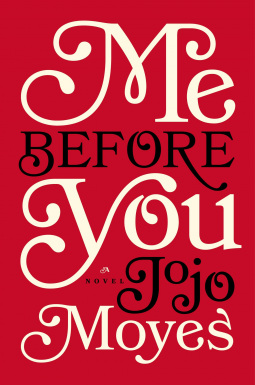
Me Before You US cover

Me Before You US cover

We can’t always judge a book by its cover, but when we do, it’s more likely that we are actually guessing a publishers intention, as they surely are well aware of the stereotypes they buy into when choosing one cover over another.

It’s something I discussed in the review of Elif Shafak’s Honour, a book I was put off reading initially and then tempted again when I saw the US cover. You only have to put a number of books of the same genre together side by side to witness a flash of recognition that it is a certain type of book or genre.

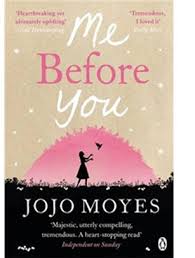
Me Before You UK cover

Me Before You UK cover

The UK cover of Me Before You suggests to me popular, light fiction, something I generally only turn to on holiday or when unable to find my reading mojo. Otherwise my reading inclination steers me towards something that might offer a unique use of language, new words, creative metaphor, unique structure, insight into a foreign culture or hopefully, evoking that elusive transporting magical sense,  something not easy to describe but utter bliss to experience.

So what about the US cover? I think it suggests that readers are already familiar with the author, it’s a bold confident move to use only text.

Maya Angelou’s recent autobiography that I read earlier this month Mom & Me & Mom had a similar text only cover (US version), and one can understand why she is beyond needing to lure readers through an enticing cover. Does this suggest that Jojo Moyes is more of a household name in the US perhaps?

Ultimately I chose to read Me Before You in order not to read too narrowly and because I am sure there will be many people who will be interested to learn more about this much talked about gripping novel.

Lou has worked in the same job for six years serving locals in a café and is more than content with her small life and daily ritual. Things change when her boss closes the café and moves away. Unable to find a suitable job she settles for a six month contract as a companion to Will, a 35-year-old quadriplegic with a number of issues since his accident almost two years previously.

Lou and Will are people who paths would not normally have crossed had they not reached such turning points in their lives concurrently and the six months they spend in each other’s company will allow them both to experience something unique and life-affirming. Well almost.

“Don’t you think it’s actually harder for you…to adapt, I mean? Because you’ve done all that stuff?

“Are you asking me if I wish I’d never done it?

“I’m just wondering if it would have been easier for you. If you’d led a smaller life. To live like this, I mean.”

“I will never, ever regret the things I’ve done. Because most days, if you’re stuck in one of these, all you have are the places in your memory that you can go to.”

It is difficult to say much about the plot without giving it away, however it is unputdownable read once started, both characters are in some way stuck and need something or someone in their lives to move them on from where they are currently.

Will’s issues are clear, though he is a stubborn, somewhat arrogant patient and Lou seems only to be sticking it out because she has to work to support her parents (her Dad has lost his job), her younger sister has a young child out of wedlock and the alternative employment for Lou would have been in some kind of vile chicken factory. Meanwhile her ever distant boyfriend of six years has become obsessed with training for the Xtreme Viking triathlon and shows signs of becoming jealous of a quadriplegic.

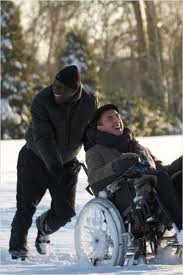
IntouchablesIf you’ve seen the excellent French film Intouchables which was a worldwide hit in 2012, knocking the popular Amelie off its pedestal for most successful French film, and is now to be remade in Hollywood (not enough Americans saw the subtitled version, the US accountable for only $13 million of the $440 million it has made so far) then you may also enjoy Me Before You.

And if you haven’t seen Intouchables, based on a true story, then make sure you see it in the original French version, before it gets done over Hollywood style! It’s brilliant.

Intouchables1The Intouchables – click to watch the trailer (make link)

Me Before You Giveaway – click to enter the giveaway (US residents only)

Note: This book was an ARC (Advance Reader Copy) provided by the publisher via NetGalley.

Shadows & Wings by Niki Tulk

Shadows & WingsLara’s father works abroad and early on in the story when Lara is seven, she and her sister learn he isn’t coming back home to Australia. She is close to her grandfather Opa, though realises a little late that there is much about his life that she doesn’t know, questions she never asked him, a subject her mother won’t speak of.

At his death, her great-aunt passes her the contents of an old wooden box, objects wrapped carefully and put away, never to be looked at; they will prompt her to travel to Germany to uncover his role in the second world war.

celloAt this point, we go back to the 1930’s to a small village in Germany where Tomas (Opa) and his friend Gustav live, Tomas’ father repairs violins, cellos and similar musical instruments and although initially Tomas doesn’t wish to play, when Gustav becomes interested and starts taking lessons, Tomas’ rekindles his love for the cello and will pursue music with the same determined passion his father had wished he would pursue a profession.

In school they are wary of the bullying Hans and his troop of followers and avoid them as much as they can, observing as they become teenagers their joining up a young Nazi youth group, something Tomas and Gustav avoid, but as 1939 approaches it will become impossible not to join their country’s ranks.

The story of the boys in their youth reminded me of David Mitchell’s excellent novel Black Swan Green and Niki Tulk successfully captures that essence of survival developed by children on and off the playground, only here for many, those playground antics would escalate to being drafted into Hitler’s Wehrmacht, and a war with repercussions and psychological consequences that would continue into subsequent generations.

Lara’s grandfather arrived later, a thin half-man on a ship that emptied its human cargo unsympathetically into a bright and bristling land. Here, not long enough after the Second World War, those who bore in their eyes another hemisphere were received with cool politeness. It was not their accents so much as their eyes – they held a silence that made others who had grown up here suddenly feel they needed to defend themselves. Tomas had discovered Lara’s grandmother like a familiar face in this country.

Lara’s search into her grandfather’s past and meeting Anton and friends in Berlin brings those repercussions forward to the present day. Lara’s own fragility and insecurities threaten to undermine her search and if it weren’t for Anton, her patient guide and new-found friend, we are left with the impression that her endeavour may quite well have failed. Her journey seemed at times so realistic, she seemed so ill-prepared and at times insensitive to what she might encounter by knocking on the doors of strangers, that it felt as if I were reading non-fiction. Unnerving yet totally believable.

The book falls into three main sections, Lara growing up in Australia with her mother and grandparents, Tomas as a boy and young man in Germany and finally Lara at 22-years-old on her extended visit to Germany.

albatross

An albatross in flight Photo: Wikipedia

Interspersed throughout the third person narrative, is Tomas’ journey on the boat between Europe and Australia and these short entries of a page or two entitled The Gift of Birds, The Gift of Time, Memory and Dreams provide some of the more poignant passages, they are the pages I returned to and reread a second time, some even a third.

They are written in the first person, at times focused on the present,  on the passage across the ocean and the words of a man making the same voyage who is knowledgeable about birds and their habits, and at other times they describe remnants of his dreams, regrets, the past, all that he intends to leave behind him when he disembarks. They provide a reflective counterpoint to the harsh reality of daily life in Germany as a young man, a life which drove him towards an activity he had no ambition for. These pages rebuild hope and show us the man he was.

“The cycle of the ages is the foundation.”

The man who loves birds stares into his fingers, deep in thought. “They recede, they advance… and the pattern of migration adjusts and adapts over many thousands of years. They are,” he adds, “in tune with the ages, whereas we consider only our own lifetimes. We are short-term thinkers, unfortunately.”

It is a thought-provoking story of the depths to which we go to protect our loved ones from the horrors of the past and suggests that silence isn’t always the route towards salvation, that memories and guilt often live on in subsequent generations, that a deprivation of family knowledge can lead to an obsession to fill in the gaps.

It reminds us that our elders are a source of great learning and that we shouldn’t wait until after they have gone to understand what life has taught them. It cautions us not to judge that which we haven’t experienced and to beware of what we might find when we go digging into the past of those who have tried to bury deep the horrors that return to them only in their sleep.

Thank you Niki for providing me with a copy of your book, not only a great story, but beautifully printed and music to accompany composed together and played by Niki on cello and her husband Mark on piano.

Shadows & Wings – the 5 track EP.

Giveaway – enter the draw to win one of two digital copies of Shadows & Wings

Australian Literature Month – April is Australia Literature Month,  visit Reading Matters to find out more.

Flight Behaviour by Barbara Kingsolver

Flight Behaviour (2)Barbara Kingsolver’s novel Flight Behaviour started off for me with a sense of déjà vu. There is something about the young character walking up into the forest, the sense that it may be a life changing moment, that evoked a memory of her earlier novel Prodigal Summer. There is something similar between the character of Dellarobia, a young mother of two children, and Deanna, the older wildlife biologist living in the forest, keeping an eye on the threatened coyote species.

Rereading the first line of my review of Prodigal Summer, the connection is obvious:

Animal nature, human nature, bugs and insects, forest life, their dependence and interdependence, habits good and bad and how the balance is affected when death, destruction or any kind of change is introduced; how species adapt, how human beings cope – or don’t – all of this we find in the juxtaposition of creatures assembled from the thoughtful poetic pen of Barbara Kingsolver in Prodigal Summer.

caterpillar-emergingHer latest story tracks another of nature’s creatures whose pattern of migration has changed, attracting scientists, environmentalists and believers. The events of this winter period coincide with Dellarobia’s realisation of what lies beneath her inclination to engage in behaviour likely to destroy her family. She is given the opportunity to work with the scientists and comes to understand that there is an alternative path to changing her life, one that will cause less suffering than the impulsive gesture she was intent on in the first pages.

Flight Behaviour also reminded me a little of Ann Patchett’s State of Wonder, they are both works of literary scientific fiction, stories that follow a particular ‘what if’ scenario. Kingsolver starts with the facts and then creates a hypothetical scenario, which science is trying to prove is related to climate change.

Just as history is sometimes more appealing to absorb through a well-researched historical novel, so too are certain scientific suppositions. And then there are the reactions of the population and how they sort themselves into like-minded categories, less about the science and more about community, faith, belonging and the short-term survival of families whose basic living may be at odds with the conservation of another of nature’s species.

Kingsolver looks at what motivates humanity to take positions against each other, the tendency to seek only those positions that support their belief system or corporate sponsor, regardless of evidence to the contrary, the challenges of the outsider and the blind acceptance of those who accept their lot without question, living in the present on account of mistakes they’ve made in the past.

coyote runningAn enjoyable novel, though slow going for me, there was something about Prodigal Summer that was urgent and compelling, while this book meandered; comparing the experience of these two books is a little like a reflection of the speed of the creatures in their midst.

Flight Behaviour has been short listed in the Women’s Prize for Fiction 2013, Barbara Kingsolver was a recent winner of the prize in 2010 for her excellent novel The Lacuna, one of the first novels reviewed here on Word by Word.

Women’s Prize for Fiction Shortlist & Pulitzer Prize 2013

Womens prize logoThe long-list becomes the short-list and it looks like a strong line-up for the Women’s Prize for Fiction 2013. Here is the short list:

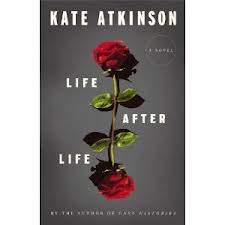
Kate Atkinson Life After Life – my review here

A M Homes May We Be Forgiven

Barbara Kingsolver Flight Behaviour

Hilary Mantel Bring Up the Bodies

Maria Semple Where’d You Go, Bernadette

Zadie Smith NW – my review here

Flight Behaviour (2) NW life after life

Here’s what Miranda Johnson, Chair of the Judges had to say:

‘The task of reducing the list of submissions from over 140 to just 20 books was always going to be daunting, but this year’s infinite variety has made the task even trickier. The list we have ended up with is, we believe, truly representative of that diversity of style, content and provenance, and contains those works which genuinely inspired the most excitement and passion amongst the judges. I don’t anticipate the job becoming easier at the next stage!’

I have managed to read two that made it through, plus others from the long list including Honour, Ignorance and The Light Between Oceans. I am currently slow-reading Barbara Kingsolver’s Flight Behaviour, she won the prize in 2010 with The Lacuna, one of the first books I reviewed here. Zadie Smith is also a previous winner, her book On Beauty won in 2006.

I was sure that Atkinson and Smith would make the list, not only because the stories are engaging, but because they dare to step outside the ordinary and test the boundaries of convention, Life After Life likely to be a more popular read, but both deserving their place here.

I know many will be surprised yet delighted to see Maria Semple’s Where’s You Go Bernadette on the list and of course the inevitable Hilary Mantel, no surprise there. Will anyone be able to knock her off her current perch I wonder?

The winner will be announced at a ceremony at the Royal Festival Hall, London on 5 June.

The Guardian – Women’s prize for fiction reveals ‘staggeringly strong’ shortlist

Pulitzer Prizepulitzer

Amid the terrible news that saddened and horrified us all in Boston yesterday, a day that should have been cause for calm celebration, the annual Pulitzer Prizes for 2013 were quietly announced.

The Snow Child was one of the three finalists for the fiction prize, the winner was The Orphan Master’s Son by Adam Johnson, a timely journey in the heart of North Korea.

It was good to see a non-fiction title I enjoyed and recommended last year Tom Reiss’s Black Count: Glory, Revolution, Betrayal, and the Real Count of Monte Cristo win the biography prize. My review here.

The Great Gatsby

Though largely ignored when it was first published and even upon F.Scott Fitzgerald’s death, the thousands of anticipated copies sold would sit gathering dust in a warehouse, it has since become much more appreciated, hailed as a classic and studied in schools across America.

great gatsbyIt may be that in its time it was too contemporary, its characters variations on the lives people lived, each harbouring their own secrets, many trying to be or become something they were not. It is something that is easier to look on and remember the superficial elements that made it an era to remember, a time of lavish parties and abundance, when friendships were shallow and loyalties non-existent. Set in the jazz era, critics have said it represents the American psyche, to me it represents illusion and aspiration.

AFF_CANNES_22X30.inddBaz Luhrmann’s adaptation with Leonardo DiCaprio playing Gatsby, will open the Cannes Film Festival on May 15. It promises to be a lavish affair and I can see why a filmmaker would be attracted to this story, the author doesn’t paint much of a picture of the surroundings, except to place them just outside New York, the weekend playground for the young and aspiring. The evening soirées are not significant to the plot, but they create wonderful images to entice a film audience.

Ironically, it is in the first pages of his novel Tender is the Night in which I find not only the kind of writing I love to read, but a paragraph that describes Cannes itself, a town Fitzgerald was no stranger to:

In the early morning the distant image of Cannes, the pink and the cream of old fortifications, the purple Alp that bounded Italy, were cast across the water and lay quavering in the ripples and rings sent up by sea-plants through the clear shallows.

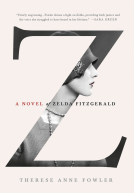
In addition to the film remake, Therese Fowler’s, Z – A Novel of Zelda, based on the life of Zelda Fitzgerald was released this month, with comparisons being made with The Paris Wife, Paula McCain’s book about Hemingway’s first wife Hadley Richardson and the years they were together. It has been said that Gatsby is drawn a little from Fitzgerald’s own experience in wooing Zelda, a young woman from outside his social strata and therefore in ordinary circumstances, unattainable, just as Daisy was to Gatsby.

GatsbyThe Great Gatsby is narrated by Carraway, a bonds trader in New York, a young man who lives in the small house next to Gatsby, which is not far from the home of his second cousin Daisy and her husband Tom. He is a narrator of convenience to the story, a sympathetic observer we don’t learn much about, his purpose to share that summer he became Gatsby’s neighbour and witnessed the events that occurred. Although, he is a mere bystander, he is the one friend Gatsby may have had in truth. Not much is known of Gatsby either and Fitzgerald keeps it that way, none of the characters getting too close to him, or indeed the reader.

The history of the summer really begins on the evening I drove over there to have dinner with the Tom Buchanans.

A visit to Daisy reveals the philandering ways of her husband Tom, when he takes a telephone call from his mistress, a fact that is clear to all present. Daisy and Tom come from ‘old money’ and unlike the middle classes or nouveau-riche, their indiscretions are rarely secret or indulged with regret, it is accepted, it is their way.It is those who hail from more humble beginnings who harbour illusions of romantic love, who carry emotional expectations and suffer in consequence.

Daisy is connected with Gatsby, although they haven’t seen each other in five years; Carraway’s arrival next door signals a turning point in their association.

There must have been moments even that afternoon when Daisy tumbled short of his dreams – not through her own fault, but because of the colossal vitality of his illusion. It had gone beyond her, beyond everything. He had thrown himself into it with a creative passion, adding to it all the time, decking it out with every bright feather that drifted his way. No amount of fire or freshness can challenge what a man can store up in his ghostly heart.

Fitzgerals

The Fitzgerald family

Overall, I find the book a little perplexing, it seems more a symbol of a past era, the 1920’s America and although it doesn’t feature in the book, there is undoubtedly the author’s connection with Paris, the French Riviera and The Lost Generation, that group of writers who made France their home and way of life, a subject that continues to fascinate every generation since, more so in current times perhaps than it did in their own.

The language used and the guarded distance from its characters I found a little annoying, though to be expected of a book of its era perhaps.  More than this, it felt as if the author were holding back from his own past through Gatsby, thus a kind of cathartic writing experience, only he might risk losing everything by being too honest, so he deliberately keeps things vague. Having said that, I am going to read Tender is the Night and already find the first few pages, a lot more free and open in its language, though I suspect Fitzgerald of having ulterior motives in his storytelling.

ZThe Facts: 10 Things You Should Know about The Great Gatsby – in pictures

The Film Trailer: Baz Luhrmann’s adaptation will open the Cannes Film Festival in May 2013 starring Leonardo DiCaprio and Carey Mulligan

Z is for Zelda: – the novel out in April 2013 about the life of Zelda Fitzgerald, wife of F.Scott Fitzgerald