Mom & Me & Mom by May Angelou

Maya Angelou starts her conversation book by mentioning something people often ask, how it is that she became the women she is, a question she says she has been tempted to respond to using lines quoted from Topsy, the young black girl in Uncle Tom’s Cabin who said, “I dunno, I just growed.”

Mom Me MomInstead, Angelou has written this thought-provoking tribute, sharing a slew of matriarchal experiences among the many others already shared in her remarkable series of autobiographies, to highlight a little of how she did become that brave, sensitive, adventurous and caring women she is, in part due to the grandmother she loved and the mother she came to adore.

It is a story written with utmost compassion and forgiveness, for this is a woman whose mother admitted when she and her husband separated that she could not mother young children, so sent them to live with their grandmother for ten years. Angelou closes the prologue reminding us that love heals and throughout the book will prove that kindness is the greatest gift we can ever give and foster in others.

Love heals. Heals and liberates. I use the word love, not meaning sentimentality, but a condition so strong that it may be that which holds the stars in their heavenly positions and that which causes the blood to flow orderly in our veins.

Vivian Baxter, Maya Angelou’s mother, was the eldest of a large family of mostly boys, for whom threats, intimidation and violence were a part of their way of their life and this petite force was often at the forefront of their skirmishes. Their father encouraged tough boy talk and tasked his daughter with ensuring the boys didn’t soften. Little wonder that after falling in love, marrying and realising that it was a mistake, they were also unable to agree on who should raise their toddlers, they separated and sent the children to their father’s mother in Stamps, Arkansas. Maya was three and Bailey five-years-old.

Ten years later, when their grandmother felt that Bailey had grown too old for Arkansas, when he had reached a dangerous age for a black boy in the segregated South, it was arranged for them to return to their mother in California. Bailey was enthusiastic, Maya much less so. It would be difficult, but for all her flaws, their mother knew how to communicate with her children and didn’t push her mother status on them. Maya decided she would call her ‘Lady’ and her mother’s response to this is one of many small pleasures Angelou offers up in her book.

Maya has a baby very young, without the foundation of a loving relationship, however with the love and support of her mother, this event in no way prevents her from pursuing her life’s dreams and ambitions.

I thought about my mother and knew she was amazing. She never made me feel as if I brought scandal to the family. The baby had not been planned and I would have to rethink plans about education, but to Vivian Baxter that was life being life.

Some years later deciding to marry Tosh tested the mother daughter relationship, Vivian didn’t try to stop her daughter from making what she thought was a mistake, but she chose to leave San Francisco, not wishing to witness the fallout. Like any young women living off the heady ambiance of newly married love, Maya wished to prove her mother wrong.

To begin with she continued doing all the things she loved, the things that made her Maya Angelou, seeing her friends, attending a dance class, going to church and speaking freely about God. However her activities slowly became issues between the young couple, so she stopped them in an attempt to maintain peace between herself and her husband.

At first the dimness is hardly noticeable but not alarming. Then with a rush, the light is vanquished by darkness.

This gem of a book, complete with gorgeous photos, is a wonderful addition to her already masterful collection of autobiographies and chronicles that one relationship that runs through our entire lives, that with our mother. It may not always be easy, but Angelou shares those moments that tested and ultimately strengthened the love and respect they had for each other. She accomplishes it with incredible honesty and selflessness, something that shines through in the brief interview I have linked here. What a wise and loving soul she is.

Interview – Learning to Love My Mother: Maya talks about her mother with a BBC interviewer.

“Exercise patience with yourself first, so you can forgive yourself for all the dumb things you do. Then exercise patience with your children.”

Buy a Copy of Mom & Me & Mom via Book Depository

Note: The book was an Advance Reader Copy (ARC) provided by the publisher via NetGalley.

Honour by Elif Shafak

US edition cover

US edition cover

Elif Shafak comments in her essay on identity The Happiness of Blond People about the stereotyping or tendency of books written by or about women from the East, that they often sport covers with an image of a veiled woman.

It is something that makes her other books stand out, because they don’t do that. The Bastard of Istanbul and The Forty Rules of Love (at least the editions that I read) have enticing covers that invite you to enter another world, depicting vibrant, warm colours and referencing stunning forms of Eastern architecture, curves, arabesques, spires and sparkling elements.

When I first spied the UK cover of her new book Honour I thought ‘Oh no’, not one of those books – I was disappointed as it looked like it belonged to that genre, the misery tale of a woman’s lot in a society where the veil is used as a symbol of varying degrees of oppression. That was before I read and reviewed the essay I refer to above, in which she cites those books with similar disdain.

It was some comfort to see that the US edition has nothing like that cover, preferring the safe symbolism of the open arches, inviting us in to take a look within its pages, no veils, no dark colours, no fear, no buying into outdated stereotypes. It would be interesting to know which cover  attracts the most readers.

Honour

UK edition cover

There is a plethora of lifestyles among Muslims, a variety of personal stories to consider; and yet only some of these stories come to the fore. They almost always happen to be the most problematic ones: we seldom hear about happy Muslims, in particular about happy Muslim women. Honour killings, female circumcision, child brides, the veil, gender segregation, lack of freedom… Gender is the number-one topic where the so-called Clash of Civilisations is manifest and crystallized. It is no coincidence that a considerable number of books related to Islam have female images on their covers, and in many, if not most cases, these females appear to be sad, silenced, secluded or suffering. Women with their mouths covered, or eyes peeking out from behind their hijab, or heads bowed miserably down… Elif Shafak, The Happiness of Blond People

Book covers aside, this is a very credible story, one that many women who have uprooted their lives and brought up or given birth to children in a foreign culture may relate to. Narrated by her daughter Esma, the story centres around the life of Pembe, identical twin to Jamila and one of eight educated daughters of a family raised in a Kurdish village, the desire and constant striving for a son eventually taking the mother in childbirth.

Life here is a precarious path for young woman, where one wrong step can easily lead to condemnation. One of the twins dreams of a life far away, the other seeks to learn from those around her, from nature and experimentation. Love is the sacrifice that will enable them to attain their so-called dreams.

Their adult lives are lived far from each other, Jamila becoming a renowned village midwife and Pembe, fulfils that desire to live elsewhere, travelling further than she ever dreams, her husband Adem, from Istanbul, brings her to live in East London where they will raise their three children Iskander, Esma and Yunis.

To her the future was a land of promises. She had not been there yet, but she trusted it to be bright and beautiful. It was a place of infinite potential, a mosaic of shifting tiles, now in a seamless order, now in mild disarray, for ever re-creating itself.

To him the past was a shrine. Reliable, solid, unchanging and, above all, enduring. It provided insight into the beginning of everything; it gave him a sense of centre, coherence and continuity.

Through the story, which alternates between 1940’s Kurdistan and 1970’s London, we come to know each of these family members and begin to understand how their individual and collective experiences has moulded them, Pembe and Jamila in their traditional village with its elders, family, traditions, superstitions; Adem with an alcoholic father and angst-ridden mother who eventually abandons her children, unable to cope with the Jeckyll and Hyde character of her husband. Each has been in some way touched by the repercussions of a ‘loss of honour’.

Iskander is raised in London with memories of his early life elsewhere, carrying memories of disappointment like molten rock deep within. He is sensitive to a vibe between his parents he doesn’t understand, something that makes him want to act. When his father leaves home and it becomes clear that his mother is moving on, the pressure of that molten rock within him causes him to explode.

RumiHonour touches on many great themes and then excels in sharing all the familial details, the interactions between its characters, the people and culture around them, to the point where we identify with each character as we spend time seeing things from their perspective and then experience a sense of anxiety knowing that these perspectives are likely to clash and the outcome will not be good.

And then there is Zeeshan, a character who arrives unexpectedly, but one I recognise instantly, knowing of Shafak’s interest in Sufism and the work of the 13th century poet and philosopher Rumi; Zeeshan is a gift and offers a lifeline to Iskender representing hope.

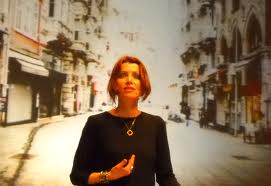
Elif Shafak is a writer with an interesting perspective, as she herself says, she has one foot in Istanbul and the other travels and makes connections in cities around the world.

Writing that crosses cultures and observes characters doing the same invokes a sense of empathy, she is a writer whose work I will be following and whose city I look forward to visiting in May this year.

Elif Shafak speaking in Sophia, Bulgaria Photo courtesy of Tayna Tzvetkova

Elif Shafak speaking in Sophia, Bulgaria
Photo courtesy of Rayna Tzvetkova

Note: This book was an Advance Reader Copy (ARC) provided by the publisher via NetGalley.

The Hare with Amber Eyes, A Hidden Inheritance

The Hare with Amber Eyes

What a story this hare could have told should he have possessed the gift of speech. Instead we see him hunched there, ears pinned back, quivering, stunned by the journey he has taken, the events that have occurred around him, surprised to have survived when so many of his companion artifacts, the more sturdy furnishings, grand paintings and even other ceramics, did not.

The Hare With Amber Eyes is a Japanese netsuke, a miniature sculpture (though they can be wood or ivory) invented in the 17th century, not just as an objet d’art, but a functional kind of toggle to attach to the end of a cord for a pouch that a man might carry, since most of the garments they wore did not contain pockets (the two Japanese characters ne+tsuke mean “root” and “to attach”).

The hare is part of a collection of 264 netsuke purchased by the third son of an aspiring and ambitious Jewish family, Charles Ephrussi (son of Leon).

By 1860 the family had become the greatest grain-exporters in the world. In 1857 the two elder sons were sent out from Odessa to Vienna, the capital city of the sprawling Hapsburg Empire. They bought a huge house in the city centre, and for ten years this was the home to a shifting population of grandparents, children and grandchildren as the family moved backwards and forwards between the two cities. One of the sons, my great-great grandfather Ignace, was tasked with handling Ephrussi business in the Austro-Hungarian Empire from this Vienna base. Paris came next: Leon, the older son, was tasked with establishing the family and business there.

Hare Amber EyesBeing the third son, Charles was spared the obligation of being groomed for the financial sector in the family business (though it may well be he was not cut out for it either as de Waal speculates), preferring to frequent the cafes, salons and a certain boudoir of an older, married woman, attaching himself only ever temporarily to that which he admired – having already lived in three large cities, with his languages, wealth and a passionate interest in the arts, he had plenty of time to indulge his many passions.

It was through his pursuits in the arts, the start of his own collection, mingling with artists, other collectors and art dealers, writers about the arts, that he became interested in Japonisme, a rarity when it began appearing and so desirous. He would purchase a large collection of netsuke from the Parisian art dealer Philippe Sichel who travelled to Japan in 1874.

There is a wonderful connection to Proust throughout this part of the book, one that was a pleasure to discover, without the necessity of having read him, if anything it is an interesting introduction to that group of intellectuals of the 1880’s – 1900’s, Charles Ephrussi himself one of the models for Proust’s depiction of Swann in Swann’s Way.

The author of the book, Edmund de Waal is a descendant of the Ephrussi family and has inherited the 264 netsuke. He is a ceramic potter himself and spent two years studying in Japan, after many years as an apprentice in England. It was in Tokyo, while visiting his Uncle Iggie (another Ignace) that he first laid eyes and hands on the family netsuke that would eventually become his, learning a little of their journey from Paris to Vienna, London and back to Tokyo. Eventually he would spend five years researching what would become this incredible book.

He too, is the third son, though his is no longer a global banking family with the same expectations of its protege. Although he shares similar characteristics to his ancestors, those who did manage to escape the family business and were able to develop that appreciation and eye for a work of art, going beyond casual observation; it is as if he converses with these objects and reads them as if they have living, human qualities.

DeWaalThrough this book, he traces the history of these netsuke and his family, as they rise in ascendancy and are undone by the events leading up to the second world war. We come to know many of the family members and Edmund’s grandmother Elizabeth, a poet and a lawyer is a wonderful woman to learn about, the first woman to receive a doctorate from the University of Vienna and passionate about her poetry, she corresponds regularly with Rilke.

This book was so fascinating and so sensitively handled, it was with an almost palpable sadness that I finished it and felt bereft, wondering where on earth I could go to from here, reading-wise, after such a story.

And then I remembered it has been two years since publication and so I consoled myself with following the work of De Waal, who has been rather prolific since 2010 and I was not surprised to see his recent exhibition A Thousand Hours, showing works behind vitrines, evidence of the longer term effect of his immersion into all that research and study of netsuke and other artifacts his family had preserved.

I leave a link to him commenting on that most recent exhibition and a wonderful article in the Telegraph, in which I learn that De Waal has recently returned from a trip to Jingdezhen, home of the purest clay in China, where porcelain has been made for 1,000 years. This was a research trip for his next book and for a collaboration with the Chinese porcelain collections at the Fitzwilliams Museum for an upcoming exhibition:

De Waal is animated, inspired, gesticulating with his long fingered hands; there is a hum of creativity around him. You can almost see the words fizzing in his head, feel the ideas taking root, springing up out of nothing and arranging themselves in little groups, to form stories, dramas, like his pots.

The Netsukephotos of some of the Ephrussi collection + family pictures

Article Edmund de Waal on his new exhibition, A Thousand Hours by Jessamy Calkin

Video Watch Edmund De Waal transform clay into beautiful works of art

Brain On Fire – My Month of Madness

Susannah Cahalan was twenty-four-years old when something in the way she perceived things changed. It started with an obsession over bedbugs and descended into hallucinations, seizures and unpredictable acts of bizarre behaviour. Blood tests, scans, numerous procedures, initially all the tests came back negative, her Doctor (a renowned neurologist) insisting it was stress and alcohol consumption. It was neither of those things and if there is one stand-out learning to be gained from this incredible story, it is to ensure always to obtain a second opinion.

Brain on FireThis true story provides a fascinating insight into a rare autoimmune disease which causes the body to attack itself and in this case – the brain. It truly is a story that can and has already changed people’s lives; the writer, a reporter on the New York Post observes her own physical and mental decline and then as her mind descends into chaos, she recalls nothing. Her account is pulled together from interviews, hospital video footage and the journal of her family, until her brain begins to regenerate memory.

It is a path that many will have followed who end up spending the rest of their lives in an institution, if they actually survive it.  Susannah Cahalan, with the help of a supportive and determined family who won’t give up until they find a treatable diagnosis, is fortunate to be seen by the tenacious and talented Dr Najjar, and one final test later, a simple pen and paper exercise, leads him to the all-important diagnosis and her to the path of eventual recovery.

It was his focus on non-psychiatric causes that prevented her from a much more disastrous outcome.  His continuous ground-breaking research posits  that some forms of schizophrenia, bipolar disorder, obsessive-compulsive disorder and depression are actually caused by inflammatory conditions  in the brain.  This research may eventually help to break down barriers between immunology, neurology and psychiatry.

Lower Manhatten from Staten Island Ferry by Diliff

Lower Manhattan from the Staten Island Ferry by Diliff

Before writing this book, the author published an article for the New York Post about her experience, prompting an outpouring from many people who had a family member with an inexplicable brain disease – her case highlights the very real possibility that there are thousands if not more people out there descending into a similar madness.

StrokeHer story reminds me of  ‘My Stroke of Insight’, the extraordinary story of the brain scientist, Jill Taylor’s experience when at 37 years a blood vessel exploded in her brain and she too observed her mind deteriorate to the point where she could not walk, talk, read, write, or recall any of her life. She recovered and used her incredible insight and knowledge to share that experience with the world – creating an important resource for the sufferers and carers of stroke victims. She gives an excellent TED talk on the subject here. Interestingly, she became a brain scientist herself due to her brother’s diagnosis of a brain disorder, schizophrenia.

A gripping, unputdownable memoir that shows how little we really know about the workings of the brain and how difficult it is to diagnose. It’s thanks to books like this that more diagnoses can and are being made helping sufferers to find the right path to recovery.

Episode 10: The Move Down Under and a Shocking Diagnosis

Thinking that a move would give us more family time and offer a less stressful lifestyle, we left London behind and travelled half way around the planet to New Zealand, where most of my family still live today. I had been away for many years and hadn’t expected to return, however now that I was back, everything looked and felt familiar and it wasn’t long before we had moved into a house in the city and I had found a full-time job.

Not quite that large an island, Allia’s interpretation of somewhere very far away.
Putting New Zealand on the Map!

Initially we spent time staying at my parent’s home on the sheep farm they had lived for twenty years. It was wonderful to be there with Allia, for her to spend time around her grandparents and for them to get to know and love her.

Being a long way from the nearest town and a very windy road to get in and out, the forced isolation was a little more difficult for my husband to endure, but he was fascinated by the workings of the farm and in particular the shearing shed when it was in full working motion. Not so for me, years of spending school holidays working in that intense, stinking, hot and competitive environment (shearers get paid per sheep shorn, not by the hour) sweeping away wool, dags (sheep shit) and the occasional maggot were something I felt no nostalgia for at all.

It seemed to be good timing to have returned at this time as my mother was unwell, so I was able to go with her to her appointments and provide support. Good timing was an under-statement; she had lost a lot of weight and was having problems with her balance. She was only 59-years-old but seemed to have entered what looked like old age in an awful hurry.

Of course it wasn’t old age. By the time it was understood that it also wasn’t asthma or some diet related weight loss and she had been for a follow-up MRI scan, we found ourselves sitting in an office, opposite an oncologist who mumbled something that sounded like “three weeks”.

“Excuse me”, what did you say? I blurted out.

“The cancer is in the lungs, but it has spread to the kidneys and other organs and those lumps in the neck and brain are tumours. In the state that your mother is in now, I would say that three weeks is being optimistic.”

“But isn’t there anything we can do?”

“Yes, we can start chemotherapy to try to slow down the rapid advance of the cancer and the radiation treatment should be able to remove those tumours so you should actually start feeling better and get your balance back” he said looking at my mother.

We were both stunned. I wanted to protest and say hey that’s not fair, you can’t wait all this time knowing something isn’t quite right, you know it was more than three weeks that we have been worrying about this and we survived that, only to hand out a three-week life card as if you are prescribing community service. This is an unfair sentence being handed out for absolutely no crime!

Completely and utterly helpless, we sat and listened to what would happen in the next few days. I don’t recall much of what he said, but I remember my mother turning to me with that familiar, uncompromising look in her eye and saying, “I’m going to fight this.”

Yes, she would fight death as she had fought life; like every other great challenge that had faced her, she never gave up without a fight. But I looked at the thin frame of a woman she had become and knew that this was a fight she was not going to win. Not this time.

Next Up: in A Silent Education: Our Quiet Challenge in Provence

Episode 11: Adapting to a New Rhythm and Creating Lasting Memories

Previous Episodes

Episode 9: She Speaks the Language of Birds

Apart from mild surprise when reading my mother’s entries in the baby book she kept for me, which lists the number of words I could say at 12 months and various intervals beyond that, I never really noticed too much that Allia didn’t speak words that could be recognised. Because she talked non-stop. She communicated incessantly with much enthusiasm and wasn’t shy.

She spoke a language tongue that we referred to as bird-talk, it was long streams of dialogue that went up and down in intonation which I was just on the verge of understanding if I listened hard enough, I was sure. Like listening to Italian or Arabic, languages that incorporate much body language and expression which communicate mood, tension and excitement without the need to understand their words.  It was very much like listening to the French language on the television or the radio in my early days of living here – somewhat familiar sounds with that feeling that surely if I did listen hard enough, it was just a matter of time before something in my brain clicked and “poof” I would understand everything.

It wasn’t until her brother arrived on the scene a year later and started using recognisable words in his rambled dialogue very early on that the contrast became noticeable – I think he understood the bird-talk because they would chatter away to each other and to us without hesitation. I wondered then if something was perhaps amiss, I say perhaps, because I am against making comparisons between children, they develop at their own pace and depending on what they are working on developing, other aspects can lag behind.

When people started suggesting we video her speaking like this, I realised it really was a little out of the ordinary, it was almost as if she had her own language, something like a twin language – but no twin. Unlike today when making a piece of film footage is child’s play, I wasn’t comfortable filming her as a kind of spectacle, I was more concerned with just interacting with her and giving her the freedom to express herself, waiting for her language to become something like one of the three languages she was hearing at home.

Next Up: in A Silent Education: Our Quiet Challenge in Provence

Episode 10: The Move Down Under and a Shocking Diagnosis

Previous Episodes

Episode 8: Ten Months of Bliss and Facing a Return to Work

Once over that initial hurdle, Allia blossomed and apart from that long scar, there was nothing to indicate there had ever been a problem. She was a happy, contented baby who loved to smile and engage with those around her, especially the band of eight and nine-year-old girls who lived in our apartment building and were frequent visitors.

For the first ten months I was able to stay at home with her, working a little, practicing aromatherapy, however I knew it was going to be necessary to find another full-time job, living in London demands it, all the more so when there is an extra mouth to feed.

Until this precious little girl came into my life, I never really questioned working long hours or weekends and I had thrived on the opportunity to travel with work. Now, I couldn’t think of anything worse – to leave this child behind, absolutely not, she had extinguished my desire to seek out the unknown, I found myself dreaming of safer pastures, the more familiar.

For the first time in eight years of living in London, the city that I thought had become my second home, I thought the unthinkable – maybe it was time to return to New Zealand?

P.S. This is what Allia came up with when I said this episode was about us having 10 months of fun times hanging out together, going to the park etc, I just love this picture, although my husband says that first one isn’t true! But her imagination is brilliant. Enjoy.

Next Up: in A Silent Education: Our Quiet Challenge in Provence

Episode 9: She Speaks the Language of Birds

Previous Episodes

Episode 7: The Verdict, the Recovery and Home in time for Christmas

Waking up the day after the birth and the operation was difficult but waking up without our baby there next to us was gut-wrenching. We returned to the hospital as quick as we could and it would become my resting place for the next three weeks. I was kitted out with a mobile, electric breast pump, not too different from the contraption we see in a cowshed, only this cow had to be milked every three hours. I saw how little they survive on in those first few days, poor starving babies, but I also saw the rich colour of that life-giving, nutritional start a newborn needs, colostrum. Seeing that invoked a determination to ensure I ate in the most healthy way possible.

Allia spent three days in intensive care and apart from being asked to leave when they removed the respiratory equipment, the days passed with little drama. We learned that she had an Ileal Atresia, basically an obstruction in the small bowel, which required 35cm of it to be removed, leaving 130cm. Reading the notes of the operation and procedures in the Intensive Care Unit, I completely understand why some things are best not witnessed or even read about at the time one is going through them. I recently came across the discharge summary and actually have no recollection of ever having read it before, it’s not pleasant reading and I feel thankful to have a healthy daughter who shows no sign whatsoever of this challenging start to her life except the scar across her middle.

As if making up for that initial separation, we were then gifted with something few mothers experience I am sure, three uninterrupted weeks of constant companionship, the two of us sharing a room that became our world,  three weeks in which I learned that this small being was connected to me in a way I had never imagined possible.

Apart from when the nurses struggled to find a vein when doing blood tests, Allia never cried. She slept, she awoke, she rested in my arms as we waited for that all important organ, the bowel to commence its function. That would be one of the first signs of recovery. She was given milk through a line, so it had to happen soon and if everything functioned well, I would be able to start feeding her.

I would slip downstairs to the cafeteria for my breakfast when I saw she was sleeping and she was always quiet on my return, I would then read the notes to check if anything had occurred while I was away and it was via this I learned that this blissful sleeping baby was aware of my absence. The nurse had noted that Allia had cried and next to this note, that the mother had left the room to have breakfast. That the two events were connected was something of a shock initially, but so reassuring, to come to understand and experience something of the magic of the bond between mother and child. It is something I remain in awe of.  The next time I left for breakfast, I made sure to tell her where I was going.

Once she recovered and was feeding and putting on weight, we were ready to go home. We were discharged on December 18th and re-entered a city transformed by the approach of Christmas. A festive celebration it was indeed and the perfect time to be coming home and preparing for the season of joy and hibernation.

épisode7

Next Up: in A Silent Education: Our Quiet Challenge in Provence

Episode 8: Ten Months of Bliss and Facing a Return to Work

Previous Episodes

Episode 6: Late Night Surgery, the Most Difficult Wait a New Mother will Endure

Exiting the lift, we entered the Anaethetist’s medical room and I watched as they prepared what they needed, looking confident and as if they had done this many times before, which of course they had, it was only Allia and I for whom all this was alarming and new. As they attached three new lines to Allia I noticed that each one had a small square sticky label with a different animal on it. Everything in there was so miniature, the sight of those tiny little animal figures like a kind of bait, luring one into a false sense of security momentarily. But then I saw the tiny mask and the realisation of what that mask signified gave me serious heart palpitations. My little girl had made it into this world, through all these months of waiting and had survived birth and was breathing effortlessly and now this gas mask was going to knock her out.

“Okay, I think I shoud go now” I said stumbling out of the door and into the lift and back up to the relative serenity of the nurturing Woodland Ward. I had stayed as long as I could, but I wouldn’t witness her lose consciousness, that I just couldn’t bear. We then waited in what seemed like and probably was the longest day of my life. Allia had been born on that very same day at 5.16am and we would wait there until after 11pm for the doctor to report back to us.

He returned alone. It was then I understood that Allia would not be coming back to this serene ward.

“She’s okay” the doctor said. He spoke softly and quietly. “She has been taken up to the intensive care ward and you will be able to see her tomorrow. We will try and organise a room for you here then” he said looking at me, “but for now she is being taken care of and the best thing would be for you to go home and get some rest.”

It was both a relief to know she was okay and an anti-climax because we couldn’t see her. I tried not to allow the nagging fear or was it paranoia that he was hiding something or protecting us from something engulf me. A mother in a state of distress has such fine-tuned nerves she picks up on everything. The wild animal instinct in me was sensitive to every word and gesture, trying to read behind every intention in this strange unfamiliar territory.

Everything comes as a surprise when we are so focused only on what is happening right now. With the benefit of hindsight, I see that all these small shocks and surprises are the things that create anxiety in the lead up to knowledge about out what is going to happen next. But the maternal instinct is a wonderful shock absorber and close to the survival instinct I am sure.

Which is just as well, because no one can warn you that will only hold your baby for a short while after birth, that she will be taken away and put in a different ward from you, that she will go to another hospital without you, that they will ask for your consent to perform surgery over the telephone and then tell you it’s better for you to stay where you are and rest, that you will escape the hospital to follow your child, not even knowing the address of where she is, that you will wait four hours for an operation to be performed and you won’t see your baby afterwards and that you will find yourself walking out into the dark streets of London just before midnight on the same day that you first gave birth, looking for a taxi that won’t appear in the freezing cold of a late November winter, that the taxi you eventually find will throw you around its back seat violently as it turns corners, accelerating into each street, that you will be too tired and stunned to even protest as the physical pain of what you have endured finally overpowers the drug-like effect of whatever bodily hormones have up until now been providing you with some measure of pain relief.

As we left the hospital to search for that taxi, the nurse insisted that I sit in a wheelchair.

“It’s been a long day and your body also needs to recover” she said.

Next Up: in A Silent Education: Our Quiet Challenge in Provence

Episode 7: The Verdict, The Recovery and Home Just in Time for Christmas

Previous Episodes

Introduction

Episode 1: The Benefits of Insomnia

Episode 2: We are not Living in France!

Episode 3: The Benefits of Contra-Indicated Essential Oils

Episode 4: Where’s My Baby and Why Isn’t She With Me?

Episode 5: GOSH: Where Peter Pan’s legacy resides, a kind of Neverland

Episode 5: GOSH Where Peter Pan’s legacy resides, a kind of Neverland

At Great Ormond St Hospital we were shown to the Woodland Ward, the family and children friendly ward names, a first step in reducing my overburdened anxiety levels. Allia was in a beautiful communal room decorated for children, with soft lighting, colour, patterned bed sheets with giraffes and monkeys. The quiet whispers of the nurses a stark contrast to the beige walls, formica cabinets and metal machines with cables and hoses draped everywhere of the hospital we had just left.

Arriving at GOSH Great Ormond St Hospital

It was like we had left the factory and entered Neverland. In a way we had. GOSH has the benefit of many private donors and receives royalties from the estate of J.M. Barrie, who claimed Peter Pan had been a patient in Great Ormond Street Hospital and that:

It was he who put me up to the little thing I did for the hospital.

Allia was asleep in an open incubator so we could actually touch her. She was so peaceful sleeping there. There was no naso-gastric tube in her nose, only lines in her hands and feet, things that in this environment were as ordinary and common as sheets and blankets. She was okay and she was going to be okay. She looked more comfortable now than she had before and I was just happy to be there with her.

It was a shock for my husband. Having missed the birth itself, he was now confronted with something even more difficult, seeing his daughter for the first time in a hospital wired up to machines and about to undergo surgery. If he thought he had arrived in time to avoid the drama, he was mistaken, he had arrived in the middle of it and now he and I would have to endure four hours of awaiting the outcome of a major event that neither of us had any role in.

My Aunt left and Susan’s husband stayed with us. Susan (whose name I have changed for this story) and I used to joke about our funny connections and serendipitous events, one of them being that she shared the name of my mother and I shared the name of her daughter. We laughed the day we met when we discovered this connection, never for a minute anticipating the future role she would play in our lives, at the birth of our daughter.

We had about half an hour before Allia was taken downstairs to the operating theatre. The doctor spoke with us and drew a diagram of the digestive system, from the mouth, down the oesophagus, to the stomach and the small intestine to the ileum, the point just before the small intestine connects to the large intestine.

“It is here just before the ileum that there is a blockage” he explained. “We don’t know exactly what it is, whether there is an end to the intestine so that the two pieces must be re-joined or whether there are striations or a blockage, in which case, we may need to cut a section out. Do you want to come down to the Anaesthetists’ ward?” he asked.

“Yes” I replied.

“No” said my husband simultaneously.

The lift opened, Allia was wheeled inside, I followed with the doctor and we all descended.

Next Up: Late Night Surgery, the most difficult wait a new mother will ever endure

Read Previous Episodes this mother/daughter collaboration: A Silent Education: Our Quiet Challenge in Provence

Introduction

Episode 1: The Benefits of Insomnia

Episode 2: We are not Living in France!

Episode 3: The Benefits of Contra-Indicated Essential Oils

Episode 4: Where’s My Baby and Why Isn’t She With Me?