
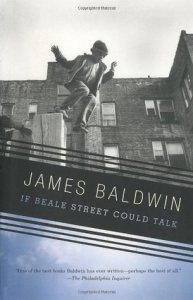
 If Beale Street Could Talk is the first work by James Baldwin that I have read. It was the first work he wrote after he moved to St Paul de Vence in the south of France, where he would pass the last 17 years of his life.
He also wrote his first two novels at the beginning of his literary career, Go Tell It on the Mountain and Giovanni’s Room, along with his best-known collection of essays, Notes of a Native Son during a nine-year period he lived in Paris.
When Jordan Elgrably of The Paris Review asked why he left the United States said:
I was broke. I got to Paris with forty dollars in my pocket, but I had to get out of New York. My reflexes were tormented by the plight of other people. Reading had taken me away for long periods at a time, yet I still had to deal with the streets and the authorities and the cold. My luck was running out. I was going to go to jail, I was going to kill somebody or be killed. My best friend had committed suicide two years earlier, jumping off the George Washington Bridge.
He found it increasingly difficult to be a witness to life in America so perhaps France provided him the distance from which to write. With Beale Street he was able to immerse in a love story, bringing out the emotional bonds that keep a family together, that give them something extra, to not just survive, but overcome the harsh, unjust realities of everyday life in America for black people.
The novel revolves around childhood sweethearts, 19-year-old Tish and 22-year-old Fonny. We meet them as she visits him in prison.
I don’t know why people always look down when they talk through a telephone, but they always do. You have to remember to look up at the person you’re talking to.
I always remember now, because he’s in jail and I love his eyes and every time I see him I’m afraid I’ll never see him again. So I pick up the phone as soon as I’m there and I keep looking up at him.
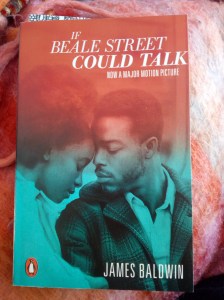 Interspersed with the regular visits, are flash-backs to childhood and the moment their friendship evolved to something deeper. Fonny takes Tish to his basement pad where he has set up a woodwork studio, his deepest passion is sculpting wood and stone, he wants to show her and for her to understand its importance to him.
After asking her to marry him, they’d looked for loft space together, they were planning a future together, when suddenly robbed of it by a false accusation. His alibi’s are discredited and he sinks into despair, but for her visits.
Though heartbroken, she is emboldened by her family, by the adamant support of her sister, who finds them a good lawyer, her mother, who travels to Porto Rico to confront the accuser, and her father, who works extra shifts to raise funds for Fonny’s bail.
It is the words, actions and support of the family that keep everyone from falling apart, they are a stalwart to Fonny especially, as his family crack under the pressure of a mother converted to a conservative faith prone to judgement and disappointment, more concerned about her own reputation than the innocence of her son.
It is interesting that Baldwin chose to narrate the novel from Tish’s perspective, and though it may have provoked criticism, it is perhaps one injustice that he sought to right – allowing the voice of a young black woman to rise and be heard.
Sharon, her mother, was a fabulous character. So in touch with her deepest roots, she is able to appease her daughter when she fearfully shares news of her pregnancy:
‘Tish’, she said, ‘when we was first brought here, the white man he didn’t give us no preachers to say words over us before we had our babies. And you and Fonny be together right now, married or not, wasn’t, wasn’t for that same damn white man. So let me tell you what you got to do. You got to think about that baby. You got to hold onto that baby, don’t care what else happens or doesn’t happen. You got to do that. Can’t nobody else do that for you. And the rest of us, well, we going to hold on to you. And we going to get Fonny out. Don’t you worry. I know it’s hard – but don’t you worry. And that baby be the best thing that ever happened to Fonny. He needs that baby. It going to give a whole lot of courage.’
Right there, the mother reinforces stability in their lives and I can’t help but be aware of the contrast, having just read the memoir An Affair With My Mother of a baby conceived within a culture that shame(s)d its daughters for pregnancy outside of wedlock, destroying lives, dividing families, creating unnecessary drama. This action and steadfast support by Sharon is a protest against the inherent culture and inherited religious beliefs, over which love and the family bond will prevail. It is a powerful matriarchal triumph, one that reaches far back in ancestral memory.
So the family encounter difficult circumstances and yet their ability to be there for each other sees them though and even Fonny is swept up in this wave of support, nourished by it, even though he has moments of sliding into darkness, as is human. By contrast, his family is fragmented, the mother and daughters reject the offer of unity offered by Joseph and Sharon, the father Frank gets it and tries to support them, to be part of this newly extended family, but without the strength of an unconditional bond within his own, he is left vulnerable.
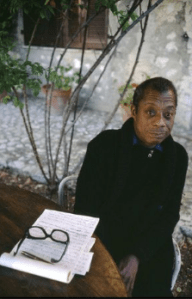
James Baldwin in France
I think Baldwin succeeds if it was his intention to write about the powerful effect of love and family, in their ability to carry each other through difficult times, when they refuse to resort to blame (of themselves or others) or judgement, when they hold each other up and decide to be a force together and not give in to destructive tendencies.
I’ve just seen the film at our local cinema. It’s challenging to watch to a film you are still reflecting on reading.
In a recent interview, Director Barry Jenkins talked about Baldwin’s work:
I chose Beale Street because I felt the novel, more than any of his other works, represented the perfect blend of Baldwin’s dual obsessions with romance and social critique, as sensual a depiction of love as it is a biting observation of systemic injustice.
I thought the movie was a beautiful and moving depiction of the story, although my big takeaways from the book about that family bond, (especially the mother to the daughter) weren’t as strong in the film. Some of the most important lines I’d noted (and went back to check) were taken from the mother and given to the father, which surprised me, as it shifted the dynamic and removed what for me had been a significant and empowering statement coming from the mother (supported by the father). Passing those lines to the father risked putting the mother back into a supporting role, and lessened the matriarchal force Baldwin imbued her with.
The other significant moment in the book for me, which I’m not sure comes across in the film with quite the same impact, is a moment near the end where there is a change in Fonny, observed here by Tish, which you’ll have to read to find out more:
“- something quite strange, altogether wonderful, happens in him…”
All the more reason, even if you’ve seen the film, to get a copy of the book! And all that said, I’d recommend both without hesitation.
Buy a Copy of Beale Street via Book Depository
Have you read James Baldwin? Do you have a favourite?
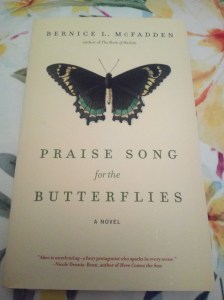 Interested in the inspiration for writing a novel, this one intrigued me; Bernice McFadden visited Ghana in 2007 and while she was there met two women who told her about a rehabilitation centre and a tradition referred to as trokosi, which they explained and suggested she write a book about, an idea she initially laughed at, but after researching the practice, a story began to emerge that she eventually pursued.
 Interested in the title, I looked up ‘Praise Song’ and learned it is one of the most widely used poetic forms in African literature; described as ‘a series of laudatory epithets applied to gods, men, animals, plants, and towns that capture the essence of the object being praised’.
 Bernice McFadden is the author of nine critically acclaimed novels including Sugar, Loving Donovan, Nowhere is a Place, The Warmest December, Gathering of Waters and The Book of Harlan (winner of American Book Award and NAACP Image Award for Outstanding Literary Work, Fiction). A four-time Hurston/Wright Legacy Award finalist, I’ll definitely be reading more of her work.
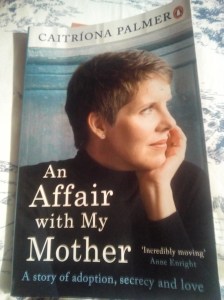 It’s set in Ireland, a country reluctant to let go of old ways, still in throe to a traditional family culture that shamed, blamed and punished young women for being the life-bearers they are – insisting they follow a code of moral behaviour documented by a system of domination, upheld by the church, supported by the state – a system that bore no consequence on men – young or old – who were equally responsible for the predicament of women.

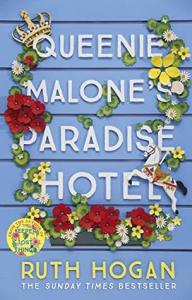 It’s described as a novel of mothers and daughters, families, secrets and the power of friendship. It’s set in Brighton and begins as Tilda returns to clear out her mother’s flat after her death. That precipitates a number of memories of her childhood, which we learn about in the alternate narrative by Tilly, her child self, whose story is told from the moment her father has disappeared, the beginning of her obsession with matches and our realisation that some of the characters she sees and interacts with can’t be seen by others.

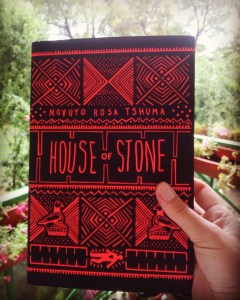
 In an interview, Novuyo Rosa Tshuma when asked about setting her novel amidst the backdrop of this massacre, said:
 It’s an accomplished novel that confronts harsh truths and pursues questions about the reinvention of a nation and the individual. A gifted storyteller who has been able to weave the essence of those personal narratives into richly formed characters that goes some way towards acknowledging a history no-one will talk about. Bereft of redemption, a feeling that pervades the narrative and one that seems to hold many in its grip today worldwide.
 I’ve been looking forward to picking this novel up, because it’s set in and around the streets and coastal inlets of Marseilles (our local city) and even ventures into Aix-en-Provence and Vauvenargues (the scene of a murder in the novel – though known locally because Picasso lived in the château there). It was originally published in French in 1995, when Izzo was 50 years old, a mere five years before his premature passing.



 Jean-Claude Izzo when asked about the phenomenal success of his trilogy, characteristically chose to shine the light on the city he loved:
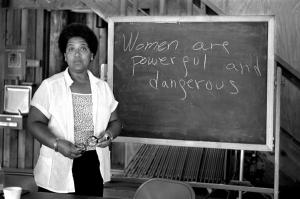
 Audre Lorde was a poet, academic, speaker, feminist activist, sister and mother of two, who grew up in 1930’s Harlem. She wrote 12 books and tragically passed away at the age of 58 from cancer in 1992.
 The collection both begins and ends with essays that focus on her travelling outside the US, a literal perception of her as an outsider, however the main body of work centers around issues within her country of birth, where that feeling of ‘outsider’, arrives because of the way we relate to others, or how they relate to our race, identity, gender, sexual orientation, class.



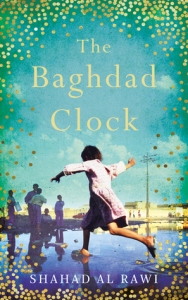 Slightly surreal, nostalgic and deeply philosophic portrayal of a neighbourhood in Baghdad, of a childhood and early youth lived under the shadow of war, shared by a girl, (our unnamed narrator) who refuses to depict her childhood through the lens of suffering and devastation.
 Eileen Battersby (1958-2018) was a renowned literary critic and reviewer, my favourite, probably the only one I knew by name, reputation and avidly followed. It wasn’t just for her excellent reviews, it was because she read so much further outside of the English language and culture than any other, and because she might as easily refer back to ancient myths and classics as she would to contemporary translations in her far-reaching analysis and commentary on literature.


 Teethmarks on My Tongue is a coming-of-age story about teenage Helen, the only child of a wealthy Southern family, who in the opening pages witnesses her mother’s death broadcast on television, shot by a mentally ill lover. Living on an esteemed property in Richmond, Virginia, she passes her free time in the company of horses or immersing herself in her intellectual passion, the science of astronomy, the solar system.

 Rebecca’s book Good and Mad will give you a deep and engaging (and sometimes enraging) historical deep dive into the way that women’s anger has been used throughout history to drive social movements, as well as how rage at the inequalities replicated within those social movements has worked to both slow them and make them stronger.
 Brittney’s book invites the question of what it takes to meet Audre Lorde’s challenge: how do we focus our anger with precision? Through a range of personal stories about becoming a feminist, navigating friendships and romance and the white-washed shoals of pop culture, as well as contending with the limits of white feminists and the legacy of white feminism, Brittney demonstrates what it means to harness anger as a superpower.
 Word by Word