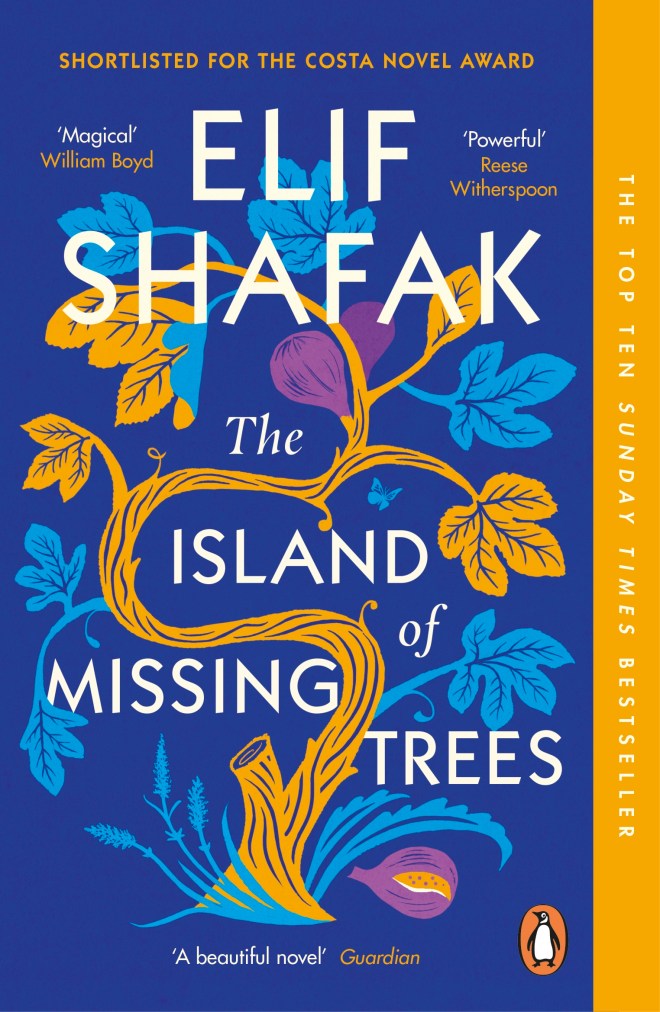
The Island of Missing Trees by Elif Shafak

Elif Shafak has been an author I have followed for many years now, one of the first authors I encountered before starting to read a lot of women in translation, who came from a non English speaking culture, who wrote stories that came from a cultural understanding that was not British or American, even if that was the audience she hoped to attract.

Since those first novels, she now writes in English and no longer lives in Istanbul. Since moving to London she has become more widely known. This book was shortlisted for the Women’s Prize for Fiction 2022 and the former Costa Novel Award. It is the 5th of her novels I have read. She also writes essay style non-fiction.

Review

In The Island of Missing Trees, she again takes the reader into another culture, to the island of Cyprus; a land with a long history that arrived at a point, where its humans decided to divide on their differences, here it was via origin, Turkish Cypriot or Greek Cypriot.

You belonged to one group or the other and were not supposed to stray. Until they created this divided line, young people would do what is natural for them to do before external influences corrupt their thinking, they develop friendships, they fall in love, they take risks. They get sent away, banned, forbidden from…

Physical Separation denies Ancestral Lineage

The story begins in London, late 2010’s with Ada, a daughter, at school on the last day of term. Ada lives with her father Kostas, her mother Defne has recently passed away. They are given a holiday assignment to write an essay, asked to interview an elderly member, they will be studying migration and generational change.

Ada dropped her gaze. She had never met her relatives on either side. She knew they lived in Cyprus somewhere but that was about the extent of her knowledge. What kind of people were they? How did they spend their days? Would they recognise her if they passed her on the street or bumped into each other in the supermarket?

Ada has never visited Cyprus, her parents only ever made excuses when she asked about family, gradually she would sense that her parents marriage had not been approved by their families. That she too was not approved.

Yet for as long as she was able to, Ada had retained the hopeful belief that if any of her extended family were to spend time with her and her parents, they would forgive them for whatever it was they had not been forgiven for.

Are Trees Conscious? A Fig Gives Voice

Photo by Daniel Watson on Pexels.com

Ada’s father digs up and buries their fig tree to protect it from the harsh winter. The fig is not in its natural climate or environment and special measures are required to keep it alive. The tree is given a narrative voice in the novel. It was a sapling from the island, it came from a mother fig that grew in the middle of a tavern, where Ada’s parents used to meet. In this way, the fig is all seeing.

The fig tree is a metaphor for the uprooted, the displaced, for the migrant, for the old ways. It is a symbol for not forgetting. It represents something of the motherland for the migrant and the way it lives through the seasons demonstrates something to humans about how to be.

Arboreal-time is equivalent to story-time – and, like a story, a tree does not grow in perfectly straight lines, flawless curves or exact right angles, but bends and twists and bifurcates into fantastical shapes, throwing out branches of wonder and arcs of invention.
They are incompatible, human-time and tree-time.

After a terrible last day at school, Ada arrives home to learn that her mother’s sister is coming to visit. She rages. She will have the opportunity to address the void within her where it resides.

Half hiding in the shadows, she watched the two adults by the fig tree, drawn to the strangeness of their behaviour but equally detached from them, as if witnessing someone else’s dream.

A Third Culture Kid Awakens

The novel explores what it is to be raised in another culture, severed from one’s own, as if not knowing it is enough to disconnect, as if assimilation is a cure for forgetting one’s past, one’s lineage, one’s identity. It demonstrates the effect of that denial, that severance, the dysfunction that arrives when one is deprived of a connection to one’s roots. And how differently each person deals with grief and loss.

It returns to Cyprus and slowly reveals the story of Ada’s parents that lead up to their separation and reuniting and the impossibility of being able to live there, the sacrifice that leaving demanded of them, the consequence.

A tree is a memory keeper. Tangled beneath our roots, hidden inside our trunks, are the sinews of history, the ruins of war nobody came to win, the bones of the missing.

The story is presented from different perspectives, showing the different realities that life is lived from depending on where one had been planted, uprooted from and replanted. It is a thought provoking read that doesn’t provide answers but offers to expand the reader’s awareness of the complications humans live under when love disrespects the rigid outlook that communities adhere to.

It shows the ripple effect of staying and/or leaving and the strangeness of being the protege of that, growing up in foreign lands that they have then acclimated to, except for the deep unsettled feeling that runs through their veins.

There is a delightful twist at the end that made me remember first encountering Elif Shafak and her describing her own childhood, of the stories her grandmother would tell, the superstitions she held. Here, I thought, is that little girl’s imagination, still going strong, writing novels that go deep into the realities of the human experience but are not above allowing something of the magic and wonder of an unbound imagination to run free.

Further Reading

Interview, Guardian: Elif Shafak: I’ve Always Believed in Inherited Pain

My Reviews of Honour, Three Daughters of Eve, The Happiness of Blond People,

Elif Shafak, Author

Elif Shafak is an award-winning British-Turkish novelist and a champion of women’s rights and freedom of expression. Her books have been translated into fifty-five languages.

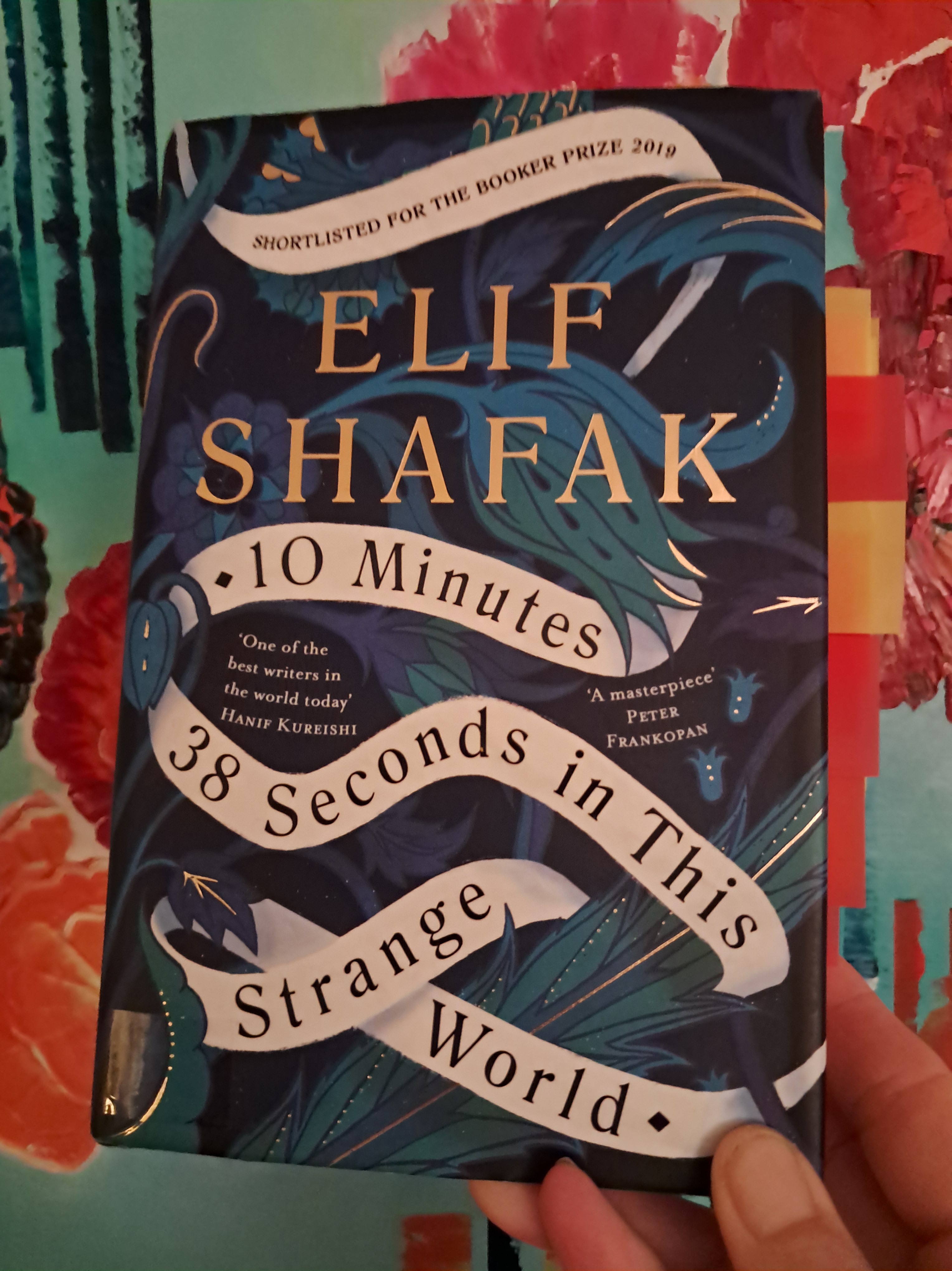
Her novels include The Bastard of IstanbulThe Forty Rules of LoveThe Architect’s ApprenticeThree Daughters of EveHonour, 10 Minutes 38 Seconds in This Strange World, which was a finalist for the 2019 Booker Prize, and The Island of Missing Trees, shortlisted for the Women’s Prize for Fiction 2022.

She is also the author of a memoir, Black Milk: On the Conflicting Demands of Writing, Creativity, and Motherhood.

She is a Vice-President of the Royal Society of Literature. Shafak was awarded the Halldór Laxness International Literature Prize for her contribution to ‘the renewal of the art of storytelling.’ An active political commentator, columnist, and public speaker, she lives in London. 

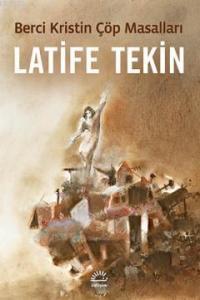
Berji Kristen: Tales From the Garbage Hills by Latife Tekin (1993)

translated by Ruth Christie, Saliha Paker

“One winter night, on a hill where the huge refuse bins came daily and dumped the city’s waste, eight shelters were set up by lantern-light near the garbage heaps.”

Berji Kristen Tales from the Garbage HIlls Latife Tekin Turkish LitThe opening sentence introduces us to the birth of a poverty-stricken community, one that will rise up despite numerous efforts to destroy it. As more displaced people hear of them, it continues to reassemble, grow, and become occupied by the marginalised, who do what they can to get ahead.
Mattresses  were unrolled and kilim-rugs spread on the earthen floors.  The damp walls were hung with  faded pictures and brushes with their blue bead  good-luck charms, cradles were slung from the roofs and a chimney pipe was knocked through the sidewall of every hut.

It’s a story of impoverishment, perseverance and the survival of the poorest. Every step forward encounters a knock back, an obstacle to overcome. Toxic factories employ them, their ailments dealt with in bribes, even their love lives are dictated by the relative positions they occupy in the unconventional heirarchy of the community.

The workers named the factories after their effects, some made the lungs collapse, some shrivelled the eye, some caused deafness, some made a woman barren. Their proverb for marriage between equals was ‘A bride with dust in her lungs to the brave lad with lead in his blood.’ The saying gained ground when one after another the young car battery workers married girls from the linen factory.

Berji Kristen Latife Tekin WIT Month

After winning the battle of constant demolition and renaming it ‘Battle Hill’, two official looking men replace their sign with a blue plaque inscribed ‘Flower Hill’.

After the renaming, people heard the demolition had stopped and came to the Hill in their hundreds, deceived by the charm of its name.

Rumour and gossip fuel their perceptions and without worldly knowledge they speculate; theories on events pass from one person to another, changing and evolving into a level of understanding they can accept.

One night yellow pamphlets are stealthily left at their doors, by morning they are strewn everywhere, caught in branches, stuck under their doors. They couldn’t understand why the workers would leave them and others wondered why they could not speak up instead of writing and why they’d left them in the dead of night.

Flower Hill Folk!

Support the strike!

Individuals rise and fall in power, characters referred to by occupation or memorable anecdote, new creatures arrive like ‘The Regular Worker’ spawning the song ‘Work Faster’ and ‘Poet Teacher’ writes about scavenger birds and his pupils.

Latife Tekin Turkish Author Tales From the Garbage Hills

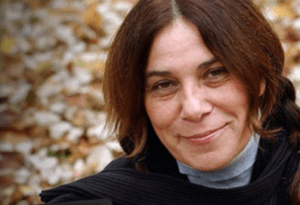
Author, Latife Tekin

A lyrical voice is given of a metaphorical nature to the deprived, who have memories of villages of old, of fleeing, of different times. Latife Tekin “gives expression not only to their way of life but also to their outlook on life, perception of reality, sense of humour and dreams.”

It is told in such an engaging style, it reads as if it is narrated aloud, though it is neither fairy tale nor fantasy, it is quite unlike anything I’ve read before, the story and the voice, a depiction of the creation and development of an aspiring community of marginalised people.

Assuming the position of a detached but devoted narrator rather than a patronising intellectual onlooker, Tekin has reconstructed the dreams and realities of sqatterland in specific detail and with a uniquely metaphoric use of the language, without overlooking the humorous attitudes, ironic perception and emotional vitality of the community amid the filth and poverty of its living conditions. Saliha Paker, Introduction

Further Reading

Article: Contemporary Turkish Women Writers in English Translation by Dr. Roberta Micallef

Review: Bosphorous Review of Books reviews Berji Kristen by Luke Frostick

My Reviews of Books by Turkish Women Authors

The Other Side of the Mountain by Erendiz Atasü tr. Elizabeth Maslen

Three Daughters of Eve by Elif Shafak

Honour by Elif Shafak

The Happiness of Blonde People by Ekif Shafak


The Gold Letter by Lena Manta (Greece) tr. Gail Holst-Warhaft

Destiny caresses the few, but molests the many.

Turkish Proverb

Greek and Turkish histories go back a long way, and I profess to knowing little about them, however it’s clear that whichever people you belong to there is likely to be a bias towards their stories, and it as likely that these populations are more mixed than they would like to believe, that there have been generations of cheerful intermingling, despite the differences that keep their identities separate.

The Gold Letter is a story of Greek families living in what was then known as Constantinople (later renamed as Istanbul, one of many name changes – The city was founded in 667 BC and named Byzantium by the Greeks ), and how the same twist of fate affects three generations of the same two families, where a young woman and a young man fall in love, only to have the union thwarted by their parents – in each generation it is for a different reason, beginning with them not being of the same wealth and social status, where marriage was more of a contract between families decided by the father’s.
He had married her not, of course, because he loved her, but because that was what her father had decided…Nobody thought of asking Kleoniki if she wanted to marry the grim Anargyros, with his rough hands and even rougher personality. Besides it was thought to be a very good marriage, since the groom was prosperous and an orphan.
“A big thing, that, my dear!” the matchmaker informed the girl. “Neither a mother-in-law in your face nor a father-in-law to boss you round. Lady and mistress of your own house!”

And in case they thought about falling into the temptations of forbidden love, there were frequent reminders of the sins of those who’d done so and had to flee, “discussed with horror and scorn in hushed voices at evening gatherings and tea parties”.

Even if some woman, deep down inside, understood the girl, she didn’t dare say so. Many romantic souls sighed secretly, calculating what a great love the girl must have felt to run off with her beloved, overlooking the fact that he was a Turk.

Though the son’s obey their fathers and the families are estranged, fate’s determined magnetism continues to bring  subsequent generations together.

He couldn’t shame his father; they hadn’t raised him that way. And the blood of the revolution didn’t run in his veins. He would have to bury his heart.

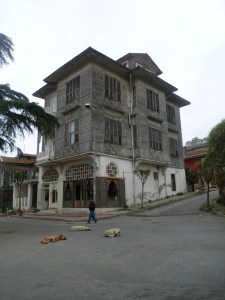
An abandoned house in Turkey

The story and family history are narrated in the present day as a middle age woman Fenia, arrives from Germany having been summoned by a family lawyer in Athens and told she has inherited a house from a grandfather she never met.

She decides to stay and do up the house and various knocks at the door lead her to meet two relatives, one bearing good wishes, the other hostility and through them she will fill in the gaps in their shared history.

And what is this Gold Letter – a beautiful gift imagined and designed by one son, that becomes an heirloom that will find its way into Fenia’s hands and connect the stories together.

I was a little skeptical when I began reading due to the clear prejudices of the characters, whether it was Greeks against Turks or the attitude of the men towards women and certainly the women in all these generations suffer greatly, those in the present day perhaps most of all. They were indicative of their time and sadly of  reality in some lands where country borders have moved and changed over the years when not everyone can flee, yet they remember the violence and deaths of members of their families in the past, which continues to keep them separate and untrusting for generations.

“My girl, sometimes you meet your fate on the road you took to avoid it.”

I was reminded of the wonderful novel about a friendship between two children in the same village, one of Greek and one of Turkish origin by Louis de Bernieres, Birds Without Wings, also a tragic love story, but one that combines the story of ordinary people’s lives in the 1930’s with a biography of the leader that will shift the balance of power in Turkey. One of my all time favourite books, exceptional.
I enjoyed reading The Gold Letter, covering three generations means there are many characters and connections to juggle so not much time is spent with some. That said, it’s clear the author is a gifted storyteller invested in her characters, whom I enjoyed following.

At times I felt almost like I was watching this on film, it’s an entertaining, episodic family drama of the old tradition, of couples trying to keep up family and cultural traditions as life modernises and social, political circumstances force change.

Lena Manta was born in Istanbul, Turkey, to Greek parents and moved to Greece at a very young age. She lives in Athens, has written 13 books and this is her second to be translated into English.

Buy a copy of The Gold Letter via Book Depository

N.B. This book was an ARC (Advance Reader Copy) kindly provided by the publisher via NetGalley.

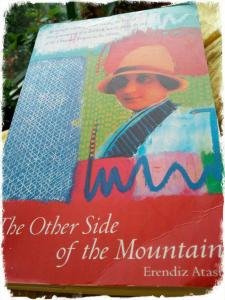
The Other Side of the Mountain by Erendiz Atasü tr. Elizabeth Maslen #WITMonth

One of the best things about August’s WIT Month (reading literature by women in translation) is the abundance of reviews that come out, that will often be my source of prospective purchases for the year ahead, as there is no better time where there is such a proliferation of titles being discussed.

The Other Side of the Mountain by Erendiz Atasü is one of those books I came across in a blog post I read in 2017, a post entitled Contemporary Turkish Writers Available in English Translation by Roberta Micallef.

Have you read any novels or books by Turkish women? I was thinking about that as I read these opening words:

Turkish literature is a rich, creative, wonderful treasure trove that is well worth exploring. I am delighted to have this opportunity to share works by extraordinary contemporary Turkish women authors whose works have been translated into English.

I visited Istanbul in 2013 (see my post Ottoman Distractions) and was excited to visit a local bookshop and get some books by local writers, it’s true I had already read quite a few books by Orhan Pamuk and while in Turkey I read his excellent, if somewhat melancholic work,  Istanbul, Memories of a City and I have read quite a few novels by Elif Shafak, The Forty Rules of Love, The Bastard of Istanbul, Honour, Three Daughters of Eve and her thought provoking non-fiction essay, The Happiness of Blond People: A Personal Meditation on the Dangers of Identity.

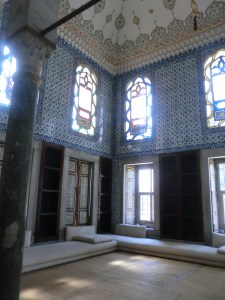
Topkapi Palace Library

But what was everyone else in Turkey reading, what other woman writers were writing stories, telling their history’s? Turkey has such a rich culture and history, straddling both the European and Asian continents, its families with strands often reaching back to geographies they’ve had to flee, a gateway between worlds.

The bookshop owner pushed two books into my hands, the classic Portrait of a Turkish Family by Irfan Orga and an archeological mystery Patasana by Ahmet Ümit. But no books by women authors.

Erendiz Atasü’s novel reads like a mix of memoir, history and storytelling, as one woman reflects on her mother’s life, how little she knew of her and struggles to try to ameliorate that through what she has left behind. It’s a theme I’ve noticed often recently, the lack of understanding that comes from only knowing or observing a mother for the adult part of her life, the events that shaped her buried deep, coming out in behaviours misunderstood by the generations that follow, pondered on when it’s too late to find out more.

Vicdan and her friend Nefise have won state scholarships to university in Cambridge, England. They’ve won them on merit and they are excited by the opportunity presented. They are also part of a political strategy which the author shares when sharing some of the inspiration for the novel, her mother was a recipient of such a scholarship in 1929:

The Revolutionary aim of the Republic was to create a social and cultural synthesis of East and West, and so bright students were sent to leading European universities to be educated not only in the sciences and technology, but also in literature, music and art.

The girls travel together, taking the boat to Marseille, travelling up to England, later they will holiday in Berlin, a visit that leaves dark impressions, they read in other languages, they mix with young people from many cultures. Nefise is at first tempted to cross lines Vicdan is resolutely against. Vicdan stays strong and true to her intention of gaining her education and returning to Turkey to benefit her country. She recalls the struggles of childhood, her family fleeing their home in the Balkans, her father called on to participate in the first world war, her brothers sent away, the prejudices of others if your accent wasn’t right, or your birthplace.

Nefise receives a proposal of marriage, the young man doesn’t understand her rejection of him:

‘I am a Republican,’ Nefise had said, ‘and you are an army officer serving an Empire.  We have nothing in common.’

Ted had been shaken; he found politics unsavoury. However, while an honourable officer might not be interested in politics, he would not hesitate to die for his King and country if necessary.

‘What country?’ Nefise had said, ‘Is India your country?’

While the narrative begins with girls going off to England, it chops and changes in perspective, telling the story of Vicdan’s family and how events changed their circumstances and destiny, the death of the father, the remarriage of the mother, her brother’s Reha and Burhan sent away to a military academy chosen by their stepfather before the wedding ceremony (a fact Burhan never forgave), their childhood over, while another would begin with the subsequent arrival of a younger half-brother, never truly accepted by his older brothers.

Reading Area in the Palace Library, Istanbul

As the narrative changes perspectives, it is interspersed with the thoughts of the various characters, demonstrating the different attitudes, resentments, all the many things never said, that build a picture of the impact of historical events on a family and the ties that bind them together, no matter what happens.

With this characteristic of writing, it can become both insightful and confusing, insightful as we are taken inside the mind and letters of a character and confusing as we skip back and forth across time.

As the author says, her interest is in:

‘the essence of things that happen,  the reasons for them and the results, the impact they have on individual psyches, the impressions on inner selves, have always been the issues of paramount importance to my mind.’

and on three people whose influence on her heart mind resonate throughout the book:

‘Mustafa Kemal Atatürk, whose being supplied the sap which has sustained my country’s life; that major poet Nazim Hikmet; and the major writer Virginia Woolf, whose work has drawn me closer to the writer hidden in me’

It was an interesting read for me and I enjoyed the blend of history and perspective and how it impacted the lives of characters throughout the novel. The author captures the influences,  and penetrates the minds of her characters and so begin to understand what they can not, how each generation if formed by their experiences and their hopes are placed in those who inspire them in their youth, but these things are not experienced in the same way as the years pass by, one who was venerated yesterday can become hated by the youth of tomorrow.

I did find the sequence it was written confusing at times, but that didn’t really distract from the overall impression, which was the diversity of backgrounds lived through and that aspiration to build a bridge between different parts of the world and their people and the importance literature has in contributing to that.


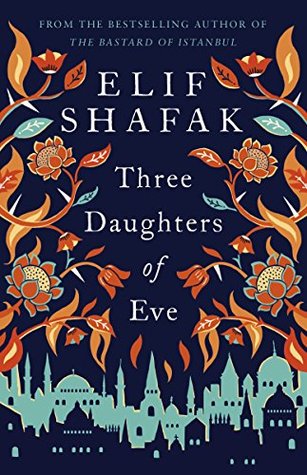
Three Daughters of Eve by Elif Shafak

Elif Shafak is a popular Turkish author, and a Rumi scholar, raised by her mother and grandmother, experiencing a childhood and influences that fed a fertile imagination. Now based in London, this is her tenth novel. Since reading The Forty Rules of Love, the first of her novels to actively reference her Rumi knowledge and learnings, I’ve read the excellent The Bastard of Istanbul, Honour and her nonfiction essay The Happiness of Blond People. She is an interesting and unique author because of her ability to straddle the thinking of both East and West, captured through engaging characters and storytelling; she demonstrated that for all our supposed differences, we are grappling with similar issues.

Three Daughters of Eve is an interesting, quietly provocative, philosophical novel. Shafak brilliantly sets up a character study of Peri, our Turkish protagonist, who on her way to a dinner party to meet her husband, decides to abandon her car in the middle of a traffic jam, in pursuit of an opportunistic handbag thief.

“Like a magic wand in the wrong hands, the traffic turned minutes into hours, humans into brutes and any trace of sanity into sheer lunacy.”

There is a violent, unsettling altercation after which she will continue on her way, shaken, but in one piece and determined not to change her plans. However this episode and the memories it awakens, will over the course of the evening, reveal her conflicted self and cause her to consider her life and address a significant event of the past, as the present madness moves forward towards astonishing heights.

“Though easy to forget at times, the city was a stormy sea swollen with drifting icebergs of masculinity, and it was better to manoeuvre away from them, gingerly and smartly, for one never knew how much danger lay beneath the surface.”

The three daughters are the three girls who appear in the photo that falls out of her handbag, referred to as the sinner, the believer and the confused. They are three young Muslim students at Oxford university, including Peri (the confused), who will all take the same class with Professor Azur and for a time they will live together. The girls all have different views, as do their fellow classmates, in the class about ‘understanding God’, a guided philosophical think-tank, where the handpicked students are forbidden to discuss religion, and must instead learn to express their opinions without the framework of doctrine.

Thus the novel is narrated across two timelines, the present day Istanbul (2016) en route to and at a bourgeoise dinner party and a period of time at the university in Oxford (2000).

Shirin is the liberal-minded sinner with no excuses or apologies for who she is, she loves to provoke reaction and is a willing accomplice come recruiter to the Professor’s circle, it is she who brings the conservative believer Mona and Peri together.

Shafak’s account of Peri’s parents and family is brilliantly characterised and aptly portrays why she is given the label of ‘confused’, they are complete opposites and over time become even more so, her two brothers are also polar opposite while Peri, loaded with empathy, understands all their positions, but can not stand in either of their shoes. Her plan to study in England, supported by her father and a cause of concern for her mother, was more of an escape for her than the brilliant opportunity her father imagined.

“They were as incompatible as tavern and mosque. The frowns that descended on their brows, the stiffness that infused their voices, identified them not as a couple in love, but as opponents in a game of chess…

Religion had plummeted into their lives as unexpectedly as a meteor, and created a chasm, separating the family into two clashing camps.”

Despite education, philosophical questions and new friends, Peri is a young, Turkish woman coming to live in a foreign country; as I was reading, I couldn’t help but notice the synchronicity between this combination of time, space and circumstance that made Peri vulnerable to manipulative intent and the protagonist of Claire Fuller’s excellent novel Swimming Lessons, a novel that chose not to explore the family background and cultural references of its young, female Norwegian university student, and rather focuses on the life that followed an equally significant turning point.

Here in Elif Shafak’s novel is an attempt to provide an experience with its cultural context. They are both young impressionable women having life-changing experiences in a foreign culture, with little support or guidance, they are lost in an age-appropriate confusion of emotions, one that is not on the same wavelength as the object of their desire.

Elif Shafak speaking in Bulgaria
Photo courtesy of Rayna Tzvetkova

While I enjoyed the novel and love Elif Shafak’s writing and philosophical questioning, there was a point very near the end, where events became too surreal for me to stay captured in the literary bubble of considering that evening dinner party in 2016 legitimate. It may be a satire of the Turkish elite, some of the things that happen and that are said are a mix of humorous and dramatic, however that’s not the tone of the novel as a whole.

I don’t know why the author chose to brings things together in the manner she did, for me personally it distracted from the thought process I’d spent the entire novel developing, and resulted in a suspension of belief, a kind of clocking out. I was waiting for the resolution, that’s where it was heading, and it does attempt to do that, however, as she not so convincingly demonstrates, humans can be unpredictable, and their actions often make no sense at all.

An excellent and thought-provoking novel that I recommend, despite a somewhat less well executed ending.

**********

Note: This book was an ARC(Advance Reader Copy) kindly provided by the publisher via NetGalley.

To purchase a copy via Book Depository, click here

Patasana: Murder at an Archaeological Dig by Ahmet Ümit tr. Amy Spangler

Patasana

Visiting another country is an opportunity to be introduced to new authors, to read outside one’s preferred genre and to gain new historical perspectives.

So while I am already a fan of the more well-known in the English language writers, Orhan Pamuk and Elif Shafak, Ahmet Ümit was completely unknown to me and while mystery isn’t my preferred genre, a book that introduces us to new places and offers insights into other cultures and their way of life is certainly appealing.

Books from the Basement

I asked in the bookshop in Istanbul for A Memento of Istanbul, another book written by Ahmet Ümit, but it wasn’t available. The only book they had in English by him, had to be retrieved from the basement. I’m not sure if that is significant or not, although having got to the end of the book and knowing the controversy surrounding the treatment of the Armenian population within Turkey, allowing his characters to thrash out their opposing views, may have courted controversy.

In 2012 France tried to make denial of the Armenian Genocide a criminal offence, souring relations between the two countries, however the draft law was struck down.

Review

HIttites
Ancient Hittites

Patasana was the son and grandson of a palace scribe, who wrote his story and that of his father and grandfather onto tablets that were then sealed and are now being uncovered 2700 years later.

Each alternate chapter is a translation of one of the tablets, so while we follow the contemporary story of the archaeological dig of an antique Hittite settlement in southeast Anatolia and it’s team members, we also learn what Patasana lived through, the confessions of a young scribe, his life, love and regrets.

The Hittites

Hittite Chariot
Hittite Chariot

“He was the chief scribe of the palace, a very important government position among the Hittites. These men were extremely well-educated. They knew several languages. Their duty was to compose texts as dictated by the king, not to write down their own feelings, thoughts and memories. But that didn’t keep the scribe Patasana from writing down his own story. That’s why the tablets are so important….We believe what we have here is the earliest documentation of humankind’s non-official history….We think he’s telling the story of the ancient city’s final days. And together with the history of the city, his own personal history as well.”

Unsure whether it is related to the dig or not, a local elder is discovered dead, having fallen, or been pushed from the minaret of the mosque, a man in monks clothes seen fleeing the scene. Esra, the leader of the team is paranoid about upsetting locals and having her first dig cancelled before they have uncovered all the tablets and participated in an important press conference being held to satisfy their funders. Her insistence on knowing everything and getting close to the police captain makes her just as suspicious as virtually every character who at one time or other she imagines as a suspect.

Euphrates River, Anatolia

Whilst it could have done with some editing down, it is an enjoyable and I believe popular book.

It is interesting that the author was born in Gaziantep, southern Antolia and while on a family picnic near the Euphrates River saw an excavation site, an old Hittite city, prompting him to immerse himself in researching the area, its people and customs and then write this book.

Ahmet Ümit, Author

Ahmet Ümit himself sounds like an interesting character straight from a novel and it is clear that his own life has inspired many of the stories and characters he has written. As a young man he was a revolutionary political activist and a member of the Turkish Communist Party and he illegally attended the Academy for Social Science for a while in Moscow.

In an interview with Maria Eliades in Time Out Istanbul in 2011 he said:

“In this land, there’s a problem with history. The Turks came here 1,000 years ago but the land has a history that is 200,000 years old. Generally, the government believes that history began 1,000 years ago. They do not count the history of people who were not Muslim. In my novels, I’m trying to show how these people influenced the history and where their position was. I’m trying to emphasize how the Hittites, the Romans, the Byzantines, the Armenians, Greeks and all the different groups affected it. Turkey needs this: an independent view of people, regardless of their race or religion. That’s the basis of my books. The detective part of the story is a catalyst for explaining the untold part of the stories.”