The Seven Moons of Maali Almeida by Shehan Karunatilaka

The Seven Moons of Maali Almeida by Sri Lankan author Shehan Karunatilaka won the Booker Prize in 2022. It wasn’t on my radar, probably because it seemed to me like it was trying to be too many things, but when I saw a hardcover copy on sale at the annual Ansouis vide grenier last September, I decided to delve into it and see for myself.

Outstanding Sri Lankan Literature

I knew that it was about the civil war era in Sri Lanka and I have read some excellent novels that are set in those difficult times, most recently the novel that won the Women’s Prize for Fiction in 2024 Brotherless Night by V.V. Ganeshananthan (see my review here), but my favourite novel set in that country is Naomi Munaweera’s Island of a Thousand Mirrors (my review here), winner of the Commonwealth Writer’s Prize in 2013.

Munaweera writes exquisitely of the island of Sri Lanka, in lyrical prose that takes the reader inside the family experiences, evoking all the senses, the aroma of the cuisine, the fear and excitement of young, forbidden love, the pain of heartbreak, the palpable tension as sisters walk to school, sometimes witnessing images that will stain their minds and revisit their dreams for years.

Mystery, Satire, Historical Fiction and Magical Realism in One

Booker Prize Winner 2022 Sri Lankan literature magic realism afterlife noir

Seven Moons is a literary mystery about the life and death of Maali Almeida, who from the opening pages, in a second person narrative, turns up dead and from the In Between, that place between life and the afterlife that he now inhabits, proceeds to uncover the mystery of his death.

Set in 1990 Colombo, Maali was a war photographer, a promiscuous gay man, sometimes gambler and seeker of the next photograph that will show the dark and gruesome elements of those in power, a witness to crimes he believes can bring down governments, stop wars.

The In Between, Down Below and The Light

When he arrives at the In Between, he and others like him are told they have seven moons, seven nights to meet the criteria to enter The Light. As they queue and ask questions about their deaths, Maali hopes he is about to wake up from a dream.

The swarm of souls presses closer, berating and badgering the woman in white. You gaze upon the pallid faces, sunken eyes in broken heads, squinted in rage and pain and confusion. The pupils are in shades of bruises and scabs. Scrambled browns, blues and greens – all of which disregard you. You have lived in refugee camps, visited street markets at noon, and fallen asleep at packed casinos. The heave of humanity has never been picturesque. This heave throngs towards you and heaves you away from the counter.

metaphysical thriller civil war Sri Lanka supernatural

Every soul has those seven moons to wander around the In Between, to recall past lives, and to forget.

While he should be completing the tasks to get to The Light, instead he shifts from The In Between back to the present, the Down Below and observes the aftermath of his death.

He tries to direct those close to him towards his most incriminating photographs in order to achieve which he was not able during life. He doesn’t understand quite how these shifts happen, and neither does the reader, making it somewhat confusing to keep up with this trippy journey.

Here’s what you remember from two nights ago: (a) visiting the Leo casino, (b) drinking at the bar, (c) eating the buffet, (d) fooling around with the bartender. here’s what you don’t remember: (a) sitting with a suddha (b) being thrown to your death.

Conversations With the Dead

As well as investigating his own murder, along the way he has conversations with a dead athiest, a dead revolutionary, lawyer, bodyguard, priest, dogs and more. He observes the number of spirits hanging on to the living whispering their ears.

You’ve always thought the voice in your head belonged to someone else. Telling you the story of your life as if it had already happened. The omniscient narrator adding a voiceover to your day. The coach telling you to stop feeling sorry and do what you’re good at. Which was winning at blackjack, seducing young peasants and photographing scary places.

Moons, Chapters and Beats

On his motivation for writing this novel, the author had this to say:

‘I began thinking about [Seven Moons] in 2009, after the end of our civil war, when there was a raging debate over how many civilians died and whose fault it was. A ghost story where the dead could offer their perspective seemed a bizarre enough idea to pursue, but I wasn’t brave enough to write about the present, so I went back 20 years, to the dark days of 1989.’

Not just an author of fiction, Shehan Karunatilaka has also written rock songs and speaks of his work in terms of beats and rhythm, infused with supernatural folklore, ghost stories and history.

It’s a long novel that for me held my interest in parts and then lost me as it shifted, but each time that began to annoy me and slow me down, the narrative would shift back to something of interest and so I persevered, however, I did find it overly long in its digressions, drifting in and out of reality. It’s an undeniably clever, erudite novel, unique in its conception that reminded me a little of the surreal experience of reading David Mitchell’s Cloud Atlas.

The Judges on A Metaphysical Thriller Winner

In addition to praising its ambitious scope and hilarious audacity of narrative techniques, the Booker judges had this to say of the metaphysical thriller:

‘Life after death in Sri Lanka: an afterlife noir, with nods to Dante and Buddha and yet unpretentious. Fizzes with energy, imagery and ideas against a broad, surreal vision of the Sri Lankan civil wars. Slyly, angrily comic.’

‘This is a metaphysical thriller, an afterlife noir that dissolves the boundaries not just of different genres, but of life and death, body and spirit, east and west. It is an entirely serious philosophical romp that takes the reader to ’the world’s dark heart’ — the murderous horrors of civil war Sri Lanka. And once there, the reader also discovers the tenderness and beauty, the love and loyalty, and the pursuit of an ideal that justify every human life.’

Have you read The Seven Moons of Maali Almeida? Share your thoughts in the comments below.

Further Information

Read an Interview With the author Shehan Karunatilka

Click here to read an extract from the first section of the novel – Read an Extract from The Seven Moons of Maali Almeida

Women’s Prize Fiction & Nonfiction Winners 2024

The 29th winner of the Women’s Prize for Fiction has been announced from the shortlist of six novels and on the same evening the inaugural winner of the Women’s Prize for Nonfiction from the shortlist of six books.

2024 Fiction Winner

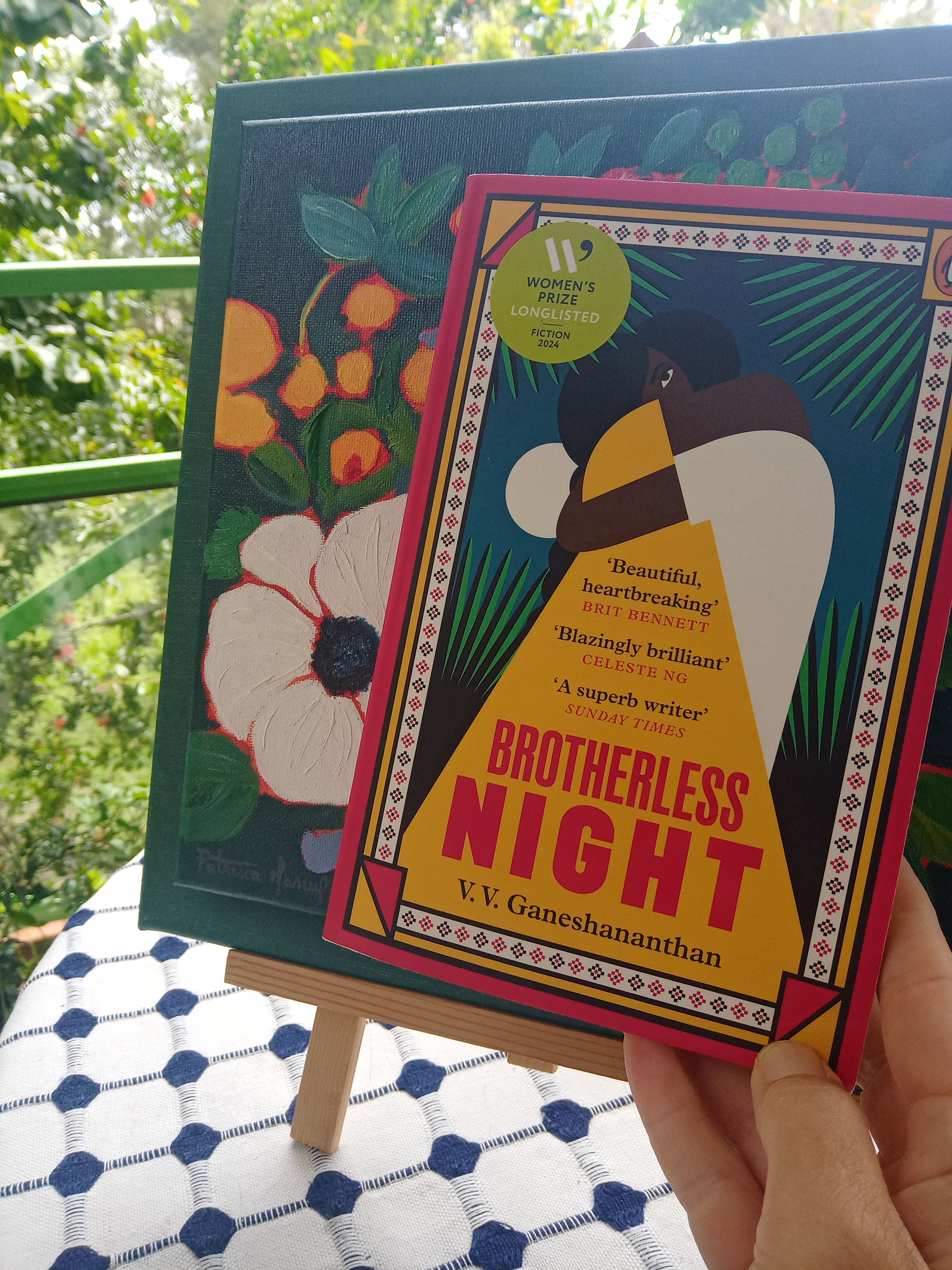
The Women’s Prize for Fiction was won by American author, V. V. Ganeshananthan, for her deeply moving, powerful second novel, Brotherless Night (my review), which depicts a family fractured by the Sri Lankan civil war.

‘Brotherless Night is a brilliant, compelling and deeply moving novel that bears witness to the intimate and epic-scale tragedies of the Sri Lankan civil war. In rich, evocative prose, Ganeshananthan creates a vivid sense of time and place and an indelible cast of characters. Her commitment to complexity and clear-eyed moral scrutiny combines with spellbinding storytelling to render Brotherless Night a masterpiece of historical fiction.’ Monica Ali, CHAIR OF JUDGES FOR THE WOMEN’S PRIZE FOR FICTION

2024 NonFiction Winner

The Women’s Prize for Non-Fiction was awarded to Canadian bestselling writer, global activist and film-maker, Naomi Klein, for Doppelganger: A Trip into the Mirror World; her urgent, illuminating examination of our polarised society.

‘This brilliant and layered analysis demonstrates humour, insight and expertise. Klein’s writing is both deeply personal and impressively expansive. Doppelganger is a courageous, humane and optimistic call-to-arms that moves us beyond black and white, beyond Right and Left, inviting us instead to embrace the spaces in between.’ Professor Suzzanah Lipscomb, CHAIR OF JUDGES FOR THE WOMEN’S PRIZE FOR NON-FICTION

Further Reading

The Guardian Article: Judges praised Klein’s Doppelganger for its ‘courageous’ study of truth in politics and called Ganeshananthan’s Brotherless Night a ‘masterpiece’ of historical fiction by Lucy Knight

Have you read either of these books? Let us know what you thought of them in the comments below.

Brotherless Night by V.V. Ganeshananthan

I became aware of Brotherless Night when it was shortlisted for the Women’s Prize for Fiction 2024, the winner of which will be announced at 6.45pm GMT on June 13th, 2024.

When I read that it was about a young woman in Sri Lanka, in the time of approaching civil war, I recalled reading Nayomi Munaweera’s excellent Island of a Thousand Mirrors (my review here), a book about families and divisions, as well as belonging – how human beings continue to perpetuate separation and difference and make it dangerous, fearful and forbidden to pursue union and friendship, due to backgrounds and ethnic differences. Two families from different ethnic origins, living up and downstairs from each other…and so the story will unfold, as another generation is compromised.

Long simmering ethnic tensions and perceptions of injustice against the government lead to a civil war that pitted one group of people against the other, Buddhist Singhalese and Hindu Tamil.

A Family and A Country Set to Lose

Sri Lanka civil war 1981 -1989 a sister who wants to become a doctor, four brother, Tamil militant recruiters, governments using ethnic differences to punish

Brotherless Night is narrated from the perspective of Sashi, from 1981-1989, the long, tumultuous, violent years of the civil war, fought between the Sinhalese-dominated state and Tamil separatist groups (bookended by chapters set in New York 2009).

It is mainly set in the city of Jaffna, where the young protagonist of a Tamil family lives, with some chapters set in the capital Colombo.

At sixteen, Sashi wants to become a doctor like her older brother. She has four brothers, all with different ambitions, three older and one younger. Their father Appa, a government surveyor, is travelling and rarely at home unless given leave.

The story opens when one of their friends K, hears Sashi’s screams as she spills hot water on herself and drops his bicycle and comes inside and tends to her burn. He is in her third brother Seelan’s class, also destined for medical school. His life will take a different direction, becoming further entwined with hers and her brothers.

Awakening to Irreparable Adult Conflict

The novel traces the beginnings of their pursuit of their dreams and the slow unravelling as the country erupts and young Tamil men are both recruited and sometimes snatched to join “the cause”.

A book sat on her brother’s shelf, an old bestseller about the 1958 anti-Tamil riots, one he read after being present at an international conference on Tamil language and culture where police had fired into the audience.

At sixteen I still hadn’t touched Emergency ’58 but I knew it was a brutal testimony to Sri Lanka’s willingness to slaughter its own Tamil citizens. My father’s slim, battered copy of the book had taken on the aura of something forbidden and terrifying. Did I need to read it to know that because we were ethnic minorities, Tamils were considered expendable?

It follows the effect on this particular family of the different choices people make, including the absent father and the daring mother. When two of the brothers join one of the militant groups, Sashi’s mother does everything to try and save the youngest son from becoming lost to them. When disaster arrives, she rallies ‘the mothers’ in one unforgettable episode that does make a difference, but won’t save them from what is coming.

The boys are challenged by their mother on a rare visit home, but are unable to provide responses to her unanswerable questions.

The Twisted Turns of Stunted Dreams

It is about the disruption of the dreams and the way they can swerve when disasters occur; about the effect on families and youth of political ideologies and both the difficulty and dangers of resisting; the futility of judgement, of regret.

I did not wait. Neither did the war. It was with us now. Since Dayalan and Seelan would not tell us, I went out and asked my friends what they had heard or knew, and in that way began to collect information about the new lives people were choosing. Were they responding to the war or were they making it? Boys joined in droves; the ranks of the militant groups swelled. Almost every week now one of our neighbours told Amma about those they knew who were going. People spoke about it more and more freely. Some of the parents were proud. “What did we expect them to do, after all,” said Jega Uncle, Saras Aunty’s husband. His nephew had joined. “After what they did in Colombo, how did they expect us to react?”

How to Survive

Perhaps education is one of the few ways that youth can escape a world in turmoil, but even that is no guarantee. So many have little choice or are made to choose between life and death, no choice at all.

Stories that involve families, their experiences, their losses, their small wins, their deep hurts, their bravery and failures perhaps tell us more than what media news stories depict, where money, power and political influence dictate. The lives of families, of mothers and sons and daughters come from the heart, from a desire to want them to survive and thrive.

Thoroughly researched and humanely presented, while not holding back from expressing its fury, this novel will make many readers grateful for the simplicity of their own lives and realise the ease with which they are able to pursue it and the banality of our own carefree decision-making, compared to the complicated conflict too many today are born into.

Highly Recommended.

“I was interested in writing about the gray space between militarized societies and questions of choice and coercion,” V.V. Ganeshananthan, in an interview with Here & Now‘s Deepa Fernandes

Further Reading

wbur Interview: ‘Brotherless Night’ explores Sri Lanka’s civil war through stories of family by Deepa Fernandes

NPR: ‘Brotherless Night,’ an ambitious novel about Sri Lankan civil war, wins $150K Carol Shields prize

The Guardian: Brotherless Night by V.V Ganeshananthan review – heartbreak in war-torn Sri Lanka by Yagnishsing Dawoor – excerpt below.

The novel has the intimacy of a memoir, the urgency of reportage, and the sweep and scale of the epic. It occasionally employs the second person to address the reader. In this, it sits somewhere between plea and testimony. And while the revelations are distressing, the narration itself is buoyed up by a rare and robust emotional force. Ganeshananthan’s prose is rich, eloquent, utterly unsparing. “The war,” Sashi tells us, “offered us only tight quarters.”

Island of a Thousand Mirrors by Nayomi Munaweera

In 2016 I read Nayomi Munaweera’s second novel What Lies Between Us and it was one of my Top Reads of 2016, a novel of a young woman trying to adjust to a new life in a new country, though still haunted by both the beauty and deeply buried tragedy of her past, her childhood in Sri Lanka.

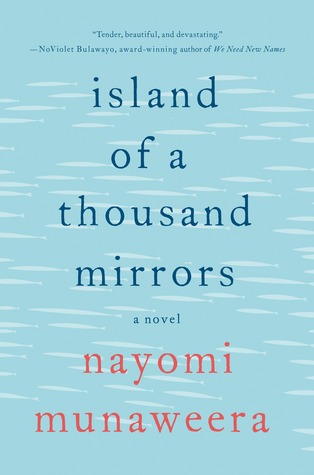
thousand-mirrorsIsland of a Thousand Mirrors similarly evokes the childhoods and family life of two families living in the same house. The house is owned by the matriarch Sylvia Sumethra and her husband The Judge, who are Sinhala people (an Indo-Aryan ethnic group originally from northern India, now native to and forming the majority (75%) of the population of Sri Lanka, mostly Buddhist) and upstairs they rent to an extended Tamil family (a culturally and linguistically distinct ethnic group native to Sri Lanka, mostly Hindu).

It is a time when they live side by side in relative peace, although there are prejudices and intolerances at the adult level, attitudes that are initially not understood by children. Multiple generations of children will grow up and some of them will be capable of bridging those differences, until violence, heartache and tragedy taint them.

Sylvia’s daughter Visaka grows up in the house and develops a fearful crush on the son of the family upstairs, later when she is married and gives birth to one of our narrators, her daughter Yasodhara too will befriend Shiva, the next generation son of the same family living upstairs.

Her father Nishan is a twin, the lighter skinned one, his sister Mala, despaired of by her mother Beatrice when she was young, perceived as being unlikely to marry, to be rejected because of her skin tone, finds love without the interference of her family, something of a scandal.

There is silence and then the familiar smack of Beatrice Muriel’s palm against her forehead. “A love marriage,” she says. In her opinion, love marriages border on the indecent. They signify a breakdown of propriety, a giving in to the base instincts exhibited by the lower castes and foreigners. She believes marriages are too important to be relegated to the randomness of chance meetings and hormonal longings. They must be conducted with precision, calculated by experts, negotiated by a vast network of relations who will verify the usual things: no insanity in the family, evidence of wealth and fertility, the presence of benevolent stars.

An old photograph reminds Yasodara of the moment she was forced to recognise the age-old prejudices that infiltrate families, that perpetuated the myth that she and her friend Shiva were different.

We had been talking in our own shared language, that particular blur of Sinhala, Tamil and English much like what our mothers used in the early days, when suddenly my grandmother, her attention telescoped on us, pins him like an insect. Her iced voice, incredulous, “Are you teaching my granddaughter Tamil?” Her hand smashing hard across his cheek. He rips his hand from mine, turns to run. The camera in my father’s hand clicks shut.

When violence enters the town and the soldiers come knocking, their world turns upside down, and both families leave. Yasodara and her family will move to America and start over.

In Part Two we meet Saraswathi, the eldest daughter of a Tamil family in the northern war zone of Sri Lanka. Her family have already lost two brothers to war, and they live in fear of losing a third or worse, something terrible happening to the girls. Sara and her sister are still in school, she hopes to become a teacher, but there are white van abductions, despicable acts of violence and lynchings which put stress on the family. There is pressure to join the Tamil Tigers, a militant group fighting for independence.

There are roofless, bombed-out houses with bullet-splattered walls and empty, eyeless rooms everywhere. I hate these houses, they look like dead bodies or like mad people, laughing through their openmouthed doorways. I want to know what this place looked like before, when all the houses were whole, when people lived in them and cared about them and grew vegetables in front of them, flowers even.

Nayomi Munaweera by Nathanael F. Trimboli

Nayomi Munaweera by Nathanael F. Trimboli

Munaweera writes exquisitely of the island of Sri Lanka, in lyrical prose that takes the reader inside the family experiences, evoking all the senses, the aroma of the cuisine, the fear and excitement of young, forbidden love, the pain of heartbreak, the palpable tension as sisters walk to school, sometimes witnessing images that will stain their minds and revisit their dreams for years.

Through the forced changes political events put on the families, we become witness to the struggle to adapt, in some the nostalgia for the past will lead them back there, in others, it is as if it never was, they have banished nostalgia and reminiscing from their minds and will do all they can to keep it from their children, not realising that they too will grow up and question their parents origins and be curious to know that part of themselves that provokes questions by others, highlighting the obvious, gaping hole in their identity.

I knew it would be good, it is a prize winning novel and deservedly so, it is endearing, evocative and sensual, touching on both the best of humanity and it’s most despicable, unpalatable horrors and the effect that exposure to those horrors can have on the innocent.

Brilliant. Highly Recommended.

Buy one of Nayomi Munaweera’s Books at Book Depository

What Lies Between Us by Nayomi Munaweera

I came across this title on the Goodreads List below, Anticipated Literary Reads for Readers of Colour which is an excellent source for finding out books that are due to be published soon that might be written by authors from different cultures and traditions than those we generally find on the bestseller tables in bookshops.

GR Cultural Reads 2016

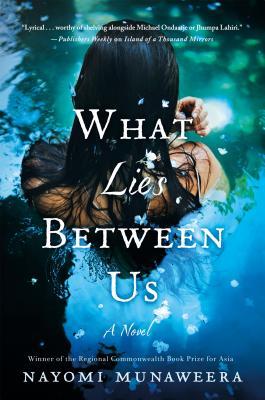
Nayomi Munaweera’s novel, at Number 2 on the list, stands out immediately with one of the most enticing covers I have seen for a long time and it lives up to that promise of an alluring appearance with a dark, mysterious reveal.

What Lies Between UsThe cover is an apt metaphor of the book, where water plays a significant role in multiple turning points in the novel and the image of a woman half-submerged, reminds me of that ability a person has of appearing to cope and be present on and above the surface, when beneath that calm exterior, below in the murky depths, unseen elements apply pressure, disturbing the tranquil image.

The prologue mentions the maternal instinct of a mother, to sacrifice for her young, describing the aptly named moon bear due to the white shape on its chest, an animal that is hunted for medicinal purposes and capable of going to extremes in order to protect its young.

Structured into five parts, the book is written in the first person by an unnamed narrator, and opens from within a cell. We understand the protagonist is a woman who for her crime often receives hate mail from mothers and marriage proposals from men. She mentions atrocities from the civil war in her home country, stories she says she was detached from, suffering that was not hers.

‘They think that maybe growing up in a war-torn land planted this splinter of rage within me, like a needle hidden in my bloodstream. They think that all those years later, it was this long embedded splinter of repressed trauma that pierced the muscle of my heart and made me do this thing.’

From here, she begins to narrate her story, her confession:

‘…in the beginning, when I was the child and not yet the mother…’

tropical gardenWe arrive in a hill city of Kandy in Sri Lanka where she recounts her solitary, yet idyllic childhood, among the scent of tropical gardens, a big old house, ‘sweeping emerald lawns leading down to the rushing river‘ overlooked by monsoon clouds.

Her father is a historian, her mother elegant, beautiful, prone to mood swings, making her feel awkward, tongue-tied and self-conscious, unlike when she is in the garden with Samson, or in the kitchen with Sita, domestic servants with whom she feels more like herself.

Lulled by lyrical descriptive prose into this dreamy, idyllic childhood, albeit with somewhat detached parents, there develops a feeling of something being not quite right, the child’s perspective clouds reality, something haunts her and the reader, a sense of unease.

Tragedy hits the family and the girl and her mother move to America to live with her cousin, Aunt and Uncle.

‘How can I leave this patch of earth that has been mine? Samson taught me once that the hydrangea blooms in a range of shades depending on the soil it sinks its roots into. From faintest pink to darkest night blue, the flower reflects the acidity of its patch of earth. How am I different? This person I am, will I be killed in the transition across the planet? What new person will emerge in that other soil?’

Having always looked towards her cousin as the epitome of modern, something she aspired to, it is a shock to learn of her upcoming arranged marriage, she agrees to be bridesmaid, despite strong feelings to the contrary, grateful that her mother, though troubled, knows better than to push her daughter in this direction.

‘I am grateful for this. Amma might throw plates, lock herself in the bathroom for hours, and cut her wrists. She might scream and yell, but this is something she could not do, this selling of a child to the highest bidder. For once we are united.’

She will fall into the way of life of those who surround her, reinventing herself, almost becoming like one who was born there, if not for that backwash of childhood, that sometimes pushes its way back into her life, threatening to sweep her out of domestic bliss like a freak wave, dumping her mercilessly on the foreshore. As strange memories resurface, her carefully created new world begins to fall apart at the edges as she frantically tries to keep all that is precious to her together.

Nayomi Munaweera by Nathanael F. Trimboli

Nayomi Munaweera by Nathanael F. Trimboli

What Lies Between Us is a powerful, accomplished novel of parts that could be stories in themselves. Munaweera’s deft, lyrical prose lulls and transports the reader into an idyllic childhood of sweet-smelling tropical scents and beauty, open vistas, an enchanted natural world, only to be pulled up short by signs of disturbance, until in an instant they become tragic.

Slowly mother and daughter adapt to the new way of life, except the past will never leave them, it haunts them, consciously and sub-consciously, destroying precious moments and threatening to derail their lives completely.

Like Toni Morrison’s God Help the Child it is a novel highlighting the effect of childhood on an adult, how the past continues to affect the present and can take everyone along with it. It blinds us, and like an invisible cloak with far-reaching tentacles, it can reach into every pocket of our lives, dampening and rotting the good.

Heartbreaking, compelling, so unfair, it is also a story representing the very real cost of ignoring mild disturbances of mental health, portraying how easily they can evolve and transform into horrific tragedy, when left untreated or ignored, not to mention how unforgiving and despicable humanity can be in dealing with those affected by it.

Highly Recommended.

Nayomi Munaweera’s debut novel, Island of a Thousand Mirrors was long-listed for the Man Asia Literary Prize and the Dublin IMPAC Prize. It won the Commonwealth Regional Prize for Asia. I’ve ordered a copy and plan to read it this year as well. She and her family left war-torn Sri Lanka when she was three years old and moved to Nigeria and eventually to America.

Island of a Thousand Mirrors