
I only had to read the first sentence of a Scotsman in Exile’s blog post of this book to put aside what I was reading and start this almost immediately; his review entitled And Over Our Heads The Hollow Seas Closed Up… continues its first line:
…These are words from the canto of Ulysses from Dante’s Inferno and they were quoted in the most moving book I’ve ever read, ‘If This Is a Man’ by Primo Levi.
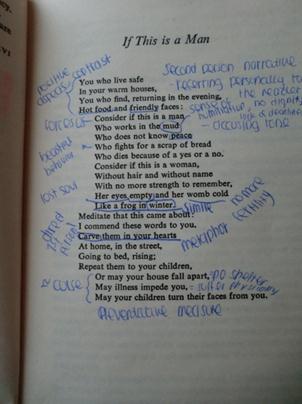
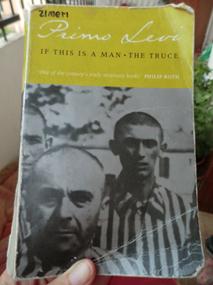 I found a copy on the second-hand shelf of our local bookshop the very next day, a copy I now own that would have to be the most annotated, scribbled in, colour highlighted, dog-eared, pored over volume that I possess (thanks to the previous owner ZIMERI). When I was a student, we studied ‘The Diary of Anne Frank’; how fortunate that today’s students are reading and studying this equally important work.
I’m not sure if I so much as read the book as followed closely in the footsteps of Primo Levi as he recounted the events that unfolded during his journey and time in the concentration camp, due to the way he chooses to express himself, which can best be summarised in his own words:
I believe in reason and in discussion as supreme instruments of progress, and therefore I repress hatred even within myself: I prefer justice. Precisely for this reason, when describing the tragic world of Auschwitz, I have deliberately assumed the calm, sober language of the witness, neither the lamenting tones of the victim nor the irate voice of someone who seeks revenge. I thought that my account would be all the more credible and useful the more it appeared objective and the less it sounded overly emotional; only in this way does a witness in matters of justice perform his task, which is that of preparing the ground for the judge. The judges are my readers.
Thus we absorb only that which he personally experienced and perceive not just the daily routine, the trivial yet so essential implements of his survival, the relentless toil and the near brokenness, but we view also the different strata of man in that direst of circumstances, a kind of perverse hierarchy.
Primo Levi was a young man of 24 years, a chemist and part of a partisan band hoping to join the Resistance movement when captured by the Fascist militia and sent to a detention camp at Fossoli. A few weeks later, all Jews in the camp were told they would be leaving for an unknown destination, revealed to be the camps of Monowitz-Buna and  Birkenau, part of Auschwitz.
650 people made the journey that day; on arrival, the majority were ‘swallowed by the night’ and 125 sent to the camps. Of those, only three made the return journey to Italy after liberation, Primo Levi being one of them.
He was fortunate to return and discover his family intact; we in turn are fortunate that he returned and wrote these two books to be read together, one the descent into darkness, the other the journey back towards an altered but real luminosity.
All I can really say is that if you haven’t read it, add it to your list and find the time one day to slow-read it, Primo Levi was an important chronicler of a difficult period in history and a man who was interested in and able to put into words his observations of humanity in all its capacity, something we all the better for knowing.
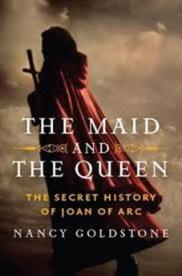
 of the female offspring of nobility to secure territorial alliances or peace between the realms. Daughters were auctioned off as young as 4 years, though depending on how power shifted and who survived into adulthood, those promises could alter.
 reinstating the dauphin as the legitimate heir to the French throne.
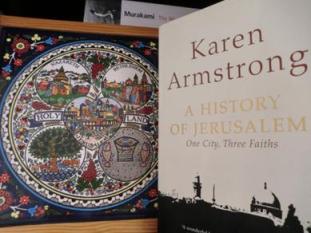 excellent but gruelling ‘A History of Jerusalem’

 Fefa opens the book hesitantly, finds the pages blank within but wide open to her imagination, a place where she can write unobserved, in any way she wishes.
 “After my mother
 Suggested by a local book club and interested in an outsider’s perception of life in France, I find myself in the company of Elaine Sciolino, Paris bureau chief of the New York Times between the pages of her alluring book.
 The book describes a world and a manner of being I know little about, despite living within its midst these past six or so years; but Paris, like many large cities is not necessarily typical of the rest and after listening to others discuss this book, opinion is indeed varied, some suggesting ‘la seduction’ old fashioned, a prerogative of certain social classes, political circles or even pure fantasy. I tend to think there are sufficient anecdotes to say oui to all of those suggestions.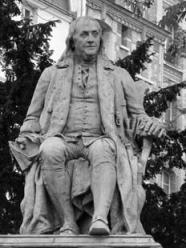


 I picked up Justin Wintle’s book ‘Perfect Hostage’ Aung San Suu Kyi, Burma and the Generals, believing it a biography, mislead perhaps by the striking portrait which graces the cover and select testimonials describing it as so. In fact, I would call it a historic treatise of Burma and while of significant interest in itself, I did find it frustrating that it took close to 200 pages to encounter Aung San Suu Kyi within its covers. Though there is depth in the historical account, I found the reverse to be true in terms of the author’s evocation of Aung San Suu Kyi, in fact I found many of his comments patronising and uncomfortable:
 However, letting go of the expectation of an exquisite biography and seen as the historical treatise that it is, I find a thorough and detailed account of a remarkable country and ethnic melting pot of people who have long been subject to tyrannical rule. Sitting between India in the west and China in the east with borders that touch so many countries, Tibet, Laos, Thailand, Bangladesh, it is not surprising that it comprises so many ethnic groupings and hill tribes and has encountered so much conflict. It has a unique history of rising to great prominence and descending into chaos, as each successive victor sought to impose their will.
 In the early 19th century, French psychiatrist Philippe Pinel coined the term ‘manie sans delusion’ referring to the one per cent of the population that appeared normal on the surface but lacked impulse controls and were prone to outbursts of violence. In 1891 it became known as ‘psychopathy‘.
 He presents a look into a field that has had its share of experimental and controversial programs, practices and institutions as well as its staunch adversaries such as the Scientologists, who continue their campaign to discredit the profession and individuals within it to this day.
 It’s an imprecise malady with no known cure and involvement best avoided if one encounters anyone with an overabundance of the suggested characteristics, and while we might think it shouldn’t take a neurologist or a psychiatrist to point that out, to be human is not always to be logical or to follow common sense, especially while under the spell of a charming, manipulative liar.
 Reading books on writing is a little like panning for gold. Most of what we read washes away, some of it is interesting to consider but doesn’t necessarily gel and then occasionally we find a gem.
 ‘The Forest for the Trees’ was recommended on writer
  If you are looking for a tongue in cheek attempt at writer’s psychological profiles, interesting and funny anecdotes and an inside look at one editor’s career path, then this will entertain. We can also learn much about the industry by keeping up with writer’s blogs and online communities, which without a doubt reflect the situation of writers today, whether persevering towards it or already succeeding to be published.

 Word by Word