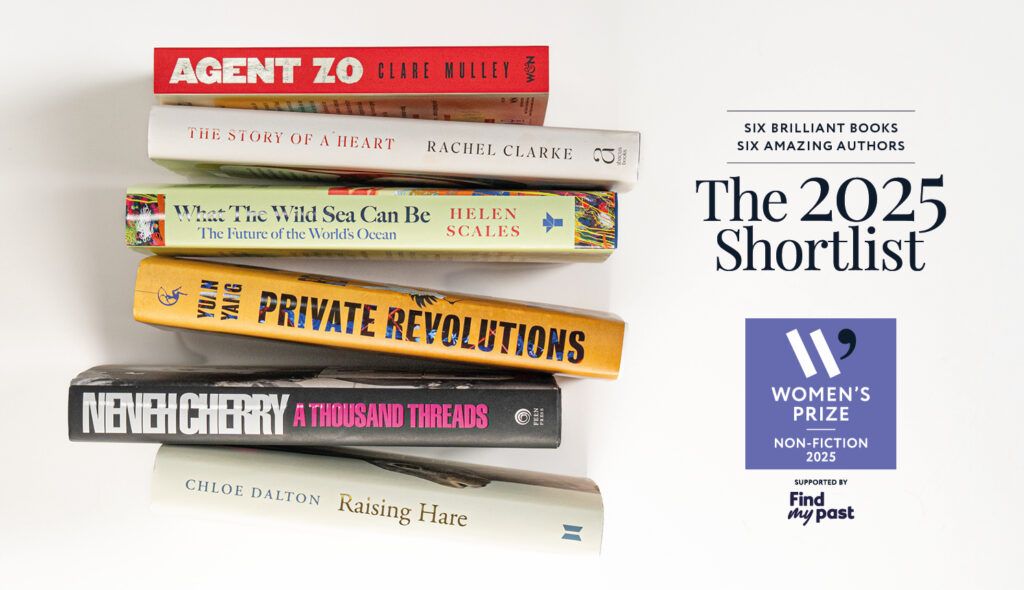
The Woman’s Prize for Nonfiction longlist 2025

Today the Women’s Prize for Nonfiction longlist 2025 was announced.

16 books ranging in matter, style and genre, from agenda-setting reportage on contemporary issues alongside revisionist histories and myth-busting biographies; to memoirs of self-determination and intimate narratives that shine a light on ordinary people combine with real-life criminal cases, notorious and forgotten, whilst others defy genre-classification, weaving multiple disciplines into a compelling narrative work.

The authors nominated are from a range of professional areas and expertise, including a music icon, human rights lawyer, political adviser, marine biologist, NHS palliative care doctor and Pulitzer Prize winner.

What the Judges Said

What unites these diverse titles, that boast so many different disciplines and genres, is the accomplishment of the writing, the originality of the storytelling and the incisiveness of the research. Here are books that provoke debate and discussion, that offer insight into new experiences and perspectives, and that bring overlooked stories back to life and recognition. Amongst this stellar list, there are also reads that expertly steer us through the most pressing issues of our time, show the resilience of the human spirit, alongside others that elucidate the dangers of unchecked power, the consequence of oppression and the need for action and defiance.

Kavita Puri, Chair of Judges

The Longlist of 16 titles

Click on any title to read the longer description of the book on the Women’s Prize website.

Autocracy, Inc.: The Dictators Who Want to Run the World  (Political Science) by Anne Applebaum (Poland/US) – explains the world we live in today and how liberal democracy is currently under threat.

Embers of the Hands: Hidden Histories of the Viking Age (History) by Eleanor Barraclough (UK) – described as an accessible gateway into this period of time, it has great storytelling, it is told with extreme authority and very readable.

The Eagle and the Hart: The Tragedy of Richard II and Henry IV (History) by Helen Castor (UK) – this book is a timely study of political power focused on Kings Richard II and Henry IV who are vividly brought to life in astonishing detail. Not just a personal history but a glimpse into different music and performance.

A Thousand Threads (Memoir) by Neneh Cherry – (Sweden/Sierra Leone) – a unique portrait of a life lifved fully creatively.

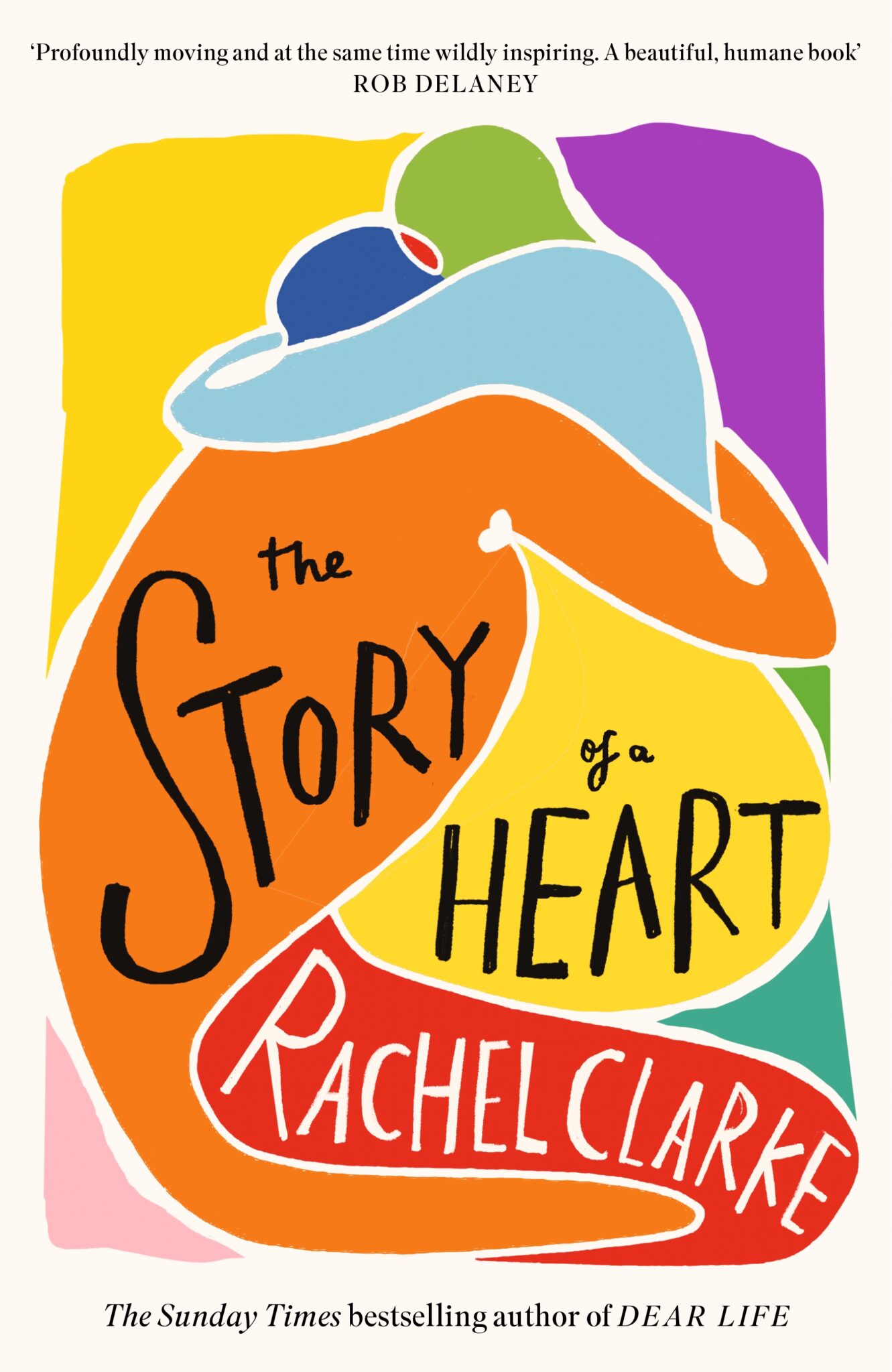
The Story of a Heart (Medical Memoir) by Rachel Clarke (UK) – it tells how one family, in the midst of their grief gives the heart of their child so that another human being can survive. It is written with such compassion, it is storytelling at its best.

Raising Hare by Chloe Dalton (UK) – a charming and beguiling book that captures the unusual relationship between the author and the leveret (baby hare) that she rescues.

Ootlin (Memoir) by Jenni Fagan (UK) – moving, enlightening and at times harrowing, a read about growing up in a broke, UK care system, a memoir written like poetry.

Why Fish Don’t Exist: A Story of Loss, Love and the Hidden Order of Life (biography/memoir/science adventure) by Lulu Miller (US) – a book that defies category, combining a personal voyage of discovery with a taxonomy of fish.

Agent Zo: The Untold Story of Fearless WW2 Resistance Fighter Elżbieta Zawacka  (biography/history/WWII) by Clare Mulley (UK) – this is a masterclass of biographical writing, a gripping read, well-researched, about a woman we should know about.

By the Fire We Carry: The Generations-Long Fight for Justice on Native Land (History/True Crime/Social Justice) by Rebecca Nagle (US) – an eye-opening read, the book delves deep into a court case that reveals the forced removal of native Americans onto treaty lands in the nations earliest years.

Wild Thing: A Life of Paul Gauguin (Biography/Art History) by Sue Prideaux ( UK/Norway) – this deep dives into a phenomenal and artistic career, the pages come alive with colour and magic, with incredible storytelling.

What the Wild Sea Can Be: The Future of the World’s Ocean (science/climate/environment) by Helen Scales (UK) – a widely researched, deeply resonant account of our threatened oceans, which strikes a helpful balance between hope and pragmatism.

The Peepshow: The Murders at 10 Rillington Place (true crime/history) by Kate Summerscale (UK) – this is how history should be written, it is evocative, carefully researched and hard to put down.

Sister in Law: Fighting for Justice in a System Designed by Men (social justice/true crime) by Harriet Wistrich (UK) – this is both a harrowing and hopeful account of of Wistrich’s battles to fight injustices against women in the legal system.

Tracker (collective memoir/biography/oral history) by Alexis Wright (Australia) – explores new ways to write biography, challenging the expectations of form, whilst giving a unique glimpse into the life of someone from the stolen generation in Australia.

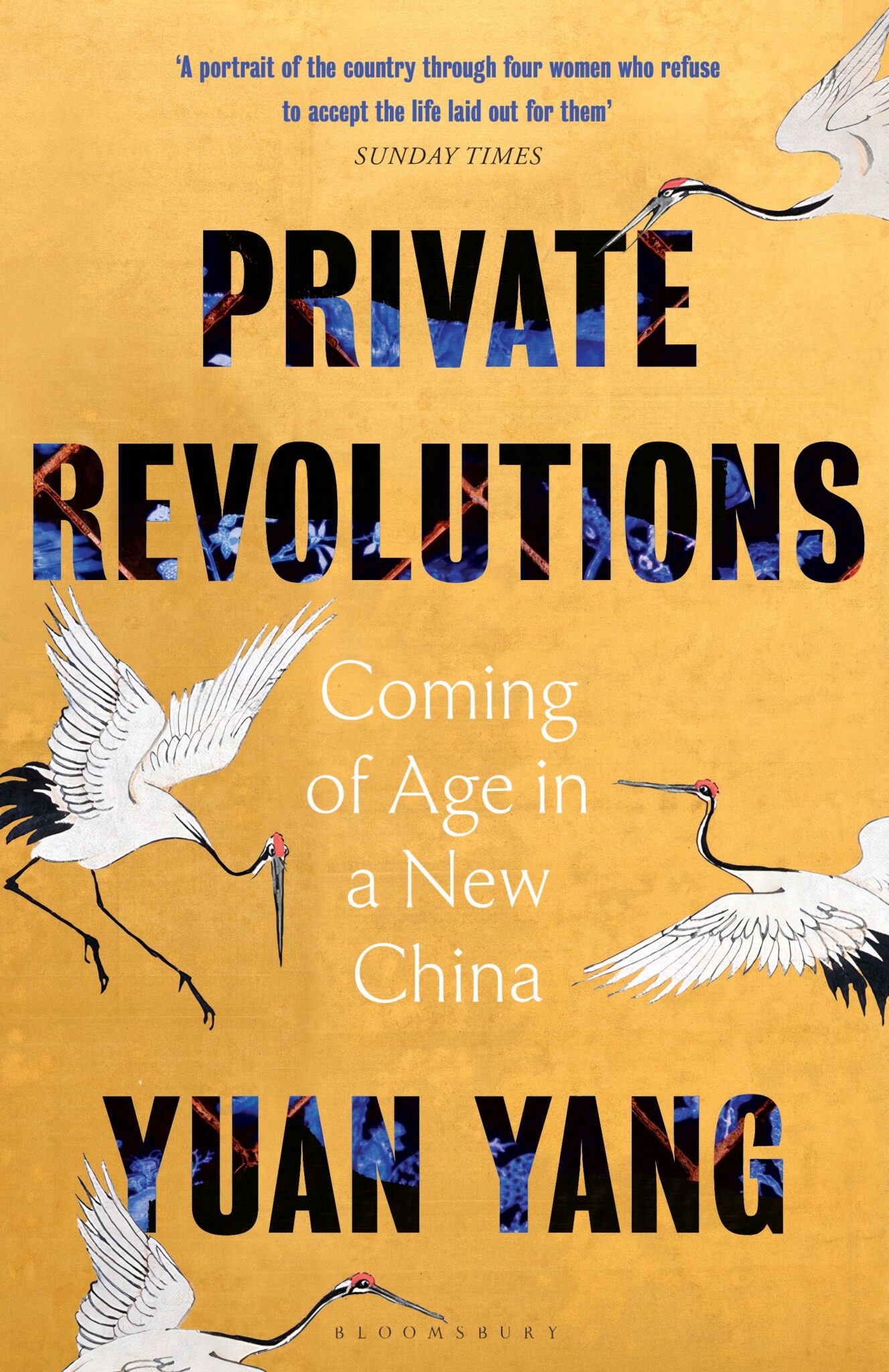
Private Revolutions: Coming of Age in a New China (history/biography/feminism) by Yuan Yang (China/UK) – a powerful and intimate portrait of life in modern China told through the stories of four young women.

Have You Read Any of These?

Let us know in the comments if you have any of these titles or if there are any that you are particularly looking forward to reading.

I haven’t read any, but I enjoyed Kate Summerscales’s The Suspicions of Mr Whicher, another true crime tale and Mrs Robinson’s Disgrace, so I’m sure her book will be an interesting read.

I like the sound of Private Revolutions, something new, to be delving into the modern lives of young women in today’s China and I can’t help but be interested in Agent Zo, the story of another woman in the resistance, after reading the excellent Madame Fourcade’s Secret War in 2024.

What do you think?

Couver Un Astre by Sophie Fontanel

How to even translate the meaning of this title. Couver means to cover, but that is insufficient to describe what Sophie Fontanel means when she writes ‘Couver un astre’.

While trying to understand the greater meaning, I came across a description that put it like a hen sitting on her eggs, protecting them, brooding, incubating.

A curious way to describe a large balloon don’t you agree? I would have to to read on and find out.

A Ball, A Ballon or An Olympic Cauldron

A large helium balloon floats up into the sky in Paris during the Olympic Games

She was referring to the large twenty-two metre diameter helium-filled balloon that the French designer Mathieu Lehanneur created for the Paris Olympics in July/August 2024. And more specifically, the attachment, adoration and psychological effect this ‘Boule’ had on her and much of the local population, as it sat in the Jardin des Tuileries and every evening rose up skywards and settled there like a full moon, then during the day descended.

It began to gather an almost cult-like following, crowds standing in the street or sitting at their apartment windows, waiting for the moment when the balloon would rise.

With a Huff and a Puff, and an I’m Out of Here

In her slim, contemplative non-fiction work, Sophie Fontanel described her cynicism at the arrival of the Olympic Games into Paris, all the unwanted infrastructure, inconvenience, people and disturbance. So much was she affronted, she left the city the opening ceremony week and went off to a Greek Island with her friends, while another friend, with quite the opposite attitude, quit Bretagne and came to Paris for a month specifically to witness and be a part of the historical moment.

She owns up to exaggerating her anticipated frustrations, but what she isn’t prepared for on her return, is the effect of a giant balloon, seen from the window of her apartment, a balloon that draws crowds as it rises every evening and descends every morning, quietly elevating the ‘joie de vivre’ of those who witness it.

Come Closer, Stand Still, Behold

The book is written during that summer, in sections relating to proximity of observation.

It begins with a series of 8 black and white photos over 4 pages that show the rise and descent of the magnificent creation, followed by:

A Prologue
De loin (From afar)
De près (Up Close)
De plus près (Closer)
De tout près (Up Very Close)
An Epilogue, by Mathieu Lehanneur

There is her contemplation and wonder of it, occasional conversations, both with friends and strangers, various encounters, concluding with that of the inventor/designer himself, who interacts on her social media post and asks his own contemplative question. A kind of invitation to respond, that manifests into an actual invitation to do what he suggests, to get closer and observe from yet another perspective, the magic of this phenomena.

《Et si vous veniez la voir de près? Histoire d’avoir un autre point de vue…》

What was this hypnotic effect of a lustrous balloon that made us not wish to turn away, that made those walking the rue ravioli lift their gaze. Some filmed it …

“Et puis, ils cessaient de le faire. Ce n’est pas que cela ne rendait pas, c’était que rien ne valait l’admiration simple.
De temps en temps, seuls les yeux compte.”
《Eh, c’est à nous, tout ça?》

And then they stopped. Not because it didn’t capture it, it was that nothing beats simple admiration. Sometimes only the eyes can appreciate.

《Hey, this is ours, all this?》

The magic of a gift of a balloon offered to the people. The incomprehension of the gift.

Sharing the Experience, An Invitation

Photo by Mathias Reding on Pexels.com

The author posted a few photos and messages on her Instagram account, having observed the balloon from her window. One day a message appears inviting her to come closer. Intrigued she does and so another wonderful aspect of the book, how sharing reflections and observing beauty and wonder can create connection and community.

I bought this as a gift for a couple of my French friends, who had been somewhat ambivalent about the then approaching season of the Olympics, who were pleasantly surprised by their own reaction when it did finally arrive and in many ways brought out the best in people.

It is a testament to the idea that magic can arrive through creativity and community, that the presence of a balloon can lift spirits, as most children know and many adults have forgotten.

I adored this little book and highly recommend it if you took any pleasure in the summer of 2024 Paris and wished to remember the good feeling it brought about in many.

For the moment it is published in French, hopefully it will get picked up and translated into English.

Sophie Fontanel, Author

Sophie Fontanel is an author and essayist living in Paris. She has been an editor at Elle France for more than a decade. She has written 18 books in the French language.

Mathieu Lehanneur, Designer

“This absolutely unique Cauldron represents all the spirit I wanted to give to the Olympic and Paralympic objects. Light, magical and unifying, it will be a beacon in the night and a sun within reach during the day. The fire that burns in it will be made of light and water, like a cool oasis in the heart of summer. I created the Torch, the Relay cauldron and the Olympic Cauldron as three chapters in the same story. The Cauldron is the epilogue and the ultimate symbol of that story. Light, magical and unifying…” ML

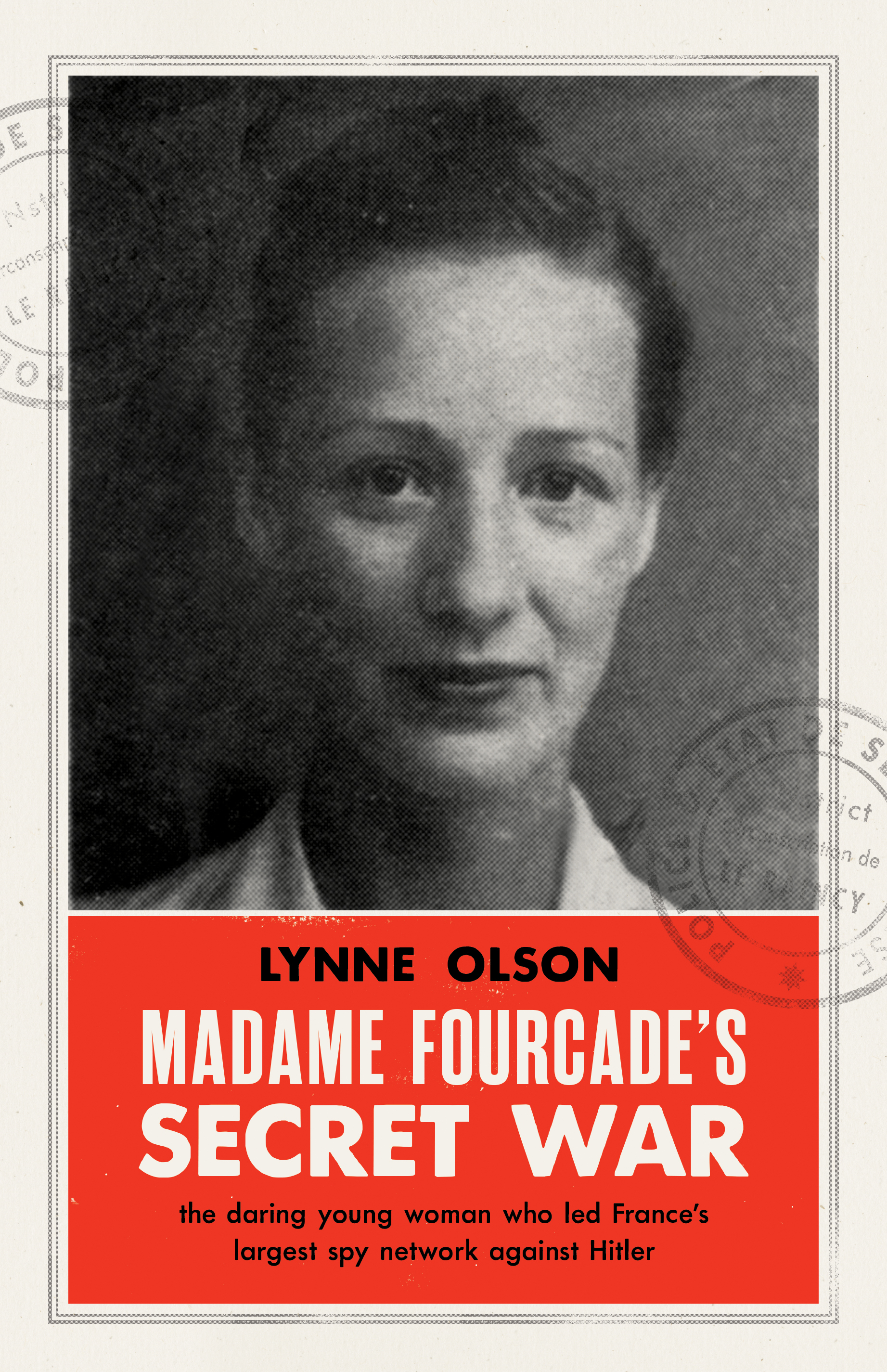
Madame Fourcade’s Secret War by Lynne Olson

The Daring Young Woman Who Led France’s Largest Spy Network Against Hitler

I became aware of this book thanks to a friend who is also interested in historical stories about women in France. I knew at once I had to read it.

While my friend was still reading it some months ago, I happened to go on a walk, following a route I have taken many times and noticed for the first time that Madame Fourcade’s name featured on one of the street signs. You can imagine my surprise and delight! She became even more of a talking point and I looked forward to getting a copy of the book (not that easy) to read.

I will say if you are interested in reading it, that the font size of the paperback version (which I read) is quite small compared to the hardback version (a copy of which I bought for a friend).

Famous French Women, A Rare Vision

Most of the street signs in France are the names of people that have featured in their recent history. However, it is very rare to come across the name of a woman. In our town Marie Curie has a street sign, but even then, she shares it with her husband. Marie Madeleine Fourcade not only has a sign all to herself, strategically placed at the top of a hill overlooking the town, but she was also the very first woman in France’s history to be given a funeral at Les Invalides, an important complex of buildings in Paris that celebrates France’s military glory.

Marie Madeleine’s father worked for a French shipping company in Shanghai. Her mother refused to stay behind in Paris, though agreed to return to Marseille for the birth of her daughter in 1909. Marie-Madeleine and her siblings grew up in Shanghai, with freedoms unheard of for the social and family circles they hailed from. Those freedoms, an early bilingual education and their return to Paris when she was 10 years old, set her up in many ways for the future role she would play, organising and ultimately leading an important French intelligence network.

As a young woman, she again lived abroad, in Morocco. She drove a car, learned to fly a plane and had a job. She rejected French society’s (and her husband’s) restrictive ideas about how women should behave. She had trained to become a concert pianist, worked at a commercial radio station and would forge her own future.

Access to Important Connections, Two Rivals

Street named after Marie Madeleine Fourcade, co founder and chef de resistance of the Alliance network 'Noah's Ark' codename hérrison, hedgehog during World War 2

Though never in the military herself, she was married briefly to a French military officer, as was her sister. She thus had opportunity to meet and observe some of the younger officers through her social connections, men who would later become important during the war years.

Two of the most prominent members of that younger group – Lieutenant Colonel Charles de Gaulle and Major Georges Loustaunau Lacau – took centre stage in the discussion on rue Vaneau, engaging in a debate that quickly escalated into a full-blown argument. It soon became obvious to Marie-Madeleine that the two officers viewed each other as rivals…

Both products of Saint-Cyr, France’s elite military academy Ecole Supérieure de Guerre, both fought and received multiple citations for bravery in WWI; they were brilliant, ambitious and egocentric. A rebellious streak put them at odds with Marshal Philippe Pétain (a French general who commanded the French Army in WW1 and would become head of what became known as the Régime de Vichy Vichy France). The rivalry between the pair would also keep them from being unified during the war years and likely impacted perceptions afterwards.

A Partnership, A Turning Point

After a discussion at one of the social events around March 1936, Loustaunau-Lacau contacted Marie-Madeleine and asked for her help in creating a journal that would argue the case for reform of the military and open the eyes of leaders to the imminent threat of Germany. The work would begin immediately.

“One of my Belgian friends has procured secret dossiers that expose the intentions of the German high command,” he said. “I need to get them quickly. Such documents must not travel by mail. You have a car. You must go to Brussels and collect them. I will pay all expenses.”

An Intelligence Network is Formed, Working Inside France

Caught up in this real life spy drama, Marie-Madeleine agreed – a decision that would radically change her life. From that moment, she wrote later, she and Loustaunau-Lacau began building an intelligence network against Nazi Germany.

Over the next two years, they would recruit informants in France, Switzerland, Belgium and Germany who passed on reports about the build up of the German armed forces. Loustaunau-Lacau adopted the codename Navarre, after Henri de Navarre, later King Henri IV of France. Given the risks they faced, that one of them might be captured or killed, Navarre insisted they share leadership of the network and when he was compromised, as promised Fourcade took the lead role.

At the same time, backbencher in the British House of Commons, Winston Churchill had created a similar private network and Charles de Gaulle decamped to London, setting up his Free French operation. Fourcade suggested they join with him.

Her mentor rejected the idea outright. In England, he said, they would be refugees, just like de Gaulle, dependent on the British for everything. At that point, almost no one in the British government, with the promising exception of Winston Churchill, took de Gaulle and his minuscule band of followers seriously.

They would resist from within.

Another Perspective of History

Founded in Vichy in Septemeber 1940 by Georges Loustaunau-Lacau and Marie-Madeleine Fourcade, the Crusade Intelligence Network (later called Alliance) moves it headquarters from Vichy to Pau in early 1941 and to Marseille later that year.

Madame Fourcade’s Secret War is a work of history, told in a compelling narrative voice, that not only focuses on the leadership role of this one extraordinary woman, but will likely expand most reader’s knowledge of what living in France under German occupation was like for the many, who vehemently opposed the way their government had capitulated to a hostile outside force, without much initial resistance.

Personally, the history I learned in school was quite different, as it was told from a very anglo-centric perspective, so the narratives stemmed from how this threat impacted the United Kingdom and their allies.

I never really understood what exactly happened within France in the lead up to the occupation, how it impacted their government and rendered the military ineffective. So many of the protections a country might normally expect when facing a hostile enemy were lacking; to go against the orders of a government (even if under occupation) was a betrayal.

Cinema Can Create Its Own Self Serving Narrative

Though there have been books and films about the war and the French resistance, little has been shown of the importance of the Alliance network and of Marie-Madeleine Fourcade’s achievements. Most of the attention has gone to stories of sabotage and escape lines, of battles and blitzes.

Saboteurs and other resistance fighters in France were certainly important after D-Day, but they did little to obstruct the Germans before then. Escape networks did heroic work in smuggling shot-down Allied airmen and others out of occupied Europe and back to freedom, but their actual contribution to victory was small.

I would certainly be interested in a cinematic development of Fourcade’s story, one that traverses France and shows a very different side to those who travelling around the country, making radio transmissions and secret flights across the channel, where they are hosted by memorable characters in this real life adventure.

Noah’s Ark and the Hedgehog

Les Invalides Paris, where Marie Madeleine Fourcade's funeral was held, the first woman in France to be commemorated there.
Les Invalides Paris

In the late 1960’s Fourcade would get her story down in a gripping memoir entitled Noah’s Ark, the name the German’s referred to their network as, after they would use codenames of animals, Fourcade’s was hérrison (hedgehog), a small animal that intelligently eluded predators.

Lynne Olson provides a thoroughly researched, immensely readable account of the creation of the Alliance, one of the original and most important resistance networks in France. From its foundation by Navarre and Fourcade to the establishment of thousands of recruits, the many dangerous activities they undertook, throughout the war, all that was able to be continued by Fourcade due to her continued leadership deserves to be more widely recognised and appreciated.

They Will Not Be Forgotten, The People

L'Arche de Noé Réseau Alliance 1940-1945 by Marie Madeleine Fourcade autobiogrpahy of her role as the leader of a French resistance during world war 2

The book is full of stories about the different people she recruited, the relationships and loyalties and daring escapades each of them went on, in order to bring their intelligence to the Alliance.

It is also, sadly, a homage to those who would be punished and killed for their roles, some, so close to the end of the war, it is excruciating to read. That Fourcade survived and was able to share her story and thus the courage and bravery and loyalty of others is a true gift to all humanity.

It’s the first time I have read an account that centres what was happening in France at this local level, with a more global scope, that renders the dangerous and delicate situation of those in the military, who were against the capitulation of their government. While in great danger to themselves, they were able to band together like-minded civilians and provide those on the outside with the information they needed to mount a significant and ultimately successful defence.

Highly Recommended!

Author, Lynne Olson

Lynne Olson is a New York Times bestselling author of nine books of history, most of which focus on World War II. Former U.S. Secretary of State Madeleine Albright has called her “our era’s foremost chronicler of World War II politics and diplomacy.”

Born in Hawaii, Lynne graduated magna cum laude from the University of Arizona. Before becoming a full-time author, she worked as a journalist, with the Associated Press as a national feature writer in New York, a foreign correspondent in AP’s Moscow bureau, and a political reporter in Washington. She left the AP to join the Washington bureau of the Baltimore Sun, where she covered national politics and eventually the White House.

Lynne’s latest book is Empress of the Nile: The Daredevil Woman Archaeologist Who Saved Egypt’s Ancient Temples From Extinction (2023).

Three of her earlier books were immediate New York Times bestsellers; Madame Fourcade’s Secret War: The Daring Young Woman Who Led France’s Largest Spy Network Against the Nazis (2019), Those Angry Days: Roosevelt, Lindbergh, and America’s Fight Over World War II (2013)and Citizens of London: The Americans Who Stood with Britain in Its Darkest, Finest Hour (2010)

Lynne lives in Washington, DC with her husband, Stanley Cloud, with whom she co-authored two books.

Unearthing (2023) by Kyo Maclear

A Story of Tangled Love and Family Secrets

“But what is the point of writing if not to unearth things… Annie Ernaux

I chose to read Unearthing because it was the overall favourite read of 2023 of Shagafta who I follow on Substack and because it ties in to a theme I have been researching, exploring separation, kinship and the discovery of one’s identity.

Of Changing Seasons and Evolving Stories

Unearthing is a memoir of twenty four sekki (節気) or “small seasons” that offers a different way of thinking about the ever changing ground of our personal stories.

Three months after Kyo Maclear’s father dies, looking to know him at a deeper level and curious about his mother’s side of the family, she takes a DNA test.

When my father died and I was his grieving and wondering daughter, I thought of a word. The word, yugen, or what the Japanese call a state of “dim” or “deep” mystery, evokes the unsettled feeling I had at various points growing up as an only child. Our family was a tiny unit with strange ways. My parents acted like criminals on the lam – loading up moving vans, changing house every few years. I was four years old when we left England, shedding backstory and friends overnight. What made a family behave this way, like people drawn to erasure? Why were we always leaving like this, unceremoniously? I did not know. Growing up, I assumed that everyone was shaped and suffused by what they could not perceive clearly, the invisible and voiceless things imparted atmospherically within families.

Ask Your Father

Shocked, when she receives the results she learns that she is not biologically related to her father and that her mother refuses to speak on the subject.

She repeated it three times. Talk to your Dad. As if his death had been a hoax; her voice no longer blurry but brisk with fear.

Though her mother does not wish to talk about it, her daughter perseveres. She will weather this storm, waiting for it to calm, listening between the lines of conversation, picking up on the cues.

When one person leaves, the old order collapses. That’s why we were speaking to each other carefully. We were a shapeshifting family, in the midst of recomposing ourselves. What is grief, if not the act of persisting and reconstituting oneself? What is its difficulty, if not the pressure to appear, once more, fully formed?

Solving the Mystery of Your Life

Photo K. Kaboompics Pexels.com

Becoming a detective in her own life, Kyo assembles the story of her lineage, tied to the seasons and the making of a garden.

Digging was my way out. An impulse born of stubbornness and bred in me by a culture that loves stories of people discovering the truth of their paternity; that champions the idea that concealment is destructive and truth is freeing.

The way the Kyo Maclear takes her time unveiling the truth of her story, the various paths she follows, the thoroughness of her pursuit to know, makes this a thrilling read.

There is something about the long, slow seasons and the process of tending the soil, not trying to rush the end result that resonates in her writing, yet never slows the narrative.

Her observations of her mother, the nuanced noticing, are so well depicted, you can feel the resolution of the mystery getting warmer and warmer, as she regains her mother’s trust and nurtures her into revealing more.

Something

It was all being pulled from some shadowy room. The details she remembered. The broken chain of events. What she spoke arrived in fragments. But there was something else, a hitch and hesitance, that made me alert.

I did not yet understand the need to hold on to an invented story, even a falsified past, at all costs. I did not recognize her dissembling. Usually impervious, I thought she seemed out of sorts. Maybe a little distraught.

She does not want to tell me something, I thought.

Along the way larger questions arise: What exactly is kinship? What does it mean to be family? What gets planted and nurtured? What gets buried and forgotten? Can tending a garden heal anything?

I thought this memoir was brilliant, I highlighted so many thoughtful and thought provoking passages. I admired the way the revelations came slowly and the characters of her family were explored, her search for herself made her realise how little she knew of her own parents. They too, were a mystery to unravel and motivations to explore, before even embarking on the second exploration, the unknown aspect that her DNA revealed.

It also celebrates those that helped, guided and accepted her along the way, new relationships and a deeper understanding of aspects of the self, while never losing her essence.

Highly Recommended.

Kyo Maclear, Author

Kyo Maclear was born in London, England, and moved to Toronto at the age of four. She holds a doctorate from York University in Environmental Humanities.

Her most recent book, the hybrid memoir, Birds Art Life, was published in seven territories and became a Canadian #1 bestseller. It was a finalist for the Hilary Weston Writers’ Trust Prize for Nonfiction and winner of the Trillium Book Award.

Unearthing was an instant bestseller in Canada and winner of the Governor General’s Literary Award for Nonfiction. Her short fiction, essays, and art criticism have been published in Orion MagazineAsia Art PacificLitHubBrickThe MillionsThe GuardianLion’s Roar, The Globe and Mail (Toronto) and elsewhere. She has been a national arts reviewer for Canadian Art and a monthly arts columnist for Toronto Life. She is also a children’s author, editor, and teacher.

She lives in Tkaronto/Toronto, on the traditional territories of the Mississaugas of the New Credit, the Haudenosaunee, Métis, and the Huron-Wendat.

The Years by Annie Ernaux tr. Alison L. Strayer

I have had Annie Ernaux’s English translation of The Years on my bookshelf for some time now, since it was shortlisted for the International Booker Prize in 2019. It was originally published in French in 2008 (Les Années) and is considered to be her chef-d’œuvre. It is a non-fiction work that spans the years 1941 to 2006 in France.

Neither memoir or autobiography, it is a unique compilation of memory, experiences, judgments, of political, cultural, personal and collective statements and images that represent a woman living through those years.

It is bookended by descriptions of things seen that are likely never to be seen again.

All the images will disappear:

the woman who squatted to urinate in broad daylight, behind the shack that served coffee at the edge of the ruins in Yvetot, after the war, who stood, skirts lifted, to pull up her underwear and then returned to the café

the tearful face of Alida Valli as she danced with Georges Wilson in the film The Long Absence

There is no call for literary devices or beautification of language or hiding the crude, raw human elements that some may grimace at.

When Ernaux won the Nobel Prize for Literature in 2022, she gave a speech entitled I Will Write to Avenge My People in which she described deciding on and finding her writing voice, that it would not be like that used by the esteemed writers she taught her students.

What came to me spontaneously was the clamour of a language which conveyed anger and derision, even crudeness; a language of excess, insurgent, often used by the humiliated and offended as their only response to the memory of others’ contempt, of shame and shame at feeling shame.

Raised by shopkeepers/cafe owners, she considered herself a class-defector through her education alongside the sons and daughters of bourgeoise families. She would find a way through the language she used to address that betrayal, to elude the gaze of the culturally privileged reader.

I adopted a neutral, objective kind of writing, ‘flat’ in the sense that it contained neither metaphors nor signs of emotion. The violence was no longer displayed; it came from the facts themselves and not the writing. Finding the words that contain both reality and the sensation provided by reality would become, and remain to this day, my ongoing concern in writing, no matter what the subject.

For Ernaux, class mobility is a violent, brutal process and she sees it as her duty to at least attempt, via her authorship, to make amends to those she remembers, has left behind and to not hide from her own perspective, actions, behaviours.

Shame Simple Passion The Years Annie Ernaux Nobel Prize Winner 2022

Knowing that The Years was considered her masterpiece, I decided to read some of her earlier short works, to engage with her style and thus appreciate this work all the more and that has certainly been the case. I began with the book she wrote of her father La Place (A Man’s Place), then of childhood Shame, and an affair Simple Passion. I do think it is a good idea to read some of these shorter works before taking on The Years.

In effect The Years is an attempt to collate and offer a faithful account of an entire generation, as it was viewed by one woman and the collective that she was part of. The narrative therefore is written from the perspective of ‘she‘ and ‘we‘, there is no ‘I‘. It is an observation of the times passing and the inclinations of people, for better or worse.

She would like to assemble these multiple images of herself, separate and discordant, thread them together with the story of her existence, starting with her birth during World War II up until the present day. Therefore, an existence that is singular but also merged with the movements of a generation.

We read and witness the impact of school, religion, the media, politics on a generation, alongside the cultural influences, the strikes, the films, the advertising, the village gossip and children’s cruelty.

Public or private, school was a place where immutable knowledge was imparted in silence and order, with respect for hierarchy and absolute submission, that is, to wear a smock, line up at the sound of the bell, stand when the headmistress or Mother Superior (but not a teaching assistant) entered the room, to equip oneself with regulation notebooks, pens and pencils, refrain from talking back when observations were made and from wearing trousers in the winter without a skirt over the top. Only teachers were allowed to ask questions. If we did not understand a word or explanation, the fault was ours. We were proud, as of a privilege, to be bound by strict rules and confinement. The uniform required of private institutions was visible proof of their perfection.

While some aspects will be universal, it is by its nature a collective and singular memory of a life in France. That will interest some and not others, but as someone who lives in France today, it is interesting to read of the familiar and also the references to the particular, the cultural, the influences.

Between what happens in the world and what happens to her, there is no point of convergence. They are two parallel series: one abstract, all information no sooner received than forgotten, the other all static shots.

Because it is clearly written over the many, many years, it comes across as being always in the now, as if she is time travelling into the various versions of the self over the years, looking and noting down the visual memories, remembering and accessing the perspective of the time they were in.

So her book’s form can only emerge from her complete immersion in the images from her memory in order to identify, with relative certainty, the specific signs of the times, the years to which the images belong, gradually linking them to others; to try to hear the words people spoke, what they said about events and things, skim it off the mass of floating speech, that hub bub that tirelessly ferries the wordings and rewordings of what we are and what we must be, think, believe, fear, and hope. All that the world had pressed upon her and her contemporaries she will reuse to reconstitute a common time, the one that made its way through the years of the distant past and glided all the way to the present. By retrieving the memory of collective memory in an individual memory, she will capture the lived dimension of History.

L'occupation Une femme Je ne suis pas sortie de ma nuit

I found it an absolutely compelling read, filling in a lot of gaps and knowledge regarding French history that I happily encounter in this kind of format.

Highly recommended if you are interested in French cultural and personal history from a unique literary perspective.

Have you read any works by Annie Ernaux?

I have a few more shown here that I intend to read in the original French version.

Further Reading

The Guardian, Interview: ‘If it’s not a risk… it’s nothing’: Nobel laureate Annie Ernaux on her unapologetic career by Alice Blackhurst

The Guardian: Annie Ernaux: the 2022 Nobel literature laureate’s greatest works

Author, Annie Ernaux

Annie Ernaux was born in Seine-Maritime, France, in September 1940 and currently lives in Paris, France. In October 2022 she was awarded the Nobel Prize in Literature.

Annie Ernaux grew up in Normandy and studied at Rouen University, before becoming a secondary school teacher. From 1977 to 2000, she was a professor at the Centre National d’Enseignement par Correspondance. Her books, in particular A Man’s Place and A Woman’s Story, have become contemporary classics in France. The Years, shortlisted for the International Booker Prize in 2019, won the Prix Renaudot in France in 2008 and the Premio Strega in Italy in 2016. In 2017 she was awarded the Marguerite Yourcenar Prize for her life’s work.

Cairn (2024) by Kathleen Jamie

A Poet Writing Nature Essays

Kathleen Jamie is a poet and writer of creative nonfiction about nature. She has written three wonderful collections that I have adored. Findings (2005), my favourite, included essays about the Hebridean and Orkney Islands near her home in Fife and Peregrines nesting; Sightlines (2012) covers a fascinating archaeological dig, tales of more birds on lonely, windswept islands and a visit to the Arctic and finally Surfacing (2019) which I review here in Surfacing 1 and Surfacing 2.

Making Ripples at 60

creative non fiction essays poetry by Scottish poet and nature writer Kathleen Jamie

In Cairn, we find a collection of writings, fragments, observations and memories. Sometimes an individual observation and other times a collective witnessing of changes in the local environment. Of migratory patterns disrupted, of things once common on the horizon, now departed.

As she arrives at her 60th year, she begins to ask different questions, about the next generation and the one after that, if there will indeed be one as children question whether to bring another generation into this vastly changing world.

There is less a note of wonder and more a tone of trepidation at the precarious situation of the natural world and those being born into what will continue after we have left.

The Bass Rock and Bird Flu

It’s a while since we could turn to the natural world for reassurance, since we could map our individual lives against the eternal cycles of the seasons, our griefs against the consolation of birds, the hills. Instead there’s the sense that things are breaking, cracking like a parched field. There they are, the seabird people, among their beloved birds at the height of the breeding season, wearing hazmat suits as they pile corpses into bin bags.

Photo by Magda Ehlers on Pexels.com

Like a cairn, these short prose pieces are markers, memories, memorials or perhaps even metaphorical or literary burial mounds, tracking the thoughts and observations of an observer over the years of the natural environment, of change in both the natural surroundings and humanity. Testimonies.

‘Stones propose another sense of time, whereby the past, the deep past of the plant, proffers a meagre yet massive support to acts of human resistance…’ John Berger

A thought-provoking collection.

Further Reading

The Guardian: Cairn by Kathleen Jamie review – a wry SOS for the world

The Caught by the River Book of the Month: July 2024 Cairn by Kathleen Jamie With its bursts of beautiful brilliance, it is something akin to lightning, writes Annie Worsley

The Guardian: Scotland’s Bass Rock: world’s largest colony of northern gannets – in pictures

Author, Kathleen Jamie

Kathleen Jamie, Photo by Alan Young

Kathleen Jamie is one of Britain’s foremost writers. In 2021 she was appointed Makar, Scotland’s national poet.

Jamie resists being identified solely as a Scottish poet, a woman writer, or a nature poet. Instead, she aims for her poetry to “provide a sort of connective tissue”.  Influenced by Seamus HeaneyElizabeth BishopJohn Clare, and Annie Dillard, Jamie writes musical poems that attend to the intersection of landscape, history, gender, and language.

Her groundbreaking works of prose – Findings (2005), Sightlines (2012) and Surfacing (2019) – are considered pioneers and exemplars of new nature writing. She lives in Fife.

Women’s Prize Fiction & Nonfiction Winners 2024

The 29th winner of the Women’s Prize for Fiction has been announced from the shortlist of six novels and on the same evening the inaugural winner of the Women’s Prize for Nonfiction from the shortlist of six books.

2024 Fiction Winner

The Women’s Prize for Fiction was won by American author, V. V. Ganeshananthan, for her deeply moving, powerful second novel, Brotherless Night (my review), which depicts a family fractured by the Sri Lankan civil war.

‘Brotherless Night is a brilliant, compelling and deeply moving novel that bears witness to the intimate and epic-scale tragedies of the Sri Lankan civil war. In rich, evocative prose, Ganeshananthan creates a vivid sense of time and place and an indelible cast of characters. Her commitment to complexity and clear-eyed moral scrutiny combines with spellbinding storytelling to render Brotherless Night a masterpiece of historical fiction.’ Monica Ali, CHAIR OF JUDGES FOR THE WOMEN’S PRIZE FOR FICTION

2024 NonFiction Winner

The Women’s Prize for Non-Fiction was awarded to Canadian bestselling writer, global activist and film-maker, Naomi Klein, for Doppelganger: A Trip into the Mirror World; her urgent, illuminating examination of our polarised society.

‘This brilliant and layered analysis demonstrates humour, insight and expertise. Klein’s writing is both deeply personal and impressively expansive. Doppelganger is a courageous, humane and optimistic call-to-arms that moves us beyond black and white, beyond Right and Left, inviting us instead to embrace the spaces in between.’ Professor Suzzanah Lipscomb, CHAIR OF JUDGES FOR THE WOMEN’S PRIZE FOR NON-FICTION

Further Reading

The Guardian Article: Judges praised Klein’s Doppelganger for its ‘courageous’ study of truth in politics and called Ganeshananthan’s Brotherless Night a ‘masterpiece’ of historical fiction by Lucy Knight

Have you read either of these books? Let us know what you thought of them in the comments below.

Girl in the Tunnel: My Story of Love and Loss as a Survivor of the Magdalene Laundries by Maureen Sullivan (2023)

This excellent memoir for me, was the anti-dote to the shortcomings I had with Claire Keegan’s Small Things Like These.

My Story of Love and Loss as a Survivor of the Magdalene Laundries

Keegan’s novel does everything except go inside the establishment to find out who is in there, why and how they are being treated. Instead it focuses on one man who is portrayed as kindly and empathetic. That man will make a righteous action, whereas the author commits the sin of omission, maintaining a societal silence that continues to bind, in neglecting to shift the narrative gaze towards anything related to those unjustly incarcerated inside. Like standing to one side at the scene of a car accident, choosing to gaze at the sheep in the fields opposite.

Girl in the Tunnel is a memoir of childhood. Of a girl from a large blended family, who is removed from abuse and sent to one of Ireland’s notorious Magdalene laundries. Maureen Sullivan’s second paragraph of her Author’s Note in the front of the book speaks volumes.

It might surprise you, or it might not, to know that there are people still pushing me to stay silent. There are people who want this book kept from your hands. People who say to me in the street, ‘Would you not get over it?’ People who tell me to shut up about it – they defend men and they defend the Catholic Church.
But this is my story to tell and this is how I remember it.

Maureen was not even a teenager when she was taken from her school, from her family, from her loving Granny, without being told where she was going, only that she was to attend a new school and would have to live there. None of her questions were ever answered. She would be deposited at the Magdalene laundry in New Ross, County Wexford run by the Order of the Good Shepherd nuns. Stripped of her possessions including the new pencil case her mother bought her as she was leaving, she was thrown into forced labour, washing clothes, pressing linens and scrubbing floors, forbidden an education or contact with any of the children who attended the school there.

I changed most of the names in this book – my abuser, relatives, locals and the nuns – because I’m not out to hurt or for revenge. I wrote this book because I was silenced as a child when I was the victim of abuse and I was silenced by society when I left the laundry. I want people to know what happened. This is my history, but it’s also the history of this country.

Someone recently said to me that a great opening line of a book can foreshadow the entire story. When I go back and read the first line of Maureen’s memoir, I find so many of the reasons for what happened to her, there in that line.

I never knew my father, John L. Sullivan, but there was a photograph of him on the wall in my grandmother’s house.

Maureen’s mother was married, nineteen and pregnant with Maureen when her father died suddenly leaving two young sons and an unborn daughter. They lived with her Granny, her father’s mother, the only person in her life who ever spoke of the father she never knew. But her Granny was poor and her mother quickly married and created a new family with another man, Marty Murphy, who from very early on took out all his frustrations on the dead man’s children.

My brother’s and I were terrified of Marty from day one. He didn’t restrain himself and lost his temper in a second, sometimes for nothing you could place, and he would go for you, even in his boots, and his kicks would hurt for days. He really hated us. Or he hated himself, maybe, for what he couldn’t stop doing to us, but either way living with Marty was like living with the devil himself. We suffered every single day.

Photo T. Miroshnichenko Pexels.com

Maureen describes their lives in incredible and evocative detail. Being so poor and having so little, when she describes the few tender and joyous moments, they stand out in the narrative, as they clearly did in her mind as that child.

The way it is written is absolutely captivating, not because of the misery or injustices, but because of the emotional intelligence exhibited. It is so honest and evocative of the way a child would experience things, except that Maureen has grown up and is able to express the questions and thoughts she had as a child. But she does so, with an understanding of where her country and society is today and how it was then. Nevertheless, there is no excuse for the cruelty and lack of basic human rights she experienced. There is a lot that remains hidden and denied to this day.

It’s hard to imagine the reasons for people behaving as they did, given how fast Ireland has progressed, and it’s hard to imagine how my mother thought things through. I know now she had no choices – women were the property of their husbands. Their bodies belonged to the men they married, their children did too.

When Maureen responds to the kind voice of her favourite teacher at school and opens up to her questions, she believes that she is going to rescued, perhaps even go to live with her Granny. This idea of being with her Granny was so powerful, she told her everything.

So I told on him. I told on Marty. I sat there in that room with a chocolate in my mouth and an open heart and talked about it.

When her mother arrives after being called in by the school and sees Maureen sitting in the hallway, she asks her why she is not in class. And worse.

As she went by me, she turned and said, ‘Oh Maureen, what have you done?’ She knocked on the office door and disappeared through it.
What had I done?

That same day she would be removed and taken to the laundry. She would also be told that she had a new name. They all did.

For years I couldn’t figure out why our names were changed in the Magdalene laundries. What reason had they? A number would have made more sense to me if they wanted us to be nothing and nobody. But a number is a way to trace us, and it would have been unique. It would have been remembered and displayed somewhere. By changing our names they made sure, not that we struggled on the inside, but that on the outside we had no way to identify or find each other. And how could we stand as a witness to what went on there if there was nothing to say we had been there at all? We didn’t exist.

Magdalene laundries rosary factory
Photo Trac Vu on Pexels.com

Maureen describes all the work they do in the laundry by day and then the work they must do at night, in the tin boxes. It is revelatory and will not leave any reader unaffected.

Merely describing the day to day activities and routine of their lives, and who they were not – (at the time she was in New Ross none of the women there were pregnant), is captivating. A 1911 census referred to them as “inmates”, at New Ross they were referred to as penitents.

It means a person who seeks forgiveness for their sins. There were no sinners in New Ross. Just victims, victims of the patriarchy, victims of misogyny.

The tunnel was the long corridor that separated the sleeping area and the children’s school from the laundry. Every so often she would be locked in there. When the men in suits arrived.

Photo by R. Asmussen Pexels.com

Those men in suits were likely state inspectors. They were sent around to all of the Magdalene laundries in Ireland to check on conditions.

People like Maureen were not supposed to be in the laundry being used as child labour, so they were hidden.

Maureen’s story is an important record of the historical treatment of girls and young women in Ireland, and a testament to the proliferation of abuses in households and the historic risk of speaking out.

Sharing their stories can change things. Last year, one of the best books I read was another memoir Poor: Grit, courage, and the life-changing value of self-belief by Katriona O’Sullivan. That book has had and continues to have a significant impact in changing societal attitudes.

Perhaps more tellingly, as Justice for Magdalenes Research’s book notes, there were never any Magdalene laundries for men. There were no corresponding church-run rehabs for the men who abandoned their families, nor for those who put girls and women in those situations that landed them in institutions. RENÉ OSTBERG, National Catholic Reporter

Highly Recommended.

Further Reading

Book: Ireland and the Magdalene Laundries: A Campaign for Justice – the long battle for justice

Essays: A Dublin Magdalene Laundry: Donnybrook and Church-State Power in Ireland

Article: National Catholic Reporter: Book details long battle to get justice for Ireland’s Magdalene survivors by René Ostberg, April 30, 2022

Resources: Justice for Magdalene Research : A Resource for People Affected by and Interested in Ireland’s Magdalene Institutions

Resource: One In Four, Ending the Trauma of Childhood Sexual Abuse – Programs for Adult survivors

Women’s Prize Nonfiction Shortlist 2024

In 2024 The Women’s Prize created a new prize to raise the profile and awareness of women authors writing nonfiction.

They began with a list of 16 titles, from gripping memoirs and polemic narratives, to groundbreaking investigative journalism and revisionist history. It featured seven debut writers, two international bestsellers, two poets and five journalists. You can see the longlist here.

From Sixteen to Six Titles

The longlist has now been whittled down to six books covering a broad range of subjects – from life writing, religion, art and history, to AI, social media and online politics. What links them is an originality of voice and an ability to turn complex ideas and personal trauma into inventive, compelling and immersive prose.

“Our magnificent shortlist is made up of six powerful, impressive books that are characterised by the brilliance and beauty of their writing and which each offer a unique, original perspective. The readers of these books will never see the world – be it through art, history, landscape, politics, religion or technology – the same again.” Suzannah Lipscomb, Chair of Judges

The six titles shortlisted are:

Thunderclap: A Memoir of Art and Life and Sudden Death by Laura Cumming (UK) (Art History & Grief)

‘We see with everything that we are’

On the morning of 12 October 1654, a gunpowder explosion devastated the Dutch city of Delft. The thunderclap was heard over seventy miles away. Among the fatalities was the painter Carel Fabritius, dead at thirty-two, leaving only his haunting masterpiece The Goldfinch and barely a dozen known paintings. The explosion that killed him also buried his reputation, along with answers to the mysteries of his life and career.

What happened to Fabritius before and after this disaster is just one of the discoveries in a book that explores the relationship between art and life, interweaving the lives of Laura Cumming, her Scottish painter father, who also died too young, and the great artists of the Dutch Golden Age.

This is a book about what a picture may come to mean: how it can enter your life and change your thinking in a thunderclap.

Doppelganger: A Trip Into the Mirror World by Naomi Klein (Canada) (Mistaken Identity)

– When Naomi Klein discovered that a woman who shared her first name, but had radically different, harmful views, was getting chronically mistaken for her, it seemed too ridiculous to take seriously. Then suddenly it wasn’t. She started to find herself grappling with a distorted sense of reality, becoming obsessed with reading the threats on social media, the endlessly scrolling insults from the followers of her doppelganger. Why had her shadowy other gone down such an extreme path? Why was identity – all we have to meet the world – so unstable?

To find out, Klein decided to follow her double into a bizarre, uncanny mirror world: one of conspiracy theories, anti-vaxxers and demagogue hucksters, where soft-focus wellness influencers make common cause with fire-breathing far right propagandists (all in the name of protecting ‘the children’). In doing so, she lifts the lid on our own culture during this surreal moment in history, as we turn ourselves into polished virtual brands, publicly shame our enemies, watch as deep fakes proliferate and whole nations flip from democracy to something far more sinister.

This is a book for our age and for all of us; a deadly serious dark comedy which invites us to view our reflections in the looking glass. It’s for anyone who has lost hours down an internet rabbit hole, who wonders why our politics has become so fatally warped, and who wants a way out of our collective vertigo and back to fighting for what really matters.

A Flat Place by Noreen Masud (Pakistan/UK) (Nature Writing Memoir)

– Noreen Masud has always loved flat landscapes – their stark beauty, their formidable calm, their refusal to cooperate with the human gaze. They reflect her inner world: the ‘flat place’ she carries inside herself, emotional numbness and memory loss as symptoms of childhood trauma. But as much as Britain’s landscapes provide solace for suffering, they are also uneasy places for a Scottish-Pakistani woman, representing both an inheritance and a dispossession.

Pursuing this paradox across the wide open plains that she loves, Noreen weaves her impressions of the natural world with the poetry, folklore and history of the land, and with recollections of her own early life, rendering a startlingly strange, vivid and intimate account of a post-traumatic, post-colonial landscape – a seemingly flat and motionless place which is nevertheless defiantly alive.

All That She Carried: The Journey of Ashley’s Sack, a Black Family Keepsake by Tiya Miles (US) (History)

– In 1850s South Carolina, Rose, an enslaved woman, faced a crisis: the imminent sale of her daughter Ashley. Thinking quickly, she packed a cotton bag with a few items. Soon after, the nine-year-old girl was separated from her mother and sold. Decades later, Ashley’s granddaughter Ruth embroidered this family history on the sack in spare, haunting language.

That, in itself, is a story. But it’s not the whole story. How does one uncover the lives of people who, in their day, were considered property? Harvard historian Tiya Miles carefully traces these women’s faint presence in archival records, and, where archives fall short, she turns to objects, art, and the environment to write a singular history of the experience of slavery, and the uncertain freedom afterward. All That She Carried gives us history as it was lived, a poignant story of resilience and love passed down against steep odds.

Code Dependent: Living in the Shadow of AI by Madhumita Murgia (India/UK) (Technology)

– What does it mean to be human in a world that is rapidly changing thanks to the development of artificial intelligence, of automated decision-making that both draws on and influences our behaviour?

Through the voices of ordinary people in places far removed from Silicon Valley, Code Dependent explores the impact of a set of powerful, flawed, and often exploitative technologies on individuals, communities, and our wider society. Madhumita Murgia, AI Editor at the FT, exposes how AI can strip away our collective and individual sense of agency – and shatter our illusion of free will.

AI is already changing what it means to be human, in ways large and small. In this compelling work, Murgia reveals what could happen if we fail to reclaim our humanity.

How to Say Babylon: A Jamaican Memoir by Safiya Sinclair (Jamaica) (Memoir)

There was more than one way to be lost, more than one way to be saved.

Born in Montego Bay, Jamaica, where luxury hotels line pristine white sand beaches, Safiya Sinclair grew up guarding herself against an ever-present threat. Her father, a volatile reggae musician and strict believer in a militant sect of Rastafari, railed against Babylon, the corrupting influence of the immoral Western world just beyond their gate. To protect the purity of the women in their family he forbade almost everything: nowhere but home and school, no friends but this family and no future but this path.

Her mother did what she could to bring joy to her children with books and poetry. But as Safiya’s imagination reached beyond its restrictive borders, her burgeoning independence brought with it ever greater clashes with her father. Soon she realised that if she was to live at all, she had to find some way to leave home. But how?

In seeking to understand the past of her family, Safiya Sinclair takes readers inside a world that is little understood by those outside it and offers an astonishing personal reckoning. How to Say Babylon is an unforgettable story of a young woman’s determination to live life on her own terms.

The Winner

The winner will be announced on the 13th of June 2024.

Have you read any of these titles? Anything here interest you? Leave a comment below letting us know if you have read or intend to read any of these titles.

In Ordinary Time, Fragments of a Family History by Carmel McMahon #ReadingIrelandMonth24

In Ordinary Time is one of those wonderful finds, when a number of your own disparate interests collide and someone has managed to put together a work that spans years, across two countries, reflecting on different events in their own life and the background of a country and culture’s history, with these continuous threads running through it, that make it almost seamless.

In a hybrid memoir, Carmel McMahon has written fragments of a family history, structuring them into four parts of three chapters, beginning with Part One: Imbolc: February, The Feast of Saint Brigid and ending in Part Four Samhain: January, Notes on A Return where the story comes full circle.

There are 21 black and white illustrations scattered throughout the text, ordinary photos that amplify the message and create a sense of travel through time. I looked back at the index page for each photo and scribbled my penciled note underneath it, such was the joy of words meeting image.

Full circle feels appropriate to describe a work that despite that linear structure of months and parts, is not that. Rather, it represents points on the spiral of life that goes through cycles; repeating cycles, short cycles, long cycles, interconnected and intergenerational cycles.

Each of the events that she describes in her family history have a shadow history in the culture and while she reflects on her own situation, she finds resonance in the voices of others who have gone before, in particular those whose story we might not have heard, or if we have, might not have been aware of the full picture.

Her story begins somewhere in the middle of her own self-imposed exile, living in New York City. It voyages through her experience with addiction, denial and recovery and ends with the heroine’s return, the learning and this book.

The city had not yet woken on the frigid Sunday morning of February 20, 2011, when the body of a young Irish woman was found outside St. Brigid’s Church in Manhattan’s East Village. The news reports cited alcoholism, homelessness, and hypothermia as contributing factors in her death. They said that earlier that month, on St. Brigid’s feast day she had turned thirty-five years old. They said she wanted to be an artist. They said her name was Grace Farrell.

Photo by C1 Superstar on Pexels.com

She questions whether it begins here, or in 1937 when the new Irish state ratified its constitution to reflect a strengthened church-state partnership, that would have a devastating effect on thousands of lives of girls and women and their children, and the unborn future generations who might inherit that affected DNA. All those sent to the Magdalene laundries.

In 1966, her mother would live a version of the shame that surrounded pregnancy out of wedlock, managing to avoid institutional incarceration by disappearing for a while.

Women and children were not afforded the rights of citizenship, of subjecthood, of being. They lived under threat of being erased, hidden, buried. This is why my mother tells me – halting, hesitating – that in her day it was the worst thing in the world for a girl to find herself pregnant, but worse still was for her to talk about it.

That first sister Michelle, born in London, would be knocked down outside her primary school, three months before Carmel was born. Six more children arrived after her and Michelle’s name was never spoken in their house. The legacy of silence she had been born into continued, was passed on, but not forgotten.

Or did the story begin when she had her first drink at the age of ten, at a family gathering? Feelings of inferiority and shame, dulled by the dregs of the adults drinks that replaced that unwanted feeling with one of warmth, of a circle of golden light.

McMahon left Ireland in the 1990’s and did not return permanently until the pandemic era, 2021. Ironically, it seems to this reader, the return has allowed the distance to reflect on the journey and the learning and to piece the interconnectivity of so many people’s lives past, present and future into this text.

Science has proven and is now able to show how stress and trauma can be passed on biologically from one generation to the next, we read.

We know that now. Vehicles of transportation include, according to the scholar of memory studies Marianne Hirsch, “narratives, actions and symptoms.” The stories we tell and don’t tell, the actions we take and don’t take, the symptoms expressed by a mother holding the trauma tightly to herself, because she refused to burden her children with it.

Listening to the podcast On Being, she hears Dr. Rachel Yehuda reminds listeners that:

…we are not in biological prison: experiences and events in our environment can also make positive changes to our programming. We can consciously move towards healing.

These intertwined fragments thus reveal the events, experiences and the slow realisation of all that is working on her, the understanding and the aspects that will aid the healing.

Photo by Jessie Crettenden on Pexels.com

There are the endless jobs she tries to hold down, while numbing herself nightly; the visits back home precipitated by tragedy, the road trip across America, an escape that brings her closer to understanding loss and aloneness.

The industrial ghost towns, the late spring rain, the wide, low skies. The old sadness rising. An excess of black bile, they used to say, made the melancholic personality. Freud said that mourning and melancholia are akin in that they are both responses to loss. Mourning is a conscious and healthy response to the loss of a love object. Melancholia is more complicated. It operates on a subconscious level. All the feelings of loss are present, but for what? The melancholic cannot say. This, Freud says, is a pathology.

McMahon reads and shares anecdotes and reflections on the lives of other women who immigrated before her; the young Irish immigrant Maeve Brennan who was a staff writer at the New Yorker before the disease of alcoholism colonized her life; Mary Smith, one of many Irish women used for gynecological experiments in New York hospitals in the mid nineteenth century; Grace Farrell.

After a family tragedy, she reads Anne Carson’s Nox, a book of poems created from the notebook she recorded memories and impressions of her brother, in the decade after he died.

She did this, she tells us, because a brother does not end. He goes on.

She reflects on the Famine, on the role of church and state, on the complicit silences and forgetting, on the advances that were made at the expense of the vulnerable, the now removed statues, the little known memorials of the unnamed. She acknowledges the collective impact of a nation’s traumas on individuals and families with brief insights (her own and Carl Jung’s) into a way forward, towards speaking up, sharing stories, creating meaning, allowing space for healing, for moving towards the light, to enable the passing on of a lighter legacy to future generations.

Sharing her story is part of that, not just for the writer herself, but for those who might find resonance in her journey, towards their own. And to remember the forgotten, the ordinary women like Mary Smith.

I could not put this book down, despite wishing to make it last. Though it is a collection of essays, some of which have been previously published, the threads that run through it make it read like a memoir, perfectly balancing the personal stories with the background history, questioning the effect of both on a young woman’s psyche.

Highly Recommended.

Further Reading

Guardian Review: In Ordinary Times: the trials of inherited trauma, Carmel Mc Mahon uses her own story of emigration, uncertainty and alcoholism as one thread in a wider historical tapestry

RTE Radio1 Interview: Carmel McMahon on The Ryan Tubridy Show – (18 mins) – on New York, family tragedy, drinking and the legacy of ‘pidgin emotion’

Guardian Books: Anne Enright: In search of the real Maeve Brennan

JSTOR: Owens, Deidre Cooper, Irish Immigrant Women and American Gynecology: In Medical Bondage: Race, Gender, and the Origins of American Gynecology, 89–107. University of Georgia Press, 2017. 

Carmel Mc Mahon, Author

Carmel Mc Mahon grew up in County Meath, and lived in New York City from 1993 – 2021, when she returned with her partner to renovate a house on Ireland’s west coast.

A graduate of CUNY, her writing has been published in the Irish Times, Humanities Review, Roanoke Review, Longreads and shortlisted for the Hennessy Literary Award.