Stet, an Editor’s Life Diana Athill

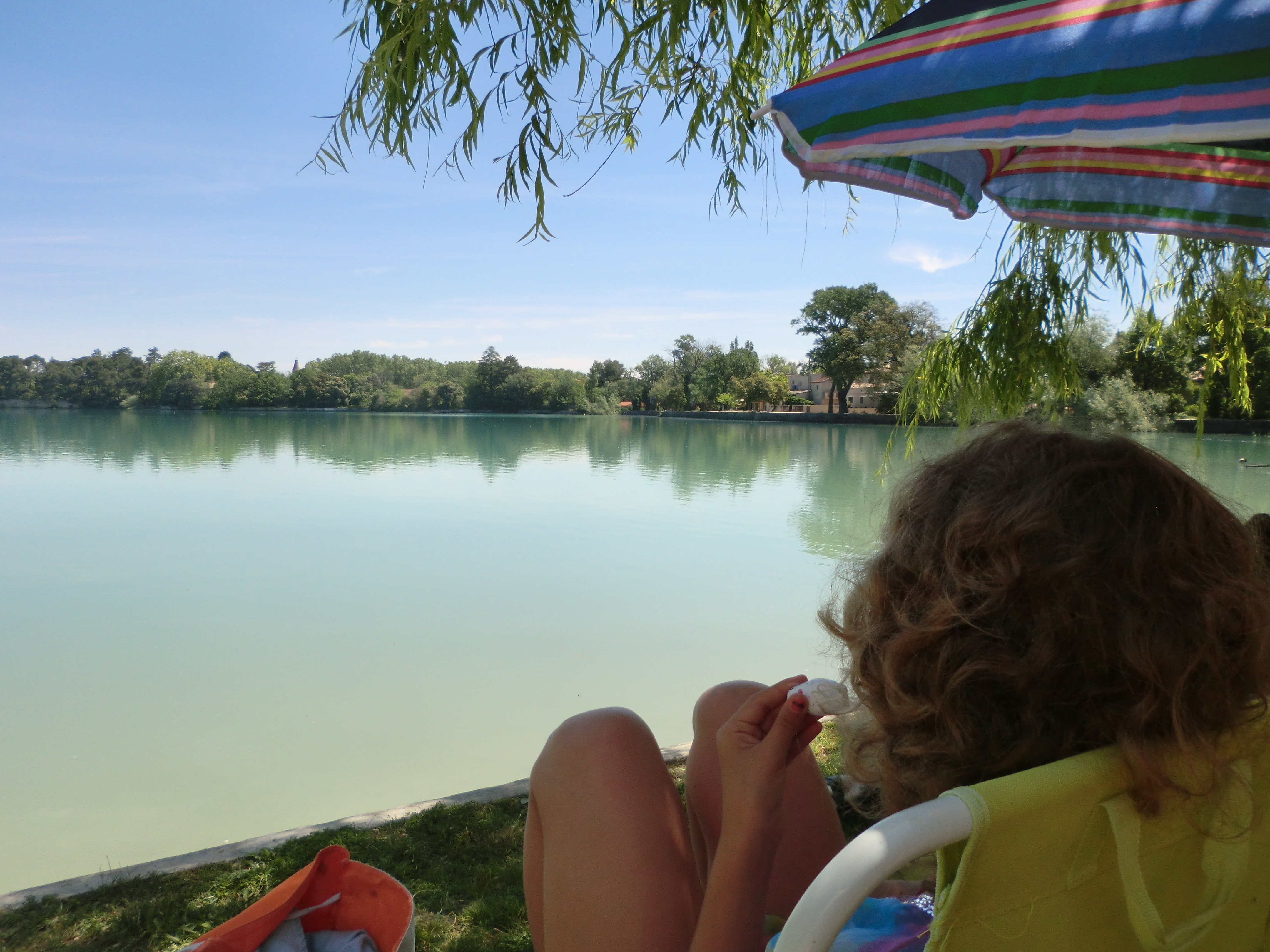
LakesideI read most of Diana Athill’s book in two afternoons, sitting under a willow tree beside the lake L’étang de la Bonde as the children swam continuously, refusing to get out until it was time to leave. Despite the fact that we were outdoors, I felt as if I had just spent two days in Athill’s living room, listening to her share this particular segment of her life, that as Editor at André Deutsch, the publishing house where she worked for four decades.

Stet is not a common word and I am perhaps only familiar with it because, back in the old days, when I was a 23-year-old Market Research Assistant without typing skills, I used to write reports and had a secretary to type them. I even had my own office with a door that could be closed. Using the word stet meant I’d changed my mind after I’d crossed something out, wanting it left in. The Concise Oxford Dictionary tells us :

Not the first of Athill’s memoirs, but the one I was attracted to, since it offers a glimpse inside an Editors office. I had already read and reviewed Betsy Lerner’s The Forest For the Trees, which this book made me recall, you could say they complement each other in a certain respect, though they are very different books, as one might expect when comparing the perspective of an English Editor to that of an American Editor. Both equally interesting and insightful in their own way.

In Part One, Athill shares how she fell into publishing as a career, knowing she would have to find a job, while her great-grandparents generation had made or married into money, her father’s generation had lost it and she talks about many aspects of the job, the decisions that were made, the dramas that were lived and worked through.

“The story began with my father telling me: ‘You will have to earn your living.’ He said it to me several times during my childhood (which began in 1917), and the way he said it implied that earning one’s living was not quite natural. I do not remember resenting the idea, but it was slightly alarming…Daughters would not, of course, have to earn their livings if they got married, but (this was never said) now that they would have to depend on love unaided by dowries, marriage could no longer be counted on with absolute confidence.”

Diana Athill

Diana Athill

The start to her career was disrupted by the onset of the Second World War, however she was fortunate to have a friend working in the recruitment office of the BBC and found an information/research position in the Overseas News Department. She and a friend lived in a small apartment in London and had a good social life, at one of the parties she met the young Hungarian intellect André Deutsch, the start of a lifelong friendship and she would eventually leave her job to join him as a shareholder and working Director when he decided to start his own publishing firm.

Not the easiest of employers, Athill shares some interesting insights about working for an often disagreeable and intolerant man whom she respected despite his deficiencies. She is also quick to point out her own flaws and it is perhaps the counterbalance of their personalities that made them such a successful pair and helped keep the publisher in business for as long as it was able. She also shares her continued love of literature, reading and writing.

Stet“They brought home to me the central reason why books have meant so much to me. It is not because of my pleasure in the art of writing, though that has been very great. It is because they have taken me so far beyond the narrow limits of my own experience and have so greatly enlarged my sense of the complexity of the life: of its consuming darkness, and also – thank God – of the light which continues to struggle through.”

In Part Two, she expounds on her relationship with a small selection of writers, providing a chapter each and very frank accounts of what transpires between Athill, the publishing house and the following authors: Mordecai Richler and Brian Moore, Jean Rhys, Alfred Chester, V.S.Naipul and Molly Keane. One is left with the impression that there was a lot more drama and pandering to personalities in the past than there can be in today’s less nurturing publisher – author relationships. Eye opening indeed!

As I mentioned in the Man Booker Prize longlist post, Diana Athill won the Costa Prize for her most recent memoir Somewhere Near the End in 2009, which she wrote in her nineties, a book which is sure to be equally enlightening and one I look forward to indulging, knowing as I did with this book, it is bound to offer delightful company for future afternoon reading.
CIMG4553

Fetish or Inspiration, Uplifting Shoe Art

manolo blahnok drawings

I mentioned in my recent review of Deborah Batterman’s Shoes Hair Nails that it had reminded me of a book lurking on my daughter’s shelf, a gift from a family member who is a designer.

The book is manolo blahník’s drawings, a small pocket-book of 120 original sketches and quotes that create a visual history of the talent of one of Spain’s most creative and alluring shoe designers. Being a book full of hand drawn images, there isn’t much to say about the content, because it just must be seen and appreciated.

Manolo Blahník

Born in the Canary Islands, he has been sketching shoes since the age of seven and had hopes of becoming a set designer, before fashion editor Diana Vreeland suggested he concentrate on shoes. No surprise that there is a theatricality to his designs and a sense of the artist at work.

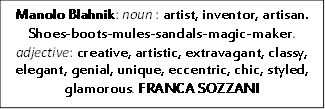
One of the best quotes, this definition of Manolo Blahník, expressed by Franca Sozzani, Editor-in-Chief of Vogue Italia:

Manolo Blahnik

Manolo Blahník

While I am not a great fan of shopping for and trying on shoes, I do love looking at and admiring them and these designs are pure inspiration, going beyond any practical requirement and into the realm of art which is more likely the reason I was so keen to visit the Shoe Gallery when it opened in London a couple of years ago.

These are some of my favourite images from the book.

Manolo speaks through his shoes. For him, the foot, the shoe, implies the whole nature of a person, and expresses a story. ANNA PIAGGI

The day we bought the book (from Liberty’s in London) was also the day of the opening of the Shoe Gallery in Selfridges in London.  A gallery of shoes and in 2010, while the middle class were keeping a low profile in the gardened suburbs due to the recession, it seems the creative younger generation of London were being inspired to flaunt shoe art!

Selfridges Shoe Gallery

Designed by the architect Jamie Fobert and the largest shoe department in the world, it contains 6 salons, 11 brand boutiques and more than 4,000 pairs of shoes. And what an outrageously joyous wander around that was, a gallery with none of the pressure of a shoe shop, one is free to wander around and admire the masterpieces of the many diva’s of shoe design. There was even a Shoe Booth, where you could have a photo taken with your favourite pair, how generous is that!

Instead of one large department, you enter six different zones, each space a character in itself. The line of Spanish alabaster plinths modelling their shoes in regal splendour, give it a real feeling of a gallery, the shoe taking pride of place and unlike in a gallery or museum, all available to buy. The architects only managed to convince Selfridges to go with concept of plinths, having proven that sales of shoes displayed on them, far outstripped sales all other pairs. It seems we all aspire to the pedestal, no matter who or what sits on top of it!

Shoe Cerise

So does anyone own a pair of Manolo’s and is it true that some like Anna Wintour will wear no other?

The Examined Life

Examined LifeRecently I listened to a podcast entitled Literature on the Couch featuring Andrew Solomon, Greg Bellow and Stephen Grosz.

It was the book written by the latter that provoked my interest, Stephen Grosz’s The Examined Life, How We Lose and Find Ourselves. While there are many books one can pick up, which write with a voice of authority and experience on the subject of Freudian psychoanalysis, there are few if any, which have been penned as a practical legacy to the children an author will one day leave behind.

I like the idea of leaving lessons of our life’s learning to one’s children, they are the few people on earth we are able to genuinely love unconditionally and it intrigued me to seek out this book, to see if writing for one’s children on a subject one is something of a professional expert in and having already been reasonably widely published can remove the influence of ego or meeting the expectations of one’s academic peers and make a subject or in this instance many case studies, accessible to the lay person and true to that spirit of sharing wisdom with one’s progeny.

The book is divided conveniently into five sections, beginnings, telling lies, loving, changing and leaving.

CIMG0990

My Other Passion, Distilling Essence

The chapters are like perfume samples, distilled to their quintessential essence yet encapsulating the base notes that make a scent whole or a lesson in life complete. Incredible given that many of the cases he mentions are the product of a year or two of conversation, meeting with a person for fifty minutes, four or five times a week, over a number of years. A life work of more than 50,000 hours listening, learning, resolving, and understanding (or at least trying to).

In Beginnings, the first case that made me go back and reread a few pages was How Praise can cause a loss of confidence and once you’ve read it, you’ll understand the subtle difference between giving praise and giving something else more likely to boost esteem and confidence in children, so subtle and yet so potentially powerful. And what a great gift to pass on to those children, who may one day become parents themselves.

Admiring our children may temporarily lift our self-esteem by signalling to those around us what fantastic parents we are and what terrific kids we have – but it isn’t doing much for a child’s sense of self. In trying so hard to be different from our parents, we’re actually doing much the same thing – doling out empty praise the way an earlier generation doled out thoughtless criticism.

In Loving, the chapter Paranoia can relieve suffering and prevent catastrophe is insightful and may make us more sympathetic to those who suffer from it, particularly the elderly.

With old age, the likelihood of developing a serious psychological disorder decreases, and yet the chance of developing paranoia increases. In hospital I have heard elderly men and women complain: “The nurses here are trying to poison me.” “I didn’t misplace my glasses, my daughter has obviously stolen them.” “You don’t believe me but I can assure you: my room is bugged, they are reading my post.” “Please take me home, I am not safe here.”

Grosz suggests that paranoid fantasies, such as a feeling of being betrayed, mocked, exploited or harmed are a defensive response to the feeling that we are being treated with indifference. They protect us from the more disturbing emotional state, from a feeling that no one cares about us or is thinking about us, that we have been forgotten.

changeIn Changing, we learn how our very survival can be put at risk by our fear of change in How a Fear of Loss Can cause us to lose Everything. How some of us will escape at the very first sign of danger, even if it means doing something we are not used to doing and how others may perish, because of the fear of acting without sufficient information.

“We are vehemently faithful to our own view of the world, our story. We want to know what new story we’re stepping into before we exit the old one. We don’t want an exit if we don’t know exactly where it is going to take us, even – or perhaps especially – in an emergency.”

Overall, an intriguing, easy read including stories which might easily be those we encounter or recognise in ourselves or others close to us and with a clear explanation of the hidden meaning and lessons that can be found within them. Not surprising to see it listed yesterday in the Guardian’s recommended Holiday Reads, literature for the couch, the beach, the balcony or wherever it is you’ll be putting your feet up this summer (or winter if you’re down-under!)

The Faraway Nearby by Rebecca Solnit

After spending a few months with me in London some years ago, a very good friend was about to return to New Zealand and was making some major changes in her life, both personal and in her career. She wasn’t entirely sure what job she wanted to do, but knew it would be in the great outdoors. She loved to travel and she loved nature. I organised a subscription to Wanderlust Travel magazine for her, an inspiration of amazing photography, fabulous ideas for out-of-the-way places to visit and best of all, a link to exciting jobs for those who love to travel across cultures, to be outdoors and meet people.

Milford-Track2

Life on the Milford Track

She completed a diploma, training in the skills required to become an outdoor guide and now works for the Department of Conversation as a guide on the Milford Track, this last season she was based in a lodge, only accessible by helicopter or a few days walk in. She is now living her dream job and it is indeed just like those jobs offered in the pages of that inspiring magazine.

Fast forward a few years and I come across a book called Wanderlust : A History of Walking by Rebecca Solnit. I was interested in it, though stronger was the feeling that I should send it into that remote wilderness to my friend, it seemed to describe where she had arrived at. So I did. I then forgot about the book until I saw the name Rebecca Solnit come up recently on NetGalley, she had a new book coming out The Faraway Nearby. Here is the book I will read I thought and requested it.

Some weeks later while in London one Saturday, I discovered The London Literature Festival was on and at 3.30pm, I could attend a talk by Rebecca Solnit speaking about her book The Faraway Nearby. Serendipity? I bought a ticket, a hardback copy of her book and went to listen to the author, curious, though I had never read a word of her writing.

FarawayThe book is good, but Rebecca Solnit’s ability to captivate an audience is spectacular. I’m almost sorry to admit it, but the live version was even better than the passive written version, which I really enjoyed, the reading experience enhanced significantly by the additional anecdotes and philosophical meanderings of Solnit in person, as she spoke without pause, the voice of a poet.

The talk was hosted by the literary critic Alex Clark, who suggested that the media coined her book not a memoir, but an anti-memoir. Part anti-memoir and part matremoir, it starts with her recounting the gift of 100 pounds of apricots from her mother, one of the few gifts she ever received from her mother and not disconnected from the fact that her mother is undergoing something of a personality change since her Alzheimer’s diagnosis. She lays them out on her bedroom floor, wanting to appreciate their abundance, but instead embraces a soon to be dissected anxiety.

“The fruit on my floor made me start to read fairy tales again. They are full of overwhelming piles and heaps that need to be contended with, the roomful of straw the poor girl in Rumpelstiltskin needs to spin into gold overnight, the thousand pearls scattered in the forest moss the youngest son needs to gather in order to win the princess, the mountain of sand to be moved by teaspoon. The heaps are only a subset of the category of impossible tasks that included quests, such as gathering a feather from the tail of the firebird who loves at the end of the world, riddles, and facing overwhelming adversaries.”


Nature essays, how stories create the narrative of our lives, philosophical meanderings, her chapters weave in and out of many subjects, flitting here and there, as she recounts pieces of a year that passed whilst her mother was regressing. She contemplates and then makes an escape to Iceland, mentions friendships and her passion for visual art, the occasional Buddhist legend, Frankenstein, Mary Shelley and her mother Mary Wollstonecraft, pain and leprosy likening her narrative to a Russian matryoshka doll, even going so far as to repeat chapter names in reverse, once she arrives at the hard core (the doll that has no doll).

“My story is a variation on one I’ve heard from many women over the years, of the mother who gave herself away to everyone or someone and then tried to get herself back from a daughter.”

ApricotsThere are many anecdotes, insights and great lines throughout the narrative, however Solnit stops short of going too deep into her subject, she observes the apricots and watches how they change, just as she does her mother, but stops short of looking too deep into the past, of really describing their relationship and how they were with each other, it is implied, not described.

I understand this reluctance, for that percentage of women out there who had the kind of relationship with their mother that Solnit did, there will be many nods of the head in recognition of what she says without having to go into detail. For the rest, it may seem superficial or even harsh, but they are the words of a mature 58-year-old women, who admits:

“If I had written about her earlier, the story would have had the aura of the courtroom, for I had been raised on the logic of argument and fact and being right, rather than the leap beyond that might be love.”

At the end of the talk, a few people asked questions and at the last minute, but too late I put up my hand, my question deemed to remain silent. Or so I thought. As everyone left the Purcell Room, a woman called Helena sitting next to me who was also visiting from the country for the day, asked me what I had been going to ask. And so I told her – and had a delightful conversation, just as interesting as it might have been, had I asked the author.

The question I wanted to ask was:

Did she believe that a challenging relationship could be a gift, that it could bring her something that she may not otherwise have developed in herself, had it been otherwise?

I suspect the answer is yes, that these relationships do give people something that can be used proactively, if self-awareness is developed to prevent regressing into the negative aspects or effects of those childhood and adulthood experiences. She may not have been able to fix her mother, but it may not be a coincidence that Rebecca Solnit is outspoken and active in terms of her support of nature, the environment, politics and art.

“I didn’t have much sympathy either; it was not that I refused to give it, but that there was none in my equipment yet, perhaps because I had experienced so little of it.”

Note: This book was an Advance Reader Copy provided by the publisher via NetGalley.

She Left Me the Gun

The GunNeither the title nor this book cover would normally attract me towards picking up this book, however it was through neither of those avenues that I came to hear about the book. It was a random tweet that included the following:

Any sentence that contains the words “Maya Angelou and Emma Brockes, who both…” works for me.

I was reading Maya Angelou’s Mom & Me & Mom at the time and so wondered who Emma Brockes was, intrigued by the reader’s comment implying she’d enjoy curling up with both books. I saw that Brockes had published a memoir about her mother and then read an excellent article in The Guardian, where it turns out Emma Brockes works (in the New York office).

Emma Brockes was born in England, her mother leaving her own country of birth South Africa in her early twenties. After some years living in London, she met her husband and they moved to an English village. She was a mature mother, having her only child later in life and lived a quite routine-lead life with her small family and had a job doing accounts for a jeweller in a neighbouring town.

Brockes recalls her mother mentioning that she’d one day tell her about her life in South Africa before coming to England, however the daughter didn’t press her mother and that moment of revelation never arrived. Apart from a couple of offhand comments hinting at some dark past and a court case, any opportunity to quietly share her past with her daughter in her later years was cut short by her illness and premature death, a time when the days seemed better spent just appreciating each other’s company.

It seemed absurd at this stage to ruin what time we had left with painful and long-avoided subjects.

Whether it was the journalist instinct or some kind of closure in making an effort to understand her mother more fully, Brockes decides to find out what it was that drove her mother to abandon her family and her country and never look back.

Jo'burg High Court

Jo’burg High Court

Knowing there was a court case against her grandfather and using her journalistic knowledge and access to resources, she searches archives, only to discover an earlier judgement, one that preceded his marriage to her grandmother, a murder conviction.

She requests the file to be sent to her and then discovers the second court case, in which mother is named in bringing a charge against her own father. The file is too large, so she makes plans to visit South Africa to do her research and to meet the numerous family members, her mother’s half sisters and brothers, the seven aunts and uncles who live there.

When she was in her mid-twenties, she said, she’d had her father arrested. There had been a highly publicized court case, during which he had defended himself, cross-examining his own children in the witness-box and destroying them one by one. Her stepmother had covered for him. He had been found not guilty.

Emma Brockes

Emma Brockes

This is a book that once started is hard to put down, the way Emma Brockes writes, it is as if you are on the same journey, with the same feeling of curiosity tempered by an instinct not to get too involved.

In fact, for me there was a turning point somewhere in her travels, just when she starts to become part of a local crowd of journalists, when she begins to become part of the weave of family fabric, when it felt like it was time to get out. That while she was there and had a clear purpose and was fulfilling some kind of tribute to her mother, all was well, but that getting any further involved might in some way rub something into her that her mother had spent a lifetime trying to protect her from.

She was right to leave when she did.

And the gun? Well you know whenever a gun is mentioned, a shot must be fired and so it was, yet while the title stretches the truth somewhat, all must be forgiven, since it was suggested to the author by the late Nora Ephron, another fitting tribute.

Note: This book was an ARC (Advance Reader Copy) provided by the publisher via NetGalley.

London Literature Festival #londonlitfest

Late last week I was working in London and had a free Saturday to enjoy the delights of the city.

Providores

The Providores + Tapa Room

I was meeting a friend for brunch in Marylebone High Street, ironically it is London’s French quarter, many of the shops and cafés and boulangeries are very familiar; however we weren’t heading for a French café, we couldn’t help but be tempted by one of New Zealand’s greatest exports, chef Peter Gordon and his restaurant The Providores with its excellent downstairs Tapa Room, the all-day restaurant, café and wine bar.

London's South Bank Centre

London’s South Bank Centre

Before heading out, a quick google search “literary events London” informed me that the London Literature Festival was on, I couldn’t believe it!

So after a terrific brunch, off I went to the South Bank Centre and the Royal Festival Hall, always a hive of activity at the weekend, and hive  an apt metaphor, as the festival was using the image of a bee and honeycomb in its publicity.

Don’t you just love those sun loungers outside Foyles bookshop. Bliss!

To my delight and surprise, the American essayist and writer of non-fiction Rebecca Solnit, was speaking in the late afternoon, so I avoided the pull of Foyles to buy a ticket and then decided to check out The Spectacular Translation Machine, a collaborative attempt to translate an entire book from French into English.

CIMG4524The book On Les Aura! was the private diary of a French solider written in 1914 , which the renowned illustrator Barroux discovered and published in France, adding his line drawings to bring the story to life. It has never been translated into English, so each illustration along with the short paragraph of text was hung on a line around a room in the Royal Festival Hall and members of the public invited to choose an image and attempt the translation.

I chose an illustration of the solider lying in bed and a steaming cup of coffee beside him. The paragraph underneath the illustration read:

Je m’éveille après une bonne nuit de sommeil et je trouve un bol de café fument. Quel changement ! J’écris a ma chère femme pour la rassurer et lui envoyer mon adresse. Vers 10 heures, le Major passe la visite.

Along with children, a couple of students, a woman who could speak 15 languages and anyone else wanting to give it a go, we sat at the table and worked on our translations in a wonderful community approach. Such fun!

From there, a quick scout of the bookshop Foyles where I picked up a copy of Chinua Achebe’s Things Fall Apart and a copy of The Artist’s Way.

CIMG4528Then on to the Queen Elizabeth Hall for an inspiring talk by Rebecca Solnit, author of The Faraway Nearby, hosted by the literary critic Alex Clark. Solnit’s book was already on my list and downloaded to the kindle to read, but jumped to the top of the pile after an engaging talk about apricots, Alzheimer’s, Iceland and the significance of stories in our lives. A very poised and engaging speaker with scores of anecdotes and quotes that she repeats without hesitation.

It must be the season for book readings, because I am back in Aix and today we have had Jonathan Coe participating in an excellent and well hosted and translated discussion. More on that soon!

*

CIMG4522

Portrait of a Turkish Family by Irfan Orga

The last of my collection of Turkish literature either brought back from Istanbul or lying on the shelf unread, Portrait of a Turkish Family was hailed as a masterpiece and I have to agree, a timeless classic, capturing a changing way of life as a consequence of war and fire, two of Turkey’s most fearsome destroyers of many families life of peace and tranquility that preceded them.

Orga IrfanIrfan Orga was born in 1908 in Istanbul, his mother only 15 years old, his father 20 and a younger brother Mehmet born two years later. His sharing of the family story really starts at age 5 when he remembers certain events with an amazing clarity, although many memories and conversations are clarified in greater depth later on to him by his mother. His curiosity and gift for eavesdropping apparent early on and perhaps those memories are so clear because life was soon to change dramatically.

By 1913, war was imminent and it was clear that Irfan’s father and only uncle were going to be called up. He sold the family business which hadn’t been doing too well, against his mother’s wishes, before being sent to war, in the hope that there might be something to come back to, a fresh start.

Ottoman uniforms WWI

Imperial Army workshop making uniforms

Once the men left for war, the family, raised and assisted by servants, continued largely in ignorance of what was to come, until food became scarce and their roles began to change.  As time went on, war forced everyone to adapt without realising that life would never again be as it had been before.

As change burrowed permanently into their lives, each would suffer in their own way, the coping mechanism of one often causing suffering in another.  Mother, mother-in-law, and the two boys were forced to move houses, downsizing significantly and rebelling against this change Irfan’s mother ripped the kafes from the windows of the house, insisting on letting the light in.

Kafes are the closely latticed harem shutters always used in Ottoman times to prevent passing males from catching glimpses of the women who moved within the house, not so much in evidence today, due to the neglect that makes them a significant fire risk. As back then, even today many families struggle to afford the upkeep required to take care of these houses, thus they crack, peel, rot and deteriorate into an unlivable state, when not consumed by fire first. We were fortunate to see this excellent restored house near Topkapi Palace and its equally neglected counterpart on Heybeliada Island below.

Without giving anything away, because it is so much better to experience the book, Orga captures the events and dramatic turning points of his family life with insight and brutal honesty. It is heart breaking at times, in particular the relationship between the mother and her sons, of which there is more focus than with his younger sister, born later and not always sharing the same experiences as the two boys.

The Orga Family

The Orga Family

Orga left Istanbul in his 30’s after a period in the Air Force to come to England and eventually married his Norman-Irish wife, amid controversy, not least of which it being deemed an illegal act in Turkey at the time, thus apart from one return visit, he was forced to remain living in exile in England.

His son Ateş Orga contributes a heartfelt afterword, sharing something of his father’s life outside the scope of his book, which focuses on those first 30 years of his life in Turkey.

A brilliant read, full of insight into life in a liberal Muslim family at the beginning of the 20th century and their challenges in coping with the effects of war and devastation.

It seems timely to be reading this as contemporary events overshadow historical reflections, provoked by the seizure of one of the last remaining urban parks in central Istanbul, it is being reclaimed to build a shopping mall and the citizens begin to revolt against what they perceive as authoritarian rule.

Ironically, on our last day in the city 2 weeks ago, we tried to find Taksim Square and Gezi Park, but all we found was a corrugated iron fence and a sea of humanity traversing the great shopping street between Taksim and Tunnel. It had been said that you haven’t seen Istanbul if you have not visited this area, but I was at a loss as to what I was supposed to find, all trace of restive beauty hidden and on the verge of replacement.

I am reminded of Pamuk’s Istanbul Memories of a City and the many pages of hüzün, that sense of melancholy that has hung over the city since Ottoman times and can’t help but wonder if the time for silent brooding is erupting into a new age of outspoken demonstration.CIMG4470

And all down the Bosphor, down, down to the Black Sea, ran the tall trees and the old wood houses that suit the skyline so well. If I turned my head to the left there on the hilltop, I could see Dolmabahçe Saray white and artificial as a wedding cake in its peaceful setting. Miniature mosques front the water’s edge and there at the end of all the shining palaces lay Istanbul – my Istanbul that will forever hold something of my heart. Grey it would look from this hill and the smoke from the boats would lie over it like a soft veil and tall and tapering are the minarets that enchant the skyline, and from my hill I would see, being the Mosques, the Marmara like a faint line of thread. Irfan Orga

Istanbul Memories of a City by Orhan Pamuk

IstanbulAlthough I carried the book  to Istanbul and back, there was no inclination to read it while I was there, I started it on the return plane journey, the appropriate occasion to do so, for Pamuk’s Istanbul is laced with more melancholy than the city I visited and I realise with hindsight, the importance of constructing my own unfettered impressions, free of this philosophical consequence of the decline of a grand empire and the inclination of its progeny to feel somewhat bereft at missing out on an era when their prominence was that much greater than it is today.

However, I remain as intrigued about the author now as I did before I started the book, it is a unique form of memoir, more of a nostalgia trip through selective memories of his childhood and his city, sharing anecdotes from both that formed him into the writer he is today.

The imagination features large in Pamuk’s  life from a very young age, when he was five-years-old he was sent to stay with an Aunt on his own and she used to point at a picture of a child and say it was him. He came to know him as the other Orhan and while he knew it was not him, this shadow of himself never left him behind. Neither did he ever leave the city of Istanbul in the fifty years up to writing this book.

CIMG4275“But the ghost of the other Orhan in another house somewhere in Istanbul never left me. Throughout my childhood and well into adolescence, he haunted my thoughts.”

Though he never left the city, he read many works by writers and poets who published impressions of Istanbul, Gustave Flaubert, the poet Gérard de Nerval, Théophile Gautier, Pierre Loti, Edmondo de Amici and laments that in the same period they were writing about the city,  little was written or painted by its own artists and writers, therefore, whilst the work of others is familiar, it remains an outsiders perspective and does not quite capture the essence of how the Istanbullus see themselves.

Pamuk often visualises the city in black and white and throughout the book on nearly every page are photographs depicting the city in monochrome. He spends an entire chapter describing Hüzün, the Turkish word for melancholy explaining how if differs from sadness and finishes by almost convincing the reader that it is something close to a virtue, absorbed with pride and shared by a community.

“the hüzün of Istanbul is not just the mood evoked by its music and its poetry, it is a way of looking at life that implicates us all, not only a spiritual state, but a state of mind that is ultimately as life affirming as it is negating.”

“… hüzün brings us comfort, softening the view like the condensation on a window when a tea kettle has been spouting steam on a winter’s day.”

CIMG4331

Entrance to the Grand Bazaar

I did not come to Istanbul expecting to see sultans, dervishes or crystal chandeliers, though there are traces of them all if you seek them out. I came to see a city that comfortably exists while straddling two sides of a significant divide.

Bosphorus

The Bosphorus with the Castles of Europe and Asia by Thomas Allum

The Bosphorus, that deep channel of powerful surging water and current that separates two continents is deceiving. The reasonably short distance from one side to the other, only 2 to 3 kilometres, the fact that it embraces one city reminds us that there is less than we might think between the people who inhabit each continent.

A deep and powerful separation of continents, yet humanity passes across it with ease. Great divides can indeed be overcome.  The streets of shops and the Grand Bazaar attest to that passage of traders and pilgrims who have entered and passed through the city over hundreds of years.

It takes until the very last chapter before we meet the more mature Orhan who will become a writer, because unlike many born to write, his first love was painting and he shares much through his observation and study of artists who painted his city, something he practiced prolifically in his youth. The demise of this early calling occurred not long after his teenage muse was packed off by her family to Switzerland, his mother’s relentless cautions against pursuing the life of an artist transforming his rebellion against completing his architectural studies into announcing:

“I don’t want to be an artist.” I said. “I am going to be a writer.”

CIMG4495

“I was, as I had begun to discover even then, the sort who could always wear the same clothes and eat the same things and go for a hundred years without getting bored so long as I could entertain wild dreams in the privacy of my imagination.”

A treat for admirers of Orhan Pamuk’s work and those who have had the good fortune to visit his wonderful city, which is not nearly as melancholic to the visitor as it is to a philosophical resident.

Next up, murder at an archaeological dig! Time to leave Istanbul and travel inland with Ahmet Umit.

Women’s Prize for Fiction Shortlist & Pulitzer Prize 2013

Womens prize logoThe long-list becomes the short-list and it looks like a strong line-up for the Women’s Prize for Fiction 2013. Here is the short list:

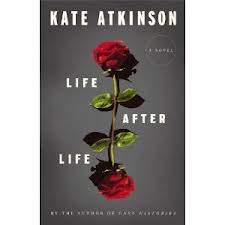
Kate Atkinson Life After Life – my review here

A M Homes May We Be Forgiven

Barbara Kingsolver Flight Behaviour

Hilary Mantel Bring Up the Bodies

Maria Semple Where’d You Go, Bernadette

Zadie Smith NW – my review here

Flight Behaviour (2) NW life after life

Here’s what Miranda Johnson, Chair of the Judges had to say:

‘The task of reducing the list of submissions from over 140 to just 20 books was always going to be daunting, but this year’s infinite variety has made the task even trickier. The list we have ended up with is, we believe, truly representative of that diversity of style, content and provenance, and contains those works which genuinely inspired the most excitement and passion amongst the judges. I don’t anticipate the job becoming easier at the next stage!’

I have managed to read two that made it through, plus others from the long list including Honour, Ignorance and The Light Between Oceans. I am currently slow-reading Barbara Kingsolver’s Flight Behaviour, she won the prize in 2010 with The Lacuna, one of the first books I reviewed here. Zadie Smith is also a previous winner, her book On Beauty won in 2006.

I was sure that Atkinson and Smith would make the list, not only because the stories are engaging, but because they dare to step outside the ordinary and test the boundaries of convention, Life After Life likely to be a more popular read, but both deserving their place here.

I know many will be surprised yet delighted to see Maria Semple’s Where’s You Go Bernadette on the list and of course the inevitable Hilary Mantel, no surprise there. Will anyone be able to knock her off her current perch I wonder?

The winner will be announced at a ceremony at the Royal Festival Hall, London on 5 June.

The Guardian – Women’s prize for fiction reveals ‘staggeringly strong’ shortlist

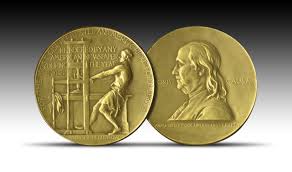
Pulitzer Prizepulitzer

Amid the terrible news that saddened and horrified us all in Boston yesterday, a day that should have been cause for calm celebration, the annual Pulitzer Prizes for 2013 were quietly announced.

The Snow Child was one of the three finalists for the fiction prize, the winner was The Orphan Master’s Son by Adam Johnson, a timely journey in the heart of North Korea.

It was good to see a non-fiction title I enjoyed and recommended last year Tom Reiss’s Black Count: Glory, Revolution, Betrayal, and the Real Count of Monte Cristo win the biography prize. My review here.

Lost Cat, Found Humour

There’s little enough humour in our lives and when there is, we don’t always appreciate it or even get it. I admit there is a lot of humour that doesn’t work on me, it’s not enough to know the English language, the cultural  and political context is critical and as for French humour – way too difficult! – however I do admire anyone able to write with humour, speak with it or just be it!

012413_1956_LostCatFoun1.jpgCaroline Paul has something of the gift, in a kind of self-deprecating way, and her book Lost Cat, allows us to have a few laughs at her expense, although they are situations that could equally apply to many of us and especially cat and dog owners.

She has written this light and entertaining tale which will appeal to all ages, a story of love, desperation and the many tools available to obsessed animal lovers in search of a missing pet. It is a true story which comes with a caveat, three in fact, (1) painkillers, (2) elapsed time, (3)normal confusion for people of a certain age.

Knowing that the author has previously written a book about her job as a fire-woman,  it came as less of a surprise to learn that she was involved in a light plane crash in an ‘experimental plane’. Her sense of humour is established not long after this revelation when hospital staff inform her that she has broken her tibia and her fibula.

“The Tibia and Fibula?!” I said, tasting the blood in my mouth, feeling the bruises on my arm, laughing through my morphine haze. When I explained that these were my cats, the staff just nodded, expressionless; to them, I was just another numskull hallucinating on a gurney. But it was true. Two thirteen –year-old tabbies, affectionately nicknamed Tibby and Fibby, were now wondering where the heck I was and why I hadn’t come home.

The accident leads to a period of enforced convalescence and a bout of the blues ; she is unable to venture out, most likely taking up too much space, both mental and physical in what had been the cats’ territory. The home dynamic has also changed since the author became involved in a new relationship, her partner not exactly a cat lover, although as a graphic artist, she has contributed sketches to the book that add to its entertainment value.

Then, a month into her recovery, without warning, something terrible happens. Tibby disappears.

Caroline panics and in the aftermath of his disappearance indulges every possible theory to find out where he is, from walking the neighbourhood to visiting the pound, from prayer to consulting a psychic. Then five weeks after his disappearance, Tibby returns, just like that.  In perfect health.  He’d even gained half a pound and his coat was as shiny as silk.

Confusion. Jealousy. Betrayal. I thought I’d known my cat of thirteen years. But that cat had been anxious and shy. This cat was a swashbuckling adventurer back from the high seas. What siren call could have lured him away? Was he still going to this place, with its overflowing food bowls and endless treats.

012413_1956_LostCatFoun3.jpg

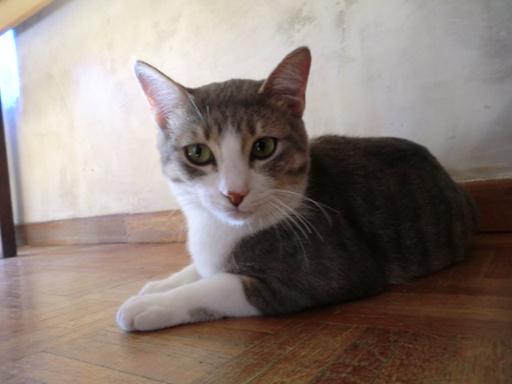
Allia’s cat Noisette

Rather than accept the fact he is safe and has returned, the author then turns detective to try to figure out where he has been, some place he’s clearly still visiting as he is no longer interested in his food. This when I discover things about animal behaviour and the obsessions of animal owners that have me laughing out loud and wanting to tell everyone about  all the crazy things it is possible to spend your hard-earned cash on when you are under the influence of an animal obsession.

And then I quieten down, remembering I have a ten-year-old who is heading in that direction, big time. I’m just thankful that dinosaurs are extinct or he’d be begging for a pet one of those too! I’m afraid of what will happen when he becomes financially independent, the ‘overflowing with life’ rooms, in the virtual home he has created online, possess no furniture or accessories, unless you call a peacock in the living room an accessory.

Camping Neighbours cat – can you believe this cat goes camping!

Where do our pets go and what do they do, when we’re not around? And why? Aren’t we enough for our furry companions? For animal lovers, these are the ultimate questions. And so began a quest familiar to anyone who has realised that the man in their life isn’t who he seems: the quest to find out where Tibby had been for those five weeks.

This book landed on my lap in a busy work period a little while ago and was the perfect antidote, even if you are not a fan of animals, it is worth reading for the enlightenment of the lengths people will go to, to understand their animal.  I wish this book had been available just before Christmas, it’s the perfect gift. There’s always next Christmas! I’ll be buying multiple copies.

Highly recommended.

Note: This book was an Advance Reader Copy provided by NetGalley on behalf of the publisher.