
 I was intrigued to read a book by a Mauritian author during Women in Translation month. Eve out of her Ruins hadn’t been on my initial list, but it was recommended to me and I decided to get a copy especially as I’ve been seeing many images of the island of Mauritius recently.
My Uncle is spending some months there at present, designing a noir thriller film called Serenity, starring Anne Hathaway and Matthew McConaughey. A fishing boat captain’s past is about to crash up against his life on a tropical island.
Thank you Andrew McAlpine for the photos shared below, which so well depict the contrasts of Mauritius.
Ananda Devi writes from her roots. Deep within the Indian Ocean, Mauritius was colonised by Dutch, French and English explorers, traces of this colonial past remain evident both in the landscape and among the languages spoken by its multifarious population, descendants of settlers, slaves, indentured servants, and finally immigrants.



Though the blurb does mention the novel is enchanting and harrowing in equal measures, it is the story that is harrowing and the lyrical prose that is enchanting.
…she has trained her novelistic gaze on disenfranchised populations and the ways in which femininity is shaped and established. Her gorgeously hewn sentences rarely shy away from depicting violence or suffering; her novels, rather, embrace the entirety of human experience, from abject suffering to unalloyed joy. Jeffrey Zuckerman, Translator
The novel is narrated through four teenage voices, two young men Saad and Clélio, who like many young people on the island are bored and belong to a gang, not through any desire to cause harm, but almost to create some kind of a sense of community, their destructive tendencies more a result of a restless energy that has no other channel.
Saadiq, though everyone calls him Saad is in love with Eve and wants nothing more than to be able to protect her, and though she is used by everyone, there is something between these two, something that both draws them together and keeps them apart. He loves words, he expresses himself through the poetry of others, inscribing lines upon a wall, when he finds the phrase that resonates.


“Our cité is our kingdom. Our city in the city, our town in the town. Port Louis has changed shape; it has grown long teeth and buildings taller than its mountains. But our neighbourhood hasn’t changed. It’s the last bastion. Here, we let our identities happen: we are those who do not belong. We call ourselves bann Troumaron – the Troumaronis – as if we were yet another kind of people on this island filled with so many kinds already. Maybe we actually are.
Our lair, our playground, our battleground, our cemetery. Everything is here. We don’t need anything else. One day we’ll be invincible and the world will tremble. That’s our ambition.”
The two girls Eve and Savita are friends, the light in each others eyes and lives, something observed by the boys that generates jealousy and inspires something terrible.
There is a second person narrative throughout, written in italics, employing the you voice, an omniscient presence that sees everything, enters the minds of characters, in particular Eve and all who encounter her, it understands everything and voices thoughts that can not be expressed.
Out of distress. Out of misery. Confirming angrily, belligerently, hopelessly, what they’re all thinking, over there, outside.
Being. Becoming. Not disappearing in your eyes. Escaping the straitjacket of passivity, of idleness, of failure, of ashen gazes, of leaden days, of sharpened hours, of shadowy lives,of faraway deaths, of gravelly failures, of lingering, of nakedness, of ugliness, of mockery, of laughter, of tears, of moments, of eternity, of shortness, of heaviness, of night, of day, of afternoons, of dawns, of faded Madonnas, of vanished temptresses.
None of that is you.
It is a tragic account, full of foreboding, it seems as if there is no escape, the one that did, a brother, promised to return, a hollow promise.
She forces open a door in darkness’s wall. This opening indeed reveals the beauty of the island, of this gift from the gods that is Mauritius, this gift that humans do not deserve but only a few innocents may ever see. J.M G. Le Clézio


 Nothing Holds Back the Night is the book Delphine de Vigan avoided writing until she could no longer resist its call. It is a book about her mother Lucile, who she introduces to us on the first page as she enters her apartment and discovers her sleeping, the long, cold, hard sleep of death. Her mother was 61-years-old.
 I read this book in a day, it’s one of those narratives that once you start you want to continue reading, it’s described as autofiction, a kind of autobiography and fiction, though there is little doubt it is the story of the author’s mother, as she constructs thoughts and dialogue inspired by the information provided by family members, acknowledging that for many of the events, some often have a different memory which she even shares.
 After her abrupt departure from Paris back to her father’s home in Montigny, to the village home where she grew up, I was curious to know what was to come of our troubled Claudine and her errant husband.
 However he is more than happy that she spend time with his sister Marthe, about whom he writes:
 I loved Claudine at School for her exuberant overconfidence and love of nature, Claudine in Paris for her naivety and prudence, realising there was much about life she had still to learn and Claudine Married for the melancholy of marriage, of the realisation of her false ideals and indulgence of strong emotional impulses.
 The impulsive Claudine, thinking a marriage of her own making and choice (not one chosen by her father or suggested by a man who had feelings for her that weren’t reciprocated) embarks on her marital journey which begins with fifteen months of a vagabond life, travelling to the annual opera Festival de Bayreuth, in Germany, to Switzerland and the south of France.
 Their relationship plays itself out, up to the denouement, when Claudine seeking refuge decides to return to Montigny, to the safety of her childhood home, the woods, her animals whose loyalty she is assured of, and the affection of the maid Mélie and her humble, absent-minded father.
 If Claudine at School represents the unfettered, exuberant joys of teenage freedom, of the innocent and immature love between friends and the cruel indulgences of playful spite, Claudine in Paris is the slap in the face of regarding an approaching adult, urban world, one where the streets are inhabited by hidden dangers, the skies are more gloomy, people are not what they seem, even old friends from school become unrecognisable when the city and her frustrated inhabitants get their clutch onto the innocent.
 Claudine develops an attachment to one of the Assistant teachers, nineteen year old Aimée and in order to spend more time with her exclusively, organises private English lessons at home. This seems to turn the new Headmistress against her even more so than was initially apparent, revealing a complex female tension within the school, tolerated only because of the Headmistress’s special relationship to the District Superintendent of Schools.
 The year passes with the continued dramas between the students, Claudine reconciles herself to friendship with Luce, the younger sister of Aimée, who complains incessantly of mistreatment by her older sister, whose sole attentions are for the Headmistress.

 Below is a summary of
  As The Story of the Cannibal Woman opens, we learn Rosélie is a 50-year-old recent widow, living alone, without family connections and few friends in Cape Town, South Africa, after the brutal murder of her white British husband, a retired university professor, who nipped out after midnight one evening, allegedly to buy cigarettes and never returned home.
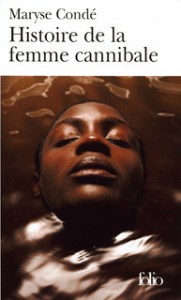 At the same time Rosalie is going through her crisis, there is a well publicised case in the newspapers of a woman named Fiela, who allegedly murdered her husband. In court she refuses to speak, the public begin to turn against her, some calling her a witch, others a cannibal. The police officer on Stephen’s case wonders aloud whether she might open up to Rosalie, as many of her patients do. Rosalie has imaginary conversations with Fiela, the one personality to whom she feels able to ask questions (albeit in her dreams), that she can not utter to anyone else: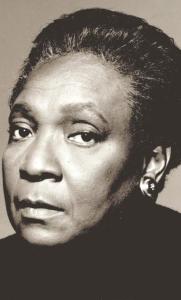
 Ladivine, written by the Senegalese-French writer Marie NDiaye, known for her 2009 Prix Goncourt award-winning Trois Femmes Puissantes (Three Strong Women) came to my attention when it was longlisted for the Man Booker International Prize in 2016.
 “NDiaye’s novels frequently feature biracial couples, absent or distant fathers, and strained filial relationships. Her characters often feel ill at ease within their communities, and struggle with doubts that they are not who they believe or wish themselves to be.” New Republic, The Metamorphoses of Marie NDiaye by Jeffrey Zuckerman
 Rachel Cooke in this Guardian article
 It should have been perfect, but things change when an old friend of her mother’s Anne arrives and she and her father announce their intention to marry. Although it is actually something Cecile feels is right for them and she adores Anne, part of her resents what signifies to her the end to the playful era she and her father have indulged, for Anne’s presence in their lives will certainly bring order and sensibility.
 Word by Word