
Infinite Country opens with the thrilling escape of teenage Talia from a girl’s reform school in northern Colombia, pulling us into her story very quickly. Her escape is motivated by the desire to get home to her father who holds a plane ticket for her, a week hence, that will enable her to return to her birthplace, to her mother and two siblings whom she hasn’t seen since she was a baby.
Talia’s journey south threads throughout the narrative, like a serpent meandering towards its den. Confident in her ability to arrive at her destination, intuitively driven.
 The story reverses and we learn how it came about that Elena and her children Nando and Karina are in America, while Mauro and Talia are in Colombia. How dreamer Mauro fell in love with contented Elena, in the market, their lives being played out on a small canvas until Mauro shared his dream and Elena facilitated it.
The dream becomes the nightmare of survival as their visas expire and they’re part of “the undocumented” moving from place to place in search of work until the day Mauro gets caught, and not long after swiftly deported. Elena becomes the sole bread winner for the family, leading to more heart-breaking events that unfold.
As I read their story, it held the echo of hundreds of couples, of families, split and fragmented by migration, exile, circumstance. This section is written in the slower form of a narrative summary, though equally compelling due to the feelings and questions it evokes in the reader as we read. And just as we begin to wonder where the action is, it shifts back to Mauro and we witness his tumultuous return to Elena’s mother Perla, who will raise his child, Talia.
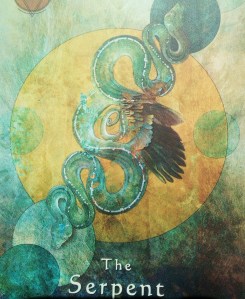 It’s an interesting blend of narrative perspectives, the switch between Talia’s adventurous journey south and the backstory of how she came to be escaping to escape, including her parents story. Through Mauro and Talia we are also exposed to their cultural stories, the Andean myths of their people, of serpent, jaguar, condor and the one story that haunts Mauro, one he wished he’d never learned, that he will never tell.
Mauro appreciated that these stories offered explanations for his being, reminded him there was another land, a better one of divine logic wrapped inside this professed tierra de Colón, that he wasn’t pacing the earth blind as he often felt and Creation provided clues that made paths clearer, as simple as the blackbird song that announces oncoming rain and the whistles of the Andean sparrow that signal the clouds will soon part.
Near the end, it switches again to a second person “you” voice, and it’s Nando speaking to his sister Karina. For the reader, this is as abrupt as the deportation of the father, a seismic shift of sorts.
It switches again to the first person “I”, the quiet reassuring voice of Karina, and we learn it is she who has been telling us this story all along.
It’s a thought provoking story of one family that is reminiscent of so many, universal and yet particular to this one family, brilliantly showing the struggle not just to survive in a new country, but to survive leaving, to survive separation, to develop the strength required to hold steadfast to a dream and if not to the dream, to one’s family, who will change, evolve, split, fragment, become something other.
From an interview with Adrienne Westenfeld, Esquire Patricia Engel Captures The Interior World of Immigration
You write at the end of the novel, “Maybe there is no nation or citizenry.” What do borders mean to you?
PE: I think something that has always sparked my curiosity, as somebody who loves animals and nature, is how we can watch endless documentaries marveling about the miracle of migration when animals do it and how they know how to cross other lands in pursuit of resources.
What doesn’t occur to us are the ways that the human species is a migratory species, which has ensured its own survival, literally, because of the instinct to migrate. Borders are ever-changing things, as we’ve seen; countries often change them, rename themselves, and cede parts of their borders to other countries.
Borders are man-made, designed to serve special interests, and really are not natural. We shouldn’t be surprised by the ways they fall short of what human instincts and human needs require.
About the Author, Patricia Engel
 Patricia Engel has written a number of award winning, internationally acclaimed novels, including The Veins of the Ocean, It’s Not Love, It’s Just Paris and Vida, for which she was the first woman to be awarded Colombia’s national prize in literature, the 2017 Premio Biblioteca de Narrativa Colombiana. Her books have been translated into many languages, her short fiction widely published and her criticism and essays have appeared in The New York Times, Virginia Quarterly Review, Catapult, and in numerous anthologies. She currently teaches creative writing at Miami University.
Patricia Engel, herself the daughter of Colombian immigrants and a dual citizen, gives voice to Mauro, Elena and their children – each one navigating a divided existence, weighing their allegiance to the past, the future, to one another, and to themselves. Rich with Bogotá urban life, steeped in Andean myth, and tense with the daily reality for the undocumented in America, Infinite Country is the story of two countries and one mixed-status family for whom every triumph is stitched with regret and every dream pursued bears the weight of a dream deferred.
N.B. This book was an ARC (Advance Reader Copy) kindly provided by the publisher via NetGalley.


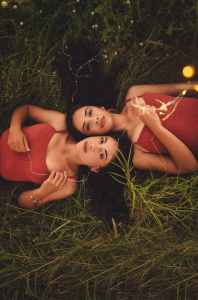
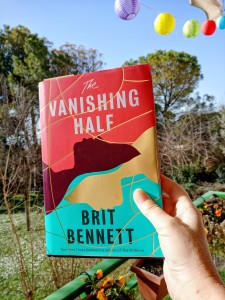 Brit Bennett’s novel features identical African American twins who leave home suddenly to make their way in the world, and looks at all the ways people survive and hide things about themselves, keep secrets and the impact that has not just on themselves but on others around them. And the many ways one can lose oneself.
 Born and raised in Southern California, Brit Bennett graduated from Stanford University and later earned her MFA in fiction at the University of Michigan. Her debut novel
  Although I was aware that this book won the popular Costa First Novel Book Award in 2019, I became intrigued to read it after listening to the author Sara Collins
 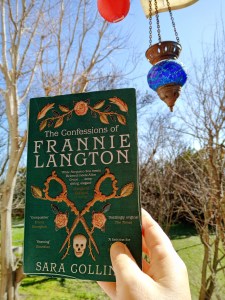 The first part of the book is set in Jamaica as Frannie narrates her story, although the opening pages are set in The Old Bailey courthouse, from where she sits accused of murder and in this short narrative, she addresses “you” the person she is telling this story, her lawyer.
 A little way into reading, I had to pause and go back to the beginning, because this story is told not in a linear way, but in a spiral and with multiple perspectives that to me didn’t relate to what the blurb says this book is about.


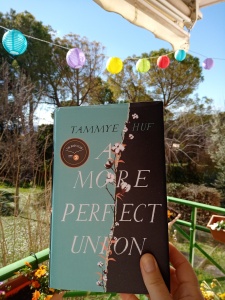 Henry is making his living as a blacksmith, after the disappointment of arriving in New York and struggling to find work due to discrimination by employers against the Irish –
  Tammye Huf is an American author now living in the UK. Her debut novel A More Perfect Union was inspired by the true story of her great-great grandparents, an exploration of identity, sacrifice, belonging, race and love. It was featured on the Jo Whiley Radio 2 Book Club.
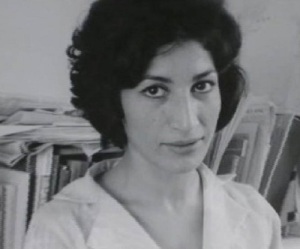 Farrokhzad (1935-1967) published poems that radiated sensuality, plunging depths of emotion, challenging the patriarchal conventions of society and transcending the acceptable boundaries of women’s expression, let alone commit to paper and public record. She wrote of love without shame, removing the invisible but ever present mask the culture adorned women with.
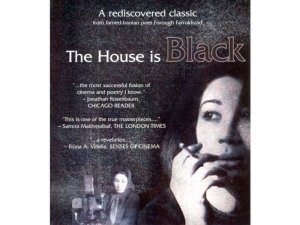 The middle parts are often only a few pages long, marking various transitions in her short life, her nine months in Europe when she flees Iran enable her to gain a different perspective but also make her realise she can’t be away from her family and her son.
 I’ve been aware of The Balkan Trilogy for a while and curious to discover it because of its international setting (Romania in the months leading up to the 2nd World War) though equally wary of English ex-pat protagonists living a life of privilege cosseted alongside a population suffering economic hardship and the imminent threat of being positioned between two untrustworthy powers (Russia and Germany).
 The novel becomes even more interesting and ironic when Guy decides to produce an amateur production of the Shakespearean play Troilus and Cressida, deliberately diverting the attention of his fans and followers, young and old, at a time when war is creeping ever closer and everyone else not involved in his amateur dramatics is frantic with worry. The play is the tragic story of lovers set against the backdrop of war.
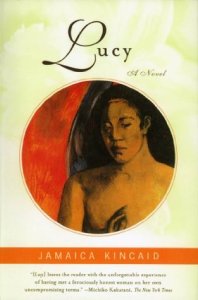 Lucy is a 19 year old woman who has left her home in the West Indies and come to America to be an au pair for a family of four young children. The book is set over one year, her experience as a new, young immigrant.

 Word by Word