
I think this is one of the most popular reads of 2020, it’s also on the Dublin Literary Award longlist 2021 a recognition of the votes of libraries and readers from around the world.
Passing
I thought initially it was a novel about ‘passing’, similar to Nella Larsen’s novel Passing (1929) that I read last year, a subject that at the time of Larsen’s book, literally hundreds of books were being written about, however it is so much more.
I knew that I was writing into this long, storied history of passing literature, but I was also writing into it as a writer in the 21st century. And I wanted to look at that genre from my perspective as a young person alive now. And some of that meant trying to skirt some of those tropes in the genre. And some of that meant just trying to reimagine what a passing story looks like in a world where we think of these categories as being inherently fluid. Brit Bennett
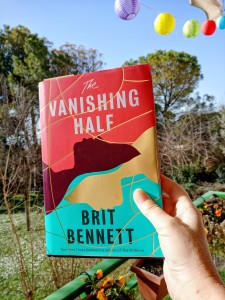 Brit Bennett’s novel features identical African American twins who leave home suddenly to make their way in the world, and looks at all the ways people survive and hide things about themselves, keep secrets and the impact that has not just on themselves but on others around them. And the many ways one can lose oneself.
It is also a reflection on the conditional aspirations of the white middle class, once you’ve entered this milieu, there are certain expectations, invisible rules, codes of conduct, and when children dare to want to be someone that doesn’t fit into a conventional perception of success, many parents will attempt to manipulate, entice or bribe them into fulfilling their expectations.
“Why can’t you just be yourself?” Stella asked once.
“Maybe I don’t know who that is,” her daughter shot back. And Stella understood, she did. That was the thrill of youth, the idea that you could be anyone. That was what had captured her in the charm shop, all those years ago. Then adulthood came, your choices solidifying, and you realise that everything you are had been set in motion years before. The rest was aftermath. So she understood why her daughter was searching for a self, and she even blamed herself for it.
From the Deep South to California, 1950’s to 1990’s
Each of the four main characters, twin sisters Desiree and Stella, and their children Jude and Kennedy, are given significant space to explore worlds as they each venture out from home, we observe their encounters and the repercussions of decisions either they make or that are made for them.

Photo by Gantas on Pexels.com
And there is Early, a wonderful character when we first meet him bringing his gifts of fruit to a teenage Desiree, then later his unique job, hunting people who have run, a byproduct of his own story of having been abandoned by his parents and his ability to be the carer, to be present in an unconventional way, despite his never quite feeling at home anywhere.
The key to staying lost was to never love anything. Time and time again, Early was amazed by what a running man came back for. Women, mostly.
On their journeys, the narrative and characters touch on a range of societal issues such as sexual abuse, racism, poverty, abandonment, domestic violence, sexism, gender fluidity, identity, silencing, dementia. It’s never too much, it’s patient, adept storytelling that doesn’t set out to solve problems, but shines a light on them and offers an inside view. Camille Okhiow
It is Bennett’s refusal to pass judgement on her characters that allows the reader to actively engage.
The Omniscient Narrator
Structured in parts, it moves back and forth in time, using a 3rd person omniscient all-knowing narrator, enabling a slow reveal of questions that build up in the reader’s mind. A dialogue between characters will open into a stream of consciousness narrative and circle back to the close of the dialogue, accessing the thoughts and imagination of the characters and the narrator.
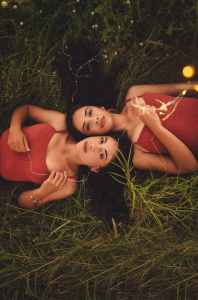
Photo by willsantt on Pexels.com
Beautifully executed and paced, it is also very rooted in the town of Mallard, the home of the twins and their mother and the point of departure for most of the characters.
Ironically, it too will disappear, initially in being too small to appear on any map and ultimately amalgamated into a nearby town. Fluid identities come in all shapes and forms.
It’s a book you can’t wait to get back to and can in no way predict the outcome, except that they represent aspects of the many different types of people in societies today.
There were many ways to be alienated from someone, few to actually belong.
I loved it and can’t wait to read her debut novel and see what she comes up with next.
How do we all become who we are?
I wanted to write toward that and think about these characters who are all performing in a way, who are transforming in a way, who are making these choices that are big and small but shape them in some way. I knew that my entry point was going to be these twin sisters who make different choices as far as which race that they want to live and which community they belong to. But I also wanted to explore these other forms of being, other types of identities.
I wanted to think about all the different ways in which we make choices that shape who we are, and [think] about the ways in which making those choices and creating ourselves … can be very liberating, but it can also be very painful. Brit Bennett
Brit Bennett, Author
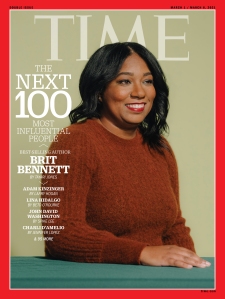 Born and raised in Southern California, Brit Bennett graduated from Stanford University and later earned her MFA in fiction at the University of Michigan. Her debut novel The Mothers (2016) was a New York Times bestseller, and her second novel The Vanishing Half (2020) was an instant #1 New York Times bestseller.
She is a National Book Foundation 5 Under 35 honoree and in 2021, she was chosen as one of Time’s Next 100 Influential People.
Her essays have been featured in The New Yorker, the New York Times Magazine, The Paris Review, and Jezebel.
Playwrights Aziza Barnes (BLKS) and Jeremy O. Harris (Slave Play) have been tapped to write and executive-produce the upcoming HBO series based on Brit Bennett’s The Vanishing Half, after a heated auction involving 17 bidders.
Further Reading
Interview: Brit Bennett on publishing The Vanishing Half during the George Floyd protests by Constance Grady
 Although I was aware that this book won the popular Costa First Novel Book Award in 2019, I became intrigued to read it after listening to the author Sara Collins
 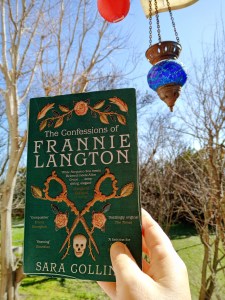 The first part of the book is set in Jamaica as Frannie narrates her story, although the opening pages are set in The Old Bailey courthouse, from where she sits accused of murder and in this short narrative, she addresses “you” the person she is telling this story, her lawyer.
 A little way into reading, I had to pause and go back to the beginning, because this story is told not in a linear way, but in a spiral and with multiple perspectives that to me didn’t relate to what the blurb says this book is about.


 Henry is making his living as a blacksmith, after the disappointment of arriving in New York and struggling to find work due to discrimination by employers against the Irish –
  Tammye Huf is an American author now living in the UK. Her debut novel A More Perfect Union was inspired by the true story of her great-great grandparents, an exploration of identity, sacrifice, belonging, race and love. It was featured on the Jo Whiley Radio 2 Book Club.
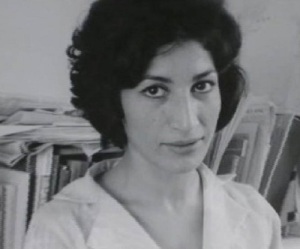 Farrokhzad (1935-1967) published poems that radiated sensuality, plunging depths of emotion, challenging the patriarchal conventions of society and transcending the acceptable boundaries of women’s expression, let alone commit to paper and public record. She wrote of love without shame, removing the invisible but ever present mask the culture adorned women with.
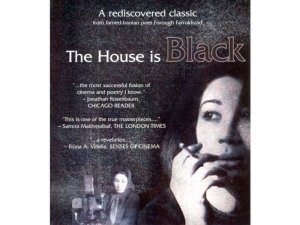 The middle parts are often only a few pages long, marking various transitions in her short life, her nine months in Europe when she flees Iran enable her to gain a different perspective but also make her realise she can’t be away from her family and her son.
 I’ve been aware of The Balkan Trilogy for a while and curious to discover it because of its international setting (Romania in the months leading up to the 2nd World War) though equally wary of English ex-pat protagonists living a life of privilege cosseted alongside a population suffering economic hardship and the imminent threat of being positioned between two untrustworthy powers (Russia and Germany).
 The novel becomes even more interesting and ironic when Guy decides to produce an amateur production of the Shakespearean play Troilus and Cressida, deliberately diverting the attention of his fans and followers, young and old, at a time when war is creeping ever closer and everyone else not involved in his amateur dramatics is frantic with worry. The play is the tragic story of lovers set against the backdrop of war.
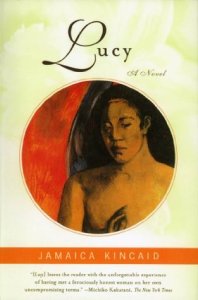 Lucy is a 19 year old woman who has left her home in the West Indies and come to America to be an au pair for a family of four young children. The book is set over one year, her experience as a new, young immigrant.


 In 2008, she won
  Word by Word