A Quiet Obsession

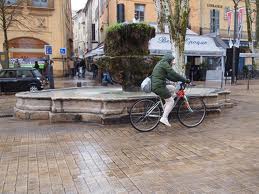
Rain in AixIt’s Saturday in Provence and my elderly neighbour in the apartment downstairs is leaning over her balcony telling me she is depressed and waving her hand skywards. It is spring and it has been raining for a couple of days every week consistently since the end of February.

With a smile I can’t suppress, I tell her it feels like home to me, the home I knew as a child anyway, that country down under where it rains every week but where there is sun every week too, and everything looks clean and green and grows constantly. But our residents in Aix-en-Provence aren’t used to it and the grey skies reflect their mood.
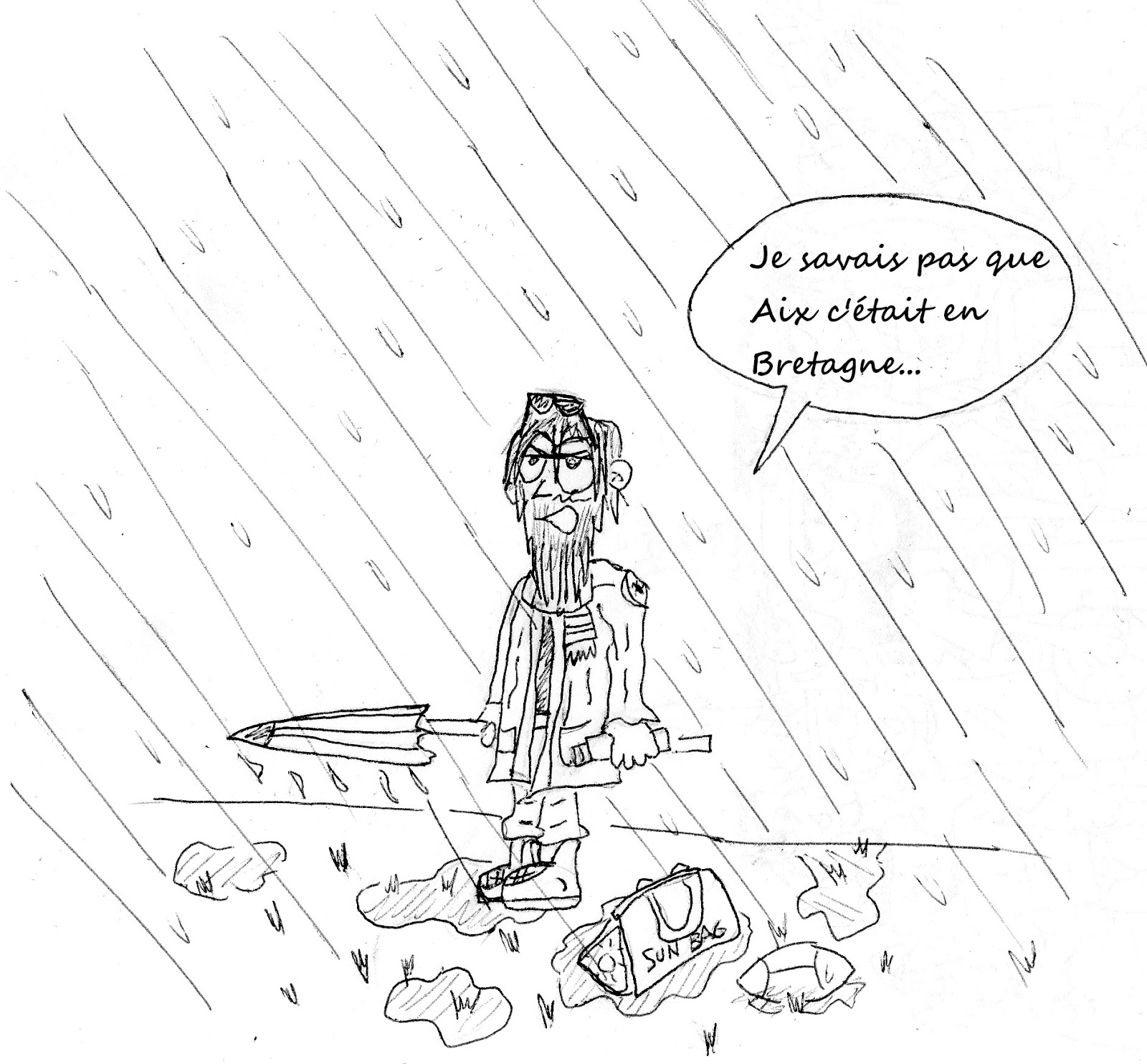
Aix sous la pluie by the artist Barbarion

Aix sous la pluie by the artist Barbarion

But not me.

Today is the English Book Sale, a rare event that I have missed on the last two occasions and I know I don’t need any more books, but I have to go just to see what is on offer and to hang about in the presence of other souls quietly obsessed with books.  You know, that old-fashioned kind, hardcover, softcover, some with post it notes and book marks, one with an attractive business card inside, I left that mystery for the next person to find. And the rain is not keeping people away here; I find the last space left in the car park and join the growing crowd of ex-pats and Anglophones scouting for book treasure.

One of the first books I find is a Virginia Woolf biography by Quentin Bell, and so soon after reading Susan Hill’s Howard’s End is on the Landing, and remembering Valerie’s comment about regretting having released all her Bloomsbury books to a sale, I rescue this volume from its fate and bring it home in readiness for its mate, the diary I will be picking up from Persephone Books on my next London visit.

The next book I purchase for my Dad, whom I will be seeing in exactly one month, in Istanbul. My father is a retired farmer who had a love of horses all his life, they were the main mode of transport around the farm and at the weekends, we would pile into his converted furniture removals truck, horses in the back, to watch him play an unsophisticated, remote countryside, farming people’s style polo. He will enjoy this true story of an equine beauty by Laura Hillenbrand I am sure.
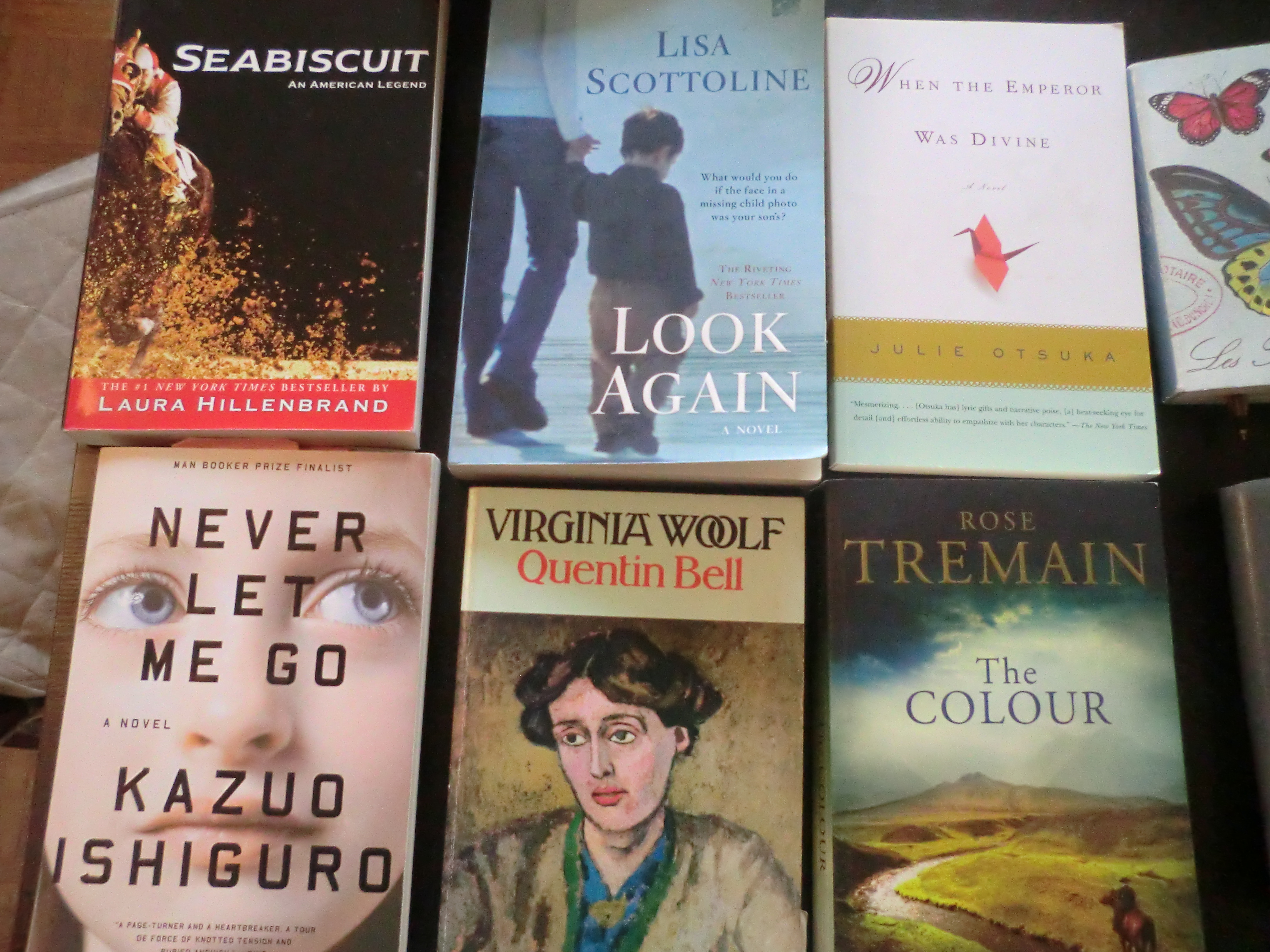
My Booksale Haul

My Booksale Haul

I am detecting a bit of a theme here, I buy this Rose Tremain novel The Colour, because it is set in New Zealand and it has been recommended numerous times and though I have picked it up and even taken it from the library once, I have never read it – and there is something about the cover on this version that makes me want to own it.

Kazuo Ishiguro’s Never Let Me Go I pick up without hesitation, I loved his recent collection of short stories and this one has slipped by unread thus far.

I see a fellow book loving friend who thrusts Lisa Scottoline’s book Look Again into my hands and tells me she stayed up all night last night reading it. It’s disturbing but unputdownable she says. Ok, always room on the shelf for a book that grips one from the first page and perfect holiday reading material, though perhaps not the upcoming Turkish holiday, I don’t want to read about lost children before taking mine to a large unknown city.

The cute little Julie Otsuka novel When the Emperor was Divine, I can’t resist. I want to read The Buddha in the Attic, but this is the book that presents itself first, it’s more of a novella and the seductive testimonial on the front cover is enough to tempt me, one who rarely buys into contrived book cover descriptions, but mesmerising, lyric gifts, narrative poise, a heat-seeking eye for detail, there are enough enticing adjectives in that one blurb for me to appreciate, living in an era of twitter fiction, so I take it.
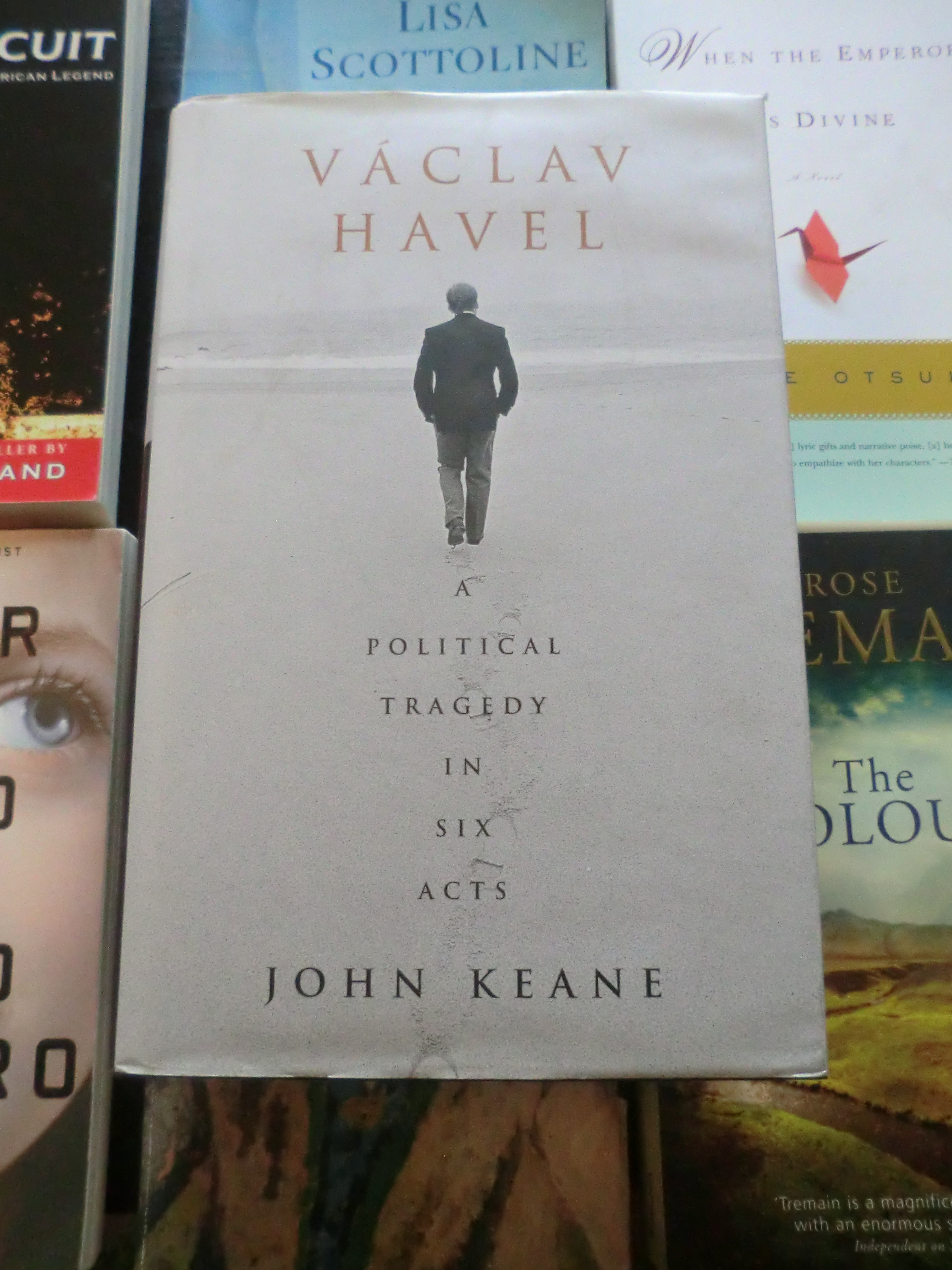
A Political Tragedy in Six Acts

A Political Tragedy in Six Acts

And the pièce de résistance, a hardback, first edition of John Keane’s biography of Václav Havel A Political Tragedy in Six Acts. I don’t know a lot about Havel, he was a renowned playwright turned President of the Czech Republic and a daring dissident in his youth, yet the little I do know of him, makes we want to know a lot more. He died in Dec 2011 but I believe that there are lessons to be learned from the life he lived.

And so, with my arms straining under the load of seven books, I look up to the balcony of my neighbour and tell her to do what I would do if I felt that way about the day, find a good book and escape into it for the afternoon, and don’t worry, the forecast is for sun tomorrow.

At last she smiles, ‘Yes, that I can do’, she says and ‘Bon Livre’ as I disappear inside with my stash of books, a hot roasted chicken, 2 fresh baguettes and 3 chocolate éclairs. Life is good!

Mom & Me & Mom by May Angelou

Maya Angelou starts her conversation book by mentioning something people often ask, how it is that she became the women she is, a question she says she has been tempted to respond to using lines quoted from Topsy, the young black girl in Uncle Tom’s Cabin who said, “I dunno, I just growed.”

Mom Me MomInstead, Angelou has written this thought-provoking tribute, sharing a slew of matriarchal experiences among the many others already shared in her remarkable series of autobiographies, to highlight a little of how she did become that brave, sensitive, adventurous and caring women she is, in part due to the grandmother she loved and the mother she came to adore.

It is a story written with utmost compassion and forgiveness, for this is a woman whose mother admitted when she and her husband separated that she could not mother young children, so sent them to live with their grandmother for ten years. Angelou closes the prologue reminding us that love heals and throughout the book will prove that kindness is the greatest gift we can ever give and foster in others.

Love heals. Heals and liberates. I use the word love, not meaning sentimentality, but a condition so strong that it may be that which holds the stars in their heavenly positions and that which causes the blood to flow orderly in our veins.

Vivian Baxter, Maya Angelou’s mother, was the eldest of a large family of mostly boys, for whom threats, intimidation and violence were a part of their way of their life and this petite force was often at the forefront of their skirmishes. Their father encouraged tough boy talk and tasked his daughter with ensuring the boys didn’t soften. Little wonder that after falling in love, marrying and realising that it was a mistake, they were also unable to agree on who should raise their toddlers, they separated and sent the children to their father’s mother in Stamps, Arkansas. Maya was three and Bailey five-years-old.

Ten years later, when their grandmother felt that Bailey had grown too old for Arkansas, when he had reached a dangerous age for a black boy in the segregated South, it was arranged for them to return to their mother in California. Bailey was enthusiastic, Maya much less so. It would be difficult, but for all her flaws, their mother knew how to communicate with her children and didn’t push her mother status on them. Maya decided she would call her ‘Lady’ and her mother’s response to this is one of many small pleasures Angelou offers up in her book.

Maya has a baby very young, without the foundation of a loving relationship, however with the love and support of her mother, this event in no way prevents her from pursuing her life’s dreams and ambitions.

I thought about my mother and knew she was amazing. She never made me feel as if I brought scandal to the family. The baby had not been planned and I would have to rethink plans about education, but to Vivian Baxter that was life being life.

Some years later deciding to marry Tosh tested the mother daughter relationship, Vivian didn’t try to stop her daughter from making what she thought was a mistake, but she chose to leave San Francisco, not wishing to witness the fallout. Like any young women living off the heady ambiance of newly married love, Maya wished to prove her mother wrong.

To begin with she continued doing all the things she loved, the things that made her Maya Angelou, seeing her friends, attending a dance class, going to church and speaking freely about God. However her activities slowly became issues between the young couple, so she stopped them in an attempt to maintain peace between herself and her husband.

At first the dimness is hardly noticeable but not alarming. Then with a rush, the light is vanquished by darkness.

This gem of a book, complete with gorgeous photos, is a wonderful addition to her already masterful collection of autobiographies and chronicles that one relationship that runs through our entire lives, that with our mother. It may not always be easy, but Angelou shares those moments that tested and ultimately strengthened the love and respect they had for each other. She accomplishes it with incredible honesty and selflessness, something that shines through in the brief interview I have linked here. What a wise and loving soul she is.

Interview – Learning to Love My Mother: Maya talks about her mother with a BBC interviewer.

“Exercise patience with yourself first, so you can forgive yourself for all the dumb things you do. Then exercise patience with your children.”

Buy a Copy of Mom & Me & Mom via Book Depository

Note: The book was an Advance Reader Copy (ARC) provided by the publisher via NetGalley.

Ignorance

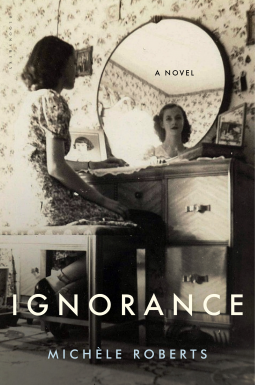
It was the book I read following Michéle Robert’s novel Ignorance that gave me something to reflect on regarding the meaning of that loaded word she uses as her title.

In Maya Angelou’s latest autobiography Mom & Me & Mom (review pending), she speaks of ignorance and quotes her mother:

She said, “Ignorance is a terrible thing. It causes families to lose their centre and causes people to lose their control. Ignorance knows no binds. Old people, young people, middle-aged, black, white can all be ignorant .

An apt epigram for this war-time novel set in occupied France.

IgnoranceTwo young girls from a rural village are sent briefly to live in a local convent, Marie Angèle because her mother is about to have a baby and Jeanne, because her mother is unwell and in hospital. Marie Angle is the daughter of local middle class grocers, Catholic and raised with something of a sense of entitlement and superiority over her lesser friend Jeanne, whose mother, a widow converted to Catholicism when she married, but lives in a community that rarely allows her to forget her Jewish past. Marie Angèle expects to inherit half of her parent’s shop, she expects that the well-connected young Maurice, the man who can obtain anything during wartime will do the right thing by her.

I could hide my ignorance most of the time, because if he felt like talking he just wanted me to listen. One day, however, parked in the woods, he said : talk to me….I left Jeanne out of these tales. We’d been thrown together as children, purely by accident, we’d had a sort of friendship for a certain time, but we couldn’t mix now. I preferred to concentrate on positive things. That was how we were getting through the war.

Jeanne rarely thinks of her friend, she knows she is loved by her mother, observes their second class status in the way the nuns treat her compared to her friend, their quickness to judge and to listen to gossip as if it were fact. She is not ignorant of the activities that take place in the house where she works, but she like her mother is realistic about her opportunities, she doesn’t allow herself willingly to be taken advantage of, she learns from her past, though it will be insufficient to save her from the consequences of the misguided morals of her childhood friend.

Marie Angèle however, believes  that Jeanne, by working in such an establishment has thus become one of them, a common tart, she believes the village gossip, judges her former friend’s improved dress and appearance.  She portrays her own husband as a man unrecognisable as the same man Jeanne describes as one of the clients of that establishment. Even when confronted with an inkling of this truth, the wife’s inclination is not to question her husband, but to seek revenge against the bearer of the message, a penance that will continue to be paid into the next generation, as Marie Angèle manipulates control of Jeanne’s daughter Andrée and both their futures.

Womens prize logoThe novel is split into sections which view life in overlapping time periods from the perspectives of the two girls which couldn’t be more different, in particular on the part of Marie Angèle concerning not just her friend, but the plight of other families that must go into hiding. Towards the end there is also a section given to Andrée, Jeanne’s daughter and another from Dolly, one of the nuns, complicit in an act of betrayal.

The simple narrative structure exposes the ruinous attitudes, religious hypocrisy and shamelessly uninformed  morality of the ignorant and how it continues to be perpetuated by gossip, fed by jealousy and fueled by ill intention. It reveals that destructive instinct humanity sometimes imposes on the weak and those who are different from the rest. Devastating.

Ignorance is on the long list for the Women’s Prize for Fiction 2013. The short list will be announced on April 16. Will this title be on it I wonder?

Note:  This book was an Advance Reader Copy (ARC) provided by the publisher via NetGalley.

NW, life’s passage via the Kilburn High Road

The back cover of Zadie Smith’s novel NW, recently long-listed for the Women’s Prize for Fiction 2013 mentions This Is The Story Of A City, the north-west corner of city, however that’s not how I think of it. London is something else, as is The City of London.

NW is a community, a fluid changing community, one of London’s many pulses; for some it is a stepping stone to the next stage, for others it is home. It has been a thoroughfare into London since the days of the Romans and in more recent times, the resting place for Irish immigrants fleeing their country for one reason or another, sometimes dramatic, sometimes not. And following the Irish are the many other groups who found NW their starting point to a life in London, that city of promise and unending challenge. NW is the same, the faces that pass through it, indicative of the era we are living within.

NWNW the novel is experimental, its structure changes with each section and after starting the second part which focuses on Felix, I realised that the narrative voice was being used as a metaphor for the state of mind of the character, a brave step or a risk on the authors part by commencing with Leah, who thoughts are all over the place and is suffering from that anxiety of a young, married woman with a successful career and a husband who loves her, who doesn’t understand why she is not content, or why she can’t admit that she isn’t ready to start a family.

So we start with the staccato stream of conscious thoughts of a woman who would benefit from therapy and/or meditation to still that rampant inner chatter, planting the reader in the midst of prose that is challenging for some and uneasy for those listening to the audio version. Not when chapter 7 is shaped like a tree, though that is one of the least challenging pages, one of beauty in fact.

But once we get to Felix’s section, things calm down, Felix’s major life troubles are behind him, the reading is easy and the pace picks up.  Although he’s not entirely immune to temptation, he seems to have moved on from his more despondent days, he’s been clean for 2 years and plans to stay that way. To me, he is the only character who shows real signs of moving on, however he has not moved out of NW,  his mistake perhaps is in staying and trying to convert those around him.

The other female character Keisha, changes her name to Natalie when she becomes a lawyer, an attempt to outgrow her past; she marries and has two children. She and Leah have been friends since their school days and their connection provides the one strong thread throughout the novel. Natalie, like Leah has risen above her past, but can’t seem to resist undermining it, with her strange behaviour, in what was for me, one of the least believable parts of the novel, in part because the author keeps us from knowing exactly what Natalie is up to online and offline, before she gets caught and flips out. I was hoping she might be more influenced by the role model of  Theodora Lewis-Lane, who tries to advise her.

“The first lesson is: turn yourself down. One notch. Two. Because this is not neutral.”  She passed a hand over her neat frame from her head to her lap, like a scanner. “This is never neutral.”

NW6For me personally, it was in part a nostalgic read, Zadie Smith’s writing comes alive when she evokes place and it is a neighbourhood I lived in and around for many years, NW is the most complete and yet complex character of all, embracing so much diversity, inviting everyone in without prejudice and yet claiming some in the harshest terms possible. There are as many reasons to hate it as there are to love it and anyone who has lived there will likely never forget it.

NW is a melancholic novel about four characters trying to escape their past and leaves the reader with few signs of hope for the future, or at least that future is left for us to imagine. Those who focus on the uniqueness of the writing or who have some experience of /interest in these communities may enjoy it, while those looking for the traditional transformation of character, or any kind of escape may be disappointed.

Despondency is the norm and we will not be rescued from it, it merely lessens with time if we survive.