
It is thanks to Jo at The Book Jotter that I have now read Rebecca, after she offered copies to readers on World Book Night,  one of the conditions being to pass the book on, so what better reason to offer the book as a give-away If you would like to enter the draw, just make a comment and leave an email address so I can contact you after the draw on Wednesday November 7. You can also assist in selecting the books that will be offered free in the US and the UK for World Book Night 2013 by clicking on the link and nominating your favourite book(s).
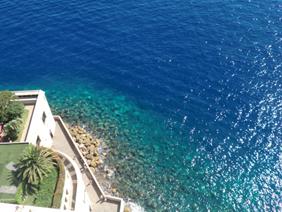
View from the Musée d’Oceanographie, Monaco
As a quiet companion to a wealthy dowager in Monte Carlo, it was hard to imagine how this young woman, who remains unnamed throughout the novel, was going to elevate her station in life by any other means than some chance encounter – and indeed Mrs Van Hopper’s convenient two-week malady provides exactly the opportunity that would likely otherwise never have occurred.
There was nothing for it but to sit in my usual place beside Mrs Van Hopper while she, like a large,complacent spider, spun her wide net of tedium about the stranger’s person.
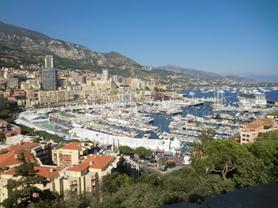 And with the change of location from the calm, sun-filled vistas of Monaco and Italy, we arrive at Manderley, the grand estate of many rooms, corridors, wings, ritual, tradition and an established staff, all haunted by memories, both real and imagined of the previous Mrs de Winter, Rebecca.

Last night I dreamt I went to Manderley again.
In Rebecca, Daphne du Maurier has created an extraordinary character who though never physically present, seems to affect everyone from the dog to the most loyal and disturbing housekeeper, Mrs Danvers to the slightly demented grandmother.
The new bride quickly comes to realise how different she is to her predecessor and perhaps being so young is therefore prone to exaggerated imaginings which add to her feeling of insecurity. All of which does make one wish someone would sit her down for a moment and explain exactly what is what, her sister-in-law comes close, but never quite stays long enough to enlighten her young sister-in-law – although that vivid imagination and neurotic behaviour do add to the suspense and excruciating discomfort of someone who feels most out of place in her new world.
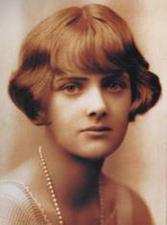
Daphne du Maurier
Du Maurier herself was living in Alexandria at the time she wrote Rebecca and was said to have felt uncomfortable with her life and obligations as the wife of a commanding officer, entertaining other wives while surviving the fierce heat of an Egyptian summer.
Both woman in the novel reflect aspects of du Maurier’s own complex character and the duality of her natural inward inclination versus the more extrovert role she was required to play. No doubt these experiences she was living through on a daily basis continued to feed her imagination and enrich the two female characters who really did seem to have little in common, the author giving away few clues as to why Maxim could have married two such opposite types of women.
 Intrigue, tradition, a grand estate, a young naïve protagonist with an over active imagination, all contribute to a fascinating and compelling read – a classic that continues to enthrall readers as much today as it did in 1938 when it was first published, not to mention a Hitchcock film!
Don’t forget to leave a comment and your email address if you would like to enter the draw to receive this copy.
Do you have a Daphne du Maurier favourite?
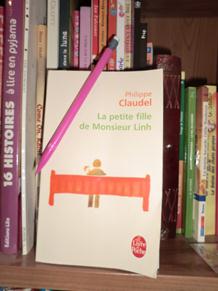 ambiguous title because it can be interpreted in two different ways, already a dilemma for the translator no doubt, because petite fille is the expression used for grand-daughter, but it can also be read as petite ‘little’ and fille ‘girl’.
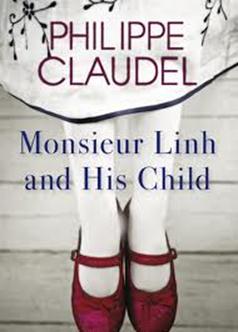 So did the English translation go with grand-daughter or little girl you might ask? Actually neither, the English title as shown is Monsieur Linh and His Child. I’m not sure why they stay with Monsieur rather than Mr, I was not under the impression that he spoke in French. It becomes clear how much of a task translating a novel must be, so many decisions to make or discard with the title alone, already certain ambiguities are lost while other insinuations are made.
 The author does not say where he came from or where he arrives at, making this part of the reading experience, in fact we all had various impressions of where the story may have taken place, my own impression very much influenced by my recent reading of Vaddey Ratner’s novel


 Mention the name Alexandre Dumas and many will associate it with the classic stories as well-known now through their film adaptations, The Count of Monte Cristo, The Three Musketeers, The Black Tulip and La Reine Margot (Marguerite de Valois) as they are through the novels.
 Tom Reiss has researched the life of General Alex Dumas and takes us from the French sugar plantations of Saint-Domingue to the battlefields of the French revolution and to a dark dungeon on an island in the Mediterranean, in recapturing the spirit of this extraordinary man, living in an unforgettable era, that we are all the better off for being reminded of.



 ever faithful, if somewhat distracted guests.


 and a unique cultural insight.
 Adam McOmber’s debut novel is set in Victorian London in an area I know well, at least in contemporary terms. Jane Silverlake and her friends Madeline Lee and Nathan Ashe live in Hampstead and regularly take walks on Hampstead Heath, the ‘Green Lungs of London’, my favourite London park. At 790 acres, it is the largest and being wooded, you can imagine it is almost a little wild in parts and certainly the closest relatively untouched inner city natural environment you will
  find.
find. However, most of that is in the future, because Jane and Maddy are living in 18 – – and concerned about the strange behaviour of their friend Nathan, since he returned from the Crimea War and took up with the strange, alluring Ariston Day and his secret society of young, wealthy male followers whom he refers to as ‘Fetches’.

 Word by Word