In the last two weeks of August, I was on holiday in St-Cyr-sur-Mer and during this time there was a lot of swapping of books. This is one of two works of historical fiction I read.
I started with this one out of interest because it was set in the Champagne region of France, which I had visited in October 2023.
It was interesting to imagine this story set during the lead up to World War II, perhaps not surprising to learn that the area was occupied for four long years and equally understanding that many of the vintners were able to keep their best vintages hidden in the array of underground tunnels behind false walls.
The Winemaker’s Wife is a dual narrative historical fiction novel, set in the champagne town of Rians, France, in 1940 and in 2018 New York City, Paris and Rians.
The plot concerns the unravelling of a family mystery, with secrets, lies, cover-ups, betrayals, and goings on in the network of tunnels beneath the chateau champagne house, Maison Chauveau.
1940 Champagne Region of Rians, France
Inès has just married Michel, the owner of the champagne house, when the Germans invade. She has tried to make herself useful, but doesn’t seem to have made much of an impression. Assisting them are Céline and Theo Laurent, the chef de cave.
Céline was quiet and serious, always tromping around with a frown on her face, while Inès did her best to look on the bright side.
When Inès has had enough, she visits her friend Edith and her husband Edouard at the Brasserie Moulin, but it’s not always safe there and in her naivete, she makes a fatal mistake that is going to affect all of them.
The two couples try to continue to run the winemaking business but the invaders have a taste for more than just champagne. Despite the danger surrounding them, they seem to be inviting trouble, when they make things even more riskier for themselves. And that doesn’t include resistance activities which are even more reason to not bring attention to themselves.
New York to Paris, A Grandmother in her Centennial Year
Meanwhile, in 2019 New York, elusive 99 year old French grandmother Edith turns up unannounced to take her niece Liv on a trip to Paris and Rians and is hiding the reason for going there.
As she gets closer to understanding why they are there, it seems all roads lead to Maison Chauveau and there might even be a love interest for the recently heart broken young woman.
I have to say I questioned the grandmother’s motives given her age. It seemed strange to me that she had waited until her 99th year before taking such a trip, as good as admitting she had intended to take her secrets to the grave. I did not trust her – and with good reason, it turns out.
Imagined History versus Real History
Though it was often difficult for me to believe in the characters and the narrative, having just read the true historical account of Marie Madeleine Fourcade in Madame Fourcade’s Secret War by Lynne Olson, I would recommend The Winemaker’s Wife as a light holiday read for those who enjoy historical fiction, champagne and visiting France.
Extra pics from a stroll down Avenue de Chapagne, where there are many champagne houses like the one above and a visit to the underground champagne storage tunnels of Möet & Chandon in Épernay, October 2023. They’re incredible and worth a visit, an underground labyrinth.
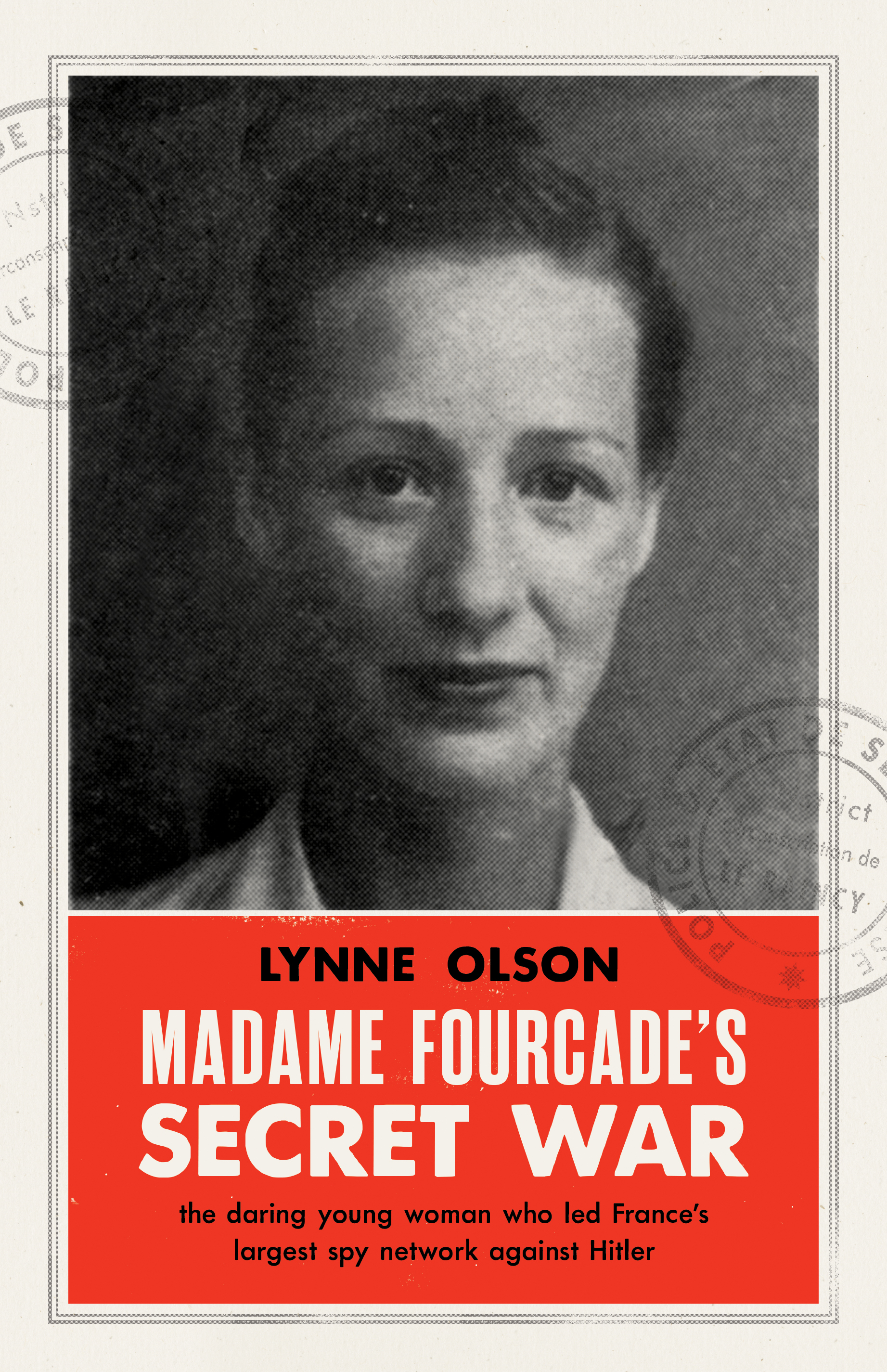
The Daring Young Woman Who Led France’s Largest Spy Network Against Hitler
I became aware of this book thanks to a friend who is also interested in historical stories about women in France. I knew at once I had to read it.
While my friend was still reading it some months ago, I happened to go on a walk, following a route I have taken many times and noticed for the first time that Madame Fourcade’s name featured on one of the street signs. You can imagine my surprise and delight! She became even more of a talking point and I looked forward to getting a copy of the book (not that easy) to read.
I will say if you are interested in reading it, that the font size of the paperback version (which I read) is quite small compared to the hardback version (a copy of which I bought for a friend).
Famous French Women, A Rare Vision
Most of the street signs in France are the names of people that have featured in their recent history. However, it is very rare to come across the name of a woman. In our town Marie Curie has a street sign, but even then, she shares it with her husband. Marie Madeleine Fourcade not only has a sign all to herself, strategically placed at the top of a hill overlooking the town, but she was also the very first woman in France’s history to be given a funeral at Les Invalides, an important complex of buildings in Paris that celebrates France’s military glory.
Marie Madeleine’s father worked for a French shipping company in Shanghai. Her mother refused to stay behind in Paris, though agreed to return to Marseille for the birth of her daughter in 1909. Marie-Madeleine and her siblings grew up in Shanghai, with freedoms unheard of for the social and family circles they hailed from. Those freedoms, an early bilingual education and their return to Paris when she was 10 years old, set her up in many ways for the future role she would play, organising and ultimately leading an important French intelligence network.
As a young woman, she again lived abroad, in Morocco. She drove a car, learned to fly a plane and had a job. She rejected French society’s (and her husband’s) restrictive ideas about how women should behave. She had trained to become a concert pianist, worked at a commercial radio station and would forge her own future.
Access to Important Connections, Two Rivals
Though never in the military herself, she was married briefly to a French military officer, as was her sister. She thus had opportunity to meet and observe some of the younger officers through her social connections, men who would later become important during the war years.
Two of the most prominent members of that younger group – Lieutenant Colonel Charles de Gaulle and Major Georges Loustaunau Lacau – took centre stage in the discussion on rue Vaneau, engaging in a debate that quickly escalated into a full-blown argument. It soon became obvious to Marie-Madeleine that the two officers viewed each other as rivals…
Both products of Saint-Cyr, France’s elite military academy Ecole Supérieure de Guerre, both fought and received multiple citations for bravery in WWI; they were brilliant, ambitious and egocentric. A rebellious streak put them at odds with Marshal Philippe Pétain (a French general who commanded the French Army in WW1 and would become head of what became known as the Régime de VichyVichy France). The rivalry between the pair would also keep them from being unified during the war years and likely impacted perceptions afterwards.
A Partnership, A Turning Point
After a discussion at one of the social events around March 1936, Loustaunau-Lacau contacted Marie-Madeleine and asked for her help in creating a journal that would argue the case for reform of the military and open the eyes of leaders to the imminent threat of Germany. The work would begin immediately.
“One of my Belgian friends has procured secret dossiers that expose the intentions of the German high command,” he said. “I need to get them quickly. Such documents must not travel by mail. You have a car. You must go to Brussels and collect them. I will pay all expenses.”
An Intelligence Network is Formed, Working Inside France
Caught up in this real life spy drama, Marie-Madeleine agreed – a decision that would radically change her life. From that moment, she wrote later, she and Loustaunau-Lacau began building an intelligence network against Nazi Germany.
Over the next two years, they would recruit informants in France, Switzerland, Belgium and Germany who passed on reports about the build up of the German armed forces. Loustaunau-Lacau adopted the codename Navarre, after Henri de Navarre, later King Henri IV of France. Given the risks they faced, that one of them might be captured or killed, Navarre insisted they share leadership of the network and when he was compromised, as promised Fourcade took the lead role.
At the same time, backbencher in the British House of Commons, Winston Churchill had created a similar private network and Charles de Gaulle decamped to London, setting up his Free French operation. Fourcade suggested they join with him.
Her mentor rejected the idea outright. In England, he said, they would be refugees, just like de Gaulle, dependent on the British for everything. At that point, almost no one in the British government, with the promising exception of Winston Churchill, took de Gaulle and his minuscule band of followers seriously.
They would resist from within.
Another Perspective of History
Madame Fourcade’s Secret War is a work of history, told in a compelling narrative voice, that not only focuses on the leadership role of this one extraordinary woman, but will likely expand most reader’s knowledge of what living in France under German occupation was like for the many, who vehemently opposed the way their government had capitulated to a hostile outside force, without much initial resistance.
Personally, the history I learned in school was quite different, as it was told from a very anglo-centric perspective, so the narratives stemmed from how this threat impacted the United Kingdom and their allies.
I never really understood what exactly happened within France in the lead up to the occupation, how it impacted their government and rendered the military ineffective. So many of the protections a country might normally expect when facing a hostile enemy were lacking; to go against the orders of a government (even if under occupation) was a betrayal.
Cinema Can Create Its Own Self Serving Narrative
Though there have been books and films about the war and the French resistance, little has been shown of the importance of the Alliance network and of Marie-Madeleine Fourcade’s achievements. Most of the attention has gone to stories of sabotage and escape lines, of battles and blitzes.
Saboteurs and other resistance fighters in France were certainly important after D-Day, but they did little to obstruct the Germans before then. Escape networks did heroic work in smuggling shot-down Allied airmen and others out of occupied Europe and back to freedom, but their actual contribution to victory was small.
I would certainly be interested in a cinematic development of Fourcade’s story, one that traverses France and shows a very different side to those who travelling around the country, making radio transmissions and secret flights across the channel, where they are hosted by memorable characters in this real life adventure.
Noah’s Ark and the Hedgehog
Les Invalides Paris
In the late 1960’s Fourcade would get her story down in a gripping memoir entitled Noah’s Ark, the name the German’s referred to their network as, after they would use codenames of animals, Fourcade’s was hérrison (hedgehog), a small animal that intelligently eluded predators.
Lynne Olson provides a thoroughly researched, immensely readable account of the creation of the Alliance, one of the original and most important resistance networks in France. From its foundation by Navarre and Fourcade to the establishment of thousands of recruits, the many dangerous activities they undertook, throughout the war, all that was able to be continued by Fourcade due to her continued leadership deserves to be more widely recognised and appreciated.
They Will Not Be Forgotten, The People
The book is full of stories about the different people she recruited, the relationships and loyalties and daring escapades each of them went on, in order to bring their intelligence to the Alliance.
It is also, sadly, a homage to those who would be punished and killed for their roles, some, so close to the end of the war, it is excruciating to read. That Fourcade survived and was able to share her story and thus the courage and bravery and loyalty of others is a true gift to all humanity.
It’s the first time I have read an account that centres what was happening in France at this local level, with a more global scope, that renders the dangerous and delicate situation of those in the military, who were against the capitulation of their government. While in great danger to themselves, they were able to band together like-minded civilians and provide those on the outside with the information they needed to mount a significant and ultimately successful defence.
Highly Recommended!
Author, Lynne Olson
Lynne Olson is a New York Times bestselling author of nine books of history, most of which focus on World War II. Former U.S. Secretary of State Madeleine Albright has called her “our era’s foremost chronicler of World War II politics and diplomacy.”
Born in Hawaii, Lynne graduated magna cum laude from the University of Arizona. Before becoming a full-time author, she worked as a journalist, with the Associated Press as a national feature writer in New York, a foreign correspondent in AP’s Moscow bureau, and a political reporter in Washington. She left the AP to join the Washington bureau of the Baltimore Sun, where she covered national politics and eventually the White House.
Lynne’s latest book is Empress of the Nile: The Daredevil Woman Archaeologist Who Saved Egypt’s Ancient Temples From Extinction (2023).
Three of her earlier books were immediate New York Times bestsellers; Madame Fourcade’s Secret War: The Daring Young Woman Who Led France’s Largest Spy Network Against the Nazis (2019), Those Angry Days: Roosevelt, Lindbergh, and America’s Fight Over World War II (2013), and Citizens of London: The Americans Who Stood with Britain in Its Darkest, Finest Hour (2010).
Lynne lives in Washington, DC with her husband, Stanley Cloud, with whom she co-authored two books.
I’ve been aware of The Balkan Trilogy for a while and curious to discover it because of its international setting (Romania in the months leading up to the 2nd World War) though equally wary of English ex-pat protagonists living a life of privilege cosseted alongside a population suffering economic hardship and the imminent threat of being positioned between two untrustworthy powers (Russia and Germany).
This is the first of three books that make up Olivia Manning’s semi-autobiographical Fortunes of War or The Balkan Trilogy, there are another three that make up A Levant Trilogy.
The story is chiefly about a young couple and their first year of marriage in Romania on the eve of war. Guy, a young English literature professor returns to Bucharest after a summer in England, with his new wife Harriet, a woman he met and married within a month. We know nothing about that month, their romance, or why/how they came together so impulsively.
Supposing she had known him for a year and during that time observed him in all his other relationships? She would have hesitated, thinking the net of his affections too widely spread to hold the weighty accompaniment of marriage.
Displacement Heightens Perceptive Ability
Over the course of the novel we get to know through Harriet’s perceptive observations and awareness of her own flaws and Guy’s, their characters, why they act in the way they do and the effect they have on each other, due to their differences. These aspects of personality are reflected through the way they interact and respond to others around them.
Guy’s natural warmth towards everyone could easily be misinterpreted. She herself had taken it for granted that it was for her alone.
It took a little while initially to overcome my reluctance in be among this crowd, (averse to novels where purposeless woman follow their husbands around wondering why they are unhappy with life), many of the characters and their behaviours in the set-up stage of the novel are tiresome, but the ability of Harriet to see through each of them, in an effort to better know her husband, after a while becomes more and more engaging.
Finding an Ally in Foreign Territory
She finds company in Guy’s friend Clarence, the similarity in their perceptions is both a comfort and an admission of her own more selfish inclinations.
The difficulty of dealing with Guy, she thought, lay in the fact that he was so often right. She and Clarence could claim that their evening had been spoilt by the presence of Dubedat. She knew it had, in fact, been spoilt not by Guy’s generosity but by their own lack of it.
Harriet lacks purpose and so it’s no surprise that her energy and focus turns towards analysing and judging others. In a way she reminded me of Hadley Richardson in Paula McLain’sThe Paris Wife and Zelda Fitzgerald in Z: A Novel of Zelda Fitzgerald by Therese Anne Fowler, women who find themselves in the shadows of the larger player, their husband’s lives, men whom other people are drawn too and seek attention from, leaving the wife as a companion and bed warmer for the few hours he finds himself solitary.
They too, are stories of the lives of young internationals, professors, diplomats, journalists, the locals they fall in with, the cafes, restaurants and hotels they frequent, the political background constantly a source of conversation, the lack of family and a rootlessness that drives them to seek each other out in this environment that throws people together, who wouldn’t otherwise cross paths. Harriet however, due to her lack of involvement in events, becomes the detached witness, the reliable narrator, of character(s) and of this twentieth century war.
It is precisely her position as a civilian external to the public sphere and to the war effort, together with her apparent lack of faith in politics, that validates her as a detached witness. Carmen Andrés Oliver
Shakespeare Foretells All
The novel becomes even more interesting and ironic when Guy decides to produce an amateur production of the Shakespearean play Troilus and Cressida, deliberately diverting the attention of his fans and followers, young and old, at a time when war is creeping ever closer and everyone else not involved in his amateur dramatics is frantic with worry. The play is the tragic story of lovers set against the backdrop of war.
Harriet is embarrassed by the idea of the play, sure it’s an endeavour that will fail, hoping it will, despite the fervour with which everyone invited to participate has responded.
Now she was beginning to realise she might be wrong. Contrary to her belief, people were not only willing to to join in, they were grateful at being included. Each seemed simply to have been waiting the opportunity to make a stage appearance.
Dropped as one of the players, Harriet is upstaged by Sophie, a woman whose affection for Guy and history that precedes her, adds to the tension of their marriage.
The Great Fortune is Life
As the novel ends, they take a look inside the window outside the German Bureau, where a map is updated daily and what they see leaves us wondering what will happen next, as Europe itself is a bed of tension and danger, depending on where one’s loyalties lie.
When they reached the window, they saw the dot of Paris hidden by a swastika that squatted like a spider, black on the heart of the country.
They stood staring at it for a while. Soberly, Guy asked: ‘What do you think will happen here? What are our chances?
Harriet responds:
We’ll get away because we must. The great fortune is life. We must preserve it.’
It is a unique novel in its close observation of the response to pending war of a small community of English people thrown together by circumstance, viewing the approaching war from inside a part of Europe that is less well traversed in English literature, given less attention at the time of writing and being rediscovered again now.
Olivia Manning, OBE (1908-1980)
Manning met her husband when he was on leave for a month in July 1939 from his first British Council post in Romania. They married in August and nine days later he was ordered back to Bucharest, so the couple left London as war was looking likely to commence. During the war, they lived in Romania, Greece, Egypt and Palestine.
She returned to England in 1945. She wrote novels, short stories, sketches, screenplays, nonfiction books, essays and reviews. She was made a Commander of the Order of the British Empire in 1976, and died four years later.
The Great Fortune was first published in 1960.
N.B. This book was a review copy ebook, kindly provided by the publisher via Netgalley.
I have been missing writing reviews lately and won’t be back to it for a little while yet, but here is a link to my most recent review, which I wrote for BookBrowse, along with a short article that goes beyond the book and looks into a related subject.
The book I reviewed was Lloyd JonesPaint Your Wife.
Lloyd Jones is a New Zealand writer, most well-known for his novel Mr Pip which made the Booker Prize shortlist and won the Commonwealth Writer’s Prize.
Paint Your Wife is the story of the inhabitants of a small community, living in a town that has lost its charm and begins to rediscover it, when one of its citizens displays portraits of the towns women that he painted while their husbands were away at war.
It is a charming, fascinating insight, a kind of domestic novel, but from the male perspective and a tribute to picking up a paintbrush and pausing for some hours to actually observe what it is that is in front of you.
Pierre Bonnard, The Bathroom
The accompanying article is about a number of well-known artists mentioned in the book, who painted their wives.
One in particular, whom the character Alma was fascinated by, the French artist Pierre Bonnard, only ever painted his wife from memory, something Alma aspired to.
Here is the link to my review at BookBrowse, the complete review will only be available for a short time for non-members, so check it out soon. It’s in This Weeks Top Picks, currently.
Lloyd Jones recently wrote a memoir about his family history, called A History of Silence, there is a link to an extraordinary radio interview below, I am really looking forward to reading it and shall be writing more about him here in the near future.
Thank you to author Niki Tulk for offering to provide two readers with a digital version of her debut novel Shadows & Wings.
Synopsis:
Tomas, a cellist and dreamer, denies the devastating changes happening in 1930’s Germany—until he is drafted into Hitler’s Wehrmacht. Many years later, having emigrated to Australia, he raises his granddaughter Lara to love music and birds. He also chooses to hide from her a terrible secret.
When her beloved Opa dies, 22 year-old Lara receives a shadow box of mysterious ornaments that force her to confront his past. Seeking to understand his years of silence, and to find a way through her own grief, she travels to Germany—the objects her only guide.
Shadows & Wings is a novel of cyclic journeys between hemispheres, the connections between ourselves and those we can never know, and the haunting power of art, love and dreams.
*
If you haven’t seen my review, click here to read it.
If you would like to be in the draw for one of the two digital copies, please leave a comment below.
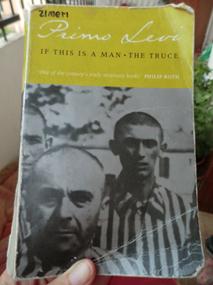
I only had to read the first sentence of a Scotsman in Exile’s blog post of this book to put aside what I was reading and start this almost immediately; his review entitled And Over Our Heads The Hollow Seas Closed Up… continues its first line:
…These are words from the canto of Ulysses from Dante’s Inferno and they were quoted in the most moving book I’ve ever read, ‘If This Is a Man’ by Primo Levi.
I found a copy on the second-hand shelf of our local bookshop the very next day, a copy I now own that would have to be the most annotated, scribbled in, colour highlighted, dog-eared, pored over volume that I possess (thanks to the previous owner ZIMERI). When I was a student, we studied ‘The Diary of Anne Frank’; how fortunate that today’s students are reading and studying this equally important work.
I’m not sure if I so much as read the book as followed closely in the footsteps of Primo Levi as he recounted the events that unfolded during his journey and time in the concentration camp, due to the way he chooses to express himself, which can best be summarised in his own words:
I believe in reason and in discussion as supreme instruments of progress, and therefore I repress hatred even within myself: I prefer justice. Precisely for this reason, when describing the tragic world of Auschwitz, I have deliberately assumed the calm, sober language of the witness, neither the lamenting tones of the victim nor the irate voice of someone who seeks revenge. I thought that my account would be all the more credible and useful the more it appeared objective and the less it sounded overly emotional; only in this way does a witness in matters of justice perform his task, which is that of preparing the ground for the judge. The judges are my readers.
Thus we absorb only that which he personally experienced and perceive not just the daily routine, the trivial yet so essential implements of his survival, the relentless toil and the near brokenness, but we view also the different strata of man in that direst of circumstances, a kind of perverse hierarchy.
Primo Levi was a young man of 24 years, a chemist and part of a partisan band hoping to join the Resistance movement when captured by the Fascist militia and sent to a detention camp at Fossoli. A few weeks later, all Jews in the camp were told they would be leaving for an unknown destination, revealed to be the camps of Monowitz-Buna and Birkenau, part of Auschwitz.
650 people made the journey that day; on arrival, the majority were ‘swallowed by the night’ and 125 sent to the camps. Of those, only three made the return journey to Italy after liberation, Primo Levi being one of them.
He was fortunate to return and discover his family intact; we in turn are fortunate that he returned and wrote these two books to be read together, one the descent into darkness, the other the journey back towards an altered but real luminosity.
All I can really say is that if you haven’t read it, add it to your list and find the time one day to slow-read it, Primo Levi was an important chronicler of a difficult period in history and a man who was interested in and able to put into words his observations of humanity in all its capacity, something we all the better for knowing.
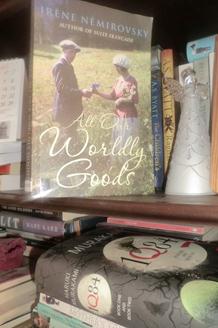
This is the second novel I picked up from the library, the first being ‘Fire in the Blood’ a tale of the consequence of indulging forbidden love. ‘All Our Worldly Goods’ has a similar theme but with different circumstances and this is more a story of what happened in the early 1990’s to those who preferred to make their own decisions regarding matrimony rather than follow the sage advice of their parents or in this case Grandfather. It is also a prelude to Némirovsky’s masterpiece ‘Suite Francaise’.
This is an era where marrying for love can be serious enough an outrage to find oneself disinherited. When there is only one son and heir and the family fortunes are dwindling, it is necessary that said son marries a woman with a significant and esteemed dowry. Pierre Hardelot follows his heart rather than his head and becomes estranged from his family just before being conscripted into the army to fight in the First World War.
With the onset of war, their families are forced to abandon the village, some fleeing by car, others on foot, only to eventually return to ruins, which they set about rebuilding in the hope that something as horrific and terrible as this war they have experienced can never be repeated.
However history has a habit of repeating itself, and so it does in both love and war. Another generation and an heiress banished by her family due to long standing interfamily resentments, and another son called up to war. Fortunately death, destruction and shared traumatic experiences can provide the necessary ingredients for forgiveness, especially when strong, capable, male resources become a scarce commodity.
It is an interesting story depicting the lead up to the forced evacuations by families from the cities and provinces to find safety from the advancing invading armies, though it is dealt with lightly and there is nothing of the terror that one assumes must have consumed Némirovsky herself, knowing what her own family went through. In this story we are never confronted with the invaders and neither do we have a very real feeling for how war must have changed Pierre.
First published in 1947, five years after her death at Auschwitz, this book can now seen in context with the more recently published collection of Némirovsky’s works, unearthed by her biographers.




 I’ve been aware of The Balkan Trilogy for a while and curious to discover it because of its international setting (Romania in the months leading up to the 2nd World War) though equally wary of English ex-pat protagonists living a life of privilege cosseted alongside a population suffering economic hardship and the imminent threat of being positioned between two untrustworthy powers (Russia and Germany).
 The novel becomes even more interesting and ironic when Guy decides to produce an amateur production of the Shakespearean play Troilus and Cressida, deliberately diverting the attention of his fans and followers, young and old, at a time when war is creeping ever closer and everyone else not involved in his amateur dramatics is frantic with worry. The play is the tragic story of lovers set against the backdrop of war.
 The book I reviewed was Lloyd Jones Paint Your Wife.


 Birkenau, part of Auschwitz.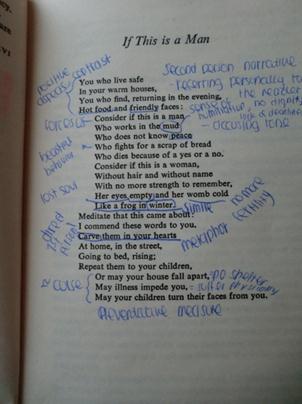
 This is the second novel I picked up from the library, the first being
 Word by Word