What the Dickens!

I couldn’t let the day pass without acknowledging that it is 200 years today since Charles Dickens, perhaps the greatest English novelist of the Victorian era, the second of eight children, was born on 7 February 1812 at Landport, near Portsmouth, Hampshire. So…


Happy Birthday Dickens!

Though not poor as such, the family went through difficult times and young Charles Dickens certainly experienced and saw hardship first-hand, images and memories that stayed with him and manifested themselves over and again through the pages of his life’s work.

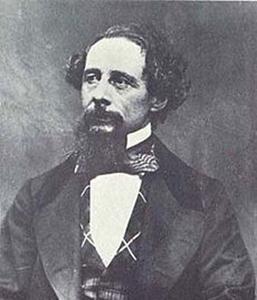
Photo via wikipedia

I’ve yet to start one of his books this year, though I have plans to read his last novel ‘Our Mutual Friend’ and ‘David Copperfield’, the latter said to be close to his own childhood experiences and perhaps less painful for him to write than his abandoned attempt to write his own autobiography, which he found too distressing to continue.

It is a testament to his popularity that his works have never been out of print and continue to be read as much today as they did when they were serialised in publications in the 19th century.

To experience or learn more of Dickens world, there is Claire Tomalin’s recently published ‘Charles Dickens,  A Life’ , an exhibition at the Museum of London and a brilliant website where you can get completely lost in Dicken’s facts and memorabilia.

My favourite commemoration thus far, would have to be Dovegreyreaders scribbles in relation to his support and inspirational campaigning for England’s first children’s hospital, the great and wonderful GOSH, Great Ormond Street Hospital.

So, do you have a favourite Dickens novel or plan to read one this year?

La Seduction – how the French play the game of life

Séduire * plaire à quelqu’un et obtenir amour ou faveurs en usant de son charme * conquérir l’admiration, l’estime, la confiance * captiver, charmer *attirer de façon irrésistible en parlant d’une chose

Suggested by a local book club and interested in an outsider’s perception of life in France, I find myself in the company of Elaine Sciolino, Paris bureau chief of the New York Times between the pages of her alluring book.

Inspired by a lecture she gave at the NY public library in 2008 entitled ‘Séduction à la française’ the author explained how seduction was key to understanding France and the French, positing that one of the reasons for President Sarkozy’s low ratings in the popularity polls post-election was because he had not mastered these rules. He may not play by the rules, but he did find his counter balance when he married Carla Bruni, who Scioloni describes as:

a modern-day woman with the manners of an eighteenth-century courtesan, skilled in the art of movement and the rituals of conversation.

Intriguing indeed and what fun the author must have had flirting flitting around the micro empires of Parisian style, beauty, cuisine, politics and culture, meeting presidents, diplomats, artists, writers, chefs, businessmen, merchants, farmers, philosophers, journalists, fashion designers, perfumers and museum curators.
The book describes a world and a manner of being I know little about, despite living within its midst these past six or so years; but Paris, like many large cities is not necessarily typical of the rest and after listening to others discuss this book, opinion is indeed varied, some suggesting ‘la seduction’ old fashioned, a prerogative of certain social classes, political circles or even pure fantasy. I tend to think there are sufficient anecdotes to say oui to all of those suggestions.

What is certain is that cultural perceptions are different even when values may be similar. While a certain look ‘le regard’ from a man is welcomed as a complement in France, it might receive a verbal legal threat in America. In France, there is greater tolerance and less testing the waters of behaviour that in the US might be construed as sexual harassment.
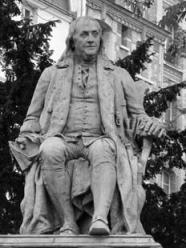
Statue of Benjamin Franklin, Paris, 16ème - Photo Lycée Condorcet

An interesting example of how long things have been so, was observed ( and well portrayed in the excellent HBO series ‘John Adams’) in the conduct and perceptions of Benjamin Franklin (first Ambassador to France) and John Adams (the second American president), Franklin understood it impolite to discuss business at dinner, immersing himself in the peculiarities of French culture while pursuing his goal; Adams however, saw Franklin’s indulgences and game playing as a complete waste of time, his disapproving manner causing the French to frown and exclude him completely. When Franklin died, France mourned him like a hero; people thought so highly of him, some believed he had been a president.

One of the paradoxes is the attitude towards privacy. Behaviours complicit in la seduction are accepted, but it is frowned upon to indulge in more than fanciful rumour; the media keep their distance from any story that verges on incriminating a person for something considered to be private or slanderous. This was highlighted recently when Sarkozy whispered an insult in the ear of President Obama about another Head of State and although the comment was overhead and reported widely by English and American media, it was not reported until a week later by the French press and even then it was kept very low profile. Not one French person I asked knew about the story. The sanctity of the right to privacy is paramount.

The chapters on gastronomy and concocting perfumes I particularly enjoyed, time spent with a connoisseur passionate about their work is pure joy and since mixing the essences of plants and flowers is one of my own passions, I was happily lost in these chapters imagining the sweet mix of aromas and the taste of Guy Savoy’s mother’s home cooking. See him work his magic here and experience his culinary art of seduction.

I recall reading ‘Sixty Million Frenchmen can’t be wrong’ by Jean-Benoit Nadeau and Julie Barlow, a Canadian attempt to understanding France and the French and their effort to explain the root of the differences. One of the analogies they made that has stayed with me was to suggest that visitors should expect a culture and a people as dissimilar to themselves as they might assume when visiting Japan or China. All are ancient civilisations and have many traits, laws, beliefs, habits, attitudes and ways of doing things that go back generations, centuries.

Our institutions originate in the decadence of ancient Rome. We are an old people. The mistresses of monarchs, from Louis XIV to Napolean III … are part of our history. – Patrick Devedjian, Paris

Rather than debate whether this is an accurate portrayal or not, I see it as another contribution to an attempted unveiling of what lies within an ancient culture and how that influences what we encounter in our modern day interactions and visitations in this intriguing country and among her patriotic people. It remains a slow opening mystery to me, so I just continue to listen, observe, interact, read and learn.

The Versatile Blogger Award

Blogging awards make excellent writing prompts and get me writing about something other than books as well as encouraging good blogging etiquette; i.e. visiting other blogs, commenting and being supportive.

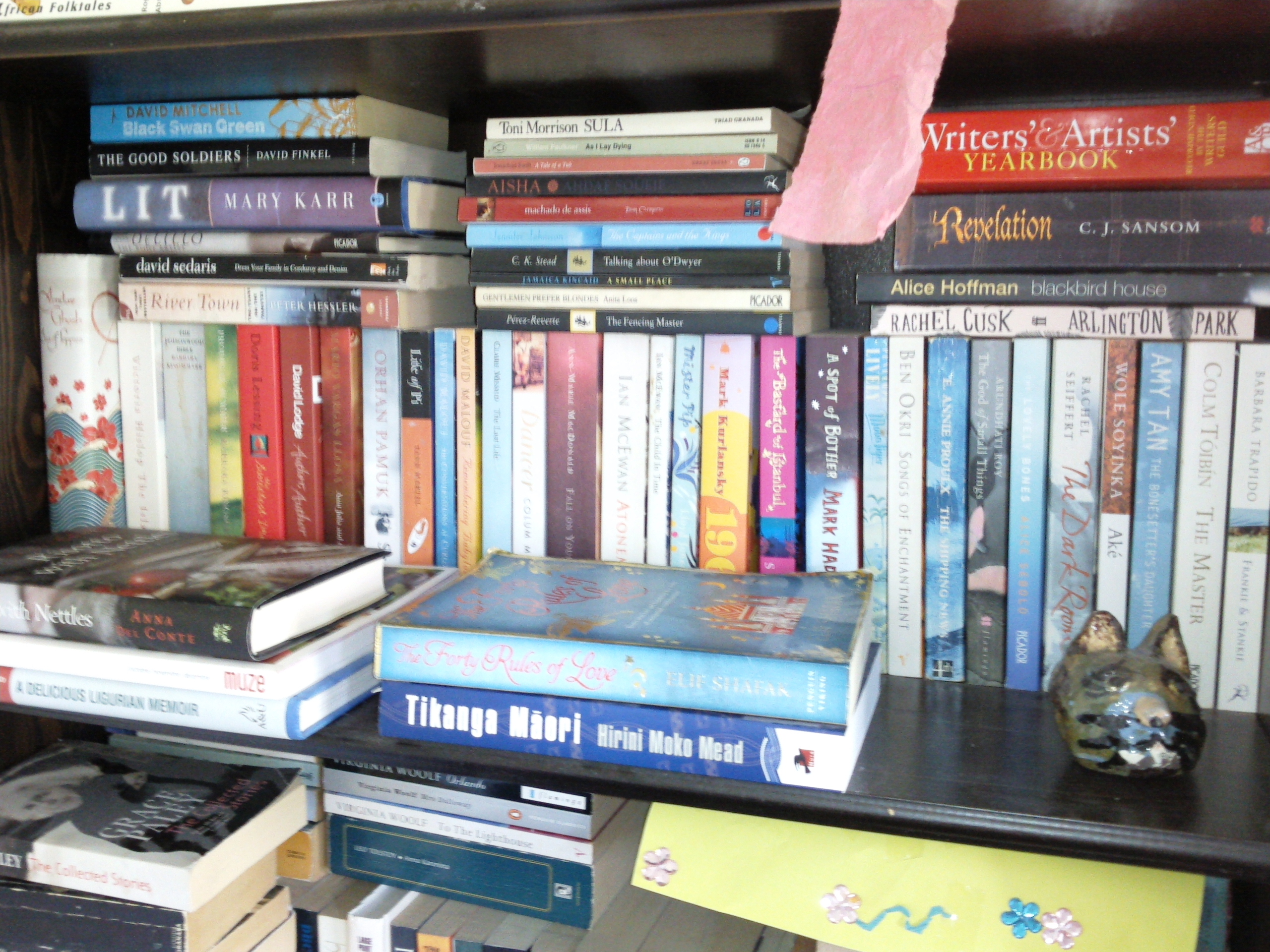

This lovely award has been passed on to me most recently via Fi’s Magical Writing Haven whose exquisite river of stones vignettes are a joy to indulge in.

However, I must also say thank you to a few others who have also mentioned this blog.  So ‘Merci beaucoup’ Elizabeth, medieval historian at Lapidary Prose who used her award to acknowledge her gratitude to family, followers and supportive writers and Subtle Kate from Sydney and Liz Shaw who offers creativity prompts for writers, journalers and artists at The Writing Reader.

Ok, 7 things you may not know about me:

  1. I am an Aquarian.
  2. The 1600 acre hill country sheep farm where I spent my childhood was one of the Middle Earth locations in the film ‘Lord of the Rings’.
  3. Golden Plover, Whitsunday Islands

    I once worked on the 104 foot (30m) tall ship ‘The Golden Plover’; I was employed as a hydro ceramic engineer (dishwasher), except when the Captain or 1stmate shouted “all hands on deck”.

  4. I have visited more than 30 countries.
  5. I was a bridesmaid at a traditional African wedding in Lagos, Nigeria.
  6. I am married to a man who was born in a manger refugee camp in Bethlehem whose name starts with J.
  7. I like to read Buddhist philosophy.

And a few more blogs I recommend:

Arabic Literature (in English) – I don’t travel as much these days, so I love to read translations, experience different cultures and travel through books.

Books & Bowel Movements – Cassie’s enthusiasm for books and the way she writes about them is contagious and I love that she loved ‘The Bone People’.

Tomcat in the Red Room – he doesn’t post very often, but writes the most amazing reviews and has a natural vocabulary I envy.

Nexus –A humanities teacher and an artist sharing wonderful moments in the classroom and elsewhere.

Hooked – One woman at Sea, Trolling for truth – when I need to go to sea I watch one of her video posts; the writing is exquisite and I hope she publishes a book soon.

Memorable Reads in 2011

It has been a memorable 2011 both in reading and sharing, one of my aspirations this year having been to learn how to create a blog.

What joy it has brought, the creation, the writing, the reading, the sharing and the community of readers and wonderful like-minded souls who comment and share and have opened their worlds to me. I didn’t expect or foresee all the joy and wonderful interaction that would come from creating a virtual entry into my world of books and reading and that this would lead me to so many others.

So thank you to all those who follow this blog, my wish for 2012 is that the inspiration and motivation we provide each other will long continue.

To rank anything would be torturous, and even to list favourites is near impossible, so I will mention some memorable reads in no particular order and no doubt regret those I have left out later.

muze 62

1. Muze No.62    ҉   not a big consumer of magazines, in February I discovered this volume at Le Mans TGV station. The words CULTURE, ECRITURE, LECTURE jumped out at me, then Louise Bourgeois – Eugénie Grandet, Proust à l’écran, Flannery O’Connor, Argentine and Le Sacré excited me and the cover just melted my heart. It did not disappoint, I now have another favourite magazine (and a most enjoyable way to improve my French).

2. Fear and Trembling by Amélie Nothomb    ҉   Recommended by mon amie B, this was my first foray into popular French fiction. A hilarious account, said to be based on the author’s experience of a year working in Japan, you end up thinking she’s either a saint or a masochist as she fails to integrate into the work environment.

3. The Children’s Book by A.S.Byatt   ҉   having not read her work for a long time, I was pulled into this Edwardian world of potters, ceramics, the Victoria & Albert museum and the varying sensitivities of children. A mesmerising and colourful journey.

4. Seven Days to Tell You by Ruby Soames   ҉   will remain with me always as a turning point, the first book I read prior to publication, fear and delight combining to produce this review.

5. The Diving Pool, The Housekeeper + The Professor by Yoko Ogawa   ҉   I will remember 2011 for discovering Yoko Ogawa’s short story collection in Oxfam, introducing me to her gripping and evocative style, followed by the poignant and memorable novella ‘The Housekeeper and Professor’.

6. Gift from the Sea by Anne Morrow Lindbergh   ҉   this classic collection of ‘coming of middle age’ essays published in 1955, stays with me because it arrived the day my daughter was admitted to hospital and was one of my choices of books to accompany me during those challenging two weeks.

7. The Lacuna by Barbara Kingsolver   ҉   the ten year wait club, I recall awaiting Louis de Berniere’s ‘Bird without Wings’, one of my all-time favourite books and this year there was Jeffery Eugenide’s long awaited ‘The Marriage Plot’ and Kingsolver’s ‘The Lacuna’ which I loved and review here.

8. A Kind Man by Susan Hill   ҉   shortly after reading an author’s interview in Mslexia and a subsequent visit to Daunt Books in Marylebone, I couldn’t help but be tempted (and indulged, thank you G) by Susan Hill’s ‘A Kind Man’. I respected her attitude and perspective in the interview and instinctively savoured each page of this fable-like novella. I then read ‘The Beacon’ confirming Hill as a writer I know I will continue to read, happy there is a lengthy backlist.

9. The Many Lives & Secret Sorrows of Josephine B by Sandra Gulland    ҉    my first blog review and wonderful memories of two trilogies shared with my best book reading buddies C and M.

And finally, no memorable list could be complete without mentioning the companionship of:

10. Mslexia   ҉   the quarterly magazine for women who write and more often women who juggle at least one or more jobs, a family and numerous responsibilities but who find 2, 5, 10, or just any hours to dedicate to writing, they are all an inspiration to me and I love to read all those who succeed in becoming published through its pages. An inspiration, a writing prompt and always a great read.

Happy New Year Everyone!

The Housekeeper + The Professor

Having recently discovered and read Yoko Ogawa’s
‘The Diving Pool’, I was further intrigued when I saw this novella displayed in my local bookshop and couldn’t resist another of her works with its beautiful cover and the promise of an alluring story about a woman who visits an eccentric mathematics professor each day to clean his home and cook his meals.

Reading ‘The Housekeeper and the Professor’ is a little like a meditation in mindfulness; although we might escape into the book, we are held in its present, for each day is a repeat of the previous and follows a pattern, such as we might too if our memory were constantly erased after eighty minutes, the habits we would continually follow, because we have been reduced to the very core of our nature, without the accumulation of memory from yesterday, last week or last year.

The Professor is a mathematics genius, whose memory ceased functioning after an accident some years before, so while he retains his mathematical genius and his long term memory before the accident, he has lost his short term memory.  It lasts only eighty minutes and so he has devised crude methods to remember things, such as pinning small pieces of paper to his suit to remind him of important facts, otherwise he starts every day anew.

The housekeeper arrives each morning and introduces herself as if they have never met. Slowly, she and her ten year old son, whom the Professor refers to as Root – a reference to the square root sign and his hair, are drawn into the Professor’s reduced world where numbers reign supreme and the two visitors begin to understand the magic and meaning behind what they had always thought of as ordinary numbers.

Whether you hated mathematics at school or loved it like I did, you will find yourself attracted to the arithmetic secrets the Professor unveils, which stir more than a mild curiosity in the significance of certain numbers and the challenge of elegant equations, as both the housekeeper and her son discover to their own delight.

Eternal truths are ultimately invisible , and you won’t find them in material things or natural phenomena, or even in human emotions.  Mathematics, however, can illuminate them, can give them expression – in fact, nothing can prevent it from doing so.

In essence, it is a meditation on the simplicity of life and an introduction to the complexity and significance of numbers; it is about letting go and accepting things the way they are and deriving small pleasures from the mundane.

Yoko Ogawa’s writing and storytelling flows like a sparkling river, it draws you in and carries you along; there are few surprises just gradual awakenings. There is a vulnerability to each of the main characters that we pick up on, which forewarns us, characters we become sympathetic to, whom I was sad to leave behind but will be revisiting again for sure.

If on a winter’s night a traveller

If you have never read Italo Calvino this may be a misleading book to start with, it’s certainly not reminiscent of his short stories and I believe it is unlike his other novels, but it has a kind of cult status in that it is was an original and much talked about experimental work.
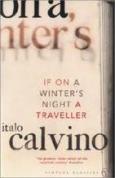
‘If on a winter’s night a traveller’ starts out as a conversation, Calvino entering and leaving the exchange within the pages of his novel in an unpredictable fashion. This is not a book to lie back and lazily escape into, it requires your attention and concentration to stay with where you are at and to understand what is going on and then just as you are spirited away by his seductive prose and enjoying the ride into the depths of one of his stories, you turn the page and Monsieur Calvino is back.

I enjoyed the diversions, although I was disappointed that he was unable to find a way to leave the sex of the reader neutral, having been almost convinced he might well be speaking to me, it becomes clear he is speaking to his male readers, political correctness not in full swing in the early 1980’s when this was published. But I readily forgive him, especially when assured by Lorna Sage, author of the memoir ‘In Bad Blood’ who wrote in the Observer:

‘devastating, wonderfully ingenious parody of all those dreary best-sellers you buy at the airport…It is a “world novel”: take it with you next time you plan to travel in an armchair’

Chapters are interspersed with stories, the titles of which are referenced in each preceding episode, the stories are the beginning of novels and you the protagonist are searching for the rest of the story while listening to Calvino expound on readers, reading, and writing. Best described in an extract from one of the stories themselves, where he writes:

I’m producing too many stories at once because what I want is for you to feel, around the story, a saturation of other stories that I could tell and maybe will tell or who knows may already have told on some other occasion…I see something like a forest that extends in all directions and is so thick that it doesn’t allow light to pass…so it is not impossible that the person who follows my story may feel himself a bit cheated, seeing that the stream is dispersed into so many trickles, and that of the essential events only the last echoes and reverberations arrive at him…’

Playful, impossible to label, is it a…, it is a question, a poem, a collection of stories, a novel and a conversation with Italo Calvino. The author imposes himself and his voice within the pages and we as the reader also become involved in the action as Calvino switches into the second person narrative. If I were an academic I would probably be littering this text with a lot of technical terms describing the literary tools Calvino plays with, literature students are likely to come across it, or at least they did in the past, as David Mitchell, author of ‘Cloud Atlas’ reminisces about here, when he rereads it for a second time.
It’s an oeuvre that defies categorisation, which plays with the reader and will entertain some while annoying others, myself I am content that it has now stopped taunting me from the bookshelf, my curiosity sated, it can now be talked about with some knowledge of its interior. That curiosity won’t rest long however, no doubt it will soon find another dusty volume to settle on, another book I haven’t read by that author I have often read about but have yet to enter their imagined world.

How to Spot a Psychopath – A journey through madness or a mad journey?

In the early 19th century, French psychiatrist Philippe Pinel coined the term ‘manie sans delusion’ referring to the one per cent of the population that appeared normal on the surface but lacked impulse controls and were prone to outbursts of violence. In 1891 it became known as ‘psychopathy‘.

I have just finished reading Jon Ronson’s riveting journey into the heart of that difficult to detect but fascinating to read about affliction, in his recently published book ‘The Psychopath Test’.  An extract from the book published in the Guardian piqued my interest as I was 1500 words into writing a short story around the theme of ‘Ego’ and I had a notion that one of the protagonists was a psychopath, or at least had psychopathic tendencies, so I was interested to know more about how to identify and make those behaviours manifest through a character. Through Ronson’s article I followed a trail and found myself eventually consulting Bob Hare’s 20 point checklist and thus had the insight I was looking for.

‘The Psychopath Test’ is no textbook and it shouldn’t be used to do what he did – random analysis of people you know; its part mystery, full of intrigue, with equal doses of curiosity and anxiety as we follow him equipped only with his journalistic tools into a world of charm, deception and manipulation where nothing is as it appears to be, or is it? He uses his tools to excellent effect to present us with investigative stories he pursued which read more like a detective novel than the work of non-fiction it is. Only it’s not a detective novel because ironically you would need more the qualities of a psychopath to be a successful detective than the anxieties and overdose of empathetic feeling the author has. Ronson is very entertaining, he admits and shares his anxieties and self-diagnoses his own mental deficiencies in a playful and identifiable way.

He presents a look into a field that has had its share of experimental and controversial programs, practices and institutions as well as its staunch adversaries such as the Scientologists, who continue their campaign to discredit the profession and individuals within it to this day.

Having tried to solve the initial mystery of uncovering who has sent a group of neurologists and academics copies of the same cryptically puzzling book, Ronson sets out to acquire basic skills in identifying potential psychopaths and arranges interviews with likely candidates, searching for and pleased by anything that seems to fit with his criteria and admitting his disappointment when their responses don’t quite fit the profile.

'How to Spot a Psychopath' by Lo Cole is available as a limited edition print from http://www.etsy.com/listing/76743583/spot-the-psychopath

Fascinating though the extremes are, it is interesting to see how many ordinary people give accounts of behaviour in pursuing high achieving goals at work, which border on psychopathic behaviour, such as detachment, the eradication of empathy and remorse. What’s more the percentage of psychopaths in the corporate sector, while low, is three times above the general population and cause for some concern, although I found myself not entirely surprised by this revelation after watching some of these executives under questioning from government officials and judges in the recent financial crisis, where a lack of empathy, failure to accept responsibility and lack of remorse or guilt seemed to be common traits.

It’s an imprecise malady with no known cure and involvement best avoided if one encounters anyone with an overabundance of the suggested characteristics, and while we might think it shouldn’t take a neurologist or a psychiatrist to point that out, to be human is not always to be logical or to follow common sense, especially while under the spell of a charming, manipulative liar.


Why People Don’t Read Short Stories

Publishers have difficulty persuading readers to buy short story collections.  Many readers love them, but more readers avoid them, preferring the novel.  Why is this?  Fiction writer Tessa Hadley suggests it is because in our culture, readers have grown used to the habit of the novel, we can pick up a novel and put it down time after time, when it opens we re-enter its world, escaping our own for a while.  There’s something discontinuous about our reading relationship with short stories.  At the end of each story we are thrown out of that world created by the chosen words of the author enhanced by our imagination, back into our surroundings without leaving a thread; we then enter another story and begin to build a new picture of characters, place and situations.

Reflecting on this now, I wonder if that is why I liked Alice Hoffman’s ‘Blackbird House’ so much, because of the subtle connection between the stories which kept me wanting to go back for more.  Or was it the writer’s style? I love this book, a unique set of short stories that traces the lives of various occupants of an old Massachusetts house over a span of 200 years, witnessing change in each family through their loved ones and the lives they live inside Blackbird House.

I like reading short stories, especially in between reading novels or other more lengthy works of non-fiction.  There are some short stories in particular that I adore, like the Italian writer Italo Calvino’s ‘The Enchanted Garden’ from his collection of short stories ‘Difficult Loves’.  Giovannino and Serenella discover an opening in a hedge leading them into a quiet garden of flower beds, eucalyptus trees and gravel paths, it’s like a mini version of Frances Hodgson Burnett’s ‘The Secret Garden, still a favourite today.  And then there’s A.S.Byatt’sStone Woman’ from her ‘Little Black Book of Stories’ the haunting tale of a woman witnessing her own gradual metamorphosis into stone; befriending an Icelandic stone carver she returns to East Iceland, the place that will become her final resting place.

Mini-gateaux, Bechard, Aix en Provence by Maki

For me, an avid reader, short stories are like the contents  of extravagant chocolate boxes or the pick n mix gâteaux at Béchard on the Cours Mirabeau here in Aix en Provence.  When I’m into reading short stories, I don’t just take one collection, I take three or four and then read a story or two from each collection, so I sample more than one writer at a time.

Why do I do this?  Well firstly, because for me short story collections are like ‘1001 Nights’, I don’t want the collections to end, so I slow down the process to savour the stories.  Secondly, I like to sample writers from different countries, so today I might read from Nigerian writer Ben Okri’s collection Stars of the New Curfew’ set in the teeming street of Lagos, or ‘Sandpiper’ Egyptian writer Adhaf Soueif’s collection about women finding themselves in countries other than their own, where language, culture and love create confusion.

The collection I have now remind me that I love to travel through books both to foreign destinations and through the minds of writers from different countries and cultures as well as returning to the familiar vernacular of my country of birth.

In addition to those mentioned I might dip into Elliot Perlman’s (Australian) ‘the reasons I won’t be coming’, Alice Munro’s (Canadian) ‘Friend of my Youth’; Janet Frame’s ‘The Lagoon’, Keri Hulme’s ‘Stonefishand ‘The Stories of Frank Sargeson’ (New Zealand writers), Indian writer Chitra Banerjee Divakaruni’s ‘Arranged Marriage’ and Jhumpa Lahiri’s ‘Unaccustomed Earth’ or Raymond Carver’s ‘What we talk about when we talk about love’ which reminds me I want to read the Japanese writer Haruki Murikami’s ‘What I talk about when I talk about running’. Then there are the slim classics Dubliners’ by James Joyce who needs no introduction and Grace Paley’s ‘The Little Disturbances of Man’.  And I’m happy to say, I’ve almost managed not to finish any of them – except Hoffmann’s ‘Blackbird House’ which reviewers describe as “not quite a novel and not quite a short story collection’ so I guess that one doesn’t count.  And I plan to read it again anyway.

In this time pressed world, one would think that short story collections are poised for a revival; after all, what better antidote for the tired, overworked individual who remembers nostalgically the enjoyment they used to get from a good book – short stories are perfect!

As writer Jonathan Falla said “Good stories are not literary fast food, made on the cheap; they are intense with a flavour that expands to fill the mind.”  The short story allows us in a short space of time to understand and consider momentous things, grand dilemmas.  Short stories pull us into their world and shake us up.

Do you read short stories?  What’s your favourite collection?

www.theshortstory.org.uk

http://www.americanshortfiction.org/

Liebster Award

During our ‘dizaine de jour’ (12 day) hospital stay, my blog was nominated for a Liebster award by the inspirational Candyce who quit her job to Return To Writing and very kindly wrote a few kind words relating to my book blogging meanderings. Thank you Candyce.

So what is a Liebster? Both a word (German for dearest or beloved) and an honour, it is bestowed by those in the early stages of writing a blog (less than 200 followers) upon 3-5 bloggers they admire.

When nominated we should:

1. Link back to the blogger who awarded us.

2. Tag 3-5 blogs to receive the award.

3. Inform them of their nomination.

4. Display the Liebster Award image on our blog.

Recently I joined the SheWrites community of writers and since then I have had many thoughtful visitors to my blog who continue to leave kind and encouraging comments. So thank you also to all the SheWrite sisters out there, it’s wonderful to be part of the group.

I am enjoying journeying through blogsville connecting with wonderful, inspiring people, admiring the diversity of passionate interests and thought provoking musings of this growing community.

So my nominations are:

  1. The Spirit that Moves Me – A beautiful and insightful blog that uncovers and shares the sacred through creativity and the feminine. In a recent post called ‘Finding home’ she writes “Home is not a cottage, a house, or the city in which I live. It is the moment when I am fully present and fully alive. It is when I am aware of myself and the love that surrounds me, of where I come from and who I am.” I feel right at home with this spirit and happy to be following.
  2.  Speaking of Words and Quilts – Amy has started her blog to record and reflect her writing journey and often uses metaphors relating to her quilt making as well as the magnificent landscape that surrounds her. I’m no quilter, but I love her honest style and the way she finds insightful teachings through her scraps of fabric, even that beautiful, ugly quilt she’s not yet ready to show us.
  3.  Mishfit – Mish is a writer, a Mum and an inspiration to many women in Melbourne, Australia, where she runs a fitness and personal training service for Mums. She is the most knowledgeable person I know regarding female incontinence and can quote scary statistics that will make you take note even if you think that’s not me; most of all she empowers women to get in shape while making the children part of it, – yes, babies have supervised fun too!
  4. Wouldn’t that rip the fork out of your nightie?? – Aria writes from the heart, embracing all of the many aspects of her persona, she is inspirational, intuitive, funny, (whacked in her words), insightful, highly creative and prolific – she wakes at 4am and doesn’t sleep till late and is definitely making the most of those hours. Be careful, you could lose hours on this wonderful blog.
  5. Stories Are Good Medicine – Children’s doctor turned author, Sayantani muses on the writing process, yoga and the dharma, reviews interesting books and offers an alternative perspective. Healthy and thought provoking medicine indeed.

Secret Gardens and the Imagination

This week I find myself rereading an old-time classic out loud.  I am being reacquainted with Frances Hodgson Burnett’s ‘The Secret Garden’ as I read it aloud to my 9 year daughter while camping out for 10 days with her in the paediatric ward of the hospital.  My French is being elevated to yet another level as we undertake a rapid apprenticeship in living with Type 1 diabetes, which after a rushed call to the hospital, we discovered was the cause of her giant fatigue and unquenchable thirst.

Both of us seeking an escape, we embark on our journey towards the secret garden with 9 year old Mary Lennox, who finds herself removed from an exotic life in India and living with a rarely seen and allegedly cantankerous Uncle, in a grand old manor on the moors of England after both her parents succumb to cholera.

We are a couple of chapters into the book and my daughter is feeling a little deceived.  “There’s no secret garden” she says, “and what does it mean, gloomy”.  I have to admit that for a story chosen to perk up an ailing child, the first few chapters are somewhat gloomy indeed.

The Secret Garden in the daytime...

At this point my daughter decides to take the matter into her own hands and here you can see her first attempt at creating a secret garden of her own.  The joy and allure of a great book title, it inspires the imagination before we have even arrived at the promised treasure the book beholds.

Young Mary has been both pampered and neglected in her former colonial life so England is something of a shock, where staff speak to her as an equal and expect her to be somewhat independent.  But this newfound freedom will lead her to discover the enchanted garden and to make new friends, not just of the human variety.

Needless to say, this wonderful book is about transformation in many guises, the human spirit, the magic and healing power of gardens, the wonder of birds and animals and the joy that acts of kindness engender.  It worked wonders for us both.

The Secret Garden at night...