
Looking Beyond the Ordinary & Expected
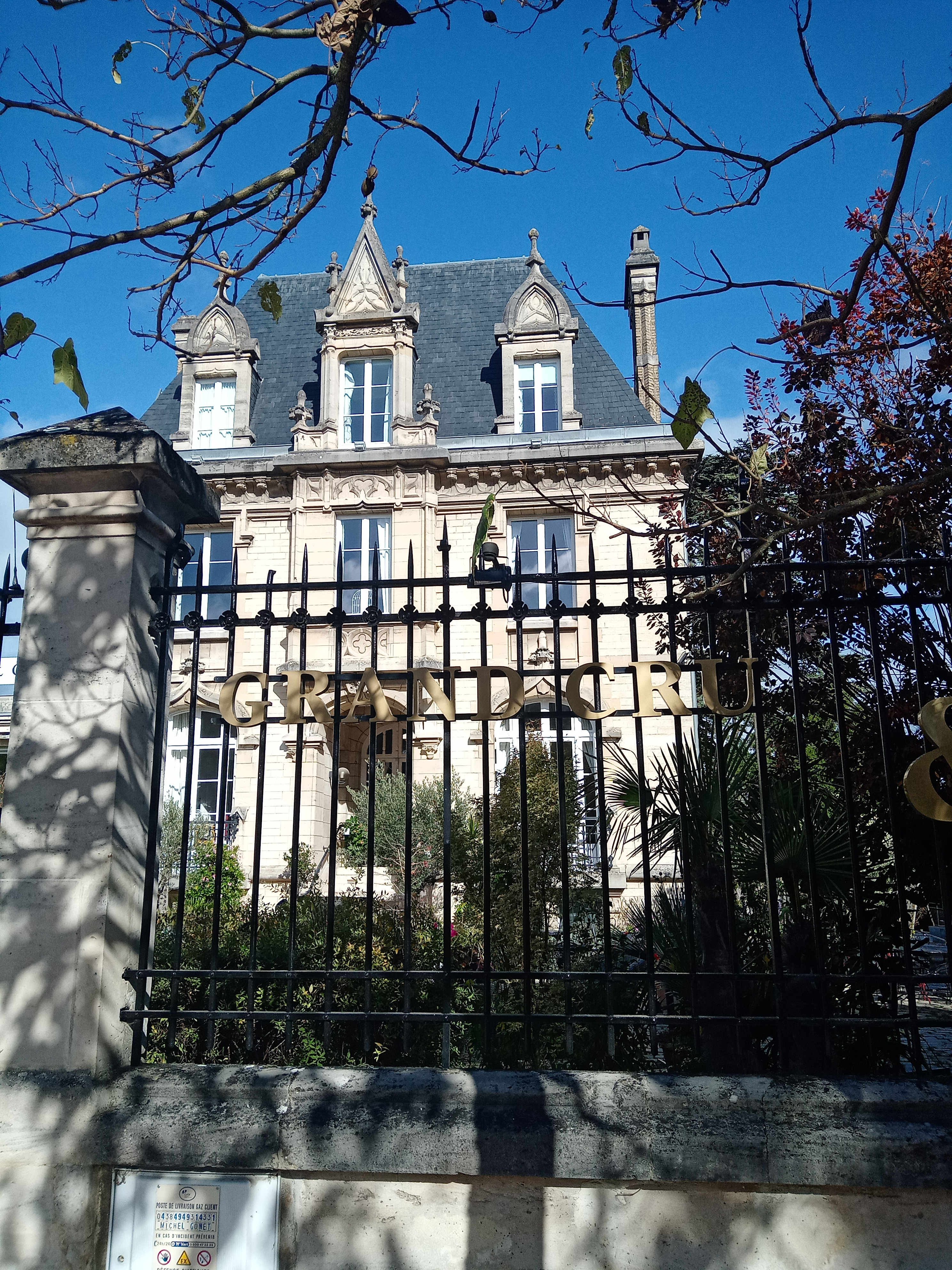
On a recent visit to Paris, I accompanied friends on a day-trip to the town of Épernay in the North East of Paris, 30 kilometres south west of Reims. Like Reims, it is known for its champagne houses, vineyards and the close to 50 kilometres of underground tunnels built to store their wine, a veritable underground city.
The town sits on layers of chalk, which gives those underground tunnels their unique aspect that contributes to the uniqueness of their product and why the fierce protection over the use of the word ‘champagne‘. Champagne is only ‘champagne‘ if grown and cellared and produced in the Champagne region of France. If not, its crémant, prosecco, cava, sparkling …
The archbishops of Reims controlled the town of Épernay from the 5th-10th century, it then passed to the counts of Champagne and in 1642 to the Duke of Bouillon.
It was badly damaged during the Hundred Years’ War, and was burned by Francis I in 1544. Having been destroyed or burned more than 20 times, the town has few ancient buildings, the mansions you can see there today are mostly from the 1800’s.
The Champagne Hillsides, Houses and Cellars are on the World Heritage list for the Protection of World Culture and Heritage for all humanity.


The town also houses some 9th century manuscripts, a wine museum and archaeological artifacts.
Stéphane Hessel encourages youth to engage!
As we wandered along the famous Avenue Champagne with its palatial 19th century mansions, some of which can be visited for wine tastings, I looked for number 31 (a favourite number) to take a photo. At about the halfway point in the long, fairly sterile avenue, it was not a champagne house, but a 2,000 + student lycée (high school), named Lycée Stéphane Hessel.
I was intrigued and delighted to see the name of this institution, certain that it must have been named recently, I knew that Stéphane Hessel had died only 10 years ago.

The high school was named in 2013/2014 when the lycée Godart-Roger et lycée Léon-Bourgeois merged to become the lycée Stéphane Hessel, renamed in tribute to this inspirational author of a best-selling essay, written and directed specifically towards youth.
Discovering this lycée was one of the highlights of my visit, I found it brilliantly provocative that in the middle of this world famous avenue of procuring bubbles, sat a human rights activist, member of the Resistance, a voice for peace and equality, the author of a famous essay, written in his 93rd year, 3 years before his death in 2013.
It a short half hour read that has since been translated into numerous languages and sold 4.5 million copies worldwide.
I knew about it because at the Salon de Livre in Paris in 2014, there were massive queues of young people lining up to get their booklet signed by him or to listen to him talk. Journalists were intrigued and wanted to know why these young students were so interested in the words of a very old man. The response was “because he lived it” they said, unlike most who teach us about this era, this man actually lived through everything he has written about. He is authentic, we respect that.
The Essay
Stéphane Hessel wrote his essay in his 93rd year and considered himself fortunate to be able to reflect at that age on events that laid the foundation for his lifelong commitment to politics and human rights.

Born in Germany, he became French in 1939 and in 1941 fled to London and became part of Charles de Gaulle’s group of Resistance members.
He returned to France to organise communications, was captured and sent to Buchenwald, tortured and later sentenced to execution by hanging. He and two others managed to escape execution through an act of identity exchange.
He wrote of the declaration adopted by the National Council of Resistance in March 1944, a set of values and principles created to guide the nation’s modern democracy once it was freed from occupation. He reiterated the importance of many freedoms that came with the end of the war, demanding that they continue to be protected for the good of all.
It is the duty of us all to ensure that our society remain one of which we are proud, not a society wary of immigrants and intent on their expulsion or a society that disputes the welfare state or a society in which the media are controlled by the wealthy.
Find Your Reason
The basic motive of the Resistance was indignation. He addressed his young audience, reminding them of this and implores them to find their reason for indignation, to join the great course of history, to understand the Universal Declaration of Human Rights and if encountering someone who is robbed of these rights, to have empathy and them help them reclaim them.
He wrote about the rise of fascism and his understanding of the origins of it, and how young people today will find their own reasons for expressing their outrage. His indignation was born less of emotion than a desire to engage. He was influenced by the words of Jean-Paul Sartre who said “You must engage – your humanity depends on it.”
The Worst Attitude is Indifference
There are unbearable things all around us, look for them he said:
This is what I tell young people: If you spend a little time searching, you will find your reasons to engage. The worst attitude is indifference. “There’s nothing I can do; I get by” – adopting this mindset will deprive you of one of the fundamental qualities of being human: outrage. Our capacity for protest is indispensable, as is our freedom to engage.
He highlights the challenges, of grievous injustices inflicted on people deprived of the essential requirements for a decent life, the widening gap between rich and poor and the violation of basic freedoms and fundamental rights, citing Franklin Delano Roosevelt’s “Four Freedoms” and his own participation in the creation of the UN’s Universal Declaration of Human Rights.
I will never forget the crucial role played by Eleanor Roosevelt, whose great kindness and natural authority worked wonders to help reconcile the disparate personalities that comprised the commission. She was a vibrant feminist, and it is largely due to her that, for the first time, and on a global scale, the equality of men and women was inscribed without ambiguity in an official text.
His message is one of active engagement, nonviolence and hope, against injustice.
“TO CREATE IS TO RESIST.
TO RESIST IS TO CREATE.”
It is an inspiring short work, that I encourage everyone to read, its message could not be more appropriate at this time, given all that the world is currently facing.
Stéphane Hessel, Author
Stéphane Frédéric Hessel (20 Oct 1917–26 Feb 2013) was a French diplomat, ambassador, writer, concentration camp survivor, French Resistance member. Born in Germany, he became a naturalised French citizen in 1939. He became an observer of the editing of the Universal Declaration of Human Rights of 1948.
In 2011 he was named by Foreign Policy magazine in its list of top global thinkers. In later years his activism focused on economic inequalities, the Israeli-Palestinian conflict and protection for the post-World War II social vision.
His book IndignezVous! (Time for Outrage! )sold 4.5 million copies worldwide. Hessel and his book were linked and cited as an inspiration for the Spanish Indignados, the Arab Spring, the American Occupy Wall Street movement and other political movements.



 Word by Word