I Always Loved You: A Novel by Robin Oliveira

Mary SutterWhile looking at a Goodreads list of Historical Fiction due out in 2014, I noticed the name Robin Oliveira, author of the excellent novel My Name is Mary Sutter published in 2010.

I don’t read a lot of historical fiction, but occasionally via word of mouth, I hear about a well written, compelling title that I can’t resist, particularly if it is set in France.

Well researched historical fiction in the hands of a talented writer, is my preferred method of learning about French history (or any history); engaging characters propel the narrative forward and we invest ourselves in the characters who have inhabited the period and discover the chronology of events as if we are living them. Historical events when presented without the force, nuance and characteristic dialogue of personalities that have shaped them, risk becoming dry, uninteresting, sedative and read by the few.

Set in 19th century America on the cusp of civil war, My Name is Mary Sutter chronicles the life of a midwife with ambitions to become a surgeon, something she will be thrown into with the advent of war. Her ambition requires the courage to cope with an abundance of men suffering war injuries amid dire living/working conditions plus sacrifices in her personal and family life. She is a captivating heroine, strong-willed yet vulnerable, living in an incredible pioneering era for women.

In her research, the author learned that 17 young women became physicians after their nursing experiences in the civil war. While Mary Sutter is fictional, she is a truly inspired character about whom Robin Oliveira had this is say:

“And through it all there was Mary Sutter, whose story I needed to tell as a celebration of women who seize the courage to live on, to thrive, to strive, even, when men conspire to war. Mary, flawed and intelligent, careening between desire and remorse, stumbling forward out of courage and stubbornness, hiding a broken heart, but hoping to redeem something beautiful from a life humbled by regret.”

Which is a prelude to saying that seeing a new Robin Oliveira novel coming out in 2014 and set in France, I jumped at the chance to read it.

I Always Loved YouI Always Loved You, an unfortunate and slightly off-putting title, sorry, is about the life of  the American painter Mary Cassatt, her life in Paris struggling to make her name while remaining true to her art, and enduring a life-long fractious relationship with the impressionist painter and sculptor Edgar Degas. It also brings to life another female painter, Berthe Morisot and her relationship with the Manet brothers, Édouard and Eugène.

Mary had left her home town of Philadelphia to pursue artistic ambitions and after ten years of hard work, having once been accepted by the Salon for her work Ida (or Spanish Dancer Wearing a Lace Mantilla), has now been rejected and is feeling disillusioned and on the point of giving in to her father who wants her to return home, find a husband and be with her family. Had it not been for his fascination with Ida and the subsequent encounter with Degas, she may well have fulfilled her father’s bidding.

“C’est vrai. Voilá quelqu’un qui sent comme moi.”
(It’s true. Here it is, someone who feels as I do).
Edgar Degas commenting on Mary Cassatt’s painting, Ida

Through Mary, we learn what it meant to be a painter in Paris in the late 1800’s, the restrictive, suffocating influence of the Salon Jury, purveyors of the official annual exhibition of the Académie des Beaux-Arts, known as the Salon de Paris, to whom all artists looking for acknowledgement and recognition would submit one or two paintings and then await acceptance or rejection. Those deemed successful by the Jury would be hung at the next exhibition and if lucky, talked up by the critics. Those who weren’t, were resigned to another year of work before resubmitting – and they all did, for it was seen as essential to exhibit there in order to achieve any success, a status quo that existed for almost 200 years in France.

Salon de Paris

Salon de Louvre 1787
Source:Wikipedia

This process spurned a rebel group lead by Edgar Degas who refused to submit their work to the Salon Jury and began to hold an alternative exhibition.  These artists were willing to let go of the past with their references and rules and were bold with colour, subject and loose with their interpretation. They became referred to disparagingly by the media as Impressionists, a term Degas despised. It was a brave move and not all of the groups members managed to sustain their nerve, the lure of the Salon despite its limitations, not easy to stand up against.

Degas had admired Mary Cassatt’s work without knowing who she was and after organising to meet her, invited her to exhibit with his group of artists and to one of their weekly salons, a social gathering that included Édouard Manet, his brother Eugène, Berthe Morisot, Renoir, the writer Émile Zola, Pissarro, Gustave Caillebotte, Zacharie Astruc, the poet Stéphane Mallarmé and Claude Monet among others. The evening would mark the beginning of a long relationship between two talented artists whose work came before all else and whose similarities and stubbornness would continue to attract and repel them until their last days.

“He was right. The something, the leap an artist makes so that his painting is more than its technique, he had already achieved. And she wanted that.”

Edouard_Dantan Un Coin du Salon, 1880

Edouard Dantan
Un Coin du Salon, 1880
Source: Wikipedia

I had never heard of Mary Cassatt when I began reading and was intrigued to discover her art, but decided not to go looking at her or Degas’s work until I had finished, allowing my imagination to create an image of their creations during the period of their encounters, which added an exciting anticipation to the reading, especially while Cassatt was preparing for her first showing with the Impressionists and when Degas was working on his sculpture The Dancer.

I hesitate to show any of images of their art here, as it was such a reward for me upon finishing the book. Getting to know or reacquainting ourselves with the artists work is a personal journey and we should decide in our own time when to view the oeuvres of these great artists. No Spoilers here!

They were an inspiration to each other with regard to their work and Oliveira brings the two alive in rich detail, you can almost see their respective studios and smell the turpentine, imagining the furrowed brow of concentration as these two passionate artists throw themselves into their work and block out the world around them.

What they couldn’t inject into their relationship, they gifted to each other through their work, some of the most poignant and yet ironic scenes are when Degas helps Cassatt find her subject and confirms what it is she should be painting. And then the joy of finally seeing them and seeing the energy and vibrancy of those paintings she created during that period when they responded so positively to each others influence, fact or fiction, it stands out in the work.

“I have no money to pay a model,” Mary said to Degas. “I don’t know what to do.”

“You must find your subject.”

Mary said, “Like yours? Ballet, horses, brothels?”

“Obsessions are an artist’s gift. Obsession is poetry,” Degas said.

Just as other writers have brought alive the Lost Generation of writers resident in Paris in the 1920’s, Robin Oliveira does the same for this group of painters, awakening our interest in this turning point in the history of art and the influence of this group on painters in the wider world, which continues today. It is a brilliantly told story of fascinating characters and their passion for art.

National Gallery of Art Washington

National Gallery of Art
Washington

And if you are fortunate enough to live near or visit Washington, it appears that there is to be an exhibition of Cassatt and Degas’s work at the National Gallery of Art May 14 – Oct 5 focused on the critical period of the late 1870s through the mid-1880s when Degas and Cassatt were closest, bringing 70 various works together to showcase the fascinating artistic dialogue that developed between these two major talents and friends.

Note: This book was an ARC (Advance Readers Copy) provided by the publisher via NetGalley.

Seasonal Comfort Reads

Merry Christmas to you all, I hope you all have/had a wonderful, relaxing day spending it exactly as you wish.

tower-and-santa-336x280We had a unique Christmas Day, with a picnic lunch on the TGV (fast train) to Paris – delicious savoury canapés, no cooking required and no dishes to wash up afterward either.

I am looking forward to reading time, although I may not get much done, since there is so much to see and do here in Paris.

But first, some Christmas Book news!

Christmas DayThis season The Guardian ran a series on writers and readers’ favourite books to curl up with on biting winter nights.

As some of you might remember, as I mentioned and gave away a copy of this book last year, my seasonal comfort read is Paul Durcan’s book length poem Christmas Day.

Well, there might not have been any books under the tree this year, but having my review published by The Guardian on Christmas Day was the best gift of all!

Click here to read the review.

Joyeuses fêtes à tous!

joyeuses fete

Hemingway’s Paris – A Moveable Feast

Hemingway makes me think of the debate streaming though comment threads on Goodreads.  The debate centres on the issue of discussing an author in book reviews, Goodreads suggesting that reviews focus only on the content of a book and not stray into opinions about the personality or character of the author. Hemingway

Being a book review site, it may not seem like an unreasonable request, except that the site has allowed five years of historical reviews to build up without comment, guidance or reprimand against reviews that may have crossed this line and in the meantime a strong community of reviewers has developed, spreading its roots and reviews deep into the site. Unsurprisingly, the community is now rebelling against wilful deletions of reviews. Some are threatening to abandon the Goodreads ship while its Captain is said to be sailing on oblivious to mutiny in its hold.

I think of Hemingway because in A Moveable Feast, he writes not just about himself, he reflects on writers he was acquainted with in Paris and about life in that city after the First World War. He shares exactly the kind of opinions that are forbidden to reviewers today. However, he is not writing a book review, he is writing about life.

Apart from the delightful short story A Clean Well-Lighted Place, I have not read Hemingway since the trauma of having to study The Old Man and The Sea at school. I am sorry to say that I detested this novel and although nothing of the prose has stayed with me, a kind of nausea, akin to sitting in a rocking boat with no means of rowing it, engulfs me when remembering it. I didn’t understand at the time why I reacted like this, worse than boredom, it was bereft of literary merit according to my 13-year-old standards.

Knowing now of Hemingway’s deliberate intention to strip his prose bare and understanding my love of the metaphor and habit to underline and admire the more descriptive linguistic passages, I see that we are not a good pair. But having met the writer again through the lives of Hadley Richardson in The Paris Wife and Zelda Fitzgerald in Z, I was intrigued to read his non-fiction account of life in Paris.

Ernest Hemingway,1923 Source: Wikipedia

Ernest Hemingway,1923 Source: Wikipedia

The chapters read like a series of vignettes, encapsulating the many aspects that made up his life during that time. He writes about the cafes he frequented and in particular the plight of two waiters, whom when the new management of the café decides it wants to attract a higher calibre of client, insists his employees shave their mustaches and wear a uniform. Hemingway and friend are poured overfull whiskeys by the waiter and they drink them in protest.

“They’re changing the management.” Evan said. “The new owners want to have a different clientele that will spend some money and they are going to put in an American bar. The waiters are going to be in white jackets, Hem, and they have been ordered to be ready to shave off their mustaches.”

“They can’t do that to André and Jean.”

“They shouldn’t be able to, but they will.”

Jean has had a mustache all his life. That’s a dragoon’s mustache. He served in a cavalry regiment.”

“He’s going to have to cut it off.”

He reflects on his habits as a writer and here we meet a man who was dedicated to his métier above all. He writes about his deliberate strategy to eliminate the adjective, to let the words stand alone without any qualifiers or modifiers, the naked verb. His aim is like the writing equivalent of meditation, de-cluttering the page instead of the mind. He would not have made a great meditator, as he was fearful of emptying the mind.

“I had learned already never to empty the well of my writing; but always to stop when there was still something there in the deep part of the well, and let it refill at night from the springs that fed it.”

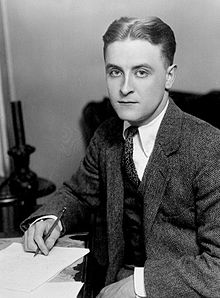
F.Scott.Fitzgerald,1921 Source: Wikipedia

F.Scott.Fitzgerald,1921 Source: Wikipedia

F.Scott Fitzgerald was a good friend. Both chapters that describe events with Fitzgerald show just how erratic his behaviour was and Hemingway suffers from having his writing discipline disrupted on a trip back to Paris from Lyon having recuperated a convertible car Scott and Zelda had abandoned due to the rain.

“I was getting tired of the literary life, if this was the literary life I was leading, and already I missed not working and I felt the death loneliness that comes at the end of every day that is wasted in your life.”

A Moveable Feast is an excellent read, sharing moments of life in Paris, we are introduced to some of Hemingway’s favourite cafés to write in, his conversations with Gertrude Stein and others about writing, up until he fell out of favour after publishing a mockery of another author’s work which she and others disapproved of, perceiving his act as disloyal to a fellow writer. He becomes a regular at the famous English bookshop Shakespeare & Co, where he is able to lend books, having no money to buy them and reads his way through Turgenev, D.H.Lawrence and Dostoevsky as well as striking up a friendship with the owner Sylvia Beach, a pleasant source of gossip as well as books.

Z: A Novel of Zelda Fitzgerald by Therese Anne Fowler

Zelda_Fitzgerald_portrait

Zelda Sayre

Born with an exotic name that lent itself to bright lights and a spirit that loved nothing more than to dwell under them, it is not surprising that Zelda Sayre’s life was illuminated and became of interest to so many who were less daring themselves but fascinated with her life and antics.

But just as light cannot exist without shadow, she would discover the darker underside of a life lived in the shadow of her husband, when she dared to pursue her own desire to be recognised as a professional in her own right.

ZZ: A Novel of Zelda is an excellent companion novel to The Paris Wife and one of an expanding collection that gathers around that group of artists, writers, wives and hangers-on of the “lost generation“, a term coined by a young French mechanic who was reprimanded for giving insufficient priority to repairs on Gertrude Stein’s Model T Ford and thus complained to his patron that they were all a “generation perdue“, those young people who served in the war, respected little and indulged themselves to immoderate excesses.

Hemingway’s A Moveable Feast is a logical follow on read, having now read the fictionalised accounts of the two wives of these well-known writers and great friends who were in the midst of that post WWI group that sought a kind of writing utopia in Paris.

scott and zelda

Zelda and F.Scott Fitzgerald

While the utopia may have eluded them, their experiences would provide rich material for their writing, even if at the expense of some of their friends and loved ones. It is interesting to note that while their output during those early years was largely even, the Hemingways‘ lived quite frugally with an awareness of their financial struggle, while the Fitzgeralds‘ lived hedonistically in complete denial of theirs.

Zelda was reluctant to be lured away from Montgomery, Alabama by a complete dreamer and in the early days of their courtship actually threatened to dump F.Scott Fitzgerald unless he proved himself worthy and obtained his first serious publishing contract.

“I was so sure of our love then, so determined to prove to Mama and Daddy that we weren’t doing things wrong, just differently. There was no way to know that certainty  would one day become a luxury too.”

save me the waltzWhen Fitzgerald succeeds in getting that commitment  from his publisher to publish This Side of Paradise, she is ready to join him in New York and their life of adventure will begin.

From New York to Paris and the south of France, where Zelda throws herself into her own professional dance ambitions and is rewarded with an offer, which makes this reader wonder, what might have happened if…

“Scott and I both were awed by how cultured all these folks appeared to be, how intact they all were. For a change, Scott listened more than he talked. They spoke of painting and music and dance – their own work as well as other artists’ – with knowledge and candor and passion. If they felt rivalries, they expressed the situations as challenges, not jealousies.”

I came to this novel with no idea about Zelda or the role she played among the writing set of Paris and while much has been written in personal letters and hospital records documenting her mental health challenges and treatments, I find Therese Anne Fowler’s depiction of the character Zelda to be both realistic and sensitive  and portrayed in a way that is compelling to read. It has made me interested to read more about Zelda Fitzgerald and that period in history she was a part of; she was one of, if not the first young women referred to as a “flapper” of the 1920’s, a kind of “it girl” whose rise in society came about alongside a public contempt for prohibition and was described by Dr. R. Murray-Leslie, who criticized

“the social butterfly type… the frivolous, scantily clad, jazzing flapper, irresponsible and undisciplined, to whom a dance, a new hat, or a man with a car, were of more importance than the fate of nations.” Times 5 Feb 1920, p 9

They were a significant step away from accepting the lives of their mothers before them and while they accepted the lesser role in support of their husbands and were not quite suffragettes, they developed an awareness that women could be more outgoing and present in the relationship and even pursue a career, something that usually required marriage to be forfeited for.

highland hospitalThe sad truth was that all that freedom and lack of  meaningful purpose was not good for their mental health and whereas today one might be prescribed medication for depression, bi-polar disorder or spend time in rehab, in the 1920’s/1930’s it was off to the psychiatric asylum for electric shock treatments and a prognosis of hysteria or even worse schizophrenia, if  one showed signs or symptoms of not coping with it all.

If you enjoyed The Paris Wife or A Moveable Feast, this book should certainly be on your list to read. A riveting read and a thought-provoking insight into an exciting and turbulent period of cultural history.

Note: This book was an Advance Reader Copy (ARC) kindly provided by the publisher via NetGalley.

The Hare with Amber Eyes, A Hidden Inheritance

The Hare with Amber Eyes

What a story this hare could have told should he have possessed the gift of speech. Instead we see him hunched there, ears pinned back, quivering, stunned by the journey he has taken, the events that have occurred around him, surprised to have survived when so many of his companion artifacts, the more sturdy furnishings, grand paintings and even other ceramics, did not.

The Hare With Amber Eyes is a Japanese netsuke, a miniature sculpture (though they can be wood or ivory) invented in the 17th century, not just as an objet d’art, but a functional kind of toggle to attach to the end of a cord for a pouch that a man might carry, since most of the garments they wore did not contain pockets (the two Japanese characters ne+tsuke mean “root” and “to attach”).

The hare is part of a collection of 264 netsuke purchased by the third son of an aspiring and ambitious Jewish family, Charles Ephrussi (son of Leon).

By 1860 the family had become the greatest grain-exporters in the world. In 1857 the two elder sons were sent out from Odessa to Vienna, the capital city of the sprawling Hapsburg Empire. They bought a huge house in the city centre, and for ten years this was the home to a shifting population of grandparents, children and grandchildren as the family moved backwards and forwards between the two cities. One of the sons, my great-great grandfather Ignace, was tasked with handling Ephrussi business in the Austro-Hungarian Empire from this Vienna base. Paris came next: Leon, the older son, was tasked with establishing the family and business there.

Hare Amber EyesBeing the third son, Charles was spared the obligation of being groomed for the financial sector in the family business (though it may well be he was not cut out for it either as de Waal speculates), preferring to frequent the cafes, salons and a certain boudoir of an older, married woman, attaching himself only ever temporarily to that which he admired – having already lived in three large cities, with his languages, wealth and a passionate interest in the arts, he had plenty of time to indulge his many passions.

It was through his pursuits in the arts, the start of his own collection, mingling with artists, other collectors and art dealers, writers about the arts, that he became interested in Japonisme, a rarity when it began appearing and so desirous. He would purchase a large collection of netsuke from the Parisian art dealer Philippe Sichel who travelled to Japan in 1874.

There is a wonderful connection to Proust throughout this part of the book, one that was a pleasure to discover, without the necessity of having read him, if anything it is an interesting introduction to that group of intellectuals of the 1880’s – 1900’s, Charles Ephrussi himself one of the models for Proust’s depiction of Swann in Swann’s Way.

The author of the book, Edmund de Waal is a descendant of the Ephrussi family and has inherited the 264 netsuke. He is a ceramic potter himself and spent two years studying in Japan, after many years as an apprentice in England. It was in Tokyo, while visiting his Uncle Iggie (another Ignace) that he first laid eyes and hands on the family netsuke that would eventually become his, learning a little of their journey from Paris to Vienna, London and back to Tokyo. Eventually he would spend five years researching what would become this incredible book.

He too, is the third son, though his is no longer a global banking family with the same expectations of its protege. Although he shares similar characteristics to his ancestors, those who did manage to escape the family business and were able to develop that appreciation and eye for a work of art, going beyond casual observation; it is as if he converses with these objects and reads them as if they have living, human qualities.

DeWaalThrough this book, he traces the history of these netsuke and his family, as they rise in ascendancy and are undone by the events leading up to the second world war. We come to know many of the family members and Edmund’s grandmother Elizabeth, a poet and a lawyer is a wonderful woman to learn about, the first woman to receive a doctorate from the University of Vienna and passionate about her poetry, she corresponds regularly with Rilke.

This book was so fascinating and so sensitively handled, it was with an almost palpable sadness that I finished it and felt bereft, wondering where on earth I could go to from here, reading-wise, after such a story.

And then I remembered it has been two years since publication and so I consoled myself with following the work of De Waal, who has been rather prolific since 2010 and I was not surprised to see his recent exhibition A Thousand Hours, showing works behind vitrines, evidence of the longer term effect of his immersion into all that research and study of netsuke and other artifacts his family had preserved.

I leave a link to him commenting on that most recent exhibition and a wonderful article in the Telegraph, in which I learn that De Waal has recently returned from a trip to Jingdezhen, home of the purest clay in China, where porcelain has been made for 1,000 years. This was a research trip for his next book and for a collaboration with the Chinese porcelain collections at the Fitzwilliams Museum for an upcoming exhibition:

De Waal is animated, inspired, gesticulating with his long fingered hands; there is a hum of creativity around him. You can almost see the words fizzing in his head, feel the ideas taking root, springing up out of nothing and arranging themselves in little groups, to form stories, dramas, like his pots.

The Netsukephotos of some of the Ephrussi collection + family pictures

Article Edmund de Waal on his new exhibition, A Thousand Hours by Jessamy Calkin

Video Watch Edmund De Waal transform clay into beautiful works of art

City of Love

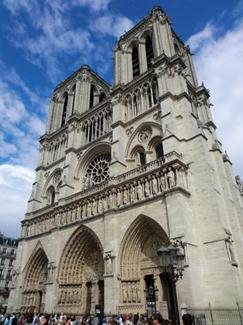
The immense and almighty Notre Dame de Paris

I have been busy retracing the many steps of the monuments of Paris these past few days, so not much time for reading, although I did manage to finish Barbara Kingsolver’s excellent ‘Prodigal Summer’ which I will write more of soon and following on from this glorious visit to Paris, I am now immersed in Hemingway’s ‘A Moveable Feast’ keeping me in Paris for a few more days yet, albeit the 1920’s.

If you need any more proof that Paris is indeed the city of love, check out this superb photo I took of that beautiful feminine monument ‘La Tour Eiffel’, is that not a beautiful heart shining down on the population?

We took an evening stroll up to the Sacre Cœur cathedral, two minutes from where we were staying.  In fact I was babysitting that evening while friends from New Zealand were at a Bruce Springsteen concert, I have to say it was the best night looking after 3 children ever, practicing french phrases during dinner and an impressive after dinner promenade to one of the city’s marvels.

Here is a detail from one of the tower walls of L’Arc de Triomphe. I love the dramatic detail of the sculptures and wall friezes.

Despite the beautiful blue skies you see, it did indeed rain every day I was in Paris, it reminded me a little of New Zealand, that rain, sun, rain, sun, beautiful green trees.

However, something that only Paris can offer, her history of monarchs, uprisings, revolutions and battles and 60,000 square metres of art works in one museum alone and then there’s the people watching, all chairs facing the street for the best view, it’s amazing what you observe and overhear during the downing of une noisette (small coffee with a dash of milk).

Now back in Aix-en-Provence where the temperatures are consistently hot and as I got out of the car, I am greeted by the incessant noise of the cicadas, who have long announced the debut of summer and witnessed the emergence of one of these gigantic insects from its chrysalis on the wall right next to me, the moment before he too joined that eternal cacophony of sound reminiscent of the season.

*

Au revoir Paris, je reviens bientôt.

The Book of Lost Fragrances

A family steeped in the history and tradition of fragrance and essences, the son Robbie desperate to keep the flailing ‘House of l’Etoile’ alive, though he lacks the natural olfactory talent of his sister Jac, who is busy chasing the origins of myths (though unlike her brother does not believe in them), while trying to forget her one great love, the archeologist Griffin.

“Jac wanted to help people understand that stories existed as metaphors, lessons and maps – but not as truths.”

M.J.Rose’s The Book of Lost Fragrances’, brings all three to Paris on the trail of an elusive scent that may have the power to provoke memories of past lives, a holy grail for Buddhist’s whom Robbie is determined will have the fragments of a piece of pottery that retains some remnant of the transporting blend, at a time when there is the threat of Chinese regulations mandating the registration of all reincarnates. And it just happens that the Dalai Lama is in town on a low key visit, as is Xie, the kidnapped Panchen Lama.

His Holiness the 14th Dalai Lama of Tibet

Through episodes that take us from past through to present, we begin to understand what connects the l’Etoile family with Cleopatra, a French nun named Marie-Geneviève and discover what secrets lie beneath the city, navigating the catacombs of Paris.

I can well imagine it as a film, instant travel to some stunning, majestic locations many only dream of visiting, overlaid with suspense, adventure and exotic travel back in time, however for me the book skimmed hurriedly through passages, even to the point of multiple sentences beginning with past verb tenses, as if they were to be fixed later, I found this annoying and it interrupted the flow.

“He’d been moved from the intensive care unit to a regular room. Was sleeping. Had been since she’d arrived a half hour before. She was waiting for him to wake up. Because she needed him to do something.”

All the elements are there, it just didn’t engage me as much as I had hoped it would, also due to a tendency to over explain, it is an historical account but may have worked better if the characters had informed us of some of that history rather than the narrator.

After revelling recently in the joy of Eowyn Ivey’s exquisitely constructed sentences and reading Jhumpha Lahiri’s excellent essay on Sunday entitled ‘My Life’s Sentences’ which I wholeheartedly concur with, it could just be that I had unreasonably high expectations of this exotic historical, biographical mystery. That recent foray into the realm of magical literary realism with its own excellent dose of believable suspense, did mean that next reads were likely to suffer the after effect. The snowy wilderness of Alaska, Faina, Mabel and Jack and The Snow Child’ remain indelibly marked on my reading brain.

My Magic Elixir's on Show

I did love finding out what was in the mysterious elixirs, being someone who likes to mix and make essential oil potions myself in my work, I have an intense interest in essences, aromas, their energetic, spiritual, chemical and healing properties and the synergy of a personalised blend. Just like Cleopatra!

One of my Flairesse Personal Blends

Finding the perfect blend to help an individual maintain their equilibrium is one of my specialties. Past life regressions? No one has asked me yet and if they do, I may just refer them to a hypnotherapist.

Note: This book was an Advance Reader Copy provided by the publisher via NetGalley.