The Gift of Stones by Jim Crace

The Gift of StonesFrom whispering muse to the gift of stones, this was the second book I read in 2016, one of Jim Crace’s earlier philosophical works, telling the tale of a village of stone workers, who live a simple life working stone into weapons, which are then traded with passers-by for food and other essentials, which they are not able to provide for themselves, in the arid landscape within which they reside. It is a livelihood they think little about, it is all they know.

A boy’s destiny is changed after he is injured in the arm by an arrow. The arrow is a symbol of change and both opens and closes this short, though provoking novella.

The injury becomes a turning point for a boy, his arm partially amputated, making him unable to follow in the village tradition, he must find another way of contributing to his community. His predicament is a foretelling of what is to come, but first he alone must learn to adapt.

He ventures outside, further from the village than anyone has ever been, near the sea and the heath, bringing them tales of beyond, discovering the allure and power of imagination. Experiencing things and feelings he has never encountered.

Already an orphan living with his uncle in a stone age village of people who work with flint, his injury turns him into a storyteller, inspired by his walks along the coastline towards the heath where he meets a woman with her baby living alone in a hut. He discovers how to captivate and amuse an audience, to take their minds off their day-to-day torments.

‘The paradox is this – we do love lies. The truth is dull and half-asleep. But lies are nimble, spirited, alive. And lying is a craft.’

He brings the woman back to the village, however she isn’t welcomed by the villagers, set in their ways. She too symbolises the lessons they must learn, though they will realise this much too late. When he tells the villagers her history, a truth, they become bored and turn away.

‘Quite soon they found it far too dark and cold to listen to my father any lore. They peeled away before the tale was done, unmoved by my father’s portrait of the widow and her child on the heath, her struggles not to die, her hardships, grief and hunger, the slaughter of the geese, the crushing of her hut. Quite soon there were no cousins left to hear my father’s tale. His audience – excluding bats and mother – had crept away, unamused and angered by the venom in his voice.

My father stood alone and startled – for now he understood the power of the truth.’

flint arrow head

It is a philosophical tale of unrequited love, abandonment, survival and the heralders of change, how communities react to the necessity to adjust, and to those who are different, outsiders.

It touches on the role of imagination and storytelling, not just as entertainment and a craft, but as those who foresee change, create invention, imagine other ways of life.

Poignant and intriguing, given the era within which it is set and a kind of tribute to the greater importance of storytelling within society.


Unsettled: A Search for Love and Meaning by Neelima Vinod

Neelima Vinod is a poet whose work I have enjoyed reading online at Neel The Muse for a while, so I was intrigued to read her novella when learning that she had been published, wondering how a poet might fill the page when the words and sentences were required to touch both margins of the page continuously. Curious too, as it delves into the supernatural within the context of the story telling heritage of southern India, not quite the same as that contemporary foray into what is we refer to as the paranormal.

UnsettledBeing a novella, it is a relatively quick read and starts out as a love story, or its anti-thesis as it is clear that the relationship between the couple is being threatened by perceived jealousy. To heal their relationship Divya and Raghav seek out the services of Dr Ray, a yogi.

The Doctor sends them on a quest, to retrieve the ancient Scrolls of Love from an old abandoned house about which many stories have been told and which no one wishes to enter, in fear of what it is said to be possessed by. The Doctor’s motives do not appear to be entirely altruistic, a twist in the story that was almost too subtle and had me rereading passages to observe him more closely than I did the first time through.

house-next-door“It is in the one hundred-roomed mansion at Cherakad that the Scrolls of Love were buried during the terrible floods. It nearly wiped the village off the map centuries ago. No one has confirmed it though.

Archaeologists I have talked to have told me that the house lies abandoned. Any one in possession of the Scrolls would understand love’s true secret-folklore at its best.”

Parallel to the contemporary love story, we read a tale of the Royal Court poet Shankara, banished from the kingdom of Cherakad five centuries ago after falling out of favour with one of the King’s concubines Meenakshi. Shankara roams the land in confusion and without purpose until he encounters a woman in white, Thathri, the same woman Divya has been dreaming of, whose story she had been told by her Grandmother when she was a child.

As the book progresses, connections between the tales arise as the mystery unravels, the past and the present become entwined as the couple attempt to conquer their quest and resurrect their struggling relationship.

storytellerWell written, it’s an enjoyable read and one that requires careful attention in order to make the connections clear. I am sure there are things I was not aware of, I even wondered if Shankara was based on a real poet and whether this fable  had connection to stories already told and passed down through families and villages. Sadly, it is a dying art, the gift of oral story telling, threatened more than ever by the technology of today’s modern world.

Its title might suggest romance, but the dark and foreboding cover and spectre like presence within suggest it may be more of an alternative ghost story. Unsettling indeed.

Thank you Neelima for sending me a copy of your e-book.

If you are interested in reading it, you can find a copy at the Indireads Book Store.

La petite fille de Monsieur Linh by Philippe Claudel tr. Euan Cameron

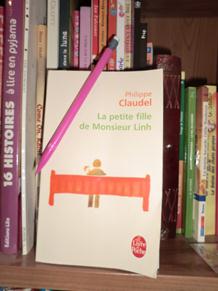
This month our bookclub chose a slim novella by the French author Philippe Claudel to read, La petite fille de Monsieur Linh; an interesting and somewhat ambiguous title because it can be interpreted in two different ways, already a dilemma for the translator no doubt, because petite fille is the expression used for grand-daughter, but it can also be read as petite ‘little’ and fille ‘girl’.
Something I have often wondered – why is it that there is only one word fille that means both girl and daughter, whereas there are two words for the male equivalent fils meaning son and garçon meaning boy?  The same thing happens with woman and wife, the French word is femme, whereas man is homme and husband is mari.

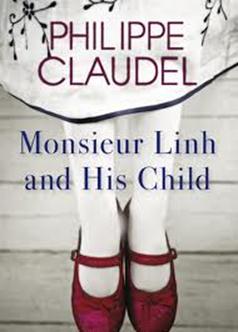
So did the English translation go with grand-daughter or little girl you might ask? Actually neither, the English title as shown is Monsieur Linh and His Child.  I’m not sure why they stay with Monsieur rather than Mr, I was not under the impression that he spoke in French.  It becomes clear how much of a task translating a novel must be, so many decisions to make or discard with the title alone, already certain ambiguities are lost while other insinuations are made.

Our English speaking bookclub has an international membership, so while we all read the book in French, the discussion is in English. For those of us reading French as a second language, the experience was quite different from reading a book in English.

We all went through a similar experience, starting out with a dictionary close at hand and looking words up, until we got fed up with that and decided to continue reading without stopping, some of us underlining words to come back to.

As you can see, I had my pencil ready and I also downloaded the English version to my kindle and started reading concurrent chapters, only to discover I really was just repeating myself and it wasn’t necessary to do that. But enough of the process, what a stunning novella!

Monsieur Linh has no choice but to flee his country of birth due to tragedy and destruction around him, war or some kind of tyrannical regime have made it impossible for him to stay, and so he takes a boat with his grand-daughter Sang diu, arriving as a refugee in a country across the water somewhere.

In the Shadow of the BanyanThe author does not say where he came from or where he arrives at, making this part of the reading experience, in fact we all had various impressions of where the story may have taken place, my own impression very much influenced by my recent reading of Vaddey Ratner’s novel In the Shadow of the Banyan and my own travels in that part of the world.

Monsieur Linh doesn’t leave the refugee dormitory at first, but when he does he befriends Monsieur Bark and so begins a regular coming together, a special friendship despite the incomprehension of each other’s language. In a sense we are as uninformed as Monsieur Linh, we follow him into the unknown, share his anxieties and fears for Sang diu and feel the deep and mutual appreciation of the gestures of new-found friendship.

Lorsque Monsieur Bark parle, Monsieur Linh l’écoute très  attentivement et le regarde, comme s’il comprenait tout et ne voulait rien perdre du sens des mots. Ce que sent le vieil homme, c’est que le ton de la voix de Monsieur Bark indique la tristesse, une mélancolie profonde, une sorte de blessure que la voix souligne, qu’elle accompagne au-delà des mots et du langage, quelque chose qui la traverse comme la sève traverse l’arbre sans qu’on la voie.

When  Monsieur Bark speaks, Monsieur Linh listens to him very attentively and looks at him, as if he understood everything and did not want to lose any of the meaning of the words.  What the old man senses is that the tone of Monsieur Bark’s voice denotes sadness, a deep melancholy, a sort of wound the voice accentuates, which accompanies it beyond words and language, something that infuses it just as the sap infuses a tree without one seeing it.

When I bought this book, another reader cautioned me against reading any reviews because there is a twist at the end of the book, so I did as mentioned and kept the reading experience pure. There is so much more I could share about how we invest ourselves in characters as readers, wishing things to happen and just as in life, ignoring the niggling instinct.

Irène Némirovsky’s Ida & La comédie bourgeoise

It is a beautiful story and I urge you to read it in English or in French, it is a testimony to kindness, tolerance, suffering and the small but heartfelt joys that friendship brings. Not just a wonderful story, but it has inspired me to be brave and try another short book in French. So I have my pencil ready loving that the novella form is so popular and inexpensive in France, so here is my next foray, – no rush mind you.

So do you read in a second language or like to read foreign fiction?

The Housekeeper + The Professor

Having recently discovered and read Yoko Ogawa’s
‘The Diving Pool’, I was further intrigued when I saw this novella displayed in my local bookshop and couldn’t resist another of her works with its beautiful cover and the promise of an alluring story about a woman who visits an eccentric mathematics professor each day to clean his home and cook his meals.

Reading ‘The Housekeeper and the Professor’ is a little like a meditation in mindfulness; although we might escape into the book, we are held in its present, for each day is a repeat of the previous and follows a pattern, such as we might too if our memory were constantly erased after eighty minutes, the habits we would continually follow, because we have been reduced to the very core of our nature, without the accumulation of memory from yesterday, last week or last year.

The Professor is a mathematics genius, whose memory ceased functioning after an accident some years before, so while he retains his mathematical genius and his long term memory before the accident, he has lost his short term memory.  It lasts only eighty minutes and so he has devised crude methods to remember things, such as pinning small pieces of paper to his suit to remind him of important facts, otherwise he starts every day anew.

The housekeeper arrives each morning and introduces herself as if they have never met. Slowly, she and her ten year old son, whom the Professor refers to as Root – a reference to the square root sign and his hair, are drawn into the Professor’s reduced world where numbers reign supreme and the two visitors begin to understand the magic and meaning behind what they had always thought of as ordinary numbers.

Whether you hated mathematics at school or loved it like I did, you will find yourself attracted to the arithmetic secrets the Professor unveils, which stir more than a mild curiosity in the significance of certain numbers and the challenge of elegant equations, as both the housekeeper and her son discover to their own delight.

Eternal truths are ultimately invisible , and you won’t find them in material things or natural phenomena, or even in human emotions.  Mathematics, however, can illuminate them, can give them expression – in fact, nothing can prevent it from doing so.

In essence, it is a meditation on the simplicity of life and an introduction to the complexity and significance of numbers; it is about letting go and accepting things the way they are and deriving small pleasures from the mundane.

Yoko Ogawa’s writing and storytelling flows like a sparkling river, it draws you in and carries you along; there are few surprises just gradual awakenings. There is a vulnerability to each of the main characters that we pick up on, which forewarns us, characters we become sympathetic to, whom I was sad to leave behind but will be revisiting again for sure.