The House on Via Gemito by Domenico Starnone (Italy) tr. Oonagh Stransky

That was quite an experience.

Starnone writes a work of fiction about the man his father was (we can assume it is autobiographical since his father’s name was Federico and he painted an artwork titled ‘The Drinkers’ which is in part featured on the cover). It is an attempt to tell the story of a man he spent his childhood in fear of and his adulthood trying not to be like.

Reconstructing a Life, Walking the Streets

In the novel, the narrator is the eldest son Mimi, who lives in Rome but has returned to Naples some time after the death of his father and is reconstructing memories, by walking the streets where they lived, visiting certain places to evoke other memories, like the hospital where his mother was when her husband could no longer deny her illness; the church where he made his first communion; the council offices, where he hopes to find some of his father’s paintings, including ‘The Drinkers’. Every location existed in service to his father’s existence and memories.

He was certain that both great and small events had a common thread: the mystery of his destiny. And he constantly tried to prove it to himself, his relatives, his friends, and to us children by weaving a vibrant pattern in which the only events that were true were the ones vitally connected to him. Consequently, all the names of cities and buildings and roads, all of geography, served merely to create a map of his needs, and this was how they were to be remembered.

Though the novel is about the man, the title refers to a street where they lived for a while and the use of street names rather than diary entries or even artworks, inscribes the neighbourhood into history, creating a different kind of legacy, one that will last longer than any man or work of art. A diary would be too intimate, a street map a kind of canvas.

Portrait of a Narcissist Father Via His Eldest Son

It is also about his own boyhood, however the character of the father overshadows the son, his wife, his wife’s family, in fact anyone in proximity to him. This is because he considers himself superior. According to himself. He makes it one of his main purposes in life to remind everyone around him of that fact. He can not be taken down or made to think he is anything less than how he perceives himself.

It’s true, he was lazy. He was arrogant. He was blowhard. He was all those things, and the first to admit it. He felt he had the right to be lazy, arrogant, and a blowhard – to anyone who busted his balls. He was born to be a painter, not a railroader.

The son walks familiar streets of Naples, streets he never strolled with his father – but knew intimately from his adolescence – as a way to navigate anecdotes about the way his father lived his life, the things he said (mostly insults about everyone else), the things he did (working for the railroad as a clerk, beating his wife, painting artworks) and his opinions about various matters. He walks and remembers. He walks and imagines anew.

A Determined Artist Perseveres

historical fiction Paris 1939 Domenico Starnone House on via gemito
Photo by Pixabay on Pexels.com

Federi is passionate about art and believes he possesses great artistic talent, but the art world is full of shit people who nominate their friends for prizes, then their friends create prizes and nominate those friends, therefore keeping him out of these circles. He blames everyone for his lack of success that he continues to strive for. Beginning with his own father who refused to educate him, in fact his parents abandoned him at a young age and sent him to live with his grandmother.

He becomes a working class man, who sees the most beautiful woman who he takes for a wife, raises four sons and a daughter and spends his free time at home painting or pursuing opportunities to advance his art.

A Literary Triptych

The book is in three sections. The first section ‘The Peacock’ introduces the character and is the part of the book where you might abandon, because it isn’t yet clear why it might benefit any reader to be subject to this psychological demonstration of one of the most extreme versions of the societal system of domination at work. The patriarchy thrives under this system, as Riane Eisler showed in her work The Chalice and the Blade: Our History, Our Future and Nurturing Our Humanity: How Domination and Partnership Shape Our Brains, Lives, and Future and the portrait this novel creates shows how someone who lives according to this conditioning impacts those in his proximity. Cycles of trauma, neglect and narcissism eroding relationships in pursuit of validation, not love.

A Masterpiece Created at All Cost

Much of the source material is inspired by journals his father kept, which trigger memories and dates of events he participated in. The artworks themselves are a kind of journal, a record of themes in his life. Part Two ‘The Boy Pouring Water’ is the most compelling and significant section, it documents the process of creating the largest, most significant art work he would do. ‘The Drinkers’ required the son to pose as the boy pouring water, other members of the family sat for him and the local fruit and vegetable seller.

The anxiety the young son would feel when he realises that there is a problem in the image, between the character holding out the glass and where he is pouring from will cause contortions of magnitude in him, to try and avoid the disaster he sees coming. His father never sees it and we think for a moment that the drama has been averted, alas no – disaster arrives at the height of his short-lived pleasure.

So why do we want to read a novel about an egomaniac? And one that was originally published just over 20 years ago.

It is both a psychological example of the effect a man with no empathy and worse, a need to belittle, insult and induce fear in people, can have on a family. It is set against a backdrop of 1960’s Naples, post WWII, a place where allegiances often changed, both in the halls of power and on the street, depending on how ‘enemies or allies’ treated the people.

It is the historical context and the journey of a working class man trying to break into the establishment of artists, who despite his unruly personality, perseveres and participates as much as is possible for someone who won’t allow himself to be intimidated. Everything is a struggle, he will fight to the end. Art ‘wasn’t fun, it was war’.

Fortunately as the years passed, I developed a strategy for blocking out his words. Using this technique, which I perfected as a teenager, the angrier he grew when telling the stories of his life and the reasons for his actions, the thicker the fog grew in my head, allowing me to think about other things. It helped establish a distance between us. It curbed the desire to kill him.

Fatherhood in Another Era, Produce, Punish, Protect

In the final part ‘The Dancer’ the humiliation of the son comes full circle as he enters adolescence and tries to impress a girl Nunzia and his father gives him terrible advice about what to do with women. As if things couldn’t get any worse, we learn that young girl has been abused by an Uncle and the son lies waiting for his fathers verdict.

The book ends with a scene that makes the reader pause to reflect on how reliable the narrator is, like the father, he too has the ability to exaggerate, to curate anecdotes and perspective.

Once I got into this, which didn’t take very long, I found it both shocking and compelling to read, the dedication by a son to honoring the passage of a man who made his boyhood hell. Thus he provides a kind of validation beyond the grave, but doesn’t hold back from focusing on the many flaws alongside the talent. It is the many layers that make it something of a classic, the psychological profile and repeat patterns of the man, the making of an artist and the impact on family and the social history of a city.

Highly Recommended.

The House on Via Gemito is a marvellous novel of Naples and its environs during and after the Second World War. The prism for this exploration is the relationship between the narrator and his railway worker / artist father – an impossible man, filled with cowardice and boastfulness. His son’s attempt to understand and forgive him is compelling; we are held through the minutiae of each argument and explosion, each hope and almost-success.’ International Booker Judges

Further Reading

New York Times Review June 2023: My Father The Frustrated Artist

A Reading Guide – The House on Via Gemito, International Booker Prize 2024

Read An Extract from the Opening Chapter here

To see the artwork of Federico Starnone visit https://starnone.it/gallery2/

Author, Domenico Starnone

About the author

Domenico Starnone is an Italian writer, screenwriter and journalist. He was born in Naples and lives in Rome

He is the author of 13 works of fiction, including First ExecutionTies, a New York Times Editors Pick and Notable Book of the Year, and a Sunday Times and Kirkus Reviews Best Book of the Year, Trick, a Finalist for the 2018 National Book Award and the 2019 PEN Translation Prize, and Trust. 

The House on Via Gemito won Italy’s most prestigious literary prize, the Strega in 2001 and was longlisted for the International Booker Prize 2024.

Those Who Leave and Those Who Stay by Elena Ferrante tr. Ann Goldstein #FerranteFever

Those Who StayThis is the third book in Elena Ferrante’s Neapolitan tetralogy about two friends Elena and Lila, growing up in an impoverished neighbourhood of Naples.

It follows on from Book One, My Brilliant Friend and Book Two, The Story of a New Name (click on the titles to read earlier reviews).

Lila has married, had a child, reformed her husband’s business, strayed and finally separated from her husband and moved to another area outside the neighbourhood to live with Enzo, a childhood friend. She gets a job in a sausage factory, working under oppressive conditions that attract the interest of social activists and harsh threats from the ‘fascists’.

“Can you imagine what it means to go in and out of refrigerated rooms at twenty degrees below zero, and get ten lire more an hour – ten lire – for cold compensation? If you imagine this, what do you think you can learn from people who are forced to live like that?”

In Pisa, Elena has remoulded herself, no longer referring or comparing herself to Lila. She observes how people from her type of neighbourhood and class are perceived outside it, among the bourgeois, those raised within the milieu of intellectuals and achievers, those with access to money, social connections, many of whom are gifted with a presence she can only dream of. Elena finishes her university studies and becomes engaged to Pietro, who was raised within that other world; coming from a well-known academic family, he too will become a university professor, teaching and writing academic works like his father.

As she is concluding her studies, Elena writes a fictional story drawn from aspects of her past, though never admitting it is anything but fiction. She gifts the story to Pietro on an impulse, hoping he will read it. He passes the manuscript to his well-connected mother Adele, thus Elena treads the path laid in front of her, towards becoming an author. Adele introduces her to contacts that will result in her first book being published, establishing her career as a writer.

“I spoke of the necessity of recounting frankly every human experience, including – I said emphatically – what seems unsayable and what we do not speak of even to ourselves.”

Though Elena does her best to avoid it, Pietro finally meets her family and though he insists on a civil ceremony for their marriage, a decision that stuns and terribly disappoints her mother, he wishes to do the traditional thing by asking her father for her hand. Her father is calm and accepting, however her mother’s thoughts insist on an airing and she lectures the young professor unabashedly.

  “When at last she was silent, he said that he knew very well how precious I was and that he was grateful to her for having brought me up as I was.”

Through marriage, Elena succeeds in elevating herself above her roots, though finds herself stranded in not quite belonging to either her future role or her past. They are like roles she assumes outside herself, taking care not to stand out when she returns to the neighbourhood and paying attention to how she should behave in her new role as the wife of a professor.

“As soon as I got off the train, I moved cautiously in the places where I had grown up, always careful to speak in dialect, as if to indicate I am one of yours, don’t hurt me.”

However, marrying the young professor, writing the story that turns into a successful novel, moving to Florence and becoming a mother leave her little time to play any other role than that of housewife.

Lila leaves the neighbourhood, escaping her marriage and taking on a job in a sausage factory owned by a friend of Nino Sarratore, whom the girls met one summer. Her job leaves her little time to spend with her son. Unwillingly, she becomes connected with worker’s rights activists and discovers the dirty arm of the neighbourhood loan sharks who are leaning on her employer, while continuing to try to lure her back into their realm.

Lila and Elena’s worlds drift further apart and although they are aware of the need to share with the other, they each possess the instinct to soldier on without admitting their struggle or need for support or encouragement. Elena will receive both her mother-in-law and her mother at different times so that she can write and Lila will return to the neighbourhood to ease her difficulties. Both have opportunities within their reach, yet both are susceptible to self-destruction.

“Too many bad things, and some terrible, had happened over the years, and to regain our old intimacy we would have had to speak our secret thoughts, but I didn’t have the strength to find the words and she, who perhaps had the strength didn’t have the desire, didn’t see the use.”

Those Who Leave and Those Who Stay is a compelling story of the lives of two women and those around them, and a penetrative observation on the creation and consequence of decisions women make, how they live with those decisions and the often destructive way they bring about change. It narrates a journey of moving away from one’s origins and the sacrifice the attainment of that desire requires.

Elena leaves her past and a life she didn’t want, behind her, however in attaining a new life, she loses sight of who she really is and what drives her. She is just coming to the point of realising that when her world spins out of control. And thankfully for us all the fourth book is being translated. I expect the wheel may come full circle.

Italian Screenwriter Francesco Piccolo

Italian Screenwriter Francesco Piccolo

Note:  It has been announced that My Brilliant Friend will be made into a television series in Italy. The author/screenwriter Francesco Piccolo, winner of the esteemed Italian literary Strega Prize 2014 (with his bittersweet memoir of life on the Italian Left, ‘Il desiderio di essere come tutti’ (The Desire To Be Like Everyone) will work on the screenplay.

Next Book in the Series: The Story of the Lost Child

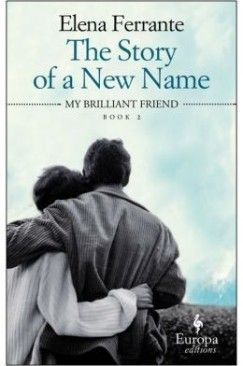
The Story of a New Name by Elena Ferrante tr. By Ann Goldstein … Neapolitan Tetralogy Book 2

The Story of a New NameThe second in the tetralogy of books about two friends Elena and Lila, growing up in an impoverished neighbourhood of Naples. The first book My Brilliant Friend I reviewed here.

Both girls were bright students in primary school, and perhaps because the story is narrated from Elena’s perspective she often sees herself in the shadow of her friend Lila, as if she must strive to attain her success, while Lila’s comes more naturally.

Lila fights to elevate herself, suggesting Elena studies with her to help her friend, thereby attaining the knowledge herself and through imposing her will on her husband, her family and business associates, who need her input and influence which she uses to both help them and to ensure her often rebellious stance is understood by them all.

It is Elena who despite her family circumstances progresses through high school and at the suggestion of a teacher applies to a university in Pisa where she can continue her studies.

Lila whose beauty and bravado bring her more to the attention of local boys wanting to move themselves up in the world financially, becomes entangled in their schemes and part of their negotiations and is married at sixteen to Stefano the grocer, partly in order to avoid the attention of the Solara brothers.

“How difficult it was to find one’s way, how difficult it was not to violate any of the incredibly detailed male regulations.”

Through her personal notebooks that she entrusts to Elena for safekeeping and Elena’s inability to withhold from the temptation of what they offer, we too as readers understand more from within the bounds of Lila’s marriage and life than we might otherwise from the limited perspective of her friend, particularly during the frequent periods where the friendship was being tested and therefore withheld.

Though unwilling to be trapped inside marriage, Elena does envy her friend the space and luxury her new status as Signora Raffaella Carracci has given her and when Lila’s husband suggests a summer holiday on doctor’s orders to increase her chances of conceiving a child, Lila’s insistence that her friend accompany becomes Elena’s excuse to find a way to be in close proximity to Nino Sarratore, the brilliant student she has had a crush on for years. His arrival becomes a turning point in their lives, though not the outcome either of them were wishing for.

Pisa NormaleElena distances herself from Lila and from her family and moves to Pisa, where initially she struggles to brush off the ways of her neighbourhood, her origin, her accent, things that make it obvious to others she is not one of them. She throws herself into her studies and into becoming more like her contemporaries; a new boyfriend aids her transition.

“That day, instead, I saw clearly the mothers of the old neighbourhood. They were nervous, they were acquiescent. They were silent, with tight lips and stooping shoulders, or they yelled terrible insults at the children who harassed them….

They had been consumed by the bodies of husbands, fathers, brothers, whom they ultimately came to resemble, because of their labours or the arrival of old age, of illness. When did that transformation begin? With housework? With pregnancies? With beatings? Would Lila be misshapen like Nunzia?…

And would my body too, one day be ruined by the emergence of not only my mother’s body, but my father’s? And would all that I was learning at school dissolve, would the neighbourhood prevail again, the cadences, the manners, everything be confounded in a black mire,…”

Leaving Naples allows Elena to begin to reform herself, to blend in, the novel highlights the tension between the Neapolitan dialect spoken in her neighbourhood and the correct Italian spoken by the professional, educated classes. Dialect is associated with aggression, insults and anger, with all the negative emotions and difficult challenges of a repressed community, while the Italian symbolises upward mobility and refinement.

Napoletana“Be careful where all this studying leads, Lenu. Remember who you are and which side you’re on.”

I found Book 2 just as engaging as Book 1, more than just narrating the events that mould the two girls’ lives is the underlying philosophical question of whether one can rise above one’s origins via the attainment of significant wealth or education. Elena and Lila represent these twin avenues, in their attempt to escape their origins.

The novel continues to focus on the friendship of the two girls and their connections with others, both those from within their sphere and those they encounter outside, a measure of how far they have progressed in their aim to rise up and out of the confines of the neighbourhood.

The narrative is less dramatic than it might be by some of the omissions. Elena doesn’t recount much of her own dialogue with her boyfriends and much of the story is narrated or told, rather than putting the reader in the midst of the events as if to experience them. It is the psychological and philosophical elements of the placement of the two women in these situations that lend themselves a kind of accepted inevitability, we won’t be shocked by anything that happens, knowing their backgrounds, it is the lure of that question of whether either of them can or will escape their fate that entices us to read on.

Next Book in the Series: Those Who Leave and Those Who Stay (click title to read review)

My Brilliant Friend, Elena Ferrante tr. by Ann Goldstein…Neapolitan Tetralogy Book1

Elena Ferrante is already something of an Italian legend. An author said to spurn interviews, her pen name fuelling speculation about her real identity. Her work is said to be autobiographical and already capturing the attention of English readers in a similar way to the autobiographical series of novels by the Norwegian Karl Ove Knausgaard.

Being a fan of translated fiction I have had my eye on this series for a while and from the reviews and articles I have read, her work reminds me of Caroline Smailes, whose excellent novel The Drowning of Arthur Braxton was my favourite read in 2013.

My Brilliant FriendIn 2012, My Brilliant Friend, the first in the trilogy of Neapolitan novels was translated into English and the two subsequent books The Story of a New Name and Those Who Leave and Those Who Stay were published in 2013 and 2014 consecutively.

The trilogy follows the lives and friendship of Elena Greco and Lila Cerullo, two astute girls from a downtrodden suburb slum of post war  1950’s & 1960’s Naples, as they navigate the challenges and opportunities necessary to survive and overcome their upbringing.

My Brilliant Friend spans Elena and Lila’s childhood and adolescence years in their neighbourhood, one where aggression, tension and feuds reign and graduating from school is less of a priority than finding safety and protection from the inhabitants of their immediate environment.

The first pages begin with the naming of characters, a family tree of the neighbourhood, members of each family and their occupations. I often find these lists of characters overwhelming, so ignored them, telling myself, if the book is good, I’ll know who all these characters are by the end. And when I went back to look at it, sure enough, I knew who they all were.

The story then begins with a prologue when the girls are women in their mid-fifties and creates a mystery that won’t be resolved in the first book, as the girls only reach the age of sixteen by its conclusion. It intrigues and teases the reader to continue to read on and discover what it is Elena knows, that no one else does.

“It’s been at least three decades since she told me that she wanted to disappear without leaving a trace, and I’m the only one who knows what she means.”

A Naples Slum

A Naples Slum

Elena is angry and so begins to write this narrative, in an act of revenge-like competitiveness, a trait that has defined her relationship with Lila throughout their childhood and adolescence.

Narrated from the point of view of Elena, the girls first recollection of being together is around the fearful presence of Don Achille, the local grocer whose name is associated with a fairy tale ogre.

In their play, Lila’s actions are always decisive and with bold intent, Elena is less bold, yet more determined, she follows her friend but wishes to surpass her and learns how to cope with the sacrifices necessary to continue to be her friend. Starting with the day Lila dropped her doll through the street grating into a dark underground cellar.

“But that day I learned a skill at which I later excelled. I held back my despair, I held it back on the edge of my wet eyes, so that Lila said to me in dialect:

‘You don’t care about her?’

I didn’t answer. I felt a violent pain, but I sensed that the pain of quarrelling with her would be even stronger. I was as if strangled by two agonies, one already happening, the loss of the doll, and one possible, the loss of Lila.”

After her early years of passing well her exams, there is one year when Elena’s attention strays and as a result her parents are no longer willing to support her in school. They won’t pay for extra tuition but if she studies and resits the exams, they will allow her to continue.

Lila, who never fails, will have to leave school, regardless of her ability, her family isn’t willing to support her education. She has a hunger for education and follows Elena’s progress, increasing her knowledge, surpassing her friend, becoming more like her teacher, though never sitting another exam.

“She had begun to study Greek even before I went to high school? She had done it on her own, while I hadn’t even thought about it, and during the summer, the vacation? Would she always do the things I was supposed to do, before and better than me? She eluded me when I followed her and meanwhile stayed close on my heels in order to pass me by?”

Snapshot 1 (09-11-2012 17-25)

Friendship by Allia

The book ends with a wedding, the girls paths seem to be heading in different directions, they continue to navigate their lives according to the expectations and threats of their community, yet their paths, in their different ways, potentially hold the seeds of their escape.

My Brilliant Friend is an emotionally charged coming-of-age read and the story held me riveted all the way through from the prologue that isn’t resolved through their early schooldays up to that wedding day.

Ferrante’s depiction of the two girls friendship bristles with vulnerable authenticity, igniting our curiosity in their interactions with their community, making the reader care about what will happen to them all next.

Next Book in the Series: The Story of a New Name (click title to read review)

Buy This Book

Buy My Brilliant Friend at Book Depository