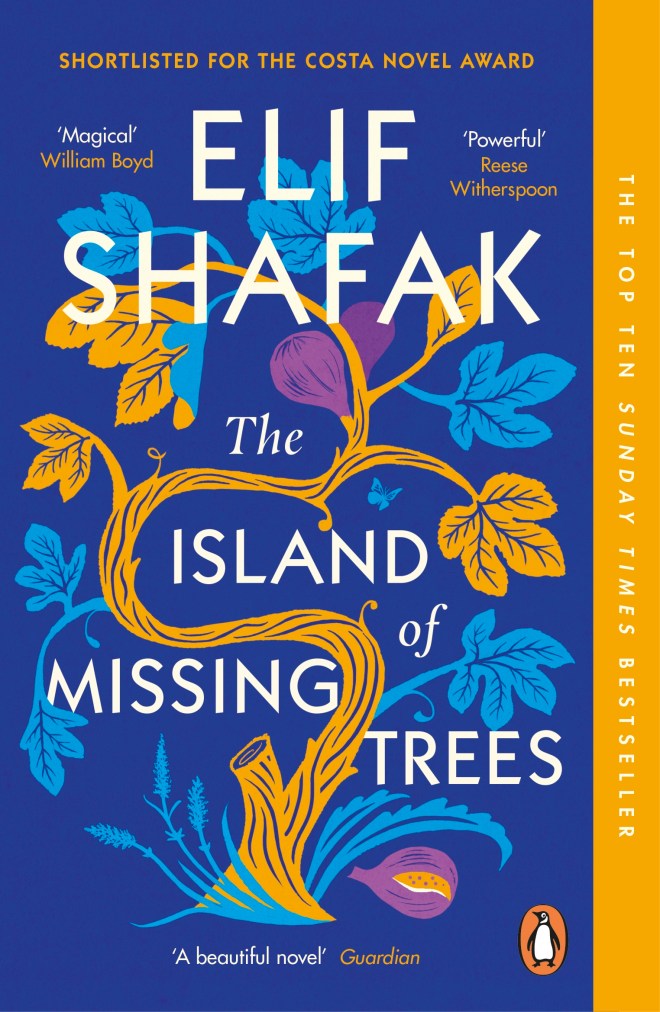
The Island of Missing Trees by Elif Shafak

Elif Shafak has been an author I have followed for many years now, one of the first authors I encountered before starting to read a lot of women in translation, who came from a non English speaking culture, who wrote stories that came from a cultural understanding that was not British or American, even if that was the audience she hoped to attract.

Since those first novels, she now writes in English and no longer lives in Istanbul. Since moving to London she has become more widely known. This book was shortlisted for the Women’s Prize for Fiction 2022 and the former Costa Novel Award. It is the 5th of her novels I have read. She also writes essay style non-fiction.

Review

In The Island of Missing Trees, she again takes the reader into another culture, to the island of Cyprus; a land with a long history that arrived at a point, where its humans decided to divide on their differences, here it was via origin, Turkish Cypriot or Greek Cypriot.

You belonged to one group or the other and were not supposed to stray. Until they created this divided line, young people would do what is natural for them to do before external influences corrupt their thinking, they develop friendships, they fall in love, they take risks. They get sent away, banned, forbidden from…

Physical Separation denies Ancestral Lineage

The story begins in London, late 2010’s with Ada, a daughter, at school on the last day of term. Ada lives with her father Kostas, her mother Defne has recently passed away. They are given a holiday assignment to write an essay, asked to interview an elderly member, they will be studying migration and generational change.

Ada dropped her gaze. She had never met her relatives on either side. She knew they lived in Cyprus somewhere but that was about the extent of her knowledge. What kind of people were they? How did they spend their days? Would they recognise her if they passed her on the street or bumped into each other in the supermarket?

Ada has never visited Cyprus, her parents only ever made excuses when she asked about family, gradually she would sense that her parents marriage had not been approved by their families. That she too was not approved.

Yet for as long as she was able to, Ada had retained the hopeful belief that if any of her extended family were to spend time with her and her parents, they would forgive them for whatever it was they had not been forgiven for.

Are Trees Conscious? A Fig Gives Voice

Photo by Daniel Watson on Pexels.com

Ada’s father digs up and buries their fig tree to protect it from the harsh winter. The fig is not in its natural climate or environment and special measures are required to keep it alive. The tree is given a narrative voice in the novel. It was a sapling from the island, it came from a mother fig that grew in the middle of a tavern, where Ada’s parents used to meet. In this way, the fig is all seeing.

The fig tree is a metaphor for the uprooted, the displaced, for the migrant, for the old ways. It is a symbol for not forgetting. It represents something of the motherland for the migrant and the way it lives through the seasons demonstrates something to humans about how to be.

Arboreal-time is equivalent to story-time – and, like a story, a tree does not grow in perfectly straight lines, flawless curves or exact right angles, but bends and twists and bifurcates into fantastical shapes, throwing out branches of wonder and arcs of invention.
They are incompatible, human-time and tree-time.

After a terrible last day at school, Ada arrives home to learn that her mother’s sister is coming to visit. She rages. She will have the opportunity to address the void within her where it resides.

Half hiding in the shadows, she watched the two adults by the fig tree, drawn to the strangeness of their behaviour but equally detached from them, as if witnessing someone else’s dream.

A Third Culture Kid Awakens

The novel explores what it is to be raised in another culture, severed from one’s own, as if not knowing it is enough to disconnect, as if assimilation is a cure for forgetting one’s past, one’s lineage, one’s identity. It demonstrates the effect of that denial, that severance, the dysfunction that arrives when one is deprived of a connection to one’s roots. And how differently each person deals with grief and loss.

It returns to Cyprus and slowly reveals the story of Ada’s parents that lead up to their separation and reuniting and the impossibility of being able to live there, the sacrifice that leaving demanded of them, the consequence.

A tree is a memory keeper. Tangled beneath our roots, hidden inside our trunks, are the sinews of history, the ruins of war nobody came to win, the bones of the missing.

The story is presented from different perspectives, showing the different realities that life is lived from depending on where one had been planted, uprooted from and replanted. It is a thought provoking read that doesn’t provide answers but offers to expand the reader’s awareness of the complications humans live under when love disrespects the rigid outlook that communities adhere to.

It shows the ripple effect of staying and/or leaving and the strangeness of being the protege of that, growing up in foreign lands that they have then acclimated to, except for the deep unsettled feeling that runs through their veins.

There is a delightful twist at the end that made me remember first encountering Elif Shafak and her describing her own childhood, of the stories her grandmother would tell, the superstitions she held. Here, I thought, is that little girl’s imagination, still going strong, writing novels that go deep into the realities of the human experience but are not above allowing something of the magic and wonder of an unbound imagination to run free.

Further Reading

Interview, Guardian: Elif Shafak: I’ve Always Believed in Inherited Pain

My Reviews of Honour, Three Daughters of Eve, The Happiness of Blond People,

Elif Shafak, Author

Elif Shafak is an award-winning British-Turkish novelist and a champion of women’s rights and freedom of expression. Her books have been translated into fifty-five languages.

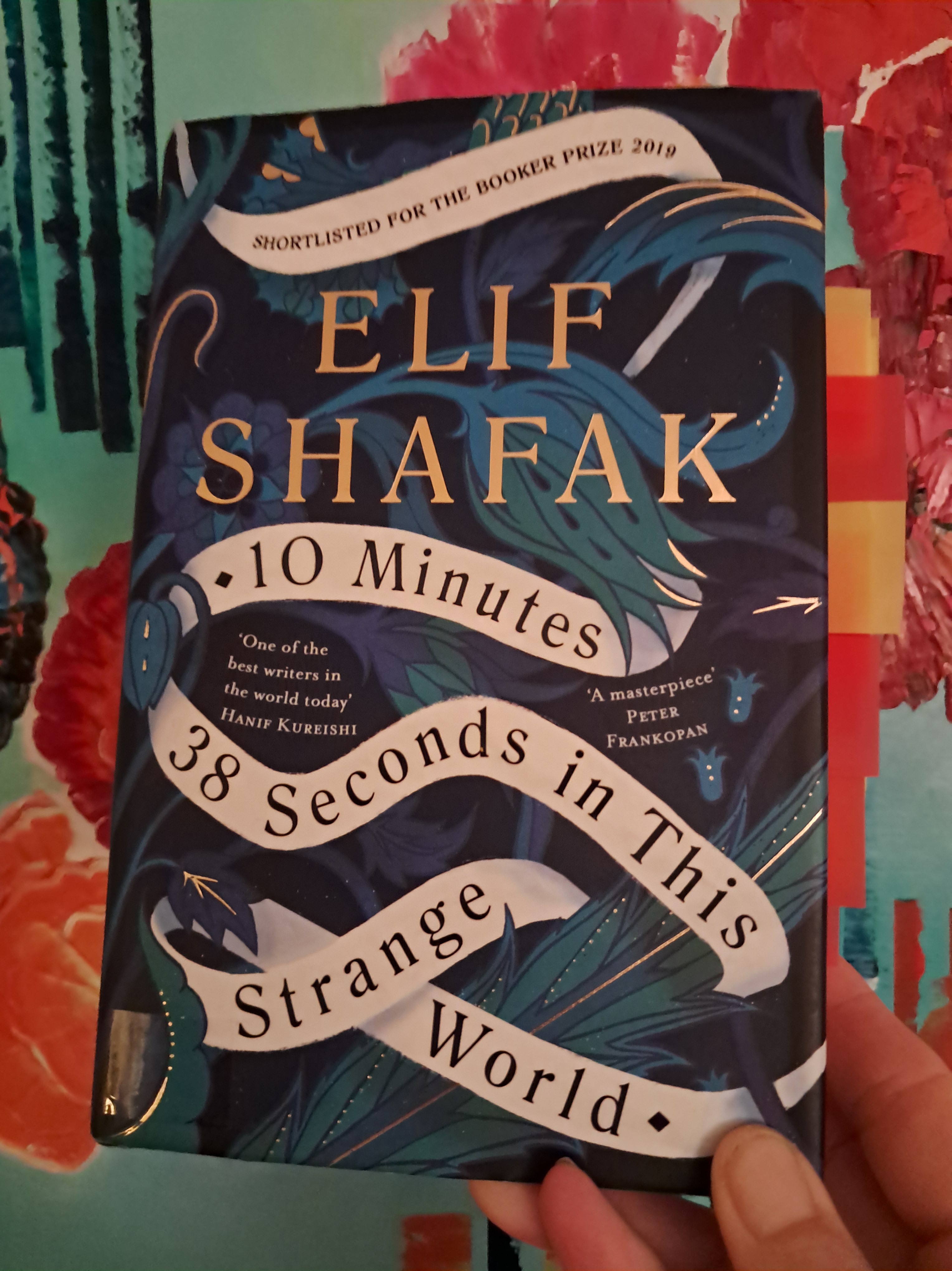
Her novels include The Bastard of IstanbulThe Forty Rules of LoveThe Architect’s ApprenticeThree Daughters of EveHonour, 10 Minutes 38 Seconds in This Strange World, which was a finalist for the 2019 Booker Prize, and The Island of Missing Trees, shortlisted for the Women’s Prize for Fiction 2022.

She is also the author of a memoir, Black Milk: On the Conflicting Demands of Writing, Creativity, and Motherhood.

She is a Vice-President of the Royal Society of Literature. Shafak was awarded the Halldór Laxness International Literature Prize for her contribution to ‘the renewal of the art of storytelling.’ An active political commentator, columnist, and public speaker, she lives in London. 

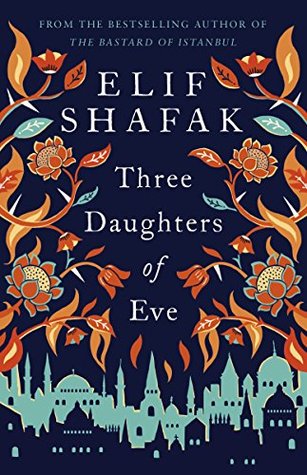
Three Daughters of Eve by Elif Shafak

Elif Shafak is a popular Turkish author, and a Rumi scholar, raised by her mother and grandmother, experiencing a childhood and influences that fed a fertile imagination. Now based in London, this is her tenth novel. Since reading The Forty Rules of Love, the first of her novels to actively reference her Rumi knowledge and learnings, I’ve read the excellent The Bastard of Istanbul, Honour and her nonfiction essay The Happiness of Blond People. She is an interesting and unique author because of her ability to straddle the thinking of both East and West, captured through engaging characters and storytelling; she demonstrated that for all our supposed differences, we are grappling with similar issues.

Three Daughters of Eve is an interesting, quietly provocative, philosophical novel. Shafak brilliantly sets up a character study of Peri, our Turkish protagonist, who on her way to a dinner party to meet her husband, decides to abandon her car in the middle of a traffic jam, in pursuit of an opportunistic handbag thief.

“Like a magic wand in the wrong hands, the traffic turned minutes into hours, humans into brutes and any trace of sanity into sheer lunacy.”

There is a violent, unsettling altercation after which she will continue on her way, shaken, but in one piece and determined not to change her plans. However this episode and the memories it awakens, will over the course of the evening, reveal her conflicted self and cause her to consider her life and address a significant event of the past, as the present madness moves forward towards astonishing heights.

“Though easy to forget at times, the city was a stormy sea swollen with drifting icebergs of masculinity, and it was better to manoeuvre away from them, gingerly and smartly, for one never knew how much danger lay beneath the surface.”

The three daughters are the three girls who appear in the photo that falls out of her handbag, referred to as the sinner, the believer and the confused. They are three young Muslim students at Oxford university, including Peri (the confused), who will all take the same class with Professor Azur and for a time they will live together. The girls all have different views, as do their fellow classmates, in the class about ‘understanding God’, a guided philosophical think-tank, where the handpicked students are forbidden to discuss religion, and must instead learn to express their opinions without the framework of doctrine.

Thus the novel is narrated across two timelines, the present day Istanbul (2016) en route to and at a bourgeoise dinner party and a period of time at the university in Oxford (2000).

Shirin is the liberal-minded sinner with no excuses or apologies for who she is, she loves to provoke reaction and is a willing accomplice come recruiter to the Professor’s circle, it is she who brings the conservative believer Mona and Peri together.

Shafak’s account of Peri’s parents and family is brilliantly characterised and aptly portrays why she is given the label of ‘confused’, they are complete opposites and over time become even more so, her two brothers are also polar opposite while Peri, loaded with empathy, understands all their positions, but can not stand in either of their shoes. Her plan to study in England, supported by her father and a cause of concern for her mother, was more of an escape for her than the brilliant opportunity her father imagined.

“They were as incompatible as tavern and mosque. The frowns that descended on their brows, the stiffness that infused their voices, identified them not as a couple in love, but as opponents in a game of chess…

Religion had plummeted into their lives as unexpectedly as a meteor, and created a chasm, separating the family into two clashing camps.”

Despite education, philosophical questions and new friends, Peri is a young, Turkish woman coming to live in a foreign country; as I was reading, I couldn’t help but notice the synchronicity between this combination of time, space and circumstance that made Peri vulnerable to manipulative intent and the protagonist of Claire Fuller’s excellent novel Swimming Lessons, a novel that chose not to explore the family background and cultural references of its young, female Norwegian university student, and rather focuses on the life that followed an equally significant turning point.

Here in Elif Shafak’s novel is an attempt to provide an experience with its cultural context. They are both young impressionable women having life-changing experiences in a foreign culture, with little support or guidance, they are lost in an age-appropriate confusion of emotions, one that is not on the same wavelength as the object of their desire.

Elif Shafak speaking in Bulgaria
Photo courtesy of Rayna Tzvetkova

While I enjoyed the novel and love Elif Shafak’s writing and philosophical questioning, there was a point very near the end, where events became too surreal for me to stay captured in the literary bubble of considering that evening dinner party in 2016 legitimate. It may be a satire of the Turkish elite, some of the things that happen and that are said are a mix of humorous and dramatic, however that’s not the tone of the novel as a whole.

I don’t know why the author chose to brings things together in the manner she did, for me personally it distracted from the thought process I’d spent the entire novel developing, and resulted in a suspension of belief, a kind of clocking out. I was waiting for the resolution, that’s where it was heading, and it does attempt to do that, however, as she not so convincingly demonstrates, humans can be unpredictable, and their actions often make no sense at all.

An excellent and thought-provoking novel that I recommend, despite a somewhat less well executed ending.

**********

Note: This book was an ARC(Advance Reader Copy) kindly provided by the publisher via NetGalley.

To purchase a copy via Book Depository, click here

Honour by Elif Shafak

US edition cover

US edition cover

Elif Shafak comments in her essay on identity The Happiness of Blond People about the stereotyping or tendency of books written by or about women from the East, that they often sport covers with an image of a veiled woman.

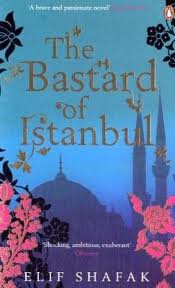
It is something that makes her other books stand out, because they don’t do that. The Bastard of Istanbul and The Forty Rules of Love (at least the editions that I read) have enticing covers that invite you to enter another world, depicting vibrant, warm colours and referencing stunning forms of Eastern architecture, curves, arabesques, spires and sparkling elements.

When I first spied the UK cover of her new book Honour I thought ‘Oh no’, not one of those books – I was disappointed as it looked like it belonged to that genre, the misery tale of a woman’s lot in a society where the veil is used as a symbol of varying degrees of oppression. That was before I read and reviewed the essay I refer to above, in which she cites those books with similar disdain.

It was some comfort to see that the US edition has nothing like that cover, preferring the safe symbolism of the open arches, inviting us in to take a look within its pages, no veils, no dark colours, no fear, no buying into outdated stereotypes. It would be interesting to know which cover  attracts the most readers.

Honour

UK edition cover

There is a plethora of lifestyles among Muslims, a variety of personal stories to consider; and yet only some of these stories come to the fore. They almost always happen to be the most problematic ones: we seldom hear about happy Muslims, in particular about happy Muslim women. Honour killings, female circumcision, child brides, the veil, gender segregation, lack of freedom… Gender is the number-one topic where the so-called Clash of Civilisations is manifest and crystallized. It is no coincidence that a considerable number of books related to Islam have female images on their covers, and in many, if not most cases, these females appear to be sad, silenced, secluded or suffering. Women with their mouths covered, or eyes peeking out from behind their hijab, or heads bowed miserably down… Elif Shafak, The Happiness of Blond People

Book covers aside, this is a very credible story, one that many women who have uprooted their lives and brought up or given birth to children in a foreign culture may relate to. Narrated by her daughter Esma, the story centres around the life of Pembe, identical twin to Jamila and one of eight educated daughters of a family raised in a Kurdish village, the desire and constant striving for a son eventually taking the mother in childbirth.

Life here is a precarious path for young woman, where one wrong step can easily lead to condemnation. One of the twins dreams of a life far away, the other seeks to learn from those around her, from nature and experimentation. Love is the sacrifice that will enable them to attain their so-called dreams.

Their adult lives are lived far from each other, Jamila becoming a renowned village midwife and Pembe, fulfils that desire to live elsewhere, travelling further than she ever dreams, her husband Adem, from Istanbul, brings her to live in East London where they will raise their three children Iskander, Esma and Yunis.

To her the future was a land of promises. She had not been there yet, but she trusted it to be bright and beautiful. It was a place of infinite potential, a mosaic of shifting tiles, now in a seamless order, now in mild disarray, for ever re-creating itself.

To him the past was a shrine. Reliable, solid, unchanging and, above all, enduring. It provided insight into the beginning of everything; it gave him a sense of centre, coherence and continuity.

Through the story, which alternates between 1940’s Kurdistan and 1970’s London, we come to know each of these family members and begin to understand how their individual and collective experiences has moulded them, Pembe and Jamila in their traditional village with its elders, family, traditions, superstitions; Adem with an alcoholic father and angst-ridden mother who eventually abandons her children, unable to cope with the Jeckyll and Hyde character of her husband. Each has been in some way touched by the repercussions of a ‘loss of honour’.

Iskander is raised in London with memories of his early life elsewhere, carrying memories of disappointment like molten rock deep within. He is sensitive to a vibe between his parents he doesn’t understand, something that makes him want to act. When his father leaves home and it becomes clear that his mother is moving on, the pressure of that molten rock within him causes him to explode.

RumiHonour touches on many great themes and then excels in sharing all the familial details, the interactions between its characters, the people and culture around them, to the point where we identify with each character as we spend time seeing things from their perspective and then experience a sense of anxiety knowing that these perspectives are likely to clash and the outcome will not be good.

And then there is Zeeshan, a character who arrives unexpectedly, but one I recognise instantly, knowing of Shafak’s interest in Sufism and the work of the 13th century poet and philosopher Rumi; Zeeshan is a gift and offers a lifeline to Iskender representing hope.

Elif Shafak is a writer with an interesting perspective, as she herself says, she has one foot in Istanbul and the other travels and makes connections in cities around the world.

Writing that crosses cultures and observes characters doing the same invokes a sense of empathy, she is a writer whose work I will be following and whose city I look forward to visiting in May this year.

Elif Shafak speaking in Sophia, Bulgaria Photo courtesy of Tayna Tzvetkova

Elif Shafak speaking in Sophia, Bulgaria
Photo courtesy of Rayna Tzvetkova

Note: This book was an Advance Reader Copy (ARC) provided by the publisher via NetGalley.

The Happiness of Blond People – A Personal Meditation on the Dangers of Identity by Elif Shafak

011312_1324_TheTigersWi2.jpgBastard of IStanbulElif Shafak writes great stories and as this essay illustrates, she both lives and has already lived an interesting life between East and West; experiencing different cultures and absorbing the influence of a high achieving, single parent mother and her superstitious, story-telling grandmother in a untypical but enriching, matriarchal upbringing.

ElifShafak Ask EbruBilun Wiki

Elif Shafak, Publicity shot by Ebru Bilun – wikipedia

As a young pupil she learnt what it means to be on the receiving end of prejudiced comments, introducing her to the clichéd stereotypes cast about by those who might never have experienced but seemed “to know” what it meant to be Turkish, that false responsibility, those who leave will all take on, for the actions of government or other citizens, on behalf of their maternal country and people.

Elif Shafak has inherited and nurtured a healthy imagination and studied many of the great philosophers, with a particular interest in Rumi, sometimes witnessed through her novels and now combines her knowledge with first-hand observations of how cultural differences are perceived in this short book.

The title of the essay was inspired by a conversation overheard at the Rotterdam airport in the Netherlands between Turkish fathers, one despairing of the difficulty of living in proximity to his downstairs neighbour.  She developed a habit of calling the police each time his children made too much noise playing in the apartment, causing his family much stress and anxiety, because the police invariably arrived with sirens blazing – makes me wonder what story she told the police, and thankful that my neighbour isn’t so bad after all!

The man finishes by asking his friend in earnest, how it is that blond children are so quiet and well-disciplined, introducing us to Shafak’s reflections on identity, cultural difference and the inherent, almost unavoidable angst of first generation immigrants worldwide.

The immigrant must be prepared to swallow his share of humiliations every day. He has to accept that life will treat him with disrespect and that he’ll be smacked and jostled with undue familiarity.

Happiness of Blond PeopleShe discusses the perception that happiness can be found in the West, less likely to have to deal with war, warlords, tribal conflict, poverty, corruption, human-rights violations or major natural disasters and the equally ingrained counter-assumption that life in the East is more real and less degenerate than in the West: where society is so selfish and individualistic that communal and family ties have virtually disappeared, unable to support a person, especially the elderly, in a time of need.

A secondary-school student I met in Ankara during a literary event put this to me in a slightly different way. “If you are young, it is better to live in the West than in the East,” he said. “But if you are old, then it is better to be in the East than in the West, because we respect our elders, whereas they don’t. In Europe I have seen old ladies in supermarkets buying one courgette, one carrot, one tomato, one bunch of parsley. Have you ever seen a Muslim woman doing that? No! We always buy at least half a kilo, if not more, because we cook for the entire family.”

What seems to be missing in the immigration experience is often lack of community, the lack of acceptance or gesture of kindness and therefore difficulty in integration, families are often not made to feel welcome (except among their own kind) which then encourages them to live separately and to maintain their own traditions and cultural perceptions and habits, rather than merging with the new country and culture. It can also breed resentment, particularly if it wasn’t a mutual decision to leave or even a choice, as in times of war.

It is often true that it must take at least one generation to normalise integration, but in more closed communities whose occupants themselves have little curiosity for the outsider or have not travelled and come to understand how and why things are done differently, with an altogether different logic elsewhere, this separation is at risk of continuing into multiple generations, especially where there are clear physical differences between people that can provoke prejudice, judgement or even worse, racism.

HonourFor me, most of the time I enjoy being confronted with those genuine mind-bending situations that require one to figure out how people came to see or do something in a way so different from our own – with the exception of violent or inhumane acts, but even behind those practices, there is a story to be told and a history to be understood, which doesn’t make it right, but can assist us to at least consider these practices in context, something Elif Shafak explores in her latest gripping novel ‘Honour‘.

An immigrant myself, I understand many of the isolating factors inherent in such a status, especially when it is necessary to learn a new language. Whilst it is not easy to participate in a traditional society with its many rituals and social codes, it is more likely that an immigrant will find success and contentment in creating a business or activity of their own, something unique that is or will be valued, than putting themselves up against their compatriots and being disappointed time after time, especially if living outside the larger multicultural cities.

This is a short read and a refreshing, open-minded perspective, from a woman who interacts with people in both the East and the West, always interesting to read and listen to.

In this life, if we are ever going to learn anything, we will be learning it from those who are different from us. It is in the crossroads of ideas, cultures, literatures, traditions, arts and cuisines that humanity has found fertile grounds for growth.