Titanic Revisited Part I

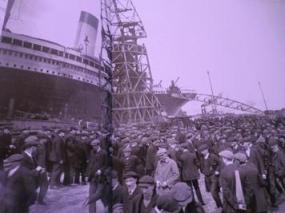
The significance of the Titanic continues to intrigue, or I should say has begun to intrigue me more since a visit to Belfast, Northern Ireland, the city in which it was built, a city which itself grew on the back of the growing shipyards and connected industries associated with it. Between 1851 and 1901 the city’s population increased from 87,000 to 350,000 and was the fastest growing city in the British Empire during that time.

Abandoned shipyards

From the top floor of the apartment in the Titanic Quarter where we stayed, I looked down on a vast, empty space, a maze of square and rectangular footprints of buildings and thoroughfares, once a labyrinth of busyness, that filled with the more than 30,000 men and women who would cross the bridge and walk or cycle down Dee St to work.

I contemplate that wasteland with its perpendicular lines; the skyline still dominated by two tall, bright yellow Harland & Wolff gantry cranes, a symbol which continues to salute the past, and I try to imagine the hive of activity that it once was.

Turning the last pages of Walter Lord’s ‘A Night to Remember’ I read in the end chapter Facts About the Titanic that she was launched at the Belfast shipyards of Harland and Wolff on 31 May 1911. The date rings a bell and I look in my diary and see that my daughter and I arrived in Belfast on 31 May 2012, exactly 101 years on from that auspicious date.

Julian Fellowes, creator of the series Downton Abbey and the film Titanic asks in the foreword why this tragedy still haunts us, as it does and certainly the opening of the significant Titanic Belfast museum is a testament to that. He suggests:

Maybe it is because the ship seemed, even then, to represent that proud, pre-war world in miniature, from the industrialists and peeresses and millionaires and Broadway producers who sat around the vast staterooms in first class, to the Irish and German and Scandinavian immigrants packed into third, carrying with them all they possessed, on their way to a new life in America….And as they headed for destruction, so did the larger world they represented, which would soon hit its own iceberg in the shape of the First World War.
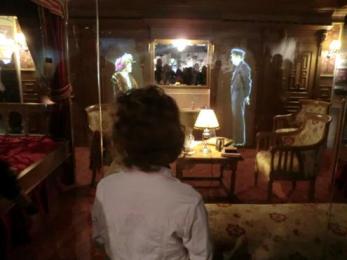
Ist Class cabin on board Titanic

Walter Lord’s book is really just that, a factual account of what happened interspersed with the comments to create a narrative of various passengers and crew throughout the two to three-hour ordeal, from the moment of impact when the ship sideswiped an iceberg, until the Carpathia arrived in dock at New York and the truth about how few survived from the more than 2,200 who had been on board when she set out was revealed. He shares the reflections of many people from all classes, providing an overview of the atmosphere and a brief introduction to the individuals thrown together in this catastrophe.

One of the significant complexities which the Titanic represented, was the separation of the classes, the architectural blueprints clearly show the delineation between 1st, 2nd and 3rd class and the museum today exhibits perfect replicas of the rooms they inhabited, complete with holograms of talking passengers. This distinction also carried through to influence the evacuation of passengers, with 1st class women and children given priority, no children from 1st or 2nd class were lost, while 53 children in 3rd class were lost (23 saved).

Titanic Belfast Museum

Even as the Mackay-Bennett returned to the scene to retrieve bodies, similar principles were applied. There were too many bodies to cope with, so many were buried at sea, arbitrary measures were used to try to decide which bodies should be kept, those with tattoos were identified was 3rd class citizens and given a prompt sea burial. At the time it wasn’t criticized, but the sinking of the Titanic could be said to have been a turning point in this respect, it was the end of the Edwardian era, just before the outbreak of World War I and many things would change in the period that followed from a social perspective.

Looking at that period from 1900 to 1912, I noted that there were many exciting and exhilarating firsts, the Wright brothers first flight in 1903, the NY subway opening in 1904, the first European country to give women the vote in 1906 (Finland), and the first electric washing machine released in 1907. Ford introduced the Model T in 1908 and electricity was becoming more widespread.

Titanic Quarter

By contrast, in the years that followed the Titanic, personal income tax was introduced in the US in 1913, World War I started in 1914 which propelled women into roles they had never considered before and equality between the classes and the sexes began its long path towards some kind of rebalance.

Now that I have the context of the ‘Night to Remember’, I have started to read ‘And the band Played On’ an account written by Christopher Ward, grandson of the 21 year-old violinist Jock Hume, who together with the other band members of the Titanic, kept playing until the ship disappeared.
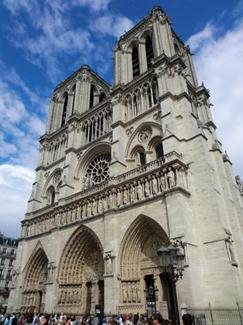
City of Love

The immense and almighty Notre Dame de Paris

I have been busy retracing the many steps of the monuments of Paris these past few days, so not much time for reading, although I did manage to finish Barbara Kingsolver’s excellent ‘Prodigal Summer’ which I will write more of soon and following on from this glorious visit to Paris, I am now immersed in Hemingway’s ‘A Moveable Feast’ keeping me in Paris for a few more days yet, albeit the 1920’s.

If you need any more proof that Paris is indeed the city of love, check out this superb photo I took of that beautiful feminine monument ‘La Tour Eiffel’, is that not a beautiful heart shining down on the population?

We took an evening stroll up to the Sacre Cœur cathedral, two minutes from where we were staying.  In fact I was babysitting that evening while friends from New Zealand were at a Bruce Springsteen concert, I have to say it was the best night looking after 3 children ever, practicing french phrases during dinner and an impressive after dinner promenade to one of the city’s marvels.

Here is a detail from one of the tower walls of L’Arc de Triomphe. I love the dramatic detail of the sculptures and wall friezes.

Despite the beautiful blue skies you see, it did indeed rain every day I was in Paris, it reminded me a little of New Zealand, that rain, sun, rain, sun, beautiful green trees.

However, something that only Paris can offer, her history of monarchs, uprisings, revolutions and battles and 60,000 square metres of art works in one museum alone and then there’s the people watching, all chairs facing the street for the best view, it’s amazing what you observe and overhear during the downing of une noisette (small coffee with a dash of milk).

Now back in Aix-en-Provence where the temperatures are consistently hot and as I got out of the car, I am greeted by the incessant noise of the cicadas, who have long announced the debut of summer and witnessed the emergence of one of these gigantic insects from its chrysalis on the wall right next to me, the moment before he too joined that eternal cacophony of sound reminiscent of the season.

*

Au revoir Paris, je reviens bientôt.

Gogol, The Namesake

I picked up Jhumpa Lahiri’s first collection of short stories ‘Interpreter of Maladies’ from the library recently, I seem to have read her work in reverse order, starting with her most recent collection ‘Unaccustomed Earth’ a collection of stories of the experience of second generation immigrants and moving eventually to the book that won the prize.

As I mention in one of my first (and most read) blog posts ‘Why People Don’t Read Short Stories’, it is not my habit to read a short story collection straight through, I stop and start and read them at random and so it has been with both these enticing volumes.

I noticed the bookshop book club was reading ‘The Namesake’ this month and I had just read an excellent essay by Lahiri in the New York Times called ‘My Life’s Sentences’ relating to her love of certain paragraphs in books and the construction of a sentence, so I decided to read her only novel ‘The Namesake’ which had been on the shelf since seeing the Mira Nair directed film a few years ago, which I loved.

‘The Namesake’ refers to Gogol, the Bengali son of the Ganguli family who immigrate to America, a consequence of Ashoke’s (Gogol’s father) changed outlook on life following a serious train accident, a catalyst for change that impacts and shapes the lives of all his family, an event that he does not speak of to his son until he is an adult.

The train is used as a metaphor for change in the novel, many of the significant turning points in the lives of the characters take place during a train journey, which in itself transports people physically from the familiar to a less familiar location and is an environment that one usually cannot escape from.

Not speaking about things is common among these characters, aided by the distant third person narrative which skips from the present to the past, in particular the most dramatic events are seen through the prism of the past, drawing the reader into this protective shield from potentially harmful events.

Gogol, is American, but his Russian name, his Bengali family and their culture mark him as different to many in his community. His home life is different to the average neighbourhood child and he finds himself like many children of immigrants and third culture kids, living between two worlds.

Whether we are conscious of it or not, we all grow up seeking to affirm our sense of personal and group identity, absorbing those questions of Who am I? Where do I belong? Traditionally, the family and the community reflect that notion and it is not until we step outside those comfort zones that we might question it. But for children growing up among worlds and between cultures the awareness comes much earlier.

For most of his life once he becomes aware of the differences, Gogol does what he can to minimise them, seeking out the ordinary, trying to blend in. He tries to suppress his cultural links, portrayed through his choice of girlfriend and change of name.

Jhumpa Lahiri

Like Lahiri’s short stories, which portray composites of life for immigrants of first or second generations from India, this book highlights one family’s experience, the dilemmas that each generation face which will mould their characters. We follow Gogol’s journey, try to understand it, imaging ourselves in the shoes of another, witness to the culture clash within this one family.

I consider briefly the clash of cultures within my own small family and understand the inclination to put it toward the back of mind. Writing is a good option for expressing the pathways of these experiences. I wonder if the presence of a large community from the parent culture assists or hinders integration. I find these stories leave many more questions than answers; there is no guide, just individual experience and the necessity to persevere, to survive.

A Piece of the Mosaic

Thank you to inspirational talent Kimberly Sullivan who lives in Rome and has written ‘In the Shadow of the Apennines’ set in the mountains of Abruzzo. She tagged me in the ‘Be Inspired’ blog hop hosted by ‘Page After Page’:

All of our stories come from somewhere, whether it be a dream, another book, a life event…So, I thought why not give people the chance to talk about their inspirations as well as their stories?

To participate, I should answer 10 questions about my novel and then tag 5 writer’s:

1. What is the name of your book?

‘A Piece of the Mosaic’

2. Where did the idea of your book come from?

It started with a prompt in a creative writing class at the Groucho Club in Soho; the tutor asked us to spend 5 minutes writing about a character. It was the scariest part of the class, that compulsory, time limited plunge into the unknown with others furiously scribbling away.

Paralysed, I had a vision of the back of a young man standing on a pier smoking a cigarette, gazing out to sea . He was wearing black trousers and a black leather jacket, observed by two schoolgirls giggling on a bench. After the class finished, I could not get that man out of my head.

3. In what genre would you classify your book?

I hate labels, I hope this book crosses as many genres as possible, but if I had to guess I would say it is contemporary, cross cultural fiction.

4. If you had to pick actors to play your characters in a movie rendition, who would you choose?

I don’t know any current Italian actors, so I would suggest a young man of Mediterranean origin to play Alfredo and because this question is too hard, I’m going to adapt it and say I dream of music composed by Ennio Morricone and the film directed by Giuseppe Tornatore director of Cinema Paradiso and Ba’aria. Authentic it must be.

5. Provide a brief synopsis.

Alfredo’s home village – Liguria

Angry with his father after his mother’s death, young Italian chef Alfredo, abandons the fishing village he has lived in all his life and travels to England, eventually finding a job in the seaside town on the South Coast. In return for low rent, he agrees to an unorthodox request from his spinster landlady Claudette, to help her find the sister she has not seen for 30 years since she and her husband immigrated to New Zealand.

Alfredo discovers more than a long-lost sister and the search soon becomes his own, to find Claudette’s niece Amber; the journey leading him towards everything he has tried to avoid in order to learn the truth.

6. Is your book already published/represented?

The synopsis and first three chapters have been read by 3 agents in London, with encouraging responses but declining representation and the full manuscript was requested by the fiction editor at Penguin NZ, who enjoyed it and suggested I seek representation in the UK.

 In order to establish some credibility with my writing, I decided to write a blog before I send it out again, so here I am blogging away, sharing my passion for the written word.

7. How long did it take you to write your book?

The actual writing part probably took about a year, but I wrote it in two bursts, the first half when I lived in London and on a whim travelled to Liguria to spend a week in a fishing village imagining and writing of lives other than my own.

I finished it in the first six months of arriving in France unable to speak French – the best excuse in the world not to have a proper job and to finish a first novel.

8. What other books within your genre would you compare it to? Or readers of which books would enjoy yours?

There are many books about people from the English-speaking world going to live in a non-English speaking country, both fiction and non-fiction, Alfredo isn’t leaving to see the world, he is escaping.  It is a story that questions identity and confronts issues of adoption and family.

I think it will appeal to people who like books that take them to places they dream of visiting and that introduce them to issues from different cultural perspectives, if anyone has any suggestions as to any other book this sounds like, let me know.

9. Which authors inspired you to write this book?

Two authors come to mind immediately, ironically Stephen King influenced this book, because I read his excellent slim masterpiece ‘On Writing’ midway through writing.  After reading it I changed a few things, I stopped writing longhand, I set a 1000 words/day word count (his is 2,000 words/day) and I stopped editing as I was writing, I just wrote it out until the end – terrified it would be crap, but discovered how to create pace.

The other author who spent some time residing in my subconscious was Italo Calvino, it took me a while to figure out what he wanted; now I know – but it’s a secret.

10. Tell us anything that might pique interest in your book?

Here are two extracts that survived that very first writing exercise, sitting in the Groucho Club in London, searching the recesses of my mind for inspiration.

Looking out over the swollen sea, Alfredo smiled knowingly at how her moods changed, one moment bright and sparkling in her refinery, phosphorescence glittering like sequins in the moonlight, the next as she was now, irascible, dark and brooding, like a young lover scorned, beauty transformed into bitterness. He watched a fish jump momentarily from her clutch, as if trying to escape her volatile and uncompromising mood, then witnessed the force of gravity, the sea’s ever-trusting accomplice, toss the cold-blooded vertebrae back into the maelstrom from which it had tried valiantly to escape.

He threw his half-finished cigarette into the sea and she hissed at him in reply. He had never been a regular smoker in Italy and wished he could kick the habit, cigarettes had become a comfort since he came to England, he liked to roll them as much as he liked to smoke them, it gave his hands something to do when his mind was restless. Thoughts extinguished, he walked down the length of the pier, eyes front, not looking at two giggling teenage girls to his right but sensing their eyes following his footsteps, over the wooden planks, where if one’s gaze was concentrated enough, you could see the pregnant swell of the waves below, as the tidal ebb carried them to and from the shore.

And now to tag 5 writers, all of whom are an inspiration to me:

  1. Brenda Moguez – Passionate Pursuits
    – Brenda is a prolific, unique and inspirational blogger with a rich family and personal history to draw on, not to mention a gigantic imagination, it’s just a matter of time before we will be reading her novel, now doing the rounds of agents.
  2. Juliet GreenwoodJulietGreenwoodAuthor – Juliet lives in a traditional Welsh cottage between the romantic Isle of Anglesey and the majestic mountains and ruined castles of Snowdonia, she is living the dream, a published writer and avid gardener; she is an inspiration.
  3. Patricia SandsEveryone Has a Story to Tell
    – Patricia has published a book about friendship, fun and the complexities of relationships among women, drawing inspiration from her own experiences. Every Friday she blogs about France and her current WIP (work in progress) is set here.
  4. Julie Christine Chalk the Sun
    – Julie is a Francophile, she is a reading writer, travels often and writes a fantastic book review. Just waiting for her to plunge right into writing that novel, a WWII star-crossed romance between a young French girl and a German POW, inspired by true events.
  5. Jen ThompsonChronicles of Jen
    – Jen is another writer who loves to read and shares her thoughts when she does, she’s a talented writer, lives in a caravan and is out there observing characters and seeking inspiration while serving hotdogs and popcorn. She may not be able to participate because her idea is so great, someone might steal it J
  6. Nelle NelleWritesI’m going to add one more, because I couldn’t have a list of writers without including Nelle, who not only is a great writer, but is a loyal follower and comments on all my reviews, even though her book budget is severely restricted.

The Pearl

I am content as my first foray into the work of John Steinbeck reveals that he too loves a fable, and like the best of them, lets the story speak for itself.

His short novel ‘The Pearl’ is based on a Mexican folk tale about Kino and Juana, a young couple who live a basic existence, their joy of a first baby threatened when it suffers the sting of a scorpion.

Kino is a pearl diver and on the day he most needs a miracle, the discovery of a large pearl appears at first to be the answer to the couple’s prayer. However, its discovery disturbs the community’s tranquil equilibrium, it seems too much to embrace and while it is in their possession, it wreaks only havoc.

There is a sense of inevitability with this kind of tale, we know the pearl is symbolic, and we recognise that desperate grasping, clutch of desire, laced with fear and stalked by paranoia, the fleeting hope it inspires is stifled by the more pervasive greed and jealousy which quickly degenerate into suspicion and violence.

Despite the inevitability, I read with the wilful hope of an optimist, always searching for some altruistic sign, an indication of man’s humanity, the charitable gesture of an honest person. Steinbeck leads us along on this journey, as we develop our own understanding bathing in his glorious prose.

Now Kino’s people had sung of everything that happened or existed. They had made songs to the fishes, to the sea on anger and to the sea in calm, to the light and the dark and the sun and the moon, and the songs were all in Kino and in his people – every song that had ever been made, even the ones that had been forgotten. And as he filled his basket the song was in Kino…

Taking the pearl from its natural habitat changes its symbolism, for in nature it is pure, lustrous, a thing of splendour and inspiration, it represents the transformation of something irritable (the grain of sand) into something of divine beauty (the pearl). But removing it from the sea will corrupt everything that sees, hears of, imagines or touches it; it becomes representative of greed and avarice, the longer it stays in their possession, the greater its destructive power. But will returning it to nature undo its curse?

In addition to this enjoyable story, the book opens with a foreword which reads like a letter from Steinbeck’s wife Elaine. She shares something of the joy of his writing life, his impulsive and creative attempts to construct the perfect writing environment (including building a writing room in the back seat of his Ford Station Wagon) all of which for me, created an almost familiar context from which to begin reading the great man’s work.

Onward to his next oeuvre, Tortilla Flat awaits.

Demi-God reawakens Classical Myths

It wasn’t the bookies favourite, but it was the bestselling book of the Orange Prize shortlist and as I discovered, Madeline Miller’s
‘The Song of Achilles’ had much to entice a multitude of readers, being a contemporary narration of an age-old tale drawn from the Greek Myths, published in the lead up to the Olympic Games and touching on issues that echo President Obama’s recent stand on equality for same-sex couples. Very 21st century then.

Inspired by Homer’s classicThe Iliad‘, Miller focuses on Achilles, the half God, half mortal son of Peleus and Thetis and his friend, the young exiled Prince, Patroclus, about whom little is known. Achilles’ mother Thetis is a sea-nymph and fears for her son’s future; she will do everything she can to protect him given his fate as the greatest warrior of his generation, and to avoid his death which it the oracles say will follow his killing of Hector.
The friendship between Achilles and Patroclus fires Miller’s imagination and the first half of the book beautifully depicts this at first distant relationship, blossom into a feverish loyalty. Not surprising to learn the author has been listening to and reading the Greek myths since she was 5 years old, a passion that carried her into studies of Greek and Latin, which comes across in this oeuvre.

Though I have only cursory knowledge of the Greek heroes, I have long been intrigued by their stories and archetypal symbolism, much in the same way I loved to learn about Maori myths and legends during my childhood; the legendary Maui, a demigod from Hawaiki, fished up New Zealand from the ocean.

I am reminded too of the child in A.S.Byatt’s ‘Ragnarök’ who relates to the Norse myths more than anything else anyone teaches her. So too, in my imagination do these legends of childhood come back to me and explain nature and humanity in a more primal way than anything else I was later taught – what we learn and how it affects us isn’t so much chosen as absorbed into our being when we are very young.

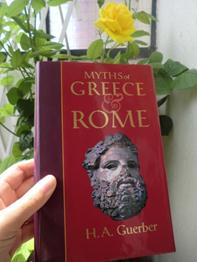
So ‘The Song of Achilles’ inspired me to pick up my ‘Myths of Greece & Rome’ by H.A.Gueber and read all the references to Achilles, Patroclus, Thetis, Peleus, Hector and more. Within its pages I found this reference to a word and metaphor we all know to refer to the tendon in the heel, but whose origin is much less known.

Thetis loved this only child so dearly, that when he was but a babe, she had carried him to the banks of the Styx, whose waters had the magic power of rendering all the parts they touched invulnerable. Premising that her son would be a great warrior, and thus exposed to great danger, she plunged him wholly into the tide with the exception of one heel, but which she held him, and then returned home.

In the original story an oracle foretells that Achilles will die from a wound in his heel after his dispatch of Hector; ultimately he will be remembered and perhaps even more renowned for this insignificant but fatal weakness, than for his epic courage and strength.

I liked this book as much for its inspiring me to look at other books and references to find out more about the legend as I did for the story itself. I came to it without much knowledge of its content and found the first half totally intriguing, reading it in one sitting. It did slow and almost lose me once they set sail for Troy and the ensuing battle scenes were a little two-dimensional, but when Patroclus found his healing abilities and tended to the wounded soldiers, the story refocused on the lead characters.  The action played off the battle field was more captivating and I was gripped throughout the last quarter.

Death at the Château Bremont

There is a shelf in our local bookstore dedicated to books crossing numerous genres that have a connection with France, you will find nonfiction travelogues such as Sarah Turnbull’s ‘Almost French’ or David Sedaris’ vignettes in ‘Me Talk Pretty One Day’, funny, true, yet never denigrating the country that has become like a second home to him. You will also find English translations of popular French authors like Jean Giono and Michel Houellebecq and novels set in France.
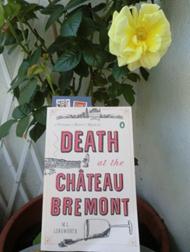
Death at the Château Bremont fits into latter, not only set in France, but here in Aix-en-Provence. I first became aware of the title thanks to a review by Lynne at Aixcentric, an excellent and informative blog I read regularly to know what’s happening in and around the area where I live.

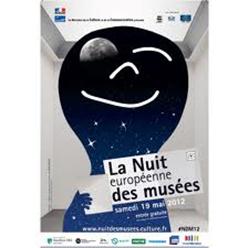
Just yesterday I read that tonight is the annual Nuit des Musées when the town’s museums are free and open from 8pm until 1am. We love this annual late night out.

Not long after that mention, the book-club that I read along with nominated it as their May read and the author M.L.Longworth who lives here in Aix-en-Provence, was invited to join us. So, a fascinating insight into the gestation of this, first in the ‘Verlaque and Bonnet Mystery’ series, which follows the lives, dramas and intrigues of Judge Antoine Verlaque and Professor Marine Bonnet, his sometime amoureuse.

It’s a mystery and in order to keep the mystery alive, I will only reveal that Étienne de Bremont falls to his death from a Château window, an investigation is requested and after some drama involving clandestine affairs, jealous siblings, polo players, Russian millionaires and a New York suicide, all will slowly be revealed.

What makes Longworth’s mystery unique is the journey. It is far from dark and gory, realms she has no apparent appetite for, however she will take you on a gastronomic excursion through the towns, vineyards and countryside of the region, visiting suspects while piecing together the connections and clues to the lives of those involved in this conspiracy. So not just a book for aficionados of mystery’s, but one for food and wine lovers and anyone who has ever dreamed of living and working in a city of culture and gastronomy in the South of France.

M.L.Longworth with Claire McAlpine

No tourist visit, this literary journey is the real thing and so agreed the group of eight women who were present to discuss the book, all sharing their favourite parts, confirming the locations the book visits and even suggesting others for the third book, which the author is working on, all suggestions were gratefully received and noted.

M.L. Longworth’s second book in the series, ‘Murder in the Rue Dumas’ will be published on 25 September 2012.

The Secret History of Joan of Arc

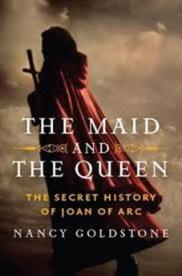
Such a seductive title ‘The Maid and the Queen’ – The Secret History of Joan of Arc and it is indeed an intriguing story, wrapped in faith, hope, superstition, manipulation, cruelty and ultimately the exoneration and beatification of a heroine (Joan of Arc was canonised in 1920).

 Joan of Arc is testimony to the transcendence of the human spirit….She remains an inspiration, not only to the citizens of France, but to oppressed people everywhere.

Ironically, it is due to the inquisition of Joan of Arc that much of the history of the era was documented and preserved, her testimony and the numerous depositions from the many eyewitnesses who knew her and who were in some way involved in the events of the Hundred Years war, that period of conflict between the Kingdoms of England and France and various other alliances from 1337 to 1453, as each sought to claim control of the French throne.

One of the insights that astounded me was the prolific negotiation of the female offspring of nobility to secure territorial alliances or peace between the realms. Daughters were auctioned off as young as 4 years, though depending on how power shifted and who survived into adulthood, those promises could alter.

Nancy Goldstone’s thoroughly researched oeuvre, takes a step back to look at the events, beliefs and susceptibilities of characters leading up the prominence of Joan of Arc, none more so than Charles VII, Yolande of Aragon’s (Queen of Sicily) son-in-law and the man who as a sensitive 11-year-old boy, she had taken into her home, nurturing and caring for him as her own, at a time when he was not destined for the throne (he had two older brothers). His propulsion into the role of King while the English were making inroads into the territory, King Henry having proclaimed himself King of England and France, and his reluctance to engage in battle, were significant risks to the Kingdom of France that required intervention.

Drawing inspiration from ‘The Story of Melusine’, commissioned in 1393 and written by Jean d’Arras (when Yolande was 12-years-old) a propaganda devised to address the political controversy surrounding the Duke of Berry’s appropriation of an ancient and imposing castle belonging to the aristocrat Lusignan family, Yolande of Aragon was able to usher Joan into an audience with the young King.

To Yolande of Aragon, the parallels to the story line of Melusine were obvious… there was just one element missing to turn this fiction into reality. The Queen of Sicily actively sought a Melusine as part of her strategy for reinstating the dauphin as the legitimate heir to the French throne.
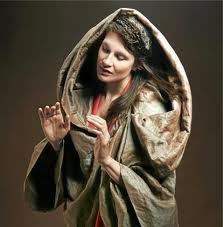
That Joan was effectively recruited, is reinforced by a French historian who reported that in 1428 alone, twenty people, mostly women, claimed to have been chosen by God to deliver a message to the King. None of them were given the opportunity unique to Joan, whose faith and convictions aligned with what Yolande wanted to hear and would result in her leading an army to relinquish the city of Orleans. By speaking passionately to Charles inner most fears, in particular an obsession with his possible illegitimacy and by her knowledge of ‘his secret prayer’ to God which he cried out in his sleep, Joan materialised as a sign and a saviour.

Gentle dauphin, I am Joan the Maid, and the King of Heaven commands that through me you be anointed and crowned in the city of Reims as a lieutenant of the King of Heaven, who is King of France.

Having succeeded in turning the English back, Joan was eventually captured and no longer considered useful by her King or sponsor, was sold to the English who sought vengeance, and submitted her to a long inquisition hoping to rid themselves of her and the fervent following she inspired among the people. Though their interrogations were inconclusive, and their hopes to condemn her destroyed by a signed recantation, she was tricked into heresy and sentenced to be executed.

I found the book full of interesting facts and connected events surrounding Joan herself, but I admit it was not an easy read and slow going at times –perhaps by necessity– to comprehend all the characters, families, alliances and influences. I did find myself wishing at times that the author might have used more creative tools to inhabit the emotional life of some of the characters, something that makes reading well-researched historical fiction a real pleasure and certainly adds pace.

But for a factual account of how The Maid came to represent a significant turning point in France’s history, I can think of none better.

If it is accepted, as it is often said, that without Joan of Arc there would be no France, it is also true that without Yolande of Aragon, there would have been no Joan.

Note: This book was an Advanced Reader Copy (ARC), provided by the publisher via NetGalley.


A Love of Words and Music

I have been struggling a little to finish ‘The Maid and the Queen’, what with school holidays, the French presidential elections (which I voted in for the first time), working on promoting my Aromatherapy business and socialising more than usual, including attending an excellent concert of the cult singer/artist ‘Camille’ at Le Silo in Marseille on Friday.

Camille

No one song can possibly represent what a performance by this artist represents, she sings, uses her voice and body as an instrument, dances barefoot in her sacking dress and easily extracted volunteers from the audience to participate.  She is total inspiration, if you would like listen, here is a sample ‘Mars is no Fun’.

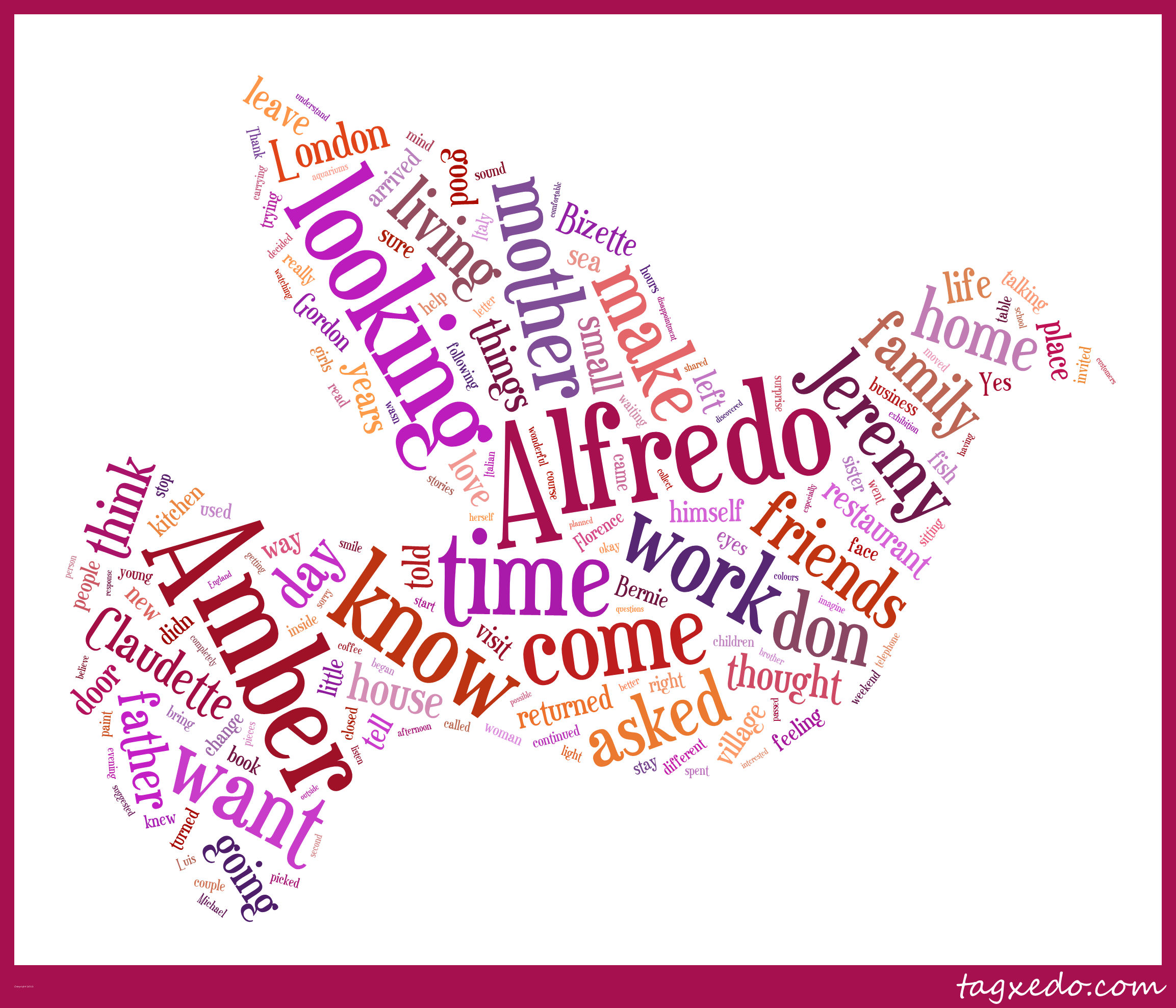
So no book chat today, instead I will share a fun word cloud tool that I discovered thanks to Elodie at  ‘Commuting Girl’ called Tagxedo into which you can copy any text or enter your blog or website name and the tool will analyse the content and show you which are the most popular words and how often they are used.

So Voila! For this blog ‘Word by Word’, here is an image of the most common words used and I am delighted that the word ‘Word’ is indeed such a dominant feature.

Intrigued, I decided to put the text of my ‘sitting on the shelf’ novel as I have always wondered which words I might be over using.  So I am not going to say anything more about the novel, except that it is called ‘A Piece of the Mosaic’ and here is a clue to what lies within.

So what does your blog, novel, poem,story look like?

Le Muguet – Becoming French

Au mois de mai, fais ce qu’il te plait.

In the month of May do what your heart fancies.

 Provencal proverb

So today I feel like sharing a little bit of French culture with you, the 1st of May is a public holiday in France for the Fête du Travail and the day you will find people offering Le Muguet (Lily of the Valley) to their friends, neighbours and acquaintances, a tradition that began during the Renaissance in 1561, when Charles IX offered them to his subjects as a symbol of porte-bonheur or good luck.

Now associated with the Fête du Travail on 1 May, anyone can sell the flower on the street without requiring a licence or permission. Today I walked into the centre-ville and came across many people who are spending their day, sharing the magic of Le Muguet with the public.

The first year I came to live in France, I learned of the tradition when my next door neighbour knocked on the door and presented me with this delightful flower, explaining its significance.

Six months into adapting to this life, language and culture, it was a welcome gesture and reminded me how important it is to reach out to others, even if they appear to be coping, we can all do with a little ‘porte-bonheur’ from time to time.

And in the spirit of acknowledgement and small celebrations, congratulations to Juliet Greenwood whose book Eden’s Garden’ has been named ‘Welsh Book of the Month’ for May 2012, a sprig of ‘Lily of the Valley’ for you Juliet. To celebrate she is giving away a free signed copy of her book, click here to enter.

Finally, with Spring emanating everywhere, I thought I’d share my recent discovery and purchase of a book of 12 stamps (un carnet de timbres), with its theme ‘the language of flowers’, I hope you can guess the English equivalent:

Le Langage des fleurs

Pensée / Affection

Coquelicot / Joie

Arum / Ardeur

Muguet / Bonheur

Tulipe / Amour

Violette / Modestie

Iris / Tendresse

Œillet / Fidélité

Rose / Passion

Pivione / Générosité

Marguerite / Attirance

Dahlia / Admiration

Bonne fête à tous!