If This is a Man: The Truce by Primo Levi

I only had to read the first sentence of a Scotsman in Exile’s blog post of this book to put aside what I was reading and start this almost immediately; his review entitled And Over Our Heads The Hollow Seas Closed Up… continues its first line:

…These are words from the canto of Ulysses from Dante’s Inferno and they were quoted in the most moving book I’ve ever read, ‘If This Is a Man’ by Primo Levi.
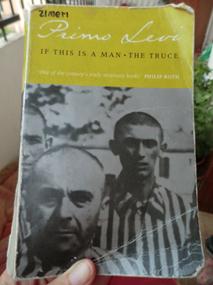
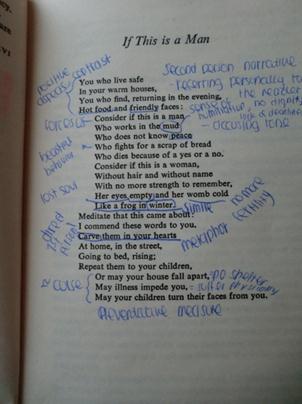
I found a copy on the second-hand shelf of our local bookshop the very next day, a copy I now own that would have to be the most annotated, scribbled in, colour highlighted, dog-eared, pored over volume that I possess (thanks to the previous owner ZIMERI). When I was a student, we studied ‘The Diary of Anne Frank’; how fortunate that today’s students are reading and studying this equally important work.

I’m not sure if I so much as read the book as followed closely in the footsteps of Primo Levi as he recounted the events that unfolded during his journey and time in the concentration camp, due to the way he chooses to express himself, which can best be summarised in his own words:

I believe in reason and in discussion as supreme instruments of progress, and therefore I repress hatred even within myself: I prefer justice. Precisely for this reason, when describing the tragic world of Auschwitz, I have deliberately assumed the calm, sober language of the witness, neither the lamenting tones of the victim nor the irate voice of someone who seeks revenge. I thought that my account would be all the more credible and useful the more it appeared objective and the less it sounded overly emotional; only in this way does a witness in matters of justice perform his task, which is that of preparing the ground for the judge. The judges are my readers.

Thus we absorb only that which he personally experienced and perceive not just the daily routine, the trivial yet so essential implements of his survival, the relentless toil and the near brokenness, but we view also the different strata of man in that direst of circumstances, a kind of perverse hierarchy.

Primo Levi was a young man of 24 years, a chemist and part of a partisan band hoping to join the Resistance movement when captured by the Fascist militia and sent to a detention camp at Fossoli. A few weeks later, all Jews in the camp were told they would be leaving for an unknown destination, revealed to be the camps of Monowitz-Buna and Birkenau, part of Auschwitz.

650 people made the journey that day; on arrival, the majority were ‘swallowed by the night’ and 125 sent to the camps. Of those, only three made the return journey to Italy after liberation, Primo Levi being one of them.

He was fortunate to return and discover his family intact; we in turn are fortunate that he returned and wrote these two books to be read together, one the descent into darkness, the other the journey back towards an altered but real luminosity.

All I can really say is that if you haven’t read it, add it to your list and find the time one day to slow-read it, Primo Levi was an important chronicler of a difficult period in history and a man who was interested in and able to put into words his observations of humanity in all its capacity, something we all the better for knowing.
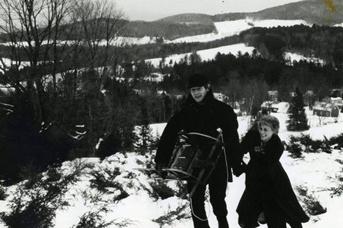
Summer by Edith Wharton

If ‘Ethan Frome’ is winter, so this, its companion novel is ‘Summer’, though ironically there is less a sense of the season and its metaphoric meaning; perhaps ‘The End of the Summer’ might have been a more apt title.

Edith Wharton was worldly and wealthy, speaking four languages and entertaining future American heiresses in her Paris home, her latter years lived in France. Yet as the range of her works testify, from rural Ethan Frome’  small town New England ‘Summer’ to the more social aspiring ‘House of Mirth’ and ‘Age of Innocence’ she understood and had empathy for those whose lives were lived at the opposite end of the spectrum of her own.

Charity Royall, an eighteen year old girl from the Mountain up there beyond, has been raised by a childless couple from town; she lives with her guardian Mr Royall, now a widow. She knows little and remembers nothing of her parents or that frowned upon community no one ever mentions.

Until the bold, young Architect Lucien Harnus appears, unafraid to ask questions. The more she learns while listening to Mr Royall respond to him, the more insecurity creeps into her being, though there is little outward sign of this change.

Initially we witness her wilful attitude, with which she succeeds in claiming the post of librarian against all other eligible girls in town, despite little interest in the actual job itself. She appears intelligent, adept at identifying opportunity, her questionable ancestry all but obliterated. However, she lacks a female role model and is barely on speaking terms with My Royall after his own near lapse with regard to the carnal instinct. In matters of love and the feminine, Charity is at a disadvantage. Her first experience with a young suitor is telling.

Her heart was ravaged by life’s cruellest discovery: the first creature who had come toward her out of the wilderness had brought her anguish instead of joy. She did not cry; tears came hard to her, and the storms of her heart spent themselves inwardly.

Without giving anything away of the story, the young man wins her over and she will have her summer of joy, but naïveté and a reluctance to assert herself in matters of the heart will compromise her position in this society that values and rewards tradition over love. She considers returning to her people:

There was no sense of guilt in her now, but only a desperate desire to defend her secret from irreverent eyes, and begin life again among people to whom the harsh code of the village was unknown.

It is a tragedy, as we have the impression that this is a young woman rescued from a life of little promise who could have made something of it, who should have, if she had been warned; she is as much a victim of the era she lives in as the lack of a female role model. I couldn’t help thinking about a possible sequel, one where she defies the odds and proves everyone wrong, because that is just the kind of girl she was.

In this respect the story differs from ‘Ethan Frome’ in which we are provided a glimpse into the future regarding what happens next, here Wharton has chosen to either leave that to the reader’s imagination, or her final act will be seen as sufficient evidence to predict a conventional outcome. You decide.

‘Summer’ has recently been adapted to the stage by Julia Stubbs Hughes and the play will focus on the three central characters of the novel, exploring the discovery of love and attraction in a society that restricts both.
It will be showing at the Jack Studio Theatre in South East London from 8 – 26 May 2012 if you happen to be in London. Further details can be found at ‘The Summer Project’.

A Rhyme for the Odes (Mu’allaqat)

No one guided me to myself. I am the guide.

Between desert and sea, I am my own guide to myself.

Born of language on the road to India between two small tribes,

adorned by the moonlight of ancient faiths and an impossible peace,

compelled to guard the periphery of a Persian neighbourhood

and the great obsession of the Byzantines,

so that the heaviness of time lightens over the Arab’s tent.

Who am I? This is a question that others ask, but has no answer.

I am my language, I am an ode, two odes, ten. This is my language.

I am my language. I am words’ writ: Be! Be my body!

And I become an embodiment of their timbre.

I am what I have spoken to the words: Be the place where

my body joins the eternity of the desert.

Be, so that I may become my words.

No land on earth bears me. Only my words bear me,

a bird born from me who builds a nest in my ruins

before me, and in the rubble of the enchanting world around me.

I stood on the wind, and my long night was without end.

This is my language, a necklace of stars around the necks

of my loved ones.

– extract from ‘A Rhyme for the Odes’

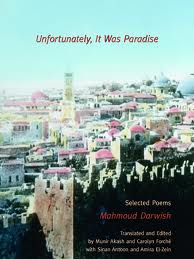
by Mahmoud Darwish, from the collection ‘Unfortunately, It Was Paradise’

(13 March 1941 – 9 August 2008)

The Woman in Black

Long awaited and much anticipated (by me), Susan Hill’s ghost story ‘The Woman in Black’, though first published in 1983, is experiencing something of a revival with the film premiering this month and the ghost story genre currently ‘à la mode’.
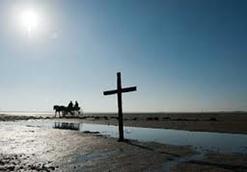
Adapted to the stage in 1987, the play has been running continuously since then (it is the second longest-running play in the history of the West End of London), thus I have been eager to discover what lies between the slim covers of this intriguing book myself, since reading ‘A Kind Man’ and ‘The Beacon’ last year and becoming a fan of her books.

Knowing that Susan Hill is one of those writer’s whose work and combination of words I like to savour, I take my time and let the language wash over me, as I come to know Arthur Kipps, while he sits by the fire on Christmas Eve listening to his stepchildren narrate ghost stories. Though it is a festive occasion, a grain of discomfort winds itself between the lines on the page and there is a flicker of an unwelcome presence, a glimmer of something he does not wish to recall, despite being far removed from his past now.

The story unfolds as we are taken back to his early days as a young solicitor, journeying to the cold, misty, windswept marshes of Crythin Gifford where he must wind up the affairs of the recently deceased Mrs Alice Drablow. Ever prosaic, he takes the responsibility in his stride and tries to ignore the reluctance of locals to engage with him or have anything to do with the matters of the deceased widow and the eerie Eel Marsh House.

While I very much doubt that I will be seeing the film, though I am sure it is excellent and well-made, utilising known techniques to ensure viewers experience ever heightened tension, heartstopping anticipation and chilling unease to elicit that emotionally wrung out feeling – I say this if like me, you have an acute sensitivity to music which accentuates all those senses (I succeed in scaring those who weren’t scared by the movie), I do love how Susan Hill uses details of nature and the physical environment to keep the reader and her protagonist grounded in reality.

There is no music accompanying the reading of this book and so I too hang on to that ambiguous reality. When Arthur visits Eel Marsh House and for practical purposes stays the night (yes, he is rather stubborn), he reassures himself and us by opening all the windows, understanding the layout of the house, going for a walk, venturing out in the dark against his better instinct only to be confronted with something that may or may not be able to be explained. And it’s not just him, even Spider the companionable dog responds to the lure of noises that sound familiar but could indeed be sinister.

It’s the perfect ghost story, because so much is left up to the interpretation of the reader, you can be a believer or a non-believer and regardless come away from this story feeling intrigued, satisfied and wanting to talk to someone about how you understood it. I am already looking forward to the next Susan Hill book that comes my way.

What the Dickens!

I couldn’t let the day pass without acknowledging that it is 200 years today since Charles Dickens, perhaps the greatest English novelist of the Victorian era, the second of eight children, was born on 7 February 1812 at Landport, near Portsmouth, Hampshire. So…
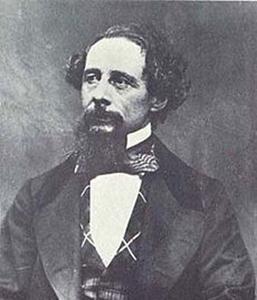
 

Happy Birthday Dickens!

Though not poor as such, the family went through difficult times and young Charles Dickens certainly experienced and saw hardship first-hand, images and memories that stayed with him and manifested themselves over and again through the pages of his life’s work.

Photo via wikipedia

I’ve yet to start one of his books this year, though I have plans to read his last novel ‘Our Mutual Friend’ and ‘David Copperfield’, the latter said to be close to his own childhood experiences and perhaps less painful for him to write than his abandoned attempt to write his own autobiography, which he found too distressing to continue.

It is a testament to his popularity that his works have never been out of print and continue to be read as much today as they did when they were serialised in publications in the 19th century.

To experience or learn more of Dickens world, there is Claire Tomalin’s recently published ‘Charles Dickens,  A Life’ , an exhibition at the Museum of London and a brilliant website where you can get completely lost in Dicken’s facts and memorabilia.

My favourite commemoration thus far, would have to be Dovegreyreaders scribbles in relation to his support and inspirational campaigning for England’s first children’s hospital, the great and wonderful GOSH, Great Ormond Street Hospital.

So, do you have a favourite Dickens novel or plan to read one this year?

Ethan Frome by Edith Wharton

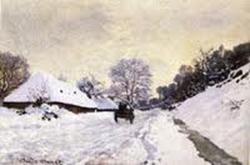
‘The Cart, Snow Covered Road at Honfleur’ by Claude Monet

In a year when many are commemorating Dicken’s for his 200th year anniversary, I was prompted by a Dovegreyreader post to do the same for Edith Wharton, in homage to 150 years since her birth on 24th January 1862. A perfect winter read, this slim volume with its enticing cover featuring Claude Monet’s painting was confirmed as my choice when I spotted it in Book in Bar’s annual 50% sale.

Sainte Claire du Vieux Château

So I am making it an ‘Edith Wharton’ year which seems appropriate for many reasons, she is a woman after all, she left her country of birth and came to France which interests me (and I have just learned she had a house here in the south of France at Ste. Claire du Vieux Château) and lastly due to the timely association between Wharton’s novels and the popular Downton Abbey series, which prompted an interesting article in the NY Times discussing the era of wealthy American heiresses marrying into the English aristocracy to save them from financial ruin, some of whom are said to have been associated with Edith Wharton.

‘Ethan Frome’ is narrated by a short stay passer-by in Starkfield whom Frome transports to his place of work during heavy snows and is subsequently invited to seek refuge from a blizzard one evening in his home, an abode no one has entered or been invited to for many years. Upon hearing of his invitation, one of the villagers curious to learn more from the visitor, opens up and reveals much of the story of Ethan’s past to him.

Thus we hear how three people’s lives were paralysed by past events, simple lives complicated by forbidden love and a desperate act. It is a story of its time, an era when people of certain classes were restrained in their behaviours, though not in the intensity of their feelings, endeavouring to suppress them for the sake of saving face or fortune.

I found it interesting how Wharton portrayed the angst of the young would be lovers, drawing the reader into sympathising with them, while portraying Ethan’s wife Zeena in a shifty, calculating way, when she would have been reacting to her natural instinct to want to separate the two. Perhaps in another version of the story it may have been possible to sympathise with Zeena had her perspective been portrayed, it is easy to be lured and swayed by a writer’s deceptive tools when there is more emphasis on one side of a story or on certain characters. I also found it interesting that she decided to portray a husband suffering for having fallen in love with another woman, rather than that of a woman who falls for another man.

I can imagine reading this again, I enjoyed the writing and Wharton’s use of metaphor to depict the landscape and the barren living conditions and I look forward to reading another of her works soon.

So, do you have an Edith Wharton favourite? Have you read any of her books?